Sustained Release Dosage
Form [SRDF]
1
CONTENT
• INTRODUCTION
• RATIONALE
• DRUG PROPERTIES SUITABLE FOR SRDF
• POLYMERS USED IN SRDF
• MECHANISM OF RELEASE OF SRDF
• ADVANTAGES
• DISADVANTAGES
• REFRENCES
2
INTRODUCTION
• Sustained release, are terms used to identify drug
delivery system that are designed to achieve a
prolonged therapeutic effect by continuously
releasing medication over an extended period of
time after administration of a single dose.
• Sustained release dosage forms provide an
amount of drug initially made available to the body
to cause the desired therapeutic response, followed
by a constant release of medication for maintenance
of activity over a period of time
3
Different Terminology
On basis of release of drug from dosage form
1. Immediate Release ( IR)
2. Delayed Release (DR)
3. Controlled/Continuous release (CR)
4. Sustained Release (SR)/
Extended release (ER/XL/XR)/Prolonged release
/Repeat action
4
Immediate Release
• Immediate release dosage form releases drug
immediately after administration of single dose.
• It generally releases 85-90%drug in 15 mins.
5
Delayed Release
• Term “delayed-release” is used for enteric coated
dosage forms that are intended to delay the release of
medicament until it has passed through the stomach.
• Capsules ,tablets may be coated, or, more commonly,
encapsulated granules coated to resist releasing the
drug in the gastric fluid of the stomach where a delay
is important to alleviate potential problems of drug
inactivation or gastric mucosal irritation.
6
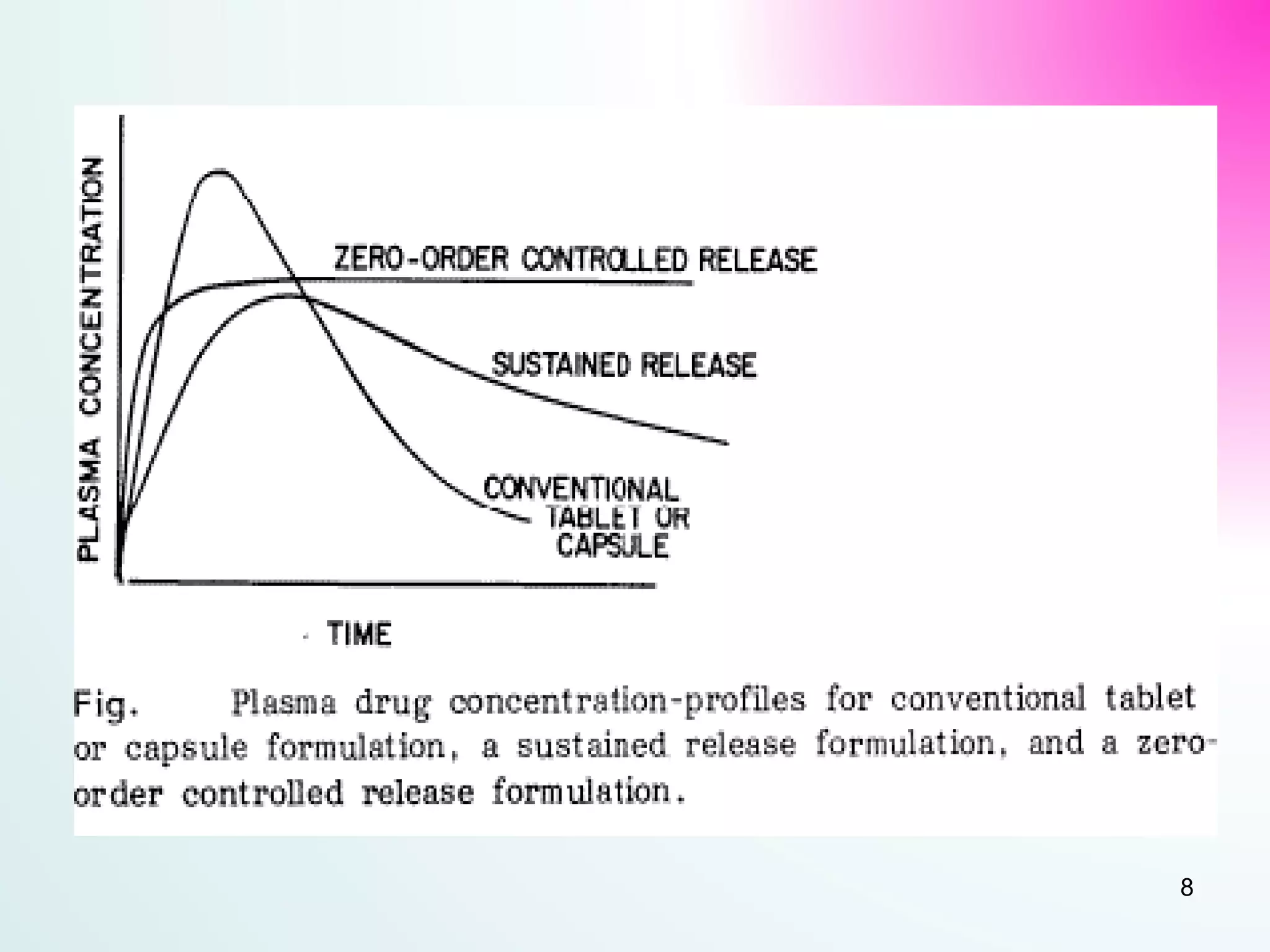
Controlled Release
• Controlled release dosage forms release drug at
predetermined rate locally, systemically for specified
period of time.
• Controlled release is perfectly zero order release.
7
8
Rationale for Sustained Release
• Drugs which are often administered repeatedly at
specified time interval to maintain therapeutic level in
blood or body tissues
• uniform drug response achieved by using different
combination of doses and dosage interval
• However, the dosage regimen of an orally
administered drug may be considered to be optimal
when the therapeutic effect is maintained for the
desired duration of the treatment at the lowest
frequency of administration.
• Frequent administration of dose produces side effect
9
DRUG PROPERTIES SUITABLE FOR SRDF
Physicochemical properties
Aqueous solubility:
Drugs having low solubility at absorption site and are pH dependent
are poor candidates
eg. Tetracycline
Partition coefficient and Molecular Size :
Drugs with high P.C. readily cross memb. While
those with low P.C. can not cross memb.
Large mol. Wt. compounds are poor candidate.
Drug stability:
Drug unstable in 1-7 pH can’t given by GIT.
10
pKa and Ionization at physiological pH:
• For passive absorption drug should be un-ionized
• Largely ionized drug poor candidate eg. Hexamethonium
• pKarange for acidic drugs is 3.0-7.5 & for basic drug
7-11
Dose:
• Dose must not be greater than 500mg.
11
BIOLOGICAL FACTORS
Absorption:
• Uniform absorption to maintain constant blood
tissues level
• Orally slowly absorbed drugs are poor candidate
Distribution:
• Affected by binding to tissues and proteins
• Bound portion of drug considered as inactive or unable to
cross membrane.
• Described by apparent volume of distribution
12
• Biological half life:
Those drugs having short half life are most suitable for
SR. eg. Diphenhydramine
• Side effect:
Those drugs causing GI irritation are selected for
SR, eg. Diclofenac sodium, potassium citrate
• Safety margin:
Drugs having narrow therapeutic index are selected
for SR, eg. Diclofenac sodium
13
POLYMERS
• Hydrophilic polymer:
Hydroxy propyl methyl cellulose (HPMC)
Hydroxy propyl cellulose (HPC)
Hydroxy ethyl cellulose (HEC)
Sodium Alginate
Poly (ethylene oxide)
Cross linked homopolymer
Copolymer of Acrylic acid
• Hydrophobic polymer
1. Waxes:
Carnauba wax
Bees wax
Candelilla wax
Microcrystalline wax
Paraffin wax 14
2. Insoluble polymer:
Ethyl cellulose
Cellulose acetate
Cellulose acetate butyrate
Cellulose acetate propionate
15
MATRIX(MONOLITH) SYSTEM
Drug/excipients embeded within a matrix
Dissolution controlled Drug release
 Homogenous dispersion of drug throughout a rate-
controlling medium
 Release rate is controlled by the dissolution rate of the polymer
 Two methods for drug-wax particle preparation
-Aqueous dispersion
-Congealing
 Drug release is often first-order
16
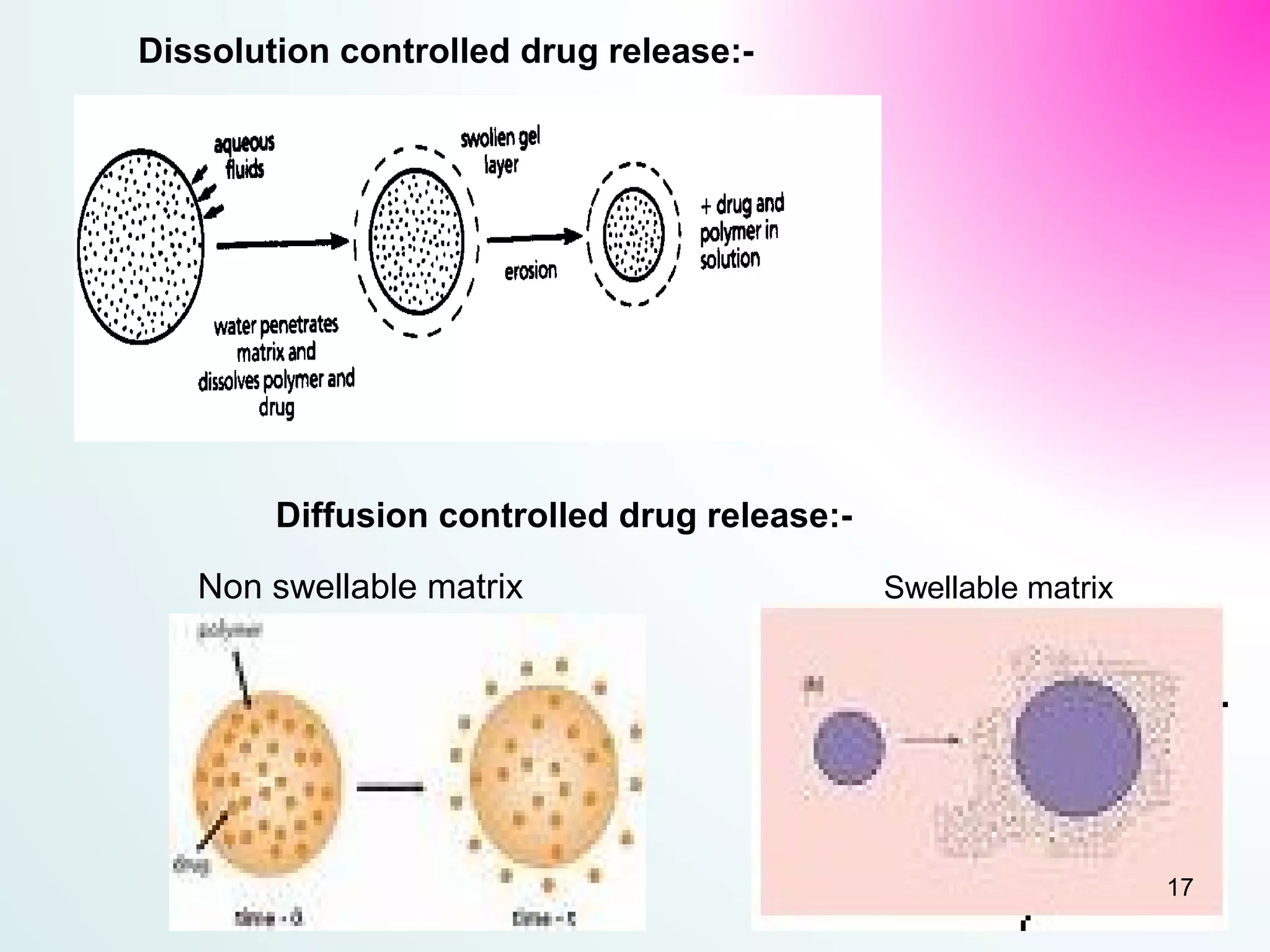
Dissolution controlled drug release:-
Diffusion controlled drug release:-
Non swellable matrix Swellable matrix
17
Diffusion controlled Drug release:-
 Drug is dispersed in an insoluble Matrix of rigid non
swellable hydrophobic material or
swellable hydrophilic substances
 Rigid matrix prepared by congealing
 Swellable matrix prepared by drug and gum granulated
then compressed into tablet
 Rate controlling step is diffusion
 From rigid matrix Drug release follows Ficks first order diffusion
18
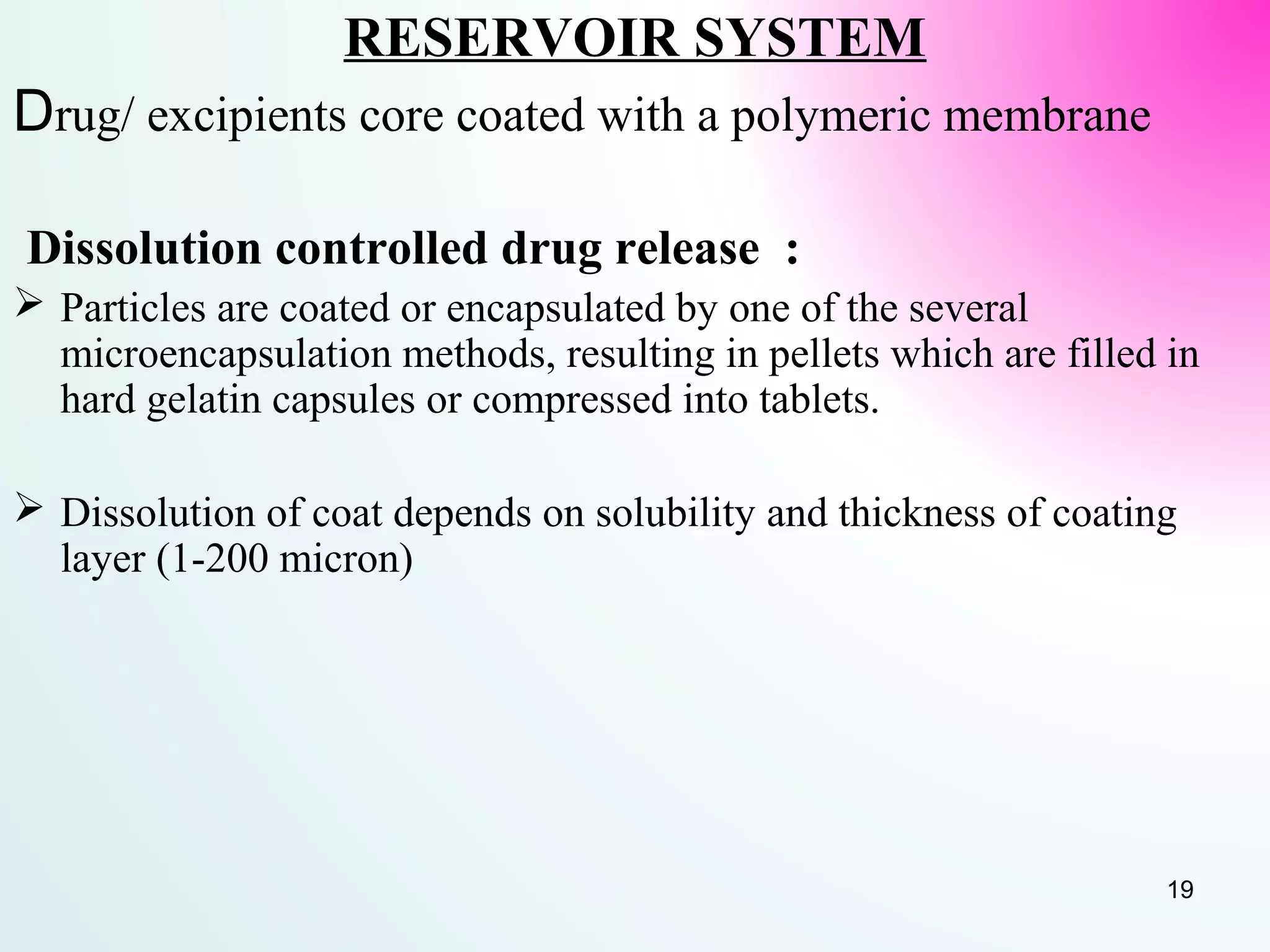
RESERVOIR SYSTEM
Drug/ excipients core coated with a polymeric membrane
Dissolution controlled drug release :
 Particles are coated or encapsulated by one of the several
microencapsulation methods, resulting in pellets which are filled in
hard gelatin capsules or compressed into tablets.
 Dissolution of coat depends on solubility and thickness of coating
layer (1-200 micron)
19
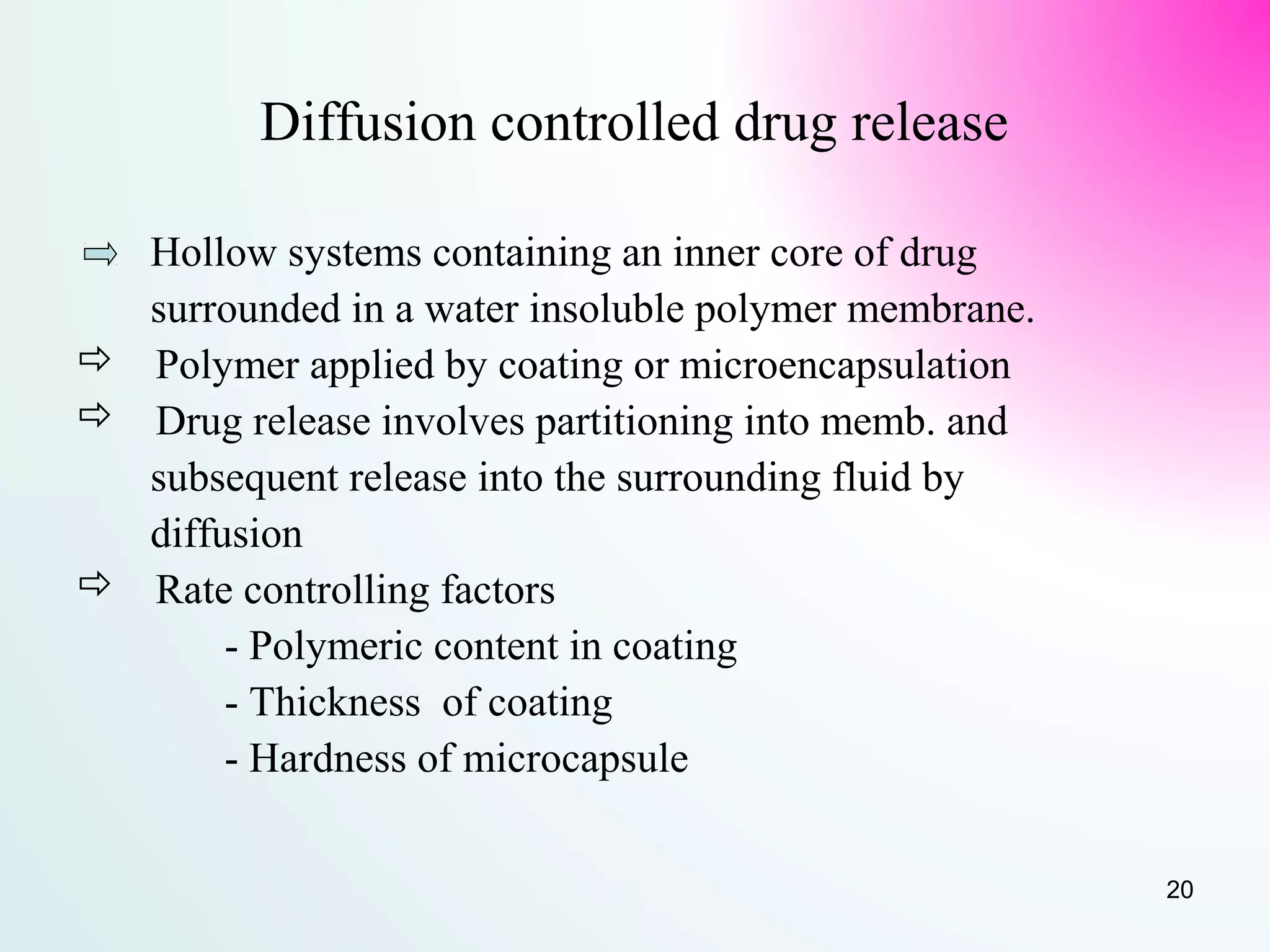
Diffusion controlled drug release
Hollow systems containing an inner core of drug
surrounded in a water insoluble polymer membrane.
 Polymer applied by coating or microencapsulation
 Drug release involves partitioning into memb. and
subsequent release into the surrounding fluid by
diffusion
 Rate controlling factors
- Polymeric content in coating
- Thickness of coating
- Hardness of microcapsule
20
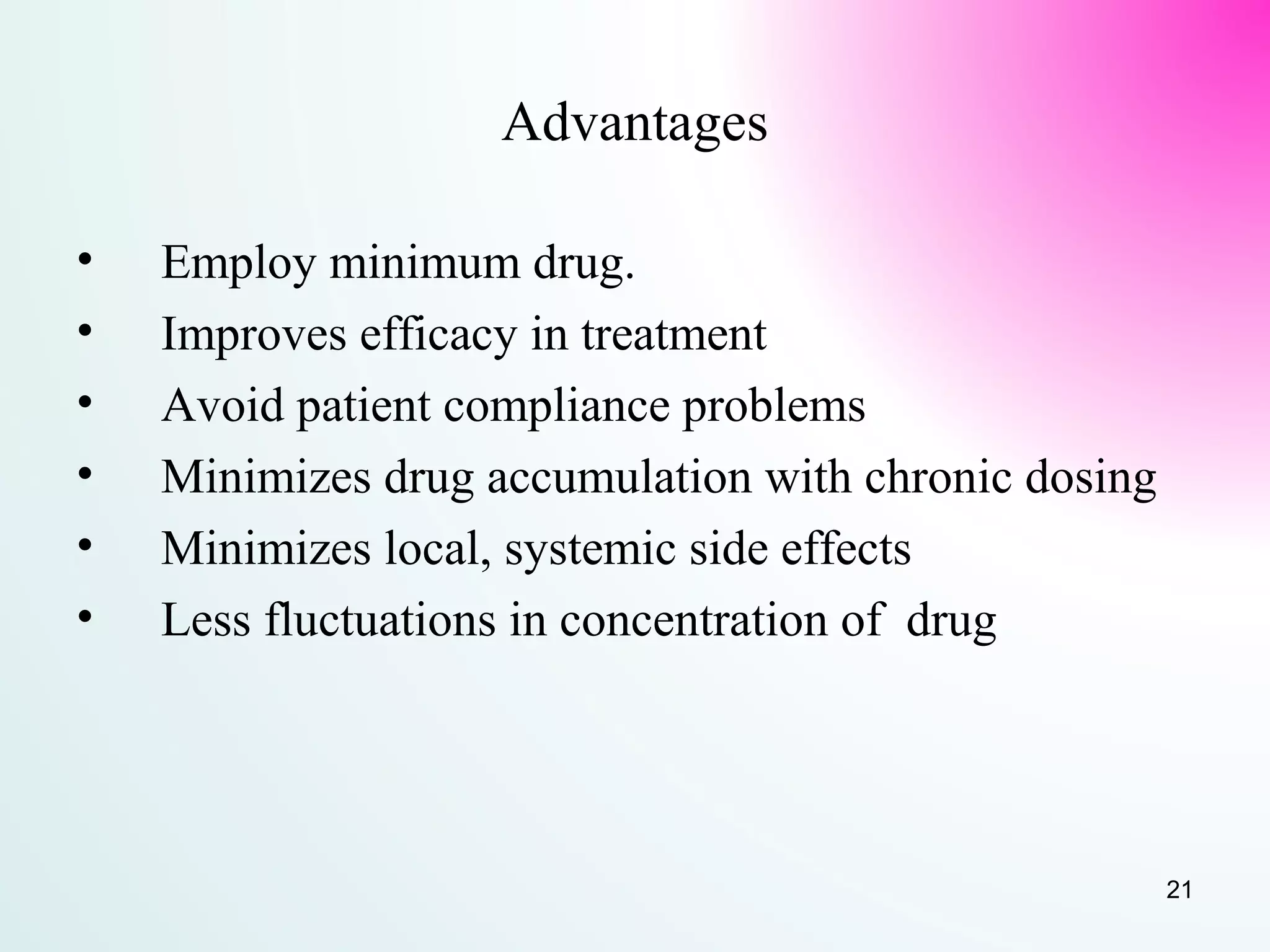
Advantages
• Employ minimum drug.
• Improves efficacy in treatment
• Avoid patient compliance problems
• Minimizes drug accumulation with chronic dosing
• Minimizes local, systemic side effects
• Less fluctuations in concentration of drug
21
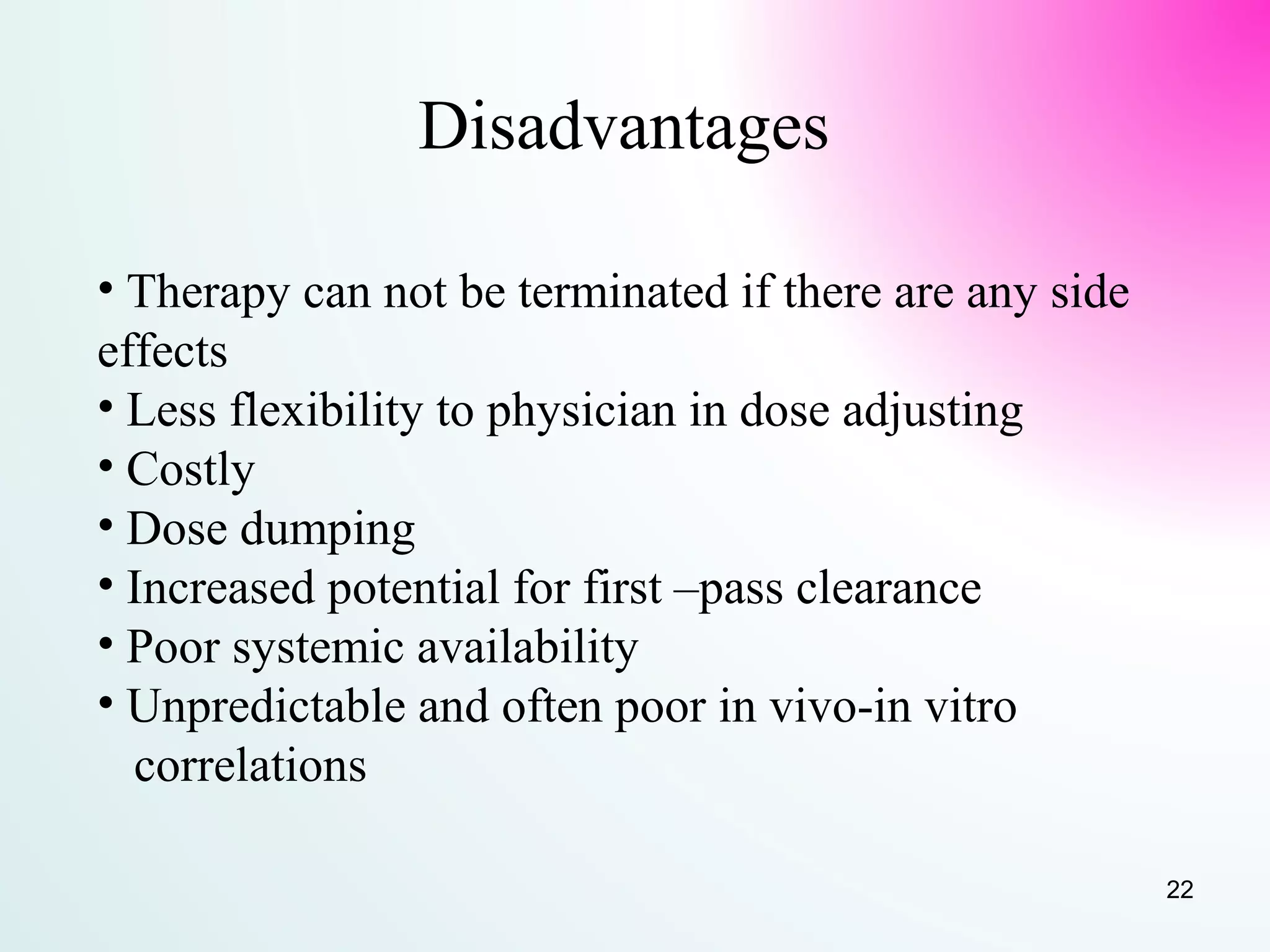
Disadvantages
• Therapy can not be terminated if there are any side
effects
• Less flexibility to physician in dose adjusting
• Costly
• Dose dumping
• Increased potential for first –pass clearance
• Poor systemic availability
• Unpredictable and often poor in vivo-in vitro
correlations
22
REFERENCES
1.Remington;The science and practice of pharmacy,20th
ed
,vol-I,p.p.898.
2. Leon Lachaman; The theory and practice of industrial
pharmacy, 3rd
ed,p.p.430-456.
3.Herbart A.Liberman ,Leon Lachaman; Pharmaceutical
dosage form; Tablets,vol-III,2nd
ed,p.p.199-302.
4.Bentley’s Textbook of pharmaceutics,8th
ed,p.p.661-666.
5. Michael E. Aulton; Pharmaceutics, The science of dosage
form design;2nd
ed, p.p.290-291.
6. "http://en.wikipedia.org/wiki/Sustained_release" 23
7. Ashok Katdale; Excipient development for pharmaceutical
biotechnology & drug delivery,p.p.12,185-187 .
8. D. M. Brahmankar, Sunil B. Jaiswal,; Biopharmaceutics and
pharmacokinetics, A Treatise, pp. 335-370.
24

Sustained release dosage form [srdf]

  • 1.
  • 2.
    CONTENT • INTRODUCTION • RATIONALE •DRUG PROPERTIES SUITABLE FOR SRDF • POLYMERS USED IN SRDF • MECHANISM OF RELEASE OF SRDF • ADVANTAGES • DISADVANTAGES • REFRENCES 2
  • 3.
    INTRODUCTION • Sustained release,are terms used to identify drug delivery system that are designed to achieve a prolonged therapeutic effect by continuously releasing medication over an extended period of time after administration of a single dose. • Sustained release dosage forms provide an amount of drug initially made available to the body to cause the desired therapeutic response, followed by a constant release of medication for maintenance of activity over a period of time 3
  • 4.
    Different Terminology On basisof release of drug from dosage form 1. Immediate Release ( IR) 2. Delayed Release (DR) 3. Controlled/Continuous release (CR) 4. Sustained Release (SR)/ Extended release (ER/XL/XR)/Prolonged release /Repeat action 4
  • 5.
    Immediate Release • Immediaterelease dosage form releases drug immediately after administration of single dose. • It generally releases 85-90%drug in 15 mins. 5
  • 6.
    Delayed Release • Term“delayed-release” is used for enteric coated dosage forms that are intended to delay the release of medicament until it has passed through the stomach. • Capsules ,tablets may be coated, or, more commonly, encapsulated granules coated to resist releasing the drug in the gastric fluid of the stomach where a delay is important to alleviate potential problems of drug inactivation or gastric mucosal irritation. 6
  • 7.
    Controlled Release • Controlledrelease dosage forms release drug at predetermined rate locally, systemically for specified period of time. • Controlled release is perfectly zero order release. 7
  • 8.
  • 9.
    Rationale for SustainedRelease • Drugs which are often administered repeatedly at specified time interval to maintain therapeutic level in blood or body tissues • uniform drug response achieved by using different combination of doses and dosage interval • However, the dosage regimen of an orally administered drug may be considered to be optimal when the therapeutic effect is maintained for the desired duration of the treatment at the lowest frequency of administration. • Frequent administration of dose produces side effect 9
  • 10.
    DRUG PROPERTIES SUITABLEFOR SRDF Physicochemical properties Aqueous solubility: Drugs having low solubility at absorption site and are pH dependent are poor candidates eg. Tetracycline Partition coefficient and Molecular Size : Drugs with high P.C. readily cross memb. While those with low P.C. can not cross memb. Large mol. Wt. compounds are poor candidate. Drug stability: Drug unstable in 1-7 pH can’t given by GIT. 10
  • 11.
    pKa and Ionizationat physiological pH: • For passive absorption drug should be un-ionized • Largely ionized drug poor candidate eg. Hexamethonium • pKarange for acidic drugs is 3.0-7.5 & for basic drug 7-11 Dose: • Dose must not be greater than 500mg. 11
  • 12.
    BIOLOGICAL FACTORS Absorption: • Uniformabsorption to maintain constant blood tissues level • Orally slowly absorbed drugs are poor candidate Distribution: • Affected by binding to tissues and proteins • Bound portion of drug considered as inactive or unable to cross membrane. • Described by apparent volume of distribution 12
  • 13.
    • Biological halflife: Those drugs having short half life are most suitable for SR. eg. Diphenhydramine • Side effect: Those drugs causing GI irritation are selected for SR, eg. Diclofenac sodium, potassium citrate • Safety margin: Drugs having narrow therapeutic index are selected for SR, eg. Diclofenac sodium 13
  • 14.
    POLYMERS • Hydrophilic polymer: Hydroxypropyl methyl cellulose (HPMC) Hydroxy propyl cellulose (HPC) Hydroxy ethyl cellulose (HEC) Sodium Alginate Poly (ethylene oxide) Cross linked homopolymer Copolymer of Acrylic acid • Hydrophobic polymer 1. Waxes: Carnauba wax Bees wax Candelilla wax Microcrystalline wax Paraffin wax 14
  • 15.
    2. Insoluble polymer: Ethylcellulose Cellulose acetate Cellulose acetate butyrate Cellulose acetate propionate 15
  • 16.
    MATRIX(MONOLITH) SYSTEM Drug/excipients embededwithin a matrix Dissolution controlled Drug release  Homogenous dispersion of drug throughout a rate- controlling medium  Release rate is controlled by the dissolution rate of the polymer  Two methods for drug-wax particle preparation -Aqueous dispersion -Congealing  Drug release is often first-order 16
  • 17.
    Dissolution controlled drugrelease:- Diffusion controlled drug release:- Non swellable matrix Swellable matrix 17
  • 18.
    Diffusion controlled Drugrelease:-  Drug is dispersed in an insoluble Matrix of rigid non swellable hydrophobic material or swellable hydrophilic substances  Rigid matrix prepared by congealing  Swellable matrix prepared by drug and gum granulated then compressed into tablet  Rate controlling step is diffusion  From rigid matrix Drug release follows Ficks first order diffusion 18
  • 19.
    RESERVOIR SYSTEM Drug/ excipientscore coated with a polymeric membrane Dissolution controlled drug release :  Particles are coated or encapsulated by one of the several microencapsulation methods, resulting in pellets which are filled in hard gelatin capsules or compressed into tablets.  Dissolution of coat depends on solubility and thickness of coating layer (1-200 micron) 19
  • 20.
    Diffusion controlled drugrelease Hollow systems containing an inner core of drug surrounded in a water insoluble polymer membrane.  Polymer applied by coating or microencapsulation  Drug release involves partitioning into memb. and subsequent release into the surrounding fluid by diffusion  Rate controlling factors - Polymeric content in coating - Thickness of coating - Hardness of microcapsule 20
  • 21.
    Advantages • Employ minimumdrug. • Improves efficacy in treatment • Avoid patient compliance problems • Minimizes drug accumulation with chronic dosing • Minimizes local, systemic side effects • Less fluctuations in concentration of drug 21
  • 22.
    Disadvantages • Therapy cannot be terminated if there are any side effects • Less flexibility to physician in dose adjusting • Costly • Dose dumping • Increased potential for first –pass clearance • Poor systemic availability • Unpredictable and often poor in vivo-in vitro correlations 22
  • 23.
    REFERENCES 1.Remington;The science andpractice of pharmacy,20th ed ,vol-I,p.p.898. 2. Leon Lachaman; The theory and practice of industrial pharmacy, 3rd ed,p.p.430-456. 3.Herbart A.Liberman ,Leon Lachaman; Pharmaceutical dosage form; Tablets,vol-III,2nd ed,p.p.199-302. 4.Bentley’s Textbook of pharmaceutics,8th ed,p.p.661-666. 5. Michael E. Aulton; Pharmaceutics, The science of dosage form design;2nd ed, p.p.290-291. 6. "http://en.wikipedia.org/wiki/Sustained_release" 23
  • 24.
    7. Ashok Katdale;Excipient development for pharmaceutical biotechnology & drug delivery,p.p.12,185-187 . 8. D. M. Brahmankar, Sunil B. Jaiswal,; Biopharmaceutics and pharmacokinetics, A Treatise, pp. 335-370. 24

Editor's Notes