Sustainable Livelihoods A livelihood comprises the capabilities, assets (including both material and social resources) and activities required for a means of living.  A livelihood is sustainable when it can cope with and recover from stresses and shocks and maintains or enhances its capabilities and assets both now and in the future, while not undermining the natural resource base."
The Sustainable Livelihoods Framework It’s ONE WAY of “organising” the complex issues surrounding POVERTY It’s NOT the ONLY WAY It needs to be: Modified Adapted Made appropriate to local circumstances Made appropriate to local priorities Slide 1 IFAD SL Workshop Sustainable Livelihoods Framework
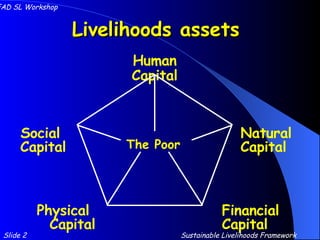
Livelihoods assets Financial  Capital Natural Capital Social  Capital Physical  Capital Human Capital The Poor Slide 2 IFAD SL Workshop Sustainable Livelihoods Framework
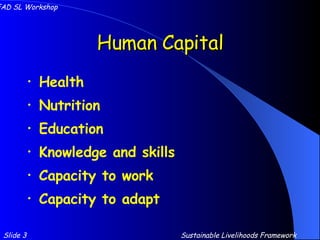
Human Capital Health Nutrition Education Knowledge and skills Capacity to work Capacity to adapt Slide 3 IFAD SL Workshop Sustainable Livelihoods Framework
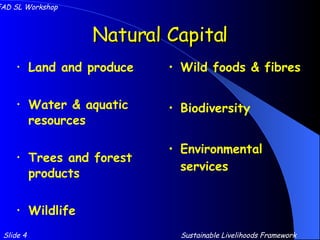
Natural Capital Land and produce Water & aquatic resources Trees and forest products Wildlife Wild foods & fibres Biodiversity Environmental services Slide 4 IFAD SL Workshop Sustainable Livelihoods Framework
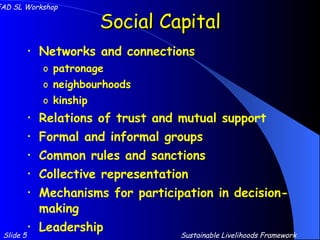
Social Capital Networks and connections patronage neighbourhoods kinship Relations of trust and mutual support Formal and informal groups Common rules and sanctions Collective representation Mechanisms for participation in decision-making Leadership Slide 5 IFAD SL Workshop Sustainable Livelihoods Framework
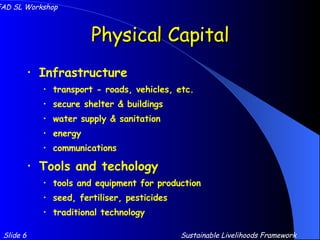
Physical Capital Infrastructure transport - roads, vehicles, etc. secure shelter & buildings water supply & sanitation energy communications Tools and techology tools and equipment for production seed, fertiliser, pesticides traditional technology Slide 6 IFAD SL Workshop Sustainable Livelihoods Framework
Financial Capital Savings Credit/debt - formal, informal, NGOs Remittances Pensions Wages Slide 7 IFAD SL Workshop Sustainable Livelihoods Framework
The Asset Mix Different households with different access to livelihood “assets” Livelihoods affected by: diversityof assets amount of assets  balance between assets Slide 8 IFAD SL Workshop Sustainable Livelihoods Framework
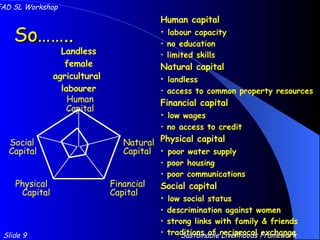
So…….. Human capital labour capacity no education limited skills Natural capital landless access to common property resources Financial capital low wages no access to credit Physical capital poor water supply poor housing poor communications Social capital low social status descrimination against women strong links with family & friends traditions of reciprocal exchange = an extremely reduced “livelihood pentagon” Landless female agricultural  labourer Slide 9 IFAD SL Workshop Sustainable Livelihoods Framework Financial  Capital Social  Capital Physical  Capital Human Capital Natural  Capital
“ Vulnerability” Context Shocks Floods, droughts, cyclones Deaths in the family Violence or civil unrest Seasonality Trends and changes Population Environmental change Technology Markets and trade Globalisation Slide 10 IFAD SL Workshop Sustainable Livelihoods Framework
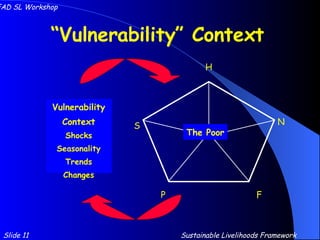
Vulnerability Context Shocks Seasonality Trends Changes “ Vulnerability” Context Slide 11 IFAD SL Workshop Sustainable Livelihoods Framework F P H N S The Poor
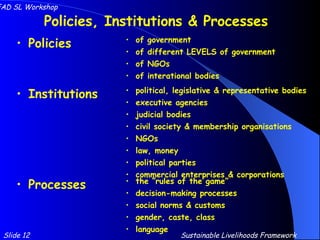
Policies, Institutions & Processes Policies of government of different LEVELS of government of NGOs of interational bodies Institutions Processes political, legislative & representative bodies executive agencies judicial bodies civil society & membership organisations NGOs law, money political parties commercial enterprises & corporations the “rules of the game” decision-making processes social norms & customs gender, caste, class language Slide 12 IFAD SL Workshop Sustainable Livelihoods Framework
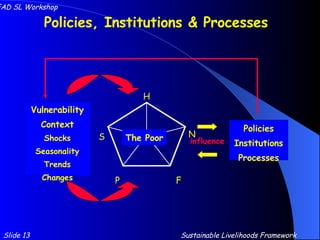
Policies Institutions Processes Policies, Institutions & Processes Slide 13 IFAD SL Workshop Sustainable Livelihoods Framework F P H N S The Poor Vulnerability Context Shocks Seasonality Trends Changes influence
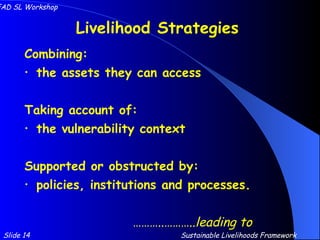
Livelihood Strategies Combining: the assets they can access Taking account of: the vulnerability context Supported or obstructed by: policies, institutions and processes. ……… ..……….. leading to Slide 14 IFAD SL Workshop Sustainable Livelihoods Framework
Livelihood Outcomes Poverty  - a “poor” livelihood outcome: based on a fragile or unbalanced set of livelihood assets unable to sustain to shocks, changes or trends not supported, or actively obstructed by policies, institutions and processes that do not allow assets to be used as they might livehood options combined in a “bad” or unsustainable strategy Slide 15 IFAD SL Workshop Sustainable Livelihoods Framework
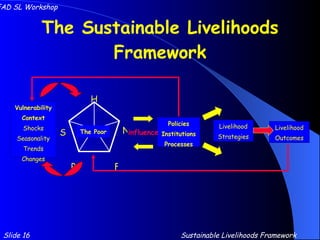
The Sustainable Livelihoods Framework Policies Institutions Processes Vulnerability Context Shocks Seasonality Trends Changes Livelihood Strategies Slide 16 IFAD SL Workshop Sustainable Livelihoods Framework N S F P H The Poor influence Livelihood Outcomes

Sustainable Livelihoods Framework

  • 1.
    Sustainable Livelihoods Alivelihood comprises the capabilities, assets (including both material and social resources) and activities required for a means of living. A livelihood is sustainable when it can cope with and recover from stresses and shocks and maintains or enhances its capabilities and assets both now and in the future, while not undermining the natural resource base."
  • 2.
    The Sustainable LivelihoodsFramework It’s ONE WAY of “organising” the complex issues surrounding POVERTY It’s NOT the ONLY WAY It needs to be: Modified Adapted Made appropriate to local circumstances Made appropriate to local priorities Slide 1 IFAD SL Workshop Sustainable Livelihoods Framework
  • 3.
    Livelihoods assets Financial Capital Natural Capital Social Capital Physical Capital Human Capital The Poor Slide 2 IFAD SL Workshop Sustainable Livelihoods Framework
  • 4.
    Human Capital HealthNutrition Education Knowledge and skills Capacity to work Capacity to adapt Slide 3 IFAD SL Workshop Sustainable Livelihoods Framework
  • 5.
    Natural Capital Landand produce Water & aquatic resources Trees and forest products Wildlife Wild foods & fibres Biodiversity Environmental services Slide 4 IFAD SL Workshop Sustainable Livelihoods Framework
  • 6.
    Social Capital Networksand connections patronage neighbourhoods kinship Relations of trust and mutual support Formal and informal groups Common rules and sanctions Collective representation Mechanisms for participation in decision-making Leadership Slide 5 IFAD SL Workshop Sustainable Livelihoods Framework
  • 7.
    Physical Capital Infrastructuretransport - roads, vehicles, etc. secure shelter & buildings water supply & sanitation energy communications Tools and techology tools and equipment for production seed, fertiliser, pesticides traditional technology Slide 6 IFAD SL Workshop Sustainable Livelihoods Framework
  • 8.
    Financial Capital SavingsCredit/debt - formal, informal, NGOs Remittances Pensions Wages Slide 7 IFAD SL Workshop Sustainable Livelihoods Framework
  • 9.
    The Asset MixDifferent households with different access to livelihood “assets” Livelihoods affected by: diversityof assets amount of assets balance between assets Slide 8 IFAD SL Workshop Sustainable Livelihoods Framework
  • 10.
    So…….. Human capitallabour capacity no education limited skills Natural capital landless access to common property resources Financial capital low wages no access to credit Physical capital poor water supply poor housing poor communications Social capital low social status descrimination against women strong links with family & friends traditions of reciprocal exchange = an extremely reduced “livelihood pentagon” Landless female agricultural labourer Slide 9 IFAD SL Workshop Sustainable Livelihoods Framework Financial Capital Social Capital Physical Capital Human Capital Natural Capital
  • 11.
    “ Vulnerability” ContextShocks Floods, droughts, cyclones Deaths in the family Violence or civil unrest Seasonality Trends and changes Population Environmental change Technology Markets and trade Globalisation Slide 10 IFAD SL Workshop Sustainable Livelihoods Framework
  • 12.
    Vulnerability Context ShocksSeasonality Trends Changes “ Vulnerability” Context Slide 11 IFAD SL Workshop Sustainable Livelihoods Framework F P H N S The Poor
  • 13.
    Policies, Institutions &Processes Policies of government of different LEVELS of government of NGOs of interational bodies Institutions Processes political, legislative & representative bodies executive agencies judicial bodies civil society & membership organisations NGOs law, money political parties commercial enterprises & corporations the “rules of the game” decision-making processes social norms & customs gender, caste, class language Slide 12 IFAD SL Workshop Sustainable Livelihoods Framework
  • 14.
    Policies Institutions ProcessesPolicies, Institutions & Processes Slide 13 IFAD SL Workshop Sustainable Livelihoods Framework F P H N S The Poor Vulnerability Context Shocks Seasonality Trends Changes influence
  • 15.
    Livelihood Strategies Combining:the assets they can access Taking account of: the vulnerability context Supported or obstructed by: policies, institutions and processes. ……… ..……….. leading to Slide 14 IFAD SL Workshop Sustainable Livelihoods Framework
  • 16.
    Livelihood Outcomes Poverty - a “poor” livelihood outcome: based on a fragile or unbalanced set of livelihood assets unable to sustain to shocks, changes or trends not supported, or actively obstructed by policies, institutions and processes that do not allow assets to be used as they might livehood options combined in a “bad” or unsustainable strategy Slide 15 IFAD SL Workshop Sustainable Livelihoods Framework
  • 17.
    The Sustainable LivelihoodsFramework Policies Institutions Processes Vulnerability Context Shocks Seasonality Trends Changes Livelihood Strategies Slide 16 IFAD SL Workshop Sustainable Livelihoods Framework N S F P H The Poor influence Livelihood Outcomes