Rural Economy & Development
     Why should we study in this paper?
3. To understand and analyze the socioeconomic
   dynamics of the rural areas of India as well as
   other countries
2. To know the basics and conceptual frameworks
   of rural development
1. To put rural development theories methodically
   into practices at state, national & international
   level
What is Economy ?
• Economy means certain living conditions
  of people in certain region through which
  the physical quality of life of the people is
  determined.
• Rural economy is characterized by the
  primary sector & allied(joined) activities.
• Rural economy is basically a producers’
  economy
Development
• Development is a continuous process of
  positive change towards improvement of
  PQL
• Development is not only the economic
  growth, but it is also the equitable
  distribution of the development gain
• Development means growth with justice
Characteristics of Development
•   Increase in PQL
•   Growth with justice
•   Removal of inequality & Poverty
•   Equitable distribution of development gain
•   Sustainability
•   Equalization of opportunities
Alternative Development Indicators
•   PQLI
•   Human Development
•   Empowerment
•   Moral & Ethics
•   GNH
Schools of Thoughts
•   Rostow’ s Growth Theory
•   Lewis Development Theory
•   International Dependence Theory
•   Gandhian Development Theory
•   Nehruvian Development Theory
•   Marxist Development Theory
Issues of Development in Global Context

•   Polarization of Wealth
•   Feminization of Poverty
•   Rural Urban Influx
•   Large Scale Displacement
•   Destruction of livelihoods System
•   Synergic Problems
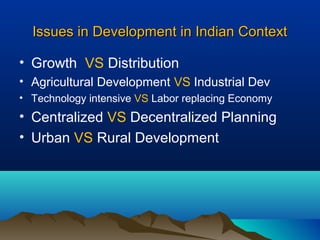
Issues in Development in Indian Context

• Growth VS Distribution
• Agricultural Development VS Industrial Dev
• Technology intensive VS Labor replacing Economy
• Centralized VS Decentralized Planning
• Urban VS Rural Development
What is Poverty ?

        The word "poverty" suggests
impoverishment: an inability to
provide a family with nutritious food,
clothing, and reasonable shelter. UNO
Types of poverty
• Absolute Poverty
  ( Physical requirements at subsistence level, price quotations, per capita consumer
 expenditure)

• Relative Poverty
   ( income distributions of fractile groups, top 10, bottom 10)
What does Poverty create ?

    People residing in tribal and forested areas
are likely to remain poor forever as a result they
foment violence, conflicts & social unrest in
future.
Factors of Poverty
• Poor Quality Human Capital: low level of
  productive efficiency
• Instability of output in Agriculture sector
• Imbalance in distribution & growing
  inequalities
• Prevalence of Chronic Unemployment
• Prevalence of low level technology
• Steadily improving rate of capital formation
Why Poor is Poor?


Poverty becomes hereditary in India because Chronic
  Poor pass on the poverty syndromes to the next
                    generation
Uneven distribution of food grains & absence of right to food act
              (People's Union for Civil Liberties )
What is Poverty Line ?

 Poverty Line is an economic benchmark
and threshold used to indicate economic
disadvantage and to identify individuals
and households in need of their
subsistence.
Underlining the Poverty
•   9th FYP criteria ( < 22,000/- AFI/ 2 hectors)
•   10th FYP criteria (Cut off mark-17 out of 52)
•   11th FYP criteria ( Rural & Urban)
•   BPL criteria in Kerala ( 4 out of 9 point criteria)
Various Studies on Poverty
• Ojha’s estimate of Poverty (2,250 calories)
• Dandekar & Rath’s Study of Poverty
  ( Rs20/-pm)
• Minha’s Study of Poverty ( varies during
  Harvest)
• Montek S. Alhuwalia’s study of Poverty
  (Agricultural performance & PoG=Z-Y/Z

  ( for detail see the book: Indian Economy by Mishra &
  Puri or Datta & Sundharam)
Poverty is widespread in India, with the
nation estimated to have 1/3rd of the
world's poor. According to a 2005 World
Bank estimate, 41.6% of the total Indian
population falls below the international
poverty line of US$ 1.25 a day.
Declining Poverty in India
International Poverty Line
Internationally, an income of less than $1.25 per
day per head of purchasing power parity is
defined as extreme poverty. Income-based
poverty lines consider the bare minimum income
to provide basic food requirements; it does not
account for other essentials such as health care
and education. That is why some times the
poverty lines have been described as starvation
lines.
Poverty in China
• < 0.2 US$ pd/ph ( 2005) & <1.25 US$ (2010)
• 230 million BPL
Poverty in United States of America
Infrastructure in Indian Economy
•   Energy & Power
•   Agriculture & Irrigation
•   Transport
•   Communication & IT
•   Industry
•   Defense
•   Entertainment & Media
•   Science & Technology
•   Banking & Insurance
•   Health & Education
Performance in Infrastructure Sector
Sectors       Unit    1950-51       2008-09
Coal          M.T     32            525
Electricity   B.KW    5             747

Petroleum     M.T     0.4           33.5

Steel         M.T     1.0           57
Cement        M.T     2.7           181.4
Railway       M.T     73            833
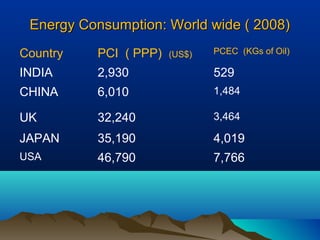
Energy Consumption: World wide ( 2008)
Country   PCI ( PPP)   (US$)   PCEC (KGs of Oil)

INDIA     2,930                529
CHINA     6,010                1,484

UK        32,240               3,464

JAPAN     35,190               4,019
USA       46,790               7,766
Natural Resources in Indian Economy
•   Land Resources
•   Water Resources
•   Forest Resources
•   Marine Resources
•   Mineral Resources
•   Non-Conventional & renewable energy
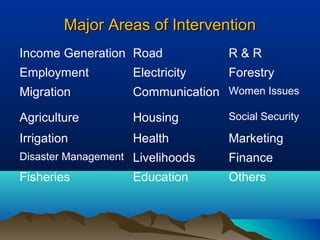
Major Areas of Intervention
Income Generation Road            R&R
Employment          Electricity   Forestry
Migration           Communication Women Issues

Agriculture         Housing       Social Security

Irrigation          Health        Marketing
Disaster Management Livelihoods   Finance
Fisheries           Education     Others
Tips for Drafting the Scheme
• Download a related scheme which is already in
  force (or phased out).
• Critically assess the scheme and find out the gaps
• Collect the all India level vital statistics on land,
  population and others.
• Draft the scheme on any one of the areas of
  rural development (Latest by 23rdof July) which will
  be presented group wise on class from 1st of
  August & will be assessed with 20 marks.
Guidelines of the Scheme ?
Give a nomenclature of the Scheme i.e.
“ National Poverty Alleviation Programme”
Part I - Programme Objectives and Guiding
                    Principles
1. Introduction
2.Programme Objectives
3.Guiding Principles
Part II – Planning, Funding & Execution


4. Planning for the projects
5. Funding and Allocation
6. Proposals
7. State Level Agencies
8. Preparation of Project Proposals and their
  Clearance
9. Scrutiny of Project Proposals
10. Empowered Committee
11. Tendering of Works
12. Programme Implementation Units
13. Execution of Works
14. Quality Control and Supervision of Works
15. Monitoring
Part III - Flow of funds, procedure for
            release and Audit
16. Flow of Funds
17. Procedure for Release Of Funds to the State
  Level Agency
18. Audit
19. Miscellaneous
20. Convergence

RURAL Economy

  • 1.
    Rural Economy &Development Why should we study in this paper? 3. To understand and analyze the socioeconomic dynamics of the rural areas of India as well as other countries 2. To know the basics and conceptual frameworks of rural development 1. To put rural development theories methodically into practices at state, national & international level
  • 2.
    What is Economy? • Economy means certain living conditions of people in certain region through which the physical quality of life of the people is determined. • Rural economy is characterized by the primary sector & allied(joined) activities. • Rural economy is basically a producers’ economy
  • 3.
    Development • Development isa continuous process of positive change towards improvement of PQL • Development is not only the economic growth, but it is also the equitable distribution of the development gain • Development means growth with justice
  • 4.
    Characteristics of Development • Increase in PQL • Growth with justice • Removal of inequality & Poverty • Equitable distribution of development gain • Sustainability • Equalization of opportunities
  • 5.
    Alternative Development Indicators • PQLI • Human Development • Empowerment • Moral & Ethics • GNH
  • 6.
    Schools of Thoughts • Rostow’ s Growth Theory • Lewis Development Theory • International Dependence Theory • Gandhian Development Theory • Nehruvian Development Theory • Marxist Development Theory
  • 7.
    Issues of Developmentin Global Context • Polarization of Wealth • Feminization of Poverty • Rural Urban Influx • Large Scale Displacement • Destruction of livelihoods System • Synergic Problems
  • 8.
    Issues in Developmentin Indian Context • Growth VS Distribution • Agricultural Development VS Industrial Dev • Technology intensive VS Labor replacing Economy • Centralized VS Decentralized Planning • Urban VS Rural Development
  • 9.
    What is Poverty? The word "poverty" suggests impoverishment: an inability to provide a family with nutritious food, clothing, and reasonable shelter. UNO
  • 10.
    Types of poverty •Absolute Poverty ( Physical requirements at subsistence level, price quotations, per capita consumer expenditure) • Relative Poverty ( income distributions of fractile groups, top 10, bottom 10)
  • 11.
    What does Povertycreate ? People residing in tribal and forested areas are likely to remain poor forever as a result they foment violence, conflicts & social unrest in future.
  • 12.
    Factors of Poverty •Poor Quality Human Capital: low level of productive efficiency • Instability of output in Agriculture sector • Imbalance in distribution & growing inequalities • Prevalence of Chronic Unemployment • Prevalence of low level technology • Steadily improving rate of capital formation
  • 13.
    Why Poor isPoor? Poverty becomes hereditary in India because Chronic Poor pass on the poverty syndromes to the next generation
  • 14.
    Uneven distribution offood grains & absence of right to food act (People's Union for Civil Liberties )
  • 15.
    What is PovertyLine ? Poverty Line is an economic benchmark and threshold used to indicate economic disadvantage and to identify individuals and households in need of their subsistence.
  • 16.
    Underlining the Poverty • 9th FYP criteria ( < 22,000/- AFI/ 2 hectors) • 10th FYP criteria (Cut off mark-17 out of 52) • 11th FYP criteria ( Rural & Urban) • BPL criteria in Kerala ( 4 out of 9 point criteria)
  • 17.
    Various Studies onPoverty • Ojha’s estimate of Poverty (2,250 calories) • Dandekar & Rath’s Study of Poverty ( Rs20/-pm) • Minha’s Study of Poverty ( varies during Harvest) • Montek S. Alhuwalia’s study of Poverty (Agricultural performance & PoG=Z-Y/Z ( for detail see the book: Indian Economy by Mishra & Puri or Datta & Sundharam)
  • 18.
    Poverty is widespreadin India, with the nation estimated to have 1/3rd of the world's poor. According to a 2005 World Bank estimate, 41.6% of the total Indian population falls below the international poverty line of US$ 1.25 a day.
  • 19.
  • 20.
    International Poverty Line Internationally,an income of less than $1.25 per day per head of purchasing power parity is defined as extreme poverty. Income-based poverty lines consider the bare minimum income to provide basic food requirements; it does not account for other essentials such as health care and education. That is why some times the poverty lines have been described as starvation lines.
  • 21.
    Poverty in China •< 0.2 US$ pd/ph ( 2005) & <1.25 US$ (2010) • 230 million BPL
  • 22.
    Poverty in UnitedStates of America
  • 23.
    Infrastructure in IndianEconomy • Energy & Power • Agriculture & Irrigation • Transport • Communication & IT • Industry • Defense • Entertainment & Media • Science & Technology • Banking & Insurance • Health & Education
  • 24.
    Performance in InfrastructureSector Sectors Unit 1950-51 2008-09 Coal M.T 32 525 Electricity B.KW 5 747 Petroleum M.T 0.4 33.5 Steel M.T 1.0 57 Cement M.T 2.7 181.4 Railway M.T 73 833
  • 25.
    Energy Consumption: Worldwide ( 2008) Country PCI ( PPP) (US$) PCEC (KGs of Oil) INDIA 2,930 529 CHINA 6,010 1,484 UK 32,240 3,464 JAPAN 35,190 4,019 USA 46,790 7,766
  • 26.
    Natural Resources inIndian Economy • Land Resources • Water Resources • Forest Resources • Marine Resources • Mineral Resources • Non-Conventional & renewable energy
  • 27.
    Major Areas ofIntervention Income Generation Road R&R Employment Electricity Forestry Migration Communication Women Issues Agriculture Housing Social Security Irrigation Health Marketing Disaster Management Livelihoods Finance Fisheries Education Others
  • 28.
    Tips for Draftingthe Scheme • Download a related scheme which is already in force (or phased out). • Critically assess the scheme and find out the gaps • Collect the all India level vital statistics on land, population and others. • Draft the scheme on any one of the areas of rural development (Latest by 23rdof July) which will be presented group wise on class from 1st of August & will be assessed with 20 marks.
  • 29.
    Guidelines of theScheme ? Give a nomenclature of the Scheme i.e. “ National Poverty Alleviation Programme”
  • 30.
    Part I -Programme Objectives and Guiding Principles 1. Introduction 2.Programme Objectives 3.Guiding Principles
  • 31.
    Part II –Planning, Funding & Execution 4. Planning for the projects 5. Funding and Allocation 6. Proposals 7. State Level Agencies 8. Preparation of Project Proposals and their Clearance 9. Scrutiny of Project Proposals
  • 32.
    10. Empowered Committee 11.Tendering of Works 12. Programme Implementation Units 13. Execution of Works 14. Quality Control and Supervision of Works 15. Monitoring
  • 33.
    Part III -Flow of funds, procedure for release and Audit 16. Flow of Funds 17. Procedure for Release Of Funds to the State Level Agency 18. Audit 19. Miscellaneous 20. Convergence