livelihood is defined as a set of activities
performed to live for a given life span ,
involving securing water, food, fodder,
medicine, shelter, clothing and the
capacity to acquire above necessities
working either individually or as a group
by using endowments (both human and
material) for meeting the requirements of
the self and his/her household on a
sustainable basis with dignity.
Concept of livelihood
Natural resource
managementļ‚— Natural resource management deals with
managing the way in whichpeople and
natural landscapes interact. It brings
together land use planning, water
management, biodiversity conservation, and
the future sustainability of industries
like agriculture, mining, tourism, fisheries an
d forestry
ļ‚— It recognises that people and their
livelihoods rely on the health and
productivity of our landscapes, and their
actions as stewards of the land play a
critical role in maintaining this health and
productivity
Department of PG studies in
social work
vidyanagara Tumkur
Assignment presentation
livelihood approach :- NRM , watershed
development , diversification
Rajendraprasad KT
MSW
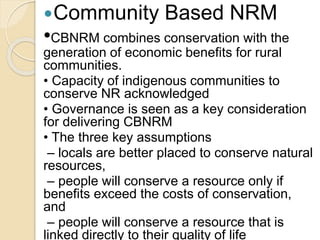
ļ‚—Community Based NRM
•CBNRM combines conservation with the
generation of economic benefits for rural
communities.
• Capacity of indigenous communities to
conserve NR acknowledged
• Governance is seen as a key consideration
for delivering CBNRM
• The three key assumptions
– locals are better placed to conserve natural
resources,
– people will conserve a resource only if
benefits exceed the costs of conservation,
and
– people will conserve a resource that is
linked directly to their quality of life
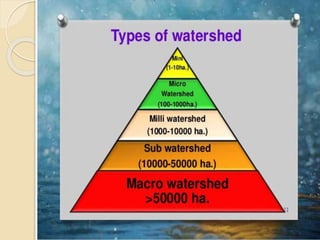
Watershed devlopment
ļ‚— i) Watershed is an area above a given
drainage point on a stream that
contributes water to the flow at that
point.
ļ‚— ii) Watershed is a natural unit draining
runoff water to common point of outlet.
ļ‚— iii) The watershed is geohydrological
unit or a piece of land that drains at
common point. Catchments basin or
drainage basin are synonymous of
watershed.
Sustainable Livelihood Strategies
Watershed Development
1)Well-being is not only about increased
incomes. Other dimensions of poverty that
must be addressed include food insecurity,
social inferiority, exclusion,lack of physical
assets, and vulnerability,
2) Household poverty is determined by
many factors, particularly access to
assets
and the influence of policies and
institutions,
3) Livelihood priorities vary and outsiders
cannot assume knowledg e of the
Livelihood Impacts of Watershed
Development Programmes
ļ‚— a) productive (optimum utilization of the
watershed's natural resources)
ļ‚— b) social (employment generation and
development of other economic
resources in the village);
ļ‚— c) ecological/environmental (easy and
affordable solutions that build on
indigenous knowledge); and
ļ‚— d) equity (emphasis on improving the
economic and social condition of the
resource poor).
Livelihood approach ppt

Livelihood approach ppt

  • 1.
    livelihood is definedas a set of activities performed to live for a given life span , involving securing water, food, fodder, medicine, shelter, clothing and the capacity to acquire above necessities working either individually or as a group by using endowments (both human and material) for meeting the requirements of the self and his/her household on a sustainable basis with dignity. Concept of livelihood
  • 4.
    Natural resource managementļ‚— Naturalresource management deals with managing the way in whichpeople and natural landscapes interact. It brings together land use planning, water management, biodiversity conservation, and the future sustainability of industries like agriculture, mining, tourism, fisheries an d forestry ļ‚— It recognises that people and their livelihoods rely on the health and productivity of our landscapes, and their actions as stewards of the land play a critical role in maintaining this health and productivity
  • 5.
    Department of PGstudies in social work vidyanagara Tumkur Assignment presentation livelihood approach :- NRM , watershed development , diversification Rajendraprasad KT MSW
  • 6.
    ļ‚—Community Based NRM •CBNRMcombines conservation with the generation of economic benefits for rural communities. • Capacity of indigenous communities to conserve NR acknowledged • Governance is seen as a key consideration for delivering CBNRM • The three key assumptions – locals are better placed to conserve natural resources, – people will conserve a resource only if benefits exceed the costs of conservation, and – people will conserve a resource that is linked directly to their quality of life
  • 11.
    Watershed devlopment ļ‚— i)Watershed is an area above a given drainage point on a stream that contributes water to the flow at that point. ļ‚— ii) Watershed is a natural unit draining runoff water to common point of outlet. ļ‚— iii) The watershed is geohydrological unit or a piece of land that drains at common point. Catchments basin or drainage basin are synonymous of watershed.
  • 12.
    Sustainable Livelihood Strategies WatershedDevelopment 1)Well-being is not only about increased incomes. Other dimensions of poverty that must be addressed include food insecurity, social inferiority, exclusion,lack of physical assets, and vulnerability, 2) Household poverty is determined by many factors, particularly access to assets and the influence of policies and institutions, 3) Livelihood priorities vary and outsiders cannot assume knowledg e of the
  • 13.
    Livelihood Impacts ofWatershed Development Programmes ļ‚— a) productive (optimum utilization of the watershed's natural resources) ļ‚— b) social (employment generation and development of other economic resources in the village); ļ‚— c) ecological/environmental (easy and affordable solutions that build on indigenous knowledge); and ļ‚— d) equity (emphasis on improving the economic and social condition of the resource poor).