The Sustainable Livelihoods Framework It’s  ONE WAY  of “organising” the  complex  issues surrounding  POVERTY It’s  NOT  the  ONLY WAY It   needs to be : Modified Adapted Made  appropriate  to  local circumstances Made  appropriate  to  local priorities
Why an ‘approach’? It’s about trying to see development  standing in the shoes of the poor   not from the shoes of: the ‘expert’ or  the ‘service delivery manager’
 
'A livelihood comprises the capabilities, assets (including both material and social resources) and activities required for a means of living. A livelihood is sustainable when it can cope with and recover from stresses and shocks and maintain or enhance its capabilities and assets both now and in the future, while not undermining the natural resource base'  (Chambers, R. and G. Conway, 1992).
Livelihood "A livelihood, on the other hand, is engagement in a number of activities which, at times, neither require a formal agreement nor are limited to a particular trade. Livelihoods may or may not involve money. Jobs invariably do. Livelihoods are self-directing. .... . Livelihoods are based on income derived from "jobs", but also on incomes derived from assets and entitlements. "   Job "A job connotes one particular activity or trade that is performed in exchange for payment. It is also a formal agreement, as manifested by a contract, between an employer and employee...... . A job can, however, comprise part of an overall livelihood, but does so only to complement other aspects of a livelihood portfolio.
What is a livelihood? A livelihood comprises    -- the capabilities,  assets (material and social) activities  required for a means of living. Not just the means to survive  but the capability to thrive
Is simply a tool to help: plan new development/adaptation initiatives assess the contribution to livelihood sustainability made by existing activities It: provides a checklist of relevant issues highlights what influences what  emphasizes the multiple interactions that affect people’s livelihoods The Sustainable Livelihood  Framework -1
The Sustainable Livelihood Framework -2 Helps us think holistically about: The things that poor rural households might be very vulnerable to The assets and resources that help them thrive and survive The policies and institutions that impact on their livelihoods How they respond to threats of climate change What sort of adaptation strategies are open to them
Principles of SLA People-centered :  beginning by understanding  peoples’ priorities and livelihood strategies . ●  Responsive and participatory :  responding to the expressed priorities of poor people. ●  Multi-level:   ensuring micro-level realities inform macro-level institutions and processes. ●  Conducted in partnership:   working with public, private and civil society actors. ●  Sustainable:   environmentally, economically, institutionally, and   socially. ●  Dynamic:   ensuring support is flexible and process-oriented, responding to changing livelihoods. ●  Holistic:   reflecting the integrated nature of people’s lives and   diverse strategies. ● Building on strengths:   while   addressing vulnerabilities .
Principles -1 People at the centre Holistic analysis Not supply driven Asset-based analysis Build on inherent potential Not on weaknesses and gaps Focus on outcomes (results)
Principles -2 If people are at ‘the centre’,  it affects the way services are delivered Participatory Involves users directly Responsive Flexible and dynamic Multi-agency ‘ Joined-up’ work (Integration) Partnerships
‘ PIPS’ effectively determine: access (to various types of capital, to livelihood strategies and to decision-making bodies and sources of influence) the terms of exchange between different types of capital returns (economic and otherwise) to any given livelihood strategy. Without a pro-poor and supportive enabling environment, interventions have little impact
SLA and RBA: Complimentary? Rights-based perspective:  focuses on linkages between public institutions and civil society and, particularly, on  how to increase the accountability of public institutions to all citizens.  The livelihoods approach, takes as its starting point a need to understand the livelihoods of poor people in context.  also recognizes the importance of these rights and of enhancing accountability
Principles -3 Focus on  institutions the ‘rules of the game’  ‘ voice’ and ‘choice’ rights, entitlements, inclusion multi-level consistency ‘ micro-macro’ linkages Focus on  sustainability
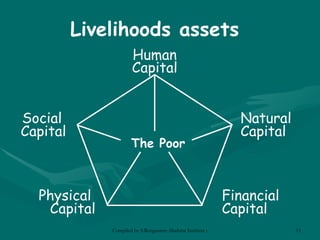
Livelihoods assets Financial  Capital Natural Capital Social  Capital Physical  Capital Human  Capital The Poor
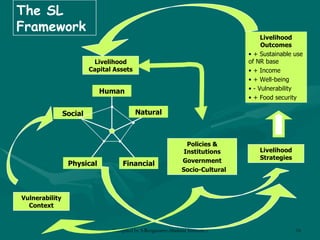
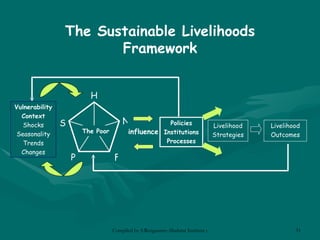
The SL Framework Livelihood Capital Assets Human Social Physical Financial Natural Vulnerability Context Livelihood Strategies Policies & Institutions Government Socio-Cultural Livelihood Outcomes + Sustainable use of NR base  + Income + Well-being - Vulnerability + Food security
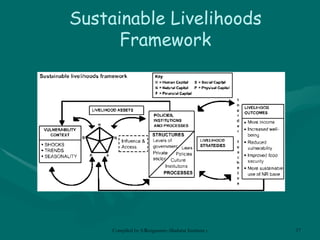
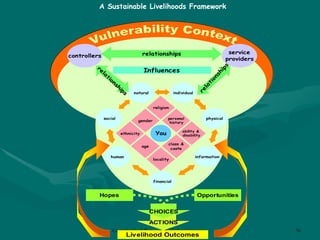
Sustainable Livelihoods Framework
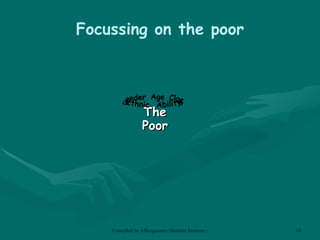
Focussing on the poor The Poor Ethnic  Ability Gender  Age  Class
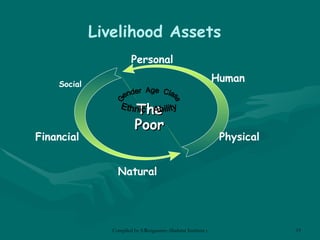
Livelihood Assets Financial Physical Natural Social Human Personal The Poor Gender  Age  Class Ethnic  Ability
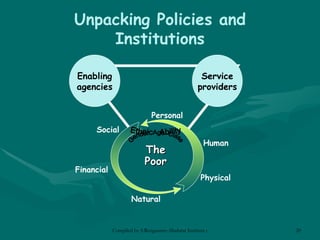
Unpacking Policies and Institutions Enabling agencies Service providers Financial Physical Natural Social Human Personal The Poor Gender  Age  Class Ethnic  Ability
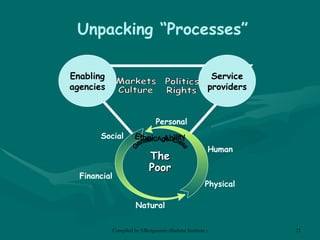
Unpacking “Processes” Markets  Politics Culture  Rights Enabling agencies Service providers Financial Physical Natural Social Human Personal The Poor Gender  Age  Class Ethnic  Ability
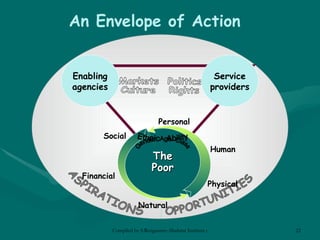
An Envelope of Action ASPIRATIONS OPPORTUNITIES Markets  Politics Culture  Rights Enabling agencies Service providers Financial Physical Natural Social Human Personal The Poor Gender  Age  Class Ethnic  Ability
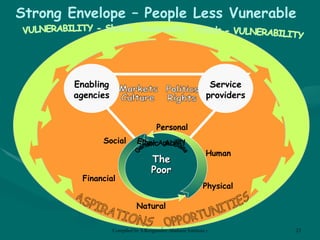
Strong Envelope – People Less Vunerable VULNERABILITY - Shocks  Seasonality  Trends - VULNERABILITY ASPIRATIONS OPPORTUNITIES Markets  Politics Culture  Rights Enabling agencies Service providers Financial Physical Natural Social Human Personal The Poor Gender  Age  Class Ethnic  Ability
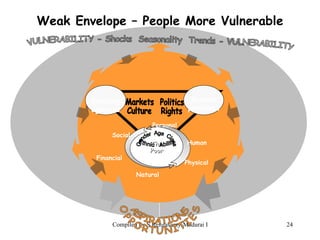
Weak Envelope – People More Vulnerable VULNERABILITY - Shocks  Seasonality  Trends - VULNERABILITY ASPIRATIONS OPPORTUNITIES Markets  Politics Culture  Rights Enabling agencies Service providers Financial Physical Natural Social Human Personal The Poor Gender  Age  Class Ethnic  Ability
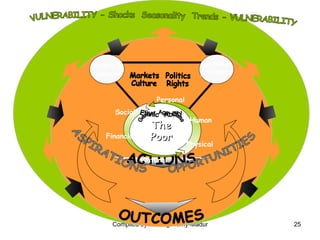
ACTIONS OUTCOMES Markets  Politics Culture  Rights VULNERABILITY - Shocks  Seasonality  Trends - VULNERABILITY ASPIRATIONS OPPORTUNITIES Enabling agencies Service providers Financial Physical Natural Social Human Personal The Poor Gender  Age  Class Ethnic  Ability
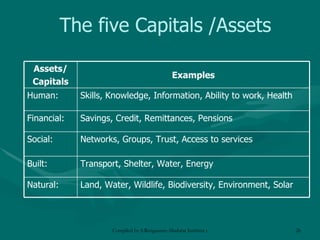
The five Capitals /Assets Land, Water, Wildlife, Biodiversity, Environment, Solar  Natural: Transport, Shelter, Water, Energy Built: Networks, Groups, Trust, Access to services Social: Savings, Credit, Remittances, Pensions Financial: Skills, Knowledge, Information, Ability to work, Health Human: Examples Assets/ Capitals
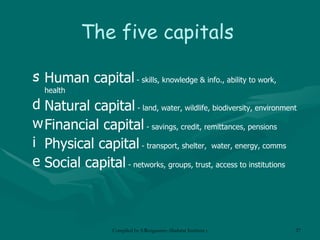
The five capitals Human capital   - skills, knowledge & info., ability to work, health  Natural capital  - land, water, wildlife, biodiversity, environment Financial capital  - savings, credit, remittances, pensions Physical capital  - transport, shelter,  water, energy, comms Social capital  - networks, groups, trust, access to institutions
Social Capital - Issues Much debate centers on the concept of social capital – one of the key terms in the development lexicon and the missing link in development ‘the glue that holds society together’ Concept attributed to Putnam who identifies three elements of social relations Interpersonal trust, networks and shared norms Where these elements function well they enable people to act together more effectively, make decisions, formulate policy and gain access to power and resources Proposed that the major obstacle of economic and social development in the ‘third world’ is ineffective institutions
Social capital - critique Key critiques of Putnam’s approach are that it Devalues political civil society – concentrates on ‘apolitical’ institutions Romanticizes associational life Deterministic – “path dependent development” – you either have social capital or you don’t. A repackaging of what social scientists have studied for years with new terms social capital equals “Bankspeak”, a term designed to neutralize and obscure problems and relations of power  (Harriss and Fine)
Counterpoints Hilary argues that the concept of social capital exposes the limitations of conventional economic approaches for understanding economic and social processes
What is a sustainable livelihood? A livelihood is sustainable when it can: cope with and recover from stresses and shocks maintain or enhance its capabilities and assets both now and in the future, while not undermining the natural resource base.
Livelihood Strategies W hat do people do? Natural-resource based Non-NR / off-farm activities Migration / remittances Pensions and grants Intensification vs. diversification Short-term vs. long-term
Livelihood outcomes What people are trying to achieve with their assets and strategies Categories of livelihood outcome More income Increased well-being Reduced vulnerability Improved food security More sustainable use of the natural resource base
Livelihood Outcomes W hat are people seeking to achieve? More sustainable use of the NR base More income Increased well-being Protect rights Recover dignity Reduced vulnerability Improved food security
Human Capital Health Nutrition Education Knowledge and skills Capacity to work Capacity to adapt
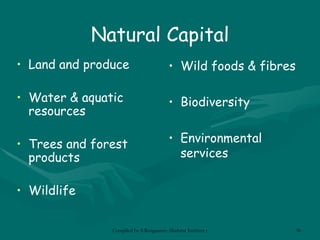
Natural Capital Land and produce Water  & aquatic resources Trees and forest products Wildlife Wild foods & fibres Biodiversity Env ironmental  services
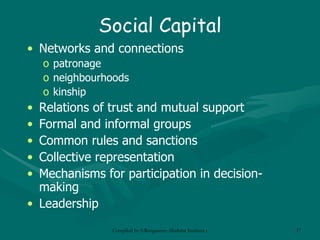
Social Capital Networks and connections patronage neighbourhoods kinship Relations of trust and mutual support Formal and informal groups Common rules and sanctions Collective representation Mechanisms for participation in decision-making Leadership
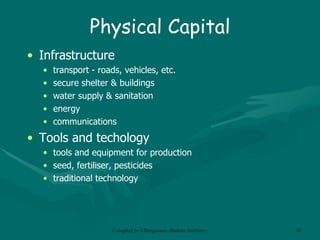
Physical Capital Infrastructure transport  - roads, vehicles, etc. secure shelter & buildings water supply & sanitation energy communications Tools and techology tools and equipment for production s eed , fertiliser, pesticides traditional technology
Financial Capital S avings Credit/debt  - formal, informal, NGOs Remittances Pensions Wages
The Asset Mix D ifferent households  with  different access to  livelihood  “assets/capital” Livelihoods affected by: diversity  of assets amount of assets   balance  between assets
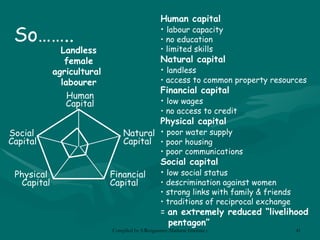
So…….. Human capital labour capacity no  education limited skills Natural capital landless access to common property resources Financial capital low wages no access to credit Physical capital poor water supply poor housing poor communications Social capital low social status descrimination against women strong links with family & friends traditions of reciprocal exchange =  an  extremely reduced “livelihood pentagon” Landless female agricultural  labourer Financial  Capital Social  Capital Physical  Capital Human  Capital Natural   Capital
Understanding vulnerability Moser characterizes vulnerability as insecurity in the well being of individuals, households or communities in the face of a changing environment Because people move in and out of poverty the concept of vulnerability better captures processes of change that poverty line measures
Understanding vulnerability Chambers observes that vulnerability has two sides An external side of risks, shocks and stress An internal side of defencelessness due to lack of means to cope with damaging loss
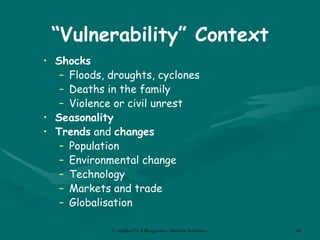
“ Vulnerability” Context Shocks Floods, droughts, cyclones Deaths in the family Violence or civil unrest Seasonality Trends  and  changes Population Environmental change Technology Markets and trade Globalisation
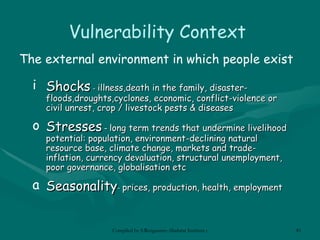
Vulnerability Context The external environment in which people exist Shocks  -  illness,death in the family, disaster-floods,droughts,cyclones, economic, conflict-violence or civil unrest, crop / livestock pests & diseases Stresses  –  long term trends that undermine livelihood potential:  population, environment- declining natural  resource  base ,  climate change, markets and trade- inflation ,  currency devaluation, structural unemployment, poor  governance, globalisation  etc Season ality -  prices, production, health, employment
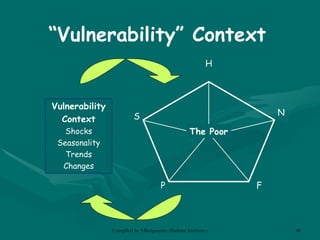
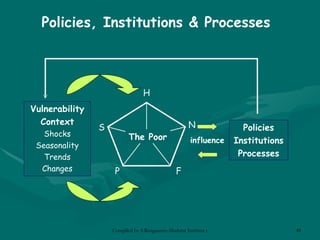
Vulnerability Context Shocks Seasonality Trends Changes “ Vulnerability” Context F P H N S The Poor
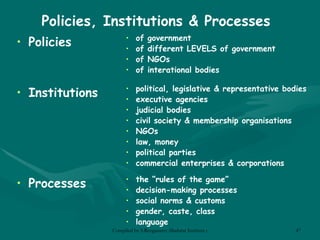
Policies, Institutions & Processes Policies of government of different LEVELS of government of NGOs of interational bodies Institutions Processes political, legislative & representative bodies executive agencies judicial bodies civil society & membership organisations NGOs law, money political parties commercial enterprises & corporations the “rules of the game” decision-making processes social norms & customs gender, caste, class language
Policies Institutions Processes Vulnerability Context Shocks Seasonality Trends Changes Policies, Institutions & Processes F P H N S The Poor influence
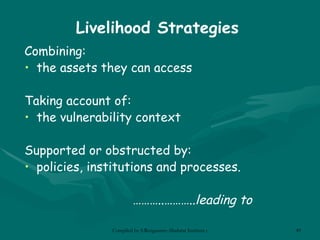
Livelihood Strategies Combining: the assets they can access Taking account of: the vulnerability context Supported or obstructed by: policies, institutions and processes . ……… ..……….. leading to
Livelihood Outcomes Poverty  -  a “poor” livelihood outcome : based on a fragile or unbalanced set of livelihood assets unable to sustain to shocks, changes or trends not supported, or actively obstructed by policies, institutions and processes that  do not allow assets to be used as they might livehood options combined in a “bad” or unsustainable strategy
The Sustainable Livelihoods Framework Policies Institutions Processes Vulnerability Context Shocks Seasonality Trends Changes Livelihood Strategies Livelihood Outcomes influence N S F P H The Poor
Uses A guide for people in the analysis of development practice and issues Encourages discussion and probing Not necessarily easier to explain but more complete Specifically identifies many features – politics, rules, social norms, gender/age/class/ethnic issues – that will help make it more culture specific Still not a magic bullet!
Advantages Addresses some of the “grey areas” identified regarding SL Places the poor firmly at the centre – makes people visible Suggests the importance of clear definition of who is at the centre of the analysis Unpacks the PIP box – more specific regarding key institutions and processes – and provides a more practical approach to analysing institutional and policy issues Incorporates political dimension more explicitly Helps understand entry points – based on opportunities and aspirations, possible at different levels (identifying them still depends on good analysis)
 
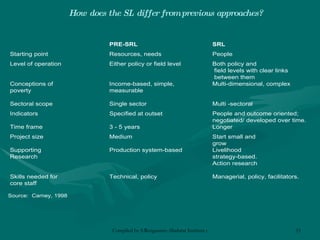
How does the SL differ from previous approaches?
A Sustainable Livelihoods Framework

Sustainable Livelihood SR

  • 1.
    The Sustainable LivelihoodsFramework It’s ONE WAY of “organising” the complex issues surrounding POVERTY It’s NOT the ONLY WAY It needs to be : Modified Adapted Made appropriate to local circumstances Made appropriate to local priorities
  • 2.
    Why an ‘approach’?It’s about trying to see development standing in the shoes of the poor not from the shoes of: the ‘expert’ or the ‘service delivery manager’
  • 3.
  • 4.
    'A livelihood comprisesthe capabilities, assets (including both material and social resources) and activities required for a means of living. A livelihood is sustainable when it can cope with and recover from stresses and shocks and maintain or enhance its capabilities and assets both now and in the future, while not undermining the natural resource base' (Chambers, R. and G. Conway, 1992).
  • 5.
    Livelihood "A livelihood,on the other hand, is engagement in a number of activities which, at times, neither require a formal agreement nor are limited to a particular trade. Livelihoods may or may not involve money. Jobs invariably do. Livelihoods are self-directing. .... . Livelihoods are based on income derived from "jobs", but also on incomes derived from assets and entitlements. " Job "A job connotes one particular activity or trade that is performed in exchange for payment. It is also a formal agreement, as manifested by a contract, between an employer and employee...... . A job can, however, comprise part of an overall livelihood, but does so only to complement other aspects of a livelihood portfolio.
  • 6.
    What is alivelihood? A livelihood comprises -- the capabilities, assets (material and social) activities required for a means of living. Not just the means to survive but the capability to thrive
  • 7.
    Is simply atool to help: plan new development/adaptation initiatives assess the contribution to livelihood sustainability made by existing activities It: provides a checklist of relevant issues highlights what influences what emphasizes the multiple interactions that affect people’s livelihoods The Sustainable Livelihood Framework -1
  • 8.
    The Sustainable LivelihoodFramework -2 Helps us think holistically about: The things that poor rural households might be very vulnerable to The assets and resources that help them thrive and survive The policies and institutions that impact on their livelihoods How they respond to threats of climate change What sort of adaptation strategies are open to them
  • 9.
    Principles of SLAPeople-centered : beginning by understanding peoples’ priorities and livelihood strategies . ● Responsive and participatory : responding to the expressed priorities of poor people. ● Multi-level: ensuring micro-level realities inform macro-level institutions and processes. ● Conducted in partnership: working with public, private and civil society actors. ● Sustainable: environmentally, economically, institutionally, and socially. ● Dynamic: ensuring support is flexible and process-oriented, responding to changing livelihoods. ● Holistic: reflecting the integrated nature of people’s lives and diverse strategies. ● Building on strengths: while addressing vulnerabilities .
  • 10.
    Principles -1 Peopleat the centre Holistic analysis Not supply driven Asset-based analysis Build on inherent potential Not on weaknesses and gaps Focus on outcomes (results)
  • 11.
    Principles -2 Ifpeople are at ‘the centre’, it affects the way services are delivered Participatory Involves users directly Responsive Flexible and dynamic Multi-agency ‘ Joined-up’ work (Integration) Partnerships
  • 12.
    ‘ PIPS’ effectivelydetermine: access (to various types of capital, to livelihood strategies and to decision-making bodies and sources of influence) the terms of exchange between different types of capital returns (economic and otherwise) to any given livelihood strategy. Without a pro-poor and supportive enabling environment, interventions have little impact
  • 13.
    SLA and RBA:Complimentary? Rights-based perspective: focuses on linkages between public institutions and civil society and, particularly, on how to increase the accountability of public institutions to all citizens. The livelihoods approach, takes as its starting point a need to understand the livelihoods of poor people in context. also recognizes the importance of these rights and of enhancing accountability
  • 14.
    Principles -3 Focuson institutions the ‘rules of the game’ ‘ voice’ and ‘choice’ rights, entitlements, inclusion multi-level consistency ‘ micro-macro’ linkages Focus on sustainability
  • 15.
    Livelihoods assets Financial Capital Natural Capital Social Capital Physical Capital Human Capital The Poor
  • 16.
    The SL FrameworkLivelihood Capital Assets Human Social Physical Financial Natural Vulnerability Context Livelihood Strategies Policies & Institutions Government Socio-Cultural Livelihood Outcomes + Sustainable use of NR base + Income + Well-being - Vulnerability + Food security
  • 17.
  • 18.
    Focussing on thepoor The Poor Ethnic Ability Gender Age Class
  • 19.
    Livelihood Assets FinancialPhysical Natural Social Human Personal The Poor Gender Age Class Ethnic Ability
  • 20.
    Unpacking Policies andInstitutions Enabling agencies Service providers Financial Physical Natural Social Human Personal The Poor Gender Age Class Ethnic Ability
  • 21.
    Unpacking “Processes” Markets Politics Culture Rights Enabling agencies Service providers Financial Physical Natural Social Human Personal The Poor Gender Age Class Ethnic Ability
  • 22.
    An Envelope ofAction ASPIRATIONS OPPORTUNITIES Markets Politics Culture Rights Enabling agencies Service providers Financial Physical Natural Social Human Personal The Poor Gender Age Class Ethnic Ability
  • 23.
    Strong Envelope –People Less Vunerable VULNERABILITY - Shocks Seasonality Trends - VULNERABILITY ASPIRATIONS OPPORTUNITIES Markets Politics Culture Rights Enabling agencies Service providers Financial Physical Natural Social Human Personal The Poor Gender Age Class Ethnic Ability
  • 24.
    Weak Envelope –People More Vulnerable VULNERABILITY - Shocks Seasonality Trends - VULNERABILITY ASPIRATIONS OPPORTUNITIES Markets Politics Culture Rights Enabling agencies Service providers Financial Physical Natural Social Human Personal The Poor Gender Age Class Ethnic Ability
  • 25.
    ACTIONS OUTCOMES Markets Politics Culture Rights VULNERABILITY - Shocks Seasonality Trends - VULNERABILITY ASPIRATIONS OPPORTUNITIES Enabling agencies Service providers Financial Physical Natural Social Human Personal The Poor Gender Age Class Ethnic Ability
  • 26.
    The five Capitals/Assets Land, Water, Wildlife, Biodiversity, Environment, Solar Natural: Transport, Shelter, Water, Energy Built: Networks, Groups, Trust, Access to services Social: Savings, Credit, Remittances, Pensions Financial: Skills, Knowledge, Information, Ability to work, Health Human: Examples Assets/ Capitals
  • 27.
    The five capitalsHuman capital - skills, knowledge & info., ability to work, health Natural capital - land, water, wildlife, biodiversity, environment Financial capital - savings, credit, remittances, pensions Physical capital - transport, shelter, water, energy, comms Social capital - networks, groups, trust, access to institutions
  • 28.
    Social Capital -Issues Much debate centers on the concept of social capital – one of the key terms in the development lexicon and the missing link in development ‘the glue that holds society together’ Concept attributed to Putnam who identifies three elements of social relations Interpersonal trust, networks and shared norms Where these elements function well they enable people to act together more effectively, make decisions, formulate policy and gain access to power and resources Proposed that the major obstacle of economic and social development in the ‘third world’ is ineffective institutions
  • 29.
    Social capital -critique Key critiques of Putnam’s approach are that it Devalues political civil society – concentrates on ‘apolitical’ institutions Romanticizes associational life Deterministic – “path dependent development” – you either have social capital or you don’t. A repackaging of what social scientists have studied for years with new terms social capital equals “Bankspeak”, a term designed to neutralize and obscure problems and relations of power (Harriss and Fine)
  • 30.
    Counterpoints Hilary arguesthat the concept of social capital exposes the limitations of conventional economic approaches for understanding economic and social processes
  • 31.
    What is asustainable livelihood? A livelihood is sustainable when it can: cope with and recover from stresses and shocks maintain or enhance its capabilities and assets both now and in the future, while not undermining the natural resource base.
  • 32.
    Livelihood Strategies What do people do? Natural-resource based Non-NR / off-farm activities Migration / remittances Pensions and grants Intensification vs. diversification Short-term vs. long-term
  • 33.
    Livelihood outcomes Whatpeople are trying to achieve with their assets and strategies Categories of livelihood outcome More income Increased well-being Reduced vulnerability Improved food security More sustainable use of the natural resource base
  • 34.
    Livelihood Outcomes What are people seeking to achieve? More sustainable use of the NR base More income Increased well-being Protect rights Recover dignity Reduced vulnerability Improved food security
  • 35.
    Human Capital HealthNutrition Education Knowledge and skills Capacity to work Capacity to adapt
  • 36.
    Natural Capital Landand produce Water & aquatic resources Trees and forest products Wildlife Wild foods & fibres Biodiversity Env ironmental services
  • 37.
    Social Capital Networksand connections patronage neighbourhoods kinship Relations of trust and mutual support Formal and informal groups Common rules and sanctions Collective representation Mechanisms for participation in decision-making Leadership
  • 38.
    Physical Capital Infrastructuretransport - roads, vehicles, etc. secure shelter & buildings water supply & sanitation energy communications Tools and techology tools and equipment for production s eed , fertiliser, pesticides traditional technology
  • 39.
    Financial Capital Savings Credit/debt - formal, informal, NGOs Remittances Pensions Wages
  • 40.
    The Asset MixD ifferent households with different access to livelihood “assets/capital” Livelihoods affected by: diversity of assets amount of assets balance between assets
  • 41.
    So…….. Human capitallabour capacity no education limited skills Natural capital landless access to common property resources Financial capital low wages no access to credit Physical capital poor water supply poor housing poor communications Social capital low social status descrimination against women strong links with family & friends traditions of reciprocal exchange = an extremely reduced “livelihood pentagon” Landless female agricultural labourer Financial Capital Social Capital Physical Capital Human Capital Natural Capital
  • 42.
    Understanding vulnerability Mosercharacterizes vulnerability as insecurity in the well being of individuals, households or communities in the face of a changing environment Because people move in and out of poverty the concept of vulnerability better captures processes of change that poverty line measures
  • 43.
    Understanding vulnerability Chambersobserves that vulnerability has two sides An external side of risks, shocks and stress An internal side of defencelessness due to lack of means to cope with damaging loss
  • 44.
    “ Vulnerability” ContextShocks Floods, droughts, cyclones Deaths in the family Violence or civil unrest Seasonality Trends and changes Population Environmental change Technology Markets and trade Globalisation
  • 45.
    Vulnerability Context Theexternal environment in which people exist Shocks - illness,death in the family, disaster-floods,droughts,cyclones, economic, conflict-violence or civil unrest, crop / livestock pests & diseases Stresses – long term trends that undermine livelihood potential: population, environment- declining natural resource base , climate change, markets and trade- inflation , currency devaluation, structural unemployment, poor governance, globalisation etc Season ality - prices, production, health, employment
  • 46.
    Vulnerability Context ShocksSeasonality Trends Changes “ Vulnerability” Context F P H N S The Poor
  • 47.
    Policies, Institutions &Processes Policies of government of different LEVELS of government of NGOs of interational bodies Institutions Processes political, legislative & representative bodies executive agencies judicial bodies civil society & membership organisations NGOs law, money political parties commercial enterprises & corporations the “rules of the game” decision-making processes social norms & customs gender, caste, class language
  • 48.
    Policies Institutions ProcessesVulnerability Context Shocks Seasonality Trends Changes Policies, Institutions & Processes F P H N S The Poor influence
  • 49.
    Livelihood Strategies Combining:the assets they can access Taking account of: the vulnerability context Supported or obstructed by: policies, institutions and processes . ……… ..……….. leading to
  • 50.
    Livelihood Outcomes Poverty - a “poor” livelihood outcome : based on a fragile or unbalanced set of livelihood assets unable to sustain to shocks, changes or trends not supported, or actively obstructed by policies, institutions and processes that do not allow assets to be used as they might livehood options combined in a “bad” or unsustainable strategy
  • 51.
    The Sustainable LivelihoodsFramework Policies Institutions Processes Vulnerability Context Shocks Seasonality Trends Changes Livelihood Strategies Livelihood Outcomes influence N S F P H The Poor
  • 52.
    Uses A guidefor people in the analysis of development practice and issues Encourages discussion and probing Not necessarily easier to explain but more complete Specifically identifies many features – politics, rules, social norms, gender/age/class/ethnic issues – that will help make it more culture specific Still not a magic bullet!
  • 53.
    Advantages Addresses someof the “grey areas” identified regarding SL Places the poor firmly at the centre – makes people visible Suggests the importance of clear definition of who is at the centre of the analysis Unpacks the PIP box – more specific regarding key institutions and processes – and provides a more practical approach to analysing institutional and policy issues Incorporates political dimension more explicitly Helps understand entry points – based on opportunities and aspirations, possible at different levels (identifying them still depends on good analysis)
  • 54.
  • 55.
    How does theSL differ from previous approaches?
  • 56.