Sustainable Livelihoods
Sustainable Livelihoods within given historical, political, cultural, economic, agro-ecological, demographic, social  contexts
Sustainable  Livelihoods people develop  livelihood strategies  such as agricultural intensification or extensification, diversification or migration
Sustainable Livelihoods these strategies are mediated through  institutional processes and structures  such as government, laws, norms, policies
Sustainable  Livelihoods to deliver  sustainable livelihood outcomes  such  as more income, increased well-being, reduced vulnerability, improved food security, more sustainable use of natural resource base
Livelihood Assets Natural capital  - The natural resource stocks from which resource flows useful to livelihood are derived (eg land, water, wildlife, biodiveristy, environmental resources).
Livelihood Assets Social capital  - The social resources (networks, membership of groups, relationships of trust, access to wider institutions of society) upon which people draw in pursuit of livelihoods.
Livelihood Assets Human capital   -  The skills, knowledge, ability to labour and good health important to the ability to pursue different livelihood strategies.
Livelihood Assets Physical capital  - The basic infrastructure (transport, shelter, water, energy and communications) and the production equipment and means which enable people to pursue their livelihoods.
Livelihood Assets Financial capital  - The financial resources which are available to people (whether savings, supplies of credit or regular remittances or pensions) and which provide them with different livelihoods options. Adapted from Scoones, 1998.
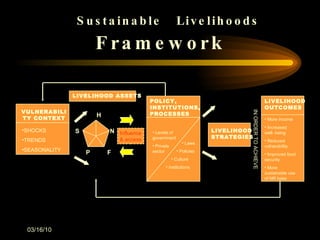
Influence & access VULNERABILITY CONTEXT SHOCKS TRENDS SEASONALITY POLICY, INSTITUTIONS, PROCESSES Levels of government Private sector Laws  Policies Culture Institutions LIVELIHOOD OUTCOMES More income  Increased  well- being Reduced vulnerability Improved food security More sustainable use of NR base H S P F N LIVELIHOOD ASSETS Framework IN ORDER TO ACHIEVE Sustainable  Livelihoods LIVELIHOOD STRATEGIES
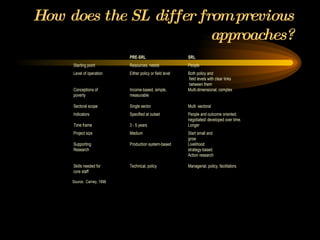
How does the SL differ from previous approaches?
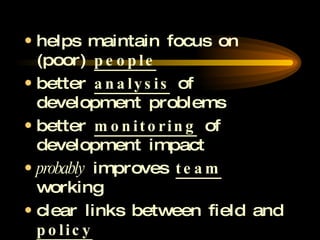
helps maintain focus on (poor)  people better  analysis  of development problems better  monitoring  of development impact probably  improves  team  working clear links between field and  policy

Sustainable Livelihoods

  • 1.
  • 2.
    Sustainable Livelihoods withingiven historical, political, cultural, economic, agro-ecological, demographic, social contexts
  • 3.
    Sustainable Livelihoodspeople develop livelihood strategies such as agricultural intensification or extensification, diversification or migration
  • 4.
    Sustainable Livelihoods thesestrategies are mediated through institutional processes and structures such as government, laws, norms, policies
  • 5.
    Sustainable Livelihoodsto deliver sustainable livelihood outcomes such as more income, increased well-being, reduced vulnerability, improved food security, more sustainable use of natural resource base
  • 6.
    Livelihood Assets Naturalcapital - The natural resource stocks from which resource flows useful to livelihood are derived (eg land, water, wildlife, biodiveristy, environmental resources).
  • 7.
    Livelihood Assets Socialcapital - The social resources (networks, membership of groups, relationships of trust, access to wider institutions of society) upon which people draw in pursuit of livelihoods.
  • 8.
    Livelihood Assets Humancapital - The skills, knowledge, ability to labour and good health important to the ability to pursue different livelihood strategies.
  • 9.
    Livelihood Assets Physicalcapital - The basic infrastructure (transport, shelter, water, energy and communications) and the production equipment and means which enable people to pursue their livelihoods.
  • 10.
    Livelihood Assets Financialcapital - The financial resources which are available to people (whether savings, supplies of credit or regular remittances or pensions) and which provide them with different livelihoods options. Adapted from Scoones, 1998.
  • 11.
    Influence & accessVULNERABILITY CONTEXT SHOCKS TRENDS SEASONALITY POLICY, INSTITUTIONS, PROCESSES Levels of government Private sector Laws Policies Culture Institutions LIVELIHOOD OUTCOMES More income Increased well- being Reduced vulnerability Improved food security More sustainable use of NR base H S P F N LIVELIHOOD ASSETS Framework IN ORDER TO ACHIEVE Sustainable Livelihoods LIVELIHOOD STRATEGIES
  • 12.
    How does theSL differ from previous approaches?
  • 13.
    helps maintain focuson (poor) people better analysis of development problems better monitoring of development impact probably improves team working clear links between field and policy

Editor's Notes

  • #2 new White Paper onInternational development increased focus onm poverty dfid department’s response - NR department has developed what was originally called a sustainable rural livelihoods approach. thinking originiated for dfid nr in conceptual frameworks used in social science research in,particularly at ids, sussexx univeriuty. development has taken place through advisory goups consisting of dfid staff and others from outside dfid, incl organisations such as oxfam which have some past experience critical point was dfid nr advisers conference and subsequent collection of papers (huge demand)
  • #12 changed to vulnerability context - includes political agroecological etc. where are the entry points ? rural strategies middle box is the policy level pentagon is the houdsehold and community level outcomes are what are monitored.