Livelihood Framework A Case of NE Upland Communities [email_address]
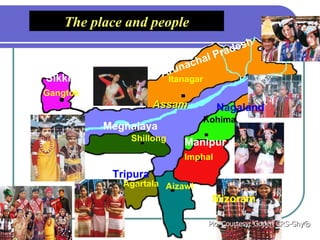
The place and people Pic. Courtesy: Gopen CRS-Ghy® Arunachal Pradesh Itanagar Assam Meghalaya Shillong Manipur Imphal Mizoram Aizawl Nagaland Kohima Tripura Agartala Sikkim Gangtok
Livelihood   Framework - Vision Every individual poor family is able to earn a decent livelihood It is an integral part of any livelihood improvement initiative – improving opportunities for the rural poor to meet their priority needs
Rural Poor  ( Upland Communities) are; Consumers   (Buyers) ( we should work towards reducing the expenditure) And   Producers  ( sellers) of goods and services (we should work towards enhancing the incomes, employment )  And most importantly towards reducing/diversifying risks in both the cases
Upland Communities  have Multiple Livelihoods Characterized by; Risks, uncertainties Low incomes, small quantities Ignorance of prices, seasonality, markets and the quality Technology gaps Indebtedness, ‘tied’ sales and purchases to credit, consumption credit needs, and input credit needs Lack of capacity to hold Missing required rural infrastructure etc.
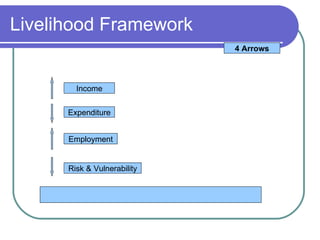
Upland Communities Focus is in Existing Livelihoods and finding new livelihood Opportunities towards Increasing the Income Decreasing the Expenditure Increasing the Employment (days), and Decreasing the risks
Livelihood of the Upland Communities Jhum Cultivation-rainfed Panikheti – wet-land agriculture NTFP (Forest) Kitchen garden Fisheries Wage Labour (hazira) Small Livestock Artisans/Semi Skilled works etc. Fisheries … have portfolios of livelihoods
Problems of Upland Communities As Consumers – small quantities, high prices, ignorance of prices, indebtedness, consumption credit needs, lack of capacity to hold, etc. As Producers - small quantities, high prices, ignorance of prices, indebtedness, consumption credit needs, lack of capacity to hold, etc.
The Premise Poor are organised/willing to be organised into affinity groups – SHGs, Village Organisations and higher order organisations for common good Poor have certain level of capacities, certain knowledge and skill-base and certain resource base. These need to be supplemented; further they might require certain hand-holding support
The Premise All sub-projects in Livelihoods are people’s projects (poor decide, plan, implement, monitor, evaluate and follow up)  as Livelihoods are theirs and the benefit of the enhancement is theirs
Livelihood Framework: Pillars Organising the poor – Social Mobilisation through Conscientisation: External Facilitation, Internal Animation = Incremental community efforts for self-reliance Knowledge & Skills (Capacity Building of poor, groups and activists) Resource Support: (including Finance, Linkages, NR & HR) Policy Support is also required
What Are Livelihoods? Ways of keeping oneself meaningfully occupied By using one’s endowments (human and material) To generate adequate resources To meet the requirements of the households In a sustainable manner Less than 10% of rural workers in India are employed regularly. Poor rural households engage in more than one activity for their livelihood
What is Livelihood Intervention? Livelihood interventions are consious efforts by an agency or an organisation to promote and support livelihood opportunities for a large number of people (other than those directly or indirectly employed by them). LIs can be in many forms and go far beyond running an IGP/IGA. Various interventions can influence the livelihoods of many people. Eg. Watershed development
Why Promote Livelihood? More than 12 million additional people seeking work every year. About 30 million unemployed or under-employed, to ensure full employment within a decade, more than 15 million new livelihoods will have to be generated annually. (Planning Commission)
Livelihood Interventions in India State: The Green revolution influenced 200 million farmers livelihood KVIC directed towards supporting 50 million rural artisans IRDP+TRYSEM was one largest livelihood interventions promoted by any State National Watershed Devt. Board changed the lives of millions of farmers living in envionmentally degraded areas.
NGO NDDB (National Dairy Development Board) – Amul enhanced livelihoods of 9+ million dairy farmers NECC (National Egg Co-ordination Committee) – changed the organisation of poultry industry in India BAIF (Bharatiya Agro Industries Foundation) – breeding and improved fodder production impacted the livelihoods of over 1 million farmers IDE (International Devt. Enterprises – enhanced 2 lakhs small & marginal farmers livelihood with foot-operated treadle pump for irrigation SIFFS -50000 fishermen (technology & Marketing) PRADHAN – 20000 farmers (Irrigation) Livelihood Interventions in India
NERCRMPUA-IFAD (Assam, Manipur & Meghalaya) NEPED (Nagaland) LIPH-IFAD/MRDS (Meghalaya)  ARIASP-WB (Assam)  Rubber Block Plantation-WB (Tripura) TAMBAC-INBAR (Manipur) INBAR (Tripura) Livelihood Interventions in NER-India
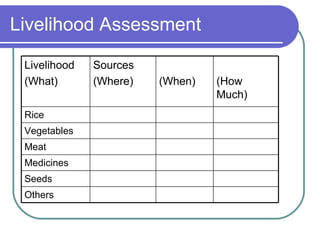
Livelihood Assessment Livelihood (What)  Sources (Where) (When) (How Much) Rice Vegetables Meat Medicines Seeds Others
Livelihood Framework 4 Arrows Income Expenditure Employment Risk & Vulnerability

Livelihoods framework : A case of NE Upland Communities

  • 1.
    Livelihood Framework ACase of NE Upland Communities [email_address]
  • 2.
    The place andpeople Pic. Courtesy: Gopen CRS-Ghy® Arunachal Pradesh Itanagar Assam Meghalaya Shillong Manipur Imphal Mizoram Aizawl Nagaland Kohima Tripura Agartala Sikkim Gangtok
  • 3.
    Livelihood Framework - Vision Every individual poor family is able to earn a decent livelihood It is an integral part of any livelihood improvement initiative – improving opportunities for the rural poor to meet their priority needs
  • 4.
    Rural Poor ( Upland Communities) are; Consumers (Buyers) ( we should work towards reducing the expenditure) And Producers ( sellers) of goods and services (we should work towards enhancing the incomes, employment ) And most importantly towards reducing/diversifying risks in both the cases
  • 5.
    Upland Communities have Multiple Livelihoods Characterized by; Risks, uncertainties Low incomes, small quantities Ignorance of prices, seasonality, markets and the quality Technology gaps Indebtedness, ‘tied’ sales and purchases to credit, consumption credit needs, and input credit needs Lack of capacity to hold Missing required rural infrastructure etc.
  • 6.
    Upland Communities Focusis in Existing Livelihoods and finding new livelihood Opportunities towards Increasing the Income Decreasing the Expenditure Increasing the Employment (days), and Decreasing the risks
  • 7.
    Livelihood of theUpland Communities Jhum Cultivation-rainfed Panikheti – wet-land agriculture NTFP (Forest) Kitchen garden Fisheries Wage Labour (hazira) Small Livestock Artisans/Semi Skilled works etc. Fisheries … have portfolios of livelihoods
  • 8.
    Problems of UplandCommunities As Consumers – small quantities, high prices, ignorance of prices, indebtedness, consumption credit needs, lack of capacity to hold, etc. As Producers - small quantities, high prices, ignorance of prices, indebtedness, consumption credit needs, lack of capacity to hold, etc.
  • 9.
    The Premise Poorare organised/willing to be organised into affinity groups – SHGs, Village Organisations and higher order organisations for common good Poor have certain level of capacities, certain knowledge and skill-base and certain resource base. These need to be supplemented; further they might require certain hand-holding support
  • 10.
    The Premise Allsub-projects in Livelihoods are people’s projects (poor decide, plan, implement, monitor, evaluate and follow up) as Livelihoods are theirs and the benefit of the enhancement is theirs
  • 11.
    Livelihood Framework: PillarsOrganising the poor – Social Mobilisation through Conscientisation: External Facilitation, Internal Animation = Incremental community efforts for self-reliance Knowledge & Skills (Capacity Building of poor, groups and activists) Resource Support: (including Finance, Linkages, NR & HR) Policy Support is also required
  • 12.
    What Are Livelihoods?Ways of keeping oneself meaningfully occupied By using one’s endowments (human and material) To generate adequate resources To meet the requirements of the households In a sustainable manner Less than 10% of rural workers in India are employed regularly. Poor rural households engage in more than one activity for their livelihood
  • 13.
    What is LivelihoodIntervention? Livelihood interventions are consious efforts by an agency or an organisation to promote and support livelihood opportunities for a large number of people (other than those directly or indirectly employed by them). LIs can be in many forms and go far beyond running an IGP/IGA. Various interventions can influence the livelihoods of many people. Eg. Watershed development
  • 14.
    Why Promote Livelihood?More than 12 million additional people seeking work every year. About 30 million unemployed or under-employed, to ensure full employment within a decade, more than 15 million new livelihoods will have to be generated annually. (Planning Commission)
  • 15.
    Livelihood Interventions inIndia State: The Green revolution influenced 200 million farmers livelihood KVIC directed towards supporting 50 million rural artisans IRDP+TRYSEM was one largest livelihood interventions promoted by any State National Watershed Devt. Board changed the lives of millions of farmers living in envionmentally degraded areas.
  • 16.
    NGO NDDB (NationalDairy Development Board) – Amul enhanced livelihoods of 9+ million dairy farmers NECC (National Egg Co-ordination Committee) – changed the organisation of poultry industry in India BAIF (Bharatiya Agro Industries Foundation) – breeding and improved fodder production impacted the livelihoods of over 1 million farmers IDE (International Devt. Enterprises – enhanced 2 lakhs small & marginal farmers livelihood with foot-operated treadle pump for irrigation SIFFS -50000 fishermen (technology & Marketing) PRADHAN – 20000 farmers (Irrigation) Livelihood Interventions in India
  • 17.
    NERCRMPUA-IFAD (Assam, Manipur& Meghalaya) NEPED (Nagaland) LIPH-IFAD/MRDS (Meghalaya) ARIASP-WB (Assam) Rubber Block Plantation-WB (Tripura) TAMBAC-INBAR (Manipur) INBAR (Tripura) Livelihood Interventions in NER-India
  • 18.
    Livelihood Assessment Livelihood(What) Sources (Where) (When) (How Much) Rice Vegetables Meat Medicines Seeds Others
  • 19.
    Livelihood Framework 4Arrows Income Expenditure Employment Risk & Vulnerability