
Sustainable Livelihood
Framework and Asset
Pentagon
 Prepared by:
Shawkat Ara
 Acknowledgement:
(This is not an original production. It was developed with the purpose of my own study which I thought might be
useful for other students to get a quick idea on this topic. )
https://www.soas.ac.uk/cedep-demos/000_P528_RF_K3736-Demo/unit1/page_22.htm
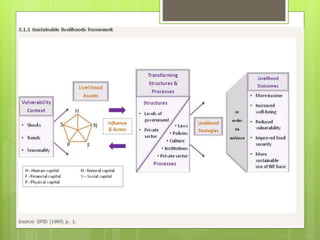
The sustainable livelihoods
framework
 An effort to conceptualize livelihoods in a holistic way
 Capturing many complexities of livelihoods, and
constraints & opportunities that they are subjected to.
 Constraints and opportunities are shaped by numerous
factors:
 global or national level trends and structures over which
individuals have no control, and may not even be aware
of,
 more local norms and institutions
 finally, the assets to which households or individual has
direct access.
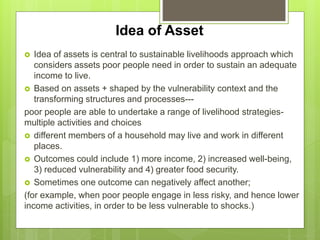
Idea of Asset
 Idea of assets is central to sustainable livelihoods approach which
considers assets poor people need in order to sustain an adequate
income to live.
 Based on assets + shaped by the vulnerability context and
transforming structures and processes---
 poor people are able to undertake a range of livelihood strategies-
multiple activities and choices
 different members of a household may live and work in different
places.
 Outcomes of strategies could include 1) more income, 2) increased
well-being, 3) reduced vulnerability and 4) greater food security.
 Sometimes one outcome can negatively affect another;
(example, in order to be less vulnerable to shocks poor people
sometimess engage in less risky, and hence lower income activities,.)
Asset Pentagon
Human capital:
skills, knowledge, ability to work and good health.
Good health is not simply a means to earning a livelihood. It has an
intrinsic value. it is of course an end in itself.
Social capital:
social resources to make a living (ex: relationships with either more
powerful people-vertical connections or with others like themselves-
horizontal connections, or membership of groups or organizations.
Generally relationships of trust, reciprocity and exchange that people
can draw on in times of need, and that lower the costs of working
productively together.
Social capital has an intrinsic value too; good social relationships are
not simply a means, they are an end in themselves.
Asset Pentagon (contd.)
Natural capital:
natural resource stocks to make livelihoods
Ex: Forests, water, air and so on.
 Physical capital:
basic infrastructure that people need to make a living, as
well as the tools and equipment that they use.
(Ex: Transport and communication systems, shelter,
water and sanitation systems, and energy.)
 Financial capital:
Any form of savings, access to financial services, and
regular inflows of money.
Impact of Assets
 The more the assets, the less the vulnerability to trends,
shocks and seasonality
 The more the assets, the more secure is their livelihood.
 Increasing one type of capital leads to an increase in other
amounts of capital, (ex. as people become educated-
increase in human capital, they may get a better job which
earns more money-increase in financial capital, which in
turn means that they are able to upgrade their home and
facilities-increase in physical capital.
 Sometimes, one form of capital decreases as another
increases. Ex: where a person or household sells their land
to migrate to a city.
 So, shape of pentagon can be distorted or uniform based on
amount of capitals.
Criticism of SLF and asset
pentagon
 Criticized by development practitioners
---for focusing too much on micro-level and
---neglecting 'higher' levels of governance, policy environment,
national and global economic growth and so on.
 limited understanding of how markets work; how processes
(far from the lives of poor people nonetheless) have an
enormous impact on existing possibilities to earn a secure
income.
 Linkage between capitals and wider environment ignored.
The latter has an effect on access to assets and on what
can be achieved with that.
Criticism of SLF and asset
pentagon-contd.
 Criticized for failing to take power dynamics into
consideration, as it relates to gender, for example.
 Social networks can be both inclusive and exclusive,
with often the weakest and most vulnerable excluded.
 They also often involve hierarchical and coercive
relationships that limit options for those at the lower
levels, and
 Even when relationships are more horizontal than
vertical, the obligations that reciprocal relationships
involve can be onerous.
Thanks for watching 

Sustainable livelihood framework and asset pentagon

  • 1.
  • 2.
     Prepared by: ShawkatAra  Acknowledgement: (This is not an original production. It was developed with the purpose of my own study which I thought might be useful for other students to get a quick idea on this topic. ) https://www.soas.ac.uk/cedep-demos/000_P528_RF_K3736-Demo/unit1/page_22.htm
  • 3.
    The sustainable livelihoods framework An effort to conceptualize livelihoods in a holistic way  Capturing many complexities of livelihoods, and constraints & opportunities that they are subjected to.  Constraints and opportunities are shaped by numerous factors:  global or national level trends and structures over which individuals have no control, and may not even be aware of,  more local norms and institutions  finally, the assets to which households or individual has direct access.
  • 5.
    Idea of Asset Idea of assets is central to sustainable livelihoods approach which considers assets poor people need in order to sustain an adequate income to live.  Based on assets + shaped by the vulnerability context and transforming structures and processes---  poor people are able to undertake a range of livelihood strategies- multiple activities and choices  different members of a household may live and work in different places.  Outcomes of strategies could include 1) more income, 2) increased well-being, 3) reduced vulnerability and 4) greater food security.  Sometimes one outcome can negatively affect another; (example, in order to be less vulnerable to shocks poor people sometimess engage in less risky, and hence lower income activities,.)
  • 6.
    Asset Pentagon Human capital: skills,knowledge, ability to work and good health. Good health is not simply a means to earning a livelihood. It has an intrinsic value. it is of course an end in itself. Social capital: social resources to make a living (ex: relationships with either more powerful people-vertical connections or with others like themselves- horizontal connections, or membership of groups or organizations. Generally relationships of trust, reciprocity and exchange that people can draw on in times of need, and that lower the costs of working productively together. Social capital has an intrinsic value too; good social relationships are not simply a means, they are an end in themselves.
  • 7.
    Asset Pentagon (contd.) Naturalcapital: natural resource stocks to make livelihoods Ex: Forests, water, air and so on.  Physical capital: basic infrastructure that people need to make a living, as well as the tools and equipment that they use. (Ex: Transport and communication systems, shelter, water and sanitation systems, and energy.)  Financial capital: Any form of savings, access to financial services, and regular inflows of money.
  • 8.
    Impact of Assets The more the assets, the less the vulnerability to trends, shocks and seasonality  The more the assets, the more secure is their livelihood.  Increasing one type of capital leads to an increase in other amounts of capital, (ex. as people become educated- increase in human capital, they may get a better job which earns more money-increase in financial capital, which in turn means that they are able to upgrade their home and facilities-increase in physical capital.  Sometimes, one form of capital decreases as another increases. Ex: where a person or household sells their land to migrate to a city.  So, shape of pentagon can be distorted or uniform based on amount of capitals.
  • 9.
    Criticism of SLFand asset pentagon  Criticized by development practitioners ---for focusing too much on micro-level and ---neglecting 'higher' levels of governance, policy environment, national and global economic growth and so on.  limited understanding of how markets work; how processes (far from the lives of poor people nonetheless) have an enormous impact on existing possibilities to earn a secure income.  Linkage between capitals and wider environment ignored. The latter has an effect on access to assets and on what can be achieved with that.
  • 10.
    Criticism of SLFand asset pentagon-contd.  Criticized for failing to take power dynamics into consideration, as it relates to gender, for example.  Social networks can be both inclusive and exclusive, with often the weakest and most vulnerable excluded.  They also often involve hierarchical and coercive relationships that limit options for those at the lower levels, and  Even when relationships are more horizontal than vertical, the obligations that reciprocal relationships involve can be onerous.
  • 11.