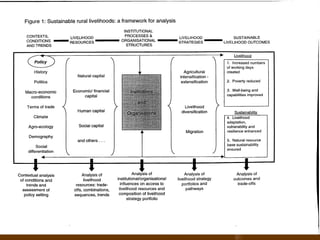
The Sustainable Livelihoods Framework It’s  ONE WAY  of “organising” the  complex  issues surrounding  POVERTY It’s  NOT  the  ONLY WAY It   needs to be : Modified Adapted Made  appropriate  to  local circumstances Made  appropriate  to  local priorities
Livelihood   -  Definitions The definition used by Department of Foreign and International Development (DFID)  incorporates these sentiments 'A livelihood comprises the capabilities, assets (including both material and social resources) and activities required for a means of living. A livelihood is sustainable when it can cope with and recover from stresses and shocks and maintain or enhance its capabilities and assets both now and in the future, while not undermining the natural resource base' (Chambers, R. and G. Conway, 1992). The United Nations Development Program (UNDP) differentiates between a job  and a livelihood, which are often used interchangeably . Jobs "A job connotes one particular activity or trade that is performed in exchange for payment. It is also a formal agreement, as manifested by a contract, between an employer and employee...... . A job can, however, comprise part of an overall livelihood, but does so only to complement other aspects of a livelihood portfolio. Livelihoods "A livelihood, on the other hand, is engagement in a number of activities which, at times, neither require a formal agreement nor are limited to a particular trade. Livelihoods may or may not involve money. Jobs invariably do. Livelihoods are self-directing. .... Livelihoods are based on income derived from "jobs", but also on incomes derived from assets and entitlements. " "a means of living or of supporting life and meeting individual and community needs"
Livelihood "A livelihood, on the other hand, is engagement in a number of activities which, at times, neither require a formal agreement nor are limited to a particular trade. Livelihoods may or may not involve money. Jobs invariably do. Livelihoods are self-directing. .... . Livelihoods are based on income derived from "jobs", but also on incomes derived from assets and entitlements. "   Job "A job connotes one particular activity or trade that is performed in exchange for payment. It is also a formal agreement, as manifested by a contract, between an employer and employee...... . A job can, however, comprise part of an overall livelihood, but does so only to complement other aspects of a livelihood portfolio. Livelihood  &  Job
Principles People-centred : beginning by understanding peoples’ priorities and livelihood strategies. Responsive and participatory : responding to the expressed priorities of poor people. Multi-level:  ensuring micro-level realities inform macro-level institutions and processes. Conducted in partnership:  working with public, private and civil society actors. Sustainable:  environmentally, economically, institutionally, and socially. Dynamic:  ensuring support is flexible and process-oriented, responding to changing livelihoods. Holistic:  reflecting the integrated nature ofpeople’s lives and diverse strategies. Building on strengths:  while addressing vulnerabilities .
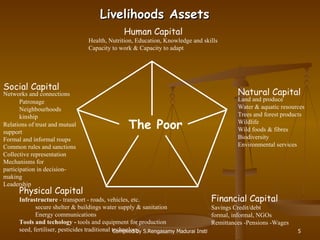
Livelihoods Assets Financial Capital S avings Credit/debt   formal, informal, NGOs Remittances -Pensions - Wages Natural  Capital Land and produce Water  & aquatic resources Trees and forest products Wildlife Wild foods & fibres Biodiversity Env ironmental  services Social Capital Networks and connections Patronage Neighbourhoods kinship Relations of trust and mutual support Formal and informal roups Common rules and sanctions Collective representation Mechanisms for participation in decision-making Leadership Physical Capital Infrastructure  - transport  - roads, vehicles, etc. secure shelter & buildings water supply & sanitation Energy communications Tools and techology -  tools and equipment for production s eed , fertiliser, pesticides traditional technology Human  Capital Health, Nutrition, Education, Knowledge and skills Capacity to work & Capacity to adapt The Poor
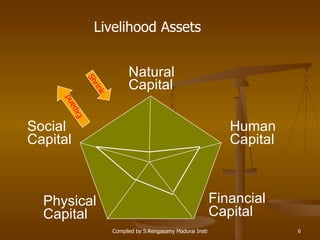
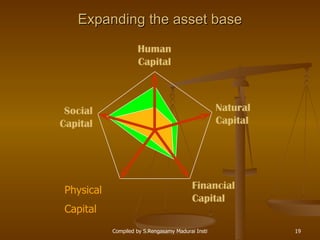
Financial   Capital Human Capital Social  Capital Physical  Capital Livelihood Assets  Natural Capital Shrink Expand
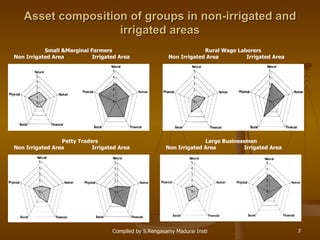
Asset composition of groups in non-irrigated and irrigated areas Small &Marginal Farmers  Non Irrigated Area  Irrigated Area Rural Wage Laborers  Non Irrigated Area  Irrigated Area Petty Traders Non Irrigated Area  Irrigated Area Large Businessmen  Non Irrigated Area  Irrigated Area
The Asset Mix D ifferent households  with  different access to  livelihood  “assets/capital” Livelihoods affected by: diversity  of assets amount of assets   balance  between assets
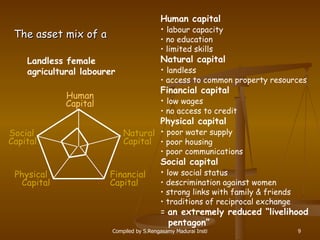
The asset mix of a   Human capital labour capacity no  education limited skills Natural capital landless access to common property resources Financial capital low wages no access to credit Physical capital poor water supply poor housing poor communications Social capital low social status descrimination against women strong links with family & friends traditions of reciprocal exchange =  an  extremely reduced “livelihood pentagon” Landless female agricultural  labourer Financial  Capital Social  Capital Physical  Capital Human  Capital Natural   Capital
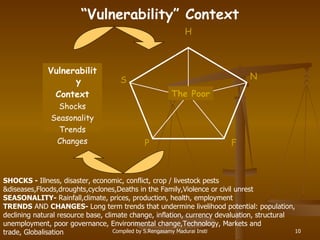
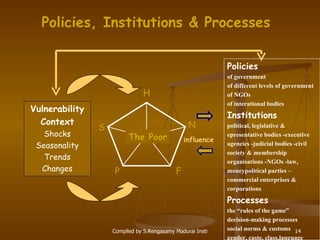
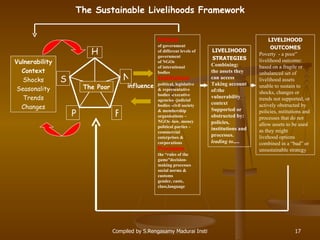
“ Vulnerability” Context SHOCKS -  Illness, disaster, economic, conflict, crop / livestock pests &diseases, Floods,droughts,cyclones,Deaths in the Family,Violence or civil unrest SEASONALITY-  Rainfall,climate,   prices, production, health, employment TRENDS  AND  CHANGES-  L ong term trends that undermine livelihood potential:  population,  declining natural  resource  base ,  climate change, inflation ,  currency devaluation, structural  unemployment, poor  governance,  Environmental change,Technology, Markets and  trade, Globalisation Vulnerability Context Shocks Seasonality Trends Changes F P H N S The Poor
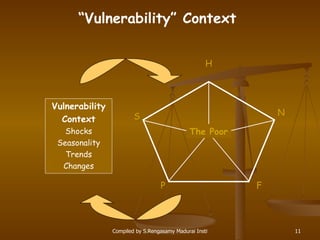
Vulnerability Context Shocks Seasonality Trends Changes “ Vulnerability” Context F P H N S The Poor F P H N S The Poor Vulnerability Context Shocks Seasonality Trends Changes
Understanding vulnerability Moser characterizes vulnerability as insecurity in the well being of individuals, households or communities in the face of a changing environment Because people move in and out of poverty the concept of vulnerability better captures processes of change that poverty line measures Understanding vulnerability Chambers observes that vulnerability has two sides An external side of risks, shocks and stress An internal side of defenselessness due to lack of means to cope with damaging loss
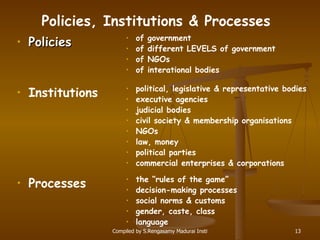
Policies, Institutions & Processes Policies of government of different LEVELS of government of NGOs of interational bodies Institutions Processes political, legislative & representative bodies executive agencies judicial bodies civil society & membership organisations NGOs law, money political parties commercial enterprises & corporations the “rules of the game” decision-making processes social norms & customs gender, caste, class language
Policies of government of different levels of government of NGOs of interational bodies Institutions political, legislative &  epresentative bodies -executive  agencies -judicial bodies -civil  society & membership  organisations -NGOs -law,  moneypolitical parties – commercial enterprises &  corporations Processes the “rules of the game” decision-making processes social norms & customs gender, caste, class,language influence Policies, Institutions & Processes F P H N S The Poor Vulnerability Context Shocks Seasonality Trends Changes
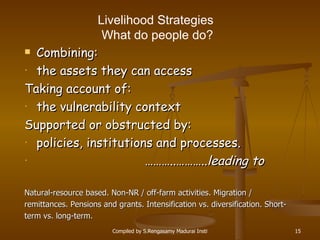
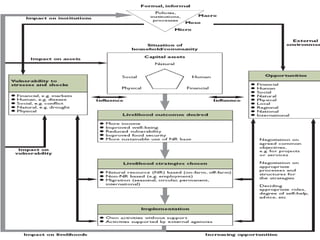
Livelihood Strategies  W hat do people do? Combining: the assets they can access Taking account of: the vulnerability context Supported or obstructed by: policies, institutions and processes . ……… ..……….. leading to Natural-resource based. Non-NR / off-farm activities. Migration /  remittances.  Pensions and grants.  Intensification vs. diversification. Short- term vs. long-term.
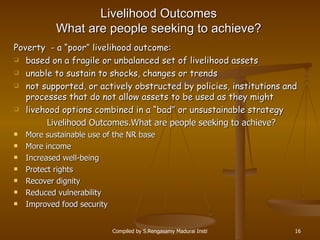
Livelihood Outcomes W hat are people seeking to achieve? Poverty  -  a “poor” livelihood outcome : based on a fragile or unbalanced set of livelihood assets unable to sustain to shocks, changes or trends not supported, or actively obstructed by policies, institutions and processes that  do not allow assets to be used as they might livehood options combined in a “bad” or unsustainable strategy Livelihood Outcomes. W hat are people seeking to achieve? More sustainable use of the NR base More income Increased well-being Protect rights Recover dignity Reduced vulnerability Improved food security
The Sustainable Livelihoods Framework LIVELIHOOD STRATEGIES Combining: the assets they  can access Taking account  of:the  vulnerability  context Supported or  obstructed by: policies,  institutions and  processes .   leading to..... Policies of government of different levels of  government of NGOs of interational  bodies Institutions political, legislative  & representative  bodies -executive  agencies -judicial  bodies -civil society  & membership  organisations – NGOs -law, money political parties – commercial  enterprises &  corporations Processes the “rules of the  game”decision- making processes social norms &  customs gender, caste,  class,language N Vulnerability Context Shocks Seasonality Trends Changes influence LIVELIHOOD OUTCOMES Poverty  -  a poor”  livelihood outcome : based on a fragile or  unbalanced set of  livelihood assets unable to sustain to  shocks, changes or  trends not supported, or  actively obstructed by  policies, nstitutions and  processes that  do not  allow assets to be used  as they might livehood options  combined in a “bad” or  unsustainable strategy S F P H The Poor
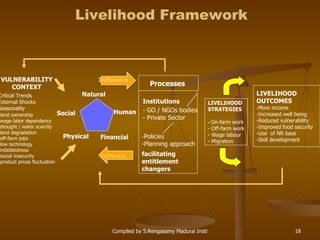
LIVELIHOOD OUTCOMES - More income -Increased well being -Reduced vulnerability -Improved food security -Use  of NR base -Skill development LIVELIHOOD STRATEGIES -  On-farm work - Off-farm work - Wage labour  - Migration Influence VULNERABILITY CONTEXT Institutions - GO / NGOs bodies - Private Sector - Policies -Planning approach facilitating entitlement changers   Human Physical Financial Natural Social Processes Livelihood Framework Critical Trends External Shocks Seasonality - land ownership -wage labor dependency -drought / water scarcity -land degradation -off-farm jobs -low technology -indebtedness -social insecurity -product prices fluctuation Influence
Expanding the asset base Physical  Capital Human Capital Natural Capital Social Capital Financial Capital
Scoones
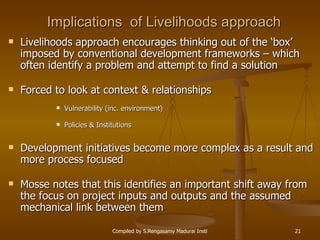
Implications   of  Livelihoods approach Livelihoods approach encourages thinking out of the ‘box’ imposed by conventional development frameworks – which often identify a problem and attempt to find a solution Forced to look at context & relationships Vulnerability (inc. environment) Policies & Institutions Development initiatives become  more  complex as a result and more process focused Mosse notes that this identifies an important shift away from the focus on project inputs and outputs and the assumed mechanical link between them
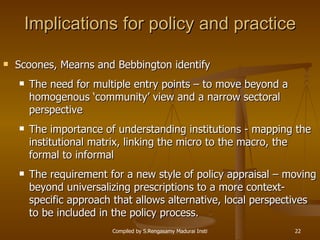
Implications for policy and practice Scoones, Mearns and Bebbington identify The need for multiple entry points – to move beyond a homogenous ‘community’ view and a narrow sectoral perspective The importance of understanding institutions - mapping the institutional matrix, linking the micro to the macro, the formal to informal The requirement for a new style of policy appraisal – moving beyond universalizing prescriptions to a more context-specific approach that allows alternative, local perspectives to be included in the policy process.
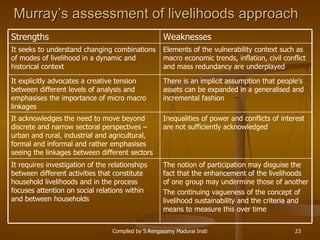
Murray’s assessment of livelihoods approach Inequalities of power and conflicts of interest are not sufficiently acknowledged   It acknowledges the need to move beyond discrete and narrow sectoral perspectives – urban and rural, industrial and agricultural, formal and informal and rather emphasises seeing the linkages between different sectors  The notion of participation may disguise the fact that the enhancement of the livelihoods of one group may undermine those of another   The continuing vagueness of the concept of livelihood sustainability and the criteria and means to measure this over time   It requires investigation of the relationships between different activities that constitute household livelihoods and in the process focuses attention on social relations within and between households  There is an implicit assumption that people’s assets can be expanded in a generalised and incremental fashion   It explicitly advocates a creative tension between different levels of analysis and emphasises the importance of micro macro linkages   Weaknesses Strengths Elements of the vulnerability context such as macro economic trends, inflation, civil conflict and mass redundancy are underplayed   It seeks to understand changing combinations of modes of livelihood in a dynamic and historical context
Social capital - issues Much debate centers on the concept of social capital – one of the key terms in the development lexicon and the missing link in development ‘the glue that holds society together’ Concept attributed to Putnam who identified three elements of social relations Interpersonal trust, networks and shared norms Where these elements function well they enable people to act together more effectively, make decisions, formulate policy and gain access to power and resources Proposed that the major obstacle of economic and social development in the ‘third world’ is ineffective institutions For a discussion of social capital and associational life in S.Africa (See Tapscott: 2001)  Key critiques of Putnam’s approach are that it Devalues political civil society – concentrates on ‘apolitical’ institutions Romanticizes associational life Deterministic – “path dependent development” – you either have social capital or you don’t. A repackaging of what social scientists have studied for years with new terms For Harriss and Fine,  social capital equals “Bankspeak”, a term designed to neutralize and obscure problems and relations of power Counterpoints Hilary argues that the concept of social capital exposes the limitations of conventional economic approaches for understanding economic and social processes
 
 
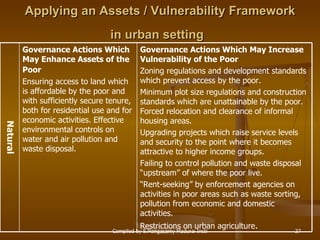
Applying an Assets / Vulnerability Framework in urban setting   Natural Governance Actions Which May Increase Vulnerability of the Poor Zoning regulations and development standards which prevent access by the poor.  Minimum plot size regulations and construction standards which are unattainable by the poor. Forced relocation and clearance of informal housing areas.  Upgrading projects which raise service levels and security to the point where it becomes attractive to higher income groups. Failing to control pollution and waste disposal “upstream” of where the poor live. “ Rent-seeking” by enforcement agencies on activities in poor areas such as waste sorting, pollution from economic and domestic activities.  Restrictions on urban agriculture . Governance Actions Which May Enhance Assets of the Poor   Ensuring access to land which is affordable by the poor and with sufficiently secure tenure, both for residential use and for economic activities. Effective environmental controls on water and air pollution and waste disposal.
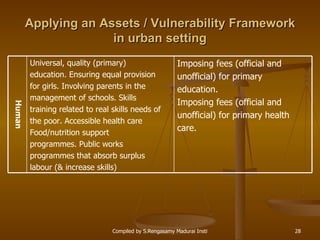
Applying an Assets / Vulnerability Framework in urban setting Human Imposing fees (official and  unofficial) for primary  education. Imposing fees (official and  unofficial) for primary health  care.  Universal, quality (primary)  education. Ensuring equal provision  for girls. Involving parents in the  management of schools. Skills  training related to real skills needs of  the poor. Accessible health care Food/nutrition support  programmes. Public works  programmes that absorb surplus  labour (& increase skills)
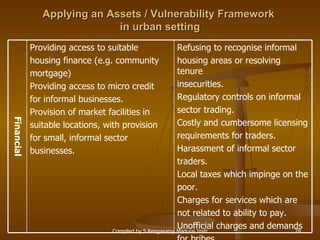
Applying an Assets / Vulnerability Framework  in urban setting Financial Refusing to recognise informal  housing areas or resolving tenure  insecurities. Regulatory controls on informal  sector trading. Costly and cumbersome licensing  requirements for traders. Harassment of informal sector  traders. Local taxes which impinge on the  poor. Charges for services which are  not related to ability to pay. Unofficial charges and demands  for bribes  Providing access to suitable  housing finance (e.g. community  mortgage) Providing access to micro credit  for informal businesses. Provision of market facilities in  suitable locations, with provision  for small, informal sector  businesses.
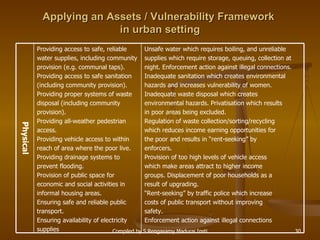
Applying an Assets / Vulnerability Framework  in urban setting Physical Unsafe water which requires boiling, and unreliable  supplies which require storage, queuing, collection at  night. Enforcement action against illegal connections. Inadequate sanitation which creates environmental  hazards and increases vulnerability of women. Inadequate waste disposal which creates  environmental hazards. Privatisation which results  in poor areas being excluded. Regulation of waste collection/sorting/recycling  which reduces income earning opportunities for  the poor and results in “rent-seeking” by  enforcers. Provision of too high levels of vehicle access  which make areas attract to higher income  groups. Displacement of poor households as a  result of upgrading. “ Rent-seeking” by traffic police which increase  costs of public transport without improving  safety. Enforcement action against illegal connections  Providing access to safe, reliable  water supplies, including community  provision (e.g. communal taps). Providing access to safe sanitation  (including community provision). Providing proper systems of waste  disposal (including community  provision). Providing all-weather pedestrian  access. Providing vehicle access to within  reach of area where the poor live. Providing drainage systems to  prevent flooding. Provision of public space for  economic and social activities in  informal housing areas. Ensuring safe and reliable public  transport. Ensuring availability of electricity  supplies
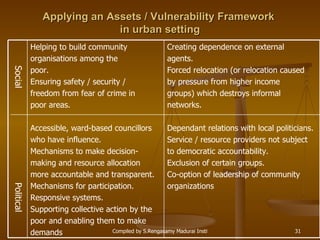
Applying an Assets / Vulnerability Framework  in urban setting Social  Political Creating dependence on external  agents. Forced relocation (or relocation caused  by pressure from higher income  groups) which destroys informal  networks. Dependant relations with local politicians. Service / resource providers not subject  to democratic accountability. Exclusion of certain groups. Co-option of leadership of community  organizations  Helping to build community  organisations among the  poor. Ensuring safety / security /  freedom from fear of crime in  poor areas.  Accessible, ward-based councillors  who have influence. Mechanisms to make decision- making and resource allocation  more accountable and transparent. Mechanisms for participation. Responsive systems. Supporting collective action by the  poor and enabling them to make  demands
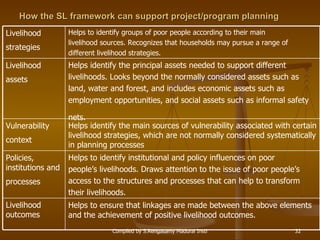
How the SL framework can support project/program planning Helps to ensure that linkages are made between the above elements and the achievement of positive livelihood outcomes.  Livelihood outcomes  Helps to identify institutional and policy influences on poor  people’s livelihoods. Draws attention to the issue of poor people’s  access to the structures and processes that can help to transform  their livelihoods.  Policies, institutions and processes   Helps identify the main sources of vulnerability associated with certain livelihood strategies, which are not normally considered systematically in planning processes  Vulnerability context   Helps identify the principal assets needed to support different  livelihoods. Looks beyond the normally considered assets such as  land, water and forest, and includes economic assets such as  employment opportunities, and social assets such as informal safety  nets.   Livelihood assets   Helps to identify groups of poor people according to their main  livelihood sources. Recognizes that households may pursue a range of  different livelihood strategies.  Livelihood strategies

Sustainable Livelihood Framework SR

  • 1.
    The Sustainable LivelihoodsFramework It’s ONE WAY of “organising” the complex issues surrounding POVERTY It’s NOT the ONLY WAY It needs to be : Modified Adapted Made appropriate to local circumstances Made appropriate to local priorities
  • 2.
    Livelihood - Definitions The definition used by Department of Foreign and International Development (DFID) incorporates these sentiments 'A livelihood comprises the capabilities, assets (including both material and social resources) and activities required for a means of living. A livelihood is sustainable when it can cope with and recover from stresses and shocks and maintain or enhance its capabilities and assets both now and in the future, while not undermining the natural resource base' (Chambers, R. and G. Conway, 1992). The United Nations Development Program (UNDP) differentiates between a job and a livelihood, which are often used interchangeably . Jobs "A job connotes one particular activity or trade that is performed in exchange for payment. It is also a formal agreement, as manifested by a contract, between an employer and employee...... . A job can, however, comprise part of an overall livelihood, but does so only to complement other aspects of a livelihood portfolio. Livelihoods "A livelihood, on the other hand, is engagement in a number of activities which, at times, neither require a formal agreement nor are limited to a particular trade. Livelihoods may or may not involve money. Jobs invariably do. Livelihoods are self-directing. .... Livelihoods are based on income derived from "jobs", but also on incomes derived from assets and entitlements. " "a means of living or of supporting life and meeting individual and community needs"
  • 3.
    Livelihood "A livelihood,on the other hand, is engagement in a number of activities which, at times, neither require a formal agreement nor are limited to a particular trade. Livelihoods may or may not involve money. Jobs invariably do. Livelihoods are self-directing. .... . Livelihoods are based on income derived from "jobs", but also on incomes derived from assets and entitlements. " Job "A job connotes one particular activity or trade that is performed in exchange for payment. It is also a formal agreement, as manifested by a contract, between an employer and employee...... . A job can, however, comprise part of an overall livelihood, but does so only to complement other aspects of a livelihood portfolio. Livelihood & Job
  • 4.
    Principles People-centred :beginning by understanding peoples’ priorities and livelihood strategies. Responsive and participatory : responding to the expressed priorities of poor people. Multi-level: ensuring micro-level realities inform macro-level institutions and processes. Conducted in partnership: working with public, private and civil society actors. Sustainable: environmentally, economically, institutionally, and socially. Dynamic: ensuring support is flexible and process-oriented, responding to changing livelihoods. Holistic: reflecting the integrated nature ofpeople’s lives and diverse strategies. Building on strengths: while addressing vulnerabilities .
  • 5.
    Livelihoods Assets FinancialCapital S avings Credit/debt formal, informal, NGOs Remittances -Pensions - Wages Natural Capital Land and produce Water & aquatic resources Trees and forest products Wildlife Wild foods & fibres Biodiversity Env ironmental services Social Capital Networks and connections Patronage Neighbourhoods kinship Relations of trust and mutual support Formal and informal roups Common rules and sanctions Collective representation Mechanisms for participation in decision-making Leadership Physical Capital Infrastructure - transport - roads, vehicles, etc. secure shelter & buildings water supply & sanitation Energy communications Tools and techology - tools and equipment for production s eed , fertiliser, pesticides traditional technology Human Capital Health, Nutrition, Education, Knowledge and skills Capacity to work & Capacity to adapt The Poor
  • 6.
    Financial Capital Human Capital Social Capital Physical Capital Livelihood Assets Natural Capital Shrink Expand
  • 7.
    Asset composition ofgroups in non-irrigated and irrigated areas Small &Marginal Farmers Non Irrigated Area Irrigated Area Rural Wage Laborers Non Irrigated Area Irrigated Area Petty Traders Non Irrigated Area Irrigated Area Large Businessmen Non Irrigated Area Irrigated Area
  • 8.
    The Asset MixD ifferent households with different access to livelihood “assets/capital” Livelihoods affected by: diversity of assets amount of assets balance between assets
  • 9.
    The asset mixof a Human capital labour capacity no education limited skills Natural capital landless access to common property resources Financial capital low wages no access to credit Physical capital poor water supply poor housing poor communications Social capital low social status descrimination against women strong links with family & friends traditions of reciprocal exchange = an extremely reduced “livelihood pentagon” Landless female agricultural labourer Financial Capital Social Capital Physical Capital Human Capital Natural Capital
  • 10.
    “ Vulnerability” ContextSHOCKS - Illness, disaster, economic, conflict, crop / livestock pests &diseases, Floods,droughts,cyclones,Deaths in the Family,Violence or civil unrest SEASONALITY- Rainfall,climate, prices, production, health, employment TRENDS AND CHANGES- L ong term trends that undermine livelihood potential: population, declining natural resource base , climate change, inflation , currency devaluation, structural unemployment, poor governance, Environmental change,Technology, Markets and trade, Globalisation Vulnerability Context Shocks Seasonality Trends Changes F P H N S The Poor
  • 11.
    Vulnerability Context ShocksSeasonality Trends Changes “ Vulnerability” Context F P H N S The Poor F P H N S The Poor Vulnerability Context Shocks Seasonality Trends Changes
  • 12.
    Understanding vulnerability Mosercharacterizes vulnerability as insecurity in the well being of individuals, households or communities in the face of a changing environment Because people move in and out of poverty the concept of vulnerability better captures processes of change that poverty line measures Understanding vulnerability Chambers observes that vulnerability has two sides An external side of risks, shocks and stress An internal side of defenselessness due to lack of means to cope with damaging loss
  • 13.
    Policies, Institutions &Processes Policies of government of different LEVELS of government of NGOs of interational bodies Institutions Processes political, legislative & representative bodies executive agencies judicial bodies civil society & membership organisations NGOs law, money political parties commercial enterprises & corporations the “rules of the game” decision-making processes social norms & customs gender, caste, class language
  • 14.
    Policies of governmentof different levels of government of NGOs of interational bodies Institutions political, legislative & epresentative bodies -executive agencies -judicial bodies -civil society & membership organisations -NGOs -law, moneypolitical parties – commercial enterprises & corporations Processes the “rules of the game” decision-making processes social norms & customs gender, caste, class,language influence Policies, Institutions & Processes F P H N S The Poor Vulnerability Context Shocks Seasonality Trends Changes
  • 15.
    Livelihood Strategies W hat do people do? Combining: the assets they can access Taking account of: the vulnerability context Supported or obstructed by: policies, institutions and processes . ……… ..……….. leading to Natural-resource based. Non-NR / off-farm activities. Migration / remittances. Pensions and grants. Intensification vs. diversification. Short- term vs. long-term.
  • 16.
    Livelihood Outcomes What are people seeking to achieve? Poverty - a “poor” livelihood outcome : based on a fragile or unbalanced set of livelihood assets unable to sustain to shocks, changes or trends not supported, or actively obstructed by policies, institutions and processes that do not allow assets to be used as they might livehood options combined in a “bad” or unsustainable strategy Livelihood Outcomes. W hat are people seeking to achieve? More sustainable use of the NR base More income Increased well-being Protect rights Recover dignity Reduced vulnerability Improved food security
  • 17.
    The Sustainable LivelihoodsFramework LIVELIHOOD STRATEGIES Combining: the assets they can access Taking account of:the vulnerability context Supported or obstructed by: policies, institutions and processes . leading to..... Policies of government of different levels of government of NGOs of interational bodies Institutions political, legislative & representative bodies -executive agencies -judicial bodies -civil society & membership organisations – NGOs -law, money political parties – commercial enterprises & corporations Processes the “rules of the game”decision- making processes social norms & customs gender, caste, class,language N Vulnerability Context Shocks Seasonality Trends Changes influence LIVELIHOOD OUTCOMES Poverty - a poor” livelihood outcome : based on a fragile or unbalanced set of livelihood assets unable to sustain to shocks, changes or trends not supported, or actively obstructed by policies, nstitutions and processes that do not allow assets to be used as they might livehood options combined in a “bad” or unsustainable strategy S F P H The Poor
  • 18.
    LIVELIHOOD OUTCOMES -More income -Increased well being -Reduced vulnerability -Improved food security -Use of NR base -Skill development LIVELIHOOD STRATEGIES - On-farm work - Off-farm work - Wage labour - Migration Influence VULNERABILITY CONTEXT Institutions - GO / NGOs bodies - Private Sector - Policies -Planning approach facilitating entitlement changers Human Physical Financial Natural Social Processes Livelihood Framework Critical Trends External Shocks Seasonality - land ownership -wage labor dependency -drought / water scarcity -land degradation -off-farm jobs -low technology -indebtedness -social insecurity -product prices fluctuation Influence
  • 19.
    Expanding the assetbase Physical Capital Human Capital Natural Capital Social Capital Financial Capital
  • 20.
  • 21.
    Implications of Livelihoods approach Livelihoods approach encourages thinking out of the ‘box’ imposed by conventional development frameworks – which often identify a problem and attempt to find a solution Forced to look at context & relationships Vulnerability (inc. environment) Policies & Institutions Development initiatives become more complex as a result and more process focused Mosse notes that this identifies an important shift away from the focus on project inputs and outputs and the assumed mechanical link between them
  • 22.
    Implications for policyand practice Scoones, Mearns and Bebbington identify The need for multiple entry points – to move beyond a homogenous ‘community’ view and a narrow sectoral perspective The importance of understanding institutions - mapping the institutional matrix, linking the micro to the macro, the formal to informal The requirement for a new style of policy appraisal – moving beyond universalizing prescriptions to a more context-specific approach that allows alternative, local perspectives to be included in the policy process.
  • 23.
    Murray’s assessment oflivelihoods approach Inequalities of power and conflicts of interest are not sufficiently acknowledged It acknowledges the need to move beyond discrete and narrow sectoral perspectives – urban and rural, industrial and agricultural, formal and informal and rather emphasises seeing the linkages between different sectors The notion of participation may disguise the fact that the enhancement of the livelihoods of one group may undermine those of another The continuing vagueness of the concept of livelihood sustainability and the criteria and means to measure this over time It requires investigation of the relationships between different activities that constitute household livelihoods and in the process focuses attention on social relations within and between households There is an implicit assumption that people’s assets can be expanded in a generalised and incremental fashion It explicitly advocates a creative tension between different levels of analysis and emphasises the importance of micro macro linkages Weaknesses Strengths Elements of the vulnerability context such as macro economic trends, inflation, civil conflict and mass redundancy are underplayed It seeks to understand changing combinations of modes of livelihood in a dynamic and historical context
  • 24.
    Social capital -issues Much debate centers on the concept of social capital – one of the key terms in the development lexicon and the missing link in development ‘the glue that holds society together’ Concept attributed to Putnam who identified three elements of social relations Interpersonal trust, networks and shared norms Where these elements function well they enable people to act together more effectively, make decisions, formulate policy and gain access to power and resources Proposed that the major obstacle of economic and social development in the ‘third world’ is ineffective institutions For a discussion of social capital and associational life in S.Africa (See Tapscott: 2001) Key critiques of Putnam’s approach are that it Devalues political civil society – concentrates on ‘apolitical’ institutions Romanticizes associational life Deterministic – “path dependent development” – you either have social capital or you don’t. A repackaging of what social scientists have studied for years with new terms For Harriss and Fine, social capital equals “Bankspeak”, a term designed to neutralize and obscure problems and relations of power Counterpoints Hilary argues that the concept of social capital exposes the limitations of conventional economic approaches for understanding economic and social processes
  • 25.
  • 26.
  • 27.
    Applying an Assets/ Vulnerability Framework in urban setting Natural Governance Actions Which May Increase Vulnerability of the Poor Zoning regulations and development standards which prevent access by the poor. Minimum plot size regulations and construction standards which are unattainable by the poor. Forced relocation and clearance of informal housing areas. Upgrading projects which raise service levels and security to the point where it becomes attractive to higher income groups. Failing to control pollution and waste disposal “upstream” of where the poor live. “ Rent-seeking” by enforcement agencies on activities in poor areas such as waste sorting, pollution from economic and domestic activities. Restrictions on urban agriculture . Governance Actions Which May Enhance Assets of the Poor Ensuring access to land which is affordable by the poor and with sufficiently secure tenure, both for residential use and for economic activities. Effective environmental controls on water and air pollution and waste disposal.
  • 28.
    Applying an Assets/ Vulnerability Framework in urban setting Human Imposing fees (official and unofficial) for primary education. Imposing fees (official and unofficial) for primary health care. Universal, quality (primary) education. Ensuring equal provision for girls. Involving parents in the management of schools. Skills training related to real skills needs of the poor. Accessible health care Food/nutrition support programmes. Public works programmes that absorb surplus labour (& increase skills)
  • 29.
    Applying an Assets/ Vulnerability Framework in urban setting Financial Refusing to recognise informal housing areas or resolving tenure insecurities. Regulatory controls on informal sector trading. Costly and cumbersome licensing requirements for traders. Harassment of informal sector traders. Local taxes which impinge on the poor. Charges for services which are not related to ability to pay. Unofficial charges and demands for bribes Providing access to suitable housing finance (e.g. community mortgage) Providing access to micro credit for informal businesses. Provision of market facilities in suitable locations, with provision for small, informal sector businesses.
  • 30.
    Applying an Assets/ Vulnerability Framework in urban setting Physical Unsafe water which requires boiling, and unreliable supplies which require storage, queuing, collection at night. Enforcement action against illegal connections. Inadequate sanitation which creates environmental hazards and increases vulnerability of women. Inadequate waste disposal which creates environmental hazards. Privatisation which results in poor areas being excluded. Regulation of waste collection/sorting/recycling which reduces income earning opportunities for the poor and results in “rent-seeking” by enforcers. Provision of too high levels of vehicle access which make areas attract to higher income groups. Displacement of poor households as a result of upgrading. “ Rent-seeking” by traffic police which increase costs of public transport without improving safety. Enforcement action against illegal connections Providing access to safe, reliable water supplies, including community provision (e.g. communal taps). Providing access to safe sanitation (including community provision). Providing proper systems of waste disposal (including community provision). Providing all-weather pedestrian access. Providing vehicle access to within reach of area where the poor live. Providing drainage systems to prevent flooding. Provision of public space for economic and social activities in informal housing areas. Ensuring safe and reliable public transport. Ensuring availability of electricity supplies
  • 31.
    Applying an Assets/ Vulnerability Framework in urban setting Social Political Creating dependence on external agents. Forced relocation (or relocation caused by pressure from higher income groups) which destroys informal networks. Dependant relations with local politicians. Service / resource providers not subject to democratic accountability. Exclusion of certain groups. Co-option of leadership of community organizations Helping to build community organisations among the poor. Ensuring safety / security / freedom from fear of crime in poor areas. Accessible, ward-based councillors who have influence. Mechanisms to make decision- making and resource allocation more accountable and transparent. Mechanisms for participation. Responsive systems. Supporting collective action by the poor and enabling them to make demands
  • 32.
    How the SLframework can support project/program planning Helps to ensure that linkages are made between the above elements and the achievement of positive livelihood outcomes. Livelihood outcomes Helps to identify institutional and policy influences on poor people’s livelihoods. Draws attention to the issue of poor people’s access to the structures and processes that can help to transform their livelihoods. Policies, institutions and processes Helps identify the main sources of vulnerability associated with certain livelihood strategies, which are not normally considered systematically in planning processes Vulnerability context Helps identify the principal assets needed to support different livelihoods. Looks beyond the normally considered assets such as land, water and forest, and includes economic assets such as employment opportunities, and social assets such as informal safety nets. Livelihood assets Helps to identify groups of poor people according to their main livelihood sources. Recognizes that households may pursue a range of different livelihood strategies. Livelihood strategies