Measuring Poverty Leland Joseph R. Dela Cruz Development Studies Program School of Social Sciences Ateneo de Manila University
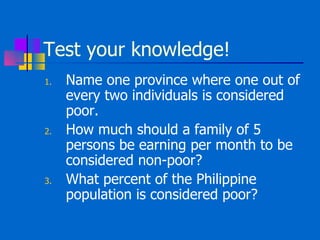
Test your knowledge! Name one province where one out of every two individuals is considered poor.  How much should a family of 5 persons be earning per month to be considered non-poor?  What percent of the Philippine population is considered poor?
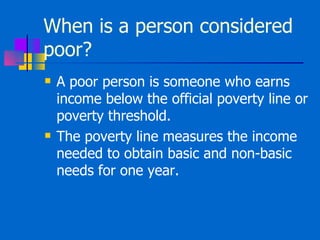
When is a person considered poor?  A poor person is someone who earns income below the official poverty line or poverty threshold. The poverty line measures the income needed to obtain basic and non-basic needs for one year.
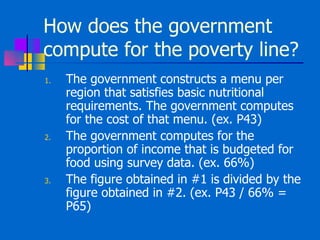
How does the government compute for the poverty line? The government constructs a menu per region that satisfies basic nutritional requirements. The government computes for the cost of that menu. (ex. P43) The government computes for the proportion of income that is budgeted for food using survey data. (ex. 66%) The figure obtained in #1 is divided by the figure obtained in #2. (ex. P43 / 66% = P65)
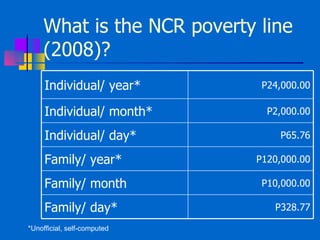
What is the NCR poverty line (2008)?  P328.77 Family/ day* P10,000.00 Family/ month P120,000.00 Family/ year* P65.76 Individual/ day* P2,000.00 Individual/ month* P24,000.00 Individual/ year* *Unofficial, self-computed
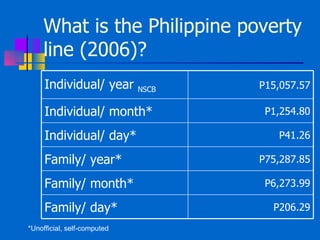
What is the Philippine poverty line (2006)?  P206.29 Family/ day* P6,273.99 Family/ month* P75,287.85 Family/ year* P41.26 Individual/ day* P1,254.80 Individual/ month* P15,057.57 Individual/ year  NSCB *Unofficial, self-computed
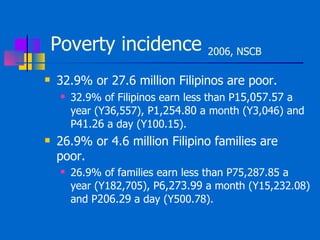
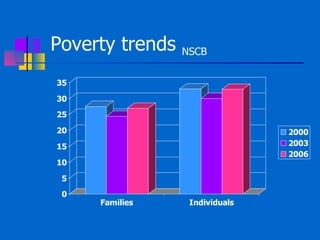
Poverty incidence  2006, NSCB 32.9% or 27.6 million Filipinos are poor.  32.9% of Filipinos earn less than P 15,057.57  a year (Y36,557), P 1,254.80  a month (Y3,046) and P 41.26  a day (Y100.15). 26.9% or 4.6 million Filipino families are poor. 26.9% of families earn less than P75,287.85 a year (Y182,705), P 6,273.99  a month (Y15,232.08) and P 206.29  a day (Y500.78).
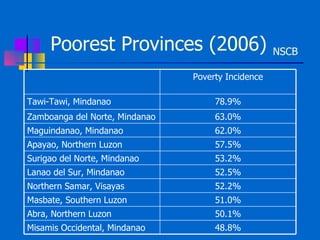
Poorest Provinces (2006)  NSCB Poverty Incidence Tawi-Tawi, Mindanao 78.9% Zamboanga del Norte, Mindanao 63.0% Maguindanao, Mindanao 62.0% Apayao, Northern Luzon 57.5% Surigao del Norte, Mindanao 53.2% Lanao del Sur, Mindanao 52.5% Northern Samar, Visayas 52.2% Masbate, Southern Luzon 51.0% Abra, Northern Luzon 50.1% Misamis Occidental, Mindanao 48.8%
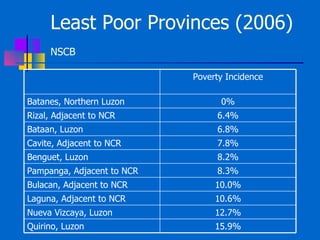
Least Poor Provinces (2006)  NSCB Poverty Incidence Batanes, Northern Luzon 0% Rizal, Adjacent to NCR 6.4% Bataan, Luzon 6.8% Cavite, Adjacent to NCR 7.8% Benguet, Luzon 8.2% Pampanga, Adjacent to NCR 8.3% Bulacan, Adjacent to NCR 10.0% Laguna, Adjacent to NCR 10.6% Nueva Vizcaya, Luzon 12.7% Quirino, Luzon 15.9%
Poverty trends  NSCB
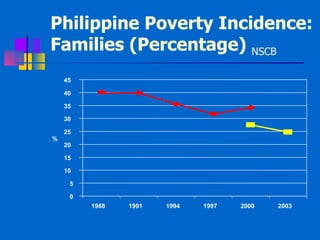
Philippine Poverty Incidence: Families (Percentage)  NSCB 0 5 10 15 20 25 30 35 40 45 1988 1991 1994 1997 2000 2003 %
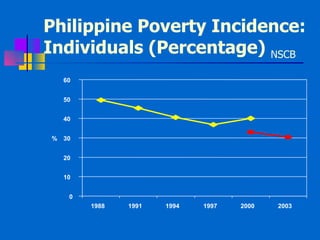
Philippine Poverty Incidence: Individuals (Percentage)  NSCB 0 10 20 30 40 50 60 1988 1991 1994 1997 2000 2003 %
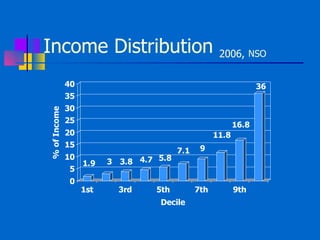
Income Distribution  2006,   NSO
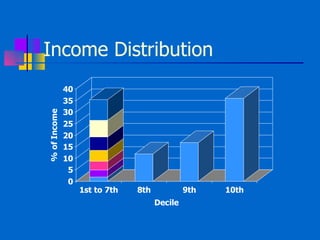
Income Distribution
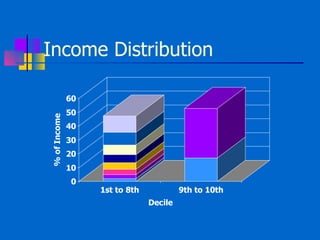
Income Distribution
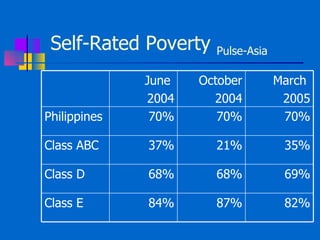
Self-Rated Poverty  Pulse-Asia June  2004 October 2004 March  2005 Philippines 70% 70% 70% Class ABC 37% 21% 35% Class D 68% 68% 69% Class E 84% 87% 82%
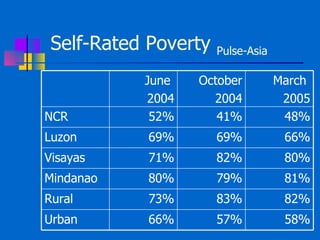
Self-Rated Poverty  Pulse-Asia June  2004 October 2004 March  2005 NCR 52% 41% 48% Luzon 69% 69% 66% Visayas 71% 82% 80% Mindanao 80% 79% 81% Rural 73% 83% 82% Urban 66% 57% 58%
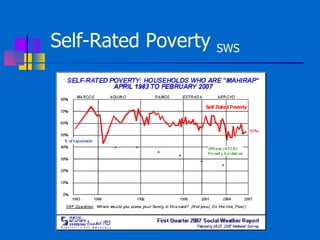
Self-Rated Poverty  SWS
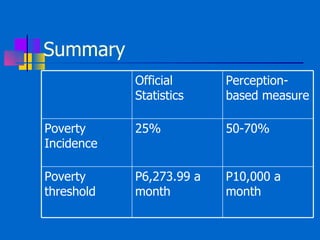
Summary Official Statistics Perception-based measure Poverty Incidence 25% 50-70% Poverty threshold P6,273.99 a month P10,000 a month
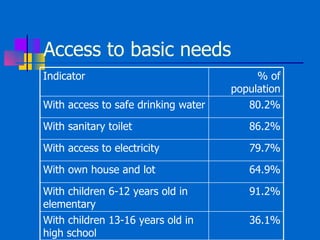
Access to basic needs Indicator % of population With access to safe drinking water 80.2% With sanitary toilet 86.2% With access to electricity 79.7% With own house and lot 64.9% With children 6-12 years old in elementary 91.2% With children 13-16 years old in high school 36.1%
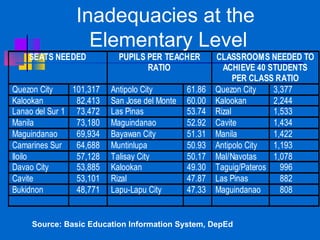
Inadequacies at the  Elementary Level Source: Basic Education Information System, DepEd
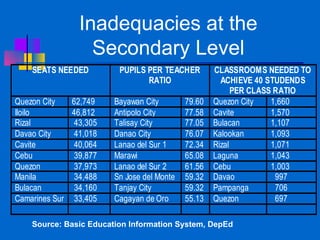
Inadequacies at the Secondary Level Source: Basic Education Information System, DepEd
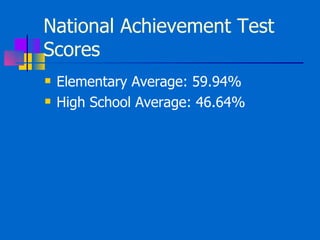
National Achievement Test Scores Elementary Average: 59.94% High School Average: 46.64%
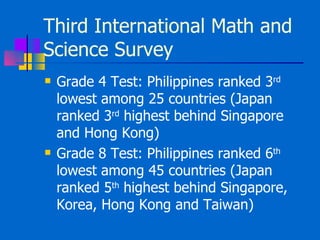
Third International Math and Science Survey Grade 4 Test: Philippines ranked 3 rd  lowest among 25 countries (Japan ranked 3 rd  highest behind Singapore and Hong Kong) Grade 8 Test: Philippines ranked 6 th  lowest among 45 countries (Japan ranked 5 th  highest behind Singapore, Korea, Hong Kong and Taiwan)
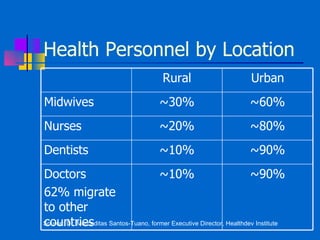
Health Personnel by Location Source: Dr. Merceditas Santos-Tuano, former Executive Director, Healthdev Institute Rural Urban Midwives ~30% ~60% Nurses ~20% ~80% Dentists  ~10% ~90% Doctors 62% migrate to other countries ~10% ~90%
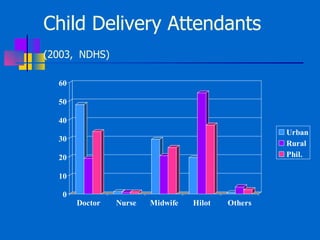
Child Delivery Attendants  (2003,   NDHS)
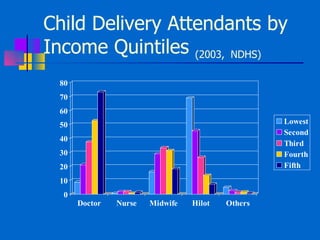
Child Delivery Attendants by Income Quintiles  (2003,   NDHS)
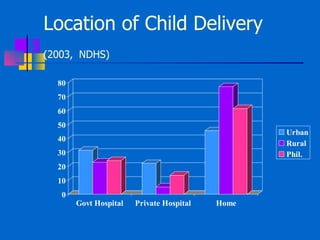
Location of Child Delivery  (2003,   NDHS)
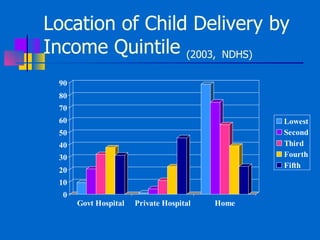
Location of Child Delivery by Income Quintile  (2003,   NDHS)
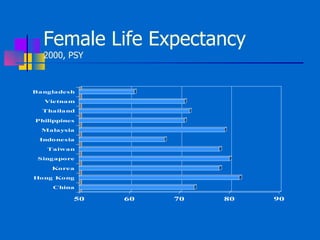
Female Life Expectancy 2000, PSY
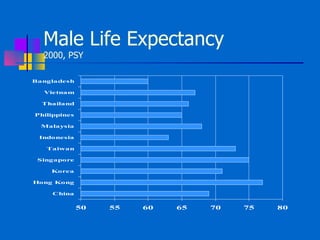
Male Life Expectancy 2000, PSY
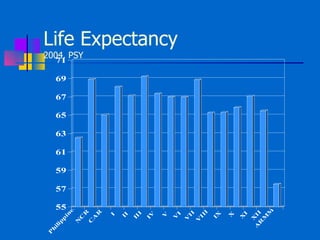
Life Expectancy 2004, PSY
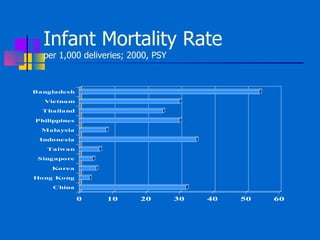
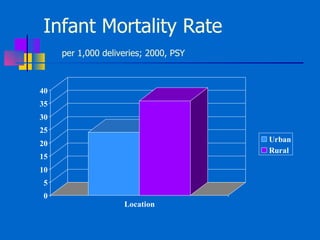
Infant Mortality Rate per 1,000 deliveries; 2000, PSY
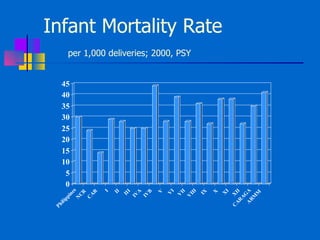
Infant Mortality Rate  per 1,000 deliveries; 2000, PSY
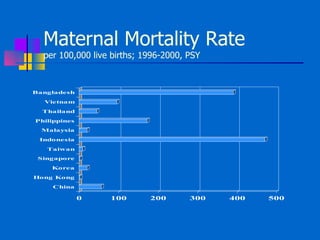
Maternal Mortality Rate per 100,000 live births; 1996-2000, PSY
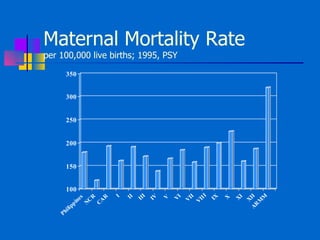
Maternal Mortality Rate per 100,000 live births; 1995, PSY
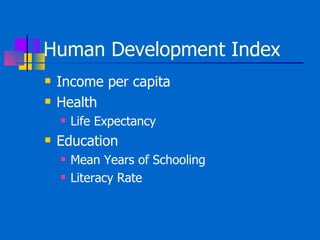
Human Development Index Income per capita Health Life Expectancy Education Mean Years of Schooling Literacy Rate
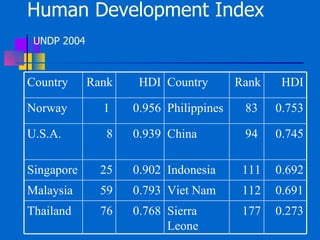
Human Development Index  UNDP 2004 Country Rank HDI Country Rank HDI Norway 1  0.956 Philippines 83  0.753 U.S.A. 8 0.939 China 94  0.745 Singapore 25 0.902 Indonesia 111 0.692 Malaysia 59 0.793 Viet Nam 112 0.691 Thailand 76 0.768 Sierra Leone 177 0.273
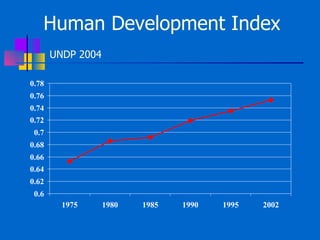
Human Development Index  UNDP 2004
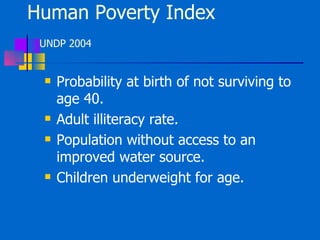
Human Poverty Index  UNDP 2004 Probability at birth of not surviving to age 40. Adult illiteracy rate. Population without access to an improved water source. Children underweight for age.
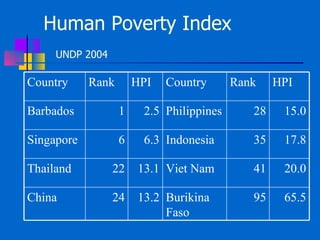
Human Poverty Index  UNDP 2004 Country Rank HPI Country Rank HPI Barbados 1 2.5 Philippines 28 15.0 Singapore 6 6.3 Indonesia 35 17.8 Thailand 22 13.1 Viet Nam 41 20.0 China 24 13.2 Burikina Faso 95 65.5
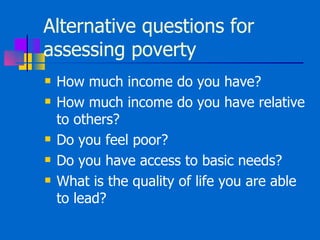
Alternative questions for assessing poverty How much income do you have? How much income do you have relative to others? Do you feel poor? Do you have access to basic needs? What is the quality of life you are able to lead?
Measuring Poverty Leland Joseph R. Dela Cruz Director, Development Studies Program Ateneo de Manila University

Measuring Philippine Poverty

  • 1.
    Measuring Poverty LelandJoseph R. Dela Cruz Development Studies Program School of Social Sciences Ateneo de Manila University
  • 2.
    Test your knowledge!Name one province where one out of every two individuals is considered poor. How much should a family of 5 persons be earning per month to be considered non-poor? What percent of the Philippine population is considered poor?
  • 3.
    When is aperson considered poor? A poor person is someone who earns income below the official poverty line or poverty threshold. The poverty line measures the income needed to obtain basic and non-basic needs for one year.
  • 4.
    How does thegovernment compute for the poverty line? The government constructs a menu per region that satisfies basic nutritional requirements. The government computes for the cost of that menu. (ex. P43) The government computes for the proportion of income that is budgeted for food using survey data. (ex. 66%) The figure obtained in #1 is divided by the figure obtained in #2. (ex. P43 / 66% = P65)
  • 5.
    What is theNCR poverty line (2008)? P328.77 Family/ day* P10,000.00 Family/ month P120,000.00 Family/ year* P65.76 Individual/ day* P2,000.00 Individual/ month* P24,000.00 Individual/ year* *Unofficial, self-computed
  • 6.
    What is thePhilippine poverty line (2006)? P206.29 Family/ day* P6,273.99 Family/ month* P75,287.85 Family/ year* P41.26 Individual/ day* P1,254.80 Individual/ month* P15,057.57 Individual/ year NSCB *Unofficial, self-computed
  • 7.
    Poverty incidence 2006, NSCB 32.9% or 27.6 million Filipinos are poor. 32.9% of Filipinos earn less than P 15,057.57 a year (Y36,557), P 1,254.80 a month (Y3,046) and P 41.26 a day (Y100.15). 26.9% or 4.6 million Filipino families are poor. 26.9% of families earn less than P75,287.85 a year (Y182,705), P 6,273.99 a month (Y15,232.08) and P 206.29 a day (Y500.78).
  • 8.
    Poorest Provinces (2006) NSCB Poverty Incidence Tawi-Tawi, Mindanao 78.9% Zamboanga del Norte, Mindanao 63.0% Maguindanao, Mindanao 62.0% Apayao, Northern Luzon 57.5% Surigao del Norte, Mindanao 53.2% Lanao del Sur, Mindanao 52.5% Northern Samar, Visayas 52.2% Masbate, Southern Luzon 51.0% Abra, Northern Luzon 50.1% Misamis Occidental, Mindanao 48.8%
  • 9.
    Least Poor Provinces(2006) NSCB Poverty Incidence Batanes, Northern Luzon 0% Rizal, Adjacent to NCR 6.4% Bataan, Luzon 6.8% Cavite, Adjacent to NCR 7.8% Benguet, Luzon 8.2% Pampanga, Adjacent to NCR 8.3% Bulacan, Adjacent to NCR 10.0% Laguna, Adjacent to NCR 10.6% Nueva Vizcaya, Luzon 12.7% Quirino, Luzon 15.9%
  • 10.
  • 11.
    Philippine Poverty Incidence:Families (Percentage) NSCB 0 5 10 15 20 25 30 35 40 45 1988 1991 1994 1997 2000 2003 %
  • 12.
    Philippine Poverty Incidence:Individuals (Percentage) NSCB 0 10 20 30 40 50 60 1988 1991 1994 1997 2000 2003 %
  • 13.
  • 14.
  • 15.
  • 16.
    Self-Rated Poverty Pulse-Asia June 2004 October 2004 March 2005 Philippines 70% 70% 70% Class ABC 37% 21% 35% Class D 68% 68% 69% Class E 84% 87% 82%
  • 17.
    Self-Rated Poverty Pulse-Asia June 2004 October 2004 March 2005 NCR 52% 41% 48% Luzon 69% 69% 66% Visayas 71% 82% 80% Mindanao 80% 79% 81% Rural 73% 83% 82% Urban 66% 57% 58%
  • 18.
  • 19.
    Summary Official StatisticsPerception-based measure Poverty Incidence 25% 50-70% Poverty threshold P6,273.99 a month P10,000 a month
  • 20.
    Access to basicneeds Indicator % of population With access to safe drinking water 80.2% With sanitary toilet 86.2% With access to electricity 79.7% With own house and lot 64.9% With children 6-12 years old in elementary 91.2% With children 13-16 years old in high school 36.1%
  • 21.
    Inadequacies at the Elementary Level Source: Basic Education Information System, DepEd
  • 22.
    Inadequacies at theSecondary Level Source: Basic Education Information System, DepEd
  • 23.
    National Achievement TestScores Elementary Average: 59.94% High School Average: 46.64%
  • 24.
    Third International Mathand Science Survey Grade 4 Test: Philippines ranked 3 rd lowest among 25 countries (Japan ranked 3 rd highest behind Singapore and Hong Kong) Grade 8 Test: Philippines ranked 6 th lowest among 45 countries (Japan ranked 5 th highest behind Singapore, Korea, Hong Kong and Taiwan)
  • 25.
    Health Personnel byLocation Source: Dr. Merceditas Santos-Tuano, former Executive Director, Healthdev Institute Rural Urban Midwives ~30% ~60% Nurses ~20% ~80% Dentists ~10% ~90% Doctors 62% migrate to other countries ~10% ~90%
  • 26.
  • 27.
    Child Delivery Attendantsby Income Quintiles (2003, NDHS)
  • 28.
    Location of ChildDelivery (2003, NDHS)
  • 29.
    Location of ChildDelivery by Income Quintile (2003, NDHS)
  • 30.
  • 31.
  • 32.
  • 33.
    Infant Mortality Rateper 1,000 deliveries; 2000, PSY
  • 34.
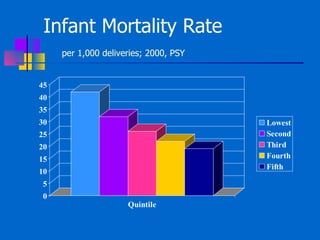
    Infant Mortality Rate per 1,000 deliveries; 2000, PSY
  • 35.
    Infant Mortality Rate per 1,000 deliveries; 2000, PSY
  • 36.
    Infant Mortality Rate per 1,000 deliveries; 2000, PSY
  • 37.
    Maternal Mortality Rateper 100,000 live births; 1996-2000, PSY
  • 38.
    Maternal Mortality Rateper 100,000 live births; 1995, PSY
  • 39.
    Human Development IndexIncome per capita Health Life Expectancy Education Mean Years of Schooling Literacy Rate
  • 40.
    Human Development Index UNDP 2004 Country Rank HDI Country Rank HDI Norway 1 0.956 Philippines 83 0.753 U.S.A. 8 0.939 China 94 0.745 Singapore 25 0.902 Indonesia 111 0.692 Malaysia 59 0.793 Viet Nam 112 0.691 Thailand 76 0.768 Sierra Leone 177 0.273
  • 41.
  • 42.
    Human Poverty Index UNDP 2004 Probability at birth of not surviving to age 40. Adult illiteracy rate. Population without access to an improved water source. Children underweight for age.
  • 43.
    Human Poverty Index UNDP 2004 Country Rank HPI Country Rank HPI Barbados 1 2.5 Philippines 28 15.0 Singapore 6 6.3 Indonesia 35 17.8 Thailand 22 13.1 Viet Nam 41 20.0 China 24 13.2 Burikina Faso 95 65.5
  • 44.
    Alternative questions forassessing poverty How much income do you have? How much income do you have relative to others? Do you feel poor? Do you have access to basic needs? What is the quality of life you are able to lead?
  • 45.
    Measuring Poverty LelandJoseph R. Dela Cruz Director, Development Studies Program Ateneo de Manila University