Livelihood
Concept & Approach
Containt
1 Livelihood concept &definition
2
Livelihood component &
framework
3 Planning & Evaluation
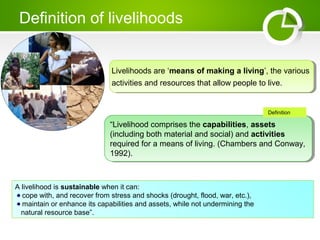
Definition of livelihoods
A livelihood is sustainable when it can:
cope with, and recover from stress and shocks (drought, flood, war, etc.),
maintain or enhance its capabilities and assets, while not undermining the
natural resource base”.
“Livelihood comprises the capabilities, assets
(including both material and social) and activities
required for a means of living. (Chambers and Conway,
1992).
“Livelihood comprises the capabilities, assets
(including both material and social) and activities
required for a means of living. (Chambers and Conway,
1992).
Definition
Livelihoods are ‘means of making a living’, the various
activities and resources that allow people to live.
Livelihoods are ‘means of making a living’, the various
activities and resources that allow people to live.
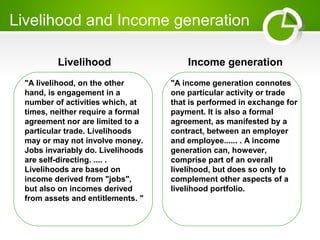
Livelihood and Income generation
Livelihood
"A livelihood, on the other
hand, is engagement in a
number of activities which, at
times, neither require a formal
agreement nor are limited to a
particular trade. Livelihoods
may or may not involve money.
Jobs invariably do. Livelihoods
are self-directing. .... .
Livelihoods are based on
income derived from "jobs",
but also on incomes derived
from assets and entitlements. "
Income generation
"A income generation connotes
one particular activity or trade
that is performed in exchange for
payment. It is also a formal
agreement, as manifested by a
contract, between an employer
and employee...... . A income
generation can, however,
comprise part of an overall
livelihood, but does so only to
complement other aspects of a
livelihood portfolio.
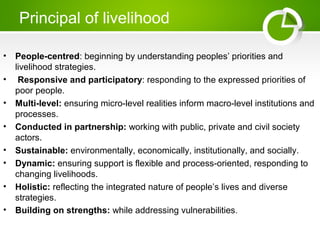
Principal of livelihood
• People-centred: beginning by understanding peoples’ priorities and
livelihood strategies.
• Responsive and participatory: responding to the expressed priorities of
poor people.
• Multi-level: ensuring micro-level realities inform macro-level institutions and
processes.
• Conducted in partnership: working with public, private and civil society
actors.
• Sustainable: environmentally, economically, institutionally, and socially.
• Dynamic: ensuring support is flexible and process-oriented, responding to
changing livelihoods.
• Holistic: reflecting the integrated nature of people’s lives and diverse
strategies.
• Building on strengths: while addressing vulnerabilities.
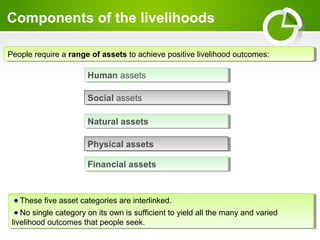
Components of the livelihoods
Human assetsHuman assets
Social assetsSocial assets
Physical assetsPhysical assets
Financial assetsFinancial assets
Natural assetsNatural assets
These five asset categories are interlinked.
No single category on its own is sufficient to yield all the many and varied
livelihood outcomes that people seek.
These five asset categories are interlinked.
No single category on its own is sufficient to yield all the many and varied
livelihood outcomes that people seek.
People require a range of assets to achieve positive livelihood outcomes:People require a range of assets to achieve positive livelihood outcomes:
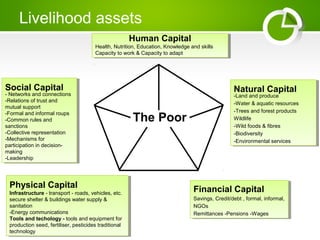
Livelihood assets
Financial Capital
Savings, Credit/debt , formal, informal,
NGOs
Remittances -Pensions -Wages
Financial Capital
Savings, Credit/debt , formal, informal,
NGOs
Remittances -Pensions -Wages
Natural Capital
-Land and produce
-Water & aquatic resources
-Trees and forest products
Wildlife
-Wild foods & fibres
-Biodiversity
-Environmental services
Natural Capital
-Land and produce
-Water & aquatic resources
-Trees and forest products
Wildlife
-Wild foods & fibres
-Biodiversity
-Environmental services
Social Capital
- Networks and connections
-Relations of trust and
mutual support
-Formal and informal roups
-Common rules and
sanctions
-Collective representation
-Mechanisms for
participation in decision-
making
-Leadership
Social Capital
- Networks and connections
-Relations of trust and
mutual support
-Formal and informal roups
-Common rules and
sanctions
-Collective representation
-Mechanisms for
participation in decision-
making
-Leadership
Physical Capital
Infrastructure - transport - roads, vehicles, etc.
secure shelter & buildings water supply &
sanitation
-Energy communications
Tools and techology - tools and equipment for
production seed, fertiliser, pesticides traditional
technology
Physical Capital
Infrastructure - transport - roads, vehicles, etc.
secure shelter & buildings water supply &
sanitation
-Energy communications
Tools and techology - tools and equipment for
production seed, fertiliser, pesticides traditional
technology
Human Capital
Health, Nutrition, Education, Knowledge and skills
Capacity to work & Capacity to adapt
Human Capital
Health, Nutrition, Education, Knowledge and skills
Capacity to work & Capacity to adapt
The Poor
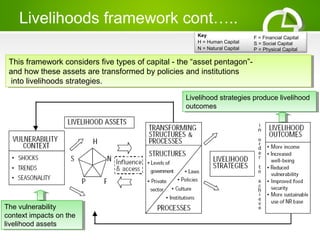
Livelihoods framework cont…..
Key
H = Human Capital
N = Natural Capital
F = Financial Capital
S = Social Capital
P = Physical Capital
Livelihood strategies produce livelihood
outcomes
Livelihood strategies produce livelihood
outcomes
The vulnerability
context impacts on the
livelihood assets
The vulnerability
context impacts on the
livelihood assets
This framework considers five types of capital - the “asset pentagon”-
and how these assets are transformed by policies and institutions
into livelihoods strategies.
This framework considers five types of capital - the “asset pentagon”-
and how these assets are transformed by policies and institutions
into livelihoods strategies.
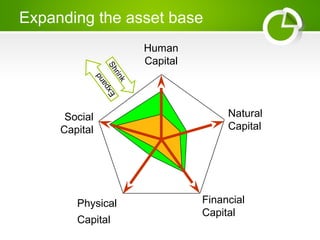
Expanding the asset base
Human
Capital
Natural
Capital
Social
Capital
Financial
Capital
Physical
Capital
Expand
Shrink
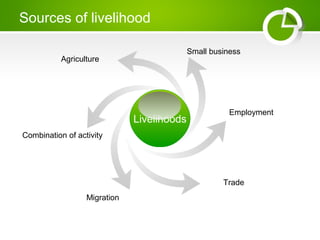
Sources of livelihood
Migration
Trade
Employment
Small business
Agriculture
Combination of activity
Livelihoods
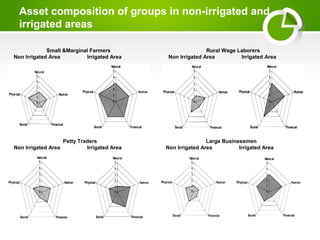
Asset composition of groups in non-irrigated and
irrigated areas
Small &Marginal Farmers
Non Irrigated Area Irrigated Area
Rural Wage Laborers
Non Irrigated Area Irrigated Area
Petty Traders
Non Irrigated Area Irrigated Area
Large Businessmen
Non Irrigated Area Irrigated Area
Sustainable Livelihoods Approach
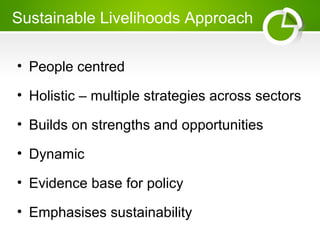
• People centred
• Holistic – multiple strategies across sectors
• Builds on strengths and opportunities
• Dynamic
• Evidence base for policy
• Emphasises sustainability
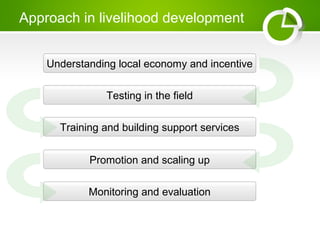
Approach in livelihood development
Understanding local economy and incentive
Testing in the field
Training and building support services
Promotion and scaling up
Monitoring and evaluation
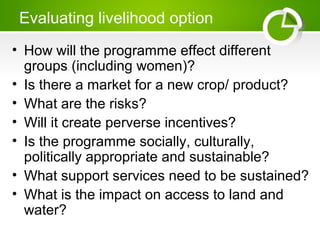
Evaluating livelihood option
• How will the programme effect different
groups (including women)?
• Is there a market for a new crop/ product?
• What are the risks?
• Will it create perverse incentives?
• Is the programme socially, culturally,
politically appropriate and sustainable?
• What support services need to be sustained?
• What is the impact on access to land and
water?
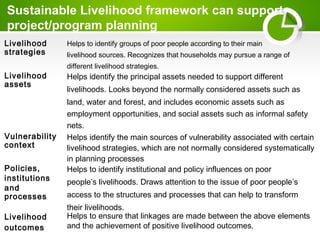
Sustainable Livelihood framework can support
project/program planning
Livelihood
strategies
Helps to identify groups of poor people according to their main
livelihood sources. Recognizes that households may pursue a range of
different livelihood strategies.
Livelihood
assets
Helps identify the principal assets needed to support different
livelihoods. Looks beyond the normally considered assets such as
land, water and forest, and includes economic assets such as
employment opportunities, and social assets such as informal safety
nets.
Vulnerability
context
Helps identify the main sources of vulnerability associated with certain
livelihood strategies, which are not normally considered systematically
in planning processes
Policies,
institutions
and
processes
Helps to identify institutional and policy influences on poor
people’s livelihoods. Draws attention to the issue of poor people’s
access to the structures and processes that can help to transform
their livelihoods.
Livelihood
outcomes
Helps to ensure that linkages are made between the above elements
and the achievement of positive livelihood outcomes.
Thank you!

Livelihood concept

  • 1.
  • 2.
    Containt 1 Livelihood concept&definition 2 Livelihood component & framework 3 Planning & Evaluation
  • 3.
    Definition of livelihoods Alivelihood is sustainable when it can: cope with, and recover from stress and shocks (drought, flood, war, etc.), maintain or enhance its capabilities and assets, while not undermining the natural resource base”. “Livelihood comprises the capabilities, assets (including both material and social) and activities required for a means of living. (Chambers and Conway, 1992). “Livelihood comprises the capabilities, assets (including both material and social) and activities required for a means of living. (Chambers and Conway, 1992). Definition Livelihoods are ‘means of making a living’, the various activities and resources that allow people to live. Livelihoods are ‘means of making a living’, the various activities and resources that allow people to live.
  • 4.
    Livelihood and Incomegeneration Livelihood "A livelihood, on the other hand, is engagement in a number of activities which, at times, neither require a formal agreement nor are limited to a particular trade. Livelihoods may or may not involve money. Jobs invariably do. Livelihoods are self-directing. .... . Livelihoods are based on income derived from "jobs", but also on incomes derived from assets and entitlements. " Income generation "A income generation connotes one particular activity or trade that is performed in exchange for payment. It is also a formal agreement, as manifested by a contract, between an employer and employee...... . A income generation can, however, comprise part of an overall livelihood, but does so only to complement other aspects of a livelihood portfolio.
  • 5.
    Principal of livelihood •People-centred: beginning by understanding peoples’ priorities and livelihood strategies. • Responsive and participatory: responding to the expressed priorities of poor people. • Multi-level: ensuring micro-level realities inform macro-level institutions and processes. • Conducted in partnership: working with public, private and civil society actors. • Sustainable: environmentally, economically, institutionally, and socially. • Dynamic: ensuring support is flexible and process-oriented, responding to changing livelihoods. • Holistic: reflecting the integrated nature of people’s lives and diverse strategies. • Building on strengths: while addressing vulnerabilities.
  • 6.
    Components of thelivelihoods Human assetsHuman assets Social assetsSocial assets Physical assetsPhysical assets Financial assetsFinancial assets Natural assetsNatural assets These five asset categories are interlinked. No single category on its own is sufficient to yield all the many and varied livelihood outcomes that people seek. These five asset categories are interlinked. No single category on its own is sufficient to yield all the many and varied livelihood outcomes that people seek. People require a range of assets to achieve positive livelihood outcomes:People require a range of assets to achieve positive livelihood outcomes:
  • 7.
    Livelihood assets Financial Capital Savings,Credit/debt , formal, informal, NGOs Remittances -Pensions -Wages Financial Capital Savings, Credit/debt , formal, informal, NGOs Remittances -Pensions -Wages Natural Capital -Land and produce -Water & aquatic resources -Trees and forest products Wildlife -Wild foods & fibres -Biodiversity -Environmental services Natural Capital -Land and produce -Water & aquatic resources -Trees and forest products Wildlife -Wild foods & fibres -Biodiversity -Environmental services Social Capital - Networks and connections -Relations of trust and mutual support -Formal and informal roups -Common rules and sanctions -Collective representation -Mechanisms for participation in decision- making -Leadership Social Capital - Networks and connections -Relations of trust and mutual support -Formal and informal roups -Common rules and sanctions -Collective representation -Mechanisms for participation in decision- making -Leadership Physical Capital Infrastructure - transport - roads, vehicles, etc. secure shelter & buildings water supply & sanitation -Energy communications Tools and techology - tools and equipment for production seed, fertiliser, pesticides traditional technology Physical Capital Infrastructure - transport - roads, vehicles, etc. secure shelter & buildings water supply & sanitation -Energy communications Tools and techology - tools and equipment for production seed, fertiliser, pesticides traditional technology Human Capital Health, Nutrition, Education, Knowledge and skills Capacity to work & Capacity to adapt Human Capital Health, Nutrition, Education, Knowledge and skills Capacity to work & Capacity to adapt The Poor
  • 8.
    Livelihoods framework cont….. Key H= Human Capital N = Natural Capital F = Financial Capital S = Social Capital P = Physical Capital Livelihood strategies produce livelihood outcomes Livelihood strategies produce livelihood outcomes The vulnerability context impacts on the livelihood assets The vulnerability context impacts on the livelihood assets This framework considers five types of capital - the “asset pentagon”- and how these assets are transformed by policies and institutions into livelihoods strategies. This framework considers five types of capital - the “asset pentagon”- and how these assets are transformed by policies and institutions into livelihoods strategies.
  • 9.
    Expanding the assetbase Human Capital Natural Capital Social Capital Financial Capital Physical Capital Expand Shrink
  • 10.
    Sources of livelihood Migration Trade Employment Smallbusiness Agriculture Combination of activity Livelihoods
  • 11.
    Asset composition ofgroups in non-irrigated and irrigated areas Small &Marginal Farmers Non Irrigated Area Irrigated Area Rural Wage Laborers Non Irrigated Area Irrigated Area Petty Traders Non Irrigated Area Irrigated Area Large Businessmen Non Irrigated Area Irrigated Area
  • 12.
    Sustainable Livelihoods Approach •People centred • Holistic – multiple strategies across sectors • Builds on strengths and opportunities • Dynamic • Evidence base for policy • Emphasises sustainability
  • 13.
    Approach in livelihooddevelopment Understanding local economy and incentive Testing in the field Training and building support services Promotion and scaling up Monitoring and evaluation
  • 14.
    Evaluating livelihood option •How will the programme effect different groups (including women)? • Is there a market for a new crop/ product? • What are the risks? • Will it create perverse incentives? • Is the programme socially, culturally, politically appropriate and sustainable? • What support services need to be sustained? • What is the impact on access to land and water?
  • 15.
    Sustainable Livelihood frameworkcan support project/program planning Livelihood strategies Helps to identify groups of poor people according to their main livelihood sources. Recognizes that households may pursue a range of different livelihood strategies. Livelihood assets Helps identify the principal assets needed to support different livelihoods. Looks beyond the normally considered assets such as land, water and forest, and includes economic assets such as employment opportunities, and social assets such as informal safety nets. Vulnerability context Helps identify the main sources of vulnerability associated with certain livelihood strategies, which are not normally considered systematically in planning processes Policies, institutions and processes Helps to identify institutional and policy influences on poor people’s livelihoods. Draws attention to the issue of poor people’s access to the structures and processes that can help to transform their livelihoods. Livelihood outcomes Helps to ensure that linkages are made between the above elements and the achievement of positive livelihood outcomes.
  • 16.