Differentiation and Small
   Group Instruction
        Presented 10/17/12
    By Building reading specialists
Data-Based Decision Making

   Planning the content of daily instruction
    based on frequent, ongoing assessment data
       DRA2, daily work, anecdotal records, data
        collected during interactive read aloud,
        conference records, progress monitoring data
   Grouping and regrouping students based
    on shared needs observed from data
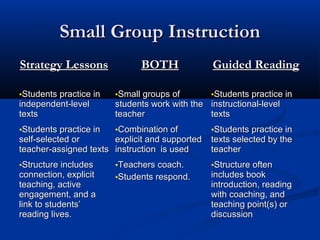
Small Group Instruction
Strategy Lessons                  BOTH            Guided Reading

•Studentspractice in     •Smallgroups of        •Students practice in
independent-level        students work with the instructional-level
texts                    teacher                texts
•Students  practice in   •Combination   of        •Students  practice in
self-selected or         explicit and supported   texts selected by the
teacher-assigned texts   instruction is used      teacher
•Structure  includes     •Teachers  coach.        •Structure often
connection, explicit     •Students respond.       includes book
teaching, active                                  introduction, reading
engagement, and a                                 with coaching, and
link to students’                                 teaching point(s) or
reading lives.                                    discussion
Stop and Jot
 What techniques do you
 currently use to differentiate
 instruction for your students?

What would you like to
 know more about?
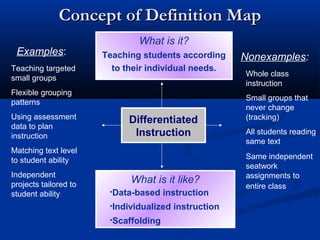
Concept of Definition Map
                               What is it?
 Examples:             Teaching students according      Nonexamples:
Teaching targeted        to their individual needs.
                                                        Whole class
small groups
                                                        instruction
Flexible grouping
                                                        Small groups that
patterns
                                                        never change
Using assessment             Differentiated             (tracking)
data to plan
instruction                   Instruction               All students reading
                                                        same text
Matching text level
to student ability                                      Same independent
                                                        seatwork
Independent                                             assignments to
projects tailored to         What is it like?
                                                        entire class
student ability         •Data-based    instruction
                        •Individualized   instruction
                        •Scaffolding
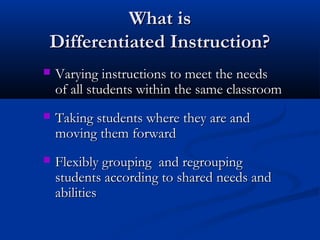
What is
Differentiated Instruction?
   Varying instructions to meet the needs
    of all students within the same classroom
   Taking students where they are and
    moving them forward
   Flexibly grouping and regrouping
    students according to shared needs and
    abilities
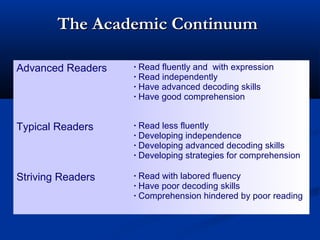
The Academic Continuum

Advanced Readers   • Read fluently and with expression
                   • Read independently
                   • Have advanced decoding skills
                   • Have good comprehension


Typical Readers    • Read less fluently
                   • Developing independence
                   • Developing advanced decoding skills
                   • Developing strategies for comprehension


Striving Readers   • Read with labored fluency
                   • Have poor decoding skills
                   • Comprehension hindered by poor reading
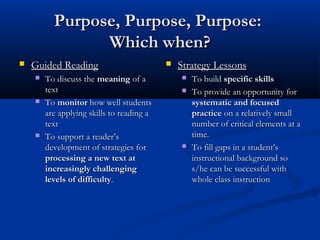
Purpose, Purpose, Purpose:
                Which when?
   Guided Reading                            Strategy Lessons
       To discuss the meaning of a               To build specific skills
        text                                      To provide an opportunity for
       To monitor how well students               systematic and focused
        are applying skills to reading a           practice on a relatively small
        text                                       number of critical elements at a
       To support a reader’s                      time.
        development of strategies for             To fill gaps in a student’s
        processing a new text at                   instructional background so
        increasingly challenging                   s/he can be successful with
        levels of difficulty.                      whole class instruction
Instructional Delivery

 Well organized
 Explicit
 Focused
 Data-based
 Doesn’t happen on the fly!
Time Matters
This means:
 Allocating more time to reading instruction is only a
  first step.
 Carefully choosing instructional materials and activities
  based on what research suggests is most effective.
AND:
 Keeping a) frequent/voluminous reading, b) adequate
  time for students to respond to what they read, and c)
  explicit instruction central to our reading workshops is
  promotes reading achievement.
Grouping Patterns
Teachers who get the best outcomes use
   multiple grouping patterns to accommodate
   student’s academic diversity.
     Whole Group
     Small Group
     Peer pairing

Eye on increasing active engagement.
Techniques for Active
        Engagement:
      Check for Understanding

1.   Everybody Questions
2.   Thumbs-Up, Thumbs-Down
3.   Use of White Boards
4.   Response Cards
Academic Engagement During
 Student-Directed Instruction

1.   Work stations
2.   Computers
3.   Peer-assisted learning
4.   Collaborative group routines
What about the students with whom the
       teacher is not working?
   Want to see lowest students getting “double
    dose.” Tier 1 Intervention (Tier 1
    intervention occurs in regular classroom.)
   Every student knows routines.
   Students may be partnered.
   Students are reading and discussing text
    selection.
   Should be an educational buzz.
Reflections on Effective Differentiated Instruction
   Currently Do:          New Thinking:
Remember...

 Reading is THINKING!


 How am I providing opportunities
 for readers to think deeply daily?

Sgi k 3

  • 1.
    Differentiation and Small Group Instruction Presented 10/17/12 By Building reading specialists
  • 2.
    Data-Based Decision Making  Planning the content of daily instruction based on frequent, ongoing assessment data  DRA2, daily work, anecdotal records, data collected during interactive read aloud, conference records, progress monitoring data  Grouping and regrouping students based on shared needs observed from data
  • 3.
    Small Group Instruction StrategyLessons BOTH Guided Reading •Studentspractice in •Smallgroups of •Students practice in independent-level students work with the instructional-level texts teacher texts •Students practice in •Combination of •Students practice in self-selected or explicit and supported texts selected by the teacher-assigned texts instruction is used teacher •Structure includes •Teachers coach. •Structure often connection, explicit •Students respond. includes book teaching, active introduction, reading engagement, and a with coaching, and link to students’ teaching point(s) or reading lives. discussion
  • 4.
    Stop and Jot What techniques do you currently use to differentiate instruction for your students? What would you like to know more about?
  • 5.
    Concept of DefinitionMap What is it? Examples: Teaching students according Nonexamples: Teaching targeted to their individual needs. Whole class small groups instruction Flexible grouping Small groups that patterns never change Using assessment Differentiated (tracking) data to plan instruction Instruction All students reading same text Matching text level to student ability Same independent seatwork Independent assignments to projects tailored to What is it like? entire class student ability •Data-based instruction •Individualized instruction •Scaffolding
  • 6.
    What is Differentiated Instruction?  Varying instructions to meet the needs of all students within the same classroom  Taking students where they are and moving them forward  Flexibly grouping and regrouping students according to shared needs and abilities
  • 7.
    The Academic Continuum AdvancedReaders • Read fluently and with expression • Read independently • Have advanced decoding skills • Have good comprehension Typical Readers • Read less fluently • Developing independence • Developing advanced decoding skills • Developing strategies for comprehension Striving Readers • Read with labored fluency • Have poor decoding skills • Comprehension hindered by poor reading
  • 8.
    Purpose, Purpose, Purpose: Which when?  Guided Reading  Strategy Lessons  To discuss the meaning of a  To build specific skills text  To provide an opportunity for  To monitor how well students systematic and focused are applying skills to reading a practice on a relatively small text number of critical elements at a  To support a reader’s time. development of strategies for  To fill gaps in a student’s processing a new text at instructional background so increasingly challenging s/he can be successful with levels of difficulty. whole class instruction
  • 9.
    Instructional Delivery  Wellorganized  Explicit  Focused  Data-based  Doesn’t happen on the fly!
  • 10.
    Time Matters This means: Allocating more time to reading instruction is only a first step.  Carefully choosing instructional materials and activities based on what research suggests is most effective. AND:  Keeping a) frequent/voluminous reading, b) adequate time for students to respond to what they read, and c) explicit instruction central to our reading workshops is promotes reading achievement.
  • 11.
    Grouping Patterns Teachers whoget the best outcomes use multiple grouping patterns to accommodate student’s academic diversity.  Whole Group  Small Group  Peer pairing Eye on increasing active engagement.
  • 12.
    Techniques for Active Engagement: Check for Understanding 1. Everybody Questions 2. Thumbs-Up, Thumbs-Down 3. Use of White Boards 4. Response Cards
  • 13.
    Academic Engagement During Student-Directed Instruction 1. Work stations 2. Computers 3. Peer-assisted learning 4. Collaborative group routines
  • 14.
    What about thestudents with whom the teacher is not working?  Want to see lowest students getting “double dose.” Tier 1 Intervention (Tier 1 intervention occurs in regular classroom.)  Every student knows routines.  Students may be partnered.  Students are reading and discussing text selection.  Should be an educational buzz.
  • 15.
    Reflections on EffectiveDifferentiated Instruction Currently Do: New Thinking:
  • 16.
    Remember...  Reading isTHINKING!  How am I providing opportunities for readers to think deeply daily?

Editor's Notes

  • #3 Data-based decision making means planning what to teach to whom based on ongoing, frequent assessment. Point to the first bullet. It means planning the content of daily instruction on the basis of frequent, ongoing assessment data. From such data, you match the content of what you teach to the observed needs of your students. Point to the second bullet. Another aspect of data-based instructional planning means using data to group and regroup students for small-group instruction according to needs observed through assessment data. By grouping and regrouping students based on observed need, you will help students master all of the objectives of the TEKS more easily. When students master the TEKS, what else will they pass? Participants: TAKS. Point to TAKS poster. Just remember, the way to the TAKS is to teach the TEKS well. (Fuchs & Fuchs, 1986, Kameenui et al, 2002; Walter-Thomas & Brownell, 2001)
  • #5 You are going to use the Concept of Definition Map to explore Differentiated Instruction with your partner. Explain the following steps. Point to each bullet discussed. Activity: l With your partner, write your own definition of differentiated instruction. - You will do this in the top box l Brainstorm examples of how a teacher might differentiate instruction. Write these in the Examples column. l Brainstorm examples that do NOT depict differentiated instruction. Write these in the non-examples column. l Identify synonyms that describe what differentiated instruction is like. Write those in the box at the bottom of the map. Tell participants, that if they teach students primarily in Spanish, they should complete this activity in Spanish on the Concept Map in Spanish. Allow @ 5 minutes
  • #6 Cover sections of the map with sticky notes or index cards until discussed. The only parts that should show initially is Differentiated Instruction in the center and titles of each section. Note: CD version is animated. Now we will discuss our maps. Point to “What is it?” How did you define Differentiated Instruction? Elicit several responses. l Discuss the extent to which they are getting at the same idea. l Show the prewritten definition on the map, and point out that everyone is defining differentiated in a similar context. l Tell participants to make any changes they want on their maps based on the discussion and example. Point to “What is it like?” What did you think differentiated instruction is like ? Elicit several responses. l Briefly discuss the responses. l Uncover the prewritten "What is it like?" on the slide. l Point out items they identified during discussion. l Tell participants to make any changes they want on their maps based on the discussion and example. Note: Explain that the following concepts as necessary. Data-based instruction = using assessment to guide instruction scaffolded = providing supports Now, give some examples of what differentiated instruction looks like in action. Elicit several responses. l Briefly discuss the responses. l Uncover the prewritten "Examples" section on the slide. l Point out items they identified during the discussion. l Tell participants to make any changes they want on their maps based on the discussion and example. Now, give some examples of what differentiated instruction does NOT look like in action. Elicit several responses. l Briefly discuss the responses. l Uncover the prewritten " Non-examples" section on the slide. l Point out items they identified during discussion. l Tell participants to make any changes they want on their maps based on the discussion and example. Note: Be prepared to discuss learning styles and/or multiple intelligences theories if they come up during discussion. Teaching to preferred learning styles or intelligence is not differentiated instruction, because there is no research showing that this approach accelerates reading. If these ideas come up in the discussion, emphasize that there is no evidence to support theories of preferred learning styles or intelligence. (Kameenui, Carnine, Dixon, Simmons, Coyne, 2002; Moody et al., 2000; Simmons, Fuchs, Fuchs, Mathes, Hodge, 1995; Taylor, 2002)
  • #7 Before discussing effective differentiated instruction, we first need to define it. Point to each bullet as discussed. Differentiated instruction means varying instruction to meet the needs of all students within the same classroom. It means taking students from where they are academically and moving them forward. For children who are behind, this means teaching them where they are, but accelerating their rate of progress to move them academically to where they need to be by the end of the year. It means flexibly grouping and regrouping students across the day and year as their reading strengths and needs change. (Moody, Vaughn, Hughes, & Fischer, 2000; Tomlinson, 2000; Walter-Thomas & Brownell, 2001)
  • #8 We know from observational research that teachers typically teach to average learners. However, in most classrooms, there are at least three categories of learners: Advance and Gifted, typical, and struggling readers. |The advanced and gifted learners in the typical classroom already read well and know much of what is being taught in the standard curriculum. If provided only the standard curriculum, how are these students likely to respond to your instruction? Take a moment to discuss this with the other members of your table. Allow @ 1 minutes. Elicit several participant responses from multiple tables Main ideas a) students will be bored,b) students are more likely to be disruptive, c) other related ideas. On the other end of the continuum, there are students who are struggling readers. They may lack skills that we think of as being first- or second-grade skills. If you teach only the standard third-grade curriculum to these students. What is likely to happen? Discuss this briefly with the other members of your table. Allow @ 1 minutes. Elicit several participant responses from multiple tables Main Ideas: a) They get farther behind, b) They learn to hate school, they experience more failure, their self- esteem drops, Other related ideas. None of us want any students to be bored with school. Likewise, we do not want any of our students to experience failure in achieving academic expectations. What do we all want for our students? Elicit several responses. As you have just stated, we all want students to be successful, motivated to learn and energized by the prospect of new learning.
  • #13 To illustrate how easy and inexpensive it is to use response cards in your class, we are going to have you make a set just as you can have your own students make a set before answering a series of questions. Now, take four index cards from you materials box. and write in bold letters the four techniques for increasing academic engagement. Write one technique per card Allow 1 minute Activity: 1. Read the following items and ask participants to identify the technique that would be most appropriate for each. 2. If participants make responses that differ from the answers listed, discuss to determine possible correctness. 3. Allow participants to hold up more than one card at a time. Discuss |Participants may have good rationale for responses not given below. Allow brief discussion Items 1. The students identify main idea of a paragraph. (White Board) 2. The students agree or disagree with another student's response. (Thumbs-up/Down, Response Cards). 3. The students match vocabulary words to definitions given by the teacher. (Response Cards) 4. The students identify the main character of a short story. (White Board) 5. The teacher makes a statement and students determine if the statement is true or false. (Thumbs-up/Down, Response cards). 6. The teacher asks the students to determine if a statement from a text selection is fact or opinion. (Everybody Question, Response Cards) 7. After introducing the suffix -ly, the teacher asks the students to say words with -ly added. For instance the teacher says, "say happy with -ly." (Everybody Question)
  • #14 Keeping the other students actively engaged in academically profitable activities is a challenge, but it is not an insurmountable challenge. There are proven techniques for keeping the other students, with whom the teacher is not working, academically and profitably engaged. We will talk about a few of these effective ways, including workstations, computers, peer-assisted learning strategies, and collaborative groups.
  • #16 On the next page of your participant notes, you will find a Reflections page. Please take that out. Allow 15 seconds. Point to each column as you discuss it. In the "Currently Do" column, write down each technique that we've discussed or that you saw in the film that you already use in your classroom. Allow 2 minutes. Now, in the "New Techniques" row, write down techniques that you've learned today that you believe you could implement. Allow 2 minutes. Now, place a check mark next to at least two techniques that you will commit to implementing in your classroom. Allow 1 minute. I want you to fill out the pledge at the bottom. This pledge says you will commit to implementing the two techniques you checked when you get back to your classroom. This pledge is both to yourself and to your students. Allow 2 minutes.
  • #17 Here are some important facts to remember: Most reading difficulties can be prevented through explicit, systematic instruction. In order for students to make progress, targeted student instruction must be continually assessed The teacher is the best intervention strategy.