Frameworks for
Collaboration
CR4YR August 27th, 2013
Vancouver Hilton Hotel
Faye Brownlie and Randy Cranston
Learning Intentions
  I have a better understanding of collaboration and
co-teaching.

  I have a plan of how to increase the effectiveness
of my collaboration and my co-teaching.

  I can create a class review and use it to plan for
instruction.
Why Collaboration/Co-teaching?
  Based on the belief that collaborative planning,

teaching and assessing better addresses the diverse
needs of students by creating ongoing effective
programming in the classroom

  It allows more students to be reached

Learning in Safe Schools, page 102 Chapter 9
  Based on the belief that collaborative planning,

teaching and assessing better addresses the diverse
needs of students by creating ongoing effective
programming in the classroom

  It allows more students to be reached
  It focuses on the ongoing context for learning for the

students, not just the specific remediation of skills
removed from the learning context of the classroom

  It builds a repertoire of strategies for teachers to
support the range of students in classes

page 102 Chapter 9

Learning in Safe Schools,
Why Collaboration/Co-teaching?
  Based on the belief that collaborative planning, teaching

and assessing better addresses the diverse needs of
students by creating ongoing effective programming in the
classroom

  It allows more students to be reached
  It focuses on the ongoing context for learning for the

students, not just the specific remediation of skills
removed from the learning context of the classroom

  It builds a repertoire of strategies for teachers to support
the range of students in classes

  Imperative students with the highest needs have the most
consistent program

Learning in Safe Schools, page 102 Chapter 9
Rationale:

 By sharing our collective

knowledge about the whole class
and developing a plan of action
based on this, we can better meet
the needs of all students.
Goal:

  to support students to be successful

learners in the classroom environment
A Key Belief

  When intervention is focused on classroom

support it improves each student’s ability and
opportunity to learn effectively/successfully in the
classroom.
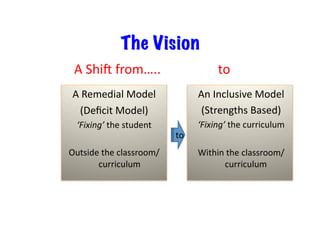
The Vision
A	
  Shi:	
  from….. 	


  to	
  
A	
  Remedial	
  Model	
  
(Deficit	
  Model)	
  

An	
  Inclusive	
  Model	
  
(Strengths	
  Based)	
  

‘Fixing’	
  the	
  student	
  

‘Fixing’	
  the	
  curriculum	
  

Outside	
  the	
  classroom/	
  
curriculum	
  

to	
  

Within	
  the	
  classroom/	
  
curriculum	
  
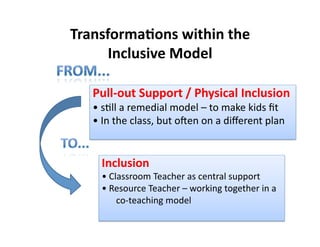
Transforma)ons	
  within	
  the	
  	
  
Inclusive	
  Model	
  
Pull-­‐out	
  Support	
  /	
  Physical	
  Inclusion	
  
•	
  sDll	
  a	
  remedial	
  model	
  –	
  to	
  make	
  kids	
  fit	
  
•	
  In	
  the	
  class,	
  but	
  o:en	
  on	
  a	
  different	
  plan	
  

Inclusion	
  

•	
  Classroom	
  Teacher	
  as	
  central	
  support	
  
•	
  Resource	
  Teacher	
  –	
  working	
  together	
  in	
  a	
  
	
  co-­‐teaching	
  model	
  
No plan, No point
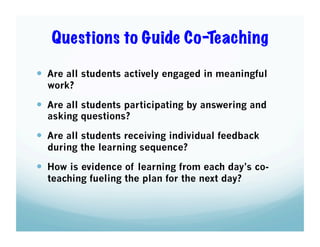
Questions to Guide Co-Teaching
  Are all students actively engaged in meaningful
work?

  Are all students participating by answering and
asking questions?

  Are all students receiving individual feedback
during the learning sequence?

  How is evidence of learning from each day’s coteaching fueling the plan for the next day?
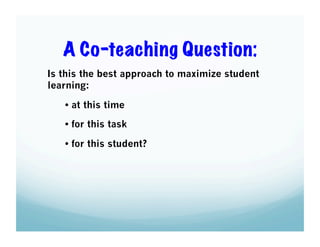
A Co-teaching Question:
Is this the best approach to maximize student
learning:
• at this time
• for this task
• for this student?
  What is your co-teaching dream?
Co-Teaching Models
(Teaching in Tandem – Effective Co-Teaching in the Inclusive
Classroom – Wilson & Blednick, 2011, ASCD)

  1 teach, 1 support
  Parallel groups
  Station teaching
  1 large group; 1 small group
  Teaming
1 Teach, 1 Support
  most frequently done, least planning
  Advantage: focus, 1:1 feedback, if alternate roles,

no one has the advantage or looks like the ‘real’
teacher, can capitalize one 1’s strengths and build
professional capacity

  Possible pitfall: easiest to go off the rails and

have one teacher feel as an ‘extra pair of hands’,
no specific task (buzzing radiator)
1 Teach, 1 Support: Examples
  demonstrating a new strategy so BOTH teachers
can use it the next day – e.g., think aloud,
questioning from pictures, listen-sketch-draft

  Students independently working on a task, one

teacher working with a small group on this task,
other teacher supporting children working
independently
Parallel Groups
  both teachers take about half the class and teach
the same thing.

  Advantage: half class size - more personal
contact, more individual attention

  Possible pitfalls: more time to co-plan, requires
trust in each other, each must know the content
and the strategies.
Parallel Groups: Examples
  word work. At Woodward Elem, the primary worked together
3 X/week, with each teacher, the principal and the RT each
taking a group for word work. Some schools have used this
with math activities.

  Focus teaching from class assessment. Westwood

Elementary: Came about as a result of an action research
question: How do we better meet the needs of our students?:
  primary team used Standard Reading Assessment, highlight
on short form of Performance Standards, Resource, ESL,
principal involved, cross-graded groups 2X a week, for 6 to 8
weeks driven by information from the performance standards
(Text features, Oral Comprehension, Risk taking, Critical
thinking with words, Getting the big picture,… , repeat
process
  NOT paper and pencil practice groups…teaching/thinking
groups
Station Teaching
  mostly small groups
  can be heterogeneous stations or more homogeneous
reading groups

  each teacher has 2 groups, 1 working independently at
a station or writing, 1 working directly with the teacher.

  Advantage: more individual attention and personal
feedback, increased focus on self regulation

  Possible pitfall: self regulation (needs to be taught),
time to plan for meaningful engagement.
Station Teaching: Examples
  Guided reading: 4 groups; RT has two and CT has
two

  math groups – Michelle’s patterning (1 direct

teaching, 2 guided practice, 1 guided practice with
observation)

  science stations: CT and RT each created two

stations; co-planning what they would look like to
ensure differentiation, teachers moved back and
forth between groups supporting self-monitoring,
independence on task
1 large group, 1 small group
  Advantage: either teacher can work with either
group, can provide tutorial, intensive, individual

  Possible pitfall: don’t want same kids always in
the ‘get help’ group
1 large group, 1 small group:
Examples
  Writing: 1 teacher works with whole class prewriting

and drafting, small groups of 3-4 students meet with 1
teacher to conference

  Reading: everyone’s reading. large group: teacher

moving from student to student listening to short oral
reads. Small group: 2 to 3 students being supported to
use specific reading strategies or
  small group is working on a Reader’s Theatre

  Math: large group using manipulatives to represent
shapes, small groups, rotating with other teacher,
using iPads to take pictures of shapes in the
environment
Teaming
  most seamless.
  co-planned
  teachers take alternate roles and lead-taking as the lesson
proceeds

  Most often in whole class instruction and could be followed
up with any of the other four co-teaching models

  Advantages: capitalizes on both teachers’ strengths, models
collaboration teaching/learning to students, can adjust
instruction readily based on student need, flexible

  Possible pitfalls: trust and skill
Teaming: Examples
  Brainstorm-categorize lesson – 1 teacher begins, other

teacher notices aspects the first teacher has missed or
sees confusion in children, adds in and assumes lead
role.

  Modeling reading strategies: two teachers model and

talk about the strategies they use to read, noting things
they do differently.

  Graphic organizer: Teachers model how to use a

semantic map as a post reading vocabulary building
activity, teacher most knowledgeable about semantic
mapping creates it as other teacher debriefs with
students; both flow back and forth

CR4YR collaboration.Aug 2013, Oct Prince Rupert

  • 1.
    Frameworks for Collaboration CR4YR August27th, 2013 Vancouver Hilton Hotel Faye Brownlie and Randy Cranston
  • 2.
    Learning Intentions   Ihave a better understanding of collaboration and co-teaching.   I have a plan of how to increase the effectiveness of my collaboration and my co-teaching.   I can create a class review and use it to plan for instruction.
  • 3.
    Why Collaboration/Co-teaching?   Basedon the belief that collaborative planning, teaching and assessing better addresses the diverse needs of students by creating ongoing effective programming in the classroom   It allows more students to be reached Learning in Safe Schools, page 102 Chapter 9
  • 4.
      Based onthe belief that collaborative planning, teaching and assessing better addresses the diverse needs of students by creating ongoing effective programming in the classroom   It allows more students to be reached   It focuses on the ongoing context for learning for the students, not just the specific remediation of skills removed from the learning context of the classroom   It builds a repertoire of strategies for teachers to support the range of students in classes page 102 Chapter 9 Learning in Safe Schools,
  • 5.
    Why Collaboration/Co-teaching?   Basedon the belief that collaborative planning, teaching and assessing better addresses the diverse needs of students by creating ongoing effective programming in the classroom   It allows more students to be reached   It focuses on the ongoing context for learning for the students, not just the specific remediation of skills removed from the learning context of the classroom   It builds a repertoire of strategies for teachers to support the range of students in classes   Imperative students with the highest needs have the most consistent program Learning in Safe Schools, page 102 Chapter 9
  • 6.
    Rationale:  By sharing ourcollective knowledge about the whole class and developing a plan of action based on this, we can better meet the needs of all students.
  • 7.
    Goal:   to supportstudents to be successful learners in the classroom environment
  • 8.
    A Key Belief  When intervention is focused on classroom support it improves each student’s ability and opportunity to learn effectively/successfully in the classroom.
  • 9.
    The Vision A  Shi:  from…..        to   A  Remedial  Model   (Deficit  Model)   An  Inclusive  Model   (Strengths  Based)   ‘Fixing’  the  student   ‘Fixing’  the  curriculum   Outside  the  classroom/   curriculum   to   Within  the  classroom/   curriculum  
  • 10.
    Transforma)ons  within  the     Inclusive  Model   Pull-­‐out  Support  /  Physical  Inclusion   •  sDll  a  remedial  model  –  to  make  kids  fit   •  In  the  class,  but  o:en  on  a  different  plan   Inclusion   •  Classroom  Teacher  as  central  support   •  Resource  Teacher  –  working  together  in  a    co-­‐teaching  model  
  • 11.
  • 12.
    Questions to GuideCo-Teaching   Are all students actively engaged in meaningful work?   Are all students participating by answering and asking questions?   Are all students receiving individual feedback during the learning sequence?   How is evidence of learning from each day’s coteaching fueling the plan for the next day?
  • 13.
    A Co-teaching Question: Isthis the best approach to maximize student learning: • at this time • for this task • for this student?
  • 14.
      What isyour co-teaching dream?
  • 15.
    Co-Teaching Models (Teaching inTandem – Effective Co-Teaching in the Inclusive Classroom – Wilson & Blednick, 2011, ASCD)   1 teach, 1 support   Parallel groups   Station teaching   1 large group; 1 small group   Teaming
  • 16.
    1 Teach, 1Support   most frequently done, least planning   Advantage: focus, 1:1 feedback, if alternate roles, no one has the advantage or looks like the ‘real’ teacher, can capitalize one 1’s strengths and build professional capacity   Possible pitfall: easiest to go off the rails and have one teacher feel as an ‘extra pair of hands’, no specific task (buzzing radiator)
  • 17.
    1 Teach, 1Support: Examples   demonstrating a new strategy so BOTH teachers can use it the next day – e.g., think aloud, questioning from pictures, listen-sketch-draft   Students independently working on a task, one teacher working with a small group on this task, other teacher supporting children working independently
  • 18.
    Parallel Groups   bothteachers take about half the class and teach the same thing.   Advantage: half class size - more personal contact, more individual attention   Possible pitfalls: more time to co-plan, requires trust in each other, each must know the content and the strategies.
  • 19.
    Parallel Groups: Examples  word work. At Woodward Elem, the primary worked together 3 X/week, with each teacher, the principal and the RT each taking a group for word work. Some schools have used this with math activities.   Focus teaching from class assessment. Westwood Elementary: Came about as a result of an action research question: How do we better meet the needs of our students?:   primary team used Standard Reading Assessment, highlight on short form of Performance Standards, Resource, ESL, principal involved, cross-graded groups 2X a week, for 6 to 8 weeks driven by information from the performance standards (Text features, Oral Comprehension, Risk taking, Critical thinking with words, Getting the big picture,… , repeat process   NOT paper and pencil practice groups…teaching/thinking groups
  • 20.
    Station Teaching   mostlysmall groups   can be heterogeneous stations or more homogeneous reading groups   each teacher has 2 groups, 1 working independently at a station or writing, 1 working directly with the teacher.   Advantage: more individual attention and personal feedback, increased focus on self regulation   Possible pitfall: self regulation (needs to be taught), time to plan for meaningful engagement.
  • 21.
    Station Teaching: Examples  Guided reading: 4 groups; RT has two and CT has two   math groups – Michelle’s patterning (1 direct teaching, 2 guided practice, 1 guided practice with observation)   science stations: CT and RT each created two stations; co-planning what they would look like to ensure differentiation, teachers moved back and forth between groups supporting self-monitoring, independence on task
  • 22.
    1 large group,1 small group   Advantage: either teacher can work with either group, can provide tutorial, intensive, individual   Possible pitfall: don’t want same kids always in the ‘get help’ group
  • 23.
    1 large group,1 small group: Examples   Writing: 1 teacher works with whole class prewriting and drafting, small groups of 3-4 students meet with 1 teacher to conference   Reading: everyone’s reading. large group: teacher moving from student to student listening to short oral reads. Small group: 2 to 3 students being supported to use specific reading strategies or   small group is working on a Reader’s Theatre   Math: large group using manipulatives to represent shapes, small groups, rotating with other teacher, using iPads to take pictures of shapes in the environment
  • 24.
    Teaming   most seamless.  co-planned   teachers take alternate roles and lead-taking as the lesson proceeds   Most often in whole class instruction and could be followed up with any of the other four co-teaching models   Advantages: capitalizes on both teachers’ strengths, models collaboration teaching/learning to students, can adjust instruction readily based on student need, flexible   Possible pitfalls: trust and skill
  • 25.
    Teaming: Examples   Brainstorm-categorizelesson – 1 teacher begins, other teacher notices aspects the first teacher has missed or sees confusion in children, adds in and assumes lead role.   Modeling reading strategies: two teachers model and talk about the strategies they use to read, noting things they do differently.   Graphic organizer: Teachers model how to use a semantic map as a post reading vocabulary building activity, teacher most knowledgeable about semantic mapping creates it as other teacher debriefs with students; both flow back and forth