Unpacking Balanced
Literacy
By Jen Sweigart, M.Ed
3rd/4th Grade Teacher
Hillside Elementary School
Fulton County Schools
Fulton County Schools Summer Summit
June 25-26 and July 25-26
www.jensweigart.blogspot.com
While You Wait…A Self-Assessment:
1) What new reading strategy or task have
you implemented successfully in your
classroom? Please share!
www.padlet.com/wall/balancedsuccess
2)Check out this website for resources:
www.jensweigart.blogspot.com
3)Where do I place myself on the Balanced
Literacy learning continuum?
Place a post-it note under the best
description of your Balanced Lit experience.
Essential Questions:
How do I create a Balanced Literacy program with
flexible and fluid instructional grouping activities for
targeted differentiation?
Where can I locate digital resources and applications to
support literacy across the curriculum?
TKES Standards:
Performance Standard 3: Instructional Strategies
The teacher promotes student learning by using research-based
instructional strategies relevant to the content to engage students in
active learning and to facilitate the students’ acquisition of key
knowledge and skills.
Performance Standard 4: Differentiated Instruction
The teacher challenges and supports each student’s learning by providing
appropriate content and developing skills which address individual
learning differences.
Performance Standard 8: Academically Challenging
Environment
The teacher creates a student-centered,
Academic environment in which teaching and
learning occur at high levels and students are
self-directed learners.
This Week’s Reading Strategy:
Questioning Author’s Purpose
Our Focused Reading Standard:
CCGPS 2.RI.8 Describe how reasons support
specific points the author makes in the text.
Our Role-Play Standard & Strategy
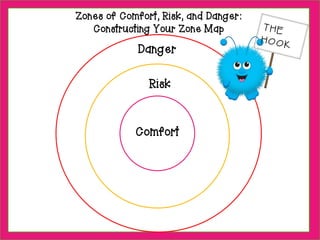
Zones of Comfort, Risk, and Danger:
Constructing Your Zone Map
Comfort
Risk
Danger
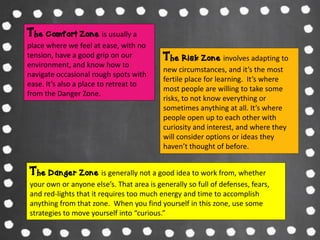
The Comfort Zone is usually a
place where we feel at ease, with no
tension, have a good grip on our
environment, and know how to
navigate occasional rough spots with
ease. It’s also a place to retreat to
from the Danger Zone.
The Risk Zone involves adapting to
new circumstances, and it’s the most
fertile place for learning. It’s where
most people are willing to take some
risks, to not know everything or
sometimes anything at all. It’s where
people open up to each other with
curiosity and interest, and where they
will consider options or ideas they
haven’t thought of before.
The Danger Zone is generally not a good idea to work from, whether
your own or anyone else’s. That area is generally so full of defenses, fears,
and red-lights that it requires too much energy and time to accomplish
anything from that zone. When you find yourself in this zone, use some
strategies to move yourself into “curious.”
Modeled Reading (aka The Read Aloud)
The teacher reads aloud to the whole class using a
purposefully selected text. The teacher chooses a
focus (in our case today it’s Author’s Purpose, and
uses think alouds to model their thinking as a reader
while students listen. The teacher would model the a
focus strategy for several lessons, and then move this
focus into the shared reading lesson.
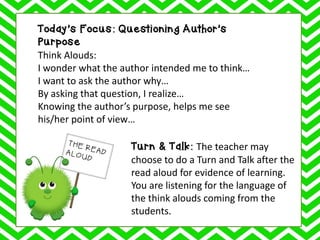
Today’s Focus: Questioning Author’s
Purpose
Think Alouds:
I wonder what the author intended me to think…
I want to ask the author why…
By asking that question, I realize…
Knowing the author’s purpose, helps me see
his/her point of view…
Turn & Talk: The teacher may
choose to do a Turn and Talk after the
read aloud for evidence of learning.
You are listening for the language of
the think alouds coming from the
students.
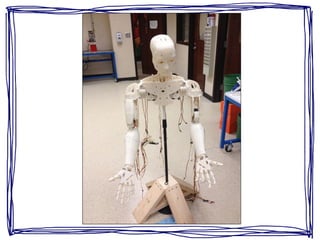
A Short Story About The Future of Jobs
In the future…we are going to see a lot more things that look like science
fiction, and fewer and fewer things that look like jobs.
*McAfee, Andrew. The Future of Jobs. TED . Feb 2013.
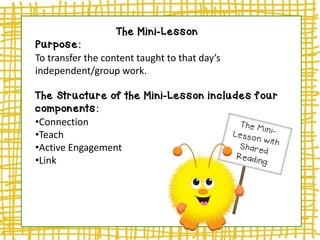
The Mini-Lesson
Purpose:
To transfer the content taught to that day’s
independent/group work.
The Structure of the Mini-Lesson includes four
components:
•Connection
•Teach
•Active Engagement
•Link
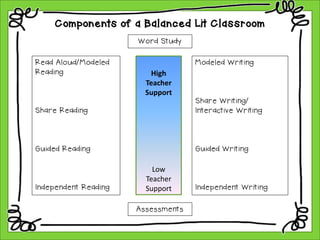
Components of a Balanced Lit Classroom
High
Teacher
Support
Low
Teacher
Support
Word Study
Read Aloud/Modeled
Reading
Share Reading
Guided Reading
Independent Reading
Modeled Writing
Share Writing/
Interactive Writing
Guided Writing
Independent Writing
Assessments
Modeled Writing
Shared Writing
Assessments
Guided Writing
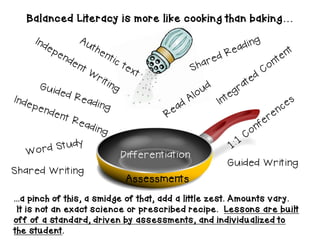
Balanced Literacy is more like cooking than baking…
...a pinch of this, a smidge of that, add a little zest. Amounts vary.
It is not an exact science or prescribed recipe. Lessons are built
off of a standard, driven by assessments, and individualized to
the student.
Differentiation
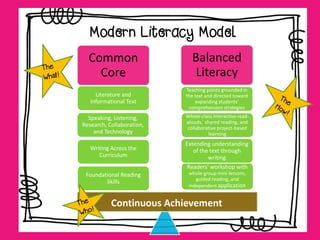
Modern Literacy Model
Common
Core
Balanced
Literacy
Teaching points grounded in
the text and directed toward
expanding students’
comprehension strategies
Readers’ workshop with
whole-group mini-lessons,
guided reading, and
independent application
Whole-class interactive read-
alouds, shared reading, and
collaborative project-based
learning
Extending understanding
of the text through
writing
Foundational Reading
Skills
Writing Across the
Curriculum
Speaking, Listening,
Research, Collaboration,
and Technology
Literature and
Informational Text
Continuous Achievement
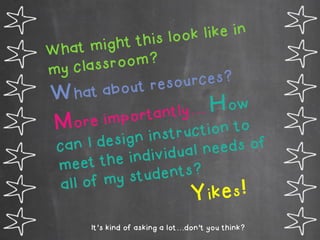
It’s kind of asking a lot…don’t you think?
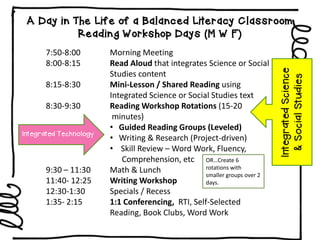
A Day in The Life of a Balanced Literacy Classroom
Reading Workshop Days (M W F)
7:50-8:00 Morning Meeting
8:00-8:15 Read Aloud that integrates Science or Social
Studies content
8:15-8:30 Mini-Lesson / Shared Reading using
Integrated Science or Social Studies text
8:30-9:30 Reading Workshop Rotations (15-20
minutes)
• Guided Reading Groups (Leveled)
• Writing & Research (Project-driven)
• Skill Review – Word Work, Fluency,
Comprehension, etc
9:30 – 11:30 Math & Lunch
11:40- 12:25 Writing Workshop
12:30-1:30 Specials / Recess
1:35- 2:15 1:1 Conferencing, RTI, Self-Selected
Reading, Book Clubs, Word Work
IntegratedScience
&SocialStudies
Integrated Technology
OR…Create 6
rotations with
smaller groups over 2
days.
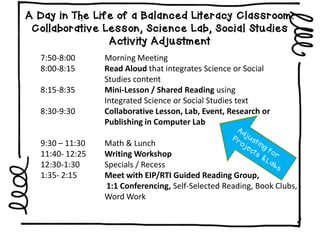
-A Day in The Life of a Balanced Literacy Classroom:
Collaborative Lesson, Science Lab, Social Studies
Activity Adjustment
7:50-8:00 Morning Meeting
8:00-8:15 Read Aloud that integrates Science or Social
Studies content
8:15-8:35 Mini-Lesson / Shared Reading using
Integrated Science or Social Studies text
8:30-9:30 Collaborative Lesson, Lab, Event, Research or
Publishing in Computer Lab
9:30 – 11:30 Math & Lunch
11:40- 12:25 Writing Workshop
12:30-1:30 Specials / Recess
1:35- 2:15 Meet with EIP/RTI Guided Reading Group,
1:1 Conferencing, Self-Selected Reading, Book Clubs,
Word Work
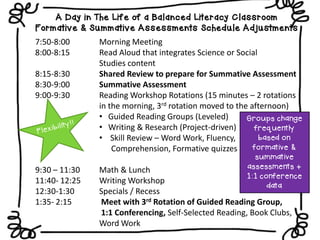
A Day in The Life of a Balanced Literacy Classroom
Formative & Summative Assessments Schedule Adjustments
7:50-8:00 Morning Meeting
8:00-8:15 Read Aloud that integrates Science or Social
Studies content
8:15-8:30 Shared Review to prepare for Summative Assessment
8:30-9:00 Summative Assessment
9:00-9:30 Reading Workshop Rotations (15 minutes – 2 rotations
in the morning, 3rd rotation moved to the afternoon)
• Guided Reading Groups (Leveled)
• Writing & Research (Project-driven)
• Skill Review – Word Work, Fluency,
Comprehension, Formative quizzes
9:30 – 11:30 Math & Lunch
11:40- 12:25 Writing Workshop
12:30-1:30 Specials / Recess
1:35- 2:15 Meet with 3rd Rotation of Guided Reading Group,
1:1 Conferencing, Self-Selected Reading, Book Clubs,
Word Work
Groups change
frequently
based on
formative &
summative
assessments +
1:1 conference
data
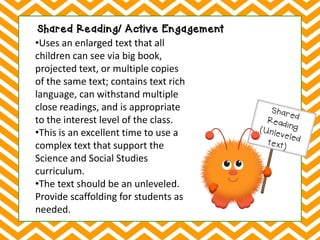
Shared Reading/ Active Engagement
•Uses an enlarged text that all
children can see via big book,
projected text, or multiple copies
of the same text; contains text rich
language, can withstand multiple
close readings, and is appropriate
to the interest level of the class.
•This is an excellent time to use a
complex text that support the
Science and Social Studies
curriculum.
•The text should be an unleveled.
Provide scaffolding for students as
needed.
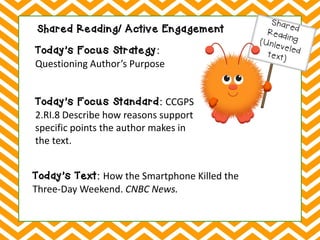
Shared Reading/ Active Engagement
Today’s Focus Strategy:
Questioning Author’s Purpose
Today’s Focus Standard: CCGPS
2.RI.8 Describe how reasons support
specific points the author makes in
the text.
Today’s Text: How the Smartphone Killed the
Three-Day Weekend. CNBC News.
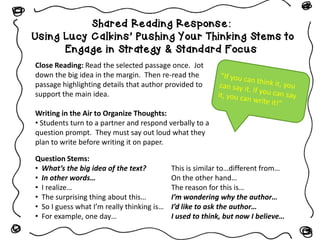
Shared Reading Response:
Using Lucy Calkins’ Pushing Your Thinking Stems to
Engage in Strategy & Standard Focus
Close Reading: Read the selected passage once. Jot
down the big idea in the margin. Then re-read the
passage highlighting details that author provided to
support the main idea.
Writing in the Air to Organize Thoughts:
• Students turn to a partner and respond verbally to a
question prompt. They must say out loud what they
plan to write before writing it on paper.
Question Stems:
• What’s the big idea of the text?
• In other words…
• I realize…
• The surprising thing about this…
• So I guess what I’m really thinking is…
• For example, one day…
This is similar to…different from…
On the other hand…
The reason for this is…
I’m wondering why the author…
I’d like to ask the author…
I used to think, but now I believe…
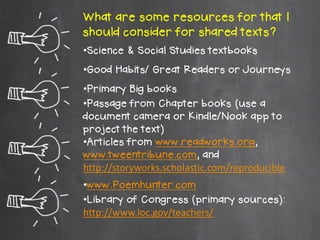
What are some resources for that I
should consider for shared texts?
•Science & Social Studies textbooks
•Good Habits/ Great Readers or Journeys
•Primary Big books
•Passage from Chapter books (use a
document camera or Kindle/Nook app to
project the text)
•Articles from www.readworks.org,
www.tweentribune.com, and
http://storyworks.scholastic.com/reproducible
•www.Poemhunter.com
•Library of Congress (primary sources):
http://www.loc.gov/teachers/
You must have
consistent norms
about your
expectations for
the workshop
format to work!!
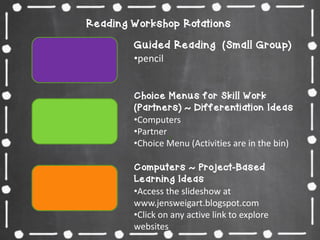
Reading Workshop Rotations
Guided Reading (Small Group)
•pencil
Choice Menus for Skill Work
(Partners) ~ Differentiation Ideas
•Computers
•Partner
•Choice Menu (Activities are in the bin)
Computers ~ Project-Based
Learning Ideas
•Access the slideshow at
www.jensweigart.blogspot.com
•Click on any active link to explore
websites
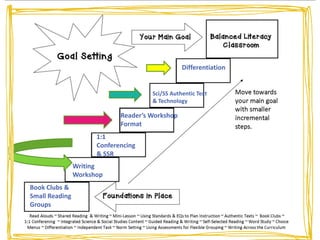
Book Clubs &
Small Reading
Groups
Writing
Workshop
1:1
Conferencing
& SSR
Reader’s Workshop
Format
Sci/SS Authentic Text
& Technology
Differentiation

Unpacking Balanced Literacy in the Classroom

  • 1.
    Unpacking Balanced Literacy By JenSweigart, M.Ed 3rd/4th Grade Teacher Hillside Elementary School Fulton County Schools Fulton County Schools Summer Summit June 25-26 and July 25-26 www.jensweigart.blogspot.com
  • 2.
    While You Wait…ASelf-Assessment: 1) What new reading strategy or task have you implemented successfully in your classroom? Please share! www.padlet.com/wall/balancedsuccess 2)Check out this website for resources: www.jensweigart.blogspot.com 3)Where do I place myself on the Balanced Literacy learning continuum? Place a post-it note under the best description of your Balanced Lit experience.
  • 3.
    Essential Questions: How doI create a Balanced Literacy program with flexible and fluid instructional grouping activities for targeted differentiation? Where can I locate digital resources and applications to support literacy across the curriculum?
  • 4.
    TKES Standards: Performance Standard3: Instructional Strategies The teacher promotes student learning by using research-based instructional strategies relevant to the content to engage students in active learning and to facilitate the students’ acquisition of key knowledge and skills. Performance Standard 4: Differentiated Instruction The teacher challenges and supports each student’s learning by providing appropriate content and developing skills which address individual learning differences. Performance Standard 8: Academically Challenging Environment The teacher creates a student-centered, Academic environment in which teaching and learning occur at high levels and students are self-directed learners.
  • 5.
    This Week’s ReadingStrategy: Questioning Author’s Purpose Our Focused Reading Standard: CCGPS 2.RI.8 Describe how reasons support specific points the author makes in the text. Our Role-Play Standard & Strategy
  • 6.
    Zones of Comfort,Risk, and Danger: Constructing Your Zone Map Comfort Risk Danger
  • 7.
    The Comfort Zoneis usually a place where we feel at ease, with no tension, have a good grip on our environment, and know how to navigate occasional rough spots with ease. It’s also a place to retreat to from the Danger Zone. The Risk Zone involves adapting to new circumstances, and it’s the most fertile place for learning. It’s where most people are willing to take some risks, to not know everything or sometimes anything at all. It’s where people open up to each other with curiosity and interest, and where they will consider options or ideas they haven’t thought of before. The Danger Zone is generally not a good idea to work from, whether your own or anyone else’s. That area is generally so full of defenses, fears, and red-lights that it requires too much energy and time to accomplish anything from that zone. When you find yourself in this zone, use some strategies to move yourself into “curious.”
  • 8.
    Modeled Reading (akaThe Read Aloud) The teacher reads aloud to the whole class using a purposefully selected text. The teacher chooses a focus (in our case today it’s Author’s Purpose, and uses think alouds to model their thinking as a reader while students listen. The teacher would model the a focus strategy for several lessons, and then move this focus into the shared reading lesson.
  • 9.
    Today’s Focus: QuestioningAuthor’s Purpose Think Alouds: I wonder what the author intended me to think… I want to ask the author why… By asking that question, I realize… Knowing the author’s purpose, helps me see his/her point of view… Turn & Talk: The teacher may choose to do a Turn and Talk after the read aloud for evidence of learning. You are listening for the language of the think alouds coming from the students.
  • 10.
    A Short StoryAbout The Future of Jobs In the future…we are going to see a lot more things that look like science fiction, and fewer and fewer things that look like jobs. *McAfee, Andrew. The Future of Jobs. TED . Feb 2013.
  • 14.
    The Mini-Lesson Purpose: To transferthe content taught to that day’s independent/group work. The Structure of the Mini-Lesson includes four components: •Connection •Teach •Active Engagement •Link
  • 15.
    Components of aBalanced Lit Classroom High Teacher Support Low Teacher Support Word Study Read Aloud/Modeled Reading Share Reading Guided Reading Independent Reading Modeled Writing Share Writing/ Interactive Writing Guided Writing Independent Writing Assessments
  • 16.
    Modeled Writing Shared Writing Assessments GuidedWriting Balanced Literacy is more like cooking than baking… ...a pinch of this, a smidge of that, add a little zest. Amounts vary. It is not an exact science or prescribed recipe. Lessons are built off of a standard, driven by assessments, and individualized to the student. Differentiation
  • 17.
    Modern Literacy Model Common Core Balanced Literacy Teachingpoints grounded in the text and directed toward expanding students’ comprehension strategies Readers’ workshop with whole-group mini-lessons, guided reading, and independent application Whole-class interactive read- alouds, shared reading, and collaborative project-based learning Extending understanding of the text through writing Foundational Reading Skills Writing Across the Curriculum Speaking, Listening, Research, Collaboration, and Technology Literature and Informational Text Continuous Achievement
  • 19.
    It’s kind ofasking a lot…don’t you think?
  • 20.
    A Day inThe Life of a Balanced Literacy Classroom Reading Workshop Days (M W F) 7:50-8:00 Morning Meeting 8:00-8:15 Read Aloud that integrates Science or Social Studies content 8:15-8:30 Mini-Lesson / Shared Reading using Integrated Science or Social Studies text 8:30-9:30 Reading Workshop Rotations (15-20 minutes) • Guided Reading Groups (Leveled) • Writing & Research (Project-driven) • Skill Review – Word Work, Fluency, Comprehension, etc 9:30 – 11:30 Math & Lunch 11:40- 12:25 Writing Workshop 12:30-1:30 Specials / Recess 1:35- 2:15 1:1 Conferencing, RTI, Self-Selected Reading, Book Clubs, Word Work IntegratedScience &SocialStudies Integrated Technology OR…Create 6 rotations with smaller groups over 2 days.
  • 21.
    -A Day inThe Life of a Balanced Literacy Classroom: Collaborative Lesson, Science Lab, Social Studies Activity Adjustment 7:50-8:00 Morning Meeting 8:00-8:15 Read Aloud that integrates Science or Social Studies content 8:15-8:35 Mini-Lesson / Shared Reading using Integrated Science or Social Studies text 8:30-9:30 Collaborative Lesson, Lab, Event, Research or Publishing in Computer Lab 9:30 – 11:30 Math & Lunch 11:40- 12:25 Writing Workshop 12:30-1:30 Specials / Recess 1:35- 2:15 Meet with EIP/RTI Guided Reading Group, 1:1 Conferencing, Self-Selected Reading, Book Clubs, Word Work
  • 22.
    A Day inThe Life of a Balanced Literacy Classroom Formative & Summative Assessments Schedule Adjustments 7:50-8:00 Morning Meeting 8:00-8:15 Read Aloud that integrates Science or Social Studies content 8:15-8:30 Shared Review to prepare for Summative Assessment 8:30-9:00 Summative Assessment 9:00-9:30 Reading Workshop Rotations (15 minutes – 2 rotations in the morning, 3rd rotation moved to the afternoon) • Guided Reading Groups (Leveled) • Writing & Research (Project-driven) • Skill Review – Word Work, Fluency, Comprehension, Formative quizzes 9:30 – 11:30 Math & Lunch 11:40- 12:25 Writing Workshop 12:30-1:30 Specials / Recess 1:35- 2:15 Meet with 3rd Rotation of Guided Reading Group, 1:1 Conferencing, Self-Selected Reading, Book Clubs, Word Work Groups change frequently based on formative & summative assessments + 1:1 conference data
  • 23.
    Shared Reading/ ActiveEngagement •Uses an enlarged text that all children can see via big book, projected text, or multiple copies of the same text; contains text rich language, can withstand multiple close readings, and is appropriate to the interest level of the class. •This is an excellent time to use a complex text that support the Science and Social Studies curriculum. •The text should be an unleveled. Provide scaffolding for students as needed.
  • 24.
    Shared Reading/ ActiveEngagement Today’s Focus Strategy: Questioning Author’s Purpose Today’s Focus Standard: CCGPS 2.RI.8 Describe how reasons support specific points the author makes in the text. Today’s Text: How the Smartphone Killed the Three-Day Weekend. CNBC News.
  • 25.
    Shared Reading Response: UsingLucy Calkins’ Pushing Your Thinking Stems to Engage in Strategy & Standard Focus Close Reading: Read the selected passage once. Jot down the big idea in the margin. Then re-read the passage highlighting details that author provided to support the main idea. Writing in the Air to Organize Thoughts: • Students turn to a partner and respond verbally to a question prompt. They must say out loud what they plan to write before writing it on paper. Question Stems: • What’s the big idea of the text? • In other words… • I realize… • The surprising thing about this… • So I guess what I’m really thinking is… • For example, one day… This is similar to…different from… On the other hand… The reason for this is… I’m wondering why the author… I’d like to ask the author… I used to think, but now I believe…
  • 26.
    What are someresources for that I should consider for shared texts? •Science & Social Studies textbooks •Good Habits/ Great Readers or Journeys •Primary Big books •Passage from Chapter books (use a document camera or Kindle/Nook app to project the text) •Articles from www.readworks.org, www.tweentribune.com, and http://storyworks.scholastic.com/reproducible •www.Poemhunter.com •Library of Congress (primary sources): http://www.loc.gov/teachers/
  • 27.
    You must have consistentnorms about your expectations for the workshop format to work!!
  • 28.
    Reading Workshop Rotations GuidedReading (Small Group) •pencil Choice Menus for Skill Work (Partners) ~ Differentiation Ideas •Computers •Partner •Choice Menu (Activities are in the bin) Computers ~ Project-Based Learning Ideas •Access the slideshow at www.jensweigart.blogspot.com •Click on any active link to explore websites
  • 29.
    Book Clubs & SmallReading Groups Writing Workshop 1:1 Conferencing & SSR Reader’s Workshop Format Sci/SS Authentic Text & Technology Differentiation