Fountas & Pinnell Benchmark Assessment System<br />Instructional Implications <br />Prepared by Andrea Hnatiuk<br />Testing is over….now what?<br />How do you use the assessment results to inform instruction?<br />Assessment and Instruction<br />Assessment should be used for action.  When faced with a situation, we need to make an accurate assessment.  From this, we need to respond with positive actions in order to get improved results.
What actions can teachers take?
Teachers can provide differentiated classrooms and approaches.
Differentiated instruction does not mean we are lowering standards.  It means we are clear about the standards and we want all students to be successful.  The end product may look different, but the learning still occurs. All students are achieving those standards.
We need to ensure we continue to modify for students to be successful.

Fountas and pinnell after the testing

  • 1.
    Fountas & PinnellBenchmark Assessment System<br />Instructional Implications <br />Prepared by Andrea Hnatiuk<br />Testing is over….now what?<br />How do you use the assessment results to inform instruction?<br />Assessment and Instruction<br />Assessment should be used for action. When faced with a situation, we need to make an accurate assessment. From this, we need to respond with positive actions in order to get improved results.
  • 2.
    What actions canteachers take?
  • 3.
    Teachers can providedifferentiated classrooms and approaches.
  • 4.
    Differentiated instruction doesnot mean we are lowering standards. It means we are clear about the standards and we want all students to be successful. The end product may look different, but the learning still occurs. All students are achieving those standards.
  • 5.
    We need toensure we continue to modify for students to be successful.
  • 6.
    We need toadjust teaching and our practice to take into account the results of the assessment.
  • 7.
  • 8.
    Teachers can createsmall groups and provide needs-alike instruction.
  • 9.
    Assessment in theclassroom needs to be effective and efficient. We do not need to mark everything, we should not factor in ‘early tries’ and we need to keep our focus and purpose clear when we mark students work.
  • 10.
    If we aregoing to test kids, then the test needs to be worth doing.
  • 11.
    Are Fountas &Pinnell tests worth doing?
  • 12.
    Fountas & Pinnelltests are worth doing: they give us an indication of where students are achieving in reading comprehension.
  • 13.
    By reviewing testresults, we can alter instruction to best meet student needs so progress can be made.
  • 14.
    We should involvestudents in the assessment. Research on effective assessment explains that we need to provide effective feedback to students and students need to have active involvement in their own learning.
  • 15.
    How can wedo that?
  • 16.
    We can reviewassessments with students
  • 17.
    We can conversewith students about the reading process
  • 18.
    We can setgoals with students
  • 19.
    We can monitorthose individual reading goals and make adjustments when necessary.
  • 20.
  • 21.
    Our students arehaving trouble with high level questioning, we need to create environments where students are thinking higher than a literal level.
  • 22.
    We are examiningour assessment and belief practices because we have changing goals.
  • 23.
    What are ournew goals and how do we attain them?
  • 24.
    Everybody must learnthe critical/core/essential learnings.
  • 25.
    We have toteach so all learners can be successful; there is no ‘one size fits all’ approach. We need to focus on a small number of CRITICAL things.Reflection on Fountas & Pinnell<br />Points to Ponder:<br />There is a lot of useful information that you can use to inform and guide your classroom practice.
  • 26.
    Three areas thatcan be influenced by the results of the benchmark testing are:
  • 27.
  • 28.
  • 29.
  • 30.
    Your results canguide book choices for independent reading.
  • 31.
    Effective conferencing withstudents can be practiced
  • 32.
    Information from testingresults can be used to group students for small group instruction or for guided reading.
  • 33.
    Teaching points andtargets can be decided upon.
  • 34.
    The analysis canhelp you select books that can focus on strategic processes.
  • 35.
    Fluency can beidentified and improvement goals can be developed.
  • 36.
    The analysis canhelp you select books for your classroom library that take into account the independent reading levels of the students.
  • 37.
    Mini lessons canbe taught to support students.
  • 38.
    Interactive instruction ininteractive read alouds.
  • 39.
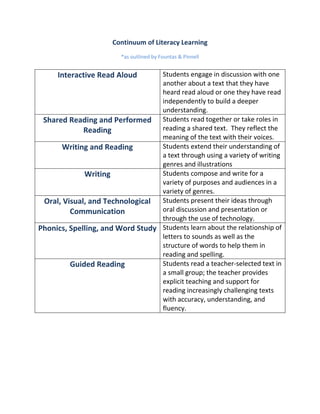
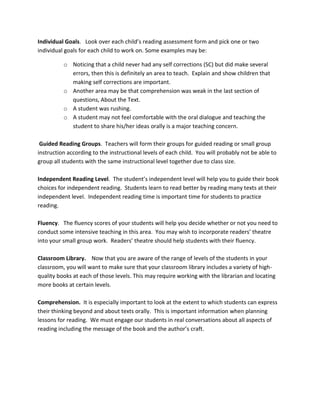
    Seven areas inthe Continua of Literacy Learning can be utilized to target specific literacy areas.Continuum of Literacy Learning <br />Interactive Read AloudStudents engage in discussion with one another about a text that they have heard read aloud or one they have read independently to build a deeper understanding.Shared Reading and Performed ReadingStudents read together or take roles in reading a shared text. They reflect the meaning of the text with their voices.Writing and ReadingStudents extend their understanding of a text through using a variety of writing genres and illustrationsWritingStudents compose and write for a variety of purposes and audiences in a variety of genres.Oral, Visual, and Technological CommunicationStudents present their ideas through oral discussion and presentation or through the use of technology.Phonics, Spelling, and Word StudyStudents learn about the relationship of letters to sounds as well as the structure of words to help them in reading and spelling.Guided ReadingStudents read a teacher-selected text in a small group; the teacher provides explicit teaching and support for reading increasingly challenging texts with accuracy, understanding, and fluency. <br />*as outlined by Fountas & Pinnell<br />Individual Goals. Look over each child’s reading assessment form and pick one or two individual goals for each child to work on. Some examples may be:<br />Noticing that a child never had any self corrections (SC) but did make several errors, then this is definitely an area to teach. Explain and show children that making self corrections are important.
  • 40.
    Another area maybe that comprehension was weak in the last section of questions, About the Text.
  • 41.
    A student wasrushing.
  • 42.
    A student maynot feel comfortable with the oral dialogue and teaching the student to share his/her ideas orally is a major teaching concern. Guided Reading Groups. Teachers will form their groups for guided reading or small group instruction according to the instructional levels of each child. You will probably not be able to group all students with the same instructional level together due to class size.<br /> <br />Independent Reading Level. The student’s independent level will help you to guide their book choices for independent reading. Students learn to read better by reading many texts at their independent level. Independent reading time is important time for students to practice reading. <br /> Fluency. The fluency scores of your students will help you decide whether or not you need to conduct some intensive teaching in this area. You may wish to incorporate readers’ theatre into your small group work. Readers’ theatre should help students with their fluency.<br /> <br />Classroom Library. Now that you are aware of the range of levels of the students in your classroom, you will want to make sure that your classroom library includes a variety of high-quality books at each of those levels. This may require working with the librarian and locating more books at certain levels.<br />Comprehension. It is especially important to look at the extent to which students can express their thinking beyond and about texts orally. This is important information when planning lessons for reading. We must engage our students in real conversations about all aspects of reading including the message of the book and the author’s craft. <br /> <br />