It’s All About Thinking:
engaging and achieving for all
learners	
  
Bodwell	
  High	
  School	
  
February	
  23,	
  2015	
  
www.slideshare.net/fayebrownlie/
bodwell/2015	
  
Learning Intentions
•  I	
  have	
  more	
  strategies	
  to	
  include	
  ALL	
  student	
  
voices	
  in	
  my	
  classes.	
  
•  I	
  am	
  conEnuing	
  to	
  grow	
  my	
  understanding	
  of	
  
effecEve	
  teaching	
  pracEces	
  for	
  adolescent	
  
learners.	
  
•  I	
  have	
  a	
  plan	
  to	
  try	
  something	
  different	
  in	
  my	
  
classes.	
  
My understanding of Bodwell goals
•  High	
  performance	
  
•  Increased	
  skill	
  in	
  reading,	
  wriEng	
  and	
  speaking	
  
English	
  
•  Building	
  a	
  community	
  of	
  learners	
  
McKinsey Report, 2007
•  The	
  top-­‐performing	
  school	
  systems	
  recognize	
  
that	
  the	
  only	
  way	
  to	
  improve	
  outcomes	
  is	
  to	
  
improve	
  instrucEon:	
  	
  learning	
  occurs	
  when	
  
students	
  and	
  teachers	
  interact,	
  and	
  thus	
  to	
  
improve	
  learning	
  implies	
  improving	
  the	
  quality	
  
of	
  that	
  interacEon.	
  
How the world’s most improved
school systems keep getting better
–McKinsey, 2010
Three	
  changes	
  collaboraEve	
  pracEce	
  brought	
  about:	
  
1.  Teachers	
  moved	
  from	
  being	
  private	
  emperors	
  to	
  
making	
  their	
  pracEce	
  public	
  and	
  the	
  enEre	
  teaching	
  
populaEon	
  sharing	
  responsibility	
  for	
  student	
  learning.	
  
2.  Focus	
  shiOed	
  from	
  what	
  teachers	
  teach	
  to	
  what	
  
students	
  learn.	
  
3.  Systems	
  developed	
  a	
  model	
  of	
  ‘good	
  instrucEon’	
  and	
  
teachers	
  became	
  custodians	
  of	
  the	
  model.	
  (p.	
  79-­‐81)	
  
•  “An	
  impressive	
  number	
  of	
  studies	
  confirm	
  that	
  
avid	
  or	
  “self-­‐selected”	
  reading	
  is	
  the	
  main	
  
source	
  of	
  our	
  reading	
  ability,	
  vocabulary	
  
knowledge,	
  our	
  ability	
  to	
  handle	
  complex	
  
grammaEcal	
  construcEons,	
  spelling,	
  and	
  our	
  
ability	
  to	
  write	
  in	
  an	
  acceptable	
  style.”	
  
•  Stephen	
  Krashan	
  in	
  Reading	
  Today,	
  Nov/Dec	
  2014	
  
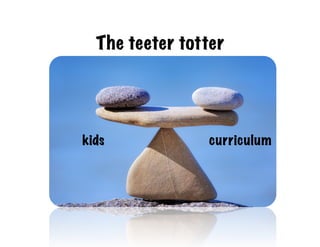
The teeter totter
kids
kids curriculum
Universal Design for Learning
p. 54, It’s All about Thinking – Math/Science
“Rather	
  than	
  taking	
  the	
  perspecEve	
  that	
  we	
  should	
  
“fix”	
  children	
  because	
  they	
  do	
  not	
  learn	
  in	
  a	
  
parEcular	
  way	
  ,	
  UDL	
  takes	
  a	
  student-­‐centered	
  
approach,	
  which	
  means	
  designing	
  many	
  ways	
  to	
  
engage	
  students,	
  many	
  ways	
  for	
  them	
  to	
  access	
  
and	
  process	
  informaEon,	
  	
  and	
  many	
  ways	
  for	
  
them	
  to	
  express	
  what	
  they	
  know	
  and	
  learn.	
  	
  We	
  
achieve	
  this	
  by	
  using	
  curricular	
  materials	
  and	
  
acEviEes	
  that	
  that	
  provide	
  mulEple	
  paths	
  for	
  
students	
  with	
  differing	
  strengths,	
  interests,	
  and	
  
abiliEes.	
  	
  These	
  alternaEves	
  are	
  built	
  into	
  the	
  
instrucEonal	
  design	
  of	
  educaEonal	
  materials;	
  
they	
  are	
  not	
  added	
  on	
  aOer	
  the	
  fact.”	
  
•  Say	
  something:	
  
– What	
  does	
  this	
  mean	
  to	
  you?	
  
– What	
  does	
  this	
  look	
  like	
  in	
  your	
  pracEce?	
  
– What	
  do	
  you	
  do	
  more	
  consciously	
  now	
  than	
  you	
  
did	
  2	
  years	
  ago?	


Backwards Design
Teaching	
  with	
  the	
  end	
  in	
  mind.	
  
QuesEons	
  to	
  guide	
  our	
  planning:	
  
	
  -­‐What	
  do	
  I	
  want	
  my	
  students	
  to	
  know	
  and	
  do?	
  
	
  -­‐How	
  will	
  I	
  know	
  that	
  they	
  have	
  developed	
  
these	
  understandings	
  and	
  thinking	
  strategies?	
  
	
  -­‐How	
  will	
  I	
  engage	
  students	
  in	
  construcEng	
  
understandings	
  and	
  developing	
  key	
  strategies?	
  
Approaches
•  Assessment	
  for	
  learning	
  (p.60-­‐61)	
  (p.47-­‐48)	
  
•  Open-­‐ended	
  strategies	
  (p.61-­‐63)	
  (p.48-­‐50)	
  
•  Gradual	
  release	
  of	
  responsibility	
  (p.63)	
  (p.50)	
  
•  CooperaEve	
  learning	
  (p.63-­‐64)	
  (p.50-­‐51)	
  
•  Literature	
  circles	
  (p.51-­‐53)	
  
•  InformaEon	
  circles	
  (p.65)	
  
•  Inquiry	
  (p.66)	
  (p.53)	
  
Task
•  Groups	
  of	
  3-­‐4	
  
•  Read	
  your	
  secEon	
  and	
  discuss	
  what	
  it	
  means	
  
to	
  you	
  
•  Create	
  a	
  10	
  word	
  poem	
  	
  
– What	
  is	
  this?	
  
– Why	
  does	
  it	
  maier?	
  
“The	
  most	
  powerful	
  single	
  influence	
  enhancing	
  
achievement	
  is	
  feedback”-­‐Dylan	
  Wiliam	
  
•  Quality	
  feedback	
  is	
  needed,	
  not	
  just	
  more	
  feedback	
  
•  Students	
  with	
  a	
  Growth	
  Mindset	
  welcome	
  feedback	
  
and	
  are	
  more	
  likely	
  to	
  use	
  it	
  to	
  improve	
  their	
  
performance	
  
•  Oral	
  feedback	
  is	
  much	
  more	
  effecEve	
  than	
  wriien	
  
•  The	
  most	
  powerful	
  feedback	
  is	
  provided	
  from	
  the	
  
student	
  to	
  the	
  teacher	
  
Strategy Sequences
•  Consider:	
  
– MulEple	
  paths	
  to	
  the	
  big	
  idea	
  
– Who	
  is	
  talking?	
  
– Who	
  is	
  doing	
  the	
  work?	
  
– Engagement	
  
– Co-­‐construcEon	
  of	
  knowledge	
  
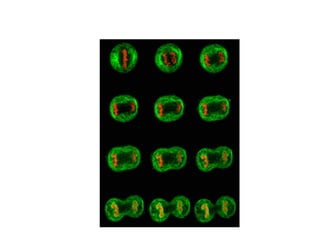
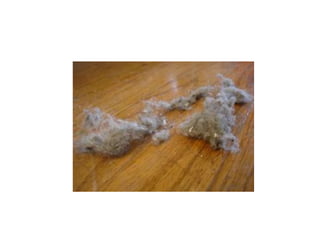
Introduction to Mitosis
•  Whip	
  around	
  –	
  what	
  do	
  you	
  remember	
  about	
  
DNA?	
  	
  Quick	
  write.	
  
•  QuesEoning	
  from	
  3	
  pictures	
  
•  AnEcipaEon	
  guide	
  –	
  with	
  partner	
  
•  Read	
  to	
  find	
  out	
  and	
  provide	
  evidence	
  for	
  your	
  
answer	
  	
  
•  Sort	
  and	
  predict	
  –	
  groups	
  of	
  3	
  
•  With	
  Ken	
  Asano,	
  Centennial	
  
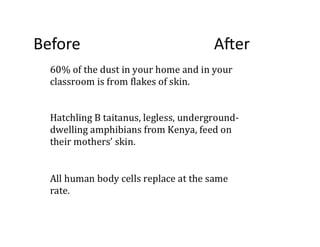
Before 	


  AOer	
  
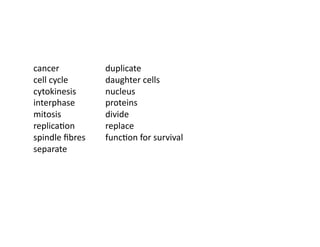
cancer	


  duplicate	
  
cell	
  cycle 	
   	
   	
  daughter	
  cells	
  
cytokinesis	
   	
   	
  nucleus	
  
interphase	
   	
   	
  proteins	
  
mitosis	


  divide	
  
replicaEon	
   	
   	
  replace	
  
spindle	
  fibres 	
   	
  funcEon	
  for	
  survival	
  
separate	
  
Goal: Reading and Writing with
Fluency
•  Grade	
  8	
  English	
  
•  Dawnn	
  Thorsen,	
  CT	
  and	
  Sheryl	
  Proskiw,	
  ELD,	
  
Prince	
  Rupert	
  Middle	
  School	
  
•  Have	
  co-­‐taught	
  for	
  2	
  years	
  
– TRUST	
  
– All	
  we	
  need	
  is	
  a	
  GOAL	
  
– Every	
  2nd	
  day	
  in	
  both	
  classes	
  
•  Both	
  classes	
  have	
  24	
  kids	
  
•  Both	
  classes	
  have	
  3	
  kids	
  on	
  IEPs	
  
•  Classroom	
  management	
  improved	
  with	
  daily	
  20	
  
minutes	
  of	
  silent	
  reading	
  
•  Class	
  1	
  
–  Lower	
  self-­‐esteem	
  
–  18	
  have	
  had	
  ESD	
  support	
  at	
  some	
  point	
  	
  
•  Class	
  2	
  
–  4	
  students	
  have	
  challenged	
  grade	
  8	
  math	
  
–  EA	
  
–  More	
  diversity	
  
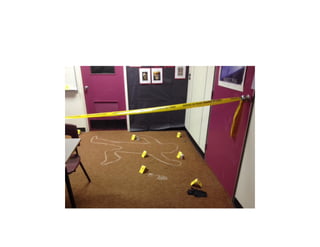
Day 1: Mystery Writing
•  Enter	
  class	
  to	
  see	
  the	
  scene	
  of	
  the	
  crime	
  
•  5	
  minute	
  write	
  
–  Set	
  the	
  scene	
  
–  What	
  happened?	
  
–  Why?	
  
–  Mood?	
  
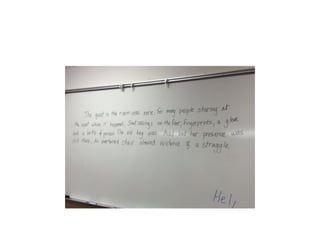
•  Dawnn	
  modeled	
  a	
  start	
  on	
  the	
  board	
  
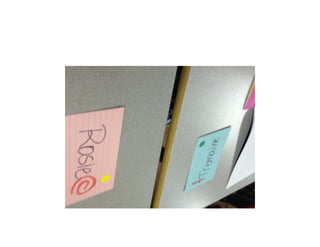
•  Change	
  groups	
  according	
  to	
  your	
  coloured	
  name	
  tag	
  
•  Character	
  (all	
  names	
  of	
  actual	
  people	
  in	
  the	
  school)	
  
–  One	
  reads	
  the	
  character’s	
  point	
  of	
  view	
  
–  5	
  minutes,	
  add	
  on	
  
•  Change	
  groups	
  
•  Piece	
  of	
  evidence	
  
–  Examine	
  the	
  evidence	
  together	
  
–  5	
  minutes,	
  add	
  on	
  
•  WriEng	
  is	
  collected	
  as	
  kids	
  leave	
  
•  Plenty	
  of	
  Eme	
  for	
  both	
  teachers	
  to	
  move	
  around	
  to	
  
support	
  and	
  extend	
  all	
  learners	
  
•  Students	
  very	
  on	
  task	
  
•  Tomorrow:	
  
–  Teachers	
  will	
  have	
  chosen	
  one	
  phrase/line	
  from	
  each	
  
writer	
  
–  Display	
  for	
  all	
  to	
  see	
  
–  Look	
  for	
  strengths	
  
–  Move	
  to	
  wriEng	
  own	
  detecEve	
  story	
  
Math 9
LO: multiply and divide rational
numbers (positive and negative
mixed number fractions)
•  Challenge:	


– engaging	
  and	
  challenging	
  the	
  various	
  levels	
  of	
  
learners	
  
– Thinking	
  about	
  raEonale	
  numbers	
  not	
  just	
  
operaEng	
  on	
  them	
  
•  Sara	
  added	
  two	
  frac,ons.	
  Her	
  sum	
  was	
  a	
  li5le	
  
more	
  than	
  5.What	
  could	
  her	
  frac,ons	
  be?	
  How	
  
many	
  ways	
  can	
  you	
  find?	
  
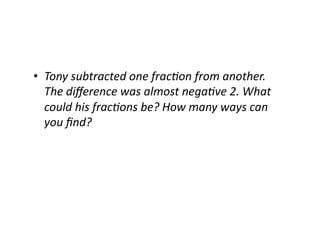
•  Tony	
  subtracted	
  one	
  frac,on	
  from	
  another.	
  
The	
  difference	
  was	
  almost	
  nega,ve	
  2.	
  What	
  
could	
  his	
  frac,ons	
  be?	
  How	
  many	
  ways	
  can	
  
you	
  find?	
  
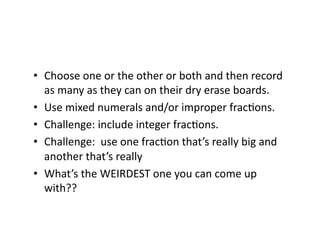
•  Choose	
  one	
  or	
  the	
  other	
  or	
  both	
  and	
  then	
  record	
  
as	
  many	
  as	
  they	
  can	
  on	
  their	
  dry	
  erase	
  boards.	
  
•  Use	
  mixed	
  numerals	
  and/or	
  improper	
  fracEons.	
  
•  Challenge:	
  include	
  integer	
  fracEons.	
  
•  Challenge:	
  	
  use	
  one	
  fracEon	
  that’s	
  really	
  big	
  and	
  
another	
  that’s	
  really	
  	
  
•  What’s	
  the	
  WEIRDEST	
  one	
  you	
  can	
  come	
  up	
  
with??	
  
Strategy Sequences
•  Using	
  the	
  language	
  
•  Who	
  is	
  talking?	
  
Lit	
  12:	
  	
  pracEce	
  without	
  penalty	
  
Naryn	
  Searcy,	
  PenEcton	
  
•  Goal:	
  	
  learn	
  how	
  to	
  represent	
  your	
  
understanding	
  of	
  a	
  poem	
  in	
  a	
  different	
  ways	
  
•  Poet:	
  	
  Robert	
  Burns	


– Auld	
  Lang	
  Syne	
  (read	
  aloud)	
  
– To	
  a	
  Mouse	
  (teams)	
  
1.	
  	
  Read	
  aloud	
  and	
  pracEce	
  stanza	
  with	
  partner	
  
2.	
  	
  Connect	
  to	
  themes:	
  
– Mankind	
  has	
  broken	
  its	
  union	
  with	
  nature	
  
– Even	
  our	
  best	
  laid	
  plans	
  oOen	
  do	
  not	
  work	
  out	
  
3.	
  	
  Microcosm	
  &	
  universal	
  truths	
  
Assignment	
  
1.  Mouse	
  Dance	
  –	
  all	
  8	
  stanzas	
  (2-­‐4	
  students)	
  
2.  Comic	
  (1-­‐2	
  students)	
  
3.  Reduced	
  poetry	
  (1-­‐2	
  students)	
  
Criteria	
  
•  Demonstrate	
  understanding	
  of	
  the	
  meaning	
  of	
  
all	
  8	
  stanzas	
  of	
  the	
  poem	
  
•  Recognize	
  and	
  demonstrate	
  the	
  2	
  themes	
  
Feedback	
  
•  What	
  worked?	
  
•  What’s	
  missing?	
  
•  What’s	
  next?	
  
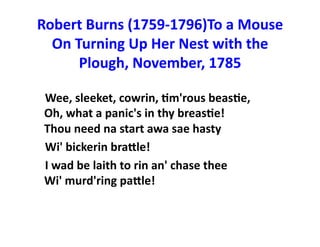
Robert	
  Burns	
  (1759-­‐1796)To	
  a	
  Mouse	
  
On	
  Turning	
  Up	
  Her	
  Nest	
  with	
  the	
  
Plough,	
  November,	
  1785	


  Wee,	
  sleeket,	
  cowrin,	
  Km'rous	
  beasKe,	


Oh,	
  what	
  a	
  panic's	
  in	
  thy	
  breasKe!	


Thou	
  need	
  na	
  start	
  awa	
  sae	
  hasty	


  Wi'	
  bickerin	
  braOle!	


  I	
  wad	
  be	
  laith	
  to	
  rin	
  an'	
  chase	
  thee	


Wi'	
  murd'ring	
  paOle!	
  
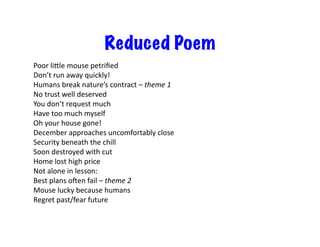
Reduced Poem
Poor	
  liile	
  mouse	
  petrified	
  
Don’t	
  run	
  away	
  quickly!	
  
Humans	
  break	
  nature’s	
  contract	
  –	
  theme	
  1	
  
No	
  trust	
  well	
  deserved	
  
You	
  don’t	
  request	
  much	
  
Have	
  too	
  much	
  myself	
  
Oh	
  your	
  house	
  gone!	
  
December	
  approaches	
  uncomfortably	
  close	
  
Security	
  beneath	
  the	
  chill	
  
Soon	
  destroyed	
  with	
  cut	
  
Home	
  lost	
  high	
  price	
  
Not	
  alone	
  in	
  lesson:	
  
Best	
  plans	
  oOen	
  fail	
  –	
  theme	
  2	
  
Mouse	
  lucky	
  because	
  humans	
  
Regret	
  past/fear	
  future	
  
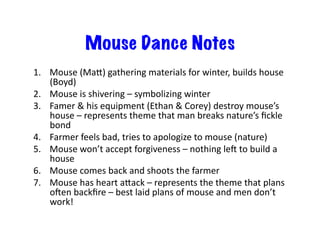
Mouse Dance Notes
1.  Mouse	
  (Mai)	
  gathering	
  materials	
  for	
  winter,	
  builds	
  house	
  
(Boyd)	
  
2.  Mouse	
  is	
  shivering	
  –	
  symbolizing	
  winter	
  
3.  Famer	
  &	
  his	
  equipment	
  (Ethan	
  &	
  Corey)	
  destroy	
  mouse’s	
  
house	
  –	
  represents	
  theme	
  that	
  man	
  breaks	
  nature’s	
  fickle	
  
bond	
  
4.  Farmer	
  feels	
  bad,	
  tries	
  to	
  apologize	
  to	
  mouse	
  (nature)	
  
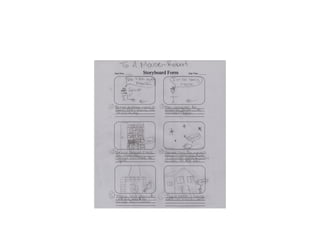
5.  Mouse	
  won’t	
  accept	
  forgiveness	
  –	
  nothing	
  leO	
  to	
  build	
  a	
  
house	
  
6.  Mouse	
  comes	
  back	
  and	
  shoots	
  the	
  farmer	
  
7.  Mouse	
  has	
  heart	
  aiack	
  –	
  represents	
  the	
  theme	
  that	
  plans	
  
oOen	
  backfire	
  –	
  best	
  laid	
  plans	
  of	
  mouse	
  and	
  men	
  don’t	
  
work!	
  
Average velocity is the rate of
change in position	
  	
  
Grade	
  10	
  science	
  
Sarah	
  Johnson,	
  Prince	
  Rupert	
  
with	
  thanks	
  to	
  Aliisa	
  Sarta,	
  Moody	
  Secondary	
  
•  hip://www.dailymoEon.com/video/
xEcm4_the-­‐hare-­‐and-­‐the-­‐tortoise-­‐aesop-­‐s-­‐
fables_animals	
  
•  Video	
  of	
  The	
  Tortoise	
  and	
  the	
  Hare	
  
•  Describe	
  the	
  movement	
  of	
  them	
  both	
  
•  Handed	
  out	
  vocabulary	
  matching	
  with	
  physics	
  
‘moEon’	
  vocabulary	
  words	
  (but	
  not	
  the	
  matches)	
  
•  See	
  the	
  video	
  again	
  
•  Describe	
  the	
  movement	
  with	
  the	
  new	
  vocabulary	
  
•  Match	
  the	
  vocabulary	
  with	
  the	
  correct	
  definiEon	
  
•  1:1	
  coaching:	
  	
  what	
  are	
  you	
  certain	
  of,	
  where	
  do	
  
you	
  need	
  help?	
  
•  Average	
  velocity	
  
•  Distance	
  
•  Magnitude	
  
•  NegaEve	
  slope	
  
•  PosiEve	
  slope	
  
•  Scalar	
  
•  Slope	
  
•  Speed	
  	
  
•  Time	
  
•  Time	
  interval	
  
•  Uniform	
  moEon	
  
•  Vector	
  
•  Velocity	
  
•  Zero	
  slope	
  
•  PosiEon-­‐Eme	
  graph	
  
(displacement-­‐Eme	
  graph)	
  
•  How	
  many	
  of	
  you	
  have	
  an	
  answer?	
  
•  How	
  many	
  of	
  you	
  would	
  like	
  to	
  share?	
  
Note-taking in Food Studies
•  Best	
  Secondary	
  with	
  Alexia	
  Baldwin	
  and	
  Denise	
  
Nemblard,	
  grade	
  9	
  Food	
  Studies	
  
•  Previously	
  had	
  lesson	
  on	
  grains	
  and	
  rice	
  cooking	
  
demo	
  
•  Challenge:	
  	
  S	
  love	
  pracEcal,	
  not	
  the	
  theory;	
  text	
  is	
  
1975,	
  present	
  by	
  lecture	
  
•  LO:	
  
–  Rice	
  is	
  part	
  of	
  the	
  grain	
  group	
  
–  NutriEonal	
  values	
  of	
  different	
  grains	
  of	
  rice	
  
–  Factors	
  influencing	
  choice	
  of	
  rice	
  
–  Wild	
  rice,	
  a	
  Canadian	
  component	
  
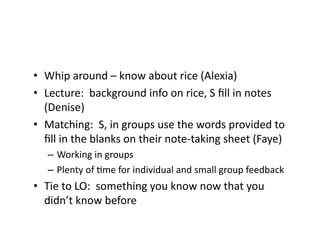
•  Whip	
  around	
  –	
  know	
  about	
  rice	
  (Alexia)	
  
•  Lecture:	
  	
  background	
  info	
  on	
  rice,	
  S	
  fill	
  in	
  notes	
  
(Denise)	
  
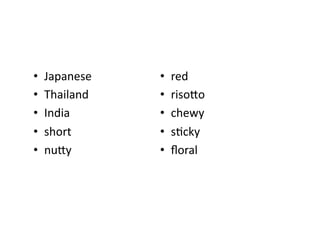
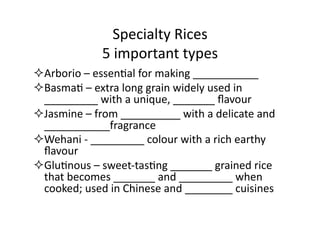
•  Matching:	
  	
  S,	
  in	
  groups	
  use	
  the	
  words	
  provided	
  to	
  
fill	
  in	
  the	
  blanks	
  on	
  their	
  note-­‐taking	
  sheet	
  (Faye)	
  
–  Working	
  in	
  groups	
  
–  Plenty	
  of	
  Eme	
  for	
  individual	
  and	
  small	
  group	
  feedback	
  
•  Tie	
  to	
  LO:	
  	
  something	
  you	
  know	
  now	
  that	
  you	
  
didn’t	
  know	
  before	
  
•  Japanese	
  
•  Thailand	
  
•  India	
  
•  short	
  
•  nuiy	
  
•  red	
  
•  risoio	
  
•  chewy	
  
•  sEcky	
  
•  floral	
  
Specialty	
  Rices	
  
5	
  important	
  types	
  
 Arborio	
  –	
  essenEal	
  for	
  making	
  ___________	
  
 BasmaE	
  –	
  extra	
  long	
  grain	
  widely	
  used	
  in	
  
_________	
  with	
  a	
  unique,	
  _______	
  flavour	
  
 Jasmine	
  –	
  from	
  __________	
  with	
  a	
  delicate	
  and	
  
___________fragrance	
  
 Wehani	
  -­‐	
  _________	
  colour	
  with	
  a	
  rich	
  earthy	
  
flavour	
  
 GluEnous	
  –	
  sweet-­‐tasEng	
  _______	
  grained	
  rice	
  
that	
  becomes	
  _______	
  and	
  _________	
  when	
  
cooked;	
  used	
  in	
  Chinese	
  and	
  ________	
  cuisines	
  
Assessment and Feedback
Criteria:	
  	
  Physics	
  11	
  Checkpoints	
  
Jacob	
  Martens,	
  Vancouver	
  
•  Exemplary:	
  Complete	
  &	
  in	
  depth	
  understanding	
  of	
  
concepts.	
  Answers	
  are	
  correct,	
  with	
  elegant	
  soluEon	
  
strategies. 	
  	
  
•  Accomplished:	
  	
  Solid	
  understanding	
  of	
  concepts.	
  	
  Most	
  
answers	
  are	
  correct.	
  	
  SoluEon	
  strategy	
  has	
  few	
  errors.	
  
•  Developing:	
  	
  Basic	
  understanding	
  of	
  concepts.	
  	
  Errors	
  and	
  
inconsistency	
  reveal	
  some	
  missing	
  elements. 	
  	
  
•  Beginning:	
  	
  Does	
  not	
  demonstrate	
  basic	
  understanding	
  of	
  
concept.	
  	
  SubstanEal	
  errors	
  and/or	
  omissions.	
  
•  Criteria:	
  	
  Michelle	
  Wood,	
  West	
  Van,	
  Science	
  10	
  IRP	
  	
  
Criteria:	
  	
  
Exemplary	


  Accomplished	
  	
  	
  Developing	
  	
  	
  Basic	
  
Concept	
  #11	
  
Solve	
  problems	
  involving	
  the	
  law	
  of	
  conservaKon	
  of	
  energy.	
  
A	
  50.	
  kg	
  girl	
  slides	
  down	
  a	
  5.0	
  m	
  long	
  playground	
  slide.	
  	
  The	
  top	
  of	
  the	
  slide	
  is	
  2.0	
  m	
  
above	
  the	
  ground	
  and	
  the	
  boiom	
  of	
  the	
  slide	
  is	
  0.5	
  m	
  above	
  the	
  ground.	
  
	
  How	
  fast	
  would	
  one	
  expect	
  her	
  to	
  be	
  moving	
  at	
  the	
  boOom	
  of	
  the	
  slide? 	


E	


  A	


  B	


  D	
  
Map	
  for	
  improvement:	
  drawing,	
  formulas	
  given,	
  working	
  shown,	
  correct	
  calculaEon,	
  
sig	
  figs,	
  answers	
  clearly	
  indicated.	


Concept	
  #9	
  
Relate	
  work	
  done	
  to	
  energy	
  transformaKon.	
  
In	
  the	
  quesEon	
  above,	
  the	
  girl	
  reaches	
  the	
  boiom	
  of	
  the	
  slide	
  moving	
  at	
  1.5	
  m/s.	
  
How	
  much	
  “work”	
  was	
  done	
  on	
  the	
  girl	
  by	
  the	
  force	
  of	
  fricEon?	
  
E	


  A	


  D	


  B	
  
Map	
  for	
  improvement:	
  drawing,	
  formulas	
  given,	
  working	
  shown,	
  correct	
  calculaEon,	
  
sig	
  figs,	
  answers	
  clearly	
  indicated.	
  
•  On	
  the	
  back	
  of	
  this	
  sheet	
  please	
  use	
  the	
  
concepts	
  learned	
  in	
  this	
  unit	
  to	
  explain	
  why	
  
the	
  girl	
  is	
  moving	
  slower	
  than	
  expected.	
  
KinemaEcs	
  
•  The	
  future	
  locaEon	
  and	
  moEon	
  of	
  
objects	
  can	
  be	
  predicted	
  based	
  on	
  
their	
  past	
  locaEon	
  and	
  moEon.	
  	
  
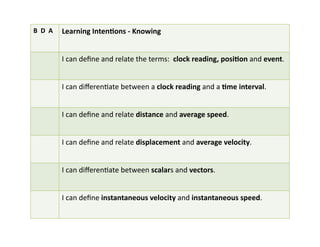
B	
  	
  D	
  	
  A	
   Learning	
  IntenKons	
  -­‐	
  Knowing	
  
I	
  can	
  define	
  and	
  relate	
  the	
  terms:	
  	
  clock	
  reading,	
  posiKon	
  and	
  event.	
  
I	
  can	
  differenEate	
  between	
  a	
  clock	
  reading	
  and	
  a	
  Kme	
  interval.	
  
I	
  can	
  define	
  and	
  relate	
  distance	
  and	
  average	
  speed.	
  
I	
  can	
  define	
  and	
  relate	
  displacement	
  and	
  average	
  velocity.	
  
I	
  can	
  differenEate	
  between	
  scalars	
  and	
  vectors.	
  
I	
  can	
  define	
  instantaneous	
  velocity	
  and	
  instantaneous	
  speed.	
  
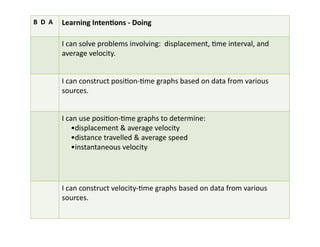
B	
  	
  D	
  	
  A	
   Learning	
  IntenKons	
  -­‐	
  Doing	
  
I	
  can	
  solve	
  problems	
  involving:	
  	
  displacement,	
  Eme	
  interval,	
  and	
  
average	
  velocity.	
  
I	
  can	
  construct	
  posiEon-­‐Eme	
  graphs	
  based	
  on	
  data	
  from	
  various	
  
sources.	
  
I	
  can	
  use	
  posiEon-­‐Eme	
  graphs	
  to	
  determine:	


  •displacement	
  &	
  average	
  velocity	


  •distance	
  travelled	
  &	
  average	
  speed	


  •instantaneous	
  velocity	
  
I	
  can	
  construct	
  velocity-­‐Eme	
  graphs	
  based	
  on	
  data	
  from	
  various	
  
sources.	
  
Art 9/10
with Sheri Tompkins, Heritage Woods
•  Teacher	
  Modelling	
  
•  Students	
  have	
  ‘Talking	
  about	
  Art’	
  sheet.	
  
•  Teacher	
  presents	
  a	
  piece	
  of	
  her	
  art,	
  using	
  
‘Talking	
  about	
  Art’	
  sheet	
  as	
  her	
  guide	
  and	
  
adding	
  her	
  own	
  ideas.	
  
•  T	
  turns	
  her	
  back;	
  students	
  discuss	
  and	
  record.	
  
•  T	
  writes	
  down	
  what	
  is	
  said	
  on	
  her	
  paper.	
  
Art 9/10
with Sheri Tompkins, Heritage Woods
•  Working	
  together	
  
•  Student	
  chooses	
  one	
  piece	
  of	
  his	
  art	
  for	
  feedback	
  
•  Student	
  self-­‐assesses,	
  presents	
  his	
  piece	
  to	
  his	
  
group	
  (of	
  4	
  or	
  5),	
  others	
  observe	
  silently,	
  student	
  
adds	
  his	
  comments.	
  
•  Student	
  turns	
  his	
  back.	
  	
  Group	
  members	
  discuss	
  
the	
  art	
  work,	
  using	
  the	
  criteria	
  sheet.	
  	
  No	
  
judgment,	
  likes	
  or	
  dislikes.	
  	
  Student	
  records	
  the	
  
remarks.	
  
•  Students	
  summarizes	
  his	
  feedback	
  and	
  others	
  
with	
  	
  
– 2	
  aspects	
  I	
  want	
  you	
  to	
  noEce	
  	
  
– 1	
  aspect	
  for	
  feedback	
  
•  The	
  art	
  work,	
  the	
  self-­‐assessment	
  and	
  the	
  
summary	
  are	
  handed	
  in	
  to	
  the	
  teacher.	
  
•  Teacher	
  responds,	
  following	
  the	
  summary	
  of	
  
the	
  student	
  direcEon.	
  
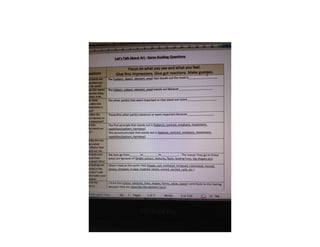
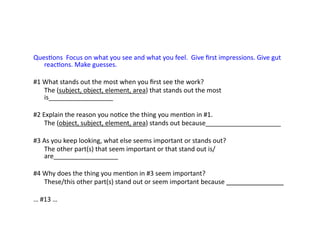
QuesEons	
  	
  Focus	
  on	
  what	
  you	
  see	
  and	
  what	
  you	
  feel.	
  	
  Give	
  first	
  impressions.	
  Give	
  gut	
  
reacEons.	
  Make	
  guesses.	
  
#1	
  What	
  stands	
  out	
  the	
  most	
  when	
  you	
  first	
  see	
  the	
  work?	
  
	
  The	
  (subject,	
  object,	
  element,	
  area)	
  that	
  stands	
  out	
  the	
  most	
  
is__________________	
  
#2	
  Explain	
  the	
  reason	
  you	
  noEce	
  the	
  thing	
  you	
  menEon	
  in	
  #1.	
  
	
  The	
  (object,	
  subject,	
  element,	
  area)	
  stands	
  out	
  because_____________________	
  
#3	
  As	
  you	
  keep	
  looking,	
  what	
  else	
  seems	
  important	
  or	
  stands	
  out?	
  
	
  The	
  other	
  part(s)	
  that	
  seem	
  important	
  or	
  that	
  stand	
  out	
  is/
are__________________	
  
#4	
  Why	
  does	
  the	
  thing	
  you	
  menEon	
  in	
  #3	
  seem	
  important?	
  
	
  These/this	
  other	
  part(s)	
  stand	
  out	
  or	
  seem	
  important	
  because	
  ________________	
  
…	
  #13	
  …	
  
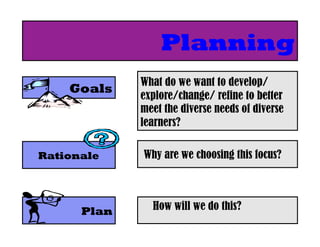
Goals
Plan
Rationale
Planning
What do we want to develop/
explore/change/ refine to better
meet the diverse needs of diverse
learners?	

Why are we choosing this focus?	

How will we do this?

Bodwell.feb.2015

  • 1.
    It’s All AboutThinking: engaging and achieving for all learners   Bodwell  High  School   February  23,  2015   www.slideshare.net/fayebrownlie/ bodwell/2015  
  • 2.
    Learning Intentions •  I  have  more  strategies  to  include  ALL  student   voices  in  my  classes.   •  I  am  conEnuing  to  grow  my  understanding  of   effecEve  teaching  pracEces  for  adolescent   learners.   •  I  have  a  plan  to  try  something  different  in  my   classes.  
  • 3.
    My understanding ofBodwell goals •  High  performance   •  Increased  skill  in  reading,  wriEng  and  speaking   English   •  Building  a  community  of  learners  
  • 4.
    McKinsey Report, 2007 • The  top-­‐performing  school  systems  recognize   that  the  only  way  to  improve  outcomes  is  to   improve  instrucEon:    learning  occurs  when   students  and  teachers  interact,  and  thus  to   improve  learning  implies  improving  the  quality   of  that  interacEon.  
  • 5.
    How the world’smost improved school systems keep getting better –McKinsey, 2010 Three  changes  collaboraEve  pracEce  brought  about:   1.  Teachers  moved  from  being  private  emperors  to   making  their  pracEce  public  and  the  enEre  teaching   populaEon  sharing  responsibility  for  student  learning.   2.  Focus  shiOed  from  what  teachers  teach  to  what   students  learn.   3.  Systems  developed  a  model  of  ‘good  instrucEon’  and   teachers  became  custodians  of  the  model.  (p.  79-­‐81)  
  • 6.
    •  “An  impressive  number  of  studies  confirm  that   avid  or  “self-­‐selected”  reading  is  the  main   source  of  our  reading  ability,  vocabulary   knowledge,  our  ability  to  handle  complex   grammaEcal  construcEons,  spelling,  and  our   ability  to  write  in  an  acceptable  style.”   •  Stephen  Krashan  in  Reading  Today,  Nov/Dec  2014  
  • 7.
  • 8.
    Universal Design forLearning p. 54, It’s All about Thinking – Math/Science “Rather  than  taking  the  perspecEve  that  we  should   “fix”  children  because  they  do  not  learn  in  a   parEcular  way  ,  UDL  takes  a  student-­‐centered   approach,  which  means  designing  many  ways  to   engage  students,  many  ways  for  them  to  access   and  process  informaEon,    and  many  ways  for   them  to  express  what  they  know  and  learn.    We   achieve  this  by  using  curricular  materials  and   acEviEes  that  that  provide  mulEple  paths  for   students  with  differing  strengths,  interests,  and   abiliEes.    These  alternaEves  are  built  into  the   instrucEonal  design  of  educaEonal  materials;   they  are  not  added  on  aOer  the  fact.”  
  • 9.
    •  Say  something:   – What  does  this  mean  to  you?   – What  does  this  look  like  in  your  pracEce?   – What  do  you  do  more  consciously  now  than  you   did  2  years  ago?      
  • 10.
    Backwards Design Teaching  with  the  end  in  mind.   QuesEons  to  guide  our  planning:    -­‐What  do  I  want  my  students  to  know  and  do?    -­‐How  will  I  know  that  they  have  developed   these  understandings  and  thinking  strategies?    -­‐How  will  I  engage  students  in  construcEng   understandings  and  developing  key  strategies?  
  • 11.
    Approaches •  Assessment  for  learning  (p.60-­‐61)  (p.47-­‐48)   •  Open-­‐ended  strategies  (p.61-­‐63)  (p.48-­‐50)   •  Gradual  release  of  responsibility  (p.63)  (p.50)   •  CooperaEve  learning  (p.63-­‐64)  (p.50-­‐51)   •  Literature  circles  (p.51-­‐53)   •  InformaEon  circles  (p.65)   •  Inquiry  (p.66)  (p.53)  
  • 12.
    Task •  Groups  of  3-­‐4   •  Read  your  secEon  and  discuss  what  it  means   to  you   •  Create  a  10  word  poem     – What  is  this?   – Why  does  it  maier?  
  • 13.
    “The  most  powerful  single  influence  enhancing   achievement  is  feedback”-­‐Dylan  Wiliam   •  Quality  feedback  is  needed,  not  just  more  feedback   •  Students  with  a  Growth  Mindset  welcome  feedback   and  are  more  likely  to  use  it  to  improve  their   performance   •  Oral  feedback  is  much  more  effecEve  than  wriien   •  The  most  powerful  feedback  is  provided  from  the   student  to  the  teacher  
  • 14.
    Strategy Sequences •  Consider:   – MulEple  paths  to  the  big  idea   – Who  is  talking?   – Who  is  doing  the  work?   – Engagement   – Co-­‐construcEon  of  knowledge  
  • 15.
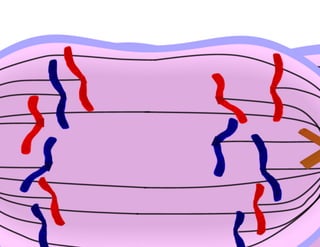
    Introduction to Mitosis • Whip  around  –  what  do  you  remember  about   DNA?    Quick  write.   •  QuesEoning  from  3  pictures   •  AnEcipaEon  guide  –  with  partner   •  Read  to  find  out  and  provide  evidence  for  your   answer     •  Sort  and  predict  –  groups  of  3   •  With  Ken  Asano,  Centennial  
  • 20.
    Before                      AOer  
  • 21.
    cancer        duplicate   cell  cycle      daughter  cells   cytokinesis      nucleus   interphase      proteins   mitosis        divide   replicaEon      replace   spindle  fibres    funcEon  for  survival   separate  
  • 27.
    Goal: Reading andWriting with Fluency •  Grade  8  English   •  Dawnn  Thorsen,  CT  and  Sheryl  Proskiw,  ELD,   Prince  Rupert  Middle  School   •  Have  co-­‐taught  for  2  years   – TRUST   – All  we  need  is  a  GOAL   – Every  2nd  day  in  both  classes  
  • 28.
    •  Both  classes  have  24  kids   •  Both  classes  have  3  kids  on  IEPs   •  Classroom  management  improved  with  daily  20   minutes  of  silent  reading   •  Class  1   –  Lower  self-­‐esteem   –  18  have  had  ESD  support  at  some  point     •  Class  2   –  4  students  have  challenged  grade  8  math   –  EA   –  More  diversity  
  • 29.
    Day 1: MysteryWriting •  Enter  class  to  see  the  scene  of  the  crime   •  5  minute  write   –  Set  the  scene   –  What  happened?   –  Why?   –  Mood?   •  Dawnn  modeled  a  start  on  the  board   •  Change  groups  according  to  your  coloured  name  tag   •  Character  (all  names  of  actual  people  in  the  school)   –  One  reads  the  character’s  point  of  view   –  5  minutes,  add  on   •  Change  groups   •  Piece  of  evidence   –  Examine  the  evidence  together   –  5  minutes,  add  on  
  • 33.
    •  WriEng  is  collected  as  kids  leave   •  Plenty  of  Eme  for  both  teachers  to  move  around  to   support  and  extend  all  learners   •  Students  very  on  task   •  Tomorrow:   –  Teachers  will  have  chosen  one  phrase/line  from  each   writer   –  Display  for  all  to  see   –  Look  for  strengths   –  Move  to  wriEng  own  detecEve  story  
  • 34.
    Math 9 LO: multiplyand divide rational numbers (positive and negative mixed number fractions) •  Challenge:       – engaging  and  challenging  the  various  levels  of   learners   – Thinking  about  raEonale  numbers  not  just   operaEng  on  them  
  • 35.
    •  Sara  added  two  frac,ons.  Her  sum  was  a  li5le   more  than  5.What  could  her  frac,ons  be?  How   many  ways  can  you  find?  
  • 36.
    •  Tony  subtracted  one  frac,on  from  another.   The  difference  was  almost  nega,ve  2.  What   could  his  frac,ons  be?  How  many  ways  can   you  find?  
  • 37.
    •  Choose  one  or  the  other  or  both  and  then  record   as  many  as  they  can  on  their  dry  erase  boards.   •  Use  mixed  numerals  and/or  improper  fracEons.   •  Challenge:  include  integer  fracEons.   •  Challenge:    use  one  fracEon  that’s  really  big  and   another  that’s  really     •  What’s  the  WEIRDEST  one  you  can  come  up   with??  
  • 38.
    Strategy Sequences •  Using  the  language   •  Who  is  talking?  
  • 39.
    Lit  12:    pracEce  without  penalty   Naryn  Searcy,  PenEcton   •  Goal:    learn  how  to  represent  your   understanding  of  a  poem  in  a  different  ways   •  Poet:    Robert  Burns       – Auld  Lang  Syne  (read  aloud)   – To  a  Mouse  (teams)  
  • 40.
    1.    Read  aloud  and  pracEce  stanza  with  partner   2.    Connect  to  themes:   – Mankind  has  broken  its  union  with  nature   – Even  our  best  laid  plans  oOen  do  not  work  out   3.    Microcosm  &  universal  truths  
  • 41.
    Assignment   1.  Mouse  Dance  –  all  8  stanzas  (2-­‐4  students)   2.  Comic  (1-­‐2  students)   3.  Reduced  poetry  (1-­‐2  students)  
  • 42.
    Criteria   •  Demonstrate  understanding  of  the  meaning  of   all  8  stanzas  of  the  poem   •  Recognize  and  demonstrate  the  2  themes  
  • 43.
    Feedback   •  What  worked?   •  What’s  missing?   •  What’s  next?  
  • 44.
    Robert  Burns  (1759-­‐1796)To  a  Mouse   On  Turning  Up  Her  Nest  with  the   Plough,  November,  1785              Wee,  sleeket,  cowrin,  Km'rous  beasKe,                             Oh,  what  a  panic's  in  thy  breasKe!                             Thou  need  na  start  awa  sae  hasty                                      Wi'  bickerin  braOle!                                      I  wad  be  laith  to  rin  an'  chase  thee                                         Wi'  murd'ring  paOle!  
  • 47.
    Reduced Poem Poor  liile  mouse  petrified   Don’t  run  away  quickly!   Humans  break  nature’s  contract  –  theme  1   No  trust  well  deserved   You  don’t  request  much   Have  too  much  myself   Oh  your  house  gone!   December  approaches  uncomfortably  close   Security  beneath  the  chill   Soon  destroyed  with  cut   Home  lost  high  price   Not  alone  in  lesson:   Best  plans  oOen  fail  –  theme  2   Mouse  lucky  because  humans   Regret  past/fear  future  
  • 48.
    Mouse Dance Notes 1. Mouse  (Mai)  gathering  materials  for  winter,  builds  house   (Boyd)   2.  Mouse  is  shivering  –  symbolizing  winter   3.  Famer  &  his  equipment  (Ethan  &  Corey)  destroy  mouse’s   house  –  represents  theme  that  man  breaks  nature’s  fickle   bond   4.  Farmer  feels  bad,  tries  to  apologize  to  mouse  (nature)   5.  Mouse  won’t  accept  forgiveness  –  nothing  leO  to  build  a   house   6.  Mouse  comes  back  and  shoots  the  farmer   7.  Mouse  has  heart  aiack  –  represents  the  theme  that  plans   oOen  backfire  –  best  laid  plans  of  mouse  and  men  don’t   work!  
  • 49.
    Average velocity isthe rate of change in position     Grade  10  science   Sarah  Johnson,  Prince  Rupert   with  thanks  to  Aliisa  Sarta,  Moody  Secondary  
  • 50.
  • 51.
    •  Video  of  The  Tortoise  and  the  Hare   •  Describe  the  movement  of  them  both   •  Handed  out  vocabulary  matching  with  physics   ‘moEon’  vocabulary  words  (but  not  the  matches)   •  See  the  video  again   •  Describe  the  movement  with  the  new  vocabulary   •  Match  the  vocabulary  with  the  correct  definiEon   •  1:1  coaching:    what  are  you  certain  of,  where  do   you  need  help?  
  • 52.
    •  Average  velocity   •  Distance   •  Magnitude   •  NegaEve  slope   •  PosiEve  slope   •  Scalar   •  Slope   •  Speed     •  Time   •  Time  interval   •  Uniform  moEon   •  Vector   •  Velocity   •  Zero  slope   •  PosiEon-­‐Eme  graph   (displacement-­‐Eme  graph)  
  • 53.
    •  How  many  of  you  have  an  answer?   •  How  many  of  you  would  like  to  share?  
  • 54.
    Note-taking in FoodStudies •  Best  Secondary  with  Alexia  Baldwin  and  Denise   Nemblard,  grade  9  Food  Studies   •  Previously  had  lesson  on  grains  and  rice  cooking   demo   •  Challenge:    S  love  pracEcal,  not  the  theory;  text  is   1975,  present  by  lecture   •  LO:   –  Rice  is  part  of  the  grain  group   –  NutriEonal  values  of  different  grains  of  rice   –  Factors  influencing  choice  of  rice   –  Wild  rice,  a  Canadian  component  
  • 55.
    •  Whip  around  –  know  about  rice  (Alexia)   •  Lecture:    background  info  on  rice,  S  fill  in  notes   (Denise)   •  Matching:    S,  in  groups  use  the  words  provided  to   fill  in  the  blanks  on  their  note-­‐taking  sheet  (Faye)   –  Working  in  groups   –  Plenty  of  Eme  for  individual  and  small  group  feedback   •  Tie  to  LO:    something  you  know  now  that  you   didn’t  know  before  
  • 56.
    •  Japanese   • Thailand   •  India   •  short   •  nuiy   •  red   •  risoio   •  chewy   •  sEcky   •  floral  
  • 57.
    Specialty  Rices   5  important  types    Arborio  –  essenEal  for  making  ___________    BasmaE  –  extra  long  grain  widely  used  in   _________  with  a  unique,  _______  flavour    Jasmine  –  from  __________  with  a  delicate  and   ___________fragrance    Wehani  -­‐  _________  colour  with  a  rich  earthy   flavour    GluEnous  –  sweet-­‐tasEng  _______  grained  rice   that  becomes  _______  and  _________  when   cooked;  used  in  Chinese  and  ________  cuisines  
  • 58.
  • 59.
    Criteria:    Physics  11  Checkpoints   Jacob  Martens,  Vancouver   •  Exemplary:  Complete  &  in  depth  understanding  of   concepts.  Answers  are  correct,  with  elegant  soluEon   strategies.     •  Accomplished:    Solid  understanding  of  concepts.    Most   answers  are  correct.    SoluEon  strategy  has  few  errors.   •  Developing:    Basic  understanding  of  concepts.    Errors  and   inconsistency  reveal  some  missing  elements.     •  Beginning:    Does  not  demonstrate  basic  understanding  of   concept.    SubstanEal  errors  and/or  omissions.   •  Criteria:    Michelle  Wood,  West  Van,  Science  10  IRP    
  • 60.
    Criteria:     Exemplary        Accomplished      Developing      Basic   Concept  #11   Solve  problems  involving  the  law  of  conservaKon  of  energy.   A  50.  kg  girl  slides  down  a  5.0  m  long  playground  slide.    The  top  of  the  slide  is  2.0  m   above  the  ground  and  the  boiom  of  the  slide  is  0.5  m  above  the  ground.    How  fast  would  one  expect  her  to  be  moving  at  the  boOom  of  the  slide?             E                                                              A                                                                        B                                                                                    D   Map  for  improvement:  drawing,  formulas  given,  working  shown,  correct  calculaEon,   sig  figs,  answers  clearly  indicated.            
  • 61.
    Concept  #9   Relate  work  done  to  energy  transformaKon.   In  the  quesEon  above,  the  girl  reaches  the  boiom  of  the  slide  moving  at  1.5  m/s.   How  much  “work”  was  done  on  the  girl  by  the  force  of  fricEon?   E                                                                A                                                                            D                                                                      B   Map  for  improvement:  drawing,  formulas  given,  working  shown,  correct  calculaEon,   sig  figs,  answers  clearly  indicated.  
  • 62.
    •  On  the  back  of  this  sheet  please  use  the   concepts  learned  in  this  unit  to  explain  why   the  girl  is  moving  slower  than  expected.  
  • 63.
    KinemaEcs   •  The  future  locaEon  and  moEon  of   objects  can  be  predicted  based  on   their  past  locaEon  and  moEon.    
  • 64.
    B    D    A   Learning  IntenKons  -­‐  Knowing   I  can  define  and  relate  the  terms:    clock  reading,  posiKon  and  event.   I  can  differenEate  between  a  clock  reading  and  a  Kme  interval.   I  can  define  and  relate  distance  and  average  speed.   I  can  define  and  relate  displacement  and  average  velocity.   I  can  differenEate  between  scalars  and  vectors.   I  can  define  instantaneous  velocity  and  instantaneous  speed.  
  • 65.
    B    D    A   Learning  IntenKons  -­‐  Doing   I  can  solve  problems  involving:    displacement,  Eme  interval,  and   average  velocity.   I  can  construct  posiEon-­‐Eme  graphs  based  on  data  from  various   sources.   I  can  use  posiEon-­‐Eme  graphs  to  determine:            •displacement  &  average  velocity            •distance  travelled  &  average  speed            •instantaneous  velocity   I  can  construct  velocity-­‐Eme  graphs  based  on  data  from  various   sources.  
  • 66.
    Art 9/10 with SheriTompkins, Heritage Woods •  Teacher  Modelling   •  Students  have  ‘Talking  about  Art’  sheet.   •  Teacher  presents  a  piece  of  her  art,  using   ‘Talking  about  Art’  sheet  as  her  guide  and   adding  her  own  ideas.   •  T  turns  her  back;  students  discuss  and  record.   •  T  writes  down  what  is  said  on  her  paper.  
  • 67.
    Art 9/10 with SheriTompkins, Heritage Woods •  Working  together   •  Student  chooses  one  piece  of  his  art  for  feedback   •  Student  self-­‐assesses,  presents  his  piece  to  his   group  (of  4  or  5),  others  observe  silently,  student   adds  his  comments.   •  Student  turns  his  back.    Group  members  discuss   the  art  work,  using  the  criteria  sheet.    No   judgment,  likes  or  dislikes.    Student  records  the   remarks.  
  • 68.
    •  Students  summarizes  his  feedback  and  others   with     – 2  aspects  I  want  you  to  noEce     – 1  aspect  for  feedback   •  The  art  work,  the  self-­‐assessment  and  the   summary  are  handed  in  to  the  teacher.   •  Teacher  responds,  following  the  summary  of   the  student  direcEon.  
  • 71.
    QuesEons    Focus  on  what  you  see  and  what  you  feel.    Give  first  impressions.  Give  gut   reacEons.  Make  guesses.   #1  What  stands  out  the  most  when  you  first  see  the  work?    The  (subject,  object,  element,  area)  that  stands  out  the  most   is__________________   #2  Explain  the  reason  you  noEce  the  thing  you  menEon  in  #1.    The  (object,  subject,  element,  area)  stands  out  because_____________________   #3  As  you  keep  looking,  what  else  seems  important  or  stands  out?    The  other  part(s)  that  seem  important  or  that  stand  out  is/ are__________________   #4  Why  does  the  thing  you  menEon  in  #3  seem  important?    These/this  other  part(s)  stand  out  or  seem  important  because  ________________   …  #13  …  
  • 72.
    Goals Plan Rationale Planning What do wewant to develop/ explore/change/ refine to better meet the diverse needs of diverse learners? Why are we choosing this focus? How will we do this?