 CFPI
 08-11-2016
 Dave Rixham
 White Rose Language
School
 ISLAND ADVENTURE
 In this creative teaching activity, students use their critical
thinking and problem-solving skills to survive being stranded
on a desert island. The students are told that their boat is
sinking and that there is a desert island nearby. In groups of
three, students choose four items from a worksheet to help
them survive on the island. The students write about their
choice of items and their reasons for choosing them. Each
group then explains their choices to the class. After that, the
groups find out what challenge they face on the island by
picking a card. Each group picks a card and makes a plan of
what they will do to survive on the island, and how the four
items they brought will help them. The groups then present
their plans to the class. The teacher assesses each group's
chances of survival according to their plan and how risky
their ideas are. Each group is awarded a score between zero
and three. After each group has presented, they roll a dice
and the awarded points are combined with the number on the
dice. Groups need to score four or more to survive, and more
than six to thrive on the island.
 WHAT’S THE CRITERIA?
 In this problem-solving teaching activity, students
guess what criteria other students have used to
put a list of 10 jobs in order. The class is divided
into groups of 6 and each student is given a card.
Working alone, the students order the jobs
according to the criteria on their card. When they
have finished, the students take it in turns to read
out their order from 1 to 10. The other students in
the group analyse the list and discuss the order
and try to come up with the criteria. The students
should try to explain their reasoning to the
student with the card. The student reading the
order can’t give away the answer. If the students
get the criteria wrong, they should keep trying
until they get it right.
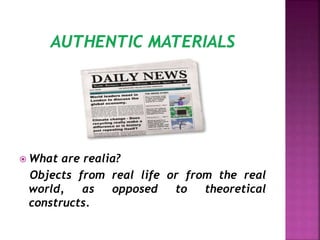
 What are realia?
Objects from real life or from the real
world, as opposed to theoretical
constructs.
Utilitarian objects, games and toys, tickets,
brochures, menus, ads, photographs, popular
music and song lyrics, newspaper and
magazine articles, music videos, etc.
 How important is it to use authentic
materials in the ESL classroom?
 Consider these in terms of:
 motivating the students
 accessibility
 ease of use
 a learning tool
What do you understand by Project-
Based-Learning (PBL)?
Watch the following short video and
discuss its implications for our ELT
classroom.
https://www.youtube.com/watch?v=LM
CZvGesRz8
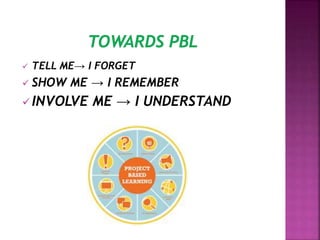
 TELL ME→ I FORGET
 SHOW ME → I REMEMBER
INVOLVE ME → I UNDERSTAND
 The project idea? (an engaging topic that
gets them thinking – non-Googleable!)
 The time frame proposed?
 Is it manageable?
 Between you and your class or other
teachers in your school/other countries?
 Subjects which could be integrated with
the project?
 Technical tools, if any, to be used?
 Planning stages in relation to the school
year?
 Involve students from the start
 Break down topic into well-defined tasks
 Plan well, set goals, define outcomes
 Divide class into working groups with well-
defined tasks
 Guide and monitor students during their
learning
 Arrive at a conclusion
 Document and present to a public audience
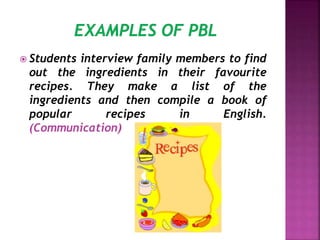
 Students interview family members to find
out the ingredients in their favourite
recipes. They make a list of the
ingredients and then compile a book of
popular recipes in English.
(Communication)
 Students write a short email describing
their school's technology, its use in class,
and appropriate-use guidelines. They ask
students of a teacher in an English-
speaking country to describe the same at
their school, and then discuss the
similarities and differences.
(Communication/Digital Literacy)
 Students team with another class in an
English-speaking country to identify and
compare endangered species in both
countries, and collaborate to produce a
multi-media informational presentation
for their peers using basic information in
the target language.
(Collaboration/Digital Literacy)
 Students engage in e-pal exchanges with
students in a target country comparing
how much time students spend on
homework and how much time they spend
on leisure activities. The students compile
the survey results and compare them
across cultures. (Digital
Literacy/Collaboration/Cross-Cultural
Awareness)
 Students diagram and report their
families' eating times and habits to come
up with a chart of what is culturally
"normal" for them as a class. This chart is
then compared with students from a
partner school, or alternatively, an
Internet investigation.
(Cross-Cultural Awareness)
 Students participate in a school
partnership program with a sister school
in another country by hosting visiting
students. The host students create a
simple survey that the exchange students
complete to determine the kinds of
attractions or events they might be
interested in seeing. Based on the results
of the survey, the host students then
prepare an appropriate programme of
activities.
(Taking Initiative)
WORKSHOP
 In groups, devise ONE activity which
incorporates at least THREE of the
following skills:
 Collaboration
 Communication
 Presentation
 Leadership
 Multi-cultural competence
 Digital literacy
 Consider the following:
 Use of original material
 Source of material
 Assignment of roles among students
 Aims of activity
 Representatives from each group explain
to the other groups the exercises devised.
 Issues are discussed relating to:
 Preparation of material
 Age-groups
 Possible drawbacks
 What are the advantages of incorporating
activities like these into your ELT classes?
Consider this in terms of:
 Motivation
 Active participation
 Learning
21 st century_skills_final_1_dave

21 st century_skills_final_1_dave

  • 1.
     CFPI  08-11-2016 Dave Rixham  White Rose Language School
  • 3.
     ISLAND ADVENTURE In this creative teaching activity, students use their critical thinking and problem-solving skills to survive being stranded on a desert island. The students are told that their boat is sinking and that there is a desert island nearby. In groups of three, students choose four items from a worksheet to help them survive on the island. The students write about their choice of items and their reasons for choosing them. Each group then explains their choices to the class. After that, the groups find out what challenge they face on the island by picking a card. Each group picks a card and makes a plan of what they will do to survive on the island, and how the four items they brought will help them. The groups then present their plans to the class. The teacher assesses each group's chances of survival according to their plan and how risky their ideas are. Each group is awarded a score between zero and three. After each group has presented, they roll a dice and the awarded points are combined with the number on the dice. Groups need to score four or more to survive, and more than six to thrive on the island.
  • 4.
     WHAT’S THECRITERIA?  In this problem-solving teaching activity, students guess what criteria other students have used to put a list of 10 jobs in order. The class is divided into groups of 6 and each student is given a card. Working alone, the students order the jobs according to the criteria on their card. When they have finished, the students take it in turns to read out their order from 1 to 10. The other students in the group analyse the list and discuss the order and try to come up with the criteria. The students should try to explain their reasoning to the student with the card. The student reading the order can’t give away the answer. If the students get the criteria wrong, they should keep trying until they get it right.
  • 5.
     What arerealia? Objects from real life or from the real world, as opposed to theoretical constructs.
  • 6.
    Utilitarian objects, gamesand toys, tickets, brochures, menus, ads, photographs, popular music and song lyrics, newspaper and magazine articles, music videos, etc.
  • 7.
     How importantis it to use authentic materials in the ESL classroom?  Consider these in terms of:  motivating the students  accessibility  ease of use  a learning tool
  • 8.
    What do youunderstand by Project- Based-Learning (PBL)? Watch the following short video and discuss its implications for our ELT classroom. https://www.youtube.com/watch?v=LM CZvGesRz8
  • 9.
     TELL ME→I FORGET  SHOW ME → I REMEMBER INVOLVE ME → I UNDERSTAND
  • 10.
     The projectidea? (an engaging topic that gets them thinking – non-Googleable!)  The time frame proposed?  Is it manageable?  Between you and your class or other teachers in your school/other countries?  Subjects which could be integrated with the project?  Technical tools, if any, to be used?  Planning stages in relation to the school year?
  • 11.
     Involve studentsfrom the start  Break down topic into well-defined tasks  Plan well, set goals, define outcomes  Divide class into working groups with well- defined tasks  Guide and monitor students during their learning  Arrive at a conclusion  Document and present to a public audience
  • 12.
     Students interviewfamily members to find out the ingredients in their favourite recipes. They make a list of the ingredients and then compile a book of popular recipes in English. (Communication)
  • 13.
     Students writea short email describing their school's technology, its use in class, and appropriate-use guidelines. They ask students of a teacher in an English- speaking country to describe the same at their school, and then discuss the similarities and differences. (Communication/Digital Literacy)
  • 14.
     Students teamwith another class in an English-speaking country to identify and compare endangered species in both countries, and collaborate to produce a multi-media informational presentation for their peers using basic information in the target language. (Collaboration/Digital Literacy)
  • 15.
     Students engagein e-pal exchanges with students in a target country comparing how much time students spend on homework and how much time they spend on leisure activities. The students compile the survey results and compare them across cultures. (Digital Literacy/Collaboration/Cross-Cultural Awareness)
  • 16.
     Students diagramand report their families' eating times and habits to come up with a chart of what is culturally "normal" for them as a class. This chart is then compared with students from a partner school, or alternatively, an Internet investigation. (Cross-Cultural Awareness)
  • 17.
     Students participatein a school partnership program with a sister school in another country by hosting visiting students. The host students create a simple survey that the exchange students complete to determine the kinds of attractions or events they might be interested in seeing. Based on the results of the survey, the host students then prepare an appropriate programme of activities. (Taking Initiative)
  • 18.
  • 19.
     In groups,devise ONE activity which incorporates at least THREE of the following skills:  Collaboration  Communication  Presentation  Leadership  Multi-cultural competence  Digital literacy
  • 20.
     Consider thefollowing:  Use of original material  Source of material  Assignment of roles among students  Aims of activity
  • 21.
     Representatives fromeach group explain to the other groups the exercises devised.  Issues are discussed relating to:  Preparation of material  Age-groups  Possible drawbacks
  • 22.
     What arethe advantages of incorporating activities like these into your ELT classes? Consider this in terms of:  Motivation  Active participation  Learning