Improving Access to the General Curriculum for Students With Disabilities Through Collaborative Teaching Your name here Date, location, etc.
Session Overview Introduction to national assistance centers and The Access Center Introduction to co-teaching Planning strategies Scheduling examples Stages of co-teaching applied to the classroom Scenario examples
The Access Center National Technical Assistance Center Funded by the U.S. Department of Education, Office of Special Education Programs Focus on issues of access What is “access”? Active learning for students with disabilities of the content and skills that define the general education curriculum
The Access Center’s Mission To provide technical assistance that strengthens state and local capacity to help students with disabilities learn through general education curriculum
The Access Center’s Goals With an emphasis on research-based programs, practices, and tools, our services are intended to: Increase awareness among educators Help educators to be informed consumers  Assist educators to implement and evaluate programs, practices, and tools
Improving Access for Students With Disabilities Through Collaborative Teaching
Background General educators are more receptive to change when they have background knowledge and a chance to participate in the decisions rather than being given a special education mandate to follow. Steele, Bell, & George, 2005
Background (cont.) Special educators have developed a tendency to “own” students on individualized education plans (IEPs), which decreases the “voice” and participation of classroom teachers in collaborative problem solving. Steele, Bell, & George, 2005
Aligning Practices Through Co-Teaching Co-teaching is becoming one of the fastest growing inclusive practices in school.  Despite this rapid increase in popularity, co-teaching remains one of the most commonly misunderstood practices in education.  Steele, Bell, & George, 2005
Defining Co-Teaching Co-teaching occurs when two or more professionals jointly deliver substantive instruction to a diverse, or blended, group of students in a single physical space. Cook & Friend, 1995, p. 1
 
Three Major Models Consultant model Coaching model Collaborative (or teaming) model Friend & Cook, 2003
Most Common Approaches One Teaching, One Drifting Parallel Teaching Station Teaching Alternative Teaching Team Teaching Friend & Cook, 2003
One teacher plans and instructs, and one teacher provides adaptations and other support as needed Requires very little joint planning Should be used sparingly Can result in one teacher, most often the general educator teacher, taking the lead role the majority of the time Can also be distracting to students, especially those who may become dependent on the drifting teacher One Teaching, One Drifting Friend & Cook, 2003
Parallel Teaching Teachers share responsibility for planning and instruction. Class is split into heterogeneous groups, and each teacher instructs half on the same material. Content covered is the same, but methods of delivery may differ. Both teachers need to be proficient in the content being taught. Friend & Cook, 2003
Station Teaching Teachers divide the responsibility of planning and instruction. Students rotate on a predetermined schedule through stations. Teachers repeat instruction to each group that comes through; delivery may vary according to student needs. Approach can be used even if teachers have very different pedagogical approaches. Each teacher instructs every student. Friend & Cook, 2003
Alternative Teaching Teachers divide responsibilities for planning and instruction. The majority of students remain in a large group setting, but some students work in a small group for preteaching, enrichment, reteaching, or other individualized instruction. Approach allows for highly individualized instruction to be offered. Teachers should be careful that the same students are not always pulled aside. Friend & Cook, 2003
Team Teaching Teachers share responsibilities for planning and instruction. Teachers work as a team to introduce new content, work on developing skills, clarify information, and facilitate learning and classroom management. This requires the most mutual trust and respect between teachers and requires that they be able to mesh their teaching styles. Friend & Cook, 2003
 
Getting Started
Where to Begin: Building Bridges Walking across the bridge, leaving the familiar ground of working alone, is the first act of collaboration. All parties are in neutral territory, with the security of knowing they can return to land better, stronger, and changed. And perhaps they will return to the same side of the bridge even though they started from opposite sides. Steele, Bell, & George, 2005
What is Change? Change is always: Risky Scary But it can also be: Rewarding Fun Steele, Bell, & George, 2005
Collaboration Won’t Just Happen Deliberate Structured Systematic Ongoing Steele, Bell, & George, 2005
Why Won’t it Just Happen? Some possibilities might be: Little understanding of curriculum, instruction, and assessment between general and special educators Collaboration does not occur without a student-driven reason and a deliberate structure with resources. Steele, Bell, & George, 2005
Why Won’t it Just Happen? (cont.) General educators begin with the curriculum first and use assessment to determine what was learned. Special educators begin with assessment first and design instruction to repair gaps in learning. No wonder we are talking different languages. Steele, Bell, & George, 2005
How Can We Work With This? Provide purpose and structure Create baseline and a plan for scaffolded change Provide a visual map to guide discussion Keep discussions objective  Allow many issues to be put on the table for consideration Steele, Bell, & George, 2005
Sounds Good . . . Now What? Getting Co-Teaching Started at the Building and Classroom Levels
Action Steps Administrators should Provide information and encourage proactive preparation from teachers Assess level of collaboration currently in place Pre-plan Implement slowly . . . baby steps! Murawski, 2005
 
Considerations Teachers need to volunteer and agree to co-teach. Co-teaching should be implemented gradually. Attention needs to be given to individualized education plan (IEP) setting changes that an inclusive classroom may invoke. Goals and support services need to reflect the new learning experiences that students will receive in general education classes. Murawski & Dieker, 2004
Not an All-or-Nothing Approach Teachers do not have to commit to only one approach of co-teaching. Teachers do not have to only co-teach. Co-teaching is not the only option for serving students. Some students with disabilities may be in a co-taught classroom for only part of the day. Murawski, 2005
Limitations and Potential Drawbacks Co-teaching is not easy to maintain in schools. There may not be enough special educators for a co-teaching program. Co-taught classrooms may be disproportionally filled with students with disabilities. Special educators can function more as a teaching assistant than as a co-educator. Friend & Cook, 2003
Benefits of Collaboration Shared responsibility for educating all students Shared understanding and use of common assessment data Supporting ownership for programming and interventions Creating common understanding Friend & Cook, 2003
Effective Co-Planning
Pre-Planning  Co-teaching requires thoughtful planning time. Administrative support is essential. Here is where the alignment of special and general education occurs Make this time as focused as possible Take turns taking the lead in planning and facilitating Murawski & Dieker, 2004; Dieker, 2002
 
 
Provide Weekly Scheduling Co-Planning Time Co-teaching teams should have a minimum of one scheduling/planning period (45–60 minutes) per week. Experienced teams should spend 10 minutes to plan each lesson. Dieker, 2001; Walther-Thomas, Bryant, & Land, 1996
Effective Classroom-Level Planning  Co-teachers should show a shared commitment and enthusiasm. Both teachers’ names should be posted on the door and in the classroom. All meetings and correspondence with families should reflect participation from both co-teachers. Skilled planners trust the professional skills of their partners. Walther-Thomas, Bryant, & Land, 1996
Effective Classroom-Level Planning (cont.) Effective planners design learning environments for their students and for themselves that demand active involvement. Effective co-planners create learning and teaching environments in which each person’s contributions are valued. Effective planners develop effective routines to facilitate their planning. Planning skills improve over time. Walther-Thomas, Bryant, & Land, 1996
Two Stages of Classroom Co-Planning Getting to know each other Weekly co-planning Walther-Thomas, Bryant, & Land, 1996
Getting to Know Each Other Ease into working with one another Deal with the “little” things first These typically become the deal-breakers down the road, and preventing these road blocks early can make life easier. Walther-Thomas, Bryant, & Land, 1996
 
 
Getting to Know Each Other (cont.) Important to spend time talking and getting better acquainted with each other’s skills, interests, and educational philosophies Having a semistructured preliminary discussion can facilitate this process. Discuss current classroom routines and rules  Walther-Thomas, Bryant, & Land, 1996
 
Getting to Know Each Other (cont.) Consider a “pilot test” It may be necessary to plan together during the summer (i.e., prior to development days involving all staff). Walther-Thomas, Bryant, & Land, 1996
Getting to Know Each Other (cont.) Consider completing a teaching style inventory Compare how each of you prefers to structure assignments, lessons, classroom schedule, etc. Examples http://fcrcweb.ftr.indstate.educationu/ tstyles3.html http://www.longleaf.net/teachingstyle.html
 
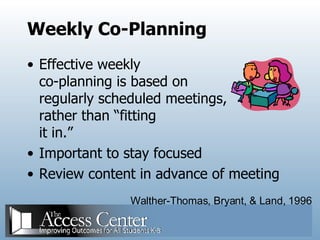
Weekly Co-Planning Effective weekly co-planning is based on  regularly scheduled meetings, rather than “fitting it in.” Important to stay focused Review content in advance of meeting Walther-Thomas, Bryant, & Land, 1996
Weekly Co-Planning (cont.) Guide the session with the following fundamental issues: What are the content goals? Who are the learners? How can we teach most effectively? Walther-Thomas, Bryant, & Land, 1996
Weekly Co-Planning (cont.) Shape instructional plans Establish timelines and priorities Assign preparation tasks Walther-Thomas, Bryant, & Land, 1996
 
 
Scheduling Co-Teaching
Collaborative Scheduling Collaborative Scheduling A Collaborative Scheduling B Collaborative Scheduling C Walsh & Jones, 2004
Collaborative Scheduling A Special educator divides teaching time between two different classes in the same day. Walsh & Jones, 2004
Advantages of Collaborative Scheduling A  Enables students with disabilities to access a broader range of general education classrooms, including AP and honors  Ensures the availability of direct support from a special educator for critical parts of the instructional programs Improved ratio of students with disabilities to students without disabilities Walsh & Jones, 2004
Challenges of Collaborative Scheduling A  Requires effective consulting skills on the part of the special educator Larger danger that the special educator will not be seen as an equal partner to the general educator Could possibly disrupt the class routine  Walsh & Jones, 2004
Collaborative Scheduling B The special educator divides time between two different classes. The involvement of the special educator varies by days of the week, not within classes in the same day. Walsh & Jones, 2004
Advantages of Collaborative Scheduling B Advantages are similar to Collaborative Scheduling A. Co-teachers report an ability to implement a full range of co-teaching models because of the planned involvement of both teachers in complete classes on certain days of the week. Walsh & Jones, 2004
Challenges of Collaborative Scheduling B  Challenges are similar to Collaborative Scheduling A. Teachers need to be cognizant of the presence of two teachers on only certain days of the week. Students with specific support and accommodation requirements have to be well aligned to the schedule. Walsh & Jones, 2004
Challenges of Collaborative Scheduling B (cont.) Requires general educator to be able to implement IEP requirements in the absence of the special educator Special educator burnout is an issue because of the greater demand of knowledge of the general education curriculum. Requires supervisory judgment regarding which teachers can effectively plan and implement this model Walsh & Jones, 2004
Collaborative Scheduling C The special educator serves as a resource to the interdisciplinary team. His/her schedule is established weekly on the basis of instructional activities. Requires the greatest amount of flexibility and planning by an interdisciplinary team of teachers Walsh & Jones, 2004
Advantages of Collaborative Scheduling C  Special educator is present when needed most for instructional support. Instructional need dictates the cooperative teaching role, not the calendar or time of day. Most responsive to students’ needs and schedules. Walsh & Jones, 2004
Challenges of Collaborative Scheduling C Requires the highest degree of planning and buy-in by a team of teachers Walsh & Jones, 2004
Co-Teaching in Action
Instruction Most difficult but also the most rewarding There are things that can be done to maximize success and rewards: Review the different approaches to co-teaching and think about how each might look in a classroom  Discuss each other’s learning style preferences to see how these can be incorporated into the lesson to assist students with varying styles Murawski & Dieker, 2004
“ We get along very well. We are both flexible and have developed similar expectations for students and similar classroom management styles. We feed off each others’ comments and teaching styles. We switch which groups we work with so that we both get to perform a variety of roles with all our students. We work together; develop together; and bounce things off each other. Working as a team makes you feel good.”  Salend, Gordon, & Lopez-Vona, 2002
“ I don’t think I’d like to work in this type of program again. She felt like a visitor in my classroom, and we never connected personally. We struggled because of differences in roles, teaching and communication styles, and philosophy. The students also were confused. They felt that I was the teacher and she was my aide. I felt like she was always watching me and judging me. We didn’t know how to do it and received little support from our principal.” Salend, Gordon, & Lopez-Vona, 2002
Instructional Tips Develop unobtrusive signals to communicate with each other Create signals for students that are consistent and can be used by either teacher  Vary instructional practices Clearly display an agenda for the class, which includes the standard(s) to be covered and any additional goals Avoid disagreeing with or undermining each other in front of the students Strive to demonstrate parity in instruction whenever possible by switching roles often Avoid stigmatization of any one group of students Murawski & Dieker, 2004
Three Stages of Co-Teaching Relationships Beginning Stage Compromising Stage Collaborative Stage Gately, 2005
Three Stages of Co-Teaching as They Apply to: Physical Arrangement Familiarity With the Curriculum Curriculum Goals and Modifications Instructional Presentation Classroom Management Assessment Gately & Gately, 2001
Physical Arrangement
Physical Arrangement:  Beginning Stage Impression of separateness Students with disabilities vs. general education students Little ownership of materials or space by special educator  Delegated spaces which are rarely abandoned Gately & Gately, 2001
Physical Arrangement: Beginning Stage  (cont.) Invisible walls A classroom within a classroom Gately & Gately, 2001
Physical Arrangement: Compromising Stage More movement and shared space Sharing of materials Territoriality becomes less evident. Special educator moves more freely around the classroom but rarely takes center stage. Gately & Gately, 2001
Physical Arrangement: Collaboration Stage Seating arrangements are intentionally interspersed.  All students participate in cooperative grouping assignments.  Teachers are more fluid in an unplanned and natural way. Gately & Gately, 2001
Physical Arrangement: Collaboration Stage  (cont.) Both teachers control space: Like an effective doubles team in tennis, the classroom is always “covered.” Space is truly jointly owned. Gately & Gately, 2001
Familiarity With the Curriculum
Familiarity With the Curriculum:  Beginning Stage Special educator may be unfamiliar with content or methodology used by the general educator. General educator may have limited understanding of modifying the curriculum and making appropriate accommodations. Unfamiliarity creates a lack of confidence in both teachers. Gately & Gately, 2001
Familiarity With the Curriculum: Compromising  Collaborative Stages Special educator acquires a knowledge of the scope and sequence and develops a solid understanding of the content of the curriculum. Special educator gains confidence to make suggestions for modifications and accommodations. Gately & Gately, 2001
Familiarity with the Curriculum: Compromising  Collaborative Stages  (cont.) General educator becomes more willing to modify the curriculum, and there is increased sharing in planning and teaching. Both teachers appreciate the specific curriculum competencies that they bring to the content area. Gately & Gately, 2001
Curriculum Goals and Modifications
Curriculum Goals and Modifications:  Beginning Stage Programs are driven by textbooks and standards, and goals tend to be “test-driven.” Modifications and accommodations are generally restricted to those identified in the IEP; little interaction regarding modifications to the curriculum. Special educator’s role is seen as “helper.” Gately & Gately, 2001
Curriculum Goals and Modifications:  Compromising Stage General educator may view modifications as “giving up” or “watering down” the curriculum. Gately & Gately, 2001
Curriculum Goals and Modifications:  Collaborative Stage Both teachers begin to differentiate concepts that all students must know from concepts that most students should know. Modifications of content, activities, homework assignments, and tests become the norm for students who require them. Gately & Gately, 2001
Instructional Presentation
Instructional Presentation: Beginning Stage Teachers often present separate lessons. One teacher is “boss”; one is “helper.” Gately & Gately, 2001
Instructional Presentation: Compromising Stage Both teachers direct some of the activities in the classroom. Special educator offers mini-lessons or clarifies strategies that students may use. Gately & Gately, 2001
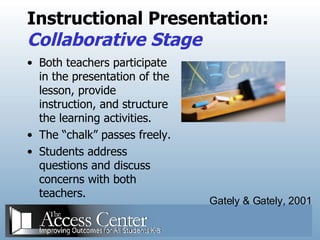
Instructional Presentation: Collaborative Stage Both teachers participate in the presentation of the lesson, provide instruction, and structure the learning activities. The “chalk” passes freely. Students address questions and discuss concerns with both teachers. Gately & Gately, 2001
Classroom Management
Classroom Management: Beginning Stage Special educator tends to assume the role of “behavior manager.” Gately & Gately, 2001
Classroom Management: Compromising Stage More communication and mutual development of rules Some discussion for individual behavior management plans Gately & Gately, 2001
Classroom Management: Collaborative Stage Both teachers are involved in developing a classroom management system that benefits all students. Common to observe individual behavior plans, use of contracts, tangible rewards, and reinforcers Development of community-building and relationship-building activities as a way to enhance classroom management Gately & Gately, 2001
Assessment
Assessment With the current emphasis on high-stakes tests, co-teaching provides an effective way to strengthen the instruction–assessment link: Discuss grading before it becomes an issue Consider a variety of assessment options Offer menus of assignments Share the grading load and align grading styles  Murawski & Dieker, 2004
Assessment:  Beginning Stage Two separate grading systems are often maintained separately by the two teachers. One grading system may also be exclusively managed by the general educator. Measures tend to be objective in nature and based only on a student’s knowledge of the content. Gately & Gately, 2001
Assessment: Compromising Stage Two teachers begin to explore alternate assessment ideas. Teachers begin to discuss how to effectively capture students’ progress, not just their knowledge of the content. Gately & Gately, 2001
Assessment: Collaborative Stage Both teachers appreciate the need for a variety of options when assessing students’ progress. Gately & Gately, 2001
 
 
Evaluation Researchers have been reluctant to measure outcomes of co-teaching. This provides a good opportunity for teachers to engage in their own action research. They should begin to collect data on their own to document outcomes. Teachers and administrators should evaluate co-teaching situations at least once per year.  The rule that assessment informs instruction should also apply to co-teaching: As co-teachers continue to assess their situation, they must ensure that they are improving their instruction to best meet students’ needs in an inclusive classroom. Murawski & Dieker, 2004; Friend & Cook, 2003
Co-Teaching Scenarios
Activity Directions Each group will read and discuss their scenario. Be prepared to report back to the group with a summary of the scenario, including: Comments about pros and cons Personal insight into why the example was a positive or negative experience for the co-teachers
Upper Elementary and Middle School Earth Science
Working Relationships Elementary team volunteered; middle school team was assigned. Both teams were upbeat and able to interject appropriately during the lesson and displayed mutual respect. Both teams indicated a genuine trust and respect for their partners. Mastropieri et al., 2005
Strengths as Motivators Both teachers on both teams claimed ownership for all of the students who were enrolled.  Teachers emphasized importance of enthusiastic teaching while maintaining effective behavior management. Mastropieri et al., 2005
Time Allocated for Co-Planning Elementary team did not have time allocated for co-planning: Met before/after school and at lunch Because they enjoyed each other’s company, lack of scheduled co-planning time did not appear to be a barrier to effective instruction. Mentioned that it would have been easier if the administration had allowed them time for co-planning Mastropieri et al., 2005
Time Allocated for Co-Planning (cont.) Seventh-grade team had a common free period for planning during which time they could: Review where they were in the content Determine what needed to be covered and by when Develop optimal ways to present information and complete activities Mastropieri et al., 2005
Appropriate Curriculum Both teams used a hands-on, activity-based approach to instruction: Made content more concrete Lessened the language and literacy demands of tasks Mastropieri et al., 2005
Appropriate Curriculum (cont.) Activity-based instruction lends itself very well to co-teaching: Teachers can share more equitably in instruction. In fact, teachers appear to be more likely to share instruction in a hands-on approach. Mastropieri et al., 2005
Effective Instructional Skills Both teams used effective instructional skills: Framework of daily review, presentation of new information, guided and independent practice activities, and formative review Effective classroom management, including good behavior as a prerequisite for participation in activities, such reinforcers as positive comments, and tangibles Mastropieri et al., 2005
Disability-Specific Teaching Adaptations Both teams planned for individual student performance within the unit and how to handle individual differences: Reduced language and literacy requirements Special educator worked with students who required adaptations. Mastropieri et al., 2005
Disability-Specific Teaching Adaptations (cont.) Seventh-grade team used PowerPoint presentations for supplemental review. Special educator adapted tests by reducing amount of written language in questions. Mastropieri et al., 2005
Expertise in the Content Area In fourth grade, both teachers deferred to each other during instruction so all students would benefit: Teachers frequently exchanged roles as presenters. Mastropieri et al., 2005
Expertise in the Content Area (cont.) In seventh grade, the division between the content and the adaptation experts was more pronounced: General educator appeared to have an advantage over the special educator with respect to content knowledge. Special educator viewed this as an advantage (i.e., giving him/her an opportunity to learn the curriculum). During lessons, special educator more frequently assumed the role of assisting individuals and small groups than the general educator. Mastropieri et al., 2005
Middle School Social Studies
Co-Planning Both teachers had allocated planning time; however, this was also their individual planning time. One period per week was allocated for co-planning. Planned for: Curriculum issues (in general), scheduling for curriculum sequence, and types of assignments and activities Ways to divide the teaching responsibilities Mastropieri et al., 2005
Co-Planning (cont.) Lack of planning was an obstacle to co-teaching Resulted in lessons that were too advanced for all students Left one of the team members feeling trapped in an unworkable situation As tensions mounted, teachers began to split the class into two small groups and moved them into separate rooms for many of the activities. Mastropieri et al., 2005
Teaching Styles Each teacher had a distinct style of instruction: One teacher was very relaxed and casual; the other was more structured and formal. In the beginning, these styles seemed to complement each other. Students appeared to adapt to the differences in styles and expectations. As the year progressed, the extreme styles contributed to the deterioration of the team. Mastropieri et al., 2005
Behavior and Classroom Management Little structure was in place in the beginning. No specific class behavior rules were posted. Teachers implied that schoolwide behavior policies were the expectations for the class. The loosely structured classroom behavior structure suited one teacher but not the other. This was a contributing factor to the eroding of the team—the final straw. Mastropieri et al., 2005
References Austin, V. L. (2001). Teachers’ beliefs about co-teaching.  Remedial and Special Education, 22,  245–255. Cook, L. H., & Friend, M. (1995). Co-teaching guidelines for creating effective practices.  Focus on Exceptional Children, 28 (2), 1–12. Cook, L. H., & Friend, M. (2003).  Interactions: Collaboration skills for school professionals  (4th ed.). Boston: Allyn and Bacon. Dieker, L. (2001). What are the characteristics of “effective” middle and high school co-taught teams?  Preventing School Failure, 46,  14–25. Dieker, L. (2002).  Co-planner (semester) . Whitefish Bay, WI: Knowledge by Design. Fennick, E. (2001). Co-teaching: An inclusive curriculum for transition.  Teaching Exceptional Children, 33 (6), 60–66. Friend, M., & Cook, L. H. (2003).  Interactions: Collaboration skills for school professionals  (4th ed.). Boston: Allyn and Bacon. Gately, S. E. (2005). Two are better than one.  Principal Leadership, 5 (9), 36–41. Gately, S. E., & Gately, F. J. (2001). Understanding co-teaching components.  Teaching Exceptional Children, 33 (4), 40–47. Geen, A. G. (1985). Team teaching in the secondary schools of England and Wales.  Educational Review, 37,  29–38.  Hourcade, J. J., & Bauwens, J. (2001). Cooperative teaching: The renewal of teachers.  Clearinghouse, 74,  242–247.
References (cont.) Mastropieri, M. A., Scruggs, T. E., Graetz, J. E., Nordland, J., Gardizi, W., & McDuffie, K. (2005). Case studies in co-teaching in the content areas: Successes, failures, and challenges.  Intervention in School and Clinic, 40,  260–270. Murawski, W. W. (2005). Addressing diverse needs through co-teaching: Take baby steps!  Kappa Delta Pi Record, 41 (2), 77–82. Murawski, W. W., & Dieker, L. A. (2004). Tips and strategies for co-teaching at the secondary level.  Teaching Exceptional Children, 36 (5), 52–58. Salend, S., Gordon, I., & Lopez-Vona, K. (2002). Evaluating cooperative teams.  Intervention in School and Clinic, 37 (4), 195–200. Steele, N., Bell, D., & George, N. (2005, April).  Risky business: The art and science of true collaboration.  Paper presented at the Council for Exceptional Children’s Annual Conference, Baltimore, MD.  Trump, J. L. (1966). Secondary education tomorrow: Four imperatives for improvement.  NASSP Bulletin, 50 (309), 87–95. Walsh, J. M., & Jones, B. (2004). New models of cooperative teaching.  Teaching Exceptional Children, 36 (5), 14–20. Walther-Thomas, C., Bryant, M., & Land, S. (1996). Planning for effective co-teaching: The key to successful inclusion.  Remedial and Special Education, 17,  255–265.
Visit our Web site for more information or to contact us: http://www.K8accesscenter.org
The Access Center: Improving Outcomes for All Students K – 8 American Institutes for Research 1000 Thomas Jefferson Street, NW  Washington, DC 20007

Co Teaching (For Teachers)

  • 1.
    Improving Access tothe General Curriculum for Students With Disabilities Through Collaborative Teaching Your name here Date, location, etc.
  • 2.
    Session Overview Introductionto national assistance centers and The Access Center Introduction to co-teaching Planning strategies Scheduling examples Stages of co-teaching applied to the classroom Scenario examples
  • 3.
    The Access CenterNational Technical Assistance Center Funded by the U.S. Department of Education, Office of Special Education Programs Focus on issues of access What is “access”? Active learning for students with disabilities of the content and skills that define the general education curriculum
  • 4.
    The Access Center’sMission To provide technical assistance that strengthens state and local capacity to help students with disabilities learn through general education curriculum
  • 5.
    The Access Center’sGoals With an emphasis on research-based programs, practices, and tools, our services are intended to: Increase awareness among educators Help educators to be informed consumers Assist educators to implement and evaluate programs, practices, and tools
  • 6.
    Improving Access forStudents With Disabilities Through Collaborative Teaching
  • 7.
    Background General educatorsare more receptive to change when they have background knowledge and a chance to participate in the decisions rather than being given a special education mandate to follow. Steele, Bell, & George, 2005
  • 8.
    Background (cont.) Specialeducators have developed a tendency to “own” students on individualized education plans (IEPs), which decreases the “voice” and participation of classroom teachers in collaborative problem solving. Steele, Bell, & George, 2005
  • 9.
    Aligning Practices ThroughCo-Teaching Co-teaching is becoming one of the fastest growing inclusive practices in school. Despite this rapid increase in popularity, co-teaching remains one of the most commonly misunderstood practices in education. Steele, Bell, & George, 2005
  • 10.
    Defining Co-Teaching Co-teachingoccurs when two or more professionals jointly deliver substantive instruction to a diverse, or blended, group of students in a single physical space. Cook & Friend, 1995, p. 1
  • 11.
  • 12.
    Three Major ModelsConsultant model Coaching model Collaborative (or teaming) model Friend & Cook, 2003
  • 13.
    Most Common ApproachesOne Teaching, One Drifting Parallel Teaching Station Teaching Alternative Teaching Team Teaching Friend & Cook, 2003
  • 14.
    One teacher plansand instructs, and one teacher provides adaptations and other support as needed Requires very little joint planning Should be used sparingly Can result in one teacher, most often the general educator teacher, taking the lead role the majority of the time Can also be distracting to students, especially those who may become dependent on the drifting teacher One Teaching, One Drifting Friend & Cook, 2003
  • 15.
    Parallel Teaching Teachersshare responsibility for planning and instruction. Class is split into heterogeneous groups, and each teacher instructs half on the same material. Content covered is the same, but methods of delivery may differ. Both teachers need to be proficient in the content being taught. Friend & Cook, 2003
  • 16.
    Station Teaching Teachersdivide the responsibility of planning and instruction. Students rotate on a predetermined schedule through stations. Teachers repeat instruction to each group that comes through; delivery may vary according to student needs. Approach can be used even if teachers have very different pedagogical approaches. Each teacher instructs every student. Friend & Cook, 2003
  • 17.
    Alternative Teaching Teachersdivide responsibilities for planning and instruction. The majority of students remain in a large group setting, but some students work in a small group for preteaching, enrichment, reteaching, or other individualized instruction. Approach allows for highly individualized instruction to be offered. Teachers should be careful that the same students are not always pulled aside. Friend & Cook, 2003
  • 18.
    Team Teaching Teachersshare responsibilities for planning and instruction. Teachers work as a team to introduce new content, work on developing skills, clarify information, and facilitate learning and classroom management. This requires the most mutual trust and respect between teachers and requires that they be able to mesh their teaching styles. Friend & Cook, 2003
  • 19.
  • 20.
  • 21.
    Where to Begin:Building Bridges Walking across the bridge, leaving the familiar ground of working alone, is the first act of collaboration. All parties are in neutral territory, with the security of knowing they can return to land better, stronger, and changed. And perhaps they will return to the same side of the bridge even though they started from opposite sides. Steele, Bell, & George, 2005
  • 22.
    What is Change?Change is always: Risky Scary But it can also be: Rewarding Fun Steele, Bell, & George, 2005
  • 23.
    Collaboration Won’t JustHappen Deliberate Structured Systematic Ongoing Steele, Bell, & George, 2005
  • 24.
    Why Won’t itJust Happen? Some possibilities might be: Little understanding of curriculum, instruction, and assessment between general and special educators Collaboration does not occur without a student-driven reason and a deliberate structure with resources. Steele, Bell, & George, 2005
  • 25.
    Why Won’t itJust Happen? (cont.) General educators begin with the curriculum first and use assessment to determine what was learned. Special educators begin with assessment first and design instruction to repair gaps in learning. No wonder we are talking different languages. Steele, Bell, & George, 2005
  • 26.
    How Can WeWork With This? Provide purpose and structure Create baseline and a plan for scaffolded change Provide a visual map to guide discussion Keep discussions objective Allow many issues to be put on the table for consideration Steele, Bell, & George, 2005
  • 27.
    Sounds Good .. . Now What? Getting Co-Teaching Started at the Building and Classroom Levels
  • 28.
    Action Steps Administratorsshould Provide information and encourage proactive preparation from teachers Assess level of collaboration currently in place Pre-plan Implement slowly . . . baby steps! Murawski, 2005
  • 29.
  • 30.
    Considerations Teachers needto volunteer and agree to co-teach. Co-teaching should be implemented gradually. Attention needs to be given to individualized education plan (IEP) setting changes that an inclusive classroom may invoke. Goals and support services need to reflect the new learning experiences that students will receive in general education classes. Murawski & Dieker, 2004
  • 31.
    Not an All-or-NothingApproach Teachers do not have to commit to only one approach of co-teaching. Teachers do not have to only co-teach. Co-teaching is not the only option for serving students. Some students with disabilities may be in a co-taught classroom for only part of the day. Murawski, 2005
  • 32.
    Limitations and PotentialDrawbacks Co-teaching is not easy to maintain in schools. There may not be enough special educators for a co-teaching program. Co-taught classrooms may be disproportionally filled with students with disabilities. Special educators can function more as a teaching assistant than as a co-educator. Friend & Cook, 2003
  • 33.
    Benefits of CollaborationShared responsibility for educating all students Shared understanding and use of common assessment data Supporting ownership for programming and interventions Creating common understanding Friend & Cook, 2003
  • 34.
  • 35.
    Pre-Planning Co-teachingrequires thoughtful planning time. Administrative support is essential. Here is where the alignment of special and general education occurs Make this time as focused as possible Take turns taking the lead in planning and facilitating Murawski & Dieker, 2004; Dieker, 2002
  • 36.
  • 37.
  • 38.
    Provide Weekly SchedulingCo-Planning Time Co-teaching teams should have a minimum of one scheduling/planning period (45–60 minutes) per week. Experienced teams should spend 10 minutes to plan each lesson. Dieker, 2001; Walther-Thomas, Bryant, & Land, 1996
  • 39.
    Effective Classroom-Level Planning Co-teachers should show a shared commitment and enthusiasm. Both teachers’ names should be posted on the door and in the classroom. All meetings and correspondence with families should reflect participation from both co-teachers. Skilled planners trust the professional skills of their partners. Walther-Thomas, Bryant, & Land, 1996
  • 40.
    Effective Classroom-Level Planning(cont.) Effective planners design learning environments for their students and for themselves that demand active involvement. Effective co-planners create learning and teaching environments in which each person’s contributions are valued. Effective planners develop effective routines to facilitate their planning. Planning skills improve over time. Walther-Thomas, Bryant, & Land, 1996
  • 41.
    Two Stages ofClassroom Co-Planning Getting to know each other Weekly co-planning Walther-Thomas, Bryant, & Land, 1996
  • 42.
    Getting to KnowEach Other Ease into working with one another Deal with the “little” things first These typically become the deal-breakers down the road, and preventing these road blocks early can make life easier. Walther-Thomas, Bryant, & Land, 1996
  • 43.
  • 44.
  • 45.
    Getting to KnowEach Other (cont.) Important to spend time talking and getting better acquainted with each other’s skills, interests, and educational philosophies Having a semistructured preliminary discussion can facilitate this process. Discuss current classroom routines and rules Walther-Thomas, Bryant, & Land, 1996
  • 46.
  • 47.
    Getting to KnowEach Other (cont.) Consider a “pilot test” It may be necessary to plan together during the summer (i.e., prior to development days involving all staff). Walther-Thomas, Bryant, & Land, 1996
  • 48.
    Getting to KnowEach Other (cont.) Consider completing a teaching style inventory Compare how each of you prefers to structure assignments, lessons, classroom schedule, etc. Examples http://fcrcweb.ftr.indstate.educationu/ tstyles3.html http://www.longleaf.net/teachingstyle.html
  • 49.
  • 50.
    Weekly Co-Planning Effectiveweekly co-planning is based on regularly scheduled meetings, rather than “fitting it in.” Important to stay focused Review content in advance of meeting Walther-Thomas, Bryant, & Land, 1996
  • 51.
    Weekly Co-Planning (cont.)Guide the session with the following fundamental issues: What are the content goals? Who are the learners? How can we teach most effectively? Walther-Thomas, Bryant, & Land, 1996
  • 52.
    Weekly Co-Planning (cont.)Shape instructional plans Establish timelines and priorities Assign preparation tasks Walther-Thomas, Bryant, & Land, 1996
  • 53.
  • 54.
  • 55.
  • 56.
    Collaborative Scheduling CollaborativeScheduling A Collaborative Scheduling B Collaborative Scheduling C Walsh & Jones, 2004
  • 57.
    Collaborative Scheduling ASpecial educator divides teaching time between two different classes in the same day. Walsh & Jones, 2004
  • 58.
    Advantages of CollaborativeScheduling A Enables students with disabilities to access a broader range of general education classrooms, including AP and honors Ensures the availability of direct support from a special educator for critical parts of the instructional programs Improved ratio of students with disabilities to students without disabilities Walsh & Jones, 2004
  • 59.
    Challenges of CollaborativeScheduling A Requires effective consulting skills on the part of the special educator Larger danger that the special educator will not be seen as an equal partner to the general educator Could possibly disrupt the class routine Walsh & Jones, 2004
  • 60.
    Collaborative Scheduling BThe special educator divides time between two different classes. The involvement of the special educator varies by days of the week, not within classes in the same day. Walsh & Jones, 2004
  • 61.
    Advantages of CollaborativeScheduling B Advantages are similar to Collaborative Scheduling A. Co-teachers report an ability to implement a full range of co-teaching models because of the planned involvement of both teachers in complete classes on certain days of the week. Walsh & Jones, 2004
  • 62.
    Challenges of CollaborativeScheduling B Challenges are similar to Collaborative Scheduling A. Teachers need to be cognizant of the presence of two teachers on only certain days of the week. Students with specific support and accommodation requirements have to be well aligned to the schedule. Walsh & Jones, 2004
  • 63.
    Challenges of CollaborativeScheduling B (cont.) Requires general educator to be able to implement IEP requirements in the absence of the special educator Special educator burnout is an issue because of the greater demand of knowledge of the general education curriculum. Requires supervisory judgment regarding which teachers can effectively plan and implement this model Walsh & Jones, 2004
  • 64.
    Collaborative Scheduling CThe special educator serves as a resource to the interdisciplinary team. His/her schedule is established weekly on the basis of instructional activities. Requires the greatest amount of flexibility and planning by an interdisciplinary team of teachers Walsh & Jones, 2004
  • 65.
    Advantages of CollaborativeScheduling C Special educator is present when needed most for instructional support. Instructional need dictates the cooperative teaching role, not the calendar or time of day. Most responsive to students’ needs and schedules. Walsh & Jones, 2004
  • 66.
    Challenges of CollaborativeScheduling C Requires the highest degree of planning and buy-in by a team of teachers Walsh & Jones, 2004
  • 67.
  • 68.
    Instruction Most difficultbut also the most rewarding There are things that can be done to maximize success and rewards: Review the different approaches to co-teaching and think about how each might look in a classroom Discuss each other’s learning style preferences to see how these can be incorporated into the lesson to assist students with varying styles Murawski & Dieker, 2004
  • 69.
    “ We getalong very well. We are both flexible and have developed similar expectations for students and similar classroom management styles. We feed off each others’ comments and teaching styles. We switch which groups we work with so that we both get to perform a variety of roles with all our students. We work together; develop together; and bounce things off each other. Working as a team makes you feel good.” Salend, Gordon, & Lopez-Vona, 2002
  • 70.
    “ I don’tthink I’d like to work in this type of program again. She felt like a visitor in my classroom, and we never connected personally. We struggled because of differences in roles, teaching and communication styles, and philosophy. The students also were confused. They felt that I was the teacher and she was my aide. I felt like she was always watching me and judging me. We didn’t know how to do it and received little support from our principal.” Salend, Gordon, & Lopez-Vona, 2002
  • 71.
    Instructional Tips Developunobtrusive signals to communicate with each other Create signals for students that are consistent and can be used by either teacher Vary instructional practices Clearly display an agenda for the class, which includes the standard(s) to be covered and any additional goals Avoid disagreeing with or undermining each other in front of the students Strive to demonstrate parity in instruction whenever possible by switching roles often Avoid stigmatization of any one group of students Murawski & Dieker, 2004
  • 72.
    Three Stages ofCo-Teaching Relationships Beginning Stage Compromising Stage Collaborative Stage Gately, 2005
  • 73.
    Three Stages ofCo-Teaching as They Apply to: Physical Arrangement Familiarity With the Curriculum Curriculum Goals and Modifications Instructional Presentation Classroom Management Assessment Gately & Gately, 2001
  • 74.
  • 75.
    Physical Arrangement: Beginning Stage Impression of separateness Students with disabilities vs. general education students Little ownership of materials or space by special educator Delegated spaces which are rarely abandoned Gately & Gately, 2001
  • 76.
    Physical Arrangement: BeginningStage (cont.) Invisible walls A classroom within a classroom Gately & Gately, 2001
  • 77.
    Physical Arrangement: CompromisingStage More movement and shared space Sharing of materials Territoriality becomes less evident. Special educator moves more freely around the classroom but rarely takes center stage. Gately & Gately, 2001
  • 78.
    Physical Arrangement: CollaborationStage Seating arrangements are intentionally interspersed. All students participate in cooperative grouping assignments. Teachers are more fluid in an unplanned and natural way. Gately & Gately, 2001
  • 79.
    Physical Arrangement: CollaborationStage (cont.) Both teachers control space: Like an effective doubles team in tennis, the classroom is always “covered.” Space is truly jointly owned. Gately & Gately, 2001
  • 80.
  • 81.
    Familiarity With theCurriculum: Beginning Stage Special educator may be unfamiliar with content or methodology used by the general educator. General educator may have limited understanding of modifying the curriculum and making appropriate accommodations. Unfamiliarity creates a lack of confidence in both teachers. Gately & Gately, 2001
  • 82.
    Familiarity With theCurriculum: Compromising  Collaborative Stages Special educator acquires a knowledge of the scope and sequence and develops a solid understanding of the content of the curriculum. Special educator gains confidence to make suggestions for modifications and accommodations. Gately & Gately, 2001
  • 83.
    Familiarity with theCurriculum: Compromising  Collaborative Stages (cont.) General educator becomes more willing to modify the curriculum, and there is increased sharing in planning and teaching. Both teachers appreciate the specific curriculum competencies that they bring to the content area. Gately & Gately, 2001
  • 84.
    Curriculum Goals andModifications
  • 85.
    Curriculum Goals andModifications: Beginning Stage Programs are driven by textbooks and standards, and goals tend to be “test-driven.” Modifications and accommodations are generally restricted to those identified in the IEP; little interaction regarding modifications to the curriculum. Special educator’s role is seen as “helper.” Gately & Gately, 2001
  • 86.
    Curriculum Goals andModifications: Compromising Stage General educator may view modifications as “giving up” or “watering down” the curriculum. Gately & Gately, 2001
  • 87.
    Curriculum Goals andModifications: Collaborative Stage Both teachers begin to differentiate concepts that all students must know from concepts that most students should know. Modifications of content, activities, homework assignments, and tests become the norm for students who require them. Gately & Gately, 2001
  • 88.
  • 89.
    Instructional Presentation: BeginningStage Teachers often present separate lessons. One teacher is “boss”; one is “helper.” Gately & Gately, 2001
  • 90.
    Instructional Presentation: CompromisingStage Both teachers direct some of the activities in the classroom. Special educator offers mini-lessons or clarifies strategies that students may use. Gately & Gately, 2001
  • 91.
    Instructional Presentation: CollaborativeStage Both teachers participate in the presentation of the lesson, provide instruction, and structure the learning activities. The “chalk” passes freely. Students address questions and discuss concerns with both teachers. Gately & Gately, 2001
  • 92.
  • 93.
    Classroom Management: BeginningStage Special educator tends to assume the role of “behavior manager.” Gately & Gately, 2001
  • 94.
    Classroom Management: CompromisingStage More communication and mutual development of rules Some discussion for individual behavior management plans Gately & Gately, 2001
  • 95.
    Classroom Management: CollaborativeStage Both teachers are involved in developing a classroom management system that benefits all students. Common to observe individual behavior plans, use of contracts, tangible rewards, and reinforcers Development of community-building and relationship-building activities as a way to enhance classroom management Gately & Gately, 2001
  • 96.
  • 97.
    Assessment With thecurrent emphasis on high-stakes tests, co-teaching provides an effective way to strengthen the instruction–assessment link: Discuss grading before it becomes an issue Consider a variety of assessment options Offer menus of assignments Share the grading load and align grading styles Murawski & Dieker, 2004
  • 98.
    Assessment: BeginningStage Two separate grading systems are often maintained separately by the two teachers. One grading system may also be exclusively managed by the general educator. Measures tend to be objective in nature and based only on a student’s knowledge of the content. Gately & Gately, 2001
  • 99.
    Assessment: Compromising StageTwo teachers begin to explore alternate assessment ideas. Teachers begin to discuss how to effectively capture students’ progress, not just their knowledge of the content. Gately & Gately, 2001
  • 100.
    Assessment: Collaborative StageBoth teachers appreciate the need for a variety of options when assessing students’ progress. Gately & Gately, 2001
  • 101.
  • 102.
  • 103.
    Evaluation Researchers havebeen reluctant to measure outcomes of co-teaching. This provides a good opportunity for teachers to engage in their own action research. They should begin to collect data on their own to document outcomes. Teachers and administrators should evaluate co-teaching situations at least once per year. The rule that assessment informs instruction should also apply to co-teaching: As co-teachers continue to assess their situation, they must ensure that they are improving their instruction to best meet students’ needs in an inclusive classroom. Murawski & Dieker, 2004; Friend & Cook, 2003
  • 104.
  • 105.
    Activity Directions Eachgroup will read and discuss their scenario. Be prepared to report back to the group with a summary of the scenario, including: Comments about pros and cons Personal insight into why the example was a positive or negative experience for the co-teachers
  • 106.
    Upper Elementary andMiddle School Earth Science
  • 107.
    Working Relationships Elementaryteam volunteered; middle school team was assigned. Both teams were upbeat and able to interject appropriately during the lesson and displayed mutual respect. Both teams indicated a genuine trust and respect for their partners. Mastropieri et al., 2005
  • 108.
    Strengths as MotivatorsBoth teachers on both teams claimed ownership for all of the students who were enrolled. Teachers emphasized importance of enthusiastic teaching while maintaining effective behavior management. Mastropieri et al., 2005
  • 109.
    Time Allocated forCo-Planning Elementary team did not have time allocated for co-planning: Met before/after school and at lunch Because they enjoyed each other’s company, lack of scheduled co-planning time did not appear to be a barrier to effective instruction. Mentioned that it would have been easier if the administration had allowed them time for co-planning Mastropieri et al., 2005
  • 110.
    Time Allocated forCo-Planning (cont.) Seventh-grade team had a common free period for planning during which time they could: Review where they were in the content Determine what needed to be covered and by when Develop optimal ways to present information and complete activities Mastropieri et al., 2005
  • 111.
    Appropriate Curriculum Bothteams used a hands-on, activity-based approach to instruction: Made content more concrete Lessened the language and literacy demands of tasks Mastropieri et al., 2005
  • 112.
    Appropriate Curriculum (cont.)Activity-based instruction lends itself very well to co-teaching: Teachers can share more equitably in instruction. In fact, teachers appear to be more likely to share instruction in a hands-on approach. Mastropieri et al., 2005
  • 113.
    Effective Instructional SkillsBoth teams used effective instructional skills: Framework of daily review, presentation of new information, guided and independent practice activities, and formative review Effective classroom management, including good behavior as a prerequisite for participation in activities, such reinforcers as positive comments, and tangibles Mastropieri et al., 2005
  • 114.
    Disability-Specific Teaching AdaptationsBoth teams planned for individual student performance within the unit and how to handle individual differences: Reduced language and literacy requirements Special educator worked with students who required adaptations. Mastropieri et al., 2005
  • 115.
    Disability-Specific Teaching Adaptations(cont.) Seventh-grade team used PowerPoint presentations for supplemental review. Special educator adapted tests by reducing amount of written language in questions. Mastropieri et al., 2005
  • 116.
    Expertise in theContent Area In fourth grade, both teachers deferred to each other during instruction so all students would benefit: Teachers frequently exchanged roles as presenters. Mastropieri et al., 2005
  • 117.
    Expertise in theContent Area (cont.) In seventh grade, the division between the content and the adaptation experts was more pronounced: General educator appeared to have an advantage over the special educator with respect to content knowledge. Special educator viewed this as an advantage (i.e., giving him/her an opportunity to learn the curriculum). During lessons, special educator more frequently assumed the role of assisting individuals and small groups than the general educator. Mastropieri et al., 2005
  • 118.
  • 119.
    Co-Planning Both teachershad allocated planning time; however, this was also their individual planning time. One period per week was allocated for co-planning. Planned for: Curriculum issues (in general), scheduling for curriculum sequence, and types of assignments and activities Ways to divide the teaching responsibilities Mastropieri et al., 2005
  • 120.
    Co-Planning (cont.) Lackof planning was an obstacle to co-teaching Resulted in lessons that were too advanced for all students Left one of the team members feeling trapped in an unworkable situation As tensions mounted, teachers began to split the class into two small groups and moved them into separate rooms for many of the activities. Mastropieri et al., 2005
  • 121.
    Teaching Styles Eachteacher had a distinct style of instruction: One teacher was very relaxed and casual; the other was more structured and formal. In the beginning, these styles seemed to complement each other. Students appeared to adapt to the differences in styles and expectations. As the year progressed, the extreme styles contributed to the deterioration of the team. Mastropieri et al., 2005
  • 122.
    Behavior and ClassroomManagement Little structure was in place in the beginning. No specific class behavior rules were posted. Teachers implied that schoolwide behavior policies were the expectations for the class. The loosely structured classroom behavior structure suited one teacher but not the other. This was a contributing factor to the eroding of the team—the final straw. Mastropieri et al., 2005
  • 123.
    References Austin, V.L. (2001). Teachers’ beliefs about co-teaching. Remedial and Special Education, 22, 245–255. Cook, L. H., & Friend, M. (1995). Co-teaching guidelines for creating effective practices. Focus on Exceptional Children, 28 (2), 1–12. Cook, L. H., & Friend, M. (2003). Interactions: Collaboration skills for school professionals (4th ed.). Boston: Allyn and Bacon. Dieker, L. (2001). What are the characteristics of “effective” middle and high school co-taught teams? Preventing School Failure, 46, 14–25. Dieker, L. (2002). Co-planner (semester) . Whitefish Bay, WI: Knowledge by Design. Fennick, E. (2001). Co-teaching: An inclusive curriculum for transition. Teaching Exceptional Children, 33 (6), 60–66. Friend, M., & Cook, L. H. (2003). Interactions: Collaboration skills for school professionals (4th ed.). Boston: Allyn and Bacon. Gately, S. E. (2005). Two are better than one. Principal Leadership, 5 (9), 36–41. Gately, S. E., & Gately, F. J. (2001). Understanding co-teaching components. Teaching Exceptional Children, 33 (4), 40–47. Geen, A. G. (1985). Team teaching in the secondary schools of England and Wales. Educational Review, 37, 29–38. Hourcade, J. J., & Bauwens, J. (2001). Cooperative teaching: The renewal of teachers. Clearinghouse, 74, 242–247.
  • 124.
    References (cont.) Mastropieri,M. A., Scruggs, T. E., Graetz, J. E., Nordland, J., Gardizi, W., & McDuffie, K. (2005). Case studies in co-teaching in the content areas: Successes, failures, and challenges. Intervention in School and Clinic, 40, 260–270. Murawski, W. W. (2005). Addressing diverse needs through co-teaching: Take baby steps! Kappa Delta Pi Record, 41 (2), 77–82. Murawski, W. W., & Dieker, L. A. (2004). Tips and strategies for co-teaching at the secondary level. Teaching Exceptional Children, 36 (5), 52–58. Salend, S., Gordon, I., & Lopez-Vona, K. (2002). Evaluating cooperative teams. Intervention in School and Clinic, 37 (4), 195–200. Steele, N., Bell, D., & George, N. (2005, April). Risky business: The art and science of true collaboration. Paper presented at the Council for Exceptional Children’s Annual Conference, Baltimore, MD. Trump, J. L. (1966). Secondary education tomorrow: Four imperatives for improvement. NASSP Bulletin, 50 (309), 87–95. Walsh, J. M., & Jones, B. (2004). New models of cooperative teaching. Teaching Exceptional Children, 36 (5), 14–20. Walther-Thomas, C., Bryant, M., & Land, S. (1996). Planning for effective co-teaching: The key to successful inclusion. Remedial and Special Education, 17, 255–265.
  • 125.
    Visit our Website for more information or to contact us: http://www.K8accesscenter.org
  • 126.
    The Access Center:Improving Outcomes for All Students K – 8 American Institutes for Research 1000 Thomas Jefferson Street, NW Washington, DC 20007

Editor's Notes

  • #2 Welcome the participants to the session on co-teaching. Introduce yourself (or selves) as presenter(s), and briefly cite your experience working with students with disabilities. Explain that the session will last approximately 3 hours and will include a PowerPoint presentation and participant activities.