Surgical Bleeding Presented by Nargess Tavakoli Guilan University of Medical Sciences
Excessive Intraoperative or Postoperative Bleeding
may be the result of: ineffective local hemostasis complications of blood transfusion a previously undetected hemostatic defect consumptive coagulopathy, and/or fibrinolysis.
 
Ineffective Local   Hemostasis Ineffective Local   Hemostasis
Excessive bleeding from the field of the procedure  without  bleeding from  other sites e.g.  cvp line intravenous line tracheostomy
exception operations on the  Prostate Pancreas Liver
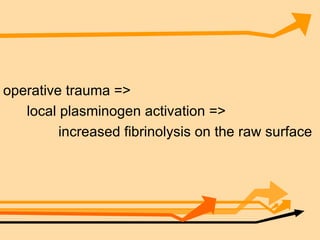
operative trauma => local plasminogen activation => increased fibrinolysis on the raw surface
EACA: 24-48-hour interruption of plasminogen activation
laboratory investigation must be confirmatory number of plt  actual plt count: if the smear is equivocal  aPTT PT TT
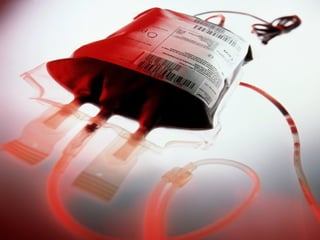
complications of blood transfusion
 
complications of blood transfusion   thrombocytopenia  due to massive blood transfusion hemolytic transfusion reaction Transfusion purpura
thrombocytopenia  due to massive blood transfusion
massive transfusion a  single  transfusion greater than  2500 mL 5000 mL  transfused over a period of  24 hours.
thrombocytopenia  due to massive blood transfusion usually  not  associated with hemostatic failure
prophylactic administration of plt: not indicated
if evidence of diffuse bleeding: empiric transfusion of 8_10 packs of fresh platelet concentrates no clear association  between plt count,BT & the occurrence of profuse bleeding
hemolytic transfusion reaction
Example: anesthetized patient : diffuse bleeding in an operative field that had previously been dry
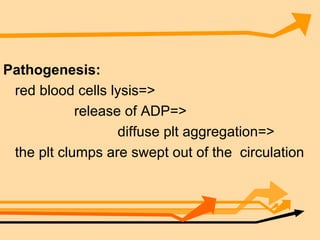
Pathogenesis: red blood cells lysis=> release of ADP=> diffuse plt aggregation=> the plt clumps are swept out of the  circulation
Release of procoagulants => progression of the clotting mechanism => intravascular defibrination The fibrinolytic mechanism may be triggered.
Transfusion purpura
Transfusion purpura uncommon
donor   plt :uncommon Pl A 1 group Recipient  makes  Ab  to the foreign plt Ag foreign plt antigen attach to the recipient's own plt
sufficient titer of Ab to destroy recipent’s plt:  within 6 or 7 days resultant thrombocytopenia & bleeding may continue for  several weeks
bleeding follows transfusion by 5 or 6 days:  Transfusion purpura  as DDx.
Management: Platelet transfusions : little help  damage from the Ab Corticosteroids:  some help  self-limited
DIC and disseminated fibrinolysis
DIC and disseminated fibrinolysis   control mechanisms fail to restrain the hemostatic process to the area of tissue damage
Caused by: trauma incompatible transfused blood Sepsis necrotic tissue fat emboli retained products of conception toxemia of pregnancy large aneurysms liver diseases
distinguish between the two processes or the dominant element : important
No single test   can confirm or exclude the  diagnosis  or  distinguish  between the two disorders
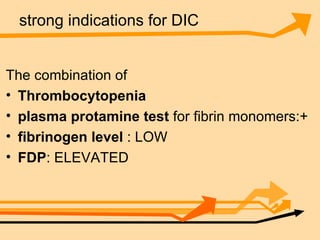
strong indications for DIC The combination of  Thrombocytopenia plasma protamine test  for fibrin monomers:+ fibrinogen level  : LOW FDP : ELEVATED
The euglobulin lysis time  detects diffusefibrinolysis
Biliary tract surgery in cirrhotic patients & Bleeding Related to: portal hypertension   coagulopathy  associated with chronic liver disease
The tests used to distinguish DIC from fibrinolysis pertain
The therapeutic approach  IV vasopressin : temporary reduction in portal hypertension  EACA  to correct the increased fibrinolysis
The therapeutic approach IV vasopressin : temporary reduction in portal hypertension  EACA  to correct the increased fibrinolysis.
Intra/Postoperative Bleeding & sepsis Endotoxin-induced thrombocytopenia Defibrination
Endotoxin-induced thrombocytopenia Gram Neg. sepsis a labile factor (possibly factor V)
Defibrination meningococcemia Clostridium perfringens  sepsis staphylococcal sepsis Hemolysis leading to defibrination Evaluation:plt count, INR, aPTT,TT
Preoperative Evaluation of Hemostasis
Ask the patient 8Qs
prolonged bleeding or swelling after biting the lip or tongue?
bruises  without apparent injury?
prolonged bleeding after dental extraction?
excessive menstrual bleeding?
bleeding problems associated with major and minor operations?
medical problems receiving a physician's attention within the past   5 years?
medical problems receiving a physician's attention within the past 5 years?
medications including  aspirin  or remedies for headache taken within the  past 10 days ?
a relative with a bleeding problem?
Four levels  Based on: History surgical procedure
level I History: negative procedure: relatively minor e.g., breast biopsy  hernia repair no screening tests are recommended
level II history:negative major operation but usually is not attended by significant bleeding platelet count  PBS  PTT
Level III history : suggestive of defective hemostasis  procedure :hemostasis may be impaired, e.g., operating using pump oxygenation or cell savers procedures : a large, raw surface is anticipated situations :minimal postoperative bleeding could be injurious(intracranial operations)
Level III plt count & bleeding time test : platelet function;  aPTT & INR : coagulation the fibrin clot should be incubated to screen for abnormal fibrinolysis
Level IV history highly suggestive of a hemostatic defect consult with ahematologist tests prescribed for level III  BT test :4 hours after ingestion of 600 mg of aspirin  operation is scheduled to take place 10 or more days after this study.
Level IV emergency procedure: platelet aggregation tests  ADP, collagen, epinephrine, and ristocetin  TT  : detect any  dysfibrinogenemia  or a circulating, weak, heparin-like anticoagulant.
uremic patients Qualitative platelet abnormality most common deficit best detected by the  bleeding time test .
Thanks for your attention

Surgical Bleeding