INCISION VS EXCISION VS RESECTION
Cynthia Brown, MBA, RHIT, CCS
CyntCoding Health Information Services
Coding Yesterday’s Nomenclature Today®
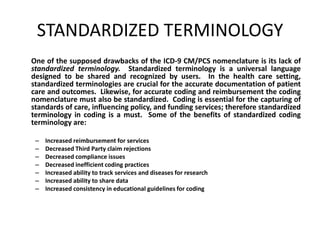
STANDARDIZED TERMINOLOGY
One of the supposed drawbacks of the ICD-9 CM/PCS nomenclature is its lack of
standardized terminology. Standardized terminology is a universal language
designed to be shared and recognized by users. In the health care setting,
standardized terminologies are crucial for the accurate documentation of patient
care and outcomes. Likewise, for accurate coding and reimbursement the coding
nomenclature must also be standardized. Coding is essential for the capturing of
standards of care, influencing policy, and funding services; therefore standardized
terminology in coding is a must. Some of the benefits of standardized coding
terminology are:
– Increased reimbursement for services
– Decreased Third Party claim rejections
– Decreased compliance issues
– Decreased inefficient coding practices
– Increased ability to track services and diseases for research
– Increased ability to share data
– Increased consistency in educational guidelines for coding
Will Result in Accurate ICD-10 PCS Coding
RESECTION
INCISION
EXCISION
Knowing the Difference
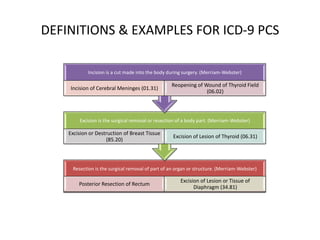
DEFINITIONS & EXAMPLES FOR ICD-9 PCS
Resection is the surgical removal of part of an organ or structure. (Merriam-Webster)
Posterior Resection of Rectum (48.64)
Excision of Lesion or Tissue of
Diaphragm (34.81)
Excision is the surgical removal or resection of a body part. (Merriam-Webster)
Excision or Destruction of Breast Tissue
(85.20)
Excision of Lesion of Thyroid (06.31)
Incision is a cut made into the body during surgery. (Merriam-Webster)
Incision of Cerebral Meninges (01.31)
Reopening of Wound of Thyroid Field
(06.02)
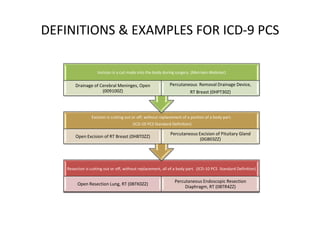
DEFINITIONS & EXAMPLES FOR ICD-10 PCS
Resection is cutting out or off, without replacement, all of a body part. (ICD-10 PCS Standard Definition)
Open Resection Lung, RT (0BTK0ZZ)
Percutaneous Endoscopic Resection
Diaphragm, RT (0BTR4ZZ)
Excision is cutting out or off, without replacement of a portion of a body part.
(ICD-10 PCS Standard Definition)
Open Excision of RT Breast (0HBT0ZZ)
Percutaneous Excision of Pituitary Gland
(0GB03ZZ)
Incision is a cut made into the body during surgery. (Merriam-Webster)
Drainage of Cerebral Meninges, Open
(009100Z)
Percutaneous Removal Drainage Device,
RT Breast (0HPT30Z)
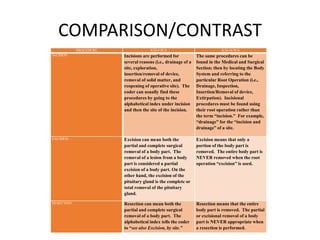
COMPARISON/CONTRAST
PROCEDURE ICD-9 PCS ICD-10 PCS
INCISION Incisions are performed for
several reasons (i.e., drainage of a
site, exploration,
insertion/removal of device,
removal of solid matter, and
reopening of operative site). The
coder can usually find these
procedures by going to the
alphabetical index under incision
and then the site of the incision.
The same procedures can be
found in the Medical and Surgical
Section; then by locating the Body
System and referring to the
particular Root Operation (i.e.,
Drainage, Inspection,
Insertion/Removal of device,
Extirpation). Incisional
procedures must be found using
their root operation rather than
the term “incision.” For example,
“drainage” for the “incision and
drainage” of a site.
EXCISION Excision can mean both the
partial and complete surgical
removal of a body part. The
removal of a lesion from a body
part is considered a partial
excision of a body part. On the
other hand, the excision of the
pituitary gland is the complete or
total removal of the pituitary
gland.
Excision means that only a
portion of the body part is
removed. The entire body part is
NEVER removed when the root
operation “excision” is used.
RESECTION Resection can mean both the
partial and complete surgical
removal of a body part. The
alphabetical index tells the coder
to “see also Excision, by site.”
Resection means that the entire
body part is removed. The partial
or excisional removal of a body
part is NEVER appropriate when
a resection is performed.
Coding Yesterday’s Nomenclature Today®
Cynthia Brown, MBA, RHIT, CCS
AHIMA Approved ICD-10 CM/PCS Trainer
CyntCoding Health Information Services
Phone: 404-992-8984/E-Fax: 678-805-4919
P.O. Box 3019
Decatur, GA 30031
cyntcoder@cyntcodinghealthinformationservices.com
www.cyntcodinghealthinformationservices.com
Coding Yesterday’s Nomenclature Today®
INCISION VS EXCISION VS RESECTION
CCHIS PRESENTATION
TERMS AND CONDITIONS OF USE
All content provided in this “CCHIS Presentation” is for informational
purposes only. The owner of this presentation makes no representations
as to the accuracy or completeness of any information in this
presentation or found by following any link in this presentation.
The owner of http://www.cyntcodinghealthinformationservices.com will
not be liable for any errors or omissions in information nor for the
availability of this information. The owner will not be liable for any
losses, injuries, or damages from the display or use of this information.
The terms and conditions are subject to change at any time with or
without notice.

Incision vs excision vs resection

  • 1.
    INCISION VS EXCISIONVS RESECTION Cynthia Brown, MBA, RHIT, CCS CyntCoding Health Information Services Coding Yesterday’s Nomenclature Today®
  • 2.
    STANDARDIZED TERMINOLOGY One ofthe supposed drawbacks of the ICD-9 CM/PCS nomenclature is its lack of standardized terminology. Standardized terminology is a universal language designed to be shared and recognized by users. In the health care setting, standardized terminologies are crucial for the accurate documentation of patient care and outcomes. Likewise, for accurate coding and reimbursement the coding nomenclature must also be standardized. Coding is essential for the capturing of standards of care, influencing policy, and funding services; therefore standardized terminology in coding is a must. Some of the benefits of standardized coding terminology are: – Increased reimbursement for services – Decreased Third Party claim rejections – Decreased compliance issues – Decreased inefficient coding practices – Increased ability to track services and diseases for research – Increased ability to share data – Increased consistency in educational guidelines for coding
  • 3.
    Will Result inAccurate ICD-10 PCS Coding RESECTION INCISION EXCISION Knowing the Difference
  • 4.
    DEFINITIONS & EXAMPLESFOR ICD-9 PCS Resection is the surgical removal of part of an organ or structure. (Merriam-Webster) Posterior Resection of Rectum (48.64) Excision of Lesion or Tissue of Diaphragm (34.81) Excision is the surgical removal or resection of a body part. (Merriam-Webster) Excision or Destruction of Breast Tissue (85.20) Excision of Lesion of Thyroid (06.31) Incision is a cut made into the body during surgery. (Merriam-Webster) Incision of Cerebral Meninges (01.31) Reopening of Wound of Thyroid Field (06.02)
  • 5.
    DEFINITIONS & EXAMPLESFOR ICD-10 PCS Resection is cutting out or off, without replacement, all of a body part. (ICD-10 PCS Standard Definition) Open Resection Lung, RT (0BTK0ZZ) Percutaneous Endoscopic Resection Diaphragm, RT (0BTR4ZZ) Excision is cutting out or off, without replacement of a portion of a body part. (ICD-10 PCS Standard Definition) Open Excision of RT Breast (0HBT0ZZ) Percutaneous Excision of Pituitary Gland (0GB03ZZ) Incision is a cut made into the body during surgery. (Merriam-Webster) Drainage of Cerebral Meninges, Open (009100Z) Percutaneous Removal Drainage Device, RT Breast (0HPT30Z)
  • 6.
    COMPARISON/CONTRAST PROCEDURE ICD-9 PCSICD-10 PCS INCISION Incisions are performed for several reasons (i.e., drainage of a site, exploration, insertion/removal of device, removal of solid matter, and reopening of operative site). The coder can usually find these procedures by going to the alphabetical index under incision and then the site of the incision. The same procedures can be found in the Medical and Surgical Section; then by locating the Body System and referring to the particular Root Operation (i.e., Drainage, Inspection, Insertion/Removal of device, Extirpation). Incisional procedures must be found using their root operation rather than the term “incision.” For example, “drainage” for the “incision and drainage” of a site. EXCISION Excision can mean both the partial and complete surgical removal of a body part. The removal of a lesion from a body part is considered a partial excision of a body part. On the other hand, the excision of the pituitary gland is the complete or total removal of the pituitary gland. Excision means that only a portion of the body part is removed. The entire body part is NEVER removed when the root operation “excision” is used. RESECTION Resection can mean both the partial and complete surgical removal of a body part. The alphabetical index tells the coder to “see also Excision, by site.” Resection means that the entire body part is removed. The partial or excisional removal of a body part is NEVER appropriate when a resection is performed.
  • 7.
    Coding Yesterday’s NomenclatureToday® Cynthia Brown, MBA, RHIT, CCS AHIMA Approved ICD-10 CM/PCS Trainer CyntCoding Health Information Services Phone: 404-992-8984/E-Fax: 678-805-4919 P.O. Box 3019 Decatur, GA 30031 cyntcoder@cyntcodinghealthinformationservices.com www.cyntcodinghealthinformationservices.com Coding Yesterday’s Nomenclature Today®
  • 8.
    INCISION VS EXCISIONVS RESECTION CCHIS PRESENTATION TERMS AND CONDITIONS OF USE All content provided in this “CCHIS Presentation” is for informational purposes only. The owner of this presentation makes no representations as to the accuracy or completeness of any information in this presentation or found by following any link in this presentation. The owner of http://www.cyntcodinghealthinformationservices.com will not be liable for any errors or omissions in information nor for the availability of this information. The owner will not be liable for any losses, injuries, or damages from the display or use of this information. The terms and conditions are subject to change at any time with or without notice.