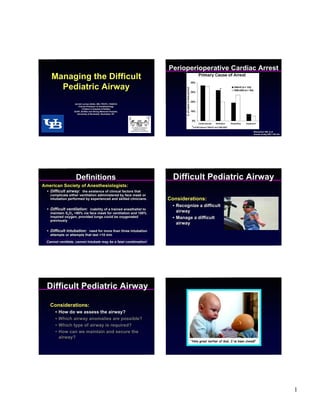
Perioperioperative Cardiac Arrest
    Managing the Difficult
      Pediatric Airway
                   Jerrold Lerman BASc, MD, FRCPC, FANZCA
                       Clinical Professor of Anesthesiology
                           Children’s Hospital of Buffalo
                   SUNY, Buffalo and Strong Memorial Hospital,
                     University of Rochester, Rochester, NY


                                                                                              Bhanankar SM, et al
                                                                                              Anesth Analg 2007:105;344


                    Definitions                                      Difficult Pediatric Airway
American Society of Anesthesiologists:
  • Difficult airway: the existence of clinical factors that
    complicate either ventilation administered by face mask or
    intubation performed by experienced and skilled clinicians.    Considerations:
                                                                    • Recognize a difficult
  • Difficult ventilation: inability of a trained anesthetist to
    maintain SaO 2 >90% via face mask for ventilation and 100%
                                                                      airway
    inspired oxygen, provided lungs could be oxygenated             • Manage a difficult
    previously
                                                                      airway
  • Difficult intubation: need for more than three intubation
    attempts or attempts that last >10 min

  Cannot ventilate, cannot Intubate may be a fatal combination!


  Difficult Pediatric Airway

    Considerations:
       •   How do we assess the airway?
       •   Which airway anomalies are possible?
       •   Which type of airway is required?
       •   How can we maintain and secure the
           airway?


                                                                                                                          1
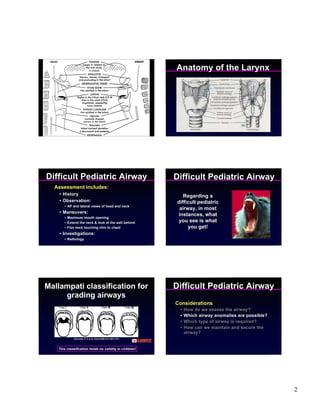
Anatomy of the Larynx


Difficult Pediatric Airway                                     Difficult Pediatric Airway
  Assessment includes:
    • History                                                      Regarding a
    • Observation:                                              difficult pediatric
      • AP and lateral views of head and neck
                                                                 airway, in most
    • Maneuvers:
                                                                instances, what
      • Maximum mouth opening
      • Extend the neck & look at the wall behind                you see is what
      • Flex neck touching chin to chest                             you get!
    • Investigations:
      • Radiology


Mallampati classification for                                  Difficult Pediatric Airway
     grading airways
                                                               Considerations
                                                                 •   How do we assess the airway?
                                                                 •   Which airway anomalies are possible?
                                                                 •   Which type of airway is required?
                                                                 •   How can we maintain and secure the
                                                                     airway?
             Reynolds, S. F. et al. Chest 2005;127:1397-1412


   This classification holds no validity in children!


                                                                                                            2
Position for laryngoscopy:
 Difficult Pediatric Airway                                                       left lateral decubitus


 Anatomical features of a "difficult airway":
      •   Skull/CNS anomalies
      •   Inability to flex/extend the neck
      •   TM joint dysfunction
      •   Maxillary hypoplasia
      •   Retro or micrognathia (with glossoptosis)
      •   Microstomia
      •   Soft tissues:
           • limitation of movement
           • mass effect
      • Laryngeal/glottic anomalies


MASK ANESTHESIA!
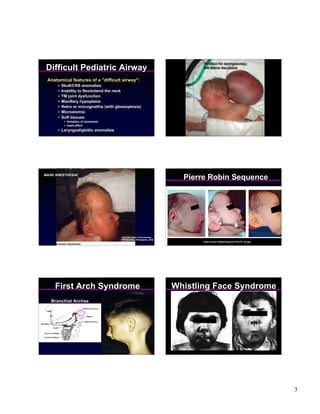
                !                                                            Pierre Robin Sequence


                                         Clark DA. Atlas of Neonatology
                                         WB Saunders, Philadelphia, 2000
                                                                                  www.scielo.cl/fbpe/img/rcp/v75n1/f1_03.jpg


     First Arch Syndrome                                                   Whistling Face Syndrome
   Branchial Arches


                                                                                                                               3
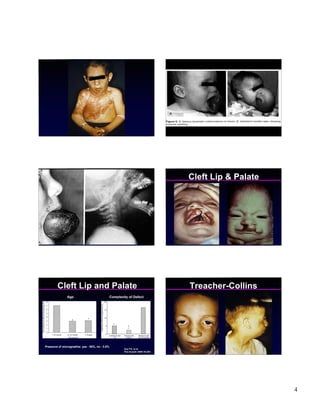
Cleft Lip & Palate


        Cleft Lip and Palate                                                      Treacher-Collins
               Age                               Complexity of Defect


Presence of micrognathia: yes - 50%, no - 3.8%
                                                         Xue FS, et al
                                                         Ped Anesth 2006:16;283


                                                                                                       4
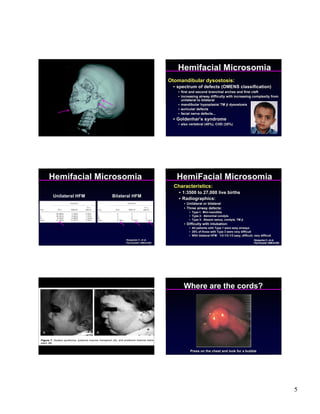
Hemifacial Microsomia
                                               Otomandibular dysostosis:
                                                • spectrum of defects (OMENS classification)
                                                  • first and second branchial arches and first cleft
                                                  • increasing airway difficulty with increasing complexity from
                                                    unilateral to bilateral
                                                  • mandibular hypoplasia/ TM jt dysostosis
                                                  • auricular defects
                                                  • facial nerve defects...
                                                • Goldenhar’s syndrome
                                                  • also vertebral (40%), CHD (35%)


Hemifacial Microsomia                             HemiFacial Microsomia
                                                 Characteristics:
                                                   • 1:3500 to 27,000 live births
Unilateral HFM   Bilateral HFM
                                                   • Radiographics:
                                                     • Unilateral or bilateral
                                                     • Three airway defects:
                                                        • Type I: Mini-mandible
                                                        • Type 2: Abnormal condyle
                                                        • Type 3: Absent ramus, condyle, TM jt
                                                     • Difficulty with intubation:
                                                        • All patients with Type 1 were easy airways
                                                        • 25% of those with Type 3 were very difficult
                                                        • With bilateral HFM: 1/3:1/3:1/3 easy, difficult, very difficult
                       Nargozian C, et al.                                                                 Nargozian C, et al.
                       Ped Anesth 1999:9;393                                                               Ped Anesth 1999:9;393


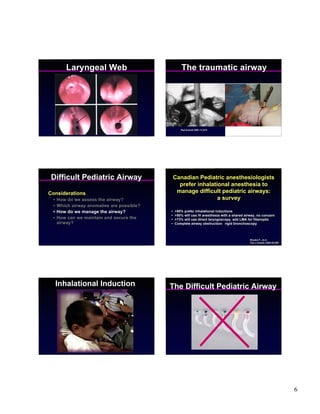
                                                     Where are the cords?


                                                         Press on the chest and look for a bubble


                                                                                                                                   5
Laryngeal Web                              The traumatic airway


                                                   Ped Anesth 2001:11;615


 Difficult Pediatric Airway                     Canadian Pediatric anesthesiologists
                                                  prefer inhalational anesthesia to
Considerations                                   manage difficult pediatric airways:
 •   How do we assess the airway?                                a survey
 •   Which airway anomalies are possible?
 •   How do we manage the airway?           •   >90% prefer inhalational inductions
                                            •   >50% will use IV anesthesia with a shared airway, no concern
 •   How can we maintain and secure the     •   >73% will use direct laryngoscopy, add LMA for fiberoptic
     airway?                                •   Complete airway obstruction: rigid bronchoscopy


                                                                                             Brooks P., et al
                                                                                             Can J Anesth 2005:52;285


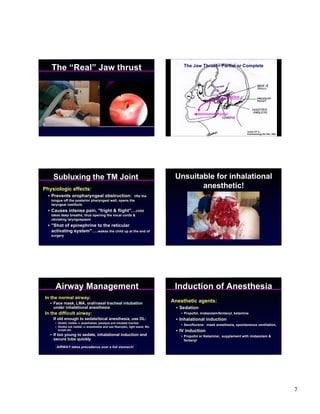
     Inhalational Induction                 The Difficult Pediatric Airway


                                                                                                                        6
The “Real” Jaw thrust                                                           The Jaw Thrust - Partial or Complete


                                                                                                           Complete


                                                                                                       Partial


                                                                                                                      Larsen CP Jr., Jr.,
                                                                                                                          Larsen CP
                                                                                                                      Anesthesiology 89:1293, 1998
                                                                                                                          Anesthesiology 89:1293, 1998


    Subluxing the TM Joint                                                     Unsuitable for inhalational
Physiologic effects:                                                                  anesthetic!
  • Prevents oropharyngeal obstruction:               lifts the
   tongue off the posterior pharyngeal wall, opens the
   laryngeal vestibule
  • Causes intense pain, "fright & flight"…child
   takes deep breaths, thus opening the vocal cords &
   obviating laryngospasm
  • "Shot of epinephrine to the reticular
    activating system"….wakes the child up at the end of
   surgery


     Airway Management                                                         Induction of Anesthesia
In the normal airway:
   • Face mask, LMA, oral/nasal tracheal intubation
                                                                              Anesthetic agents:
     under inhalational anesthesia                                              • Sedation
In the difficult airway:                                                          • Propofol, midazolam/fentanyl, ketamine
    If old enough to sedate/local anesthesia, use DL:                           • Inhalational induction
     • Glottis visible ⇒ anesthetize, paralyze and intubate trachea
                                                                                  • Sevoflurane: mask anesthesia, spontaneous ventilation,
     • Glottis not visible ⇒ anesthetize and use fiberoptic, light wand, Wu
       scope etc                                                                • IV induction
   • If too young to sedate, inhalational induction and                           • Propofol or Ketamine; supplement with midazolam &
     secure tube quickly                                                            fentanyl
      AIRWAY takes precedence over a full stomach!


                                                                                                                                                         7
Neuromuscular Blockade?                                                          Neuromuscular Blockade?
  Considerations:                                                                Avoid NMB drugs because:
       • NEVER paralyze a child with an uncertain                                  • May be unable to ventilate the lungs…suggamadex
         or difficult airway …unable to ventilate?                                 • Spontaneous ventilation maintains laryngeal muscle
       • Succinylcholine is the preferred agent                                      tone; negative intra-thoracic pressure, easier to
         unless…                                                                     view larynx
             • Contraindications: Airway difficulty, MH,                           • Permits wakening the child & regrouping
               hyperkalemia
                                                                                   • Use of the airway devices: LMA, lightwand,
       • Rocuronium is a poor second choice…                                         fiberoptic bronchoscope etc.
             • Contraindicated with airway difficulty
             • Cannot be reversed easily…Sugammadex!


 Difficult Pediatric Airway                                                               Airway management
    Considerations:                                                                      Techniques:
         •   How do we assess the airway?                                                    •   Direct laryngoscopy with a stylette
                                                                                             •   LMA
         •   Which airway anomalies are possible?
                                                                                             •   Fiberoptic scope
         •   Which type of airway is required?                                               •   Bullard
         •   How can we maintain and secure the                                              •   Lightwand
             airway?                                                                         •   Glidescope
                                                                                             •   Surgical airway


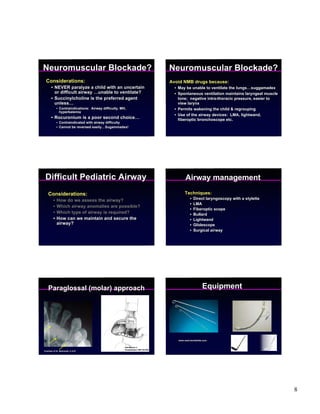
    Paraglossal (molar) approach                                                                      Equipment


                                                                                     www.med-worldwide.com


                                                       Henderson J.
                                                       Anaesthesia 1997:52;552
Courtesy of Dr. Berkowitz, U of R


                                                                                                                                          8
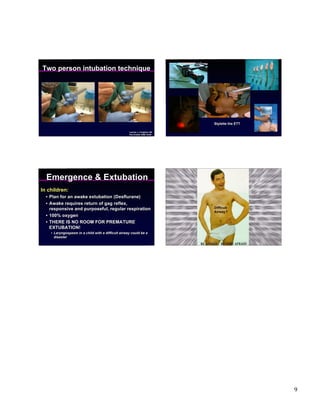
Two person intubation technique


                                                                              Stylette the ETT

                                                    Lerman J, Creighton RE.
                                                    Ped Anesth 2005:16;96


  Emergence & Extubation
In children:
  • Plan for an awake extubation (Desflurane)
  • Awake requires return of gag reflex,
    responsive and purposeful, regular respiration                            Difficult
                                                                              Airway?
  • 100% oxygen
  • THERE IS NO ROOM FOR PREMATURE
    EXTUBATION!
    • Laryngospasm in a child with a difficult airway could be a
      disaster


                                                                                                 9

Managing the Difficult Pediatric Airway

  • 1.
    Perioperioperative Cardiac Arrest Managing the Difficult Pediatric Airway Jerrold Lerman BASc, MD, FRCPC, FANZCA Clinical Professor of Anesthesiology Children’s Hospital of Buffalo SUNY, Buffalo and Strong Memorial Hospital, University of Rochester, Rochester, NY Bhanankar SM, et al Anesth Analg 2007:105;344 Definitions Difficult Pediatric Airway American Society of Anesthesiologists: • Difficult airway: the existence of clinical factors that complicate either ventilation administered by face mask or intubation performed by experienced and skilled clinicians. Considerations: • Recognize a difficult • Difficult ventilation: inability of a trained anesthetist to maintain SaO 2 >90% via face mask for ventilation and 100% airway inspired oxygen, provided lungs could be oxygenated • Manage a difficult previously airway • Difficult intubation: need for more than three intubation attempts or attempts that last >10 min Cannot ventilate, cannot Intubate may be a fatal combination! Difficult Pediatric Airway Considerations: • How do we assess the airway? • Which airway anomalies are possible? • Which type of airway is required? • How can we maintain and secure the airway? 1
  • 2.
    Anatomy of theLarynx Difficult Pediatric Airway Difficult Pediatric Airway Assessment includes: • History Regarding a • Observation: difficult pediatric • AP and lateral views of head and neck airway, in most • Maneuvers: instances, what • Maximum mouth opening • Extend the neck & look at the wall behind you see is what • Flex neck touching chin to chest you get! • Investigations: • Radiology Mallampati classification for Difficult Pediatric Airway grading airways Considerations • How do we assess the airway? • Which airway anomalies are possible? • Which type of airway is required? • How can we maintain and secure the airway? Reynolds, S. F. et al. Chest 2005;127:1397-1412 This classification holds no validity in children! 2
  • 3.
    Position for laryngoscopy: Difficult Pediatric Airway left lateral decubitus Anatomical features of a "difficult airway": • Skull/CNS anomalies • Inability to flex/extend the neck • TM joint dysfunction • Maxillary hypoplasia • Retro or micrognathia (with glossoptosis) • Microstomia • Soft tissues: • limitation of movement • mass effect • Laryngeal/glottic anomalies MASK ANESTHESIA! ! Pierre Robin Sequence Clark DA. Atlas of Neonatology WB Saunders, Philadelphia, 2000 www.scielo.cl/fbpe/img/rcp/v75n1/f1_03.jpg First Arch Syndrome Whistling Face Syndrome Branchial Arches 3
  • 4.
    Cleft Lip &Palate Cleft Lip and Palate Treacher-Collins Age Complexity of Defect Presence of micrognathia: yes - 50%, no - 3.8% Xue FS, et al Ped Anesth 2006:16;283 4
  • 5.
    Hemifacial Microsomia Otomandibular dysostosis: • spectrum of defects (OMENS classification) • first and second branchial arches and first cleft • increasing airway difficulty with increasing complexity from unilateral to bilateral • mandibular hypoplasia/ TM jt dysostosis • auricular defects • facial nerve defects... • Goldenhar’s syndrome • also vertebral (40%), CHD (35%) Hemifacial Microsomia HemiFacial Microsomia Characteristics: • 1:3500 to 27,000 live births Unilateral HFM Bilateral HFM • Radiographics: • Unilateral or bilateral • Three airway defects: • Type I: Mini-mandible • Type 2: Abnormal condyle • Type 3: Absent ramus, condyle, TM jt • Difficulty with intubation: • All patients with Type 1 were easy airways • 25% of those with Type 3 were very difficult • With bilateral HFM: 1/3:1/3:1/3 easy, difficult, very difficult Nargozian C, et al. Nargozian C, et al. Ped Anesth 1999:9;393 Ped Anesth 1999:9;393 Where are the cords? Press on the chest and look for a bubble 5
  • 6.
    Laryngeal Web The traumatic airway Ped Anesth 2001:11;615 Difficult Pediatric Airway Canadian Pediatric anesthesiologists prefer inhalational anesthesia to Considerations manage difficult pediatric airways: • How do we assess the airway? a survey • Which airway anomalies are possible? • How do we manage the airway? • >90% prefer inhalational inductions • >50% will use IV anesthesia with a shared airway, no concern • How can we maintain and secure the • >73% will use direct laryngoscopy, add LMA for fiberoptic airway? • Complete airway obstruction: rigid bronchoscopy Brooks P., et al Can J Anesth 2005:52;285 Inhalational Induction The Difficult Pediatric Airway 6
  • 7.
    The “Real” Jawthrust The Jaw Thrust - Partial or Complete Complete Partial Larsen CP Jr., Jr., Larsen CP Anesthesiology 89:1293, 1998 Anesthesiology 89:1293, 1998 Subluxing the TM Joint Unsuitable for inhalational Physiologic effects: anesthetic! • Prevents oropharyngeal obstruction: lifts the tongue off the posterior pharyngeal wall, opens the laryngeal vestibule • Causes intense pain, "fright & flight"…child takes deep breaths, thus opening the vocal cords & obviating laryngospasm • "Shot of epinephrine to the reticular activating system"….wakes the child up at the end of surgery Airway Management Induction of Anesthesia In the normal airway: • Face mask, LMA, oral/nasal tracheal intubation Anesthetic agents: under inhalational anesthesia • Sedation In the difficult airway: • Propofol, midazolam/fentanyl, ketamine If old enough to sedate/local anesthesia, use DL: • Inhalational induction • Glottis visible ⇒ anesthetize, paralyze and intubate trachea • Sevoflurane: mask anesthesia, spontaneous ventilation, • Glottis not visible ⇒ anesthetize and use fiberoptic, light wand, Wu scope etc • IV induction • If too young to sedate, inhalational induction and • Propofol or Ketamine; supplement with midazolam & secure tube quickly fentanyl AIRWAY takes precedence over a full stomach! 7
  • 8.
    Neuromuscular Blockade? Neuromuscular Blockade? Considerations: Avoid NMB drugs because: • NEVER paralyze a child with an uncertain • May be unable to ventilate the lungs…suggamadex or difficult airway …unable to ventilate? • Spontaneous ventilation maintains laryngeal muscle • Succinylcholine is the preferred agent tone; negative intra-thoracic pressure, easier to unless… view larynx • Contraindications: Airway difficulty, MH, • Permits wakening the child & regrouping hyperkalemia • Use of the airway devices: LMA, lightwand, • Rocuronium is a poor second choice… fiberoptic bronchoscope etc. • Contraindicated with airway difficulty • Cannot be reversed easily…Sugammadex! Difficult Pediatric Airway Airway management Considerations: Techniques: • How do we assess the airway? • Direct laryngoscopy with a stylette • LMA • Which airway anomalies are possible? • Fiberoptic scope • Which type of airway is required? • Bullard • How can we maintain and secure the • Lightwand airway? • Glidescope • Surgical airway Paraglossal (molar) approach Equipment www.med-worldwide.com Henderson J. Anaesthesia 1997:52;552 Courtesy of Dr. Berkowitz, U of R 8
  • 9.
    Two person intubationtechnique Stylette the ETT Lerman J, Creighton RE. Ped Anesth 2005:16;96 Emergence & Extubation In children: • Plan for an awake extubation (Desflurane) • Awake requires return of gag reflex, responsive and purposeful, regular respiration Difficult Airway? • 100% oxygen • THERE IS NO ROOM FOR PREMATURE EXTUBATION! • Laryngospasm in a child with a difficult airway could be a disaster 9