+
Erosion – Surface Water
…moving, transporting,
and depositing sediment.
+
Surface Water
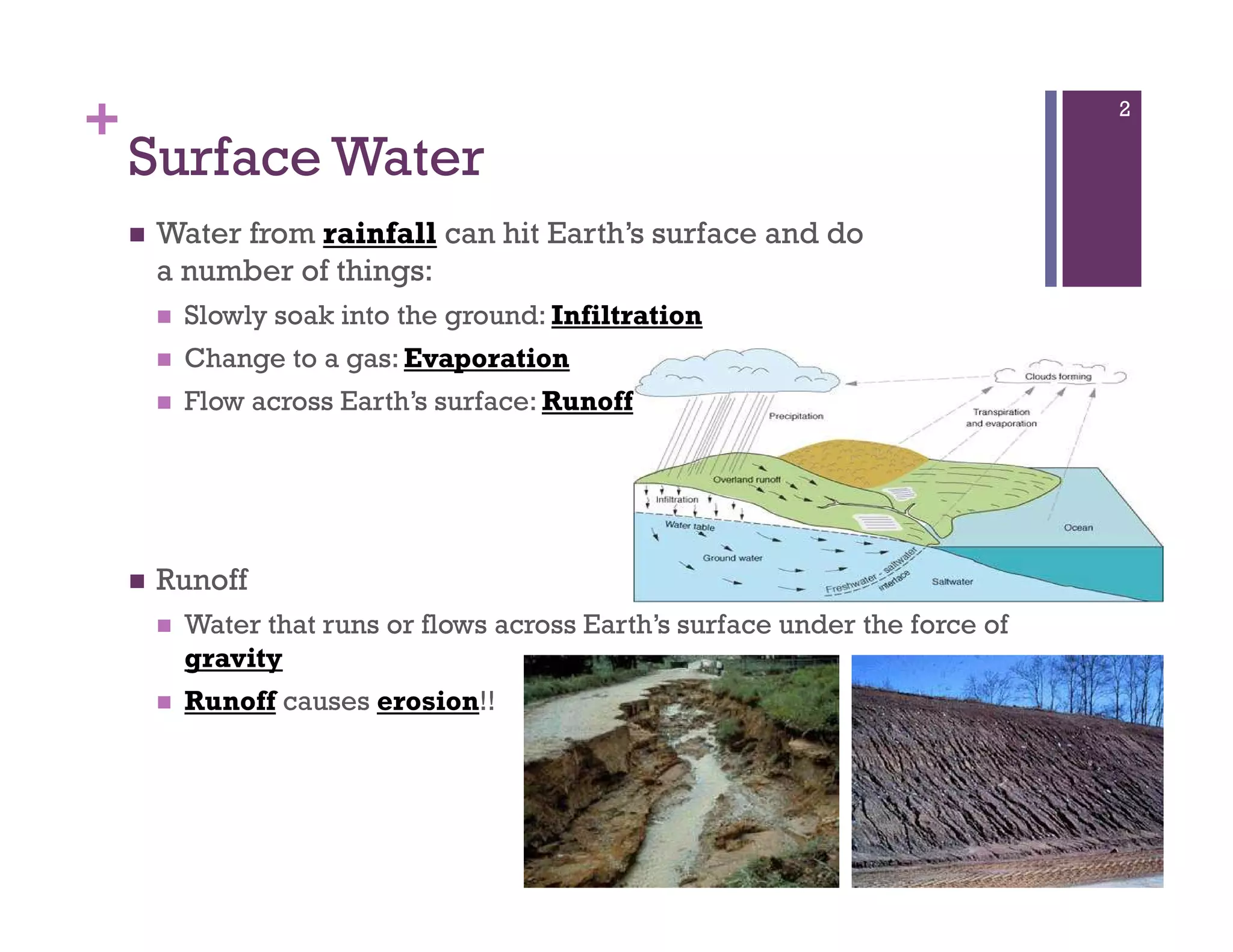
Water from rainfall can hit Earth’s surface and do
a number of things:
Slowly soak into the ground: Infiltration
Change to a gas: Evaporation
Flow across Earth’s surface: Runoff
2
Runoff
Water that runs or flows across Earth’s surface under the force of
gravity
Runoff causes erosion!!
+
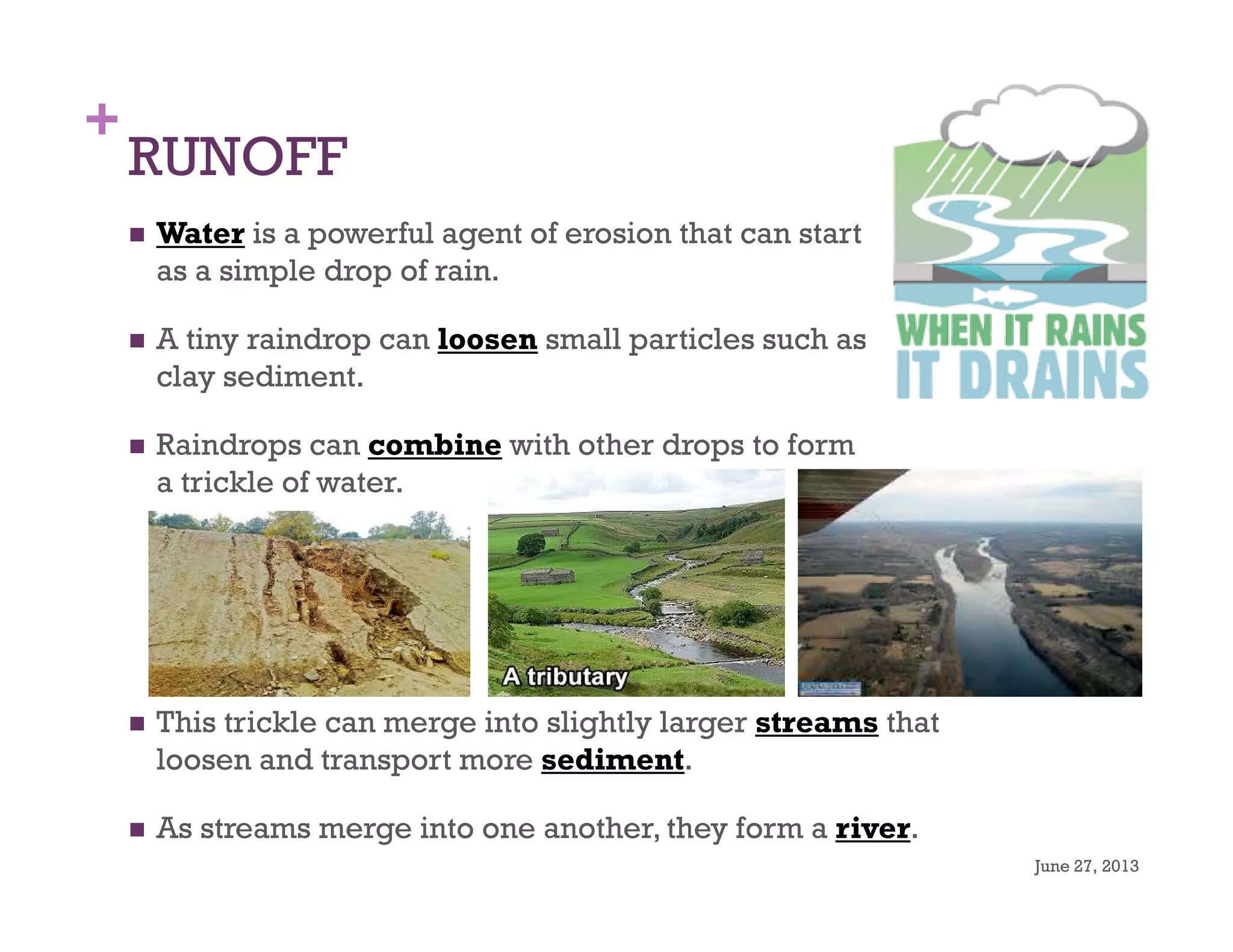
RUNOFF
Water is a powerful agent of erosion that can start
as a simple drop of rain.
A tiny raindrop can loosen small particles such as
clay sediment.
Raindrops can combine with other drops to form
a trickle of water.
June 27, 2013
3
This trickle can merge into slightly larger streams that
loosen and transport more sediment.
As streams merge into one another, they form a river.
+
RUNOFF
As a river or stream flows, it will create a path by weathering
and eroding away soft layers of rock, like sandstone.
Sometimes, rivers will encounter layers of rock that do not
weather and erode as easily, such as granite.
June 27, 2013
4
This can cause rivers to change course, or
meander, as rushing water tends to flow in
the direction of least resistance.
However, even harder layers of rock, like
granite, can be eroded by flowing water
over time.
+
RUNOFF
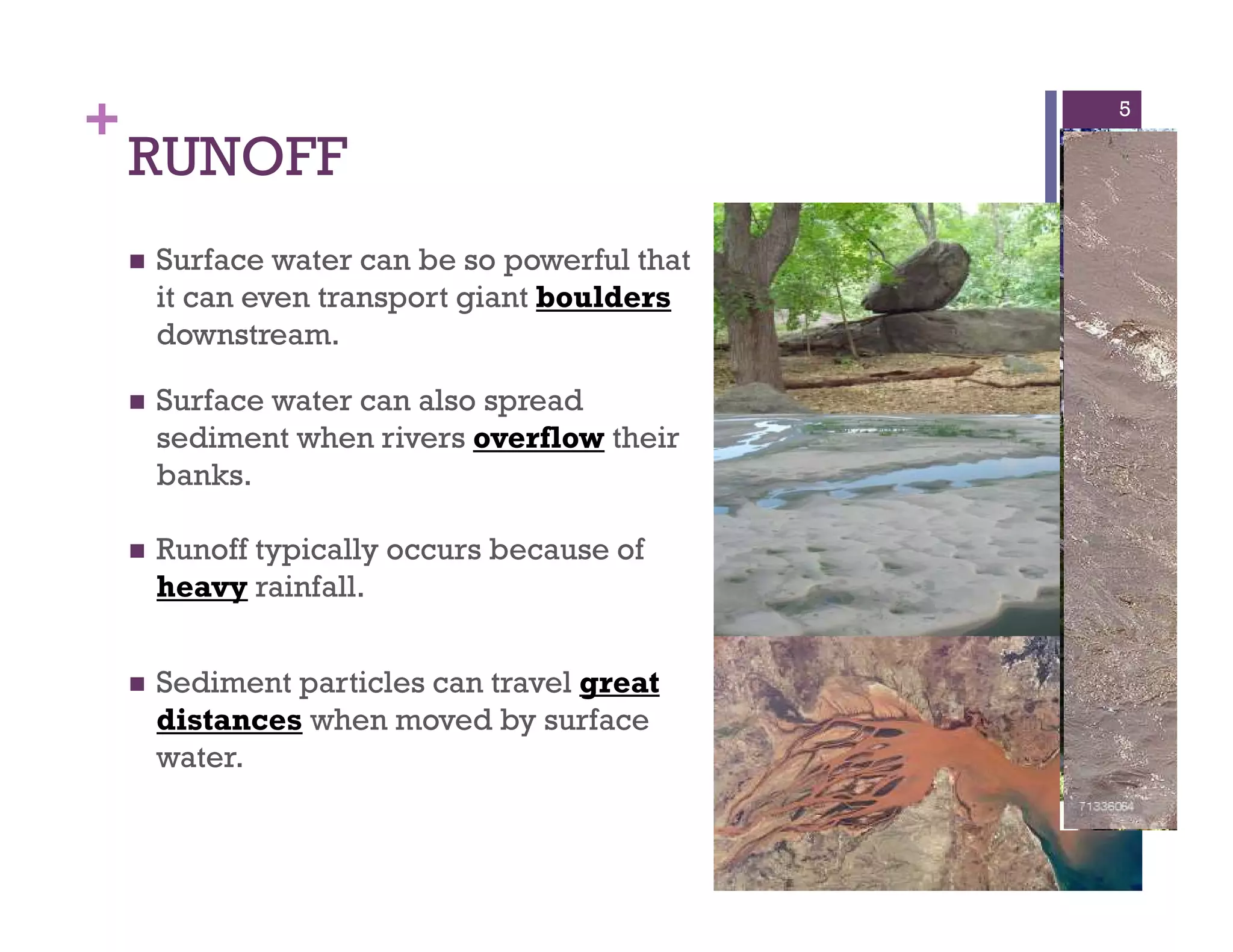
Surface water can be so powerful that
it can even transport giant boulders
downstream.
5
Surface water can also spread
sediment when rivers overflow their
banks.
Runoff typically occurs because of
heavy rainfall.
Sediment particles can travel great
distances when moved by surface
water.
+
RUNOFF
6
If water carrying sediment flows over a depression or basin,
its sediment load can be deposited.
If water meets an obstacle or has to spread out over a larger
area, it might not have enough energy to carry its full load of
sediment and will deposit it.
Over time, sediment particles can gradually accumulate and
can eventually form sedimentary rock.
+
What affects runoff and erosion?
The intensity and duration of rainfall
The harder and longer it rains, the more
water that will flow on the surface.
June 27, 2013
7
The water content of the soil
Is the soil saturated, or can rainfall soak into it?
Slope of the land
Water flows fast down steep slopes which
lead to more Erosional energy.
Vegetation
Vegetation can slow runoff and allow the surface
water to soak in.
+
Running Water
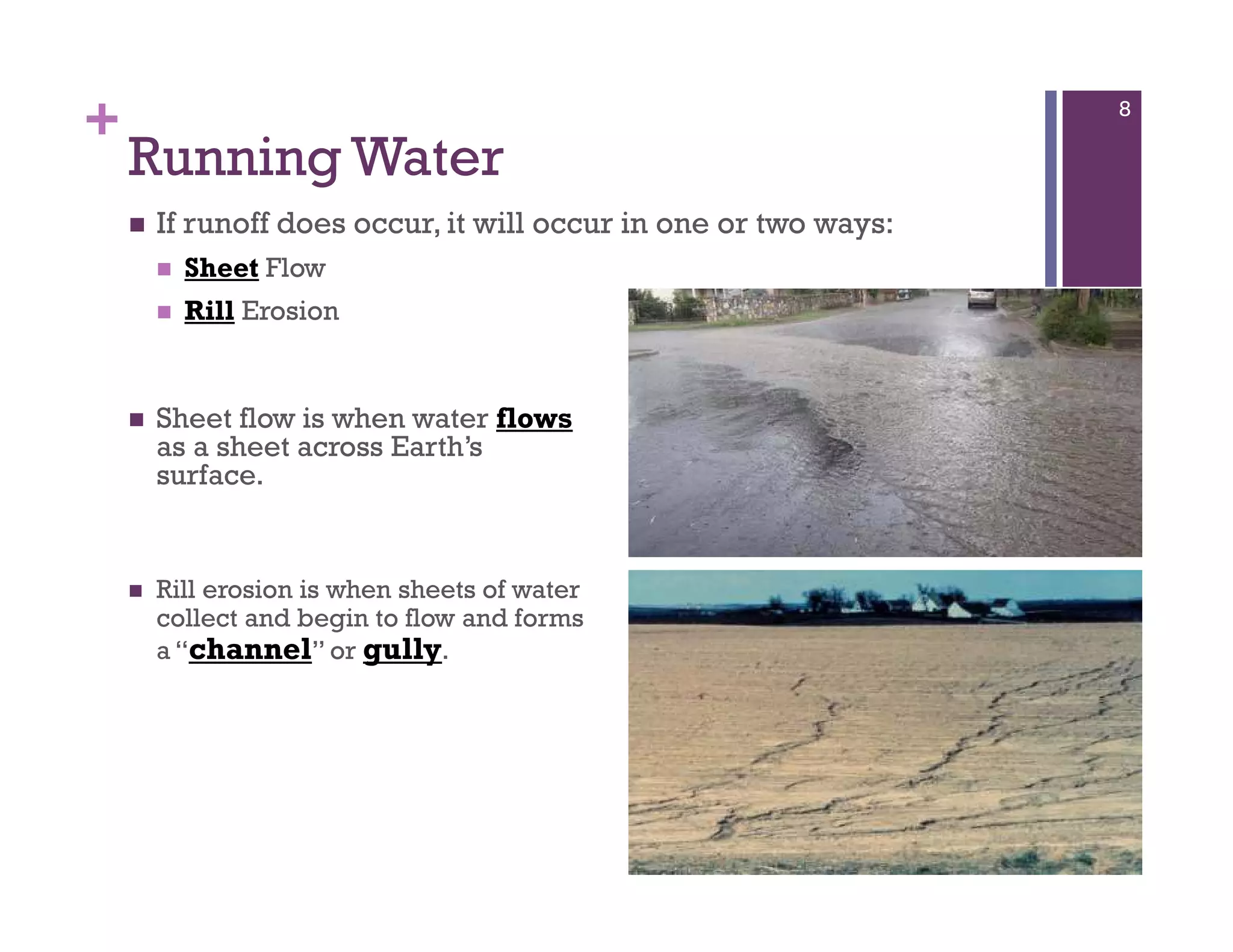
If runoff does occur, it will occur in one or two ways:
Sheet Flow
Rill Erosion
8
Sheet flow is when water flows
as a sheet across Earth’s
surface.
Rill erosion is when sheets of water
collect and begin to flow and forms
a “channel” or gully.
+
Running Water
Over time, continuous rill erosion leads to the development
of a stream.
A stream is any channelized flow of water.
There are many different types of streams that differ in terms of
their shape, speed, and volume of water.
9
+
River Systems
June 27, 2013
10
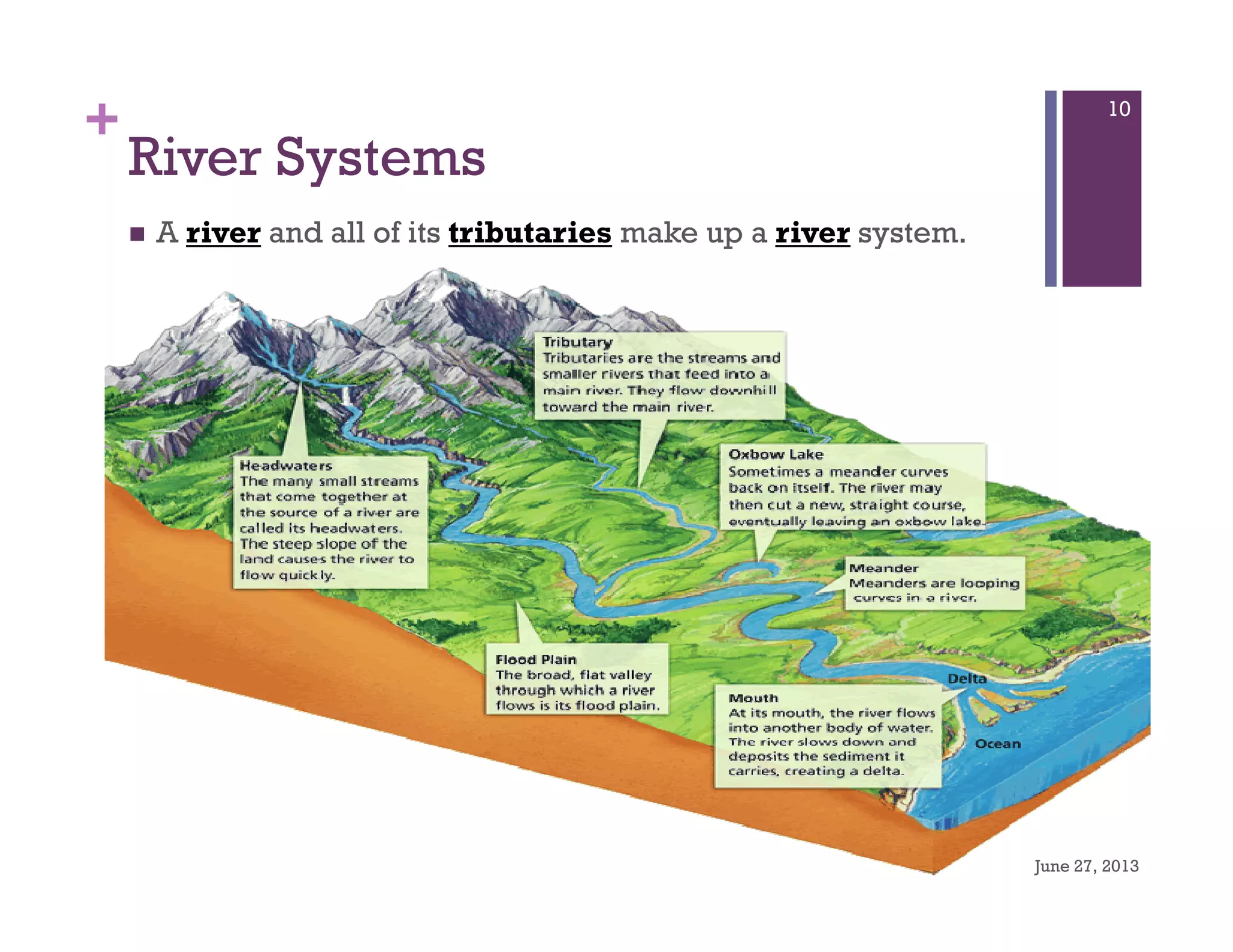
A river and all of its tributaries make up a river system.
+
June 27, 2013
11
+
WATERSHED
All the water that drains into a large stream or river is known
as a watershed (a drainage basin).
12
The land area that supplies water to a river system is also
called a watershed.
+
PA River System Watersheds
13
+
STREAM DEVELOPMENT STAGES
Longitudinal Profile:
The side-view of a stream from its head (start) to its mouth (end).
Conditions upstream are much different from conditions
downstream.
We will follow a typical stream in its journey from upstream
to downstream.
14
Headwaters – Young
River - Upstream
Transition Zone Depositional Zone – Mature
River - Downstream
- Mountain headwater streams flow
swiftly down steep slopes.
- Cut deep V-Shape Valleys.
- Rapids and Waterfalls common.
- Middle Elevation
streams merge and
flow down gentler
slopes (hills).
- The valley
broadens and the
river begins to
meander.
- At low elevations the
river wanders across a
broad, nearly flat valley.
- At its mouth it may
divide into many
separate channels as it
flows across a delta.
- Deltas are built from
sediments deposited
into the ocean
+
Stages of Development of a Stream
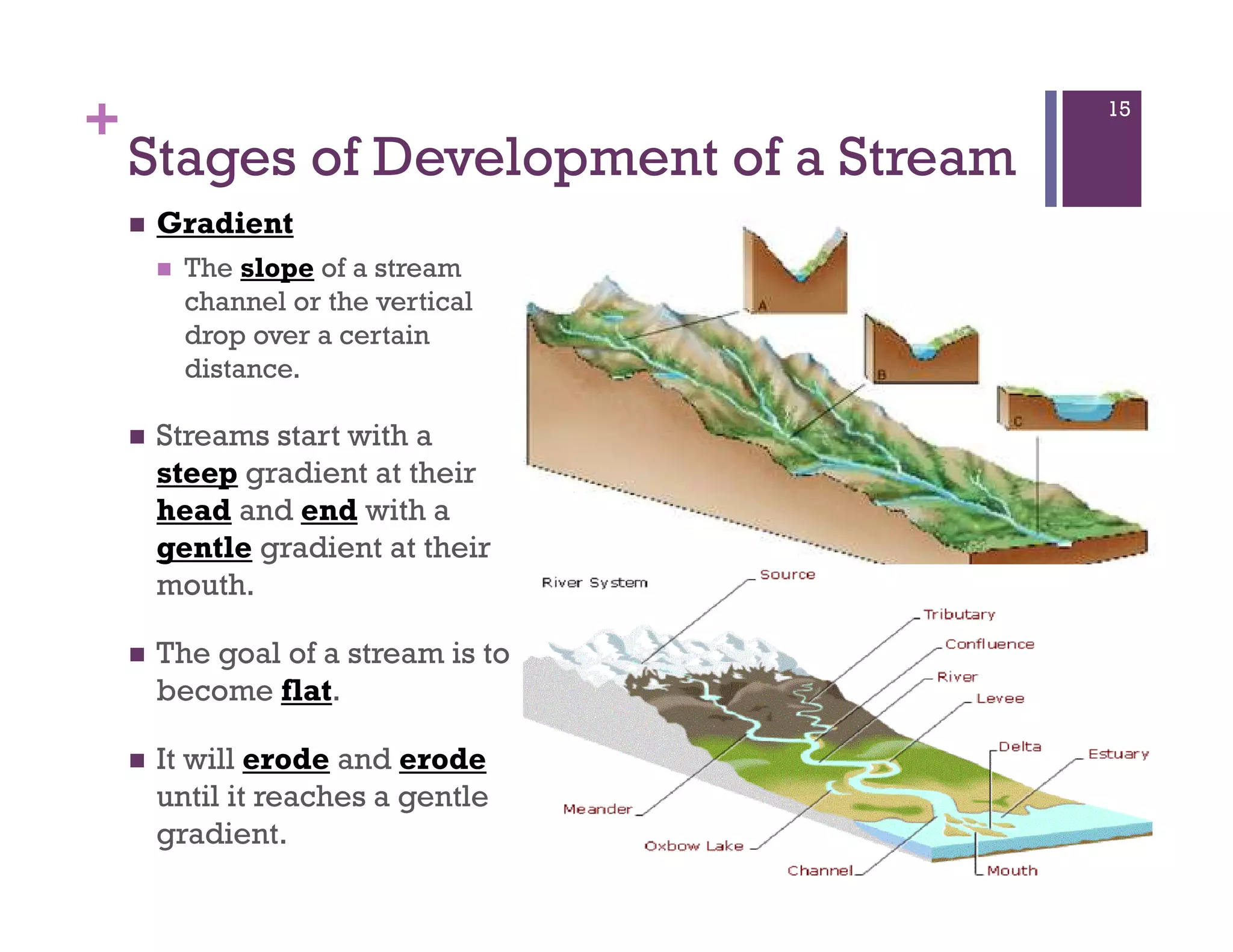
Gradient
The slope of a stream
channel or the vertical
drop over a certain
distance.
Streams start with a
steep gradient at their
head and end with a
gentle gradient at their
mouth.
The goal of a stream is to
become flat.
It will erode and erode
until it reaches a gentle
gradient.
15
+
Stages of Development of a Stream
16
Gravity makes it do this!
The erosion water does
under the force of gravity
is called “down-cutting”.
A stream will cut a V-
shaped channel in the
land to try to decrease its
gradient.
+
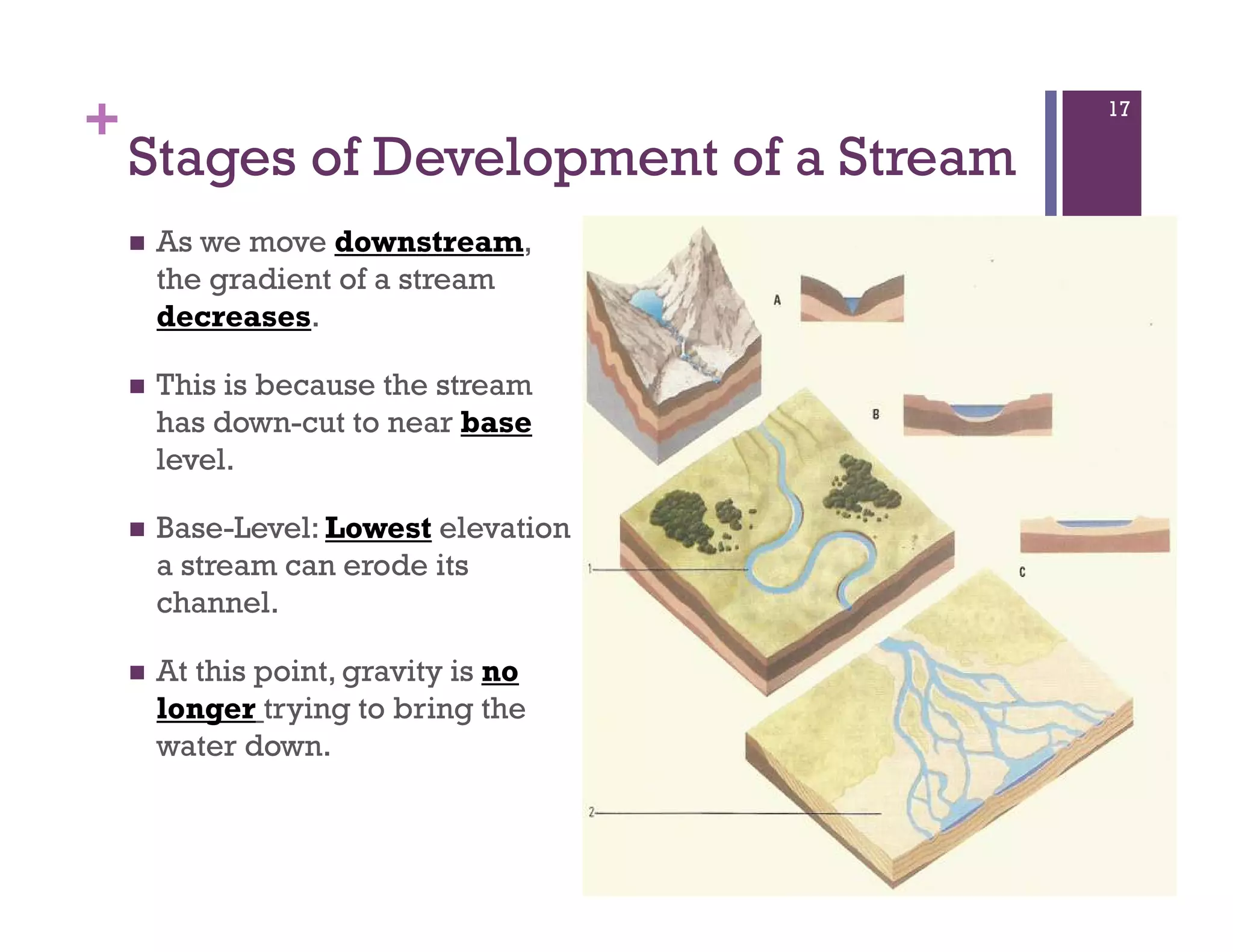
Stages of Development of a Stream
As we move downstream,
the gradient of a stream
decreases.
This is because the stream
has down-cut to near base
level.
Base-Level: Lowest elevation
a stream can erode its
channel.
At this point, gravity is no
longer trying to bring the
water down.
17
+
Stages of Development of a Stream
18
Upstream gravity was
affecting the moving water
and pulling on it so much
that it cut and eroded
through the land.
Downstream, near base-
level, gravity has much less
of an affect on the water and
does not cause it to cut-down
anymore.
+
June 27, 2013
19
+
Stages of Development of a Stream
Now, instead of down-cutting, downstream erosion occurs
from side-to-side.
Moving water will erode side-to-side to form MEANDERS.
MEANDERS are the curving, windy, path water takes downstream.
A flood plain is created as meanders weave side-to-side over
the land.
A flood plain is the flat area land on either side of a meander.
A flood plain is where a stream or river will “flood” during high
waters.
20
+
STREAM CHARACTERISTICS
UPSTREAM:YOUNG STREAMS
1. Steep gradient
2. Steep gradients = fast-moving water.
3. Fast-moving water = down-cutting and erosion at
a higher rate.
4. Down-cutting = deep but narrow V-shaped
channelized water.
Velocity is another word used to describe the
speed of water in a stream.
Velocity is highest in the CENTER of a down-
cutting stream = less friction.
FEATURES OF AYOUNG RIVER
- Waterfalls
- Rapids
- V-Shaped Valleys
21
+
Waterfalls form upstream
22
+
STREAM CHARACTERISTICS
DOWNSTREAM: MATURE STREAM
1. Gentle gradient.
2. Gentle gradient = slow-moving water and less down-cutting.
3. Less down-cutting = most erosion is side-to-side forming
meanders.
4. Meanders indicate a stream is nearest base-level (Mature).
23
Velocity is highest on the
outside of a meander.
FEATURES OF A MATURE
RIVER
- Meanders
- Oxbow Lake
- Flood Plains
+
June 27, 2013
24
+
The work of a stream: Erosion
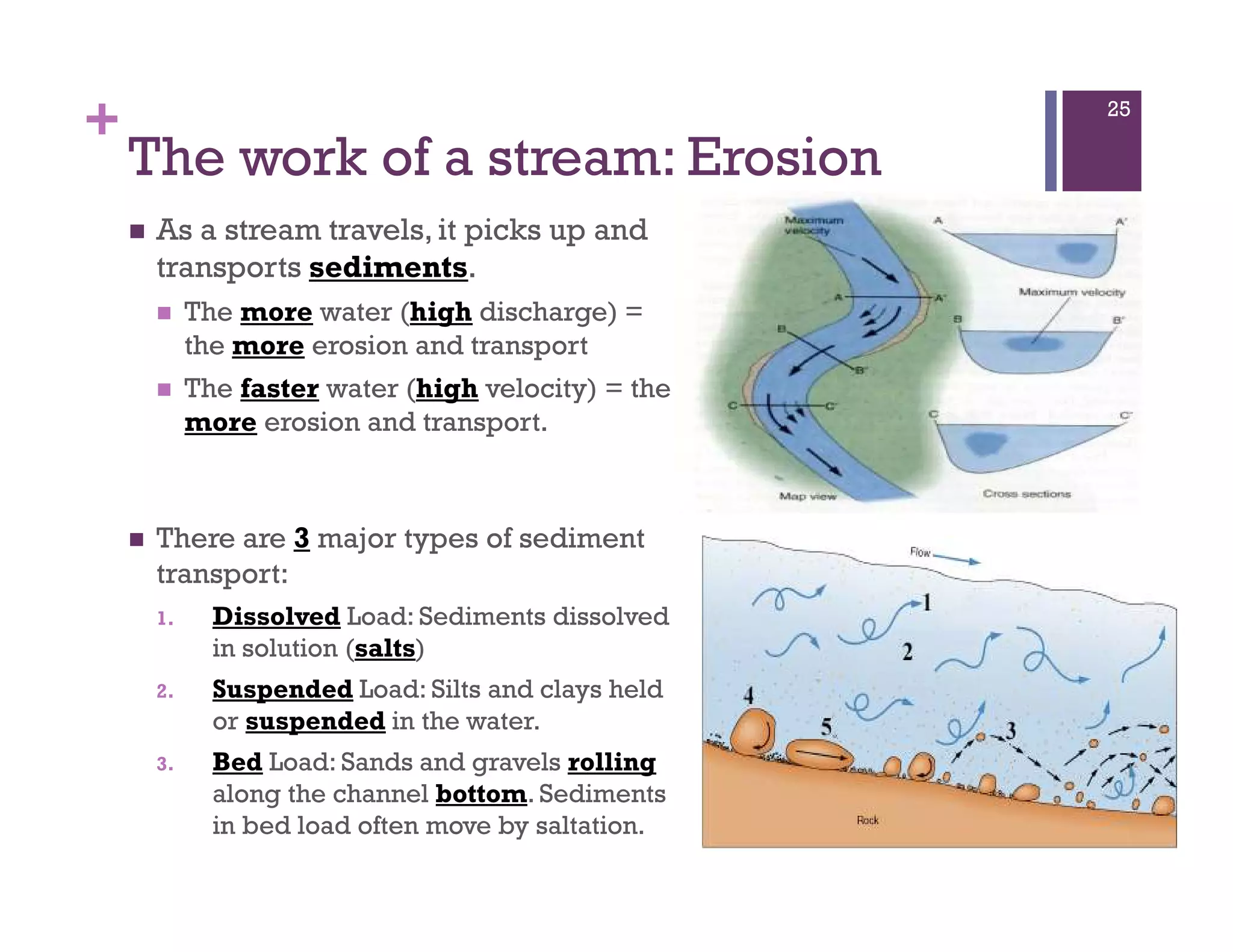
As a stream travels, it picks up and
transports sediments.
The more water (high discharge) =
the more erosion and transport
The faster water (high velocity) = the
more erosion and transport.
25
There are 3 major types of sediment
transport:
1. Dissolved Load: Sediments dissolved
in solution (salts)
2. Suspended Load: Silts and clays held
or suspended in the water.
3. Bed Load: Sands and gravels rolling
along the channel bottom. Sediments
in bed load often move by saltation.
+
June 27, 2013
26
+
The work of a stream: Erosion
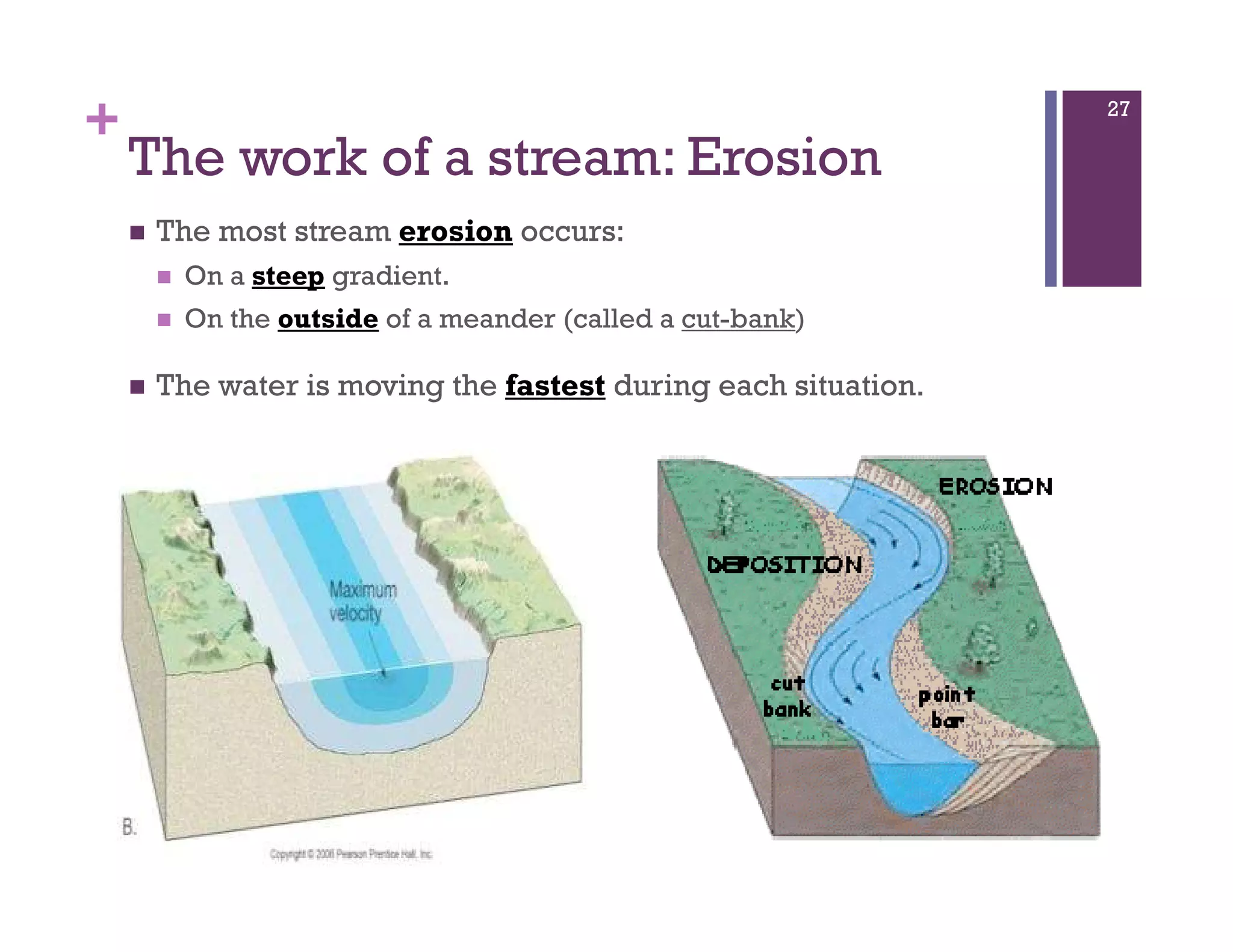
The most stream erosion occurs:
On a steep gradient.
On the outside of a meander (called a cut-bank)
The water is moving the fastest during each situation.
27
+
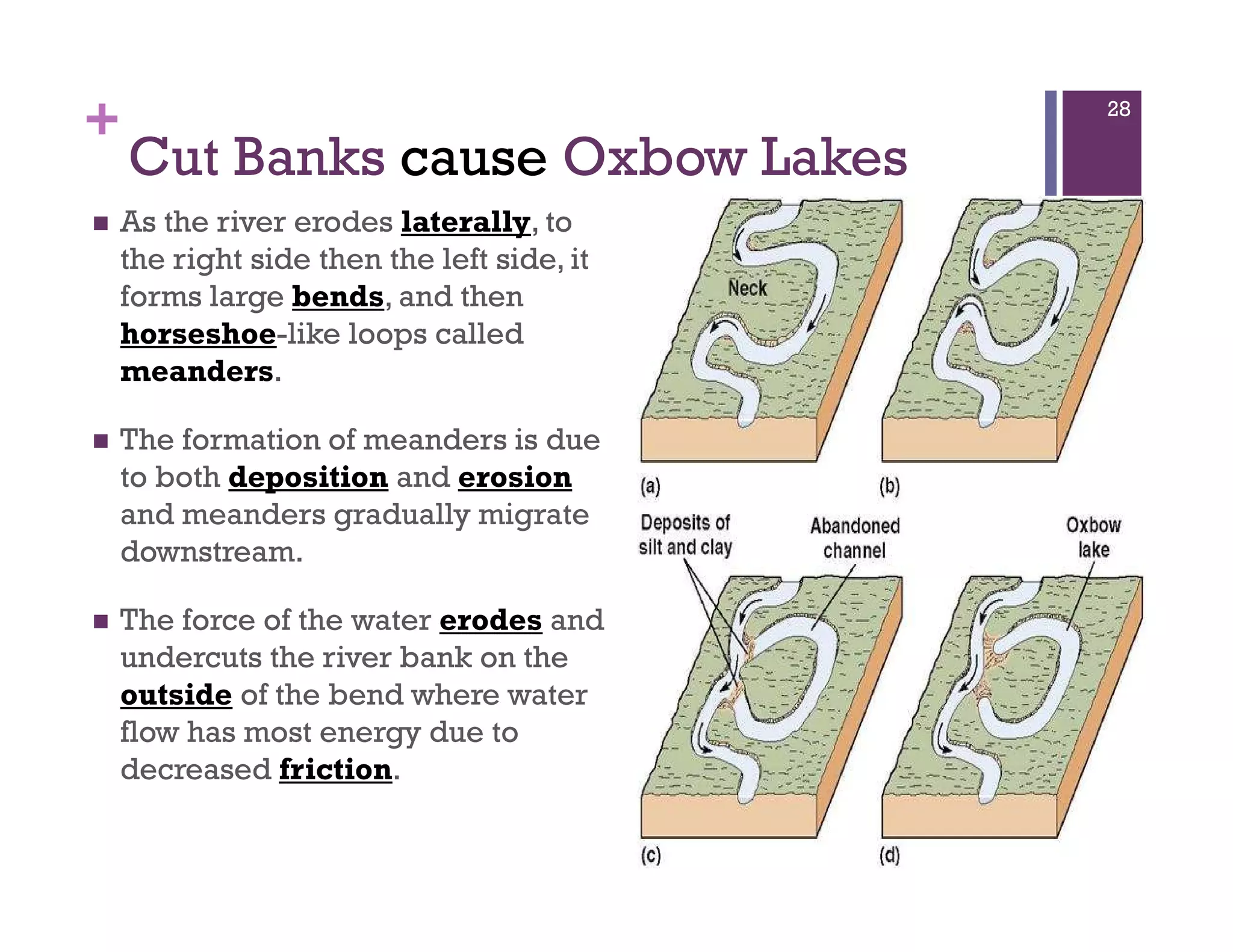
As the river erodes laterally, to
the right side then the left side, it
forms large bends, and then
horseshoe-like loops called
meanders.
The formation of meanders is due
to both deposition and erosion
and meanders gradually migrate
downstream.
The force of the water erodes and
undercuts the river bank on the
outside of the bend where water
flow has most energy due to
decreased friction.
Cut Banks cause Oxbow Lakes
28
+
Cut Banks cause Oxbow Lakes
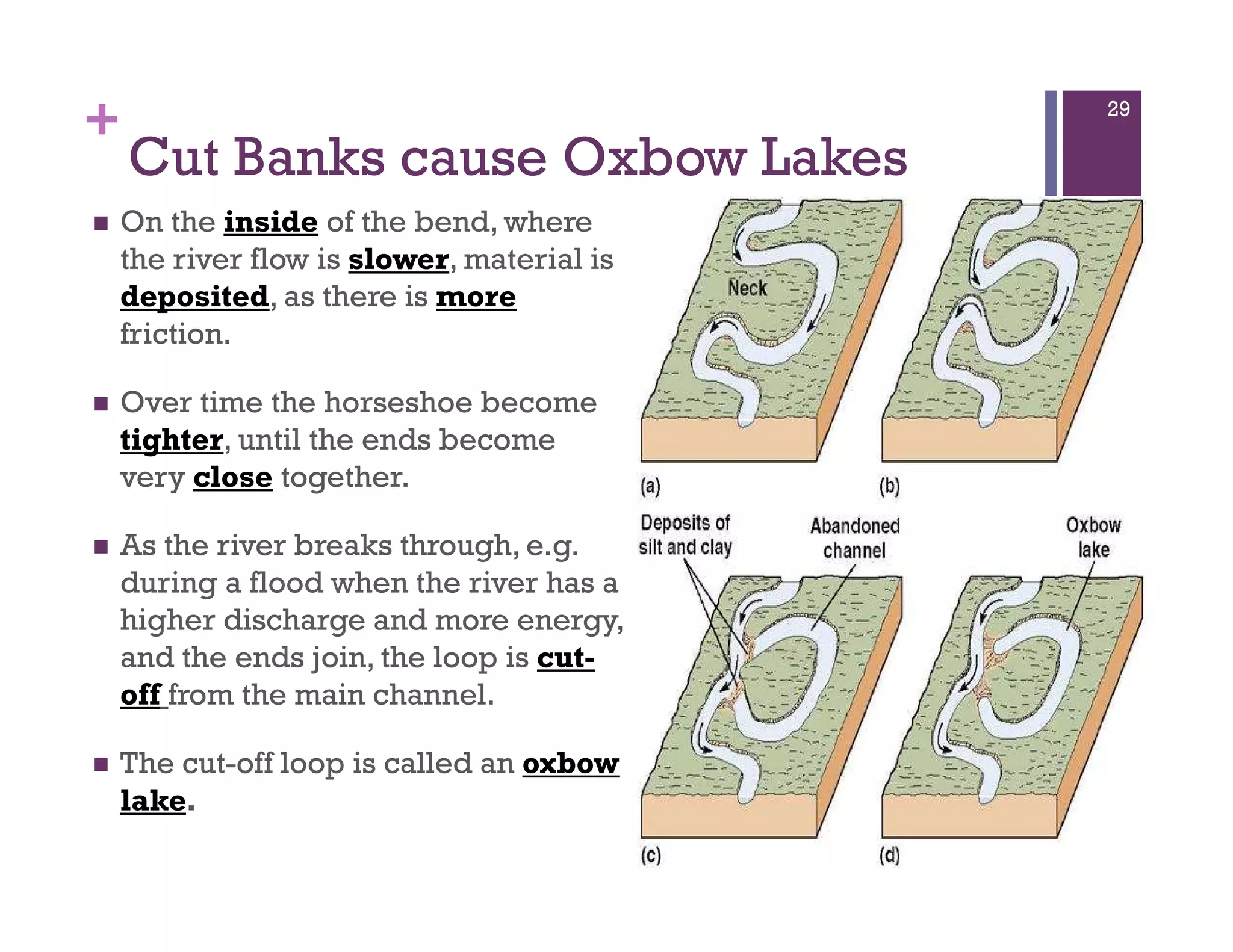
On the inside of the bend, where
the river flow is slower, material is
deposited, as there is more
friction.
Over time the horseshoe become
tighter, until the ends become
very close together.
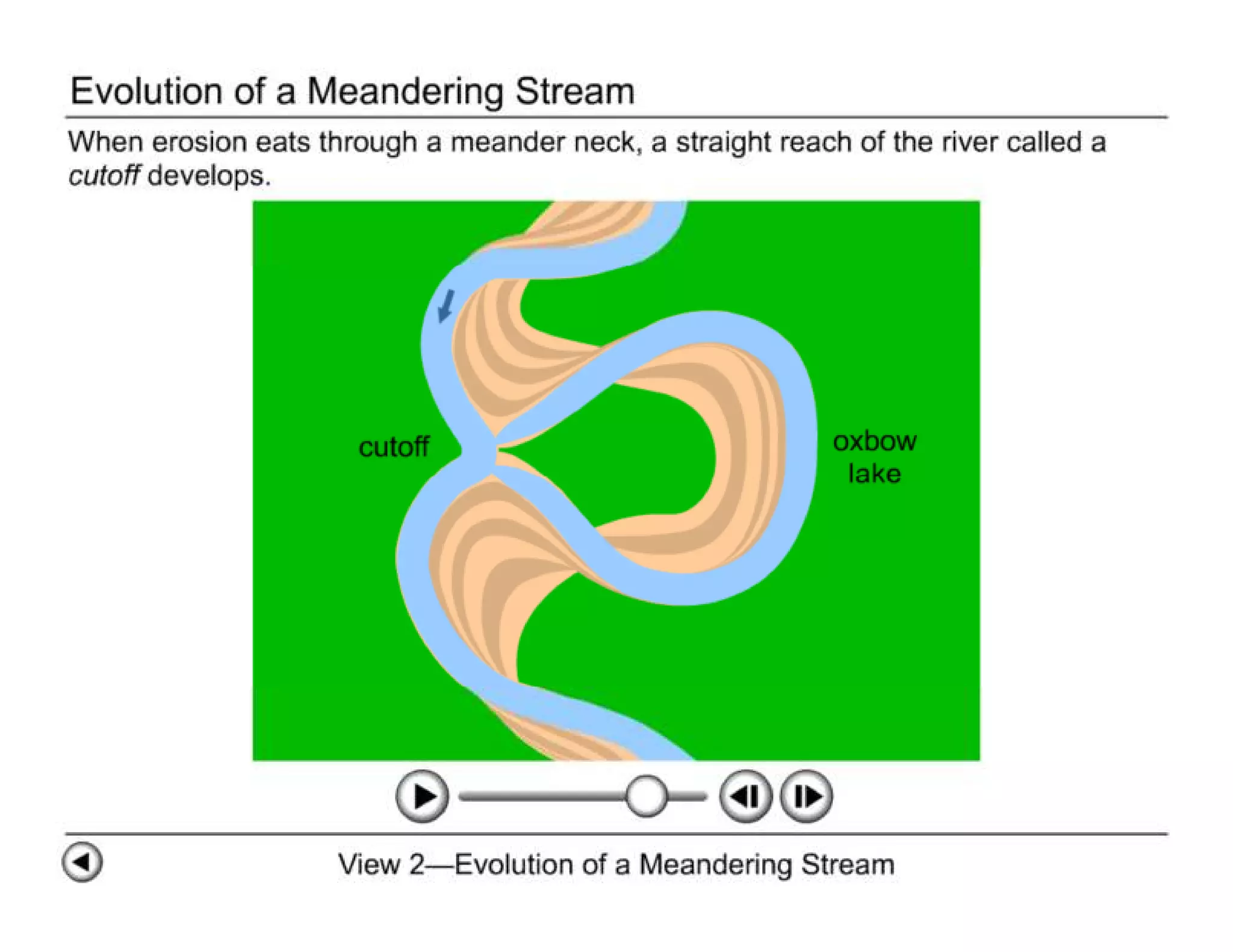
As the river breaks through, e.g.
during a flood when the river has a
higher discharge and more energy,
and the ends join, the loop is cut-
off from the main channel.
The cut-off loop is called an oxbow
lake.
29
+
June 27, 2013
30
+
The work of a stream: Deposition
As a stream travels, it also deposits its load of sediment.
The less water (low discharge) = the more deposition.
The slower water (low velocity) = the more deposition.
31
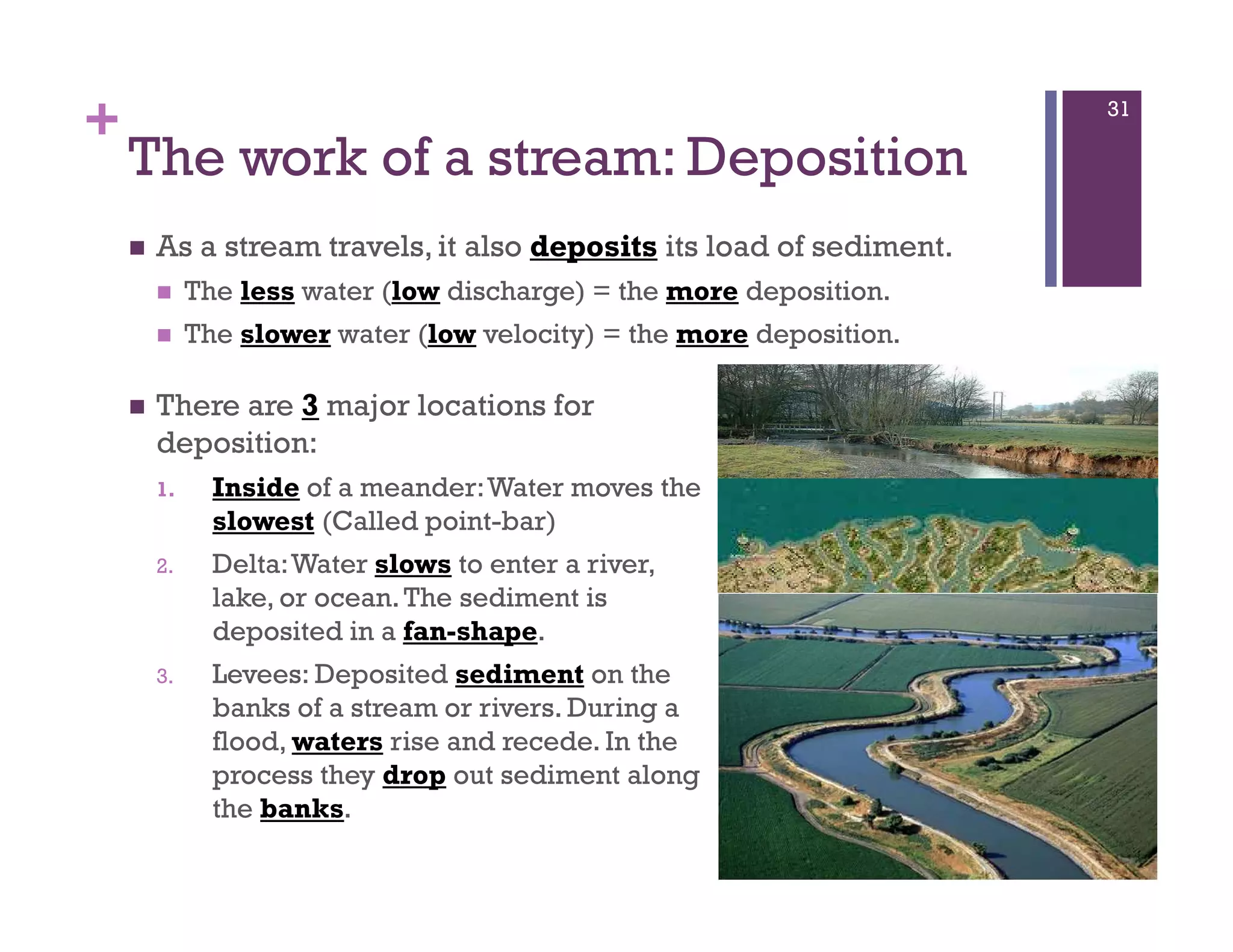
There are 3 major locations for
deposition:
1. Inside of a meander:Water moves the
slowest (Called point-bar)
2. Delta:Water slows to enter a river,
lake, or ocean.The sediment is
deposited in a fan-shape.
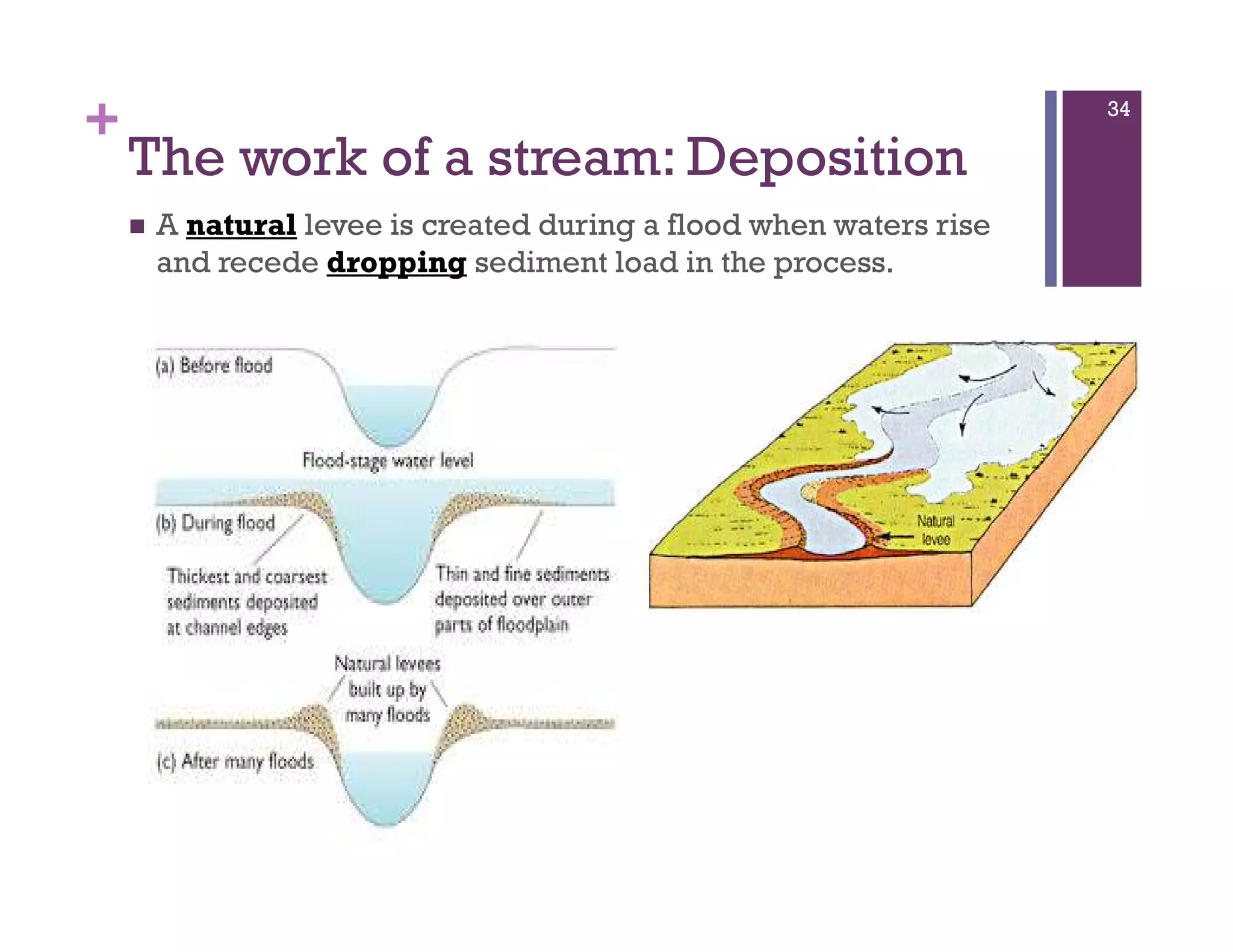
3. Levees: Deposited sediment on the
banks of a stream or rivers. During a
flood, waters rise and recede. In the
process they drop out sediment along
the banks.
+
The work of a stream: Deposition
A delta is a fan-shaped area of deposition at the mouth of a
river or stream where water slows down to enter another
body of water, depositing its sediment load in the process.
June 27, 2013
32
+
The work of a stream: Deposition
Alluvial fan
a fan-shaped alluvial deposit formed by a stream where its
velocity is abruptly decreased, as at the mouth of a ravine or at
the foot of a mountain.
33
+
The work of a stream: Deposition
A natural levee is created during a flood when waters rise
and recede dropping sediment load in the process.
34
+
June 27, 2013
35

Surface Water Runoff and River Systems

  • 1.
    + Erosion – SurfaceWater …moving, transporting, and depositing sediment.
  • 2.
    + Surface Water Water fromrainfall can hit Earth’s surface and do a number of things: Slowly soak into the ground: Infiltration Change to a gas: Evaporation Flow across Earth’s surface: Runoff 2 Runoff Water that runs or flows across Earth’s surface under the force of gravity Runoff causes erosion!!
  • 3.
    + RUNOFF Water is apowerful agent of erosion that can start as a simple drop of rain. A tiny raindrop can loosen small particles such as clay sediment. Raindrops can combine with other drops to form a trickle of water. June 27, 2013 3 This trickle can merge into slightly larger streams that loosen and transport more sediment. As streams merge into one another, they form a river.
  • 4.
    + RUNOFF As a riveror stream flows, it will create a path by weathering and eroding away soft layers of rock, like sandstone. Sometimes, rivers will encounter layers of rock that do not weather and erode as easily, such as granite. June 27, 2013 4 This can cause rivers to change course, or meander, as rushing water tends to flow in the direction of least resistance. However, even harder layers of rock, like granite, can be eroded by flowing water over time.
  • 5.
    + RUNOFF Surface water canbe so powerful that it can even transport giant boulders downstream. 5 Surface water can also spread sediment when rivers overflow their banks. Runoff typically occurs because of heavy rainfall. Sediment particles can travel great distances when moved by surface water.
  • 6.
    + RUNOFF 6 If water carryingsediment flows over a depression or basin, its sediment load can be deposited. If water meets an obstacle or has to spread out over a larger area, it might not have enough energy to carry its full load of sediment and will deposit it. Over time, sediment particles can gradually accumulate and can eventually form sedimentary rock.
  • 7.
    + What affects runoffand erosion? The intensity and duration of rainfall The harder and longer it rains, the more water that will flow on the surface. June 27, 2013 7 The water content of the soil Is the soil saturated, or can rainfall soak into it? Slope of the land Water flows fast down steep slopes which lead to more Erosional energy. Vegetation Vegetation can slow runoff and allow the surface water to soak in.
  • 8.
    + Running Water If runoffdoes occur, it will occur in one or two ways: Sheet Flow Rill Erosion 8 Sheet flow is when water flows as a sheet across Earth’s surface. Rill erosion is when sheets of water collect and begin to flow and forms a “channel” or gully.
  • 9.
    + Running Water Over time,continuous rill erosion leads to the development of a stream. A stream is any channelized flow of water. There are many different types of streams that differ in terms of their shape, speed, and volume of water. 9
  • 10.
    + River Systems June 27,2013 10 A river and all of its tributaries make up a river system.
  • 11.
  • 12.
    + WATERSHED All the waterthat drains into a large stream or river is known as a watershed (a drainage basin). 12 The land area that supplies water to a river system is also called a watershed.
  • 13.
    + PA River SystemWatersheds 13
  • 14.
    + STREAM DEVELOPMENT STAGES LongitudinalProfile: The side-view of a stream from its head (start) to its mouth (end). Conditions upstream are much different from conditions downstream. We will follow a typical stream in its journey from upstream to downstream. 14 Headwaters – Young River - Upstream Transition Zone Depositional Zone – Mature River - Downstream - Mountain headwater streams flow swiftly down steep slopes. - Cut deep V-Shape Valleys. - Rapids and Waterfalls common. - Middle Elevation streams merge and flow down gentler slopes (hills). - The valley broadens and the river begins to meander. - At low elevations the river wanders across a broad, nearly flat valley. - At its mouth it may divide into many separate channels as it flows across a delta. - Deltas are built from sediments deposited into the ocean
  • 15.
    + Stages of Developmentof a Stream Gradient The slope of a stream channel or the vertical drop over a certain distance. Streams start with a steep gradient at their head and end with a gentle gradient at their mouth. The goal of a stream is to become flat. It will erode and erode until it reaches a gentle gradient. 15
  • 16.
    + Stages of Developmentof a Stream 16 Gravity makes it do this! The erosion water does under the force of gravity is called “down-cutting”. A stream will cut a V- shaped channel in the land to try to decrease its gradient.
  • 17.
    + Stages of Developmentof a Stream As we move downstream, the gradient of a stream decreases. This is because the stream has down-cut to near base level. Base-Level: Lowest elevation a stream can erode its channel. At this point, gravity is no longer trying to bring the water down. 17
  • 18.
    + Stages of Developmentof a Stream 18 Upstream gravity was affecting the moving water and pulling on it so much that it cut and eroded through the land. Downstream, near base- level, gravity has much less of an affect on the water and does not cause it to cut-down anymore.
  • 19.
  • 20.
    + Stages of Developmentof a Stream Now, instead of down-cutting, downstream erosion occurs from side-to-side. Moving water will erode side-to-side to form MEANDERS. MEANDERS are the curving, windy, path water takes downstream. A flood plain is created as meanders weave side-to-side over the land. A flood plain is the flat area land on either side of a meander. A flood plain is where a stream or river will “flood” during high waters. 20
  • 21.
    + STREAM CHARACTERISTICS UPSTREAM:YOUNG STREAMS 1.Steep gradient 2. Steep gradients = fast-moving water. 3. Fast-moving water = down-cutting and erosion at a higher rate. 4. Down-cutting = deep but narrow V-shaped channelized water. Velocity is another word used to describe the speed of water in a stream. Velocity is highest in the CENTER of a down- cutting stream = less friction. FEATURES OF AYOUNG RIVER - Waterfalls - Rapids - V-Shaped Valleys 21
  • 22.
  • 23.
    + STREAM CHARACTERISTICS DOWNSTREAM: MATURESTREAM 1. Gentle gradient. 2. Gentle gradient = slow-moving water and less down-cutting. 3. Less down-cutting = most erosion is side-to-side forming meanders. 4. Meanders indicate a stream is nearest base-level (Mature). 23 Velocity is highest on the outside of a meander. FEATURES OF A MATURE RIVER - Meanders - Oxbow Lake - Flood Plains
  • 24.
  • 25.
    + The work ofa stream: Erosion As a stream travels, it picks up and transports sediments. The more water (high discharge) = the more erosion and transport The faster water (high velocity) = the more erosion and transport. 25 There are 3 major types of sediment transport: 1. Dissolved Load: Sediments dissolved in solution (salts) 2. Suspended Load: Silts and clays held or suspended in the water. 3. Bed Load: Sands and gravels rolling along the channel bottom. Sediments in bed load often move by saltation.
  • 26.
  • 27.
    + The work ofa stream: Erosion The most stream erosion occurs: On a steep gradient. On the outside of a meander (called a cut-bank) The water is moving the fastest during each situation. 27
  • 28.
    + As the rivererodes laterally, to the right side then the left side, it forms large bends, and then horseshoe-like loops called meanders. The formation of meanders is due to both deposition and erosion and meanders gradually migrate downstream. The force of the water erodes and undercuts the river bank on the outside of the bend where water flow has most energy due to decreased friction. Cut Banks cause Oxbow Lakes 28
  • 29.
    + Cut Banks causeOxbow Lakes On the inside of the bend, where the river flow is slower, material is deposited, as there is more friction. Over time the horseshoe become tighter, until the ends become very close together. As the river breaks through, e.g. during a flood when the river has a higher discharge and more energy, and the ends join, the loop is cut- off from the main channel. The cut-off loop is called an oxbow lake. 29
  • 30.
  • 31.
    + The work ofa stream: Deposition As a stream travels, it also deposits its load of sediment. The less water (low discharge) = the more deposition. The slower water (low velocity) = the more deposition. 31 There are 3 major locations for deposition: 1. Inside of a meander:Water moves the slowest (Called point-bar) 2. Delta:Water slows to enter a river, lake, or ocean.The sediment is deposited in a fan-shape. 3. Levees: Deposited sediment on the banks of a stream or rivers. During a flood, waters rise and recede. In the process they drop out sediment along the banks.
  • 32.
    + The work ofa stream: Deposition A delta is a fan-shaped area of deposition at the mouth of a river or stream where water slows down to enter another body of water, depositing its sediment load in the process. June 27, 2013 32
  • 33.
    + The work ofa stream: Deposition Alluvial fan a fan-shaped alluvial deposit formed by a stream where its velocity is abruptly decreased, as at the mouth of a ravine or at the foot of a mountain. 33
  • 34.
    + The work ofa stream: Deposition A natural levee is created during a flood when waters rise and recede dropping sediment load in the process. 34
  • 35.