Presented By:-
Subhash Chand Jat
BANARAS HINDU UNIVERSITY
INSTITUTE OF AGRICULTURAL SCIENCES
Research Scholar, Department of Soil Science & Agri. Chemistry
RAJIV GANDHI SOUTH CAMPUS
BANARAS HINDU UNIVERSITY
MIRZAPUR (UP)
(scjatag@gmail.com)
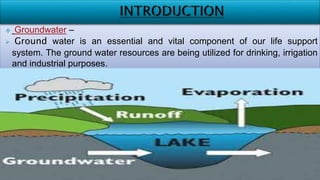
 Groundwater –
 Ground water is an essential and vital component of our life support
system. The ground water resources are being utilized for drinking, irrigation
and industrial purposes.
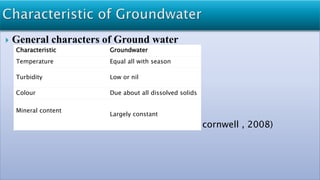
 General characters of Ground water
Constant composition
Bacteriologically safe
No dissolved oxygen
High hardness
H2S ,Fe, Mn
(Davis & cornwell , 2008)
Characteristic Groundwater
Temperature Equal all with season
Turbidity Low or nil
Colour Due about all dissolved solids
Mineral content
Largely constant
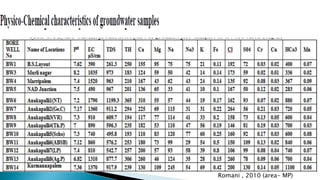
Romani , 2010 (area- MP)
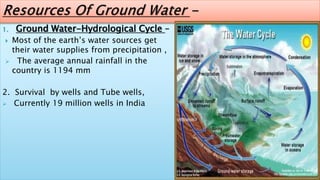
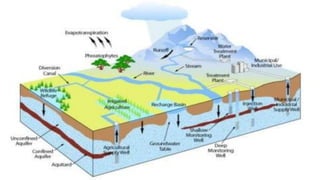
1. Ground Water-Hydrological Cycle –
 Most of the earth’s water sources get
their water supplies from precipitation ,
 The average annual rainfall in the
country is 1194 mm
2. Survival by wells and Tube wells,
 Currently 19 million wells in India
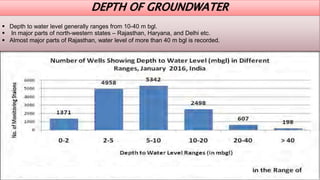
DEPTH OF GROUNDWATER
 Depth to water level generally ranges from 10-40 m bgl.
 In major parts of north-western states – Rajasthan, Haryana, and Delhi etc.
 Almost major parts of Rajasthan, water level of more than 40 m bgl is recorded.
Ground water use in India
 About 85% of the ground water sources are drawn for irrigation and
domestic , Industry etc .
 Ground water use in Delhi, Haryana, Punjab & Rajasthan is more than
100% and in States of Gujarat, Karnataka, Tamil Nadu and Uttar Pradesh it
is more than 70%. (CGWB report 2006)
 Causing imbalance between over-withdrawal of ground water and deficit
recharge
 Resulting permanent fall in the water table every year to the tune of 2 -3
meters
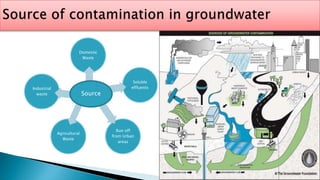
Domestic
Waste
Soluble
effluents
Run off
from Urban
areas
Agricultural
Waste
Industrial
waste Source
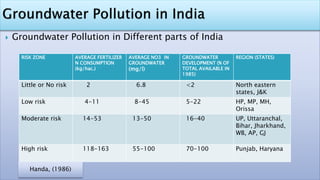
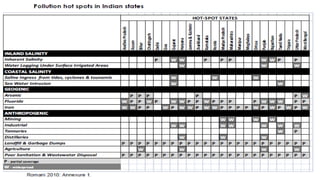
 Groundwater Pollution in Different parts of India
RISK ZONE AVERAGE FERTILIZER
N CONSUMPTION
(kg/hac.)
AVERAGE NO3 IN
GROUNDWATER
(mg/l)
GROUNDWATER
DEVELOPMENT (% OF
TOTAL AVAILABLE IN
1985)
REGION (STATES)
Little or No risk 2 6.8 <2 North eastern
states, J&K
Low risk 4-11 8-45 5-22 HP, MP, MH,
Orissa
Moderate risk 14-53 13-50 16-40 UP, Uttaranchal,
Bihar, Jharkhand,
WB, AP, GJ
High risk 118-163 55-100 70-100 Punjab, Haryana
Handa, (1986)
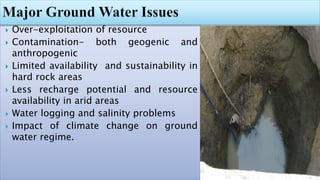
 Over-exploitation of resource
 Contamination- both geogenic and
anthropogenic
 Limited availability and sustainability in
hard rock areas
 Less recharge potential and resource
availability in arid areas
 Water logging and salinity problems
 Impact of climate change on ground
water regime.
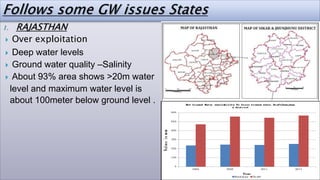
1. RAJASTHAN
 Over exploitation
 Deep water levels
 Ground water quality –Salinity
 About 93% area shows >20m water
level and maximum water level is
about 100meter below ground level .
 Declining water levels
 Water for Agricultural and Industrial purposes State of ground water
utilization ranges
Bihar-
 Major GW issue is Arsenic contamination affecting
 Total number of villages: 839
 Arsenic affected villages: 273
 Total Population : 27.52 lacs
 Population of the affected villages: 7.68 lacs
 % of population living in affected villages: 28%
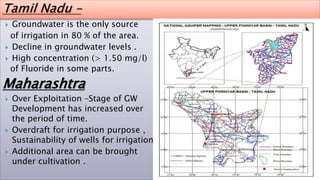
 Groundwater is the only source
of irrigation in 80 % of the area.
 Decline in groundwater levels .
 High concentration (> 1.50 mg/l)
of Fluoride in some parts.
Maharashtra
 Over Exploitation –Stage of GW
Development has increased over
the period of time.
 Overdraft for irrigation purpose ,
Sustainability of wells for irrigation
 Additional area can be brought
under cultivation .
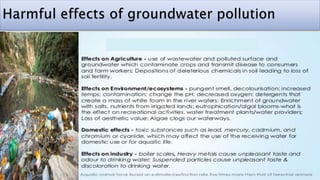
Harmful effects of
groundwater
pollution
Harmful effects
on soil
increases
alkalinity
affects soil
fertility
Harmful effect on
Human body
Epidemic &
Chronic disease-
Tuberculosis ,
hepatitis
causing skin and
stomach diseases
fatal diseases like
lung cancer
Plant metabolism
severely & disturb
the whole
ecosystem
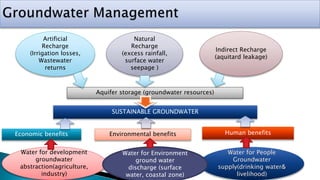
Artificial
Recharge
(Irrigation losses,
Wastewater
returns
Indirect Recharge
(aquitard leakage)
Natural
Recharge
(excess rainfall,
surface water
seepage )
Aquifer storage (groundwater resources)
SUSTAINABLE GROUNDWATER
Human benefitsEnvironmental benefitsEconomic benefits
Water for development
groundwater
abstraction(agriculture,
industry)
Water for People
Groundwater
supply(drinking water&
livelihood)
Water for Environment
ground water
discharge (surface
water, coastal zone)
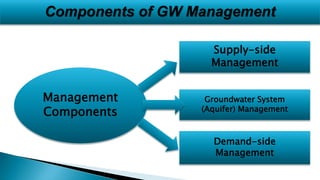
Components of GW Management
Management
Components
Supply-side
Management
Groundwater System
(Aquifer) Management
Demand-side
Management
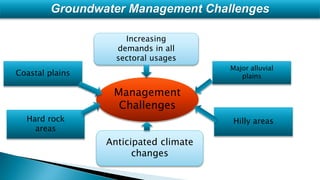
Groundwater Management Challenges
Increasing
demands in all
sectoral usages
Anticipated climate
changes
Management
Challenges
Major alluvial
plainsCoastal plains
Hilly areasHard rock
areas
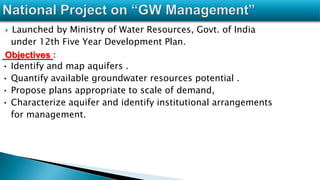
 Launched by Ministry of Water Resources, Govt. of India
under 12th Five Year Development Plan.
Objectives :
• Identify and map aquifers .
• Quantify available groundwater resources potential .
• Propose plans appropriate to scale of demand,
• Characterize aquifer and identify institutional arrangements
for management.
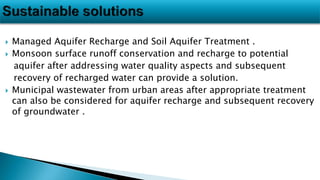
 Managed Aquifer Recharge and Soil Aquifer Treatment .
 Monsoon surface runoff conservation and recharge to potential
aquifer after addressing water quality aspects and subsequent
recovery of recharged water can provide a solution.
 Municipal wastewater from urban areas after appropriate treatment
can also be considered for aquifer recharge and subsequent recovery
of groundwater .
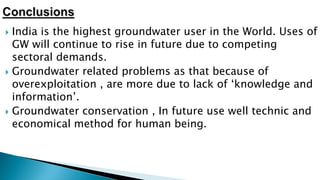
 India is the highest groundwater user in the World. Uses of
GW will continue to rise in future due to competing
sectoral demands.
 Groundwater related problems as that because of
overexploitation , are more due to lack of ‘knowledge and
information’.
 Groundwater conservation , In future use well technic and
economical method for human being.
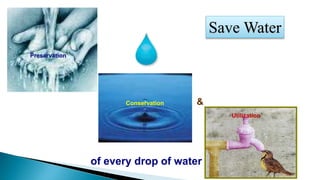
Preservation
Save Water
Conservation
Utilization
&
of every drop of water
Thankyou
“Speak only if it improves upon the silence.”
Mahatma Gandhi

GROUNDWATER QUALITY:- PROBLEMS CHALLENGES, & MANAGEMENT PROSPECTS IN INDIA

  • 2.
    Presented By:- Subhash ChandJat BANARAS HINDU UNIVERSITY INSTITUTE OF AGRICULTURAL SCIENCES Research Scholar, Department of Soil Science & Agri. Chemistry RAJIV GANDHI SOUTH CAMPUS BANARAS HINDU UNIVERSITY MIRZAPUR (UP) (scjatag@gmail.com)
  • 3.
     Groundwater – Ground water is an essential and vital component of our life support system. The ground water resources are being utilized for drinking, irrigation and industrial purposes.
  • 5.
     General charactersof Ground water Constant composition Bacteriologically safe No dissolved oxygen High hardness H2S ,Fe, Mn (Davis & cornwell , 2008) Characteristic Groundwater Temperature Equal all with season Turbidity Low or nil Colour Due about all dissolved solids Mineral content Largely constant
  • 6.
    Romani , 2010(area- MP)
  • 7.
    1. Ground Water-HydrologicalCycle –  Most of the earth’s water sources get their water supplies from precipitation ,  The average annual rainfall in the country is 1194 mm 2. Survival by wells and Tube wells,  Currently 19 million wells in India
  • 8.
    DEPTH OF GROUNDWATER Depth to water level generally ranges from 10-40 m bgl.  In major parts of north-western states – Rajasthan, Haryana, and Delhi etc.  Almost major parts of Rajasthan, water level of more than 40 m bgl is recorded.
  • 9.
    Ground water usein India  About 85% of the ground water sources are drawn for irrigation and domestic , Industry etc .  Ground water use in Delhi, Haryana, Punjab & Rajasthan is more than 100% and in States of Gujarat, Karnataka, Tamil Nadu and Uttar Pradesh it is more than 70%. (CGWB report 2006)  Causing imbalance between over-withdrawal of ground water and deficit recharge  Resulting permanent fall in the water table every year to the tune of 2 -3 meters
  • 10.
  • 11.
     Groundwater Pollutionin Different parts of India RISK ZONE AVERAGE FERTILIZER N CONSUMPTION (kg/hac.) AVERAGE NO3 IN GROUNDWATER (mg/l) GROUNDWATER DEVELOPMENT (% OF TOTAL AVAILABLE IN 1985) REGION (STATES) Little or No risk 2 6.8 <2 North eastern states, J&K Low risk 4-11 8-45 5-22 HP, MP, MH, Orissa Moderate risk 14-53 13-50 16-40 UP, Uttaranchal, Bihar, Jharkhand, WB, AP, GJ High risk 118-163 55-100 70-100 Punjab, Haryana Handa, (1986)
  • 13.
     Over-exploitation ofresource  Contamination- both geogenic and anthropogenic  Limited availability and sustainability in hard rock areas  Less recharge potential and resource availability in arid areas  Water logging and salinity problems  Impact of climate change on ground water regime.
  • 14.
    1. RAJASTHAN  Overexploitation  Deep water levels  Ground water quality –Salinity  About 93% area shows >20m water level and maximum water level is about 100meter below ground level .
  • 15.
     Declining waterlevels  Water for Agricultural and Industrial purposes State of ground water utilization ranges Bihar-  Major GW issue is Arsenic contamination affecting  Total number of villages: 839  Arsenic affected villages: 273  Total Population : 27.52 lacs  Population of the affected villages: 7.68 lacs  % of population living in affected villages: 28%
  • 16.
     Groundwater isthe only source of irrigation in 80 % of the area.  Decline in groundwater levels .  High concentration (> 1.50 mg/l) of Fluoride in some parts. Maharashtra  Over Exploitation –Stage of GW Development has increased over the period of time.  Overdraft for irrigation purpose , Sustainability of wells for irrigation  Additional area can be brought under cultivation .
  • 17.
    Harmful effects of groundwater pollution Harmfuleffects on soil increases alkalinity affects soil fertility Harmful effect on Human body Epidemic & Chronic disease- Tuberculosis , hepatitis causing skin and stomach diseases fatal diseases like lung cancer Plant metabolism severely & disturb the whole ecosystem
  • 19.
    Artificial Recharge (Irrigation losses, Wastewater returns Indirect Recharge (aquitardleakage) Natural Recharge (excess rainfall, surface water seepage ) Aquifer storage (groundwater resources) SUSTAINABLE GROUNDWATER Human benefitsEnvironmental benefitsEconomic benefits Water for development groundwater abstraction(agriculture, industry) Water for People Groundwater supply(drinking water& livelihood) Water for Environment ground water discharge (surface water, coastal zone)
  • 21.
    Components of GWManagement Management Components Supply-side Management Groundwater System (Aquifer) Management Demand-side Management
  • 22.
    Groundwater Management Challenges Increasing demandsin all sectoral usages Anticipated climate changes Management Challenges Major alluvial plainsCoastal plains Hilly areasHard rock areas
  • 23.
     Launched byMinistry of Water Resources, Govt. of India under 12th Five Year Development Plan. Objectives : • Identify and map aquifers . • Quantify available groundwater resources potential . • Propose plans appropriate to scale of demand, • Characterize aquifer and identify institutional arrangements for management.
  • 26.
     Managed AquiferRecharge and Soil Aquifer Treatment .  Monsoon surface runoff conservation and recharge to potential aquifer after addressing water quality aspects and subsequent recovery of recharged water can provide a solution.  Municipal wastewater from urban areas after appropriate treatment can also be considered for aquifer recharge and subsequent recovery of groundwater .
  • 27.
     India isthe highest groundwater user in the World. Uses of GW will continue to rise in future due to competing sectoral demands.  Groundwater related problems as that because of overexploitation , are more due to lack of ‘knowledge and information’.  Groundwater conservation , In future use well technic and economical method for human being.
  • 28.
  • 29.
    Thankyou “Speak only ifit improves upon the silence.” Mahatma Gandhi