Wednesday 23rd November 2022
London, UK
Project Management
Specialist Group
A Project / Programme Managers Guide
Daljit Banger MSc FBCS
Architectural Engagement
Through The Project Lifecycle
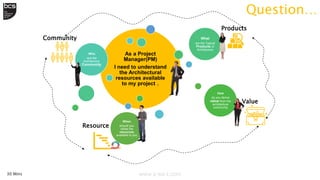
Question…
www.s-ea-t.com
As a Project
Manager(PM)
I need to understand
the Architectural
resources available
to my project ..
•Who
•are the
Architecture
Community
What
are the Typical
Products of
Architecture
How
do you derive
value from the
architecture
community
When
should you
utilise the
resources
available to you
Community
Resource
Products
Value
30 Mins
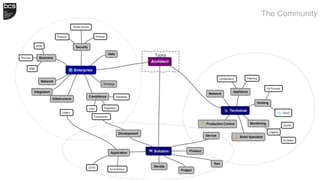
The Community
At a minimum they
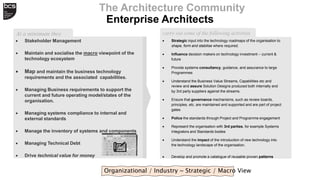
The Architecture Community
Enterprise Architects
 Stakeholder Management
 Maintain and socialise the macro viewpoint of the
technology ecosystem
 Map and maintain the business technology
requirements and the associated capabilities.
 Managing Business requirements to support the
current and future operating model/states of the
organisation.
 Managing systems compliance to internal and
external standards
 Manage the inventory of systems and components
 Managing Technical Debt
 Drive technical value for money
 Strategic input into the technology roadmaps of the organisation to
shape, form and stabilise where required.
 Influence decision makers on technology investment – current &
future
 Provide systems consultancy, guidance, and assurance to large
Programmes
 Understand the Business Value Streams, Capabilities etc and
review and assure Solution Designs produced both internally and
by 3rd party suppliers against the streams.
 Ensure that governance mechanisms, such as review boards,
principles, etc. are maintained and supported and are part of project
gates
 Police the standards through Project and Programme engagement
 Represent the organisation with 3rd parties, for example Systems
Integrators and Standards bodies
 Understand the impact of the introduction of new technology into
the technology landscape of the organisation.
 Develop and promote a catalogue of reusable proven patterns
Organizational / Industry ~ Strategic / Macro View
carry out some of the following activities
The Architecture Community
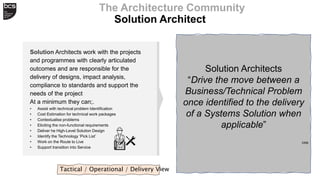
Solution Architect
Tactical / Operational / Delivery View
Solution Architects work with the projects
and programmes with clearly articulated
outcomes and are responsible for the
delivery of designs, impact analysis,
compliance to standards and support the
needs of the project
At a minimum they can;.
• Assist with technical problem Identification
• Cost Estimation for technical work packages
• Contextualise problems
• Eliciting the non-functional requirements
• Deliver he High-Level Solution Design
• Identify the Technology ‘Pick List’
• Work on the Route to Live
• Support transition into Service
Solution Architects
“Drive the move between a
Business/Technical Problem
once identified to the delivery
of a Systems Solution when
applicable”
DRB
The Architecture Community
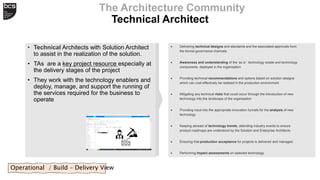
Technical Architect
• Technical Architects with Solution Architect
to assist in the realization of the solution.
• TAs are a key project resource especially at
the delivery stages of the project
• They work with the technology enablers and
deploy, manage, and support the running of
the services required for the business to
operate
 Delivering technical designs and standards and the associated approvals from
the formal governance channels
 Awareness and understanding of the ‘as is’ technology estate and technology
components deployed in the organisation
 Providing technical recommendations and options based on solution designs
which can cost-effectively be realised in the production environment
 Mitigating any technical risks that could occur through the introduction of new
technology into the landscape of the organisation
 Providing input into the appropriate innovation funnels for the analysis of new
technology
 Keeping abreast of technology trends, attending industry events to ensure
product roadmaps are understood by the Solution and Enterprise Architects.
 Ensuring that production acceptance for projects is delivered and managed.
 Performing Impact assessments on selected technology
Operational / Build – Delivery View
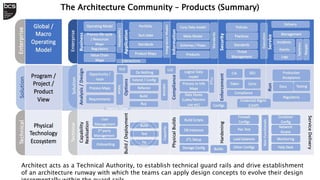
Architect acts as a Technical Authority, to establish technical guard rails and drive establishment
of an architecture runway with which the teams can apply design concepts to evolve their design
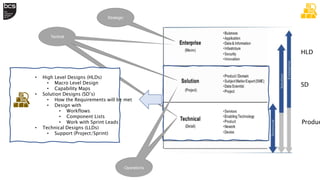
The Architecture Community – Products (Summary)
HLD
SD
Produc
Operations
Strategic
Tactical
Tactical
• High Level Designs (HLDs)
• Macro Level Design
• Capability Maps
• Solution Designs (SD’s)
• How the Requirements will be met
• Design with
• Workflows
• Component Lists
• Work with Sprint Leads
• Technical Designs (LLDs)
• Support (Project/Sprint)
Operations
Tactical
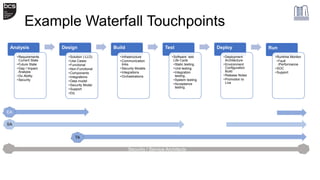
Example Waterfall Touchpoints
Analysis
•Requirements
Current State
•Future State
•Gap / Impact
Analysis
•Do Ability
•Security
Design
•Solution (:LLD)
•Use Cases
•Functional
•Non-Functional
•Components
•Integrations
•Data model
•Security Model
•Support
•Etc
Build
•Infrastructure
•Communication
links
•Security Models
•Integrations
•Orchestrations
Test
•Software test
Life Cycle
•Static testing.
•Unit testing.
•Integration
testing..
•System testing.
•Acceptance
testing.
Deploy
•Deployment
Architecture
•Environment
Configuration
Build
•Release Notes
•Promotion to
Live
Run
•Runtime Monitor
•Fault
/Performance
•SOC
•Support
EA
SA
TA
Security / Service Architects
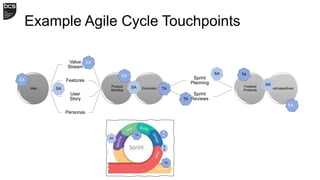
Example Agile Cycle Touchpoints
Idea
Value
Stream
Features
User
Story
Personas
Product
Backlog
Execution
Sprint
Planning
Sprint
Reviews
Finished
Products
Retrospectives
SA SA
SA
SA
EA
EA
EA
EA
TA
TA
TA
E
A
SA
TA
S
A
TA
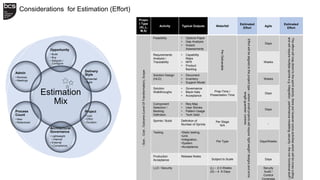
Considerations for Estimation (Effort)
Projec
t Type
(XL,L,
M,S)
Activity Typical Outputs Waterfall
Estimated
Effort
Agile
Estimated
Effort
-
Size
..
Cost
,
Outcome
(Level
Of
Transformation),
Scope
Feasibility • Options Paper
• Gap Analysis
• Impact
Assessments
Per
Deliverable
Effort
will
be
aligned
to
the
project
type
–
where
small
projects
will
require
‘light
weight’
designs
and
arms
length
guardrail
controls
Days
The
effort
will
map
direct
to
the
sprint
activity,
there
are
however
some
activities
which
will
be
cross
cutting
and
will
require
multiple
sprints
e.g.
integration
,
performance
modelling,
security
–
the
non
functional
stuff
!
Requirements
Analysis /
Traceability
• Capability
Maps
• NFR
• Product
Backlog
Weeks
Solution Design
(HLD)
• Document
• Inventory
• Support Model
Weeks
Solution
Walkthroughs
• Governance
• Black Hats
• Acceptance
Prep-Time /
Presentation Time
Days
Component
Selection /
Backlog
Definition
• Req Map
• User Stories
• Pattern Usage
• Tech Debt
Days
Sprints / Build Definition of
Number of Sprints
Per Stage
N/A
-
Testing •Static testing.
•Unit.
•Integration..
•System.
•Acceptance.
Per Type Days/Weeks
Production
Acceptance
Release Notes
Subject to Scale Days
LLD / Security (L) – 2-3 Weeks
(S) – 4 -5 Days
Secuity
Audit /
Control
Coverage
Estimation
Mix
Opportunity
• Build
• Buy
• Refactor /
Configure
Delivery
Style
• Waterfall
• Agile
Project
• Cost
• Effort
• Duration
Architectural
Governance
• Lightweight
• Internal
• External
• Compliance
Process
Count
• New
• Refactored
Admin
• Reviews
• Meetings
What are the challenges,
you have faced, when
working with the
Architecture Community
?
Open Discussion….
20--25
URLs
• SFIA - The global skills and competency framework for the digital world - https://sfia-online.org/
• Architectural Services / Touch Points - A Project / Programme Managers Guide This presentation ..
• The Blog https://dalbanger.blogspot.com/
• Enterprise Systems Architecture: Aligning Business Operating Models to Technology Landscapes (Paperback)
– Amazon / Springer (https://link.springer.com/book/10.1007/978-1-4842-8646-3)
www.s-ea-t.com
Thank You
www.s-ea-t.com

Architectural Engagement Through the Project Lifecycle

  • 1.
    Wednesday 23rd November2022 London, UK Project Management Specialist Group A Project / Programme Managers Guide Daljit Banger MSc FBCS Architectural Engagement Through The Project Lifecycle
  • 2.
    Question… www.s-ea-t.com As a Project Manager(PM) Ineed to understand the Architectural resources available to my project .. •Who •are the Architecture Community What are the Typical Products of Architecture How do you derive value from the architecture community When should you utilise the resources available to you Community Resource Products Value 30 Mins
  • 3.
  • 4.
    At a minimumthey The Architecture Community Enterprise Architects  Stakeholder Management  Maintain and socialise the macro viewpoint of the technology ecosystem  Map and maintain the business technology requirements and the associated capabilities.  Managing Business requirements to support the current and future operating model/states of the organisation.  Managing systems compliance to internal and external standards  Manage the inventory of systems and components  Managing Technical Debt  Drive technical value for money  Strategic input into the technology roadmaps of the organisation to shape, form and stabilise where required.  Influence decision makers on technology investment – current & future  Provide systems consultancy, guidance, and assurance to large Programmes  Understand the Business Value Streams, Capabilities etc and review and assure Solution Designs produced both internally and by 3rd party suppliers against the streams.  Ensure that governance mechanisms, such as review boards, principles, etc. are maintained and supported and are part of project gates  Police the standards through Project and Programme engagement  Represent the organisation with 3rd parties, for example Systems Integrators and Standards bodies  Understand the impact of the introduction of new technology into the technology landscape of the organisation.  Develop and promote a catalogue of reusable proven patterns Organizational / Industry ~ Strategic / Macro View carry out some of the following activities
  • 5.
    The Architecture Community SolutionArchitect Tactical / Operational / Delivery View Solution Architects work with the projects and programmes with clearly articulated outcomes and are responsible for the delivery of designs, impact analysis, compliance to standards and support the needs of the project At a minimum they can;. • Assist with technical problem Identification • Cost Estimation for technical work packages • Contextualise problems • Eliciting the non-functional requirements • Deliver he High-Level Solution Design • Identify the Technology ‘Pick List’ • Work on the Route to Live • Support transition into Service Solution Architects “Drive the move between a Business/Technical Problem once identified to the delivery of a Systems Solution when applicable” DRB
  • 6.
    The Architecture Community TechnicalArchitect • Technical Architects with Solution Architect to assist in the realization of the solution. • TAs are a key project resource especially at the delivery stages of the project • They work with the technology enablers and deploy, manage, and support the running of the services required for the business to operate  Delivering technical designs and standards and the associated approvals from the formal governance channels  Awareness and understanding of the ‘as is’ technology estate and technology components deployed in the organisation  Providing technical recommendations and options based on solution designs which can cost-effectively be realised in the production environment  Mitigating any technical risks that could occur through the introduction of new technology into the landscape of the organisation  Providing input into the appropriate innovation funnels for the analysis of new technology  Keeping abreast of technology trends, attending industry events to ensure product roadmaps are understood by the Solution and Enterprise Architects.  Ensuring that production acceptance for projects is delivered and managed.  Performing Impact assessments on selected technology Operational / Build – Delivery View
  • 7.
    Architect acts asa Technical Authority, to establish technical guard rails and drive establishment of an architecture runway with which the teams can apply design concepts to evolve their design The Architecture Community – Products (Summary)
  • 8.
    HLD SD Produc Operations Strategic Tactical Tactical • High LevelDesigns (HLDs) • Macro Level Design • Capability Maps • Solution Designs (SD’s) • How the Requirements will be met • Design with • Workflows • Component Lists • Work with Sprint Leads • Technical Designs (LLDs) • Support (Project/Sprint) Operations Tactical
  • 9.
    Example Waterfall Touchpoints Analysis •Requirements CurrentState •Future State •Gap / Impact Analysis •Do Ability •Security Design •Solution (:LLD) •Use Cases •Functional •Non-Functional •Components •Integrations •Data model •Security Model •Support •Etc Build •Infrastructure •Communication links •Security Models •Integrations •Orchestrations Test •Software test Life Cycle •Static testing. •Unit testing. •Integration testing.. •System testing. •Acceptance testing. Deploy •Deployment Architecture •Environment Configuration Build •Release Notes •Promotion to Live Run •Runtime Monitor •Fault /Performance •SOC •Support EA SA TA Security / Service Architects
  • 10.
    Example Agile CycleTouchpoints Idea Value Stream Features User Story Personas Product Backlog Execution Sprint Planning Sprint Reviews Finished Products Retrospectives SA SA SA SA EA EA EA EA TA TA TA E A SA TA S A TA
  • 11.
    Considerations for Estimation(Effort) Projec t Type (XL,L, M,S) Activity Typical Outputs Waterfall Estimated Effort Agile Estimated Effort - Size .. Cost , Outcome (Level Of Transformation), Scope Feasibility • Options Paper • Gap Analysis • Impact Assessments Per Deliverable Effort will be aligned to the project type – where small projects will require ‘light weight’ designs and arms length guardrail controls Days The effort will map direct to the sprint activity, there are however some activities which will be cross cutting and will require multiple sprints e.g. integration , performance modelling, security – the non functional stuff ! Requirements Analysis / Traceability • Capability Maps • NFR • Product Backlog Weeks Solution Design (HLD) • Document • Inventory • Support Model Weeks Solution Walkthroughs • Governance • Black Hats • Acceptance Prep-Time / Presentation Time Days Component Selection / Backlog Definition • Req Map • User Stories • Pattern Usage • Tech Debt Days Sprints / Build Definition of Number of Sprints Per Stage N/A - Testing •Static testing. •Unit. •Integration.. •System. •Acceptance. Per Type Days/Weeks Production Acceptance Release Notes Subject to Scale Days LLD / Security (L) – 2-3 Weeks (S) – 4 -5 Days Secuity Audit / Control Coverage Estimation Mix Opportunity • Build • Buy • Refactor / Configure Delivery Style • Waterfall • Agile Project • Cost • Effort • Duration Architectural Governance • Lightweight • Internal • External • Compliance Process Count • New • Refactored Admin • Reviews • Meetings
  • 12.
    What are thechallenges, you have faced, when working with the Architecture Community ? Open Discussion…. 20--25
  • 13.
    URLs • SFIA -The global skills and competency framework for the digital world - https://sfia-online.org/ • Architectural Services / Touch Points - A Project / Programme Managers Guide This presentation .. • The Blog https://dalbanger.blogspot.com/ • Enterprise Systems Architecture: Aligning Business Operating Models to Technology Landscapes (Paperback) – Amazon / Springer (https://link.springer.com/book/10.1007/978-1-4842-8646-3) www.s-ea-t.com
  • 14.

Editor's Notes

  • #2 25 Mins
  • #3 Presentation is in 4 Parts