Enterprise Architecture


Mahdi Ameri (8711121026)
Mahmoud Dehghan(8711121012)
Introduction

•   An enterprise architecture is a rigorous description of the structure of an
    enterprise, which comprises enterprise components (business entities),
    the externally visible properties of those components, and the
    relationships (e.g. behavior) between them.


•   EA describes the terminology, the composition of enterprise components,
    and their relationships with the external environment, and the guiding
    principles for the requirement (analysis), design, and evolution of an
    enterprise.
Basic Concepts in Enterprise Architecture


        What is Architecture?
Architecture Definitions

•   IEEE: “An architecture is the fundamental organization of a system
    embodied in its components, their relationships to each other, and to the
    environment, and the principles guiding its design and evolution.”
•   TOGAF: “Architecture has two meanings depending upon its contextual usage:
    (1) A formal description of a system, or a detailed plan of the system at component
    level to guide its implementation; (2) The structure of components, their
    interrelationships, and the principles and guidelines governing their design and
    evolution over time.”
•   The Netherlands Architecture Forum(NAF):“a normative restriction of design
    freedom and operationally as a set of design principles.”
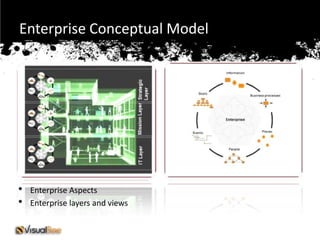
Enterprise Conceptual Model


•   Enterprise Aspects
•   Enterprise layers and views
Enterprise Aspects

•   Information: Information is the Memory of organizations. Forms, Reports,
    Financial Documents are examples of information.

•   Business Processes: A business process or business method is a collection of
    related, structured activities or tasks that produce a specific service or product (serve a
    particular goal) for a particular customer or customers. It often can be visualized with a
    flowchart as a sequence of activities.

•   Places:
     •   offices, Warehouses, Factories, Manufacturing units

•   People: every organization has specific structure which       Organizational position ,
    Management ,…. Defined in it.

•   Events
•   Goals
Enterprise layers and views


•   Strategic Layer: refers to a layer which all major decisions of
    an organisation are taken there.
    •   All topics related to this layer are out of the EA issues and we just use
        their documentations as entries the of EA Process.
•   Mission Layer: All processes of the organization
    •   It contains: Supreme Management, Intermediate Management and
        Operational Management
•   ICT Layer: This Layer contains all informational and
    communicational processes which are used to do mission
    layer tasks.
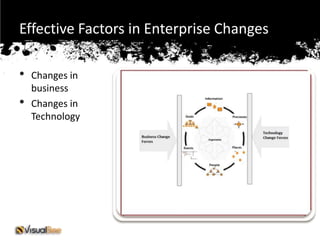
Effective Factors in Enterprise Changes

•   Changes in
    business
•   Changes in
    Technology
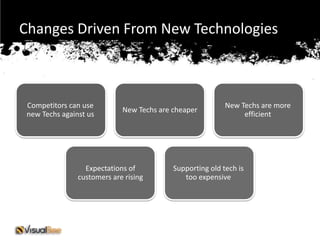
Changes Driven From New Technologies


 Competitors can use                                       New Techs are more
                             New Techs are cheaper
 new Techs against us                                           efficient


                  Expectations of          Supporting old tech is
                customers are rising          too expensive
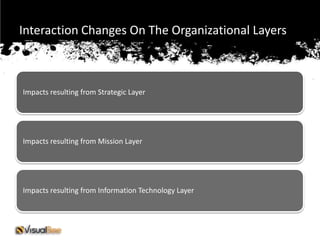
Interaction Changes On The Organizational Layers


Impacts resulting from Strategic Layer


Impacts resulting from Mission Layer


Impacts resulting from Information Technology Layer
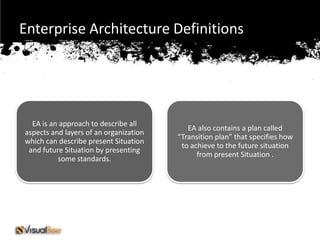
Enterprise Architecture Definitions


  EA is an approach to describe all
                                           EA also contains a plan called
aspects and layers of an organization
                                        “Transition plan” that specifies how
which can describe present Situation
                                         to achieve to the future situation
 and future Situation by presenting
                                              from present Situation .
          some standards.
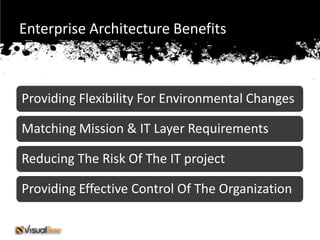
Enterprise Architecture Benefits


Providing Flexibility For Environmental Changes

Matching Mission & IT Layer Requirements

Reducing The Risk Of The IT project

Providing Effective Control Of The Organization
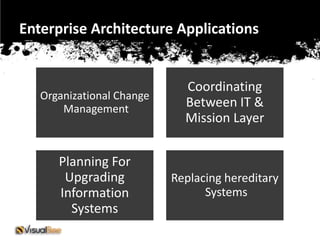
Enterprise Architecture Applications


                             Coordinating
   Organizational Change
       Management            Between IT &
                             Mission Layer


      Planning For
       Upgrading           Replacing hereditary
      Information                Systems
        Systems
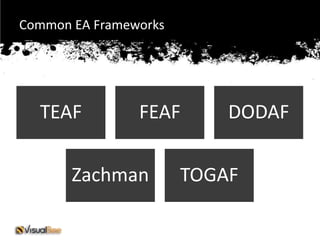
Common EA Frameworks


  TEAF          FEAF       DODAF


       Zachman         TOGAF
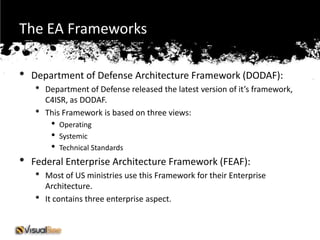
The EA Frameworks

•   Department of Defense Architecture Framework (DODAF):
    •   Department of Defense released the latest version of it’s framework,
        C4ISR, as DODAF.
    •   This Framework is based on three views:
        • Operating
        • Systemic
        • Technical Standards
•   Federal Enterprise Architecture Framework (FEAF):
    •   Most of US ministries use this Framework for their Enterprise
        Architecture.
    •   It contains three enterprise aspect.
The EA Frameworks (cont.)

•   Treasury Enterprise Architecture Framework (TEAF):
    •   The first version, was introduced in 2000.
    •   This Framework is a customized version of FEAF and is used for
        financial systems.


•   The Open Group Architecture Framework(TOGAF):
    •   The Open Group institute introduced this Framework in 1995.
    •   Is based on older version named TAFIM.
    •   This framework is the oldest framework which is presented by an
        independent company.
The EA Frameworks (cont.)

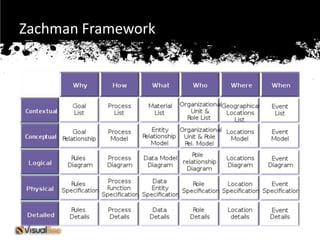
•   Zachman Architecture:
    •   Introduced in 1987 by Mr. Zachman.

    •   In theoretical point of view it is the most complete framework.

    •   It contains all six aspects and all views related to information system of an
        organization.

    •   Principles and Concepts of this framework is affected other frameworks.

    •   Zifa institute which is established by Zachman is supporting this framework.
Zachman Framework
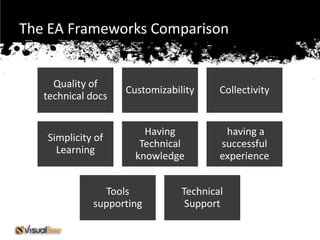
The EA Frameworks Comparison


     Quality of
                    Customizability     Collectivity
   technical docs


                        Having           having a
   Simplicity of
                       Technical        successful
     Learning
                      knowledge         experience


               Tools            Technical
             supporting          Support
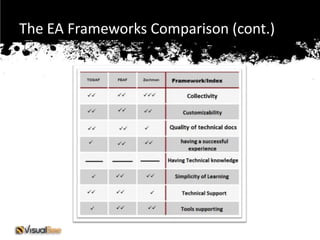
The EA Frameworks Comparison (cont.)
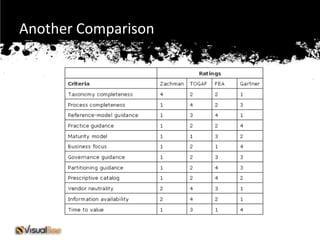
Another Comparison
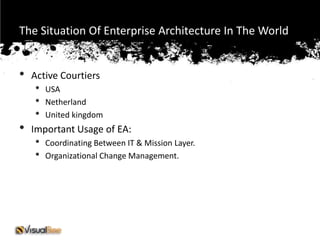
The Situation Of Enterprise Architecture In The World


•   Active Courtiers
    •   USA
    •   Netherland
    •   United kingdom
•   Important Usage of EA:
    •   Coordinating Between IT & Mission Layer.
    •   Organizational Change Management.
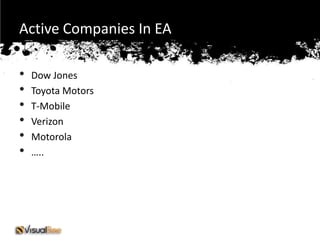
Active Companies In EA

•   Dow Jones
•   Toyota Motors
•   T-Mobile
•   Verizon
•   Motorola
•   …..
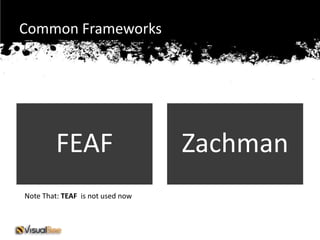
Common Frameworks


         FEAF                     Zachman
Note That: TEAF is not used now
Enterprise Architecture In Iran

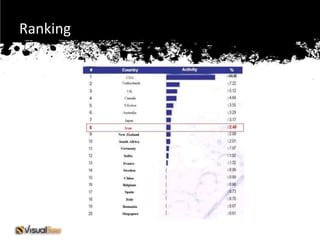
•   Iran was 8th active country on Enterprise Architecture in the
    world in 2004.

•   Iranian active companies:
    •   Ministry of culture.
    •   Ministry of Agriculture.
    •   The Presidential Administration.
    •   Iranian Railways.
    •   Iranian Armed Forces.
Ranking

Enterprise Architecture basics

  • 1.
    Enterprise Architecture Mahdi Ameri(8711121026) Mahmoud Dehghan(8711121012)
  • 3.
    Introduction • An enterprise architecture is a rigorous description of the structure of an enterprise, which comprises enterprise components (business entities), the externally visible properties of those components, and the relationships (e.g. behavior) between them. • EA describes the terminology, the composition of enterprise components, and their relationships with the external environment, and the guiding principles for the requirement (analysis), design, and evolution of an enterprise.
  • 5.
    Basic Concepts inEnterprise Architecture What is Architecture?
  • 6.
    Architecture Definitions • IEEE: “An architecture is the fundamental organization of a system embodied in its components, their relationships to each other, and to the environment, and the principles guiding its design and evolution.” • TOGAF: “Architecture has two meanings depending upon its contextual usage: (1) A formal description of a system, or a detailed plan of the system at component level to guide its implementation; (2) The structure of components, their interrelationships, and the principles and guidelines governing their design and evolution over time.” • The Netherlands Architecture Forum(NAF):“a normative restriction of design freedom and operationally as a set of design principles.”
  • 7.
    Enterprise Conceptual Model • Enterprise Aspects • Enterprise layers and views
  • 8.
    Enterprise Aspects • Information: Information is the Memory of organizations. Forms, Reports, Financial Documents are examples of information. • Business Processes: A business process or business method is a collection of related, structured activities or tasks that produce a specific service or product (serve a particular goal) for a particular customer or customers. It often can be visualized with a flowchart as a sequence of activities. • Places: • offices, Warehouses, Factories, Manufacturing units • People: every organization has specific structure which Organizational position , Management ,…. Defined in it. • Events • Goals
  • 9.
    Enterprise layers andviews • Strategic Layer: refers to a layer which all major decisions of an organisation are taken there. • All topics related to this layer are out of the EA issues and we just use their documentations as entries the of EA Process. • Mission Layer: All processes of the organization • It contains: Supreme Management, Intermediate Management and Operational Management • ICT Layer: This Layer contains all informational and communicational processes which are used to do mission layer tasks.
  • 10.
    Effective Factors inEnterprise Changes • Changes in business • Changes in Technology
  • 11.
    Changes Driven FromNew Technologies Competitors can use New Techs are more New Techs are cheaper new Techs against us efficient Expectations of Supporting old tech is customers are rising too expensive
  • 12.
    Interaction Changes OnThe Organizational Layers Impacts resulting from Strategic Layer Impacts resulting from Mission Layer Impacts resulting from Information Technology Layer
  • 13.
    Enterprise Architecture Definitions EA is an approach to describe all EA also contains a plan called aspects and layers of an organization “Transition plan” that specifies how which can describe present Situation to achieve to the future situation and future Situation by presenting from present Situation . some standards.
  • 15.
    Enterprise Architecture Benefits ProvidingFlexibility For Environmental Changes Matching Mission & IT Layer Requirements Reducing The Risk Of The IT project Providing Effective Control Of The Organization
  • 16.
    Enterprise Architecture Applications Coordinating Organizational Change Management Between IT & Mission Layer Planning For Upgrading Replacing hereditary Information Systems Systems
  • 18.
    Common EA Frameworks TEAF FEAF DODAF Zachman TOGAF
  • 19.
    The EA Frameworks • Department of Defense Architecture Framework (DODAF): • Department of Defense released the latest version of it’s framework, C4ISR, as DODAF. • This Framework is based on three views: • Operating • Systemic • Technical Standards • Federal Enterprise Architecture Framework (FEAF): • Most of US ministries use this Framework for their Enterprise Architecture. • It contains three enterprise aspect.
  • 20.
    The EA Frameworks(cont.) • Treasury Enterprise Architecture Framework (TEAF): • The first version, was introduced in 2000. • This Framework is a customized version of FEAF and is used for financial systems. • The Open Group Architecture Framework(TOGAF): • The Open Group institute introduced this Framework in 1995. • Is based on older version named TAFIM. • This framework is the oldest framework which is presented by an independent company.
  • 21.
    The EA Frameworks(cont.) • Zachman Architecture: • Introduced in 1987 by Mr. Zachman. • In theoretical point of view it is the most complete framework. • It contains all six aspects and all views related to information system of an organization. • Principles and Concepts of this framework is affected other frameworks. • Zifa institute which is established by Zachman is supporting this framework.
  • 22.
  • 23.
    The EA FrameworksComparison Quality of Customizability Collectivity technical docs Having having a Simplicity of Technical successful Learning knowledge experience Tools Technical supporting Support
  • 24.
    The EA FrameworksComparison (cont.)
  • 25.
  • 27.
    The Situation OfEnterprise Architecture In The World • Active Courtiers • USA • Netherland • United kingdom • Important Usage of EA: • Coordinating Between IT & Mission Layer. • Organizational Change Management.
  • 28.
    Active Companies InEA • Dow Jones • Toyota Motors • T-Mobile • Verizon • Motorola • …..
  • 29.
    Common Frameworks FEAF Zachman Note That: TEAF is not used now
  • 30.
    Enterprise Architecture InIran • Iran was 8th active country on Enterprise Architecture in the world in 2004. • Iranian active companies: • Ministry of culture. • Ministry of Agriculture. • The Presidential Administration. • Iranian Railways. • Iranian Armed Forces.
  • 31.