Basics of Supply Chain Management
Definitions
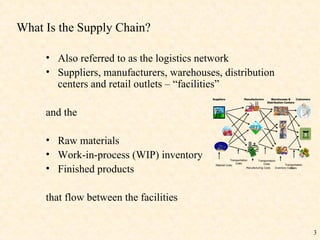
What Is the Supply Chain?  Also referred to as the logistics network Suppliers, manufacturers, warehouses, distribution centers and retail outlets – “facilities” and the Raw materials Work-in-process (WIP) inventory Finished products that flow between the facilities Suppliers Manufacturers Warehouses & Distribution Centers Customers Material Costs Transportation Costs Transportation Costs Transportation Costs Inventory Costs Manufacturing Costs
The Supply Chain Suppliers Manufacturers Warehouses & Distribution Centers Customers Material Costs Transportation Costs Transportation Costs Transportation Costs Inventory Costs Manufacturing Costs
The Supply Chain – Another View Plan Source Make Deliver Buy Suppliers Manufacturers Warehouses & Distribution Centers Customers Material Costs Transportation Costs Transportation Costs Transportation Costs Inventory Costs Manufacturing Costs
What Is Supply Chain Management (SCM)?  A set of approaches used to efficiently integrate Suppliers Manufacturers Warehouses Distribution centers So that the product is produced and distributed In the right quantities To the right locations And at the right time System-wide  costs  are minimized and Service level  requirements are satisfied  Plan Source Make Deliver Buy
History of Supply Chain Management 1960’s - Inventory Management Focus, Cost Control 1970’s - MRP & BOM  - Operations Planning 1980’s - MRPII, JIT - Materials Management, Logistics 1990’s - SCM - ERP - “Integrated” Purchasing, Financials, Manufacturing, Order Entry 2000’s - Optimized “Value Network” with Real-Time Decision Support; Synchronized & Collaborative Extended Network
Why Is SCM Difficult?  Uncertainty is inherent to every supply chain Travel times Breakdowns of machines and vehicles Weather, natural catastrophe, war Local politics, labor conditions, border issues The complexity of the problem to globally optimize a supply chain is significant Minimize internal costs Minimize uncertainty Deal with remaining uncertainty Plan Source Make Deliver Buy
The Importance of Supply Chain Management  Dealing with uncertain environments – matching supply and demand Write-offs due to “raw materials shortages, internal and supplier parts shortages and productivity inefficiencies” -Boeing Loss due to “larger than anticipated inventories on the shelves of hospitals” - U.S Surgical Corporation  Selling out the entire supply of a new product resulting in loss in potential revenue - IBM Finding it difficult to obtain important components for its PC’s from suppliers due to a massive earthquake - HP and Dell
The Importance of Supply Chain Management  Shorter product life cycles of high-technology products Less opportunity to accumulate historical data on customer demand Wide choice of competing products makes it difficult to predict demand The growth of technologies such as the Internet enable greater collaboration between supply chain trading partners If you don’t do it, your competitor will Major buyers such as Wal-Mart demand a level of “supply chain maturity” of its suppliers Availability of SCM technologies on the market Firms have access to multiple products (e.g., SAP, Baan, Oracle, JD Edwards) with which to integrate  internal  processes
Supply Chain Management and Uncertainty Inventory and back-order levels fluctuate considerably across the supply chain even when customer demand doesn’t vary The variability worsens as we travel “up” the supply chain Forecasting doesn’t help ! Manufacturer Wholesale Distributors Consumers Multi-tier Suppliers Retailers Time Sales Sales Time Sales Time Sales Time Bullwhip Effect
Factors Contributing to the Bullwhip  Demand forecasting practices Min-max inventory management (reorder points to bring inventory up to predicted levels) Lead time Longer lead times lead to greater variability in estimates of average demand, thus increasing variability and safety stock costs Batch ordering Peaks and valleys in orders Fixed ordering costs Impact of transportation costs (e.g., fuel costs) Sales quotas Price fluctuations Promotion and discount policies Lack of centralized information
Today’s Marketplace Requires:  Personalized  content and services for their customers Collaborative   planning with design partners, distributors,  and suppliers Real-time  commitments for design, production, inventory, and transportation capacity Flexible   logistics options to ensure timely fulfillment   Order tracking  & reporting across  multiple vendors and carriers Shared visibility for  trading partners
Supply Chain Management – Key Issues Forecasts are never right Very unlikely that actual demand will exactly equal forecast demand The longer the forecast horizon, the worse the forecast A forecast for a year from now will never be as accurate as a forecast for 3 months from now Aggregate forecasts are more accurate A demand forecast for all CV therapeutics will be more accurate than a forecast for a specific CV-related product Nevertheless, forecasts (or plans, if you prefer) are important management tools when some methods are applied to reduce uncertainty
Supply Chain Management – Key Issues Overcoming functional silos with conflicting goals Purchasing Manufacturing Distribution Customer Service/ Sales Few change- overs Stable schedules Long run lengths High inventories High service levels Regional stocks SOURCE MAKE DELIVER SELL Low pur-chase price Multiple vendors Low invent-ories Low trans-portation
Supply Chain Management – Key Issues Source:  Simchi-Levi How are inventory holding and transportation costs affected by product design? How does product design enable mass customization? Product Design What are our core supply chain capabilities and which are not? Does our product design mandate different outsourcing approaches? Risk management Outsourcing & Procurement Strategies How can integration with partners be achieved? What level of integration is best? What information and processes can be shared? What partnerships should be implemented and in which situations? Integration and Strategic Partnering Selection of distribution strategies (e.g., direct ship vs. cross-docking) How many cross-dock points are needed? Cost/Benefits of different strategies Distribution Strategies Impact of volume discount and revenue sharing Pricing strategies to reduce order-shipment variability Supply Contracts How should inventory be managed? Why does inventory fluctuate and what strategies minimize this? Inventory Control Warehouse locations and capacities Plant locations and production levels Transportation flows between facilities to minimize cost and time Network Planning CONSIDERATIONS ISSUE
Supply Chain Management Operations Strategies Source:  Simchi-Levi complex products, unique customer specifications many variations on finished product; infrequent demand customized products, many variations standardized products, relatively predictable demand WHEN TO CHOOSE Enables response to specific customer requirements Engineer to Order Low inventory levels; wide range of product offerings; simplified planning Configure to Order Customization; reduced inventory; improved service levels Make to Order Low manufacturing costs; meet customer demands quickly Make to Stock BENEFITS STRATEGY
Supply Chain Management – Benefits Some of the significant benefits to integrating the supply chain Source:  Cohen & Roussel 20%-30% Improvement Fill Rates 10%-20% Improvement Improved Capacity Realization 25%-50% Improvement Lower Supply-Chain Costs 10%-16% Improvement Overall Productivity 25%-80% Improvement Forecast Accuracy 30%-50% Improvement Fulfillment Cycle Time 25%-60% Improvement Inventory Reduction 16%-28% Improvement Delivery Performance
Supply Chain Imperatives for Success View the supply chain as a strategic asset and a differentiator Wal-Mart’s partnership with Proctor & Gamble to automatically replenish inventory Dell’s innovative direct-to-consumer sales and build-to-order manufacturing Create unique supply chain configurations that align with your company’s strategic objectives Operations strategy Outsourcing strategy Channel strategy Customer service strategy Asset network Reduce uncertainty Forecasting Collaboration Integration Supply chain configuration components
Value of Information and SCM
Information In The Supply Chain Each facility further away from actual customer demand must make forecasts of demand Lacking actual customer buying data, each facility bases its forecasts on ‘downstream’ orders, which are more variable than actual demand To accommodate variability, inventory levels are overstocked thus increasing inventory carrying costs Source Make Deliver Sell Suppliers Manufacturers Warehouses & Distribution Centers Retailer It’s estimated that the typical pharmaceutical company supply chain carries over 100 days of product to accommodate uncertainty Plan Order Lead Time Delivery Lead Time Production Lead Time
Taming the Bullwhip Reduce uncertainty in the supply chain Centralize demand information Keep each stage of the supply chain provided with up-to-date customer demand information More frequent planning (continuous real-time planning the goal)  Reduce variability in the supply chain Every-day-low-price strategies for stable demand patterns Reduce lead times Use cross-docking to reduce order lead times Use EDI techniques to reduce information lead times Eliminate the bullwhip through strategic partnerships Vendor-managed inventory (VMI) Collaborative planning, forecasting and replenishment (CPFR) Four critical methods for reducing the Bullwhip effect:
Methods for Improving Forecasts Accurate Forecasts Panels of Experts Internal experts External experts Domain experts Delphi technique Moving average Exponential smoothing Trend analysis Seasonality analysis Judgment Methods Time-Series Methods Causal Analysis Market Research Analysis Relies on data other than  that being predicted Economic data, commodity  data, etc. Market testing Market surveys Focus groups
The Evolving Supply Chain
Supply Chain Integration – Push Strategies Classical manufacturing supply chain strategy Manufacturing forecasts are long-range  Orders from retailers’ warehouses Longer response time to react to marketplace changes  Unable to meet changing demand patterns Supply chain inventory becomes obsolete as demand for certain products disappears Increased variability (Bullwhip effect) leading to: Large inventory safety stocks Larger and more variably sized production batches Unacceptable service levels Inventory obsolescence Inefficient use of production facilities (factories) How is demand determined? Peak? Average?  How is transportation capacity determined? Examples:  Auto industry, large appliances, others?
Supply Chain Integration – Pull Strategies Production and distribution are demand-driven Coordinated with true customer demand None or little inventory held Only in response to specific orders Fast information flow mechanisms POS data Decreased lead times Decreased retailer inventory Decreased variability in the supply chain and especially at manufacturers Decreased manufacturer inventory More efficient use of resources More difficult to take advantage of scale opportunities Examples:  Dell, Amazon
Supply Chain Integration – Push/Pull Strategies Hybrid of “push” and “pull” strategies to overcome disadvantages of each Early stages of product assembly are done in a “push” manner Partial assembly of product based on aggregate demand forecasts (which are more accurate than individual product demand forecasts) Uncertainty is reduced so safety stock inventory is lower Final product assembly is done based on customer demand for specific product configurations Supply chain timeline determines “push-pull boundary” Supply Chain Timeline Raw Materials End Consumer Push Strategy Pull Strategy Push- Pull Boundary “ Generic” Product “ Customized” Product
Choosing Between Push/Pull Strategies Where do the following industries fit in this model: Automobile? Aircraft? Fashion? Petroleum refining? Pharmaceuticals? Biotechnology? Medical Devices? Pull Push Pull Push Economies of Scale Low High Low High Demand Uncertainty Industries where: Customization is High Demand is uncertain Scale economies are Low Computer equipment Industries where: Standard processes are the  norm Demand is stable Scale economies are High Grocery, Beverages Industries where: Uncertainty is low Low economies of scale Push-pull supply chain Books, CD’s Industries where: Demand is uncertain Scale economies are High Low economies of scale Furniture Source:  Simchi-Levi
Characteristics of Push, Pull and Push/Pull Strategies Source:  Simchi-Levi Short Long Lead Time Order Fulfillment Supply Chain Planning Processes Resource Allocation High Minimize Cost PUSH Responsiveness Focus Low Complexity Maximize Service Level Objective PULL
Supply Chain Collaboration – What Is It? Many different definitions depending on perspective The means by which companies within the supply chain work together towards mutual goals by sharing Ideas Information Processes Knowledge Information Risks Rewards Why collaborate? Accelerate entry into new markets Changes the relationship between cost/value/profit equation
Supply Chain Collaboration Cornerstone of effective SCM The focus of many of today’s SCM initiatives The only method that has the potential to eliminate or minimize the Bullwhip effect Manufacturer Distributors/ Wholesalers Suppliers Retailers Collaborative Demand Planning Collaborative Logistics Planning Transportation services Distribution center services Synchronized Production Scheduling Collaborative Product Development Logistics Providers
Benefits of Supply Chain Collaboration Source:  Cohen & Roussel Improved customer service More efficient use of human resources Lower freight costs Faster and more reliable delivery Lower capital costs Reduced depreciation Lower fixed costs Reduced inventory Lower warehousing costs Lower material acquisition costs Fewer stockout conditions Reduced inventory Increased revenue Lower order management costs Higher Gross Margin Better forecast accuracy Better allocation of promotional budgets SERVICE  SUPPLIERS MATERIAL SUPPLIERS CUSTOMERS
Supply Chain Collaboration Spectrum The green arrow describes increasing complexity and sophistication of:  Information systems Systems infrastructure Decision support systems Planning mechanisms Information sharing Process understanding Higher levels of collaboration imply the need for both trading partners to have equivalent (or close) levels of supply chain maturity Synchronized collaboration demands joint planning, R&D and sharing of information and processing models Movement to real-time customer demand information throughout the supply chain  Source:  Cohen & Roussel Number of Relationships Extent of Collaboration Many Few Limited Extensive Transactional Collaboration Synchronized Collaboration Cooperative Collaboration Coordinated Collaboration Not Viable Low Return
Successful Supply Chain Collaboration Try to collaborate internally before you try external collaboration Help your partners to work with you Share the savings Start small (a limited number of selected partners) and stay focused on what you want to achieve in the collaboration Advance your IT capabilities only to the level that you expect your partners to manage Put a comprehensive metrics program in place that allows you to monitor your partners’ performance Make sure people are kept part of the equation Systems do not replace people Make sure your organization is populated with competent professionals who’ve done this before
Emerging Best Practices in SCM Strategy
The SCOR Model
Process Reference Models Process reference models integrate the well-known concepts of business process reengineering, benchmarking, and process measurement into a cross-functional framework Quantify the operational performance of similar companies and establish internal targets based on “best-in-class” results Benchmarking Characterize the management practices  and software solutions that result in “best-in-class” performance Best Practices  Analysis Process Reference  Model Capture the “as-is” state of a process and derive the desired “to-be” future state Business Process  Reengineering Capture the “as-is” state of a process and derive the desired “to-be” future state Quantify the operational performance of similar companies and establish internal targets based on “best-in-class” results Characterize the management practices  and software solutions that result in “best-in-class” performance
Customers Suppliers P1  Plan Supply Chain Plan P2  Plan Source P3  Plan Make P4  Plan Deliver Source Make Deliver S1  Source Stocked Products M1  Make-to-Stock M2  Make-to-Order M3  Engineer-to-Order D1  Deliver Stocked Products D2  Deliver MTO Products D3 Deliver ETO Products S2  Source MTO Products S3  Source ETO Products Return Source P5  Plan Returns Return Deliver Enable D4  Deliver Retail Products SCOR 7.0 Model Structure
Consumer Foods Project Time (Start to Finish) – 3 months Investment - $50,000  1 st  Year Return - $4,300,000  Electronics Project Time (Start to Finish) – 6 months Investment - $3-5 Million  Projected Return on Investment - $ 230 Million  Software and Planning SAP bases APO key performance indicators (KPIs) on SCOR Model  Aerospace and Defense SCOR Benchmarking and use of SCOR metrics to specify performance criteria and provide basis for contracts / purchase orders Examples of SCOR Adoptions

Ibcs nov2011

  • 1.
    Basics of SupplyChain Management
  • 2.
  • 3.
    What Is theSupply Chain? Also referred to as the logistics network Suppliers, manufacturers, warehouses, distribution centers and retail outlets – “facilities” and the Raw materials Work-in-process (WIP) inventory Finished products that flow between the facilities Suppliers Manufacturers Warehouses & Distribution Centers Customers Material Costs Transportation Costs Transportation Costs Transportation Costs Inventory Costs Manufacturing Costs
  • 4.
    The Supply ChainSuppliers Manufacturers Warehouses & Distribution Centers Customers Material Costs Transportation Costs Transportation Costs Transportation Costs Inventory Costs Manufacturing Costs
  • 5.
    The Supply Chain– Another View Plan Source Make Deliver Buy Suppliers Manufacturers Warehouses & Distribution Centers Customers Material Costs Transportation Costs Transportation Costs Transportation Costs Inventory Costs Manufacturing Costs
  • 6.
    What Is SupplyChain Management (SCM)? A set of approaches used to efficiently integrate Suppliers Manufacturers Warehouses Distribution centers So that the product is produced and distributed In the right quantities To the right locations And at the right time System-wide costs are minimized and Service level requirements are satisfied Plan Source Make Deliver Buy
  • 7.
    History of SupplyChain Management 1960’s - Inventory Management Focus, Cost Control 1970’s - MRP & BOM - Operations Planning 1980’s - MRPII, JIT - Materials Management, Logistics 1990’s - SCM - ERP - “Integrated” Purchasing, Financials, Manufacturing, Order Entry 2000’s - Optimized “Value Network” with Real-Time Decision Support; Synchronized & Collaborative Extended Network
  • 8.
    Why Is SCMDifficult? Uncertainty is inherent to every supply chain Travel times Breakdowns of machines and vehicles Weather, natural catastrophe, war Local politics, labor conditions, border issues The complexity of the problem to globally optimize a supply chain is significant Minimize internal costs Minimize uncertainty Deal with remaining uncertainty Plan Source Make Deliver Buy
  • 9.
    The Importance ofSupply Chain Management Dealing with uncertain environments – matching supply and demand Write-offs due to “raw materials shortages, internal and supplier parts shortages and productivity inefficiencies” -Boeing Loss due to “larger than anticipated inventories on the shelves of hospitals” - U.S Surgical Corporation Selling out the entire supply of a new product resulting in loss in potential revenue - IBM Finding it difficult to obtain important components for its PC’s from suppliers due to a massive earthquake - HP and Dell
  • 10.
    The Importance ofSupply Chain Management Shorter product life cycles of high-technology products Less opportunity to accumulate historical data on customer demand Wide choice of competing products makes it difficult to predict demand The growth of technologies such as the Internet enable greater collaboration between supply chain trading partners If you don’t do it, your competitor will Major buyers such as Wal-Mart demand a level of “supply chain maturity” of its suppliers Availability of SCM technologies on the market Firms have access to multiple products (e.g., SAP, Baan, Oracle, JD Edwards) with which to integrate internal processes
  • 11.
    Supply Chain Managementand Uncertainty Inventory and back-order levels fluctuate considerably across the supply chain even when customer demand doesn’t vary The variability worsens as we travel “up” the supply chain Forecasting doesn’t help ! Manufacturer Wholesale Distributors Consumers Multi-tier Suppliers Retailers Time Sales Sales Time Sales Time Sales Time Bullwhip Effect
  • 12.
    Factors Contributing tothe Bullwhip Demand forecasting practices Min-max inventory management (reorder points to bring inventory up to predicted levels) Lead time Longer lead times lead to greater variability in estimates of average demand, thus increasing variability and safety stock costs Batch ordering Peaks and valleys in orders Fixed ordering costs Impact of transportation costs (e.g., fuel costs) Sales quotas Price fluctuations Promotion and discount policies Lack of centralized information
  • 13.
    Today’s Marketplace Requires: Personalized content and services for their customers Collaborative planning with design partners, distributors, and suppliers Real-time commitments for design, production, inventory, and transportation capacity Flexible logistics options to ensure timely fulfillment Order tracking & reporting across multiple vendors and carriers Shared visibility for trading partners
  • 14.
    Supply Chain Management– Key Issues Forecasts are never right Very unlikely that actual demand will exactly equal forecast demand The longer the forecast horizon, the worse the forecast A forecast for a year from now will never be as accurate as a forecast for 3 months from now Aggregate forecasts are more accurate A demand forecast for all CV therapeutics will be more accurate than a forecast for a specific CV-related product Nevertheless, forecasts (or plans, if you prefer) are important management tools when some methods are applied to reduce uncertainty
  • 15.
    Supply Chain Management– Key Issues Overcoming functional silos with conflicting goals Purchasing Manufacturing Distribution Customer Service/ Sales Few change- overs Stable schedules Long run lengths High inventories High service levels Regional stocks SOURCE MAKE DELIVER SELL Low pur-chase price Multiple vendors Low invent-ories Low trans-portation
  • 16.
    Supply Chain Management– Key Issues Source: Simchi-Levi How are inventory holding and transportation costs affected by product design? How does product design enable mass customization? Product Design What are our core supply chain capabilities and which are not? Does our product design mandate different outsourcing approaches? Risk management Outsourcing & Procurement Strategies How can integration with partners be achieved? What level of integration is best? What information and processes can be shared? What partnerships should be implemented and in which situations? Integration and Strategic Partnering Selection of distribution strategies (e.g., direct ship vs. cross-docking) How many cross-dock points are needed? Cost/Benefits of different strategies Distribution Strategies Impact of volume discount and revenue sharing Pricing strategies to reduce order-shipment variability Supply Contracts How should inventory be managed? Why does inventory fluctuate and what strategies minimize this? Inventory Control Warehouse locations and capacities Plant locations and production levels Transportation flows between facilities to minimize cost and time Network Planning CONSIDERATIONS ISSUE
  • 17.
    Supply Chain ManagementOperations Strategies Source: Simchi-Levi complex products, unique customer specifications many variations on finished product; infrequent demand customized products, many variations standardized products, relatively predictable demand WHEN TO CHOOSE Enables response to specific customer requirements Engineer to Order Low inventory levels; wide range of product offerings; simplified planning Configure to Order Customization; reduced inventory; improved service levels Make to Order Low manufacturing costs; meet customer demands quickly Make to Stock BENEFITS STRATEGY
  • 18.
    Supply Chain Management– Benefits Some of the significant benefits to integrating the supply chain Source: Cohen & Roussel 20%-30% Improvement Fill Rates 10%-20% Improvement Improved Capacity Realization 25%-50% Improvement Lower Supply-Chain Costs 10%-16% Improvement Overall Productivity 25%-80% Improvement Forecast Accuracy 30%-50% Improvement Fulfillment Cycle Time 25%-60% Improvement Inventory Reduction 16%-28% Improvement Delivery Performance
  • 19.
    Supply Chain Imperativesfor Success View the supply chain as a strategic asset and a differentiator Wal-Mart’s partnership with Proctor & Gamble to automatically replenish inventory Dell’s innovative direct-to-consumer sales and build-to-order manufacturing Create unique supply chain configurations that align with your company’s strategic objectives Operations strategy Outsourcing strategy Channel strategy Customer service strategy Asset network Reduce uncertainty Forecasting Collaboration Integration Supply chain configuration components
  • 20.
  • 21.
    Information In TheSupply Chain Each facility further away from actual customer demand must make forecasts of demand Lacking actual customer buying data, each facility bases its forecasts on ‘downstream’ orders, which are more variable than actual demand To accommodate variability, inventory levels are overstocked thus increasing inventory carrying costs Source Make Deliver Sell Suppliers Manufacturers Warehouses & Distribution Centers Retailer It’s estimated that the typical pharmaceutical company supply chain carries over 100 days of product to accommodate uncertainty Plan Order Lead Time Delivery Lead Time Production Lead Time
  • 22.
    Taming the BullwhipReduce uncertainty in the supply chain Centralize demand information Keep each stage of the supply chain provided with up-to-date customer demand information More frequent planning (continuous real-time planning the goal) Reduce variability in the supply chain Every-day-low-price strategies for stable demand patterns Reduce lead times Use cross-docking to reduce order lead times Use EDI techniques to reduce information lead times Eliminate the bullwhip through strategic partnerships Vendor-managed inventory (VMI) Collaborative planning, forecasting and replenishment (CPFR) Four critical methods for reducing the Bullwhip effect:
  • 23.
    Methods for ImprovingForecasts Accurate Forecasts Panels of Experts Internal experts External experts Domain experts Delphi technique Moving average Exponential smoothing Trend analysis Seasonality analysis Judgment Methods Time-Series Methods Causal Analysis Market Research Analysis Relies on data other than that being predicted Economic data, commodity data, etc. Market testing Market surveys Focus groups
  • 24.
  • 25.
    Supply Chain Integration– Push Strategies Classical manufacturing supply chain strategy Manufacturing forecasts are long-range Orders from retailers’ warehouses Longer response time to react to marketplace changes Unable to meet changing demand patterns Supply chain inventory becomes obsolete as demand for certain products disappears Increased variability (Bullwhip effect) leading to: Large inventory safety stocks Larger and more variably sized production batches Unacceptable service levels Inventory obsolescence Inefficient use of production facilities (factories) How is demand determined? Peak? Average? How is transportation capacity determined? Examples: Auto industry, large appliances, others?
  • 26.
    Supply Chain Integration– Pull Strategies Production and distribution are demand-driven Coordinated with true customer demand None or little inventory held Only in response to specific orders Fast information flow mechanisms POS data Decreased lead times Decreased retailer inventory Decreased variability in the supply chain and especially at manufacturers Decreased manufacturer inventory More efficient use of resources More difficult to take advantage of scale opportunities Examples: Dell, Amazon
  • 27.
    Supply Chain Integration– Push/Pull Strategies Hybrid of “push” and “pull” strategies to overcome disadvantages of each Early stages of product assembly are done in a “push” manner Partial assembly of product based on aggregate demand forecasts (which are more accurate than individual product demand forecasts) Uncertainty is reduced so safety stock inventory is lower Final product assembly is done based on customer demand for specific product configurations Supply chain timeline determines “push-pull boundary” Supply Chain Timeline Raw Materials End Consumer Push Strategy Pull Strategy Push- Pull Boundary “ Generic” Product “ Customized” Product
  • 28.
    Choosing Between Push/PullStrategies Where do the following industries fit in this model: Automobile? Aircraft? Fashion? Petroleum refining? Pharmaceuticals? Biotechnology? Medical Devices? Pull Push Pull Push Economies of Scale Low High Low High Demand Uncertainty Industries where: Customization is High Demand is uncertain Scale economies are Low Computer equipment Industries where: Standard processes are the norm Demand is stable Scale economies are High Grocery, Beverages Industries where: Uncertainty is low Low economies of scale Push-pull supply chain Books, CD’s Industries where: Demand is uncertain Scale economies are High Low economies of scale Furniture Source: Simchi-Levi
  • 29.
    Characteristics of Push,Pull and Push/Pull Strategies Source: Simchi-Levi Short Long Lead Time Order Fulfillment Supply Chain Planning Processes Resource Allocation High Minimize Cost PUSH Responsiveness Focus Low Complexity Maximize Service Level Objective PULL
  • 30.
    Supply Chain Collaboration– What Is It? Many different definitions depending on perspective The means by which companies within the supply chain work together towards mutual goals by sharing Ideas Information Processes Knowledge Information Risks Rewards Why collaborate? Accelerate entry into new markets Changes the relationship between cost/value/profit equation
  • 31.
    Supply Chain CollaborationCornerstone of effective SCM The focus of many of today’s SCM initiatives The only method that has the potential to eliminate or minimize the Bullwhip effect Manufacturer Distributors/ Wholesalers Suppliers Retailers Collaborative Demand Planning Collaborative Logistics Planning Transportation services Distribution center services Synchronized Production Scheduling Collaborative Product Development Logistics Providers
  • 32.
    Benefits of SupplyChain Collaboration Source: Cohen & Roussel Improved customer service More efficient use of human resources Lower freight costs Faster and more reliable delivery Lower capital costs Reduced depreciation Lower fixed costs Reduced inventory Lower warehousing costs Lower material acquisition costs Fewer stockout conditions Reduced inventory Increased revenue Lower order management costs Higher Gross Margin Better forecast accuracy Better allocation of promotional budgets SERVICE SUPPLIERS MATERIAL SUPPLIERS CUSTOMERS
  • 33.
    Supply Chain CollaborationSpectrum The green arrow describes increasing complexity and sophistication of: Information systems Systems infrastructure Decision support systems Planning mechanisms Information sharing Process understanding Higher levels of collaboration imply the need for both trading partners to have equivalent (or close) levels of supply chain maturity Synchronized collaboration demands joint planning, R&D and sharing of information and processing models Movement to real-time customer demand information throughout the supply chain Source: Cohen & Roussel Number of Relationships Extent of Collaboration Many Few Limited Extensive Transactional Collaboration Synchronized Collaboration Cooperative Collaboration Coordinated Collaboration Not Viable Low Return
  • 34.
    Successful Supply ChainCollaboration Try to collaborate internally before you try external collaboration Help your partners to work with you Share the savings Start small (a limited number of selected partners) and stay focused on what you want to achieve in the collaboration Advance your IT capabilities only to the level that you expect your partners to manage Put a comprehensive metrics program in place that allows you to monitor your partners’ performance Make sure people are kept part of the equation Systems do not replace people Make sure your organization is populated with competent professionals who’ve done this before
  • 35.
    Emerging Best Practicesin SCM Strategy
  • 36.
  • 37.
    Process Reference ModelsProcess reference models integrate the well-known concepts of business process reengineering, benchmarking, and process measurement into a cross-functional framework Quantify the operational performance of similar companies and establish internal targets based on “best-in-class” results Benchmarking Characterize the management practices and software solutions that result in “best-in-class” performance Best Practices Analysis Process Reference Model Capture the “as-is” state of a process and derive the desired “to-be” future state Business Process Reengineering Capture the “as-is” state of a process and derive the desired “to-be” future state Quantify the operational performance of similar companies and establish internal targets based on “best-in-class” results Characterize the management practices and software solutions that result in “best-in-class” performance
  • 38.
    Customers Suppliers P1 Plan Supply Chain Plan P2 Plan Source P3 Plan Make P4 Plan Deliver Source Make Deliver S1 Source Stocked Products M1 Make-to-Stock M2 Make-to-Order M3 Engineer-to-Order D1 Deliver Stocked Products D2 Deliver MTO Products D3 Deliver ETO Products S2 Source MTO Products S3 Source ETO Products Return Source P5 Plan Returns Return Deliver Enable D4 Deliver Retail Products SCOR 7.0 Model Structure
  • 39.
    Consumer Foods ProjectTime (Start to Finish) – 3 months Investment - $50,000 1 st Year Return - $4,300,000 Electronics Project Time (Start to Finish) – 6 months Investment - $3-5 Million Projected Return on Investment - $ 230 Million Software and Planning SAP bases APO key performance indicators (KPIs) on SCOR Model Aerospace and Defense SCOR Benchmarking and use of SCOR metrics to specify performance criteria and provide basis for contracts / purchase orders Examples of SCOR Adoptions

Editor's Notes

  • #2 Dependent on each instructor’s requirements
  • #3 Dependent on each instructor’s requirements
  • #21 Dependent on each instructor’s requirements
  • #25 Dependent on each instructor’s requirements
  • #37 Dependent on each instructor’s requirements
  • #38 34