Welcome to
Major project presentation
on
“SUPPLY CHAIN MANAGEMENT”
INTRODUCTION
Project statement
“To study the supply chain management practiced
by small scale spinning industry and identifying key
impacting factors of their SCM system.”
INTRODUCTION
Project objectives
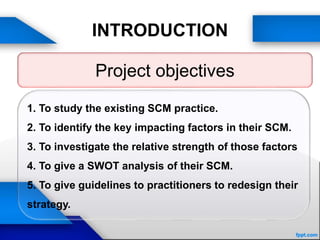
1. To study the existing SCM practice.
2. To identify the key impacting factors in their SCM.
3. To investigate the relative strength of those factors
4. To give a SWOT analysis of their SCM.
5. To give guidelines to practitioners to redesign their
strategy.
INTRODUCTION
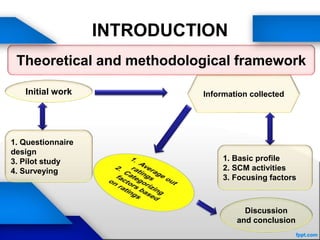
Theoretical and methodological framework
Initial work
1. Questionnaire
design
3. Pilot study
4. Surveying
Information collected
1. Basic profile
2. SCM activities
3. Focusing factors
Discussion
and conclusion
LITERATURE REVIEW
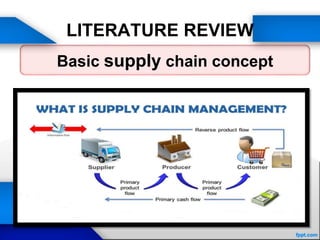
Basic supply chain concept
LITERATURE REVIEW
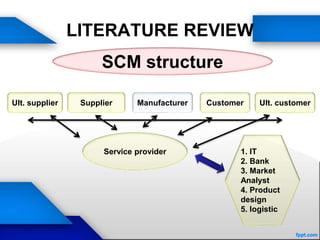
SCM structure
Ult. supplier Supplier Manufacturer Customer Ult. customer
Service provider 1. IT
2. Bank
3. Market
Analyst
4. Product
design
5. logistic
Literature review
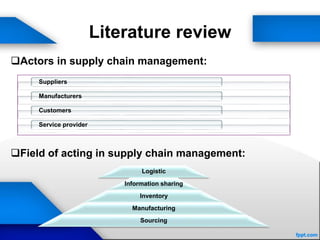
Actors in supply chain management:
Field of acting in supply chain management:
Suppliers
Manufacturers
Customers
Service provider
Logistic
Information sharing
Inventory
Manufacturing
Sourcing
LITERATURE REVIEW
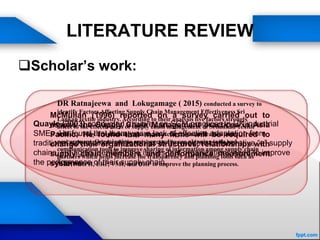
Scholar’s work:
McMullan (1996) reported on a survey carried out to
assess the Supply Chain Management practices in Asia
Pacific. He found that many firms will be required to
change their organizational structures, relationships with
supply chain members and performance measurement
systems.
Quayle (2003) conducted a survey on SCM practices in UK industrial
SMEs. He found that there was a lack of effective adaptation from
traditional adversarial relationships to the modern collaborative “e” supply
chains. He again identified the issues that organizations need to improve
the performance of their supply chain.
DR Ratnajeewa and Lokugamage ( 2015) conducted a survey to
identify Factors Affecting Supply Chain Management Effectiveness Sri
Lankan textile industry. According to their analysis five factors strongly
affect to the effectiveness of supply chain management of Srilankan Textile
industry. They are planning, quality, sourcing, communication and
procurement. Organizations are suggested to use planning tools and
communication tools to improve sharing of information among supply chain
partners which helps increase the transparency and planning tools such as
MRP, MRPII, ERP, VMI, and DRP to improve the planning process.
LITERATURE REVIEW
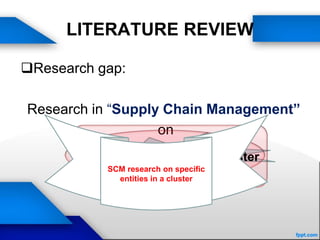
Research gap:
Research in “Supply Chain Management”
on
Textile industry
Small and medium scale industries
Textile cluster-OverallSCM study on Specific cluster
SCM research on specific
entities in a cluster
Not Yet………..
Why? Now what?
Lets know about
Panipat!!!
Munir
So, Now lets do some work? I mean
field work?
Welcome to
Panipat
Ok bhai!!….me also
coming…..
Overview of textile industry
Textile industry in Panipat
1947 - 2016
Overview of Textile industry
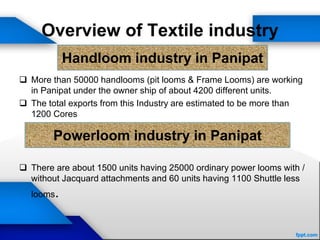
 More than 50000 handlooms (pit looms & Frame Looms) are working
in Panipat under the owner ship of about 4200 different units.
 The total exports from this Industry are estimated to be more than
1200 Cores
 There are about 1500 units having 25000 ordinary power looms with /
without Jacquard attachments and 60 units having 1100 Shuttle less
looms.
Handloom industry in Panipat
Powerloom industry in Panipat
Overview of Textile industry
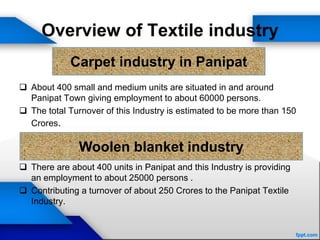
 About 400 small and medium units are situated in and around
Panipat Town giving employment to about 60000 persons.
 The total Turnover of this Industry is estimated to be more than 150
Crores.
 There are about 400 units in Panipat and this Industry is providing
an employment to about 25000 persons .
 Contributing a turnover of about 250 Crores to the Panipat Textile
Industry.
Carpet industry in Panipat
Woolen blanket industry
Overview of textile Industry
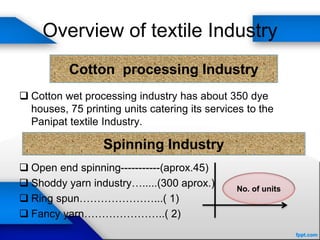
 Cotton wet processing industry has about 350 dye
houses, 75 printing units catering its services to the
Panipat textile Industry.
 Open end spinning-----------(aprox.45)
 Shoddy yarn industry….....(300 aprox.)
 Ring spun…………………...( 1)
 Fancy yarn…………………..( 2)
Cotton processing Industry
Spinning Industry
No. of units
Overview of textile Industry
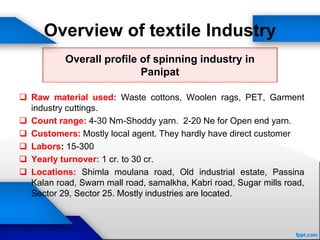
 Raw material used: Waste cottons, Woolen rags, PET, Garment
industry cuttings.
 Count range: 4-30 Nm-Shoddy yarn. 2-20 Ne for Open end yarn.
 Customers: Mostly local agent. They hardly have direct customer
 Labors: 15-300
 Yearly turnover: 1 cr. to 30 cr.
 Locations: Shimla moulana road, Old industrial estate, Passina
Kalan road, Swarn mall road, samalkha, Kabri road, Sugar mills road,
Sector 29, Sector 25. Mostly industries are located.
Overall profile of spinning industry in
Panipat
Overview of textile Industry
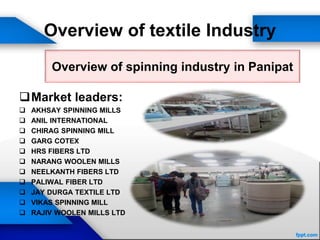
Market leaders:
 AKHSAY SPINNING MILLS
 ANIL INTERNATIONAL
 CHIRAG SPINNING MILL
 GARG COTEX
 HRS FIBERS LTD
 NARANG WOOLEN MILLS
 NEELKANTH FIBERS LTD
 PALIWAL FIBER LTD
 JAY DURGA TEXTILE LTD
 VIKAS SPINNING MILL
 RAJIV WOOLEN MILLS LTD
Overview of spinning industry in Panipat
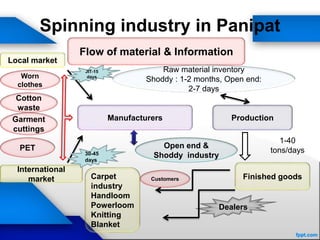
Spinning industry in Panipat
Flow of material & Information
Worn
clothes
Cotton
waste
Garment
cuttings
PET
Local market
International
market
Manufacturers
Raw material inventory
Shoddy : 1-2 months, Open end:
2-7 days
Open end &
Shoddy industry
Production
Finished goodsCarpet
industry
Handloom
Powerloom
Knitting
Blanket
1-40
tons/days
Dealers
Customers
30-45
days
JIT-15
days
Project work
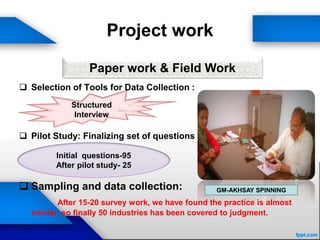
 Selection of Tools for Data Collection :
 Pilot Study: Finalizing set of questions
 Sampling and data collection:
After 15-20 survey work, we have found the practice is almost
similar, so finally 50 industries has been covered to judgment.
Paper work & Field Work
Structured
Interview
Initial questions-95
After pilot study- 25
GM-AKHSAY SPINNING
Project work
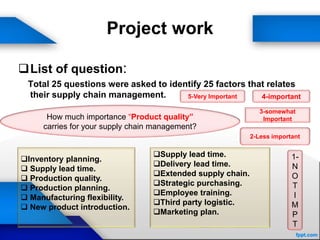
List of question:
Total 25 questions were asked to identify 25 factors that relates
their supply chain management.
Inventory planning.
 Supply lead time.
 Production quality.
 Production planning.
 Manufacturing flexibility.
 New product introduction.
Supply lead time.
Delivery lead time.
Extended supply chain.
Strategic purchasing.
Employee training.
Third party logistic.
Marketing plan.
How much importance “Product quality”
carries for your supply chain management?
5-Very Important 4-important
3-somewhat
Important
2-Less important
1-
N
O
T
I
M
P
T
Project work
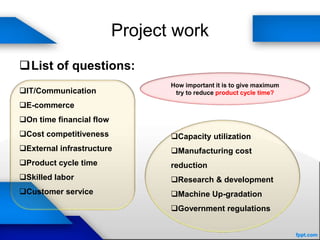
List of questions:
IT/Communication
E-commerce
On time financial flow
Cost competitiveness
External infrastructure
Product cycle time
Skilled labor
Customer service
Capacity utilization
Manufacturing cost
reduction
Research & development
Machine Up-gradation
Government regulations
How important it is to give maximum
try to reduce product cycle time?
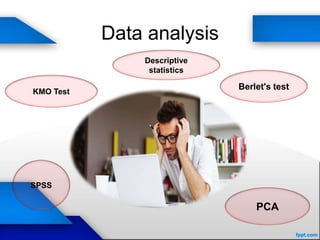
Data analysis
KMO Test
Berlet's test
PCA
Descriptive
statistics
SPSS
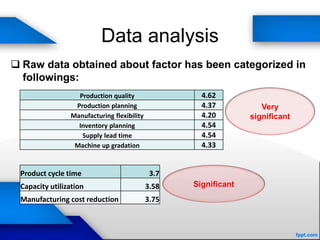
Data analysis
 Raw data obtained about factor has been categorized in
followings:
Production quality 4.62
Production planning 4.37
Manufacturing flexibility 4.20
Inventory planning 4.54
Supply lead time 4.54
Machine up gradation 4.33
Very
significant
Product cycle time 3.7
Capacity utilization 3.58
Manufacturing cost reduction 3.75
Significant
Data analysis
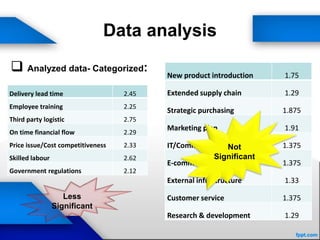
 Analyzed data- Categorized:
Delivery lead time 2.45
Employee training 2.25
Third party logistic 2.75
On time financial flow 2.29
Price issue/Cost competitiveness 2.33
Skilled labour 2.62
Government regulations 2.12
New product introduction 1.75
Extended supply chain 1.29
Strategic purchasing 1.875
Marketing plan 1.91
IT/Communication 1.375
E-commerce 1.375
External infrastructure 1.33
Customer service 1.375
Research & development 1.29
Less
Significant
Not
Significant
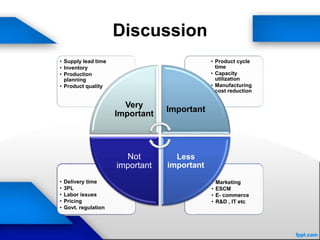
Discussion
• Marketing
• ESCM
• E- commerce
• R&D , IT etc
• Delivery time
• 3PL
• Labor issues
• Pricing
• Govt. regulation
• Product cycle
time
• Capacity
utilization
• Manufacturing
cost reduction
• Supply lead time
• Inventory
• Production
planning
• Product quality
Very
Important
Important
Less
important
Not
important
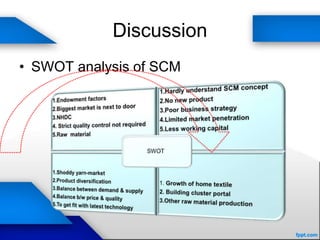
Discussion
• SWOT analysis of SCM
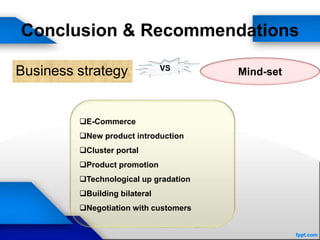
Conclusion & Recommendations
Business strategy Mind-setVS
E-Commerce
New product introduction
Cluster portal
Product promotion
Technological up gradation
Building bilateral
Negotiation with customers
Further study scope
 SCM study on Handloom Industry.
 SCM study on Carpet Industry.
 Overall SCM study in entire Industry.
 SCM performance Judgment.
 Study on responsiveness vs. Efficiency practice

Supply chain management practice by Spining Industry.

  • 1.
    Welcome to Major projectpresentation on “SUPPLY CHAIN MANAGEMENT”
  • 2.
    INTRODUCTION Project statement “To studythe supply chain management practiced by small scale spinning industry and identifying key impacting factors of their SCM system.”
  • 3.
    INTRODUCTION Project objectives 1. Tostudy the existing SCM practice. 2. To identify the key impacting factors in their SCM. 3. To investigate the relative strength of those factors 4. To give a SWOT analysis of their SCM. 5. To give guidelines to practitioners to redesign their strategy.
  • 4.
    INTRODUCTION Theoretical and methodologicalframework Initial work 1. Questionnaire design 3. Pilot study 4. Surveying Information collected 1. Basic profile 2. SCM activities 3. Focusing factors Discussion and conclusion
  • 5.
  • 6.
    LITERATURE REVIEW SCM structure Ult.supplier Supplier Manufacturer Customer Ult. customer Service provider 1. IT 2. Bank 3. Market Analyst 4. Product design 5. logistic
  • 7.
    Literature review Actors insupply chain management: Field of acting in supply chain management: Suppliers Manufacturers Customers Service provider Logistic Information sharing Inventory Manufacturing Sourcing
  • 8.
    LITERATURE REVIEW Scholar’s work: McMullan(1996) reported on a survey carried out to assess the Supply Chain Management practices in Asia Pacific. He found that many firms will be required to change their organizational structures, relationships with supply chain members and performance measurement systems. Quayle (2003) conducted a survey on SCM practices in UK industrial SMEs. He found that there was a lack of effective adaptation from traditional adversarial relationships to the modern collaborative “e” supply chains. He again identified the issues that organizations need to improve the performance of their supply chain. DR Ratnajeewa and Lokugamage ( 2015) conducted a survey to identify Factors Affecting Supply Chain Management Effectiveness Sri Lankan textile industry. According to their analysis five factors strongly affect to the effectiveness of supply chain management of Srilankan Textile industry. They are planning, quality, sourcing, communication and procurement. Organizations are suggested to use planning tools and communication tools to improve sharing of information among supply chain partners which helps increase the transparency and planning tools such as MRP, MRPII, ERP, VMI, and DRP to improve the planning process.
  • 9.
    LITERATURE REVIEW Research gap: Researchin “Supply Chain Management” on Textile industry Small and medium scale industries Textile cluster-OverallSCM study on Specific cluster SCM research on specific entities in a cluster
  • 10.
    Not Yet……….. Why? Nowwhat? Lets know about Panipat!!! Munir So, Now lets do some work? I mean field work? Welcome to Panipat Ok bhai!!….me also coming…..
  • 11.
    Overview of textileindustry Textile industry in Panipat 1947 - 2016
  • 12.
    Overview of Textileindustry  More than 50000 handlooms (pit looms & Frame Looms) are working in Panipat under the owner ship of about 4200 different units.  The total exports from this Industry are estimated to be more than 1200 Cores  There are about 1500 units having 25000 ordinary power looms with / without Jacquard attachments and 60 units having 1100 Shuttle less looms. Handloom industry in Panipat Powerloom industry in Panipat
  • 13.
    Overview of Textileindustry  About 400 small and medium units are situated in and around Panipat Town giving employment to about 60000 persons.  The total Turnover of this Industry is estimated to be more than 150 Crores.  There are about 400 units in Panipat and this Industry is providing an employment to about 25000 persons .  Contributing a turnover of about 250 Crores to the Panipat Textile Industry. Carpet industry in Panipat Woolen blanket industry
  • 14.
    Overview of textileIndustry  Cotton wet processing industry has about 350 dye houses, 75 printing units catering its services to the Panipat textile Industry.  Open end spinning-----------(aprox.45)  Shoddy yarn industry….....(300 aprox.)  Ring spun…………………...( 1)  Fancy yarn…………………..( 2) Cotton processing Industry Spinning Industry No. of units
  • 15.
    Overview of textileIndustry  Raw material used: Waste cottons, Woolen rags, PET, Garment industry cuttings.  Count range: 4-30 Nm-Shoddy yarn. 2-20 Ne for Open end yarn.  Customers: Mostly local agent. They hardly have direct customer  Labors: 15-300  Yearly turnover: 1 cr. to 30 cr.  Locations: Shimla moulana road, Old industrial estate, Passina Kalan road, Swarn mall road, samalkha, Kabri road, Sugar mills road, Sector 29, Sector 25. Mostly industries are located. Overall profile of spinning industry in Panipat
  • 16.
    Overview of textileIndustry Market leaders:  AKHSAY SPINNING MILLS  ANIL INTERNATIONAL  CHIRAG SPINNING MILL  GARG COTEX  HRS FIBERS LTD  NARANG WOOLEN MILLS  NEELKANTH FIBERS LTD  PALIWAL FIBER LTD  JAY DURGA TEXTILE LTD  VIKAS SPINNING MILL  RAJIV WOOLEN MILLS LTD Overview of spinning industry in Panipat
  • 17.
    Spinning industry inPanipat Flow of material & Information Worn clothes Cotton waste Garment cuttings PET Local market International market Manufacturers Raw material inventory Shoddy : 1-2 months, Open end: 2-7 days Open end & Shoddy industry Production Finished goodsCarpet industry Handloom Powerloom Knitting Blanket 1-40 tons/days Dealers Customers 30-45 days JIT-15 days
  • 18.
    Project work  Selectionof Tools for Data Collection :  Pilot Study: Finalizing set of questions  Sampling and data collection: After 15-20 survey work, we have found the practice is almost similar, so finally 50 industries has been covered to judgment. Paper work & Field Work Structured Interview Initial questions-95 After pilot study- 25 GM-AKHSAY SPINNING
  • 19.
    Project work List ofquestion: Total 25 questions were asked to identify 25 factors that relates their supply chain management. Inventory planning.  Supply lead time.  Production quality.  Production planning.  Manufacturing flexibility.  New product introduction. Supply lead time. Delivery lead time. Extended supply chain. Strategic purchasing. Employee training. Third party logistic. Marketing plan. How much importance “Product quality” carries for your supply chain management? 5-Very Important 4-important 3-somewhat Important 2-Less important 1- N O T I M P T
  • 20.
    Project work List ofquestions: IT/Communication E-commerce On time financial flow Cost competitiveness External infrastructure Product cycle time Skilled labor Customer service Capacity utilization Manufacturing cost reduction Research & development Machine Up-gradation Government regulations How important it is to give maximum try to reduce product cycle time?
  • 21.
    Data analysis KMO Test Berlet'stest PCA Descriptive statistics SPSS
  • 22.
    Data analysis  Rawdata obtained about factor has been categorized in followings: Production quality 4.62 Production planning 4.37 Manufacturing flexibility 4.20 Inventory planning 4.54 Supply lead time 4.54 Machine up gradation 4.33 Very significant Product cycle time 3.7 Capacity utilization 3.58 Manufacturing cost reduction 3.75 Significant
  • 23.
    Data analysis  Analyzeddata- Categorized: Delivery lead time 2.45 Employee training 2.25 Third party logistic 2.75 On time financial flow 2.29 Price issue/Cost competitiveness 2.33 Skilled labour 2.62 Government regulations 2.12 New product introduction 1.75 Extended supply chain 1.29 Strategic purchasing 1.875 Marketing plan 1.91 IT/Communication 1.375 E-commerce 1.375 External infrastructure 1.33 Customer service 1.375 Research & development 1.29 Less Significant Not Significant
  • 24.
    Discussion • Marketing • ESCM •E- commerce • R&D , IT etc • Delivery time • 3PL • Labor issues • Pricing • Govt. regulation • Product cycle time • Capacity utilization • Manufacturing cost reduction • Supply lead time • Inventory • Production planning • Product quality Very Important Important Less important Not important
  • 25.
  • 26.
    Conclusion & Recommendations Businessstrategy Mind-setVS E-Commerce New product introduction Cluster portal Product promotion Technological up gradation Building bilateral Negotiation with customers
  • 27.
    Further study scope SCM study on Handloom Industry.  SCM study on Carpet Industry.  Overall SCM study in entire Industry.  SCM performance Judgment.  Study on responsiveness vs. Efficiency practice