
Impact Sourcing at Scale: Moving from Idea to Practice
1
Conference
Summary
JOHANNESBURG, SOUTH AFRICA
Inanda Polo Lounge
Johannesburg
South Africa
13th - 14th November 2014
Impact Sourcing
Conference
November 2014
Impact Sourcing at Scale: Moving from Idea to Practice
3
Table of Contents
Table of Contents
Foreword
Acknowledgements
Executive summary
Participants
Programme
Day 1 - November 13th
Summary of the day
Participants
Site visits
Impact Sourcing Academy - ISA
Harambee Youth Employment Accelerator
Opening Ceremony
Official Welcome from the Rockefeller Foundation
Official Welcome from NEPAD
Keynote Address
Impact Sourcing Reimagined: Impact Sourcing and Digital
Jobs Africa overview
Impact Sourcing Value Proposition
Concluding Remarks
Day 2 - November 14th
Welcome: Impact Sourcing - the opportunity revisited
“Seed of the Day” - Africa: Delivering Greater Value
From Legislation to Implementation: The Role of Government
Impact Sourcing in Practice
Global Buyers Experience: How Impact Sourcing has Improved
the Business Model
Engaging Youth, Our Future
New Opportunities for the Workforce Engagement: Portals,
Online Work, Gamification and Media
03
05
06
06
06
07
07
07
07
07
07
08
10
11
11
14
17
19
24
25
25
25
27
32
36
43
43
Conference Summary
4
Highlights and Concluding Remarks
Cocktail & Gala Dinner
EOH Cocktail
Gala Dinner
Keeping the momentum
About the Rockefeller Foundation
Acronyms
Appendix
Programme - 13th November
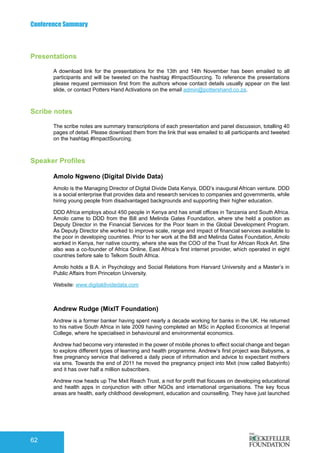
Programme - 14th November
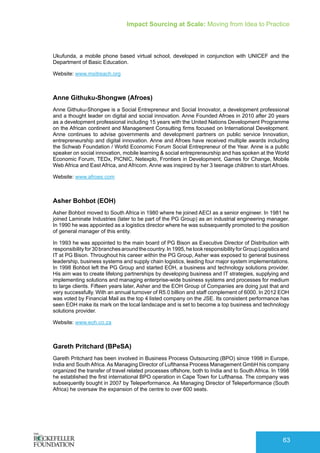
Presentations
Scribe notes
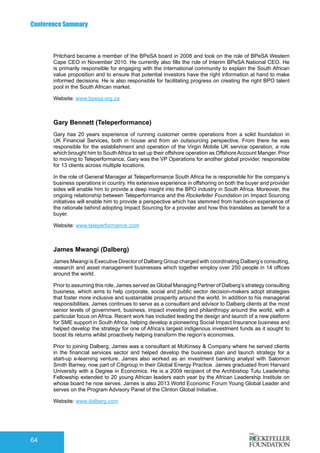
Speaker profiles
List of participating organisations
48
50
50
51
58
59
59
60
60
61
62
62
62
73
Impact Sourcing at Scale: Moving from Idea to Practice
5
Foreward
Dear Delegates,
Thank you for making the Impact Sourcing At Scale: Moving from Idea to Practice conference an
immeasurable success!
A special “thank you” to South Africa for the warm welcome! We were honored to host over 300
stakeholders from 12 countries representing the private sector, government, training institutions,
academia, philanthropy and the youth at the Polo Club in Johannesburg, South Africa.
This conference emerged as a pivotal moment for the Digital Jobs Africa initiative, an effort that seeks
to impact the lives of 1 million people in six countries in Africa by catalyzing sustainable Information
and Communications Technology (ICT) enabled employment opportunities for African youth who
would not otherwise have an opportunity for sustainable employment.
The Rockefeller Foundation was inspired by the enthusiasm of the participants and is very optimistic
about the future of Impact Sourcing. Recognizing that the most sustainable and scalable path to
achieving impact is the tangible business value which Impact Sourcing provides to the corporate
sector, we are motivated by the commitments made by corporations such as Microsoft. Through
this partnership and the others that were forged, we are confident that collectively we will be able to
harness the latent potential and “humble confidence” of our youth and ultimately accelerate viable
solutions for tackling the global youth unemployment challenge.
We are now at a tipping point so let’s seize this moment to mainstream a practice that has the ability
to not only advance business value for countless companies, but stands to create measurable impact
on the livelihoods of millions of people.
Again, I thank each of you for your contribution and commitments. I know that together we will have
an impact on the lives of our youth and the economies of our countries.
Sincerely,
Mr. Mamadou Biteye
Managing Director, Africa Regional Office
The Rockefeller Foundation
Conference Summary
6
Executive summary
The conference was the second Impact Sourcing conference hosted by the Rockefeller Foundation,
and the first since the launch of its Digital Jobs Africa initiative in May 2013.
The first Impact Sourcing Conference was hosted in Johannesburg on 5 December 2011 entitled,
“Impact Sourcing: An Emerging Path to Sustainable Job Creation?” It helped raise awareness on
Impact Sourcing, orient new role-players to the landscape and mechanics of the process, and provide
the initial impetus for people to test out the models.
By 2014, developments in Impact Sourcing had moved fast enough to warrant a conference
now focused on upscaling the early success stories and practices. Upscaling requires expanded
networks of partnerships and the conference succeeded in bringing together an international mix of
stakeholders representative of the BPO and Impact Sourcing communities, as well as governments
and international governance organisations.
Visits to Impact Sourcing Service Providers, panel discussions and questions from participants
created an environment where buyers were able to with confidence make serious commitments to
Impact Sourcing and Digital Jobs Africa, which had a ripple effect of energizing the rest of the value
chain, and vindicating the hard work of the early adopters.
The conference went beyond intellectual clarification and partner networking by showcasing the
inspirational manner in which the lives of disadvantaged youth are changed. An unscripted emotional
ingredient was present in the site visits, learner interviews and Youth Dialogue which appealed to
the participants and showed the advantage Impact Sourcing has over regular outsourcing practices.
Other than the encouraging commitments from buyers such as Microsoft (and by implication their
OEM network) and from BPO providers such as Accenture and Deloitte, the conference heard a
clear call for more formal sharing opportunities and the desire for greater coordination of the Impact
Sourcing ecosystem.
Acknowledgements
Participants
The Rockefeller Foundation wishes to acknowledge the support of multiple partners across various
countries and domains of expertise in what is now becoming a global Impact Sourcing community of
practice. Those partners who were able to physically attend the conference are listed in the Appendix,
and for those who weren’t here, we hope that this Conference Summary will brief you on the key
outcomes.
The conference convened a diverse international group of stakeholders including: outsourcing
services buyers and providers, Impact Sourcing Service Providers, industry associations, experts
on training, labor standards and certifications, funders and donors, youth representatives and
government officials. A list of participating organisations is available in the Appendix. The Narrative
Report for this event provides more detail on delegate management.
Impact Sourcing at Scale: Moving from Idea to Practice
7
Programme
The programme consisted of site visits, speeches, presentations and plenary discussions. A cocktail
evening and gala dinner on the second day of the event provided networking and socialising
opportunities and the Africa-themed entertainment provided cultural stimulation for the many
international participants.
Day 1 - November 13th
The event was held at the Inanda Polo Lounge, Johannesburg, and included role-players from the
global Impact Sourcing ecosystem.
Summary of the day
The 13th November consisted of site visits to two Impact Sourcing Service Providers, and three
plenary sessions. A cocktail and networking evening was hosted by the Digital Jobs Africa grantee
EOH and this was followed by a Gala Dinner.
Participants
Close on 300 delegates attended the 13th November and 14th November events.
Site visits
The day began with site visits to two South African Impact Sourcing Service Providers, the Impact
Sourcing Academy of the Maharishi Institute and the Harambee Youth Employment Accelerator.
Delegates were assigned to either one of the two site visits which then took place in parallel from
9 am to 12 pm. Transport by bus was provided from the conference venue to each site, and tour
facilitators at the sites welcomed the guests, introduced them to the organisations and then took
them on a brief tour of their facilities.
The site visits gave a “hands-on” experience to delegates that is seldom offered in conference and
seminar type events. Effectiveness of this item was seen in both the overwhelmingly positive guest
feedback (highest rating selected by 88% of guests), and also in the positive feedback from the
keynote speaker, Ms. Rene Yoakum of Microsoft about the Impact Sourcing service providers (Site
visit hosts).
About the Impact Sourcing Service Providers - Impact Sourcing Academy - ISA
This site is located at the 9 Ntemi Piliso Street in central Johannesburg. This was originally the Anglo
American Headquarters before it was donated to the Maharishi Institute. More detail on the site visit
is available in the scribe notes in the Appendix; a summary of the highlights is provided below.
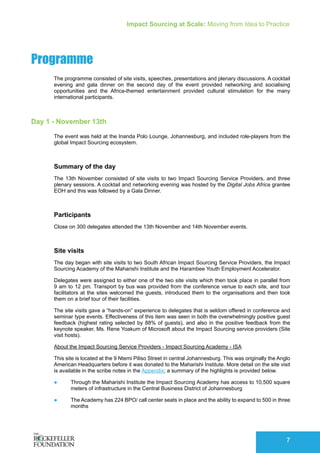
●	 Through the Maharishi Institute the Impact Sourcing Academy has access to 10,500 square
meters of infrastructure in the Central Business District of Johannesburg
●	 The Academy has 224 BPO/ call center seats in place and the ability to expand to 500 in three
months
Conference Summary
8
●	 Advanced networking infrastructure is in place to support call centre operations
●	 The Academy has 550 fully trained BPO students to draw on including 100 Monyetla Level 2
and Level 4 qualified agents
●	 The Academy runs on a “learn and earn” model which both equips the students with real work
experience relevant to their field of study, as well as providing them with income assisting
them to cover the costs of their tuition and travel.
●	 This includes a “pay it forward” system whereby graduates who find employment pay back
part of their bursaries to fund the studies of new students entering the system, with preference
for members of their extended families and communities.
Dr Taddy Blecher, CEO of the Community and Individual DevelopmentAssociation, and the Maharishi
Institute, welcomed guests and explained why they were there:
1.	 To hear the voice of the youth
2.	 To thank existing partners and celebrate
3.	 To build new partnerships and linkages
Dr Blecher celebrated the fact that they had achieved the following:
●	 14,250 graduates placed in jobs (98% placement rate) including 4,500 entrepreneurs
●	 Over R17.2 billion of broad-based share ownership value had been secured into perpetuity
for disadvantaged families
●	 70,000 lives directly and indirectly assisted through the above
●	 Students include refugees from other African countries
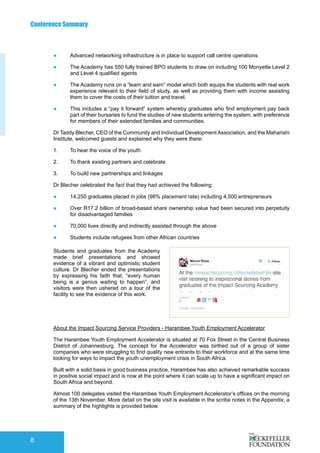
Students and graduates from the Academy
made brief presentations and showed
evidence of a vibrant and optimistic student
culture. Dr Blecher ended the presentations
by expressing his faith that, “every human
being is a genius waiting to happen”, and
visitors were then ushered on a tour of the
facility to see the evidence of this work.
About the Impact Sourcing Service Providers - Harambee Youth Employment Accelerator
The Harambee Youth Employment Accelerator is situated at 70 Fox Street in the Central Business
District of Johannesburg. The concept for the Accelerator was birthed out of a group of sister
companies who were struggling to find quality new entrants to their workforce and at the same time
looking for ways to impact the youth unemployment crisis in South Africa.
Built with a solid basis in good business practice, Harambee has also achieved remarkable success
in positive social impact and is now at the point where it can scale up to have a significant impact on
South Africa and beyond.
Almost 100 delegates visited the Harambee Youth Employment Accelerator’s offices on the morning
of the 13th November. More detail on the site visit is available in the scribe notes in the Appendix; a
summary of the highlights is provided below.
Impact Sourcing at Scale: Moving from Idea to Practice
9
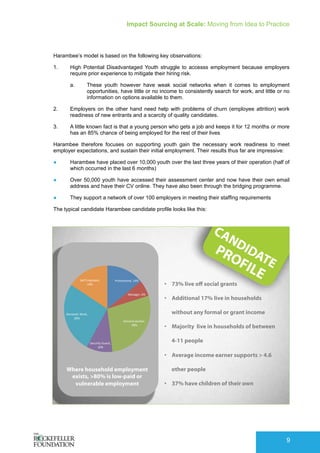
Where household employment
exists, >80% is low-paid or
vulnerable employment
Professional,	
  14%	
  
Manager,	
  6%	
  
General	
  worker,	
  
28%	
  
Security	
  Guard,	
  
10%	
  
DomesAc	
  Work,	
  
26%	
  
Self	
  Employed,	
  
16%	
   •  73% live off social grants
•  Additional 17% live in households
without any formal or grant income
•  Majority live in households of between
4-11 people
•  Average income earner supports > 4.6
other people
•  37% have children of their own
Harambee’s model is based on the following key observations:
1.	 High Potential Disadvantaged Youth struggle to accesss employment because employers
require prior experience to mitigate their hiring risk.
a.	 These youth however have weak social networks when it comes to employment
opportunities, have little or no income to consistently search for work, and little or no
information on options available to them.
2.	 Employers on the other hand need help with problems of churn (employee attrition) work
readiness of new entrants and a scarcity of quality candidates.
3.	 A little known fact is that a young person who gets a job and keeps it for 12 months or more
has an 85% chance of being employed for the rest of their lives
Harambee therefore focuses on supporting youth gain the necessary work readiness to meet
employer expectations, and sustain their initial employment. Their results thus far are impressive:
●	 Harambee have placed over 10,000 youth over the last three years of their operation (half of
which occurred in the last 6 months)
●	 Over 50,000 youth have accessed their assessment center and now have their own email
address and have their CV online. They have also been through the bridging programme.
●	 They support a network of over 100 employers in meeting their staffing requirements
The typical candidate Harambee candidate profile looks like this:
Conference Summary
10
Ms. Maryana Iskander, CEO of Harambee, welcomed the delegates and gave them a brief overview
of Harambee’s background, successes to date and plans for the future.
Ms. Iskander’s overview of Harambee was followed by conversations with a selection of candidates
who had gone through the Harambee bridging process. They spoke about the challenges that they
have faced in searching for employment, what they have learned and gained from being on the work
readiness programmes and their hopes for their futures.
Delegates then had an opportunity to tour the building and see some of the programmes in action –
the tour included a visit to the assessment center, a view of the bridging sessions and a chance to
see the Harambee call center and meet some of the staff.
Going forward, Harambee is targeting to place 100,000 youth into employment or self-employment,
over the next five years.
Opening Ceremony
Mistress of Ceremony, Ms. Pumela Salela (Founder: Source Africa) officially opened the event. She
referred back to the 2011 conference in Johannesburg: “Impact Sourcing - an emerging path to
sustainable job creation?” Much progress had been made since then, she noted, and the current
conference was now ready to talk about upscaling those successes.
Ms. Salela stressed that Impact Sourcing was a call to humanity and about doing business whilst
doing well. She said that we need to remain aware, and sometimes reminded, that the business of
business is the creation of value. Highlights of her opening included:
●	 Business aims to create profits. It aims to increase margins. Impact Sourcing does not change
the core objectives of business. The differentiator is that Impact Sourcing is where profits
meet philanthropy.
●	 Outsourcing work must be given to those communities who are poor as a means of stirring up
economic growth in the areas where they live.
●	 Governments need to come up with policies that create an enabling environment for Impact
Investing. Governments need to direct the market and industry to be socially responsible and
sustainable. Governments should encourage new activities in underserved areas.
●	 Innovative approaches should be encouraged in order to bring about a new way of doing things
and solving day-to-day problems. The government could provide direct financial support in
the form of incentives or institutional support and influence markets through laws, regulation,
policy innovation and economic development.
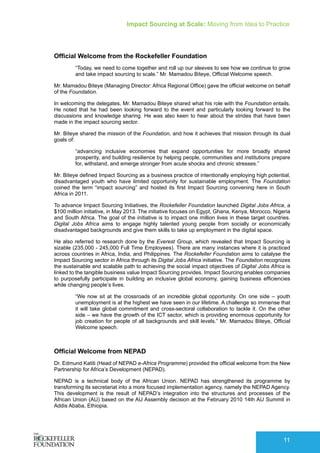
Ms. Salela welcomed everyone and
encouraged them to participate in the
discussion and share best practices in
order to grow the industry.
Impact Sourcing at Scale: Moving from Idea to Practice
11
Official Welcome from the Rockefeller Foundation
“Today, we need to come together and roll up our sleeves to see how we continue to grow
and take impact sourcing to scale.” Mr. Mamadou Biteye, Official Welcome speech.
Mr. Mamadou Biteye (Managing Director: Africa Regional Office) gave the official welcome on behalf
of the Foundation.
In welcoming the delegates, Mr. Mamadou Biteye shared what his role with the Foundation entails.
He noted that he had been looking forward to the event and particularly looking forward to the
discussions and knowledge sharing. He was also keen to hear about the strides that have been
made in the impact sourcing sector.
Mr. Biteye shared the mission of the Foundation, and how it achieves that mission through its dual
goals of:
“advancing inclusive economies that expand opportunities for more broadly shared
prosperity, and building resilience by helping people, communities and institutions prepare
for, withstand, and emerge stronger from acute shocks and chronic stresses.”
Mr. Biteye defined Impact Sourcing as a business practice of intentionally employing high potential,
disadvantaged youth who have limited opportunity for sustainable employment. The Foundation
coined the term “impact sourcing” and hosted its first Impact Sourcing convening here in South
Africa in 2011.
To advance Impact Sourcing Initiatives, the Rockefeller Foundation launched Digital Jobs Africa, a
$100 million initiative, in May 2013. The initiative focuses on Egypt, Ghana, Kenya, Morocco, Nigeria
and South Africa. The goal of the initiative is to impact one million lives in these target countries.
Digital Jobs Africa aims to engage highly talented young people from socially or economically
disadvantaged backgrounds and give them skills to take up employment in the digital space.
He also referred to research done by the Everest Group, which revealed that Impact Sourcing is
sizable (235,000 - 245,000 Full Time Employees). There are many instances where it is practiced
across countries in Africa, India, and Philippines. The Rockefeller Foundation aims to catalyse the
Impact Sourcing sector in Africa through its Digital Jobs Africa initiative. The Foundation recognizes
the sustainable and scalable path to achieving the social impact objectives of Digital Jobs Africa is
linked to the tangible business value Impact Sourcing provides. Impact Sourcing enables companies
to purposefully participate in building an inclusive global economy, gaining business efficiencies
while changing people’s lives.
“We now sit at the crossroads of an incredible global opportunity. On one side – youth
unemployment is at the highest we have seen in our lifetime. A challenge so immense that
it will take global commitment and cross-sectoral collaboration to tackle it. On the other
side – we have the growth of the ICT sector, which is providing enormous opportunity for
job creation for people of all backgrounds and skill levels.” Mr. Mamadou Biteye, Official
Welcome speech.
Official Welcome from NEPAD
Dr. Edmund Katiti (Head of NEPAD e-Africa Programme) provided the official welcome from the New
Partnership for Africa’s Development (NEPAD).
NEPAD is a technical body of the African Union. NEPAD has strengthened its programme by
transforming its secretariat into a more focused implementation agency, namely the NEPAD Agency.
This development is the result of NEPAD’s integration into the structures and processes of the
African Union (AU) based on the AU Assembly decision at the February 2010 14th AU Summit in
Addis Ababa, Ethiopia.
Conference Summary
12
Dr Katiti is also a policy and regulatory advisor at NEPAD. He noted that Africa is the youngest
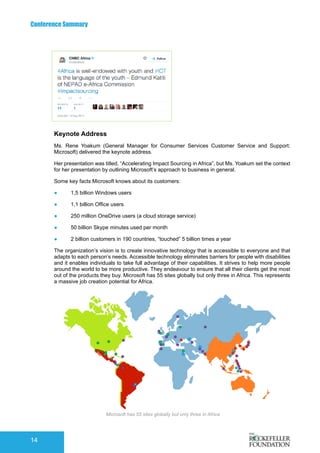
continent, and that ICT is commonly acknowledged as the language of the youth.
He applauded the Rockefeller Foundation for Digital Jobs Africa for mobilizing employers to work
with institutions that are training the youth to ensure a synergetic collaboration that will cause the
kind of impact that is required.
Dr Katiti emphasized the impact made by institutions like NEPAD and the African Union (AU) and the
need for these institutions to facilitate change in the Impact Sourcing space. He said theAfrican Union
realises that it needs to go beyond peacekeeping and security and begin working on development
programmes that are going to integrate this continent.
NEPAD’s job is to create environments to mobilize partnerships for such things to happen, and for
them to happen with the enabling power of the new technologies of the ICT sector. NEPAD launched
e-Africa Programme, which works in the area of technology to promoteAfrica as a globally competitive
digital society. The programme was previously known as the NEPAD e-Africa Commission and is
tasked with developing policies, strategies and projects at continental level for the development of
information and communication technologies (ICT) throughout Africa.
The aim of the NEPAD e-Africa Programme is to pursue cross-sector initiatives so that ICT is
entrenched in all social sectors, e-services are developed and Africa is digitally competitive.
NEPAD’s ICT Broadband Infrastructure Network for Africa is one of the key initiatives of the e-Africa
programme, which aims to:
●	 Connect all African countries to one another and to the rest of the world through existing and
planned submarine (Uhurunet) and terrestrial (Umojanet) cable systems.
●	 Integrate the continent and enable trade, social and cultural interchange to take place with
ease and affordability.
Uhurunet is being developed by Baharicom Development Company (BDC) which has signed an MoU
with ACE (Africa Coast to Europe) to jointly build a submarine cable that will extend from Europe
to South Africa, running along the West African coast, and connecting every African country along
that coast. Umojanet is a terrestrial network that will link every African country to its neighbours, will
connect to Uhurunet to realise the dream of the cross-border continental NEPAD Network.
Another key project of the e-Africa programme is the NEPAD e-Schools Initiative. The initiative aims
to harness ICT technology to improve the quality of teaching and learning in African primary and
secondary schools in order to equip youngAfricans with the knowledge and skills that will enable them
to participate confidently and effectively in the global information society and knowledge economy.
Sixteen African countries have signed MoUs with the NEPAD e-Africa Programme and a consortium
of private sector companies to participate in the NEPAD e-Schools Demo Project. To date over
80 demonstrations NEPAD e-Schools have been implemented. Each school in the demonstration
project was equipped with a computer laboratory containing at least 20 PCs as well as a server
and networking infrastructure and peripheral devices such as scanners, electronic whiteboards
and printers. The schools were connected to the Internet to enable them to access content and to
communicate with the rest of the world.
In closing Dr Katiti reiterated that effective e-learning was necessary to create the kind of impact that
is needed in Africa’s ICT space, and that this will have a direct impact on the success of initiatives
such as Digital Jobs Africa.
Impact Sourcing at Scale: Moving from Idea to Practice
13
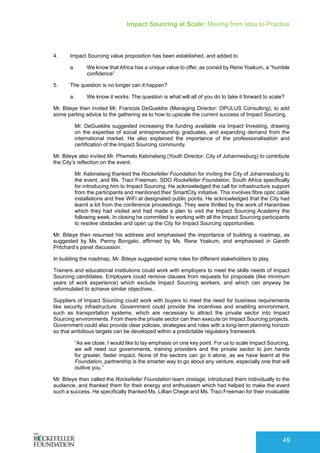
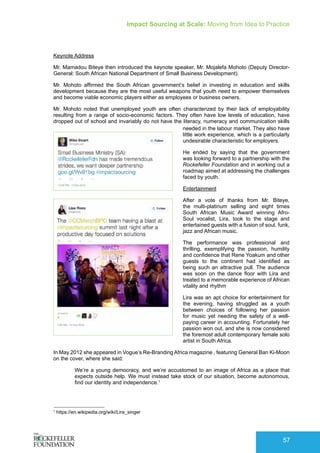
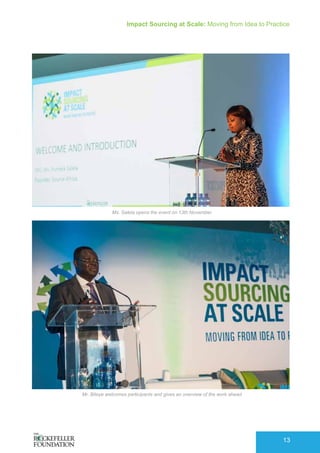
Ms. Salela opens the event on 13th November
Mr. Biteye welcomes participants and gives an overview of the work ahead
Conference Summary
14
Keynote Address
Ms. Rene Yoakum (General Manager for Consumer Services Customer Service and Support:
Microsoft) delivered the keynote address.
Her presentation was titled, “Accelerating Impact Sourcing in Africa”, but Ms. Yoakum set the context
for her presentation by outlining Microsoft’s approach to business in general.
Some key facts Microsoft knows about its customers:
●	 1,5 billion Windows users
●	 1,1 billion Office users
●	 250 million OneDrive users (a cloud storage service)
●	 50 billion Skype minutes used per month
●	 2 billion customers in 190 countries, “touched” 5 billion times a year
The organization’s vision is to create innovative technology that is accessible to everyone and that
adapts to each person’s needs. Accessible technology eliminates barriers for people with disabilities
and it enables individuals to take full advantage of their capabilities. It strives to help more people
around the world to be more productive. They endeavour to ensure that all their clients get the most
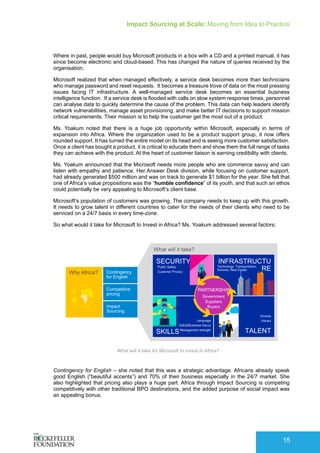
out of the products they buy. Microsoft has 55 sites globally but only three in Africa. This represents
a massive job creation potential for Africa.
TP Edinburg
Microsoft has 55 sites globally but only three in Africa
Impact Sourcing at Scale: Moving from Idea to Practice
15
Where in past, people would buy Microsoft products in a box with a CD and a printed manual, it has
since become electronic and cloud-based. This has changed the nature of queries received by the
organisation.
Microsoft realized that when managed effectively, a service desk becomes more than technicians
who manage password and reset requests. It becomes a treasure trove of data on the most pressing
issues facing IT infrastructure. A well-managed service desk becomes an essential business
intelligence function. If a service desk is flooded with calls on slow system response times, personnel
can analyse data to quickly determine the cause of the problem. This data can help leaders identify
network vulnerabilities, manage asset provisioning, and make better IT decisions to support mission
critical requirements. Their mission is to help the customer get the most out of a product.
Ms. Yoakum noted that there is a huge job opportunity within Microsoft, especially in terms of
expansion into Africa. Where the organization used to be a product support group, it now offers
rounded support. It has turned the entire model on its head and is seeing more customer satisfaction.
Once a client has bought a product, it is critical to educate them and show them the full range of tasks
they can achieve with the product. At the heart of customer liaison is earning credibility with clients.
Ms. Yoakum announced that the Microsoft needs more people who are commerce savvy and can
listen with empathy and patience. Her Answer Desk division, while focusing on customer support,
had already generated $500 million and was on track to generate $1 billion for the year. She felt that
one of Africa’s value propositions was the “humble confidence” of its youth, and that such an ethos
could potentially be very appealing to Microsoft’s client base.
Microsoft’s population of customers was growing. The company needs to keep up with this growth.
It needs to grow talent in different countries to cater for the needs of their clients who need to be
serviced on a 24/7 basis in every time-zone.
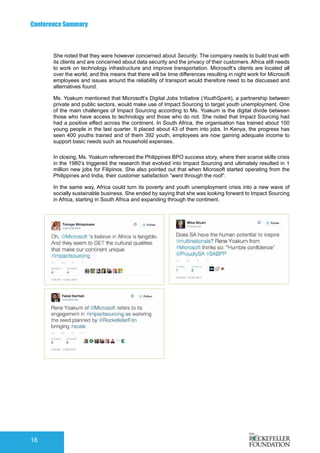
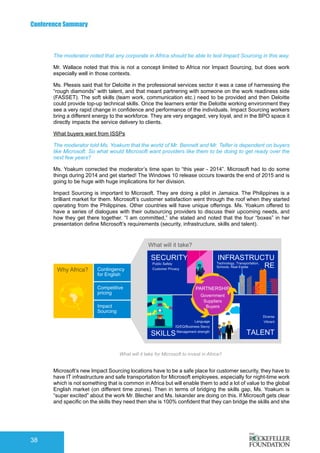
So what would it take for Microsoft to Invest in Africa? Ms. Yoakum addressed several factors:
What will it take for Microsoft to invest in Africa?
Investment
Contingency for English – she noted that this was a strategic advantage. Africans already speak
good English (“beautiful accents”) and 70% of their business especially in the 24/7 market. She
also highlighted that pricing also plays a huge part. Africa through Impact Sourcing is competing
competitively with other traditional BPO destinations, and the added purpose of social impact was
an appealing bonus.
Conference Summary
16
She noted that they were however concerned about Security. The company needs to build trust with
its clients and are concerned about data security and the privacy of their customers. Africa still needs
to work on technology infrastructure and improve transportation. Microsoft’s clients are located all
over the world, and this means that there will be time differences resulting in night work for Microsoft
employees and issues around the reliability of transport would therefore need to be discussed and
alternatives found.
Ms. Yoakum mentioned that Microsoft’s Digital Jobs Initiative (YouthSpark), a partnership between
private and public sectors, would make use of Impact Sourcing to target youth unemployment. One
of the main challenges of Impact Sourcing according to Ms. Yoakum is the digital divide between
those who have access to technology and those who do not. She noted that Impact Sourcing had
had a positive effect across the continent. In South Africa, the organisation has trained about 100
young people in the last quarter. It placed about 43 of them into jobs. In Kenya, the progress has
seen 400 youths trained and of them 392 youth, employees are now gaining adequate income to
support basic needs such as household expenses.
In closing, Ms. Yoakum referenced the Philippines BPO success story, where their scarce skills crisis
in the 1980’s triggered the research that evolved into Impact Sourcing and ultimately resulted in 1
million new jobs for Filipinos. She also pointed out that when Microsoft started operating from the
Philippines and India, their customer satisfaction “went through the roof”.
In the same way, Africa could turn its poverty and youth unemployment crisis into a new wave of
socially sustainable business. She ended by saying that she was looking forward to Impact Sourcing
in Africa, starting in South Africa and expanding through the continent.
Impact Sourcing at Scale: Moving from Idea to Practice
17
Impact Sourcing Reimagined: Impact Sourcing and Digital Jobs Africa
overview
Mr. Mamadou Biteye (Managing Director: Africa Regional Office) gave presentation covering the
following:
●	 Digital Jobs Africa Overview
●	 Impact Sourcing Overview
●	 Rockefeller Foundation’s Role in Catalysing Impact Sourcing
Outlining the objectives of Impact Sourcing, Mr. Mamadou Biteye noted that global youth
unemployment has become the primary focus of governments across the African continent. Nowhere
has this issue become more pressing than in Africa, a continent with the youngest population in the
world of nearly 200 million people between the ages of 15 and 24. It is estimated that by 2045 this
number will have doubled.
Digital Jobs Africa is looking at addressing the issue of youth unemployment and skills development.
The initiative aims to engage highly talented young people from socially or economically disadvantaged
backgrounds. Many of whom will have completed high school but are still unable to get a job. The
initiative aims to impact 1 million lives across six countries in Africa by catalysing employment
opportunities and skills development for disadvantaged African youth with high potential, thereby
generating social and economic opportunities for their families and communities.
Impact Sourcing is a business practice of intentionally employing high potential, disadvantaged youth
who have limited opportunity for sustainable employment. Mr. Biteye emphasized the need to create
an enabling environment for this. He noted that a range of services that are relevant to Impact
Sourcing were needed, way beyond the initial call center operations focus. These services have
increased to now include:
●	 Supply chain management services such as:
-- Document digitisation
-- Data entry
Ms. Yoakum (Microsoft) talking on ‘Accelerating Impact Sourcing in Africa’
Conference Summary
18
●	 Sales & marketing services such as:
-- Sales data capture and visualisation
-- Telemarketing
-- Document digitisation
-- Content conversion, editing and tagging
●	 Finance & accounting
-- OCR image validation
-- Invoice data entry
-- Invoice indexing
●	 Customer service
-- Voice support
-- Web design
-- Helpdesk
●	 Human resources services such as:
-- Document scanning and digitisation
-- Data entry
-- On-line
The changes brought about by mobile connectivity, which has connected Africans in completely
different ways, has reduced the distance and divides between urban and rural centres. It has
transformed the way people do business, particularly in the financial transfers sector, with innovations
such as M-PESA.
Digital technology has created many opportunities today in Africa and in many sectors; and is
continuing to create more opportunities. Ten years ago, M-PESA didn’t exist; today many hundreds
of thousands of Africans live off M-PESA transfers. That has been transformative. He added that it
might even continue to create types of jobs that the current generations haven’t even thought of.
While a lot of Impact Sourcing activity happens in emerging markets, it is a global opportunity. Buyers
and providers have the opportunity to make an impact on people in need of employment, while also
positively influencing their business objectives.
Mr. Biteye shared with the delegates three forms of Impact Sourcing models:
●	 Model A - Pure Impact Sourcing Service Providers (ISSPs)
-- A buyer makes use of an ISSP to directly hire trained, disadvantaged youth with high
potential
●	 Model B - Mainstream ISSPs
-- A buyer makes use of traditional BPO providers which has a social mission to hire
disadvantaged youth with high potential
Impact Sourcing at Scale: Moving from Idea to Practice
19
●	 Model C – Sub-contracting ISSPs
-- In mature outsourcing markets, buyers contract traditional BPO providers who in turn
sub-contract to ISSPs
The Rockefeller Foundation’s role in Africa was to support:
1.	 The training and placement of youth in companies
2.	 Impact oriented business models
3.	 Improvements in the business environments in countries to help make them attractive
destinations for outsourcing
Its role globally is to support the development of tools and resources that will make it easier for
business to adopt the Impact Sourcing model, such as:
●	 Industry measurements for companies to track and report on their Impact Sourcing activity,
and
●	 Consultants and advisors to work with companies to help them make the transition to Impact
Sourcing
Mr. Biteye concluded that Impact Sourcing provides a holistic approach to create business value
and affect the lives of the poor and vulnerable by allowing them to earn an income, enabling them
to improve their lives and the lives of their families and communities. For governments around the
world, Impact Sourcing takes advantage of business imperatives to expand the supply of labour
while simultaneously providing large-scale skills development to the ICT sector and employment
for poor and vulnerable people. With the endorsement and backing of governments, buyers and
suppliers of services have an opportunity to implement a sustainable, socially responsible sourcing
model at an affordable price.
He also reiterated that Impact Sourcing is fostering a business model that is a classic win-win — it’s
a good business practice that is socially responsible.
Impact Sourcing Value Proposition
Mr. Shyan Mukerjee (Vice President: Global Sourcing, Everest Group) presented on the business
case for Impact Sourcing within BPO.
This was based on the findings of research that the Everest Group, supported by the Rockefeller
Foundation, had conducted. The research was an in-depth assessment on Impact Sourcing (IS) as
a business process service delivery construct. The study presents a detailed, fact-based business
case for Impact Sourcing that substantiates its benefits for Business Process Outsourcing (BPO).
The Everest Group’s definition of Impact Sourcing is, “a business process service delivery model that
provides quality and cost at parity with traditional BPO services, but with optimized enhancements
such as:
●	 A qualified, trained, untapped talent pool with skillsets aligned to match client needs;
●	 Lower attrition rates and higher corresponding levels of employee engagement; and
●	 Opportunities to fulfil corporate social responsibility and diversity objectives while operating
within a traditional BPO framework.
Conference Summary
20
With increased focus on shared value, inclusive of business and corporate social responsibility,
business are looking for both financial return and social impact in their own practices and in those of
their supply chain. Impact Sourcing creates business benefits such as:
●	 Costs and performance comparable to traditional BPO
●	 Attrition rate 15-40% lower and stronger employee engagement
●	 Where applicable, provides greater access to local markets and culture which can enable
business opportunities.
Impact Sourcing also helps impact sourcing workers who are:
●	 Economically disadvantaged: low income areas, lack of access to jobs
●	 Socially disadvantaged: minorities and gender groups
●	 Persons with disadvantageous life circumstances: disabled, health limitations
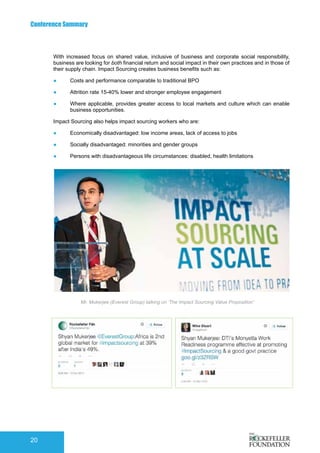
Mr. Mukerjee (Everest Group) talking on ‘The Impact Sourcing Value Proposition’
Impact Sourcing at Scale: Moving from Idea to Practice
21
Research has shown an increase in income of between 40% and 200% which benefits 3 to 4 family
members. As a result, whole communities are strengthened.
There are four segments of companies using IS:
●	 Captive buyers such as Metropolitan Health, Microsoft, First Rand Bank, Standard Bank and
Valeo
●	 Traditional BPOs such as Aegis, Fullcircle, Infosys, Serco and Teleperformance
●	 Impact Sourcing Service Providers such as Cloudfactory, DDD, Head Held High and
Samasource
●	 Training Providers such as Careerbox, Harambee and Impact Sourcing Academy.
The value of Impact Sourcing is business process service delivery but with optimized enhancements.
The enhancements include:
●	 Low costs
-- Significant cost savings (70%+) over source locations in US and UK
-- Costs comparable or lower than traditional BPOs
●	 Proven, reliable service delivery
-- Performance comparable to traditional BPOs
-- Track record of meeting client Service Level Agreements / Key Performance Indicators
and expectations
●	 Large and untapped talent pool
-- An alternative to supplement the traditional talent pool
-- Vernacular language capabilities
●	 Stable and engaged workforce
-- Lower attrition than traditional BPO employees
-- Motivated workforce
●	 Social Impact
-- Direct impact (individuals, families)
-- Indirect impact (communities, support services, local economy)
When Everest was conducting their research they found that Impact Sourcing offers significant
cost savings over source locations for offshore BPO. At 70%, this saving is comparable or lower
than the savings offered by traditional offshoring. When compared to traditional sourcing, Impact
Sourcing offers savings across both in-house employment and outsourcing models. In South Africa
for example, the cost for impact workers are 8-10% lower than traditional workers when averaged
over a three year period for in-house employment. In India, impact Sourcing offers a 35%-40%
savings as compared to traditional BPO in an outsourced model. The costs for additional savings
however vary by location.
The group’s research showed a proven and reliable delivery service by Impact Source workers. The
research showed that the performance achieved from Impact Sourcing is comparable to traditional
Conference Summary
22
BPOs with a robust record of accomplishment of meeting client Service Level Agreements / Key
Performance Indicators and expectations. The evidence can be seen in multiple examples as
illustrated in the case studies of Teleperformance, Accenture, Rural Shores, and Sure Hire.
Furthermore, companies have successfully mitigated the concerns such as lack of talent, data
security and infrastructure linked to service delivery of using Impact Sourcing by focusing on skills
development initiatives and replicating security infrastructure similar to traditional sourcing. In this
regard, Aegis SA provides a 12-16 week training program for impact workers that teach basic office
competencies and behavioural skills.
There are several training institutions (Impact Sourcing Academy, Harambee, Careerbox, Piramal
Udgam) that focus on developing skills-sets of impact workers. On the other hand, Rural Shores
have implemented a robust infrastructure to mitigate concerns on data security.
Given that most locations in Africa (South Africa, Kenya, Nigeria, Egypt, Ghana, Morocco) and Asia
(India and Philippines) where Impact Sourcing is largely used have a high unemployment rate among
the youth, Impact Sourcing provides an opportunity to access this large, untapped qualified pool. For
example, there are over 155,000 unemployed graduates in South Africa. Over 35% graduate youth
(age 15-29 years) in rural India are unemployed. Through Impact Sourcing companies can tap into
this alternate pool to augment talent supply. For example, Impact Sourcing has become TCS’ primary
source for entry-level talent during non-campus-hiring season and enables extending its recruitment
throughout the year. A detailed case study on TCS illustrates this in greater detail and provides
insights on its outcome.
This talent pool is especially suited to serve the domestic market. Companies leverage this talent
pool as a source of competitive advantage for domestic service delivery, given local language
capabilities and cost arbitrage. For example, Rural Shores uses Impact Sourcing for vernacular
language support for domestic market.
One of the strongest elements of Impact Sourcing value proposition is the stability and motivation
level associated with impact workers. According to Everest’s research, impact workers have 15-40%
lower attrition than traditional BPO workers and exhibit high motivation levels that lead to improved
performance over a period of time and lower hiring and training costs. Mr. Mukerjee revealed that
a study by Careerbox comparing the performance of impact workers with traditional workers shows
about 10% higher retention for impact workers measured after 90 days and 180 days of recruitment.
The lower attrition rates are driven by the strong emotional bond and loyalty towards the employer
that helped educate, train and provide employment to the disadvantaged worker. In addition, impact
sourcing provides a strong fit with personal/family aspirations (e.g., opportunity to work in local
community without migrating to urban centres). Furthermore, for most impact workers BPO is a
preferred career option compared to alternatives (e.g. agricultural, industrial labour), as it offers
higher salaries and better work environment.
These four value proposition elements – low cost, reliable delivery, access to alternate talent, and
stable workforce – are built around a fifth one, social impact. He stressed that value proposition for
Impact Sourcing exists because of the types of employees hired. Impact Sourcing employees have
high potential but are disadvantaged economically, socially or some other way. For example, they
may come from a low-income area or not have had the opportunity for a university education. Impact
sourcing offers these types of people an opportunity to earn and build transferable workplace skills.
As a result, employees improve their well-being, and the well-being of their families and communities.
For Impact Sourcing to scale, it has to make business sense, which it does, because it offers a unique
proposition relative to traditional BPO. This is anchored on attractive costs, comparable performance,
access to an untapped talent pool, and the opportunity to create substantial social impact. Impact
Impact Sourcing at Scale: Moving from Idea to Practice
23
Sourcing can play multiple roles in the global sourcing portfolios of companies, for example: enable
further optimization in global delivery, provide competitive advantage in domestic sourcing, provide
geographic diversification, and help achieve CSR objectives.
There are multiple roles that Impact Sourcing can play in the global sourcing portfolios of buyers and
BPOs:
●	 Enable further optimization in global service delivery
-- Achieve lower costs
-- Absorb demand fluctuation and provide flexibility
-- Free up internal bandwidth for higher order work
●	 Competitive advantage in domestic sourcing
-- Access large untapped talent pool with vernacular skills
-- Support global companies entry into domestic markets
●	 Provides geographic diversification
-- Enable country diversification
-- Enable diversification within a country
-- Support entry into new business markets in developing world.
●	 Helps achieve Corporate Social Responsibility (CSR) objectives
-- Achieve supplier diversity
-- Create employment for disadvantaged communities
-- Help improve CSR objectives
Mr. Mukerjee concluded that Impact sourcing really is a win-win with tangible positive impact on
business and on people. The combined value proposition of Impact Sourcing is compelling, especially
for certain types of BPO work.
Additional slides and Impact Sourcing benefit overview is covered in the Appendix along with
transcription.
Conference Summary
24
Concluding Remarks
In concluding day one’s proceedings Mr.
Mamadou Biteye thanked all the speakers
for their contribution and participation. He
noted that infrastructure development, as
an issue raised by most speakers, was
important. It was also a catalyst needed to
scale Impact Sourcing in Africa. He noted
that people cannot widely promote online
work if many villages are not online and do
not have electricity.
The Mistress of Ceremonies, Ms. Pumela
Salela, read an inspiring poem as a send-
off, which was a high note to end the day
on.


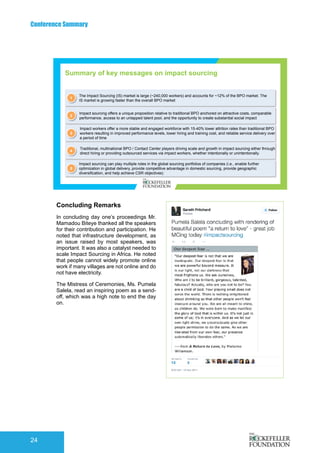
1
The Impact Sourcing (IS) market is large (~240,000 workers) and accounts for ~12% of the BPO market. The
IS market is growing faster than the overall BPO market
2
Impact sourcing offers a unique proposition relative to traditional BPO anchored on attractive costs, comparable
performance, access to an untapped talent pool, and the opportunity to create substantial social impact
3
Impact workers offer a more stable and engaged workforce with 15-40% lower attrition rates than traditional BPO
workers resulting in improved performance levels, lower hiring and training cost, and reliable service delivery over
a period of time
5
Impact sourcing can play multiple roles in the global sourcing portfolios of companies (i.e., enable further
optimization in global delivery, provide competitive advantage in domestic sourcing, provide geographic
diversification, and help achieve CSR objectives)
4
Traditional, multinational BPO / Contact Center players driving scale and growth in impact sourcing either through
direct hiring or providing outsourced services via impact workers, whether intentionally or unintentionally.
Summary of key messages on impact sourcing
Impact Sourcing at Scale: Moving from Idea to Practice
25
Day 2 - November 14th
Welcome: Impact Sourcing - the
opportunity revisited
Ms. Maryana Iskander (CEO: Harambee
Youth Employment Accelerator) was the
Mistress of Ceremony. She introduced
herself and summarised the previous’ days
discussions.
Ms. Iskander noted that a lot of time was
spent in trying to persuade the private sector
as to the value of Impact Sourcing , and so
for many it would have been a real treat to
have a keynote speaker Rene Yoakum from
Microsoft, who in short “totally gets it.”
She highlighted the following from Ms. Yoakum’s presentation:
●	 Africa has an incredible value proposition globally
●	 The African continent has empathy, good listening skills and “humble confidence”
She commented on the Rockefeller Foundation’s role, that it takes quite seriously its power as
influencer and its ability to convene different stakeholders, and we could see the result of this at this
event.
Reflecting on Mr. Shayne Mukerjee’s presentation, Ms. Iskander said that it offered clarity on the value
proposition for Impact Sourcing and strengthened the business case required to scale it beyond the
realm of simple social responsibility. She also expressed gratitude for the voices of the youth which
were heard during the Youth Dialogue panel the previous evening, and which helped ground a lot of
the intellectual concepts in an emotional reality.
Ms. Iskander outlined the program for the day and noted that it was going to focus on the practice of
Impact Sourcing, including the challenges and conflicts.
“Seed of the Day” - Africa: Delivering Greater Value
The Honorable Mr. Edward Ato Sarpong (Deputy Minister of Communications: Ghana) spoke about
the growing need to connect Africa’s populations and to bring technology closer to those that do not
have access to it.
Mr. Sarpong talked about the invention in 1858 of the first transatlantic cable which the president
of the United States of America at the time described as, “a fantastic instrument which will diffuse
religion, civilisation, liberty and law throughout the world.”
Centuries later, the internet is achieving this result in a far more profound way than the telegraph ever
could, and technology has changed everything that we do.
Mr. Sarpong then discussed how Africa was sharing in and advancing these technological shifts.
For example in 1992 Ayisi Makatiani, then studying at MIT, started a company known then as Africa
Online. It was the first internet service provider to start operations in Kenya. From there it moved into
Ghana, Cote d’Ivoire, Tanzania, Uganda, Zimbabwe, and had some footprint in South Africa. That
company was later bought by Telkom South Africa.
Conference Summary
26
Mr. Sarpong described the work of Nigerian entrepreneur and philanthropist, Mike Adenuga, who is
personally financing the connection of West Africa via fibre optic submarine cables.
Mr. Sarpong’s presentation commented on how technology makes a huge difference in the lives of
people. Statistics show that over 400 million people in Africa live under the poverty line but technology
can improve these people’s lives. Technology opens opportunities and provides people with access
to information which can lead to job and employment opportunities, which is why Africans are often
so passionate about advancing technology.
In Ghana and in other African countries the Rockefeller Foundation has been instrumental in helping
touch the lives of people at the “bottom of the pyramid”. A rich man once told Dr. Sarpong that the
wealth is always at the bottom of the pyramid, that one cent earned from each of the millions of
people at the bottom of the pyramid is the key to wealth with meaningful success.
Mr. Sarpong described the story of a young entrepreneur in Nigeria whom he had met two weeks
prior, in a very poor suburb. The entrepreneur is building an online library for his community to bring
knowledge to those who often have only one book for every nine people, whereas in developed
countries each person has on average nine books.
Mr. Sarpong acknowledged the role of organizations like the Rockefeller Foundation in moving Africa
to where it is today and expressed excitement at the new partnerships that were opening up, not only
alone but with other donors and other institutions represented at the Impact Sourcing event.
“Where growth is, is in Africa.” Africa is growing at an average of 5,8% annually, he said. Most
organizations are looking to Africa for growth, because 80% of a continent living below the poverty
line is a huge opportunity for development.
Mr. Sarpong mentioned that Ghana now has six mobile operators. The country once had a monopoly
owned by the state. Ghana however realized that for it to grow it needed to deregulate the environment.
The country now has 29 million subscribers, 13 million of which are using their devices for mobile
internet services. Moving from an internet penetration of 1% a few years ago to close to 50% now,
has huge implications for business growth. Five international fibre optics cables now land in Ghana,
but only 9% of it is being used, again showing space for huge growth.
Ghana however is struggling to get economic growth to reach people at the “bottom of the pyramid”,
which is what makes the Digital Jobs Africa initiative so important there.
Other Ghanaian technology initiatives mentioned by Sarpong include:
●	 the e-School initiative to broadcast lessons by the best teachers in the country to the
approximately 75,000 Ghanaian high school students
●	 the e-Health initiative will use satellite technology to broadcast expensive medical expertise
into remote communities that could not otherwise afford local specialists
●	 e-Parliament will speed up regulatory and legislative processes that will make government in
Ghana more efficient
●	 e-Fishing is helping small scale fisher people to become more efficient at meeting local
community nutritional needs
In conclusion Mr. Sarpong called for new partnerships with Ghana to support its development and
expressed the hope that the audience would in the future look back and see that together, we have
been able to move 600 billion people out of poverty.
Impact Sourcing at Scale: Moving from Idea to Practice
27
From Legislation to Implementation: The Role of Government
This was a panel discussion with Ms. Maryana Iskander as the Moderator. The panelists were:
●	 Honorable Mr. Edward Ato Sarpong (Deputy Minister of Communications: Government of
Ghana)
●	 Ms. Najwah Allie-Edries (Head of Employment & Social Security: Jobs Fund, South Africa)
●	 Ms. Mavis Ampah (Lead ICT Policy Specialist for Global ICT: World Bank)
●	 Dr. Edmund Katiti (Head of NEPAD e-Africa Programme) joined the panel at the invitation of
the moderator
Ms. Maryana Iskander opened the discussion by asking Ms. Allie-Edries to introduce herself and
explain the work of the Jobs Fund.
The Jobs Fund
Ms. Allie-Edries is responsible for the Jobs Fund which was launched in 2011 with an amount of
R9 billion allocated over a three year period, towards job creation projects. The size of the Fund
provides an indication of the South African government’s seriousness in investing in new ideas
for job creation. South Africa has an exceptionally high unemployment rate. The objective of the
Jobs Fund is to co-finance projects by public, private and non-governmental organizations that will
significantly contribute to job creation. This involves the use of public money to catalyse innovation
and investment on behalf of a range of economic stakeholders in activities that contribute directly to
employment creation in South Africa. It also results in improvements to government policy making
based on the experience of successful projects.
The Fund runs on “challenge-financing” principles, where the best and most audacious ideas for job
creation are financed through shared risk with government, to lower cost barriers associated with
innovation. There are four funding windows:
1.	 Infrastructure development
2.	 Enterprise development
3.	 Support for work seekers, and
4.	 Institutional capacity building
The funds are allocated by an independent committee based on transparent criteria. The Fund
realises the need for unique inputs from diverse stakeholders.
Ms. Allie-Edries discussed how much funding had specifically been allocated to job creation in the
ICT sector, and discussed ICT specific job creation projects. She admitted that the amounts allocated
to date were small (R410 million), but said this was due to the lack of workable projects that had
been brought to them for consideration. She encouraged the audience to approach the Fund with
proposals linked to Impact Sourcing and Digital Jobs Africa.
The World Bank
Next Ms. Ampah introduced herself and her work at the World Bank, where she is the lead ICT
Policy Specialist and also the regional coordinator for Africa. The World Bank takes a global view of
ICT challenges and looks for possible growth opportunities and sectors. It uses the potential of the
internet to address its current goal of shared prosperity. The Bank’s research has shown that for at
least every 10% growth in penetration in broadband leads to 0.2% -1.5% GDP growth. The potential
contribution of the internet to GDP in Africa is about $300 billion by 2025. Online Work is only about
Conference Summary
28
$1,9 billion out of this total, yet it will create about 30 million jobs. Africa has about 600 million cell
phones, a considerable proportion of its 1,1 billion population.
However there are still major challenges ahead: only 20% of Africans have access to internet,
and less than 1% have access to broadband internet. The World Bank is therefore focusing on
stimulating demand as a key priority. Even existing ICT infrastructure is significantly underutilized at
the moment. The ICT unit of the Bank alone has spent about $1,1 billion over the last ten years to
bring in international fibre optics cables, especially to fragile countries that were missing out on ICT
development.
Challenges remain at the national level to ensure that broadband coming in is being used to create
jobs and reach the disadvantaged. Ms. Ampah cited the Kenyan example where government has
lead the way in ICT through e-Government digitization initiatives which directly created 2,000 jobs.
Over 20 million archived government records have been identified for digitization in other West
African countries.
Ms. Ampah feels the biggest challenge is equipping youth to be able to capitalize on the new digital
opportunities, which is why the World Bank was so interested in seeing what comes out of the Impact
Sourcing at Scale conference. Ms. Ampah stated that the visit to Harambee on Day 1 was an eye-
opener as to what is possible.
The moderator asked the Deputy Minister of Ghana to share with the audience what the country was
focusing on regarding technology advances and which opportunities would yield the greatest impact.
Ghana
The Ghanaian government believes that if it were to create jobs for the youth there will be peace and
stability within the economy and that would present an opportunity for businesses to thrive. A host of
e-initiatives are underway to support job creation for disadvantaged youth while also supporting the
development of the national ICT infrastructure.
The differing roles of the public and private sector
The moderator noted that the R9 billion allocated to the Jobs Fund could be allocated directly to the
private sector to create jobs and feed families, and asked Ms. Allie-Edries what her view on such an
approach was.
Ms. Allie-Edries felt that government should lead the process, as it is responsible to its electorate to
do so, although the private sector is a key partner. When the Fund started, Ms. Allie-Edries thought
they would be overwhelmed with requests by the private sector, but this did not happen. The Fund
had to actively build a strong project pipeline. The Fund managers were surprized how little interest
the private sector showed in innovative job creation projects.
Ms. Allie-Edries felt there was a need to narrow the trust deficit between government and business to
make this a more effective partnership. She stated that the Jobs Fund does not intend to tackle these
long-term, structural causes of low growth and unemployment on its own. Numerous government
initiatives are already tackling this challenge. The Jobs Fund does not aim to replicate or substitute
these initiatives; rather it complements them. These funding interventions will seek to overcome
some of the barriers to job creation identified. Some of these relate to demand for labour, some to
the supply of labour and some to the broader institutional environment.
The Jobs Fund was designed specifically to overcome these barriers by providing public funding
through four “funding windows”:
1.	 Enterprise Development
2.	 Infrastructure Investment
Impact Sourcing at Scale: Moving from Idea to Practice
29
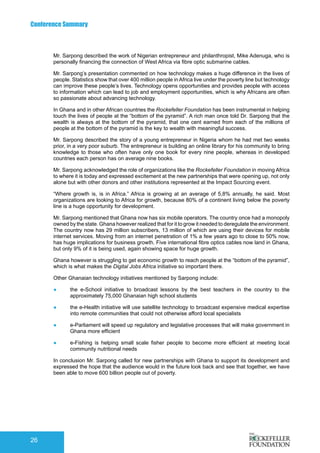
Ms. Iskander introduces her panel discussion
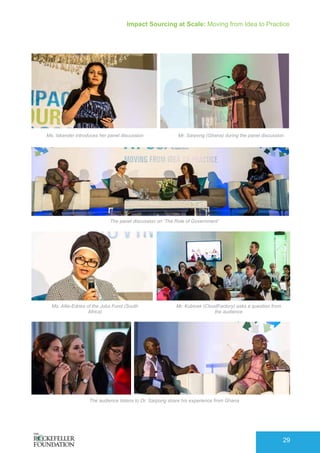
Ms. Allie-Edries of the Jobs Fund (South
Africa)
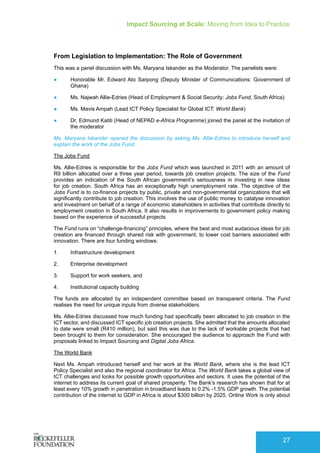
Mr. Sarpong (Ghana) during the panel discussion
Mr. Kubicek (CloudFactory) asks a question from
the audience
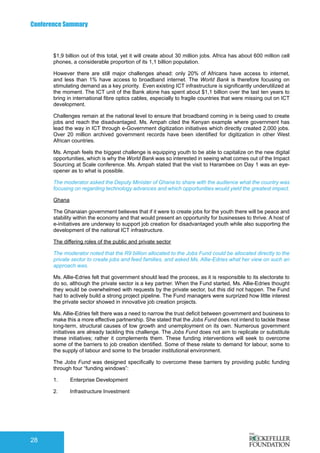
The panel discussion on ‘The Role of Government’
The audience listens to Dr. Sarpong share his experience from Ghana
Conference Summary
30
3.	 Support for Work Seekers, and
4.	 Institutional Capacity Building
Within the four identified broad windows, the Jobs Fund seeks to stimulate good ideas, risk-taking
and investment to discover new ways of working, where the costs and risks may be unknown, and
where the pro-poor impact, principally in the form of sustainable job creation, may be significantly
larger than with conventional approaches.
At its core, the Jobs Fund seeks to operate as a catalyst for innovation and investment in activities that
directly contribute to sustainable job creation initiatives, as well as long-term employment creation.
The need for clear government strategies and targets
The moderator asked what the view of the World Bank was regarding overcoming the challenges and
accessing opportunities in ICT for Africa?
Ms. Ampah felt that there were many trust issues that need to be dealt with. The World Bank has
protracted processes to access finance which it acknowledges are part of the problem. If there is
a clear strategy from the government’s side to set the agenda and set measurable targets, then
it makes it easier for the Bank to understand and respect the goals. Instead governments often
approach the Bank on an ad hoc basis, which makes it more difficult to finance. Having clear bold
targets, like Digital Jobs Africa’s one million people target and having the whole value chain present
in the decision making process, as the Foundation was doing at this conference, was a model for
governments to follow.
The importance of community information centers and privatization
The moderator asked Mr. Sarpong to articulate the one government influenced opportunity which he
believed could have the biggest impact in furthering Impact Sourcing.
Mr. Sarpong mentioned the importance of community Information centers which can directly impact
50 - 60 people, and indirectly affect 200 - 300 people, in each village. He also advised that targeted
privatization of the cell phone industry had been a great step forward for job creation and therefore
supporting the private sector in job creation was a very important lever.
The Digital Divide
Mr. Weale from LivityAfrica.com said it was great to hear that the Jobs Fund is open to innovative
ideas, in terms of young people in digital, but asked when can those of us with innovative ideas could
expect young people to have good, affordable access to technology to make those innovative ideas
come to life?
Ms. Allie-Edries responded that the Jobs Fund looked for those intermediaries that would allow them
to penetrate deeper. She pointed out that in the room there they had Microsoft present and there
were two projects that they are supporting Microsoft on. One involves young people who would like
to establish businesses in the ICT sector. The Jobs Fund collaborates with Microsoft which then
incubates young people in their supply chain division. Ms. Allie-Edries mentioned another project
with Microsoft which targets matric students with an interest in the ICT sector, graduating them
through an entry level programme and then connecting them with a work opportunity. She also
mentioned an ICT innovation incubator in Diepsloot (a low income area in Johannesburg, Gauteng,
South Africa) which had been established.
Career counselling
Mr. Lubner from Afrika Tikkun highlighted the problems resulting from a lack of coordination across
multiple government initiatives, where youth were not given proper career counselling. This was
resulting in youth taking job opportunities out of financial necessity rather than because of a good
match in interest and aptitude.
Impact Sourcing at Scale: Moving from Idea to Practice
31
Ms. Allie-Edries agreed with Mr. Lubner and reminded the audience that the Jobs Fund was a
supporter of the Harambee Youth Employment Accelerator because of the solutions it offered to
those specific problems. “We cannot do it alone,” she said.
The need to grow economic demand
Mr. Kubicek from Cloud Factory expressed a concern with governments changing the personal tax
regime with little warning which affects employee remuneration and made it difficult to operate. He
asked the panelists to suggest ways in which operating conditions can be made more predictable
than they often are in Africa, and how governments and institutions can help grow economic demand.
Ms. Ampah noted that banks can grow demand through lending, and most of the available funds
are subsidized. Governments have to make demands that are in line with priority areas for their
countries. The World Bank is in this regard reactive. However, Ms. Ampah said that partnering
with the Rockefeller Foundation was a great opportunity because while the World Bank had larger
resources, the Foundation was able to be more agile in deploying resources flexibly upfront that
would allow the Bank to upscale further down the line.
The role of government in creating an enabling environment
The moderator asked two of the panelists to comment on the role of government in creating an
enabling environment.
Dr. Katiti cited the recent drafting of the CISA, the Comprehensive ICT Strategy for Africa (2015 -
2025) which is now being reviewed by the private sector and civil society.
He also cited the NEPAD Smart Africa Strategy was initiated last year with the involvement of the
World Bank. It has five principles intended to put ICT at the top of national economic strategies
across the continent. It calls for African leaders to ensure information and communication technology
play a central role in socio-economic transformation, improve access to ICT and promote the role of
the private sector in ICT.
There is also a strategy to ensure access of landlocked countries to submarine fibre optic cables,
and to ensure diverse ownership of these cables. NEPAD participates at ICANN forums on behalf of
African states that are not able to participate directly. The Dot Africa Project intends to take advantage
of the new top level domains that are coming online. This will be a new way for governments to
identify that they are doing certain things at a continental level.
At the continental level, NEPAD has the e-Africa Programme, which aims to better connect the
continent through the development of broadband infrastructure and equip Africans with the necessary
skills to make use of ICTs.
Tax considerations
Mr. Sarpong mentioned that on the question of tax implications, ECOWAS, chaired by Ghana,
provides incentives for the private sector to set up businesses outside the capital cities. Ghana is
also reviewing its tax policies, planning to tax business on the bottom line rather than the top line.
Government views business as critical to the development of the economy and for taxation income.
The moderator summed up the answers from the last few questions and highlighted that trust issues
and the need for dialogue resulting in better mutual understanding, were common threads in all the
answers.
Conference Summary
32
Impact Sourcing in Practice
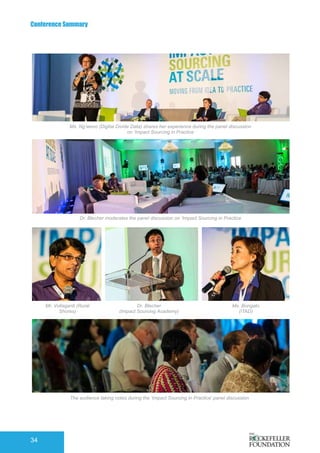
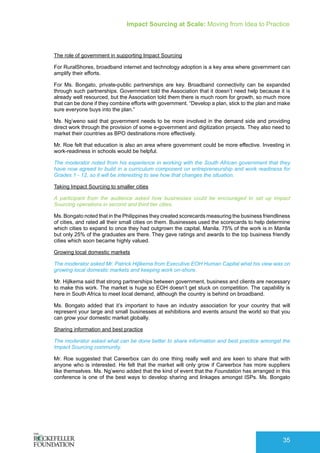
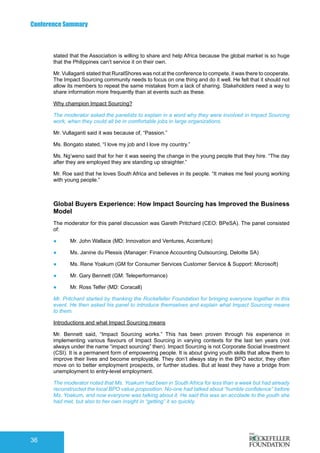
Dr. Taddy Blecher (CEO: Impact Sourcing Academy) moderated this panel discussion. The panel
members were:
●	 Mr. Martin Roe (Managing Director: Careerbox)
●	 Ms. Amolo Ng’weno (Managing Director: Digital Divide Data)
●	 Ms. Penny S. Bongato (Executive Director, Talent Development, IT & Business Process
Association Philippines)
●	 Mr. Murali Vullaganti (CEO: Rural Shores)
To start, Dr Blecher asked each panelist to introduce themselves and their work:
Ms. Bongato gave background information on the Philippines and their BPO journey. With regard to
Impact Sourcing they are approaching it from a specifically rural perspective with a goal of creating
500,000 jobs by 2016 from this sector. This reaches communities where parents will not allow their
children to leave to work or study in cities.
Ms. Ng’weno introduced Digital Divide Data (DDD), an innovative social enterprise, and one of the first
Impact Sourcing Providers, having started up about 13 years ago in Cambodia. It currently employs
about 1,000 people in its Asian offices. They have operations in Kenya, working with disadvantaged
urban youth, and are expanding into other African countries.
Their main challenge for scale is demand but they struggle to get large employers to take an interest
in sourcing from non-traditional markets (only 2,800 Impact Sourcing jobs in Kenya at the moment).
Kenya needs to put more effort into marketing the country as a BPO destination.
Mr. Vullaganti introduced RuralShores, a socio-commercial initiative dedicated to create employment
in villages in India through its mission of rural-focused Impact Sourcing. It has 20 sites across India
in tier six and seven cities and rural areas, employing 2,500 people.
There are about 60 million rural youth job seekers in India and RuralShores is targeting to assist
100,000 of them become knowledge workers. They have been constantly surprized by how creative
and skillful youth become when provided with basic training and assistance.
The social impact of the program has so far included:
●	 100% of youth now have bank accounts
●	 75% remained in rural or semi-urban areas rather than migrating to the city
●	 21% took up higher education via distance learning
●	 9% fund the education of their younger siblings
●	 75% of youth experienced a 50% increase in annual household income
Mr. Roe introduced Careerbox - a two year old ISSP based in the KwaZulu-Natal province of South
Africa. They have taken about 1,500 young, disadvantaged youth through short training programmes,
and deliver high performing contact center agents.
Impact Sourcing or low-cost work?
The moderator asked if, when they sell their work, are they selling it as Impact Sourcing or as low-
cost work?
Impact Sourcing at Scale: Moving from Idea to Practice
33
DDD sells high quality work as a pure commercial proposition. Most of DDD’s clients require workers
that can read old hand written documents. Most of the young people that the organization works
with went to English speaking schools are therefore fluent in English. The organization prides itself
in delivering quality work. When one of their larger clients discovered they were an Impact Sourcing
company it was a bonus and when they experienced a quality issue with the same client later, they
were not terminated like their competitors, but were helped in fact to take on a larger amount of work.
RuralShores initially sold “low-cost” to attract business and later on they were able to sell a value
proposition based on Impact Sourcing by demonstrating that they can deliver quality work cheaply
and responsibly. They showed a better work ethic and a much lower attrition rate than competitors
in regular outsourcing work.
What can Africa learn from the Philippines?
The moderator asked Ms. Bongato how she would advise Africa to grow its Impact Sourcing market
based on their success in the Philippines.
A key breakthrough in the Philippines was getting the support of the government. This was achieved
by demonstrating to government the value in tax income from one million jobs. Government needs
to see the difference that will be made to the electorate. It needs statistics and evidence. The Talent
Development, IT and Business Process Association Philippines partnered with various stakeholders
and funded the development of a road map on the value of Impact Sourcing. The road map also
acted as a guide with set deliverables and milestones.
The Association also used the road map to develop strategy based on feedback from employers and
universities. Where employers complained that the graduates were not work ready, the organization
investigated the gap and worked with higher learning institutions to change the curriculum and align it
with employer needs. A key breakthrough was when employers stopped complaining all the time and
worked with the educational institutions to develop a programme that they then jointly presented to
government for approval. “If you don’t get involved you have no right to complain” was a key lesson
they learned as the private sector. Without facts and research government would not have supported
them.
Scaling Impact Sourcing in Africa
The moderator asked how we scale Impact Sourcing in Africa and what does scale look like?
Mr. Roe felt that an integrated road map design is hugely important as well as events like the
Impact Sourcing at Scale conference, and the catalyst that the Rockefeller Foundation provides.
A collaborative approach of all the industries working together with government, and working with
organizations like the Rockefeller Foundation, can deliver tens of thousands of jobs. In KwaZulu-
Natal there is an opportunity to go from the 4 - 5,000 jobs to 15 - 20,000 jobs. There is a huge volume
of talented people that Careerbox can’t offer work to at the moment.
Ms. Bongato pointed out that the initial expectations for job creation in the Philippines were low but
the Association started small and built success carefully and incrementally to reach the current one
million jobs.
Growth expectations of ISSPs
DDD has about 1,500 employees worldwide and their five year objective would be to raise that to
5,000 employees.
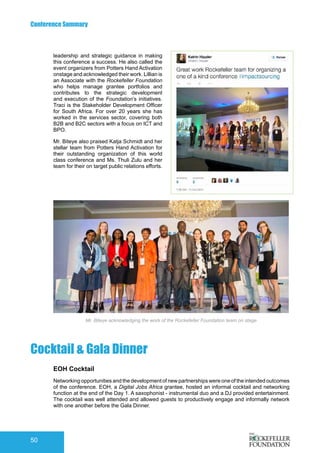
RuralShores was initially taking jobs into the rural areas from the cities. But the BPO sector in India
is now growing at 30% annually and growth is happening in the rural areas, so the supply chains are
targeting new operations for new growth in the rural areas.
Conference Summary
34
Ms. Ng’weno (Digital Divide Data) shares her experience during the panel discussion
on ‘Impact Sourcing in Practice
The audience taking notes during the ‘Impact Sourcing in Practice’ panel discussion
Dr. Blecher moderates the panel discussion on ‘Impact Sourcing in Practice
Mr. Vullaganti (Rural
Shores)
Dr. Blecher
(Impact Sourcing Academy)
Ms. Bongato
(ITAD)
Impact Sourcing at Scale: Moving from Idea to Practice
35
The role of government in supporting Impact Sourcing
For RuralShores, broadband internet and technology adoption is a key area where government can
amplify their efforts.
For Ms. Bongato, private-public partnerships are key. Broadband connectivity can be expanded
through such partnerships. Government told the Association that it doesn’t need help because it is
already well resourced, but the Association told them there is much room for growth, so much more
that can be done if they combine efforts with government. “Develop a plan, stick to the plan and make
sure everyone buys into the plan.”
Ms. Ng’weno said that government needs to be more involved in the demand side and providing
direct work through the provision of some e-government and digitization projects. They also need to
market their countries as BPO destinations more effectively.
Mr. Roe felt that education is also an area where government could be more effective. Investing in
work-readiness in schools would be helpful.
The moderator noted from his experience in working with the South African government that they
have now agreed to build in a curriculum component on entrepreneurship and work readiness for
Grades 1 - 12, so it will be interesting to see how that changes the situation.
Taking Impact Sourcing to smaller cities
A participant from the audience asked how businesses could be encouraged to set up Impact
Sourcing operations in second and third tier cities.
Ms. Bongato noted that in the Philippines they created scorecards measuring the business friendliness
of cities, and rated all their small cities on them. Businesses used the scorecards to help determine
which cities to expand to once they had outgrown the capital, Manila. 75% of the work is in Manila
but only 25% of the graduates are there. They gave ratings and awards to the top business friendly
cities which soon became highly valued.
Growing local domestic markets
The moderator asked Mr. Patrick Hijlkema from Executive EOH Human Capital what his view was on
growing local domestic markets and keeping work on-shore.
Mr. Hijlkema said that strong partnerships between government, business and clients are necessary
to make this work. The market is huge so EOH doesn’t get stuck on competition. The capability is
here in South Africa to meet local demand, although the country is behind on broadband.
Ms. Bongato added that it’s important to have an industry association for your country that will
represent your large and small businesses at exhibitions and events around the world so that you
can grow your domestic market globally.
Sharing information and best practice
The moderator asked what can be done better to share information and best practice amongst the
Impact Sourcing community.
Mr. Roe suggested that Careerbox can do one thing really well and are keen to share that with
anyone who is interested. He felt that the market will only grow if Careerbox has more suppliers
like themselves. Ms. Ng’weno added that the kind of event that the Foundation has arranged in this
conference is one of the best ways to develop sharing and linkages amongst ISPs. Ms. Bongato
Conference Summary
36
stated that the Association is willing to share and help Africa because the global market is so huge
that the Philippines can’t service it on their own.
Mr. Vullaganti stated that RuralShores was not at the conference to compete, it was there to cooperate.
The Impact Sourcing community needs to focus on one thing and do it well. He felt that it should not
allow its members to repeat the same mistakes from a lack of sharing. Stakeholders need a way to
share information more frequently than at events such as these.
Why champion Impact Sourcing?
The moderator asked the panelists to explain in a word why they were involved in Impact Sourcing
work, when they could all be in comfortable jobs in large organizations.
Mr. Vullaganti said it was because of, “Passion.”
Ms. Bongato stated, “I love my job and I love my country.”
Ms. Ng’weno said that for her it was seeing the change in the young people that they hire. “The day
after they are employed they are standing up straighter.”
Mr. Roe said that he loves South Africa and believes in its people. “It makes me feel young working
with young people.”
Global Buyers Experience: How Impact Sourcing has Improved the Business
Model
The moderator for this panel discussion was Gareth Pritchard (CEO: BPeSA). The panel consisted
of:
●	 Mr. John Wallace (MD: Innovation and Ventures, Accenture)
●	 Ms. Janine du Plessis (Manager: Finance Accounting Outsourcing, Deloitte SA)
●	 Ms. Rene Yoakum (GM for Consumer Services Customer Service & Support: Microsoft)
●	 Mr. Gary Bennett (GM: Teleperformance)
●	 Mr. Ross Telfer (MD: Coracall)
Mr. Pritchard started by thanking the Rockefeller Foundation for bringing everyone together in this
event. He then asked his panel to introduce themselves and explain what Impact Sourcing means
to them.
Introductions and what Impact Sourcing means
Mr. Bennett said, “Impact Sourcing works.” This has been proven through his experience in
implementing various flavours of Impact Sourcing in varying contexts for the last ten years (not
always under the name “impact sourcing” then). Impact Sourcing is not Corporate Social Investment
(CSI). It is a permanent form of empowering people. It is about giving youth skills that allow them to
improve their lives and become employable. They don’t always stay in the BPO sector, they often
move on to better employment prospects, or further studies. But at least they have a bridge from
unemployment to entry-level employment.
The moderator noted that Ms. Yoakum had been in South Africa for less than a week but had already
reconstructed the local BPO value proposition. No-one had talked about “humble confidence” before
Ms. Yoakum, and now everyone was talking about it. He said this was an accolade to the youth she
had met, but also to her own insight in “getting” it so quickly.
Impact Sourcing at Scale: Moving from Idea to Practice
37
Ms. Yoakum stated that her job at Microsoft was about serving customers. In order for their customers
to love Microsoft, their agents have to love them. And so it takes a certain kind of skill set from their
agents around the world to really be able to provide that kind of service. She said that she doesn’t
have any interest bigger than that. Impact Sourcing workers have a “context” unlike regular workers.
They don’t carry entitlement attitudes, they really have empathy, they have been through difficult
things in their life, and it gives them the room to care, and that care comes across the phone, across
the chat. She is in this lucky position, she said, of being able to do her job, and do good, at the same
time.
The moderator pointed out that many ISPs have a very short planning cycle and need to deliver
results immediately, whereas Rene Yoakum was talking about a ten year or twenty year plan.
Ms. Yoakum responded that her team works by quarters and yearly cycles but she needs to have a
longer vision. If the Impact Sourcing community can get together as a team and agree on a road map
on how to get there, then it will help all role-players with planning. Ms. Yoakum’s division at Microsoft
is willing to be open with their KPAs and requirements in this respect.
Ms. du Plessis introduced herself and said that Impact Sourcing primarily started as an approach
to look for diverse, low cost talent for Deloitte. Nevertheless, Deloitte soon realized that these
unemployed individuals, when trained through the Financial & Accounting Services Sector Education
& Training Authority (FASSET), are a great fit to their talent requirements for entry-level roles. Their
preparation includes a two week work readiness programme and Deloitte partnered with them for
this. Deloitte was very impressed with the quality and attitudes of the learners and have been doing
this for six years now. They currently have about 300 Impact Sourcing workers in their BPO business,
which is 10 - 12% of the workforce.
Mr. Wallace introduced himself and said that Accenture has been in the BPO industry for about 25
years. It now employs 45,000 people worldwide operating out of 50 centers, in 39 different languages
and offers a massive spectrum of BPO services.
To them Impact Sourcing makes sense on at least three levels:
●	 On a business level it’s a commercially viable proposition offered to clients
●	 On a market level it’s a good initiative in terms of employment and education
●	 On a CSI level its enables a qualitative and quantitative way to measure and account for
spending
Mr. Telfer started working in South Africa on a specific contract. When the contract finished his family
did not want to leave the country so he helped set up call center operation in Durban, KwaZulu-
Natal, and this involved outsourcing aspects of their operations. During this process Mr. Telfer met
Harambee and was very impressed with the work ready quality of their learners, something his
business could not afford to do on its own. Since then they have incorporated a skills pipeline to
Harambee and made it a permanent feature of their business.
Advice from Impact Sourcing buyers
The moderator asked the panel how they can collectively advise more buyers to adopt Impact
Sourcing so that it can be upscaled.
Mr. Wallace said that buyers or employers should take a portion of their CSI budget and use it to
fund their training and work readiness, and then integrate the same learners into their workforce.
This offers the company an opportunity to test the process and fine-tune it on a small scale before
upscaling it.
Conference Summary
38
The moderator noted that any corporate in Africa should be able to test Impact Sourcing in this way.
Mr. Wallace noted that this is not a concept limited to Africa nor Impact Sourcing, but does work
especially well in those contexts.
Ms. Plessis said that for Deloitte in the professional services sector it was a case of harnessing the
“rough diamonds” with talent, and that meant partnering with someone on the work readiness side
(FASSET). The soft skills (team work, communication etc.) need to be provided and then Deloitte
could provide top-up technical skills. Once the learners enter the Deloitte working environment they
see a very rapid change in confidence and performance of the individuals. Impact Sourcing workers
bring a different energy to the workforce. They are very engaged, very loyal, and in the BPO space it
directly impacts the service delivery to clients.
What buyers want from ISSPs
The moderator told Ms. Yoakum that the world of Mr. Bennett and Mr. Telfer is dependent on buyers
like Microsoft. So what would Microsoft want providers like them to be doing to get ready over the
next few years?
Ms. Yoakum corrected the moderator’s time span to “this year - 2014”. Microsoft had to do some
things during 2014 and get started! The Windows 10 release occurs towards the end of 2015 and is
going to be huge with huge implications for her division.
Impact Sourcing is important to Microsoft. They are doing a pilot in Jamaica. The Philippines is a
brilliant market for them. Microsoft’s customer satisfaction went through the roof when they started
operating from the Philippines. Other countries will have unique offerings. Ms. Yoakum offered to
have a series of dialogues with their outsourcing providers to discuss their upcoming needs, and
how they get there together. “I am committed,” she stated and noted that the four “boxes” in her
presentation define Microsoft’s requirements (security, infrastructure, skills and talent).
Investment
What will it take for Microsoft to invest in Africa?
Microsoft’s new Impact Sourcing locations have to be a safe place for customer security, they have to
have IT infrastructure and safe transportation for Microsoft employees, especially for night-time work
which is not something that is common in Africa but will enable them to add a lot of value to the global
English market (on different time zones). Then in terms of bridging the skills gap, Ms. Yoakum is
“super excited” about the work Mr. Blecher and Ms. Iskander are doing on this. If Microsoft gets clear
and specific on the skills they need then she is 100% confident that they can bridge the skills and she
Impact Sourcing at Scale: Moving from Idea to Practice
39
really believes this could be a great place to do business, from both an EQ and IQ perspective. Talent
and talent sourcing is something she already feels comfortable about. “I am happy with the bottom
two boxes from my presentation but we need work on the top two boxes,” she said.
A roadmap for Impact Sourcing in Africa
The moderator noted that Ms. Bongato and Ms. Yoakum had committed to the Impact Sourcing
journey. Ms. Bongato has a road map for the Philippines which she has offered to share with the
Impact Sourcing community and it would be great if she could also be part of a review board for Africa
which would enable us to adapt and tweak it.
The moderator suggested that the roadmap idea is one of the most important ones for the whole of
Africa, that everyone agree collectively on the way forward. He pointed out that at the moment there
isn’t such a thing at a government or private sector level.
Mr. Bennett added that in terms of the four boxes on security, BPOs will create the environment
that works for them, which will be different to the security requirements of Vodacom and Vodafone
[current multinational clients operating from South Africa]. The idea of a roadmap will open up greater
possibilities in meeting Microsoft’s and others’ skills needs because BPOs currently struggle with the
RFP requirements which state requirements like “two years call center experience.” Certain standard
requirements can’t currently be met in that way. However BPOs do have people who can meet the
Key Performance Indicators (KPIs) and if Impact Sourcing workers can deliver on their outputs and
KPIs it should not matter where their talent is coming from.
Transport [in Africa] is always going to be a question mark, he said. It’s an endemic issue. Cape Town
and Durban have good transport. Johannesburg is more stretched because it relies more on taxis
(public transport for the majority).
BPOs can lobby government, as they did recently in the Western Cape, to invest more in public
transport. Harambee found the cost of transport was a big demotivating factor for youth who ended
up paying most of their income to public transport every day. ISSPs could look at more operations in
township/low income areas, not necessarily rural, and other creative solutions to transport.
Mr. Bennett concluded by saying that the biggest challenge for BPOs is staffing needs which change
from hour to hour together with the need for bridging requirements for Impact Sourcing workers that
take eight weeks or more to implement. Planning is therefore key, and the roadmap will help.
Mr. Telfer agreed that the roadmap is key. Impact Sourcing workers are not ready to hit the ground
running on day one, they do require more bridging and investment but with longer-term planning, as
Microsoft is suggesting, it is do-able.
Do Impact Sourcing workers have special needs?
The moderator asked how impact workers are treated differently relative to regular workers and is
their performance managed differently.
Ms. Plessis said that at Deloitte, impact workers are not ring fenced. They have the same KPIs as the
other employees. They may take a little longer than other workers to get oriented in the first month
or so, but from then on they are on par with all our other workers. Deloitte also found that induction
also works very well. They have two types of induction, one at company level and a mini induction
at a project level.
Mr. Wallace agreed. Impact Sourcing workers are coming in at entry level jobs but they are as good
as anybody else who is coming in. They have talent and the sky’s the limit for them.
Conscious or unconscious Impact Sourcing?
The moderator asked if Impact Sourcing was something Accenture stumbled on, or if it was a
conscious track they chose?
Conference Summary
40
Ms. Guido (SmartWoman) during the panel discussion on
Workforce Engagement
The panel discussion on the Global Buyers’ Experience
A question from the audience during the Global Buyers’ Experience panel discussion
Mr. Bennett sharing his experience at Teleperformance
Mr. Pritchard (BPeSA) facilitating the panel discussion
on the Global Buyers’ Experience
Ms. du Plessis from Deloitte talking about the Global
Buyers’ Experience
Impact Sourcing at Scale: Moving from Idea to Practice
41
Mr. Wallace answered that Accenture had stumbled into it, but saw the results and made it part of
their strategy. They are now building call centers globally based on the Impact Sourcing model. He
encouraged business to consider using it because Accenture has done its homework and knows it
can work.
Ms. Plessis added that they are aware that these are entry level BPO positions and she tells
employees that she doesn’t want to see them stuck in the same position for several years. However
in Deloitte it’s easy for them to get bursaries/funding and training to take themselves on a lot further
from where they start.
Careerpathing opportunities for Impact Sourcing employees
The moderator asked about collaboration that would enable people from entry level BPO positions
such as those offered by Mr. Bennett and Mr. Telfer to be able to career path into higher level Impact
Sourcing work in organizations like Deloitte.
Ms. Plessis answered that Deloitte facilitates this by assigning every employee a counsellor who can
discuss with them how to progress on their desired career path.
Mr. Bennett added that Teleperformance has conversations with employees about what’s working and
not working, including through coaching and engagement interventions. But once Impact Sourcing
workers have the initial work experience in the entry level positions, it’s a lot easier to move them
upwards and having Impact Sourcing bridging puts them in a much better position than the person
who walks in off the street and wants a position.
Ms. Yoakum noted that contact center work is not intrinsically entry level only. She herself had started
her career in 1982 as a contact center agent and worked her way up through every level in contact
centers. Finding the strengths of people and matching those to jobs is what is needed. Not everyone
is suited to contact center work.
The moderator summed up by suggesting that they need to do a better job of explaining to the youth
the wide range of options in Impact Sourcing. Youth see a dead-end job whereas there is a whole
range of opportunities out there.
He also said that in the domestic markets in Africa they can do a whole lot more in explaining Impact
Sourcing and how it works. On an international level there is a lot that needs to be done to make
sure that they cover those four points that Ms. Yoakum mentioned (security, infrastructure, skills and
talent) in order to attract more companies. Also central to this work is the roadmap concept, which is
homework that needs to be done at a continental level and then at a country level. Africa is maybe 10
years behind the Philippines and 20 years behind India, so there is catching up to do.
Opportunities for small Impact Sourcing Service Providers
A small Impact Sourcing Service Provider asked how they could break into the bigger tier one markets
being discussed at the event.
Ms. Yoakum answered by saying that Microsoft had recently reduced numbers from 40 - 50 providers
in about 300 sites across the world to essentially 5 providers across 50 sites. This was so that they
could give a more consistent experience to their customers, and reduce their management load.
However Microsoft acknowledges the benefit of diversity in their supply chain as well, as different
providers bring different strengths, so there is a balance to be struck.
Mr. Telfer pointed out that Coracall is a relatively small provider (200 - 300 seats). They had a
business development team working hard to grow their market share. Some buyers like Microsoft
prefer to work with a small boutique of providers as their strategy. Coracall started with two clients
and now have ten and are growing so fast that they have passed on leads to smaller organizations
Conference Summary
42
more suitable for them. In KwaZulu-Natal, South Africa, the industry has started to come together
and act a bit more maturely. He offered to put the questioner in touch with providers who could help
them.
Mr. Bennett agreed that it is difficult for small ISSPs to grow. Teleperformance is too large to take
on small projects (4 - 50 seaters) so they have a relationship with smaller providers to pass leads
to them for small projects. They also offer consulting services to smaller providers to help them
take Teleperformance’s experience and grow their businesses. It’s part of their Black Economic
Empowerment spend and enterprise development.
Will Impact Sourcing be second nature in 2020?
The Upfront Foundation stated from the audience that the dialogue sounded very positive and did
this mean that Impact Sourcing would be second nature in 2020?
Mr. Bennett agreed that it would be, based on his experience in the Western Cape. Teleperformance
has a limited talent pool and BPOs there can’t all keep poaching from each other so by necessity they
have to start growing the talent pool.
The moderator noted that by breaking the targets up into ten Impact Sourcing workers per company,
like Mr. Wallace suggested, the overall scale targets could be made more achievable. And if people
are not ambitious like Ms. Bongato, they don’t achieve the kind of outcomes they have achieved in
the Philippines, where Convergys now has about 40,000 seats.
Mr. Telfer noted that Careerbox started out of necessity with Impact Sourcing because it was fishing
out of the same small talent pool as other BPOs, but now what they have discovered out of experience
is that the Impact Sourcing workers perform better than the people they “poach”. They only now
recruit “experienced” workers (non-Impact Sourcing), when the client insists on it and they are under
contractual obligation to do so.
Translating Impact Sourcing from a leadership level to ground level
Ms. Iskander shared her experience that you may have CEO approval for Impact Sourcing but you
often hit resistance from middle management in operationalizing that approval. Practical solutions
to make Impact Sourcing work in a business are needed when dealing with the cynics who are not
necessarily at this event. That is how you translate it from a leadership level to a team leader level
on the ground.
Mr. Wallace agreed but suggested that such problems are not necessarily unique to Impact Sourcing
but probably typical of many employment and training contexts. What it needs is strength of leadership
and champions. There are negatives that need to be navigated and there are also strong positives.
Accenture has been really surprized at how good the quality of Impact Sourcing workers is.
Mr. Bennett acknowledged problems initially when working with Harambee. He described these
as trying to force Harambee’s “round peg” into Teleperformance’s “square hole”. Teleperformance
clients forcing them to submit Harambee’s candidates to standardized, historical assessments that
were not actually relevant for the position required. At other times Teleperformance needed to ask
Harambee to improve interview skills of candidates to meet sector or client specific nuances.
Ms. Yoakum felt that leadership is not just telling your people “let’s do this” and then letting them get
on with it. Her job as a leader will be to authorize a couple of pilots and then she will be there every
week, inspecting the results, anticipating the flexible build changes they need to make on their side
to make the whole thing work. As per Mr. Bennett’s RFP comment, Microsoft accepts that they will
have to make changes to make the whole thing work.
BPO providers as Impact Sourcing champions
Dr. Blecher asked a question from the audience to find out to what extent BPO providers are telling
Impact Sourcing at Scale: Moving from Idea to Practice
43
buyers to use Impact Sourcing.
Ms. Yoakum meets with the executives of their OEM providers regularly (including companies like
HP and Dell), and they talk strategy. She committed to taking her learnings from the Impact Sourcing
conference back to them to make sure that its part of their joint planning.
Teleperformance has started influencing the RFP process to make it more amenable to Impact
Sourcing candidates. They need to take investors to showcases like Harambee and the Impact
Sourcing Academy. When BPeSA (South Africa’s BPO Association) organizes events they need to
make sure Careerbox and other ISSPs are there so that clients can see the skills pipeline.
The moderator thanked the panel and then summarized the discussion by saying there was a positive
future for all the domestic markets, starting with pilots, and potential for the smaller operators to link
up with bigger operators to share the demand.
Engaging Youth, Our Future
This was a presentation by Mr. Raymond de Villiers (Youth and Technology Futurist: Tomorrow
Today).
Mr. de Villiers gave a presentation to raise awareness on intergenerational differences in learning
and working which was helpful for the many employers and youth-focused organizations participating
in the conference.
The presentation included a look at “Generation Y” (born between the 1980’s and early 2000’s), and
Digital Natives (born since the year 2000), and how humans are adapting to changes in technology
by evolving new distributed styles of relating and communicating which have major implications for
business success in the future.
Mr. de Villiers’presentation helped set up the context for the final panel discussion on using technology
to improve engagement.
New Opportunities for the Workforce Engagement: Portals, Online Work,
Gamification and Media
The moderator for this panel discussion was Mr. James Mwangi (Executive Director: Dalberg Group)
and the panel consisted of:
●	 Ms. Anne Githuku-Shongwe (Founder and CEO: Afroes)
●	 Ms. Katrin Hippler (Senior Manager: Elance-oDesk)
●	 Mr. Marco Rosa (Managing Director: Formula D)
●	 Mr. Andrew Rudge (Chief Executive Officer: Mixit Reach)
●	 Ms. Louise Guido (Founder and CEO: SmartWoman)
Mr. Mwangi started by stating that the purpose of the discussion was to highlight new opportunities
for workforce engagement such as portals, online work, gamification, and other media with a focus
on challenges and opportunities in the Impact Sourcing sector. He pointed out that in Africa the
shift from unemployment to formal employment was in itself a major social and cultural change,
happening at the same time, and amplified by, the major technological shifts that Mr. de Villiers spoke
about in the previous presentation. Each panelist then introduced themselves and their work.
Conference Summary
44
SmartWoman
Ms. Guido introduced SmartWoman. It is a company that builds mobile applications to support
online communities for connecting and empowering people. All of its work is in emerging markets.
It provides mentoring platforms for women and understands that content alone is not good enough,
there needs to be interaction for real value to be created. SmartWoman realizes that people learn
from social interaction, and women particularly so. The platform facilitates one-on-one personal
mentoring interactions. It also has a business-to-business platform to support women-run small
businesses to sell products or buy services. All the content on the platform is localized, written by
expert writers and includes magazine-like topics such as health, careers, financial management,
entrepreneurship, and relationships. The content is not only static but also includes interactive chats.
In Africa, SmartWoman Kenya, SmartWoman Nigeria, SmartWoman Tanzania, have been launched
and SmartWoman South Africa is in the pipeline. 	
Formula D
Mr. Rosa said that Formula D designs interactive experiences. They use technology and digital
design to create interactions to help people learn and absorb content. “Serious games” are just like
normal games except there is a real-world objective such as learning something. Mr. Rosa provided
some examples of games they had developed which included fields such as finance skills for non-
profits, energy usage awareness, and recruitment and training.
Gamification is about applying game design principles and mechanics to non-gaming contexts in
order to encourage certain desired behaviours. This includes using tools such as points, badges,
leaderboards, rewards. GEFORCE (Gaming Environment For Online Recruitment and Career
Empowerment) is a game which Formula D is developing for BPeSA (the BPO Association in South
Africa) with Rockefeller Foundation funding to assess learner aptitude and interest for certain careers
through gameplay. The game raises awareness of career options in the BPO sector and connects
learners to potential relevant employers. The game will be launched in May 2015.
Afroes
Ms. Githuku-Shongwe related how her son had piqued her interest in the gaming industry. She had
an argument with him about spending too much time playing games instead of doing his history
homework. He replied that the game he was playing was a history game about Mansa Musa, king
of West Africa’s Malian Empire in the fourteenth century CE, and the wealthiest man ever. This
experience made her realize how effective games could be in getting information across to young
people and was one of the reasons she began work on Afroes, her company.
With about 450 million African youth having access to a mobile phone, the potential to develop
games that can teach youth life skills to help them succeed at work, is potentially game-changing.
This could save youth years of frustration in job-seeking. It could also help prepare youth for work
outside the formal sector, which has a shrinking capacity to absorb future work seekers. Online
Work is one such employment opportunity. Afroes is researching games which would allow youth to
simulate performance and competition in an Online Work environment without risking anything real.
Ms. Githuku-Shongwe described a game concept with the preliminary title “Job Hunt” to help change
misconceptions about Online Work and familiarize youth with its mechanics including project and
resource management, and bidding.
Elance-oDesk
Ms. Hippler gave a short presentation on “Talent, Opportunity and the Future of Work”. She defined
Online Work as performed by remote workers where the work product is delivered virtually via the
internet. It can be done at any time and anywhere as long as a person has a computer with them. It
is also about 1:1 relationships where a company hires and deals with a freelancer for a specific work
project. Some key insights from her presentation included:
Impact Sourcing at Scale: Moving from Idea to Practice
45
●	 Work is no longer a place
●	 Employability is becoming more important than employment, and income security more
important than job security
eLance and oDesk have 61,000 freelancers registered in SouthAfrica, and 19,000 clients (employers).
The biggest sectors in Online Work, by income generated are:
●	 Technology
●	 Writing and translation
●	 Sales and marketing
●	 Design & multimedia
Adoption of Online Work has increased rapidly, and South African freelancers for instance had a 40%
increase in income between 2013 and 2014. Globally Online Work generated $1,6 billion in 2013 and
middle road projections see earnings of $23 billion by 2020.
An interesting trend noticed by eLance-oDesk is that successful freelancers end up building teams
of other freelancers to handle the oversupply of work that they generate because of their good
reputations, thus resulting in entrepreneurship as the next level of freelancing.
Online Work holds potential to slow down the trend of urbanization which is putting enormous pressure
on city infrastructure, by empowering people to work from anywhere. It can also open up access to
work and income for youth in developing countries which geographically may otherwise be isolated.
Mixit Reach
Mr. Rudge left a career in banking to study Applied Economics, specializing in behavioural and
environmental economics. On returning to South Africa he launched a maternal health project
with the hypothesis that if they could drip-feed information to mothers, customized to their stage
of pregnancy, the information would be well adopted, and retained, having a positive impact on
maternal health and reducing infant mortality.
The project had initial success but was expensive because of its use of SMS / texting technology
which is very expensive in South Africa. Mr. Rudge then contacted Mixit a mobile messaging platform
using 2G / WAP technology, to run the project and connect to users on low-end devices, which are
used by the majority of people in South Africa.
One of the applications Mixit Reach has now developed encourages adults to read to children.
This is based on research that shows if a child is read to for 40 minutes a week, during their first 12
months, there is a 95% chance that they will have a degree by the age of 25. Mr. Rudge showed
some examples of reading apps they had developed and these are available in all 11 official South
African languages.
Mixit Reach has also developed a service to enable a trained counselor sitting in a call center to
interact with a client via a text-based system. When dealing with socially sensitive issues like HIV
status, and reproductive health, it is very helpful to be able to engage with a counsellor via texting
and results in a better quality interaction actually than voice contact.
Another project, the iBali Lami / My Story writing competition was designed to raise awareness of
children about career options and their linked educational requirements. Children were asked to write
a story about how they planned to get to the career they envisioned. Mr. Rudge shared the results of
Conference Summary
46
Mr. de Villiers speaks about Digital Natives
Ms. Hippler (Elance-oDEsk) speaks about Online Work
The panel discussion on Workforce Engagement:
Mr. Mwangi
The panel discussion on Workforce Engagement:
Mr. Rosa
The panel discussion on Workforce Engagement:
Ms. Githuku-Shongwe
Impact Sourcing at Scale: Moving from Idea to Practice
47
the data collected from the competition. The need for more comprehensive career advice was one
of the clear outcomes from the project, with support from career role-models. 23% of the students
expressed the intention to give back to their communities via their career choices. Data on the need
for post-school education and bursaries was also gathered.
The challenge of youth unemployment
The moderator made an observation that Africa is now largely succeeding at basic education and
literacy but not yet at high school education. At the same time, aspirations of high school drop-
outs are now heightened by access to technology and media, whereas their ability to access those
opportunities has not opened up at the same pace. This is a potentially dangerous situation from the
perspective of social stability.
Mr. Rudge agreed and noted that they were working on a project with the UN Children’s’ Fund and
the Department of Education (South Africa) to replicate many of the features of a well managed
school environment, including counseling, leadership courses, and soft skills training, via their Mixit
technology platform.
Ms. Githuku-Shongwe said that mind-set limitations are one of the factors holding back real scaling of
Impact Sourcing solutions. Investors have short planning and investment cycles which lack the real
commitment or appetite to consider a big enough plan to tackle the problem of youth unemployment.
She mentioned a project called SocialEDU in Rwanda which focuses on developing digital skills
by transforming the way learning happens in Rwanda. This kind of massive, scalable design, from
inception, is what is needed. Rockefeller Foundation is one of the few foundations she is aware of
that have the willingness to invest and take risks with pioneers in the field. Most other funders want a
guaranteed result upfront which is not always possible when looking for innovative solutions.
Mr. Rosa pointed out that in Mixit Reach’s research, youth did not mention any BPO careers as an
aspiration despite the huge need for skills in that field. He was excited about using success stories of
individual’s careers in his gaming applications to start changing this lack of awareness.
Ms. Hippler spoke about a programme to take Online Work offline, in an effort to reach communities
which did not yet have internet access.
How can improvements be made?
One participant struggled to get eLance-oDesk to work for her and asked what work was happening
to make it easier for freelancers to use the platform.
Another participant from the Ministry of Communications, Ghana, said that he had worked with the
World Bank but the pace was slower than expected. Working with the Rockefeller Foundation had
been fantastic. At their visit to Harambee yesterday they heard about how successful they had been,
but still millions can’t physically have access to their offices. At the same time we have huge bandwidth
capacity entering Africa and remaining underutilized at 5 - 10% of capacity [so broadcasting services
like Harambee is a real option]. In Nigeria they are taxing carriers to fund the delivery of infrastructure
to remote areas that would otherwise miss out.
Another participant wanted to know more about raising awareness of youth to careers that are not on
the radar of their community or family members because they are so new.
Ms. Hippler responded to the first question by saying it’s probably as difficult to get established as
an online freelancer as it is to get established as a mortar-and-brick freelancer. It requires making a
brand for yourself and taking special care that your online profile is as good as it can be. Your online
profile is more powerful than a conventional CV because more can be displayed. Start small, don’t
expect a large job immediately. You need patience.
Ms. Githuku-Shongwe agreed that there is a huge market to raise career awareness in youth to new
and emerging occupations. One of the projects they worked with in the Eastern Cape was extended
Conference Summary
48
from a mobile game to a toolkit that youth could use to engage with parents and teachers offline so
that they were not left out of the learning process.
Mr. Rudge noted that most of the 450 million African youth mentioned do have mobile phones, so its
not a case of “can we reach them”, but “how do we most effectively reach them”? People should also
consider proxies for the behaviour they are looking for. For example is there a correlation between
being a good chess player and being a good logistics manager? If employers can be a bit more
flexible and open to such proxies, then they can open up new skills pipelines for businesses and tap
hidden potential in youth.
Mr. Rosa built on this by saying that one of the nice features of the GEFORCE app they are working
on is that it identifies aptitudes and interests in youth playing the game and then offers them matching
career options based on those results.
Highlights and Concluding Remarks
Mr. Mamadou Biteye thanked the delegates for their inputs to an event focusing on empowering
Africa’s youth through employment in the Impact Sourcing sector.
He offered some initial reflections on what we had learned from the event:
1.	 Scaling Impact Sourcing starts with one
a.	 we need individual champions to drive change
2.	 The representatives of the system are here
a.	 Partnerships and collaboration will take Impact Sourcing to scale, and that requires
trust and taking a leap of faith
3.	 The role of government is really important
a.	 We need clear policies, strategies and roles
The moderator thanked the panel and the
Rockefeller Foundation for their inputs and work.
This Mistress of Ceremony summarized the three
day event with reference to the circular conference
logo. Like the circle in the logo, they had figuratively
gone in a circular journey of discovery from unknown
(at the start of the conference) to known (through
speaker presentations) and then back to unknown
as they discovered through panel discussions and
questions new areas of exploration and potential.
The arrows coming out of the circle represent
connectivity and new connections that are formed
through this event, and arrows heading in unknown
directions showing areas they have yet to imagine
and explore.
Impact Sourcing at Scale: Moving from Idea to Practice
49
4.	 Impact Sourcing value proposition has been established, and added to
a.	 We know that Africa has a unique value to offer, as coined by Rene Yoakum, a “humble
confidence”
5.	 The question is no longer can it happen?
a.	 We know it works. The question is what will all of you do to take it forward to scale?
Mr. Biteye then invited Mr. Francois DeGueldre (Managing Director: OPULUS Consulting), to add
some parting advice to the gathering as to how to upscale the current success of Impact Sourcing.
Mr. DeGueldre suggested increasing the funding available via Impact Investing, drawing
on the expertise of social entrepreneurship graduates, and expanding demand from the
international market. He also explained the importance of the professionalisation and
certification of the Impact Sourcing community.
Mr. Biteye also invited Mr. Phemelo Kebinelang (Youth Director: City of Johannesburg) to contribute
the City’s reflection on the event.
Mr. Kebinelang thanked the Rockefeller Foundation for inviting the City of Johannesburg to
the event, and Ms. Traci Freeman, SDO Rockefeller Foundation, South Africa specifically
for introducing him to Impact Sourcing. He acknowledged the call for infrastructure support
from the participants and mentioned their SmartCity initiative. This involves fibre optic cable
installations and free WiFi at designated public points. He acknowledged that the City had
learnt a lot from the conference proceedings. They were thrilled by the work of Harambee
which they had visited and had made a plan to visit the Impact Sourcing Academy the
following week. In closing he committed to working with all the Impact Sourcing participants
to resolve obstacles and open up the City for Impact Sourcing opportunities.
Mr. Biteye then resumed his address and emphasised the importance of building a roadmap, as
suggested by Ms. Penny Bongato, affirmed by Ms. Rene Yoakum, and emphasised in Gareth
Pritchard’s panel discussion.
In building the roadmap, Mr. Biteye suggested some roles for different stakeholders to play.
Trainers and educational institutions could work with employers to meet the skills needs of Impact
Sourcing candidates. Employers could remove clauses from requests for proposals (like minimum
years of work experience) which exclude Impact Sourcing workers, and which can anyway be
reformulated to achieve similar objectives..
Suppliers of Impact Sourcing could work with buyers to meet the need for business requirements
like security infrastructure. Government could provide the incentives and enabling environment,
such as transportation systems, which are necessary to attract the private sector into Impact
Sourcing environments. From there the private sector can then execute on Impact Sourcing projects.
Government could also provide clear policies, strategies and roles with a long-term planning horizon
so that ambitious targets can be developed within a predictable regulatory framework.
“As we close, I would like to lay emphasis on one key point. For us to scale Impact Sourcing,
we will need our governments, training providers and the private sector to join hands
for greater, faster impact. None of the sectors can go it alone, as we have learnt at the
Foundation, partnership is the smarter way to go about any venture, especially one that will
outlive you.”
Mr. Biteye then called the Rockefeller Foundation team onstage, introduced them individually to the
audience, and thanked them for their energy and enthusiasm which had helped to make the event
such a success. He specifically thanked Ms. Lillian Chege and Ms. Traci Freeman for their invaluable
Conference Summary
50
leadership and strategic guidance in making
this conference a success. He also called the
event organizers from Potters Hand Activation
onstage and acknowledged their work. Lillian is
an Associate with the Rockefeller Foundation
who helps manage grantee portfolios and
contributes to the strategic development
and execution of the Foundation’s initiatives.
Traci is the Stakeholder Development Officer
for South Africa. For over 20 years she has
worked in the services sector, covering both
B2B and B2C sectors with a focus on ICT and
BPO.
Mr. Biteye also praised Katja Schmidt and her
stellar team from Potters Hand Activation for
their outstanding organization of this world
class conference and Ms. Thuli Zulu and her
team for their on target public relations efforts.
Mr. Biteye acknowledging the work of the Rockefeller Foundation team on stage
Cocktail & Gala Dinner
EOH Cocktail
Networking opportunities and the development of new partnerships were one of the intended outcomes
of the conference. EOH, a Digital Jobs Africa grantee, hosted an informal cocktail and networking
function at the end of the Day 1. A saxophonist - instrumental duo and a DJ provided entertainment.
The cocktail was well attended and allowed guests to productively engage and informally network
with one another before the Gala Dinner.
Impact Sourcing at Scale: Moving from Idea to Practice
51
Gala Dinner
Conference Summary
52
The proceedings opened with a stirring African tribal dance performance by Umoja that got hearts
pumping and people in the mood for the evening.
The Master of Ceremony for the dinner was Mr. Stafford Masie, founder of ThumbzUp, and a leading
technology entrepreneur. Mr. Masie recently developed a smartphone attachment which enables
a basic smartphone to become a credit card processing terminal. This will enable hundreds of
thousands of small entrepreneurs and individuals to receive and pay for cashless services on-site,
at minimal cost.
Mr. Masie shared some of his experiences as head of Google SA, and his own struggles in trying to
establish himself as a black entrepreneur locally and globally.
Supporting Remarks
Mr. Mamadou Biteye welcomed guests and introduced Mr. Asher Bohbot (Chief Executive Officer:
EOH) who delivered supporting remarks.
EOH has pioneered youth employment through the EOH Youth Job Creation Initiative which is
becoming widely supported by partners and South African businesses at large.
EOH provides the technology, knowledge, skills and organizational ability critical to Africa’s
development and growth. The Department of Higher Education and Training (DHET) has endorsed
the initiative in order to smooth young people’s transition from education and training into the labour
market. This is not a ‘token’ initiative – it was embraced by EOH with effect from 2012, and is being
grown both within the company and in its partner ecosystem.
By making effective use of government skills development initiatives and the intellectual resources at
the disposal of EOH, the company took on over 600 learners and graduate interns in 2012, absorbed
them into the workforce, and set about imparting work skills to them.
Most of these individuals are now employed within the company or EOH’s partner ecosystem. In
2014, another 600 youth were being mentored, learning the business skills that will make them
Impact Sourcing at Scale: Moving from Idea to Practice
53
African dance group Umoja preparing guests for the evening ahead
Mr. Masie (Master of Ceremony) sharing his
experiences as head of Google SA
Mr. Bohbot (CEO of EOH) delivering supporting
remarks
Poet McLean’s inspiring her listeners Eight times SAMA award winner, Lira, giving an
unforgettable performance
Conference Summary
54
employable for life. EOH has made the skills
development team and resources freely
available to any other company that wishes to
replicate the model.
In 2013 alone, EOH created over 1,500 job
opportunities for the youth through the initiative.
Working together with its customers, business
partners, and government, EOH has set itself
a target to create 28,000 jobs by 2016. EOH
believes that South Africa is short of skills,
rather than short of jobs.
With a $1 million grant from the Rockefeller
Foundation, EOH aims to spur job creation in
the ICT sector for South Africa’s disadvantaged
youth. Together they are going to employ youth
from disadvantaged backgrounds who have
completed high school but are still unable to
secure a job.
The Rockefeller Foundation grant enabled
EOH to build on the success of the Youth Job
Creation Initiative, and place 1,750 unemployed
youth in a Work Readiness Programme in
2014. The youth combined theory training
with practical placement of the learner at EOH
partners or clients, enabling the learners to
receive work experience and an increased
chance of employment. Furthermore, the grant
ensured that more EOH partners were able to
get involved in the Initiative.
Mr. Bohbot stated that its not just the
responsibility of government to be an agent
of social change. The social responsibility
of business in developing countries is much
greater than it is in developed ones. Moreover,
the experience of EOH in bringing young
people into its company had many unforeseen
benefits which far outweighed the financial
incentives and considerations. These included
the vibrancy and creativity young people
brought to the business as well as a freshness
approach to problem solving which was lacking
in some traditional business environments.
Youth dialogue
Mr. Stafford Masie then shared the stage with a panel of four local Impact Sourcing students who
discussed their experiences with the audience, and received a large dose of encouragement and
advice. The audience and panel went very emotional when one of the students shared how much
Harambee’s faith in him had helped him, and stood up to point at their team in the audience, crying
as he said, “I believe in you!” The spontaneous expression of gratitude had illustrated how Impact
Sourcing amply returns the investment of employers and training providers in the youth they have
supported.
Impact Sourcing at Scale: Moving from Idea to Practice
55
Inspiration
More inspiration followed the youth dialogue, at the words of poet Naima McLean who recited from
memory a lyrical vision of a new Africa emerging. Playing on the words “Impact Sourcing”, she
reminded the audience that the true power to change the world lies within each and every person:
It’s so easy to get caught up in the grandeur of a vision we forget where the SOURCE of
the true IMPACT lies.
Mr. Massie (Master of Ceremony) asking the Youth Dialogue about their experiences
Conference Summary
56
Naima McLean’s “Impact Sourcing“ poem
Impact Sourcing at Scale: Moving from Idea to Practice
57
Keynote Address
Mr. Mamadou Biteye then introduced the keynote speaker, Mr. Mojalefa Mohoto (Deputy Director-
General: South African National Department of Small Business Development).
Mr. Mohoto affirmed the South African government’s belief in investing in education and skills
development because they are the most useful weapons that youth need to empower themselves
and become viable economic players either as employees or business owners.
Mr. Mohoto noted that unemployed youth are often characterized by their lack of employability
resulting from a range of socio-economic factors. They often have low levels of education, have
dropped out of school and invariably do not have the literacy, numeracy and communication skills
Entertainment
After a vote of thanks from Mr. Biteye,
the multi-platinum selling and eight times
South African Music Award winning Afro-
Soul vocalist, Lira, took to the stage and
entertained guests with a fusion of soul, funk,
jazz and African music.
The performance was professional and
thrilling, exemplifying the passion, humility
and confidence that Rene Yoakum and other
guests to the continent had identified as
being such an attractive pull. The audience
was soon on the dance floor with Lira and
treated to a memorable experience of African
vitality and rhythm
Lira was an apt choice for entertainment for
the evening, having struggled as a youth
between choices of following her passion
for music yet needing the safety of a well-
paying career in accounting. Fortunately her
passion won out, and she is now considered
the foremost adult contemporary female solo
artist in South Africa.
1
https://en.wikipedia.org/wiki/Lira_singer
needed in the labour market. They also have
little work experience, which is a particularly
undesirable characteristic for employers.
He ended by saying that the government
was looking forward to a partnership with the
Rockefeller Foundation and in working out a
roadmap aimed at addressing the challenges
faced by youth.
In May 2012 she appeared in Vogue’s Re-Branding Africa magazine , featuring General Ban Ki-Moon
on the cover, where she said:
We’re a young democracy, and we’re accustomed to an image of Africa as a place that
expects outside help. We must instead take stock of our situation, become autonomous,
find our identity and independence.1
Conference Summary
58
Guests taking a health break in between sessions
The Impact Sourcing At Scale conference confirmed the need for ongoing coordination, forums and
interaction to keep the momentum from the event rolling.
Please also follow the #ImpactSourcing hashtag and the #DigitalJobsAfrica hashtag on Twitter to
keep up to date with developments.
Should you not have attended the event but would like to participate as the Impact Sourcing
movement unfolds, please email the event organisers katja@pottershand.co.za so that they can put
you in touch with your local Impact Sourcing champions.
Keeping the momentum
Impact Sourcing at Scale: Moving from Idea to Practice
59
About the Rockefeller Foundation
The Rockefeller Foundation’s mission is to promote the well-being of humanity throughout the world.
We pursue this mission through dual goals: advancing inclusive economies that expand opportunities
for more broadly shared prosperity, and building resilience by helping people, communities and
institutions prepare for, withstand, and emerge stronger from acute shocks and chronic stresses.
To achieve these goals, the Foundation works at the intersection of four focus areas – advance
health, revalue ecosystems, secure livelihoods, and transform cities.
For more information on the Rockefeller Foundation see: http://www.rockefellerfoundation.org/
Acronyms
BEE		Black Economic Empowerment
BPO 		Business Process Outsourcing
CSI		 Corporate Social Investment
CSR		 Corporate Social Responsibility
DJA 		 Digital Jobs Africa
FASSET	 Financial & Accounting Services Sector Education & Training Authority
GDP		 Gross Domestic Product
ISSPs		 Impact Sourcing Service Providers
ITO 		 Information Technology Outsourcing
KPA		 Key Performance Areas
KPI		 Key Performance Indicators
KZN		 KwaZulu-Nata (province)
HPHDY 	 High Potential Historically Disadvantaged Youth
OEM		Original Equipment Manufacturer
RFP		Request for Proposal
Conference Summary
60
Programme - 13th November
Appendix
Impact Sourcing at Scale: Moving from Idea to Practice
61
Programme - 14th November
Conference Summary
62
Presentations
A download link for the presentations for the 13th and 14th November has been emailed to all
participants and will be tweeted on the hashtag #ImpactSourcing. To reference the presentations
please request permission first from the authors whose contact details usually appear on the last
slide, or contact Potters Hand Activations on the email admin@pottershand.co.za.
Scribe notes
The scribe notes are summary transcriptions of each presentation and panel discussion, totalling 40
pages of detail. Please download them from the link that was emailed to all participants and tweeted
on the hashtag #ImpactSourcing.
Speaker Profiles
Amolo Ngweno (Digital Divide Data)
Amolo is the Managing Director of Digital Divide Data Kenya, DDD’s inaugural African venture. DDD
is a social enterprise that provides data and research services to companies and governments, while
hiring young people from disadvantaged backgrounds and supporting their higher education.
DDD Africa employs about 450 people in Kenya and has small offices in Tanzania and South Africa.
Amolo came to DDD from the Bill and Melinda Gates Foundation, where she held a position as
Deputy Director in the Financial Services for the Poor team in the Global Development Program.
As Deputy Director she worked to improve scale, range and impact of financial services available to
the poor in developing countries. Prior to her work at the Bill and Melinda Gates Foundation, Amolo
worked in Kenya, her native country, where she was the COO of the Trust for African Rock Art. She
also was a co-founder of Africa Online, East Africa’s first internet provider, which operated in eight
countries before sale to Telkom South Africa.
Amolo holds a B.A. in Psychology and Social Relations from Harvard University and a Master’s in
Public Affairs from Princeton University.
Website: www.digitaldividedata.com
Andrew Rudge (MixIT Foundation)
Andrew is a former banker having spent nearly a decade working for banks in the UK. He returned
to his native South Africa in late 2009 having completed an MSc in Applied Economics at Imperial
College, where he specialised in behavioural and environmental economics.
Andrew had become very interested in the power of mobile phones to effect social change and began
to explore different types of learning and health programme. Andrew’s first project was Babysms, a
free pregnancy service that delivered a daily piece of information and advice to expectant mothers
via sms. Towards the end of 2011 he moved the pregnancy project into Mxit (now called Babyinfo)
and it has over half a million subscribers.
Andrew now heads up The Mxit Reach Trust, a not for profit that focuses on developing educational
and health apps in conjunction with other NGOs and international organisations. The key focus
areas are health, early childhood development, education and counselling. They have just launched
Impact Sourcing at Scale: Moving from Idea to Practice
63
Ukufunda, a mobile phone based virtual school, developed in conjunction with UNICEF and the
Department of Basic Education.
Website: www.mxitreach.org
Anne Githuku-Shongwe (Afroes)
Anne Githuku-Shongwe is a Social Entrepreneur and Social Innovator, a development professional
and a thought leader on digital and social innovation. Anne Founded Afroes in 2010 after 20 years
as a development professional including 15 years with the United Nations Development Programme
on the African continent and Management Consulting firms focused on International Development.
Anne continues to advise governments and development partners on public service Innovation,
entrepreneurship and digital innovation. Anne and Afroes have received multiple awards including
the Schwab Foundation / World Economic Forum Social Entrepreneur of the Year. Anne is a public
speaker on social innovation, mobile learning & social entrepreneurship and has spoken at the World
Economic Forum, TEDx, PICNIC, Netexplo, Frontiers in Development, Games for Change, Mobile
Web Africa and East Africa, and Africom. Anne was inspired by her 3 teenage children to start Afroes.
Website: www.afroes.com
Asher Bohbot (EOH)
Asher Bohbot moved to South Africa in 1980 where he joined AECI as a senior engineer. In 1981 he
joined Laminate Industries (later to be part of the PG Group) as an industrial engineering manager.
In 1990 he was appointed as a logistics director where he was subsequently promoted to the position
of general manager of this entity.
In 1993 he was appointed to the main board of PG Bison as Executive Director of Distribution with
responsibilityfor30branchesaroundthecountry.In1995,hetookresponsibilityforGroupLogisticsand
IT at PG Bison. Throughout his career within the PG Group, Asher was exposed to general business
leadership, business systems and supply chain logistics, leading four major system implementations.
In 1998 Bohbot left the PG Group and started EOH, a business and technology solutions provider.
His aim was to create lifelong partnerships by developing business and IT strategies, supplying and
implementing solutions and managing enterprise-wide business systems and processes for medium
to large clients. Fifteen years later, Asher and the EOH Group of Companies are doing just that and
very successfully. With an annual turnover of R5.0 billion and staff complement of 6000. In 2012 EOH
was voted by Financial Mail as the top 4 listed company on the JSE. Its consistent performance has
seen EOH make its mark on the local landscape and is set to become a top business and technology
solutions provider.
Website: www.eoh.co.za
Gareth Pritchard (BPeSA)
Gareth Pritchard has been involved in Business Process Outsourcing (BPO) since 1998 in Europe,
India and South Africa. As Managing Director of Lufthansa Process Management GmbH his company
organized the transfer of travel related processes offshore, both to India and to South Africa. In 1998
he established the first international BPO operation in Cape Town for Lufthansa. The company was
subsequently bought in 2007 by Teleperformance. As Managing Director of Teleperformance (South
Africa) he oversaw the expansion of the centre to over 600 seats.
Conference Summary
64
Pritchard became a member of the BPeSA board in 2008 and took on the role of BPeSA Western
Cape CEO in November 2010. He currently also fills the role of Interim BPeSA National CEO. He
is primarily responsible for engaging with the international community to explain the South African
value proposition and to ensure that potential investors have the right information at hand to make
informed decisions. He is also responsible for facilitating progress on creating the right BPO talent
pool in the South African market.
Website: www.bpesa.org.za
Gary Bennett (Teleperformance)
Gary has 20 years experience of running customer centre operations from a solid foundation in
UK Financial Services, both in house and from an outsourcing perspective. From there he was
responsible for the establishment and operation of the Virgin Mobile UK service operation, a role
which brought him to SouthAfrica to set up their offshore operation as OffshoreAccount Manger. Prior
to moving to Teleperformance, Gary was the VP Operations for another global provider, responsible
for 13 clients across multiple locations.
In the role of General Manager at Teleperformance South Africa he is responsible for the company’s
business operations in country. His extensive experience in offshoring on both the buyer and provider
sides will enable him to provide a deep insight into the BPO industry in South Africa. Moreover, the
ongoing relationship between Teleperformance and the Rockefeller Foundation on Impact Sourcing
initiatives will enable him to provide a perspective which has stemmed from hands-on experience of
the rationale behind adopting Impact Sourcing for a provider and how this translates as benefit for a
buyer.
Website: www.teleperformance.com
James Mwangi (Dalberg)
James Mwangi is Executive Director of Dalberg Group charged with coordinating Dalberg’s consulting,
research and asset management businesses which together employ over 250 people in 14 offices
around the world.
Prior to assuming this role, James served as Global Managing Partner of Dalberg’s strategy consulting
business, which aims to help corporate, social and public sector decision-makers adopt strategies
that foster more inclusive and sustainable prosperity around the world. In addition to his managerial
responsibilities, James continues to serve as a consultant and advisor to Dalberg clients at the most
senior levels of government, business, impact investing and philanthropy around the world, with a
particular focus on Africa. Recent work has included leading the design and launch of a new platform
for SME support in South Africa, helping develop a pioneering Social Impact Insurance business and
helped develop the strategy for one of Africa’s largest indigenous investment funds as it sought to
boost its returns whilst proactively helping transform the region’s economies.
Prior to joining Dalberg, James was a consultant at McKinsey & Company where he served clients
in the financial services sector and helped develop the business plan and launch strategy for a
start-up e-learning venture. James also worked as an investment banking analyst with Salomon
Smith Barney, now part of Citigroup in their Global Energy Practice. James graduated from Harvard
University with a Degree in Economics. He is a 2009 recipient of the Archbishop Tutu Leadership
Fellowship extended to 20 young African leaders each year by the African Leadership Institute on
whose board he now serves. James is also 2013 World Economic Forum Young Global Leader and
serves on the Program Advisory Panel of the Clinton Global Initiative.
Website: www.dalberg.com
Impact Sourcing at Scale: Moving from Idea to Practice
65
Janine du Plessis (Deloitte, South Africa)
Janine du Plessis is a chartered accountant and manager at Deloitte South Africa. She specializes
in providing financial management - and accounting outsourcing services to both Public and Private
sector clients.
On top of her R17 million outsourcing client portfolio, she heads up various Deloitte talent initiatives.
These include: internal learning and development for Deloitte’s Business Process Solutions service
area and My-Journey secondments for Deloitte Audit.
She is involved in the “Deloitte Woman in Leadership” initiative which focuses on developing and
nurturing female leaders and frequently speaks and attends talent and transformation events,
sharing her passion for developing and encouraging people to reach their full potential and live out
their dreams and purpose.
She does all of this on a (recently) reduced working arrangement – to ensure that she has sufficient
time for her property developer husband and one year old daughter.
Website: www.deloitte.com
John Wallace (Accenture South Africa)
John is one of Accenture South Africa’s leadership team, and is responsible for driving large
transformational business value in collaboration with our clients and partners
John is a senior executive with 24 years experience in business consulting, business transformation
& outsourcing completing projects for large corporations in Europe, North America, Asia, the Middle
East & Africa. Highly skilled at developing board & executive level relationships to drive strategic
& business objectives that fuel business growth & profitability. Extensive experience in the areas
of strategic planning, innovation, joint ventures, business capability design & implementation and
outsourcing.
Website: www.accenture.com
Katrin Hippler (Elance-oDesk)
Katrin is the Senior Manager, International Marketing at Elance-oDesk, and responsible for a
worldwide team of trainers to increase awareness about online freelancing and hiring. Apart from
that she supports growing Elance-oDesk´s visibility in the international market. Katrin Hippler holds
an M.A. in Business and Applied Cultural Sciences from the Leuphana University of Lüneburg.
Website: https://www.elance-odesk.com
Louise M. Guido (ChangeCorp)
Louise is the CEO and Managing Partner of ChangeCorp, a social enterprise that provides mobile
services in emerging markets. ChangeCorp targets a growing population of ‘mobile-only-users’
offering educational content in life skills, communication skills, financial literacy, health, parenting and
business. Its main focus is on women’s empowerment through the mobile apps that offer a learning
model to maximize impact and effectiveness.
Conference Summary
66
Ms. Guido also is the Founder of the Foundation for Social Change – a not-for-profit organization
that focuses on teaching women and girls life and business skills training. Each year the Foundation
hosts the Global Conference for Social Change with the United Nations. The Foundation for Social
Change created the eLife Tablet for Teachers providing valuable life and communication skills,
financial literacy, business and entrepreneurship skills for teachers to use and infuse in their day
classes. The program originated as an after-school curriculum for girls; and is currently taught in
schools in Colombia (Fundacion Pies Descalzos, founded by Shakira), Kashmir, Pakistan (Marshall
Direct Fund), reaching over 8,000 women and girls.
Ms. Guido launched an international publishing company called, LivingAbroad, an on-line web service
featuring day-to-day living details about 185 countries including the culture, housing, education,
taxes, insurance, and more. Over 100 companies subscribe to Living Abroad. www.livingabroad.
com. Ms. Guido was graduated from Seton Hall University with a B.A. in Communication Arts. She
lives and works in New York City.
Website: http://change-corp.com
Mamadou Biteye (Rockefeller Foundation)
Mamadou Biteye oversees the Rockefeller Foundation’s work across Africa, bringing with him
decades of experience and expertise in the development sector in Africa. He joined the Foundation
from Oxfam Great Britain’s West Africa Regional Center, where he was the Regional Director,
responsible for strategic program leadership and overall management of the West Africa region,
including eight country offices.
Earlier in his career, he was the Financial Officer at the African Development Foundation (Senegal
Country Liaison Office), before which he was Coordinator of “Sustainable Use of Wild Species
Program” at The World Conservation Union. He has served as the Branch Manager and Coordinator
of the “Small Rural Operations Program” under an IFAD/World Bank Development Loan Program for
Women at the National Agricultural Credit Bank of Senegal. He was also a Program Officer at Sahel,
Etudes Assistance, Conseil Agency, SEAC. Mamadou is an agricultural economist by training, with
over twenty years of experience in strategic leadership, human resources management, financial
management, program development and implementation, public policy analysis, advocacy and
campaigning and community participatory development.
He has had extensive field experience in Senegal, Burkina Faso, The Gambia, Guinea, GuineaBissau,
Mali, Ghana, Nigeria, Sierra Leone, Liberia, Chad and Zimbabwe. He is multilingual, speaking English,
French, Russian, Portuguese and Wolof. A native of Senegal in West Africa, Biteye holds a Master’s
degree in Agricultural Economics with specialization in Microfinance/ Microcredit and Management
of Financial Institutions from Ohio State University in the U.S. He also earned a Master’s degree and
Bachelor of Science degree in Agricultural Economics from The Crimean Agricultural Institute in the
Ukraine.
Website: www.rockefellerfoundation.org
Marco Rosa (Formula D)
Marco’s interest in design began when he studied architecture at Wits Technikon and completed his
internship with O’Malley Moses and Associates in Johannesburg. After completing his internship,
he was offered an opportunity in the financial services industry with the Liberty Group, based in
Johannesburg.
Impact Sourcing at Scale: Moving from Idea to Practice
67
After a successful few years in sales, Marco decided to move to Cape Town in 2001 and worked as
an investment consultant in the financial services sector for Investec. Marco then ventured into start
up territory with a company that employed tablet PC technology to streamline sales processes in
financial services. He sold the company two years later.
Marco’s passion for technology, design and education and training came together whilst consulting
to Apple on their education initiatives. Shortly after he became partner and Managing Director at
Formula D interactive where he uses his combined skills and passion to help grow a company that
sees the intersection of design, technology and education at the heart of a future world.
Website: www.formula-d.com
Martin Roe (Careerbox)
Martin has been in the people business for over 20 years and has worked in the UK, U.S, India,
Egypt and South Africa. He has worked with some of the world’s biggest brands to deliver service
excellence through the recruitment and development of talented people.
A politics graduate, Martin began his career working for some of the world’s largest Business Process
Outsourcers, establishing large scale operations on behalf of some of the world’s biggest companies
and later established a management consultancy that advised many blue chip brands, NGO’s and
governments on how to deliver bottom line benefit through developing people to deliver business
benefits.
Careerbox is a new recruitment and skills development business in South Africa.
Website: www.careerbox.co.za
Maryana Iskander (Harmabee Youth Employment Accelerator)
Harambee partners with South African employers to source, place and successfully retain young,
first-time work seekers in the business process outsourcing, financial services, insurance, retail,
hospitality, and industrial sectors. Harambee has placed over 10,000 at-risk youth into sustained
employment as at October 2014, with established operations in Johannesburg, Cape Town, Durban,
and Port Elizabeth, and mobile capacity extended nationally across South Africa.
From 2006-2012, Maryana served as Chief Operating Officer of the Planned Parenthood Federation
of America in New York, a US$1billion national operation, and she currently sits on the board of
directors. She has been an associate at global business consultancy McKinsey & Co., a strategy
consultant for W.L. Gore & Associates, and a law clerk at Cravath, Swaine & Moore in New York, and
Vinson & Elkins in Houston. Maryana also served as Adviser to the President of Rice University and
as a law clerk on the United States Court of Appeals for the Seventh Circuit. Maryana earned a B.A.
magna cum laude from Rice University, a M.Sc. from Oxford University as a Rhodes Scholar, and a
J.D. from Yale Law School.
Website: www.harambee.co.za
Conference Summary
68
Mavis Ampah (World Bank)
Mavis is a lead ICT Policy Specialist at the World Bank. Since joining the Bank she has led the
development of the Africa ICT Strategy which has been instrumental in shaping the dialogue between
the World Bank and Africa on regional connectivity, and resulted in several innovative projects. Mavis
has led the delivery of several of these projects which have spanned sector reforms, institutional
capacity building, investment in submarine cable systems, and development of IT and IT enabled
programs. Mavis has also managed several transformational projects in Africa and the Caribbean
which has spanned use of ICT to improve efficiency of government services, to development of IT and
IT enabled industries. Her work has resulted in deepening engagement with development partners
including the African Union, the African Development Bank, and ECOWAS. Mavis has recently also
led the World Bank’s efforts in partnering with the Rockefeller Foundation on several initiatives in
Ghana that are expected to generate thousands of digital jobs in the country. Prior to joining the
World Bank, Mavis worked in various senior level positions in the telecommunications and finance
sector in Africa. Mavis holds an MPP in Public Policy (International Trade and Development) from
Harvard University’s Kennedy School, and a BA (Economics) from the University of Massachusetts,
Amherst.
Website: www.worldbank.org/ict
Murali Vullaganti (Rural Shores Business Services)
Mr. Murali is the Chief Architect, Co-founder and CEO of RuralShores Business Services Pvt Ltd,
a social enterprise with a vision to create employment opportunities for 1,000,00 rural youth while
providing cost efficiencies for the corporates through establishing rural process outsourcing centres
across India.
The economic inclusion of rural youth mitigates their migration to cities and empowers them with a
dignified profession at their door step. Murali was also the Co-founder and Director of Compassites
Software, a Bangalore based business ideation and Innovation Company. Prior to this, Murali was
Managing Director of Xansa India (now Steria) and Executive Member of the Group Management
Board. Murali spent nearly 15 years in USA and 5 years in Asia Pacific serving large corporates
including Electronic Data Systems (EDS). He served as a Founder and Director of EDS Global
Financial Markets Group in New York and was credited with successfully building new practices
(including Trading and Risk Management in the USA) and new markets (Capital Markets in Asia).
His last role at EDS was Managing Director for EDS’ Solutions Consulting Asia Practice, covering
Greater China, South-East Asia and India.
Murali has a Master’s Degree in Computer Science from BITS, Pilani and Master’s Degree in Applied
Mathematics from IIT Kharagpur.
Website: http://ruralshores.com
Najwah Allie-Edries (Jobs Fund)
Najwah Edries currently heads the Project Management Office of the, South African National
Treasury’s R9 billion Jobs Fund, launched in 2011. The Jobs Fund is designed on the principles of
a challenge fund: public money is used to co-finance projects with public, private and NGO sector
organisations through a competitive grant process. Najwah oversees the management and operation
of the Fund.
Najwah began her career working as a labour researcher at the South African Labour and
Development Research Unit (SALDRU) and as a senior policy advisor to the National Manpower
Commission. Since then, Najwah has built extensive experience in South Africa’s public sector, with
Impact Sourcing at Scale: Moving from Idea to Practice
69
15 years of experience in key executive management positions. These positions have asserted
Najwah’s expertise in the areas of executive and strategic leadership, organisation transformation
and change and introducing policies, processes and practices to promote sustainable business. Her
career resonates a commitment to improving the lives of the poor and delivering economic growth
and opportunity.
Notably, Najwah was the Chief Operations Officer of the Public Investment Corporation (PIC)’s CBS
Property Group and worked as deputy director general of the Corporate Services Division of the
National Treasury, contributing to strategic decision-making at the senior management level within
Treasury. In 2004, Najwah also served as the acting Chief Executive Officer (CEO) of the Government
Employees Pension Fund (GEPF), the largest asset pool in South Africa.
For the South African Revenue Service (SARS), Najwah guided the organisation through a process
of intense focus on transformation of service delivery and organisation effectiveness. This included
managing 14 multi-disciplinary teams driving the transformation in SARS. Najwah also has extensive
experience within the Development Bank of South Africa (DBSA), having worked in the Bank as a
Project Manager, a Divisional Manager in charge of Human Development in the Northern Cape and
Mpumalanga. She has also worked with the United Nations and the Canadian Labour Market and
Productivity Centre.
Website: www.jobsfund.org.za
Penny S. Bongato (IT & Business Process Association, Philippines)
As the executive director for talent development at the Information Technology and Business
Processing Association of the Philippines (IBPAP), Penny Bongato manages all talent-related
initiatives for the industry, strategic implementation of competency development for academe
and industry, as well as partnering with government and industry stakeholders for the growth and
development of the talent pool.
In her more than 15 years of HR experience, Penny played several executive HR roles in major
outsourcing players in the country (Convergys, Dell and TeleTech) and served as vice president for
HR of the Philippine American life and General Insurance Company, and regional HR director for
Asia Pacific of Headstrong.
An engineer by education, Penny completed two engineering degrees – Bachelor of Science in
Chemical Engineering and Bachelor of Science in Industrial Management Engineering at De La
Salle University. She completed her Masters in Business Administration, Regis Program at Ateneo
Graduate School of Business.
Penny is a fellow in Personnel Management, and a former Board of Director of the People Management
Association of the Philippines (PMAP) and Board of Trustee of the Philippine Society for Training
and Development (PSTD). She is currently the PRO of the Career Development Association of the
Philippines (CDAP). She is frequently invited as a speaker, delivering talks on Leadership Ethics,
Customer Service, Talent Acquisition and as Leadership Performance and Growth and the IT-BPM
industry. She is also a part time faculty of the Human Resources Program at De La Salle College of
St. Benilde.
Website: www.ibpap.org
Conference Summary
70
Pumela Salela (Source Africa)
Pumela Salela is a Board member of the Global Sourcing Council, an Ambassador for Sustainable
and Socially Responsible Outsourcing in Africa, and sits on the Executive Committee of the Tri-Sister
City Alliance (TriSCA), the first Sister City Alliance between BRICS cities in order to create jobs for
knowledge workers. She was appointed to be in the Advisory Council of the World BPO Forum,
which is considered “the Davos of BPO”. Pumela also serves in the Advisory Board of the World
Summit on Internet and Social Media (WSIM).
The Rockefeller Foundation acknowledged her contribution and innovation in formulating systems
which address poverty by selecting Salela to be one the 18 global recipients of the foundation’s
inaugural Global Fellowship on Social Innovation – the only South African to receive the honour.
Pumela is the founder of SourceAfrica, an Africa-wide initiative to promote viable business process
outsourcing (BPO) and ICT-enabled services.
Prior to this, she was a BPO/ITeS Consultant for the World Bank, based at the organisation’s
United States headquarters in Washington D.C., and a Director: BPO and O (Business Process
Outsourcing and Offshoring) and Information Communications Technology (ICT) Enabled Services
at the Department of Trade and Industry (the dti), Industrial Development Division, South Africa,
where she was responsible for drafting strategies and policies to create an enabling environment for
the BPO and ICT sectors in South Africa. Before that Pumela held the position of Deputy Director for
Investment Promotion at Trade and Investment South Africa (TISA - within the dti), where she was
responsible for attracting and negotiating with potential foreign investors to set up BPO operations
in South Africa.
Website: http://sourceafrica.info
Raymond de Villiers (Tomorrow Today)
Raymond has experience in several fields with a main focus on the technology, futures / strategy
environments, and the creation of strategic and innovative people strategies for organizations.
His orientation is fundamentally entrepreneurial and innovative. Having held management and
executive roles in most organizations he has been in he is comfortable engaging at the most senior
levels of the corporate world. He has worked in a variety of roles that relate to the intersection
of people and technology. He is generally tasked with understanding people related issues and
designing a comprehensive solution to meet these challenges.
Raymond has worked in Saudi Arabia as a consultant for KPMG UK with SABIC (Saudi Arabia Basic
Industries Corporation) on a working capital optimization project that aimed to release $2 Billion in 2
years. He has worked as a consultant for several of South Africa’s ‘Blue Chip’ companies including
Old Mutual, Sanlam, Vodacom, British American Tobacco, and Woolworths. He was Chief Exec
of Wisdom Games (Pty) Ltd – a game development company in South Africa that built business
simulations and computer games for the corporate market, a partner and Director of Talent at
TomorrowToday from 2004 – 2007, Director of Operations for B2B4C Future Management (Pty) Ltd,
a management consulting company based in Cape Town.
Raymond has also worked for Dimension Data, run the Cape Town office of Barrel & Screw
Technologies (Pty) Ltd – a Johannesburg engineering company, and had articles published in
numerous publications in South Africa. Articles have dealt with Computer Gaming and the Workplace,
Leadership, Innovation, Talent Management, and Futures Orientated thinking. Publications include
CEO magazine, Financial Mail, Beeld, Star, Cape Argus.
Website: www.tomorrowtodayglobal.com
Impact Sourcing at Scale: Moving from Idea to Practice
71
Rene Yoakum (Microsoft)
Rene Yoakum is General Manager for Consumer Services Customer Service and Support, part of
the Microsoft Services organization.
The Consumer Services teams provide sales, accounts & billing, up & running and technical support
for customers in over 190 countries. The team is on point for all phone and chat support for Microsoft
Store and the Microsoft Answer Desk. Core Microsoft Services and products include Windows,
Office, and Online Services such as Skype, Outlook.com, Bing, MSN.
Rene has been with Microsoft for 15 years, the first 7 of which were in Support and Services. She
began running US Premier OS and SMS Support, and then moved to London for 4 years managing
the UK Premier and Business Critical Services business. While in London, she earned her Marketing
MBA, worked across EMEA on Server Competitive Strategy, and returned to the US in 2005 to run
the Linux Compete Field team. She then led WW Strategy & Business Operations for 4 years in
SMS&P. Most recently, Rene has been GM of WW Strategy and Operations for CSS.
Prior to Microsoft, Rene spent 15 years in mainframe systems and CAD/CAM services. Her undergrad
degree was in Math and Computer Science.
Website: www.microsoft.com
Shyan Mukerjee (Global Sourcing Everest)
Shyan Mukerjee is a Vice President and Global Practice Leader in Everest Group’s Global Sourcing
Practice. Shyan brings a multi-geography professional experience of a decade across strategy,
business transformation, and research in IT/ITeS as an executive advisor to the Public Sector, IT-BPO
service providers, and enterprises. His areas of focus include market/portfolio assessments, strategy
and optimization of global service delivery models, benchmarking, sourcing cost optimization, and
transaction execution.
An expert on Asian and African locations, Shyan has served governments / industry development
organizations and not-for-profits in India, Philippines, South Africa, Egypt, Mauritius and Rockefeller
Foundation on IT/ITeS investment strategy, employment / talent development and country promotion.
He has published several thought leadership reports on the global services industry and is a
prolific speaker in the international conference circuit. An engineer by training from BMS College
of Engineering, Bangalore Shyan previously worked as a consultant with Boston Consulting Group
(BCG) and Infosys.
Website: www.everestgrp.com
Stafford Masie (thumbzup)
Stafford’s presentations and workshops range from discussing the impact that technology is having
in societies, cultures and history to disclosing, present day and short term, exactly what is happening
out there, how to take advantage of it, and what to watch out for.
His target audience is everyone: the technology geeks will find it insightful and non-IT participants
will finally get a layman’s understanding of how our world has changed and where it’s all heading.
Stafford is a regular local radio contributor on 702, Metro FM and Moneyweb and internationally on
PBS Review & NY Times weekly. Stafford has been in the IT industry for more than 18 years and
has assumed numerous roles throughout his career. After completing his tertiary computer science
studies in Israel in the early 90’s, he returned to South Africa and worked for Telkom, and Dimension
Data.
Conference Summary
72
He spent over 7 years in the USA where he played a significant role in the open source software
arena and he has been responsible for global partnerships and corporate technology strategy for
numerous international territories including: Latin America (Brazil, Argentina, and Venezuela), the
Middle East, sub-Saharan Africa and Southern Europe. Stafford was country manager for Novell
South Africa and developed and launched Google South Africa. A self-confessed serial entrepreneur
and internationally recognised business strategy consultant, he is involved in several leading-edge
technology start-ups...whilst flying micro lights and single prop aircraft, scuba diving and snow skiing
when time allows.
Website: http://thumbzup.com
Taddy Blecher (Dr.) (Impact Sourcing Academy)
Taddy Blecher is the CEO of the Community and Individual Development Association, and the
Maharishi Institute, a virtually free institution offering students a business degree. He also founded
the broad-based BEE fund: Imvula Educational Empowerment Fund. For young people who are not
in a position to study full-time, he started the Impact Sourcing Academy, which provides training in
the call centre industry to young unemployed people, thereby making them employable. In addition,
he initiated the “Learn and Earn” model, which sees students of the Maharishi Institute gaining
valuable work experience while studying, by working in the in-house call centre, known as Invincible
Outsourcing.
Community and Individual Development Association (COMMUNITY) is a non-profit project-facilitation
organisation with a 30-year history and a significant track record for innovation and effective and
measurable impact. Being a project facilitation organization, COMMUNITY has created structures
and legal organizations, each with their own Board, constitution, staff, local representation, and
funding. Once projects are established, they are ‘floated’ and continue on their own or with support.
This has allowed greatest possible impact over the years.
COMMUNITY itself has maintained a very small core group of social entrepreneurs, who have always
been deployed into the various projects and initiatives to conceptualize, initiate, build, and sustain
organizations, and has not had a large Board structure or funding in its own right.
Website: www.communityindividual.org
Warrick Renney (Aegis Outsourcing, South Africa)
Warrick is Vice President & Country Head of Aegis Outsourcing South Africa. He began his career as
a Trainee Manager within the FMCG in 1987. Post 8 years in the FMCG, Warrick changed direction
and joined the financial industry as a business manager for BMW Finance. It was in 1997 that
Warrick became involved in the world of call centre technology and subsequently utsourced Contact
Centres / BPO in 1999. A total of 15 years’ experience in the Call Centre / BPO space.
Warrick started his call centre career on the technology side working for Alcatel Business Systems
in sales as Sales Manager. In 1999 Warrick was asked to join the fledgling start up Outsourcer /
BPO as part of the founding team. Warrick has been involved in the start-up and operating of 2 BPO
companies as well as independent BPO and Call Centre Technology consultancy. Warrick Returned
to the CCN/Aegis family in 2008 and now heads up Aegis SA as Country Head.
Warrick has fulfilled the roles of Head of Sales/BD, Director of Operations, HOD of Professional
Services, Director of Transitions and IT and now Country Head across his 15 years with BPO and
Contact Centre Career. He was also a minority shareholder in two BPO companies.
Website: www.aegisglobal.com
Impact Sourcing at Scale: Moving from Idea to Practice
73
List of participating organistions
This is not an exhaustive list but is based on registration data provided.
1Stream
ABN
Absa Barclays
Accent Labs
Accenture
ACWICT
Adores
Aegis Outsourcing South Africa
African Centre for Women,
Information & Communications
Technology
African Development Bank
African Innovation Foundation
African Leadership Network
AfricaWorldwide Media
Afrika Tikkun
Afroes
AGE Business Management
Solutions
Akhani Education
Alpha Consulting
Amazon
Aqula Creative Communications
Arise Billionaires
Arvato
Asher Logic
Association of Ghana Industries
Avasant
Bambanani Occupational Health
BankservAfrica Integrated Services
Behold SA
BMF
BPeSA
British Council
CallForce Direct
Capita SA
Careerbox
Center for Democracy and Social
Peace Studies
Centre for Social Development in Africa
(UJ)
Changecorp
Channel Consult
Cisco Systems
City of Joburg
City of Tshwane
Cloud Factory
CNBC Africa
Co-Creation Hub
Contact Center Coach & Academy
Convergence Partners Investments
Coracall
CubiCasa
Customer Contact Solutions Nigeria
Limited
Deloitte
Department of Economic Development
Department of Economic Development,
Environment and Tourism (Limpopo)
Department of Small Business
Development (South Africa)
Department of Trade & Industry (South
Africa)
Department of Trade & Investment,
KwaZulu-Natal
Digital Divide Data
Digital Opportunity Trust
DreamTeam Foundation
Dv8 Technology Group
Educate Girl Child Campaign
Education for Employment
eKasi Entrepreneurs
Elance-oDesk
Enablis
Envision Risk
EOH
eServices Africa Ltd.
Conference Summary
74
Etafeni Day Care Centre Trust
Everest Group
Faroese
First Call Centre Solutions
Flux Interactive
Formula D Interactive
Frost & Sullivan
Future Factory
Future Mobile
Genpact
GIBS
Global Business Solutions
Goldrand
Google
Guma
Harambee Youth Employment
Accelerator
Herlaar Business Coaching B.V.
Hichert and Associates
Home of Compassion
Homeboyz Foundation
HP
IAOP
IBM
IDC
iFundi
IICD
Impact Enterprises International
Impact Sourcing Academy
Inlook
Institute for Healthcare Improvement
Intel
Inter-regional Bridge Group
Intervate
IQ Business Group
Isibizo Investments
IT and Business Process Association
of the Philippines
ITAD
ITES Secretariat Ghana
ITWEB
IWW
Jima Services
Kenya Private Sector Alliance
Kiote Services
Kofax
Kunjalo
Leading Ladies of Africa
Livity
Maharishi Institute
Making Cents International
ManPower Group South Africa
Max ASP
Mazars
Media Revolution
Mental Wave
Mentec
Merchants
Mercy Corps
Microsoft
Ministry of Communications Technology, Nigeria
Ministry of Communications, Ghana
Miracle Communications
Mobile Factory
MXit Reach
Naiorbits Trust
National Business Initiative
National Information Technology Development
Agency (NITDA)
National Treasury
Native VML
Nedbank
NEPAD
Net 1
NHIA
Omidyar
Open Window Institute
Opulus
Orange Device Group
Outworx Contact Centre
Paradigm Initiative Nigeria
Perfect Word
Pikitup Youth Service
Impact Sourcing at Scale: Moving from Idea to Practice
75
Pleiades
Polka dot Management
Power FM
Praekelt Foundation
ProConSol
Proserv
Realmcom
Realmcom SA
Rhinos R US
RLabs
Robert Shitima Project
Rural Shores
RuralShores
SABEF
Samasource
SAP
Savanah Fund
Savannah Marine
Sensory intelligence
Sidi Moumen Cultural Center
Simanye
Singizi Consulting
Skills Handbook
Smart Woman
SNV Netherlands
Social Gratitude
Souktel Mobile Solutions
SourceAfrica
Techno Brain Group
Teleperformance
Thanda After-School
The Future Project
The Innovation Hub
The Outsource Practice
The Youth Banner
ThoughtWorks
TWKB
Ubuntu Institute
Ubuntu Institute
Ukaija Invesments
UNHCR
University of Cape Town
Voimar
Webhelp
Winning Teams
Wipro Technologies
World Bank
Xasa Facilitating
Yei Umnombo
Zungu Business Consulting
Conference Summary
76
Conference Summary
78
“As we close, I would like to lay emphasis on one key point. For
us to scale Impact Sourcing, we will need our governments,
training providers and the private sector to join hands for greater,
faster impact. None of the sectors can go it alone, as we have
learnt at the Foundation, partnership is the smarter way to go
about any venture, especially one that will outlive you.
(Mr. Mamadou Biteye, Rockefeller Foundation)

Impact Sourcing Conference Summary

  • 1.
    Impact Sourcing atScale: Moving from Idea to Practice 1 Conference Summary JOHANNESBURG, SOUTH AFRICA Inanda Polo Lounge Johannesburg South Africa 13th - 14th November 2014 Impact Sourcing Conference November 2014
  • 3.
    Impact Sourcing atScale: Moving from Idea to Practice 3 Table of Contents Table of Contents Foreword Acknowledgements Executive summary Participants Programme Day 1 - November 13th Summary of the day Participants Site visits Impact Sourcing Academy - ISA Harambee Youth Employment Accelerator Opening Ceremony Official Welcome from the Rockefeller Foundation Official Welcome from NEPAD Keynote Address Impact Sourcing Reimagined: Impact Sourcing and Digital Jobs Africa overview Impact Sourcing Value Proposition Concluding Remarks Day 2 - November 14th Welcome: Impact Sourcing - the opportunity revisited “Seed of the Day” - Africa: Delivering Greater Value From Legislation to Implementation: The Role of Government Impact Sourcing in Practice Global Buyers Experience: How Impact Sourcing has Improved the Business Model Engaging Youth, Our Future New Opportunities for the Workforce Engagement: Portals, Online Work, Gamification and Media 03 05 06 06 06 07 07 07 07 07 07 08 10 11 11 14 17 19 24 25 25 25 27 32 36 43 43
  • 4.
    Conference Summary 4 Highlights andConcluding Remarks Cocktail & Gala Dinner EOH Cocktail Gala Dinner Keeping the momentum About the Rockefeller Foundation Acronyms Appendix Programme - 13th November Programme - 14th November Presentations Scribe notes Speaker profiles List of participating organisations 48 50 50 51 58 59 59 60 60 61 62 62 62 73
  • 5.
    Impact Sourcing atScale: Moving from Idea to Practice 5 Foreward Dear Delegates, Thank you for making the Impact Sourcing At Scale: Moving from Idea to Practice conference an immeasurable success! A special “thank you” to South Africa for the warm welcome! We were honored to host over 300 stakeholders from 12 countries representing the private sector, government, training institutions, academia, philanthropy and the youth at the Polo Club in Johannesburg, South Africa. This conference emerged as a pivotal moment for the Digital Jobs Africa initiative, an effort that seeks to impact the lives of 1 million people in six countries in Africa by catalyzing sustainable Information and Communications Technology (ICT) enabled employment opportunities for African youth who would not otherwise have an opportunity for sustainable employment. The Rockefeller Foundation was inspired by the enthusiasm of the participants and is very optimistic about the future of Impact Sourcing. Recognizing that the most sustainable and scalable path to achieving impact is the tangible business value which Impact Sourcing provides to the corporate sector, we are motivated by the commitments made by corporations such as Microsoft. Through this partnership and the others that were forged, we are confident that collectively we will be able to harness the latent potential and “humble confidence” of our youth and ultimately accelerate viable solutions for tackling the global youth unemployment challenge. We are now at a tipping point so let’s seize this moment to mainstream a practice that has the ability to not only advance business value for countless companies, but stands to create measurable impact on the livelihoods of millions of people. Again, I thank each of you for your contribution and commitments. I know that together we will have an impact on the lives of our youth and the economies of our countries. Sincerely, Mr. Mamadou Biteye Managing Director, Africa Regional Office The Rockefeller Foundation
  • 6.
    Conference Summary 6 Executive summary Theconference was the second Impact Sourcing conference hosted by the Rockefeller Foundation, and the first since the launch of its Digital Jobs Africa initiative in May 2013. The first Impact Sourcing Conference was hosted in Johannesburg on 5 December 2011 entitled, “Impact Sourcing: An Emerging Path to Sustainable Job Creation?” It helped raise awareness on Impact Sourcing, orient new role-players to the landscape and mechanics of the process, and provide the initial impetus for people to test out the models. By 2014, developments in Impact Sourcing had moved fast enough to warrant a conference now focused on upscaling the early success stories and practices. Upscaling requires expanded networks of partnerships and the conference succeeded in bringing together an international mix of stakeholders representative of the BPO and Impact Sourcing communities, as well as governments and international governance organisations. Visits to Impact Sourcing Service Providers, panel discussions and questions from participants created an environment where buyers were able to with confidence make serious commitments to Impact Sourcing and Digital Jobs Africa, which had a ripple effect of energizing the rest of the value chain, and vindicating the hard work of the early adopters. The conference went beyond intellectual clarification and partner networking by showcasing the inspirational manner in which the lives of disadvantaged youth are changed. An unscripted emotional ingredient was present in the site visits, learner interviews and Youth Dialogue which appealed to the participants and showed the advantage Impact Sourcing has over regular outsourcing practices. Other than the encouraging commitments from buyers such as Microsoft (and by implication their OEM network) and from BPO providers such as Accenture and Deloitte, the conference heard a clear call for more formal sharing opportunities and the desire for greater coordination of the Impact Sourcing ecosystem. Acknowledgements Participants The Rockefeller Foundation wishes to acknowledge the support of multiple partners across various countries and domains of expertise in what is now becoming a global Impact Sourcing community of practice. Those partners who were able to physically attend the conference are listed in the Appendix, and for those who weren’t here, we hope that this Conference Summary will brief you on the key outcomes. The conference convened a diverse international group of stakeholders including: outsourcing services buyers and providers, Impact Sourcing Service Providers, industry associations, experts on training, labor standards and certifications, funders and donors, youth representatives and government officials. A list of participating organisations is available in the Appendix. The Narrative Report for this event provides more detail on delegate management.
  • 7.
    Impact Sourcing atScale: Moving from Idea to Practice 7 Programme The programme consisted of site visits, speeches, presentations and plenary discussions. A cocktail evening and gala dinner on the second day of the event provided networking and socialising opportunities and the Africa-themed entertainment provided cultural stimulation for the many international participants. Day 1 - November 13th The event was held at the Inanda Polo Lounge, Johannesburg, and included role-players from the global Impact Sourcing ecosystem. Summary of the day The 13th November consisted of site visits to two Impact Sourcing Service Providers, and three plenary sessions. A cocktail and networking evening was hosted by the Digital Jobs Africa grantee EOH and this was followed by a Gala Dinner. Participants Close on 300 delegates attended the 13th November and 14th November events. Site visits The day began with site visits to two South African Impact Sourcing Service Providers, the Impact Sourcing Academy of the Maharishi Institute and the Harambee Youth Employment Accelerator. Delegates were assigned to either one of the two site visits which then took place in parallel from 9 am to 12 pm. Transport by bus was provided from the conference venue to each site, and tour facilitators at the sites welcomed the guests, introduced them to the organisations and then took them on a brief tour of their facilities. The site visits gave a “hands-on” experience to delegates that is seldom offered in conference and seminar type events. Effectiveness of this item was seen in both the overwhelmingly positive guest feedback (highest rating selected by 88% of guests), and also in the positive feedback from the keynote speaker, Ms. Rene Yoakum of Microsoft about the Impact Sourcing service providers (Site visit hosts). About the Impact Sourcing Service Providers - Impact Sourcing Academy - ISA This site is located at the 9 Ntemi Piliso Street in central Johannesburg. This was originally the Anglo American Headquarters before it was donated to the Maharishi Institute. More detail on the site visit is available in the scribe notes in the Appendix; a summary of the highlights is provided below. ● Through the Maharishi Institute the Impact Sourcing Academy has access to 10,500 square meters of infrastructure in the Central Business District of Johannesburg ● The Academy has 224 BPO/ call center seats in place and the ability to expand to 500 in three months
  • 8.
    Conference Summary 8 ● Advancednetworking infrastructure is in place to support call centre operations ● The Academy has 550 fully trained BPO students to draw on including 100 Monyetla Level 2 and Level 4 qualified agents ● The Academy runs on a “learn and earn” model which both equips the students with real work experience relevant to their field of study, as well as providing them with income assisting them to cover the costs of their tuition and travel. ● This includes a “pay it forward” system whereby graduates who find employment pay back part of their bursaries to fund the studies of new students entering the system, with preference for members of their extended families and communities. Dr Taddy Blecher, CEO of the Community and Individual DevelopmentAssociation, and the Maharishi Institute, welcomed guests and explained why they were there: 1. To hear the voice of the youth 2. To thank existing partners and celebrate 3. To build new partnerships and linkages Dr Blecher celebrated the fact that they had achieved the following: ● 14,250 graduates placed in jobs (98% placement rate) including 4,500 entrepreneurs ● Over R17.2 billion of broad-based share ownership value had been secured into perpetuity for disadvantaged families ● 70,000 lives directly and indirectly assisted through the above ● Students include refugees from other African countries Students and graduates from the Academy made brief presentations and showed evidence of a vibrant and optimistic student culture. Dr Blecher ended the presentations by expressing his faith that, “every human being is a genius waiting to happen”, and visitors were then ushered on a tour of the facility to see the evidence of this work. About the Impact Sourcing Service Providers - Harambee Youth Employment Accelerator The Harambee Youth Employment Accelerator is situated at 70 Fox Street in the Central Business District of Johannesburg. The concept for the Accelerator was birthed out of a group of sister companies who were struggling to find quality new entrants to their workforce and at the same time looking for ways to impact the youth unemployment crisis in South Africa. Built with a solid basis in good business practice, Harambee has also achieved remarkable success in positive social impact and is now at the point where it can scale up to have a significant impact on South Africa and beyond. Almost 100 delegates visited the Harambee Youth Employment Accelerator’s offices on the morning of the 13th November. More detail on the site visit is available in the scribe notes in the Appendix; a summary of the highlights is provided below.
  • 9.
    Impact Sourcing atScale: Moving from Idea to Practice 9 Where household employment exists, >80% is low-paid or vulnerable employment Professional,  14%   Manager,  6%   General  worker,   28%   Security  Guard,   10%   DomesAc  Work,   26%   Self  Employed,   16%   •  73% live off social grants •  Additional 17% live in households without any formal or grant income •  Majority live in households of between 4-11 people •  Average income earner supports > 4.6 other people •  37% have children of their own Harambee’s model is based on the following key observations: 1. High Potential Disadvantaged Youth struggle to accesss employment because employers require prior experience to mitigate their hiring risk. a. These youth however have weak social networks when it comes to employment opportunities, have little or no income to consistently search for work, and little or no information on options available to them. 2. Employers on the other hand need help with problems of churn (employee attrition) work readiness of new entrants and a scarcity of quality candidates. 3. A little known fact is that a young person who gets a job and keeps it for 12 months or more has an 85% chance of being employed for the rest of their lives Harambee therefore focuses on supporting youth gain the necessary work readiness to meet employer expectations, and sustain their initial employment. Their results thus far are impressive: ● Harambee have placed over 10,000 youth over the last three years of their operation (half of which occurred in the last 6 months) ● Over 50,000 youth have accessed their assessment center and now have their own email address and have their CV online. They have also been through the bridging programme. ● They support a network of over 100 employers in meeting their staffing requirements The typical candidate Harambee candidate profile looks like this:
  • 10.
    Conference Summary 10 Ms. MaryanaIskander, CEO of Harambee, welcomed the delegates and gave them a brief overview of Harambee’s background, successes to date and plans for the future. Ms. Iskander’s overview of Harambee was followed by conversations with a selection of candidates who had gone through the Harambee bridging process. They spoke about the challenges that they have faced in searching for employment, what they have learned and gained from being on the work readiness programmes and their hopes for their futures. Delegates then had an opportunity to tour the building and see some of the programmes in action – the tour included a visit to the assessment center, a view of the bridging sessions and a chance to see the Harambee call center and meet some of the staff. Going forward, Harambee is targeting to place 100,000 youth into employment or self-employment, over the next five years. Opening Ceremony Mistress of Ceremony, Ms. Pumela Salela (Founder: Source Africa) officially opened the event. She referred back to the 2011 conference in Johannesburg: “Impact Sourcing - an emerging path to sustainable job creation?” Much progress had been made since then, she noted, and the current conference was now ready to talk about upscaling those successes. Ms. Salela stressed that Impact Sourcing was a call to humanity and about doing business whilst doing well. She said that we need to remain aware, and sometimes reminded, that the business of business is the creation of value. Highlights of her opening included: ● Business aims to create profits. It aims to increase margins. Impact Sourcing does not change the core objectives of business. The differentiator is that Impact Sourcing is where profits meet philanthropy. ● Outsourcing work must be given to those communities who are poor as a means of stirring up economic growth in the areas where they live. ● Governments need to come up with policies that create an enabling environment for Impact Investing. Governments need to direct the market and industry to be socially responsible and sustainable. Governments should encourage new activities in underserved areas. ● Innovative approaches should be encouraged in order to bring about a new way of doing things and solving day-to-day problems. The government could provide direct financial support in the form of incentives or institutional support and influence markets through laws, regulation, policy innovation and economic development. Ms. Salela welcomed everyone and encouraged them to participate in the discussion and share best practices in order to grow the industry.
  • 11.
    Impact Sourcing atScale: Moving from Idea to Practice 11 Official Welcome from the Rockefeller Foundation “Today, we need to come together and roll up our sleeves to see how we continue to grow and take impact sourcing to scale.” Mr. Mamadou Biteye, Official Welcome speech. Mr. Mamadou Biteye (Managing Director: Africa Regional Office) gave the official welcome on behalf of the Foundation. In welcoming the delegates, Mr. Mamadou Biteye shared what his role with the Foundation entails. He noted that he had been looking forward to the event and particularly looking forward to the discussions and knowledge sharing. He was also keen to hear about the strides that have been made in the impact sourcing sector. Mr. Biteye shared the mission of the Foundation, and how it achieves that mission through its dual goals of: “advancing inclusive economies that expand opportunities for more broadly shared prosperity, and building resilience by helping people, communities and institutions prepare for, withstand, and emerge stronger from acute shocks and chronic stresses.” Mr. Biteye defined Impact Sourcing as a business practice of intentionally employing high potential, disadvantaged youth who have limited opportunity for sustainable employment. The Foundation coined the term “impact sourcing” and hosted its first Impact Sourcing convening here in South Africa in 2011. To advance Impact Sourcing Initiatives, the Rockefeller Foundation launched Digital Jobs Africa, a $100 million initiative, in May 2013. The initiative focuses on Egypt, Ghana, Kenya, Morocco, Nigeria and South Africa. The goal of the initiative is to impact one million lives in these target countries. Digital Jobs Africa aims to engage highly talented young people from socially or economically disadvantaged backgrounds and give them skills to take up employment in the digital space. He also referred to research done by the Everest Group, which revealed that Impact Sourcing is sizable (235,000 - 245,000 Full Time Employees). There are many instances where it is practiced across countries in Africa, India, and Philippines. The Rockefeller Foundation aims to catalyse the Impact Sourcing sector in Africa through its Digital Jobs Africa initiative. The Foundation recognizes the sustainable and scalable path to achieving the social impact objectives of Digital Jobs Africa is linked to the tangible business value Impact Sourcing provides. Impact Sourcing enables companies to purposefully participate in building an inclusive global economy, gaining business efficiencies while changing people’s lives. “We now sit at the crossroads of an incredible global opportunity. On one side – youth unemployment is at the highest we have seen in our lifetime. A challenge so immense that it will take global commitment and cross-sectoral collaboration to tackle it. On the other side – we have the growth of the ICT sector, which is providing enormous opportunity for job creation for people of all backgrounds and skill levels.” Mr. Mamadou Biteye, Official Welcome speech. Official Welcome from NEPAD Dr. Edmund Katiti (Head of NEPAD e-Africa Programme) provided the official welcome from the New Partnership for Africa’s Development (NEPAD). NEPAD is a technical body of the African Union. NEPAD has strengthened its programme by transforming its secretariat into a more focused implementation agency, namely the NEPAD Agency. This development is the result of NEPAD’s integration into the structures and processes of the African Union (AU) based on the AU Assembly decision at the February 2010 14th AU Summit in Addis Ababa, Ethiopia.
  • 12.
    Conference Summary 12 Dr Katitiis also a policy and regulatory advisor at NEPAD. He noted that Africa is the youngest continent, and that ICT is commonly acknowledged as the language of the youth. He applauded the Rockefeller Foundation for Digital Jobs Africa for mobilizing employers to work with institutions that are training the youth to ensure a synergetic collaboration that will cause the kind of impact that is required. Dr Katiti emphasized the impact made by institutions like NEPAD and the African Union (AU) and the need for these institutions to facilitate change in the Impact Sourcing space. He said theAfrican Union realises that it needs to go beyond peacekeeping and security and begin working on development programmes that are going to integrate this continent. NEPAD’s job is to create environments to mobilize partnerships for such things to happen, and for them to happen with the enabling power of the new technologies of the ICT sector. NEPAD launched e-Africa Programme, which works in the area of technology to promoteAfrica as a globally competitive digital society. The programme was previously known as the NEPAD e-Africa Commission and is tasked with developing policies, strategies and projects at continental level for the development of information and communication technologies (ICT) throughout Africa. The aim of the NEPAD e-Africa Programme is to pursue cross-sector initiatives so that ICT is entrenched in all social sectors, e-services are developed and Africa is digitally competitive. NEPAD’s ICT Broadband Infrastructure Network for Africa is one of the key initiatives of the e-Africa programme, which aims to: ● Connect all African countries to one another and to the rest of the world through existing and planned submarine (Uhurunet) and terrestrial (Umojanet) cable systems. ● Integrate the continent and enable trade, social and cultural interchange to take place with ease and affordability. Uhurunet is being developed by Baharicom Development Company (BDC) which has signed an MoU with ACE (Africa Coast to Europe) to jointly build a submarine cable that will extend from Europe to South Africa, running along the West African coast, and connecting every African country along that coast. Umojanet is a terrestrial network that will link every African country to its neighbours, will connect to Uhurunet to realise the dream of the cross-border continental NEPAD Network. Another key project of the e-Africa programme is the NEPAD e-Schools Initiative. The initiative aims to harness ICT technology to improve the quality of teaching and learning in African primary and secondary schools in order to equip youngAfricans with the knowledge and skills that will enable them to participate confidently and effectively in the global information society and knowledge economy. Sixteen African countries have signed MoUs with the NEPAD e-Africa Programme and a consortium of private sector companies to participate in the NEPAD e-Schools Demo Project. To date over 80 demonstrations NEPAD e-Schools have been implemented. Each school in the demonstration project was equipped with a computer laboratory containing at least 20 PCs as well as a server and networking infrastructure and peripheral devices such as scanners, electronic whiteboards and printers. The schools were connected to the Internet to enable them to access content and to communicate with the rest of the world. In closing Dr Katiti reiterated that effective e-learning was necessary to create the kind of impact that is needed in Africa’s ICT space, and that this will have a direct impact on the success of initiatives such as Digital Jobs Africa.
  • 13.
    Impact Sourcing atScale: Moving from Idea to Practice 13 Ms. Salela opens the event on 13th November Mr. Biteye welcomes participants and gives an overview of the work ahead
  • 14.
    Conference Summary 14 Keynote Address Ms.Rene Yoakum (General Manager for Consumer Services Customer Service and Support: Microsoft) delivered the keynote address. Her presentation was titled, “Accelerating Impact Sourcing in Africa”, but Ms. Yoakum set the context for her presentation by outlining Microsoft’s approach to business in general. Some key facts Microsoft knows about its customers: ● 1,5 billion Windows users ● 1,1 billion Office users ● 250 million OneDrive users (a cloud storage service) ● 50 billion Skype minutes used per month ● 2 billion customers in 190 countries, “touched” 5 billion times a year The organization’s vision is to create innovative technology that is accessible to everyone and that adapts to each person’s needs. Accessible technology eliminates barriers for people with disabilities and it enables individuals to take full advantage of their capabilities. It strives to help more people around the world to be more productive. They endeavour to ensure that all their clients get the most out of the products they buy. Microsoft has 55 sites globally but only three in Africa. This represents a massive job creation potential for Africa. TP Edinburg Microsoft has 55 sites globally but only three in Africa
  • 15.
    Impact Sourcing atScale: Moving from Idea to Practice 15 Where in past, people would buy Microsoft products in a box with a CD and a printed manual, it has since become electronic and cloud-based. This has changed the nature of queries received by the organisation. Microsoft realized that when managed effectively, a service desk becomes more than technicians who manage password and reset requests. It becomes a treasure trove of data on the most pressing issues facing IT infrastructure. A well-managed service desk becomes an essential business intelligence function. If a service desk is flooded with calls on slow system response times, personnel can analyse data to quickly determine the cause of the problem. This data can help leaders identify network vulnerabilities, manage asset provisioning, and make better IT decisions to support mission critical requirements. Their mission is to help the customer get the most out of a product. Ms. Yoakum noted that there is a huge job opportunity within Microsoft, especially in terms of expansion into Africa. Where the organization used to be a product support group, it now offers rounded support. It has turned the entire model on its head and is seeing more customer satisfaction. Once a client has bought a product, it is critical to educate them and show them the full range of tasks they can achieve with the product. At the heart of customer liaison is earning credibility with clients. Ms. Yoakum announced that the Microsoft needs more people who are commerce savvy and can listen with empathy and patience. Her Answer Desk division, while focusing on customer support, had already generated $500 million and was on track to generate $1 billion for the year. She felt that one of Africa’s value propositions was the “humble confidence” of its youth, and that such an ethos could potentially be very appealing to Microsoft’s client base. Microsoft’s population of customers was growing. The company needs to keep up with this growth. It needs to grow talent in different countries to cater for the needs of their clients who need to be serviced on a 24/7 basis in every time-zone. So what would it take for Microsoft to Invest in Africa? Ms. Yoakum addressed several factors: What will it take for Microsoft to invest in Africa? Investment Contingency for English – she noted that this was a strategic advantage. Africans already speak good English (“beautiful accents”) and 70% of their business especially in the 24/7 market. She also highlighted that pricing also plays a huge part. Africa through Impact Sourcing is competing competitively with other traditional BPO destinations, and the added purpose of social impact was an appealing bonus.
  • 16.
    Conference Summary 16 She notedthat they were however concerned about Security. The company needs to build trust with its clients and are concerned about data security and the privacy of their customers. Africa still needs to work on technology infrastructure and improve transportation. Microsoft’s clients are located all over the world, and this means that there will be time differences resulting in night work for Microsoft employees and issues around the reliability of transport would therefore need to be discussed and alternatives found. Ms. Yoakum mentioned that Microsoft’s Digital Jobs Initiative (YouthSpark), a partnership between private and public sectors, would make use of Impact Sourcing to target youth unemployment. One of the main challenges of Impact Sourcing according to Ms. Yoakum is the digital divide between those who have access to technology and those who do not. She noted that Impact Sourcing had had a positive effect across the continent. In South Africa, the organisation has trained about 100 young people in the last quarter. It placed about 43 of them into jobs. In Kenya, the progress has seen 400 youths trained and of them 392 youth, employees are now gaining adequate income to support basic needs such as household expenses. In closing, Ms. Yoakum referenced the Philippines BPO success story, where their scarce skills crisis in the 1980’s triggered the research that evolved into Impact Sourcing and ultimately resulted in 1 million new jobs for Filipinos. She also pointed out that when Microsoft started operating from the Philippines and India, their customer satisfaction “went through the roof”. In the same way, Africa could turn its poverty and youth unemployment crisis into a new wave of socially sustainable business. She ended by saying that she was looking forward to Impact Sourcing in Africa, starting in South Africa and expanding through the continent.
  • 17.
    Impact Sourcing atScale: Moving from Idea to Practice 17 Impact Sourcing Reimagined: Impact Sourcing and Digital Jobs Africa overview Mr. Mamadou Biteye (Managing Director: Africa Regional Office) gave presentation covering the following: ● Digital Jobs Africa Overview ● Impact Sourcing Overview ● Rockefeller Foundation’s Role in Catalysing Impact Sourcing Outlining the objectives of Impact Sourcing, Mr. Mamadou Biteye noted that global youth unemployment has become the primary focus of governments across the African continent. Nowhere has this issue become more pressing than in Africa, a continent with the youngest population in the world of nearly 200 million people between the ages of 15 and 24. It is estimated that by 2045 this number will have doubled. Digital Jobs Africa is looking at addressing the issue of youth unemployment and skills development. The initiative aims to engage highly talented young people from socially or economically disadvantaged backgrounds. Many of whom will have completed high school but are still unable to get a job. The initiative aims to impact 1 million lives across six countries in Africa by catalysing employment opportunities and skills development for disadvantaged African youth with high potential, thereby generating social and economic opportunities for their families and communities. Impact Sourcing is a business practice of intentionally employing high potential, disadvantaged youth who have limited opportunity for sustainable employment. Mr. Biteye emphasized the need to create an enabling environment for this. He noted that a range of services that are relevant to Impact Sourcing were needed, way beyond the initial call center operations focus. These services have increased to now include: ● Supply chain management services such as: -- Document digitisation -- Data entry Ms. Yoakum (Microsoft) talking on ‘Accelerating Impact Sourcing in Africa’
  • 18.
    Conference Summary 18 ● Sales& marketing services such as: -- Sales data capture and visualisation -- Telemarketing -- Document digitisation -- Content conversion, editing and tagging ● Finance & accounting -- OCR image validation -- Invoice data entry -- Invoice indexing ● Customer service -- Voice support -- Web design -- Helpdesk ● Human resources services such as: -- Document scanning and digitisation -- Data entry -- On-line The changes brought about by mobile connectivity, which has connected Africans in completely different ways, has reduced the distance and divides between urban and rural centres. It has transformed the way people do business, particularly in the financial transfers sector, with innovations such as M-PESA. Digital technology has created many opportunities today in Africa and in many sectors; and is continuing to create more opportunities. Ten years ago, M-PESA didn’t exist; today many hundreds of thousands of Africans live off M-PESA transfers. That has been transformative. He added that it might even continue to create types of jobs that the current generations haven’t even thought of. While a lot of Impact Sourcing activity happens in emerging markets, it is a global opportunity. Buyers and providers have the opportunity to make an impact on people in need of employment, while also positively influencing their business objectives. Mr. Biteye shared with the delegates three forms of Impact Sourcing models: ● Model A - Pure Impact Sourcing Service Providers (ISSPs) -- A buyer makes use of an ISSP to directly hire trained, disadvantaged youth with high potential ● Model B - Mainstream ISSPs -- A buyer makes use of traditional BPO providers which has a social mission to hire disadvantaged youth with high potential
  • 19.
    Impact Sourcing atScale: Moving from Idea to Practice 19 ● Model C – Sub-contracting ISSPs -- In mature outsourcing markets, buyers contract traditional BPO providers who in turn sub-contract to ISSPs The Rockefeller Foundation’s role in Africa was to support: 1. The training and placement of youth in companies 2. Impact oriented business models 3. Improvements in the business environments in countries to help make them attractive destinations for outsourcing Its role globally is to support the development of tools and resources that will make it easier for business to adopt the Impact Sourcing model, such as: ● Industry measurements for companies to track and report on their Impact Sourcing activity, and ● Consultants and advisors to work with companies to help them make the transition to Impact Sourcing Mr. Biteye concluded that Impact Sourcing provides a holistic approach to create business value and affect the lives of the poor and vulnerable by allowing them to earn an income, enabling them to improve their lives and the lives of their families and communities. For governments around the world, Impact Sourcing takes advantage of business imperatives to expand the supply of labour while simultaneously providing large-scale skills development to the ICT sector and employment for poor and vulnerable people. With the endorsement and backing of governments, buyers and suppliers of services have an opportunity to implement a sustainable, socially responsible sourcing model at an affordable price. He also reiterated that Impact Sourcing is fostering a business model that is a classic win-win — it’s a good business practice that is socially responsible. Impact Sourcing Value Proposition Mr. Shyan Mukerjee (Vice President: Global Sourcing, Everest Group) presented on the business case for Impact Sourcing within BPO. This was based on the findings of research that the Everest Group, supported by the Rockefeller Foundation, had conducted. The research was an in-depth assessment on Impact Sourcing (IS) as a business process service delivery construct. The study presents a detailed, fact-based business case for Impact Sourcing that substantiates its benefits for Business Process Outsourcing (BPO). The Everest Group’s definition of Impact Sourcing is, “a business process service delivery model that provides quality and cost at parity with traditional BPO services, but with optimized enhancements such as: ● A qualified, trained, untapped talent pool with skillsets aligned to match client needs; ● Lower attrition rates and higher corresponding levels of employee engagement; and ● Opportunities to fulfil corporate social responsibility and diversity objectives while operating within a traditional BPO framework.
  • 20.
    Conference Summary 20 With increasedfocus on shared value, inclusive of business and corporate social responsibility, business are looking for both financial return and social impact in their own practices and in those of their supply chain. Impact Sourcing creates business benefits such as: ● Costs and performance comparable to traditional BPO ● Attrition rate 15-40% lower and stronger employee engagement ● Where applicable, provides greater access to local markets and culture which can enable business opportunities. Impact Sourcing also helps impact sourcing workers who are: ● Economically disadvantaged: low income areas, lack of access to jobs ● Socially disadvantaged: minorities and gender groups ● Persons with disadvantageous life circumstances: disabled, health limitations Mr. Mukerjee (Everest Group) talking on ‘The Impact Sourcing Value Proposition’
  • 21.
    Impact Sourcing atScale: Moving from Idea to Practice 21 Research has shown an increase in income of between 40% and 200% which benefits 3 to 4 family members. As a result, whole communities are strengthened. There are four segments of companies using IS: ● Captive buyers such as Metropolitan Health, Microsoft, First Rand Bank, Standard Bank and Valeo ● Traditional BPOs such as Aegis, Fullcircle, Infosys, Serco and Teleperformance ● Impact Sourcing Service Providers such as Cloudfactory, DDD, Head Held High and Samasource ● Training Providers such as Careerbox, Harambee and Impact Sourcing Academy. The value of Impact Sourcing is business process service delivery but with optimized enhancements. The enhancements include: ● Low costs -- Significant cost savings (70%+) over source locations in US and UK -- Costs comparable or lower than traditional BPOs ● Proven, reliable service delivery -- Performance comparable to traditional BPOs -- Track record of meeting client Service Level Agreements / Key Performance Indicators and expectations ● Large and untapped talent pool -- An alternative to supplement the traditional talent pool -- Vernacular language capabilities ● Stable and engaged workforce -- Lower attrition than traditional BPO employees -- Motivated workforce ● Social Impact -- Direct impact (individuals, families) -- Indirect impact (communities, support services, local economy) When Everest was conducting their research they found that Impact Sourcing offers significant cost savings over source locations for offshore BPO. At 70%, this saving is comparable or lower than the savings offered by traditional offshoring. When compared to traditional sourcing, Impact Sourcing offers savings across both in-house employment and outsourcing models. In South Africa for example, the cost for impact workers are 8-10% lower than traditional workers when averaged over a three year period for in-house employment. In India, impact Sourcing offers a 35%-40% savings as compared to traditional BPO in an outsourced model. The costs for additional savings however vary by location. The group’s research showed a proven and reliable delivery service by Impact Source workers. The research showed that the performance achieved from Impact Sourcing is comparable to traditional
  • 22.
    Conference Summary 22 BPOs witha robust record of accomplishment of meeting client Service Level Agreements / Key Performance Indicators and expectations. The evidence can be seen in multiple examples as illustrated in the case studies of Teleperformance, Accenture, Rural Shores, and Sure Hire. Furthermore, companies have successfully mitigated the concerns such as lack of talent, data security and infrastructure linked to service delivery of using Impact Sourcing by focusing on skills development initiatives and replicating security infrastructure similar to traditional sourcing. In this regard, Aegis SA provides a 12-16 week training program for impact workers that teach basic office competencies and behavioural skills. There are several training institutions (Impact Sourcing Academy, Harambee, Careerbox, Piramal Udgam) that focus on developing skills-sets of impact workers. On the other hand, Rural Shores have implemented a robust infrastructure to mitigate concerns on data security. Given that most locations in Africa (South Africa, Kenya, Nigeria, Egypt, Ghana, Morocco) and Asia (India and Philippines) where Impact Sourcing is largely used have a high unemployment rate among the youth, Impact Sourcing provides an opportunity to access this large, untapped qualified pool. For example, there are over 155,000 unemployed graduates in South Africa. Over 35% graduate youth (age 15-29 years) in rural India are unemployed. Through Impact Sourcing companies can tap into this alternate pool to augment talent supply. For example, Impact Sourcing has become TCS’ primary source for entry-level talent during non-campus-hiring season and enables extending its recruitment throughout the year. A detailed case study on TCS illustrates this in greater detail and provides insights on its outcome. This talent pool is especially suited to serve the domestic market. Companies leverage this talent pool as a source of competitive advantage for domestic service delivery, given local language capabilities and cost arbitrage. For example, Rural Shores uses Impact Sourcing for vernacular language support for domestic market. One of the strongest elements of Impact Sourcing value proposition is the stability and motivation level associated with impact workers. According to Everest’s research, impact workers have 15-40% lower attrition than traditional BPO workers and exhibit high motivation levels that lead to improved performance over a period of time and lower hiring and training costs. Mr. Mukerjee revealed that a study by Careerbox comparing the performance of impact workers with traditional workers shows about 10% higher retention for impact workers measured after 90 days and 180 days of recruitment. The lower attrition rates are driven by the strong emotional bond and loyalty towards the employer that helped educate, train and provide employment to the disadvantaged worker. In addition, impact sourcing provides a strong fit with personal/family aspirations (e.g., opportunity to work in local community without migrating to urban centres). Furthermore, for most impact workers BPO is a preferred career option compared to alternatives (e.g. agricultural, industrial labour), as it offers higher salaries and better work environment. These four value proposition elements – low cost, reliable delivery, access to alternate talent, and stable workforce – are built around a fifth one, social impact. He stressed that value proposition for Impact Sourcing exists because of the types of employees hired. Impact Sourcing employees have high potential but are disadvantaged economically, socially or some other way. For example, they may come from a low-income area or not have had the opportunity for a university education. Impact sourcing offers these types of people an opportunity to earn and build transferable workplace skills. As a result, employees improve their well-being, and the well-being of their families and communities. For Impact Sourcing to scale, it has to make business sense, which it does, because it offers a unique proposition relative to traditional BPO. This is anchored on attractive costs, comparable performance, access to an untapped talent pool, and the opportunity to create substantial social impact. Impact
  • 23.
    Impact Sourcing atScale: Moving from Idea to Practice 23 Sourcing can play multiple roles in the global sourcing portfolios of companies, for example: enable further optimization in global delivery, provide competitive advantage in domestic sourcing, provide geographic diversification, and help achieve CSR objectives. There are multiple roles that Impact Sourcing can play in the global sourcing portfolios of buyers and BPOs: ● Enable further optimization in global service delivery -- Achieve lower costs -- Absorb demand fluctuation and provide flexibility -- Free up internal bandwidth for higher order work ● Competitive advantage in domestic sourcing -- Access large untapped talent pool with vernacular skills -- Support global companies entry into domestic markets ● Provides geographic diversification -- Enable country diversification -- Enable diversification within a country -- Support entry into new business markets in developing world. ● Helps achieve Corporate Social Responsibility (CSR) objectives -- Achieve supplier diversity -- Create employment for disadvantaged communities -- Help improve CSR objectives Mr. Mukerjee concluded that Impact sourcing really is a win-win with tangible positive impact on business and on people. The combined value proposition of Impact Sourcing is compelling, especially for certain types of BPO work. Additional slides and Impact Sourcing benefit overview is covered in the Appendix along with transcription.
  • 24.
    Conference Summary 24 Concluding Remarks Inconcluding day one’s proceedings Mr. Mamadou Biteye thanked all the speakers for their contribution and participation. He noted that infrastructure development, as an issue raised by most speakers, was important. It was also a catalyst needed to scale Impact Sourcing in Africa. He noted that people cannot widely promote online work if many villages are not online and do not have electricity. The Mistress of Ceremonies, Ms. Pumela Salela, read an inspiring poem as a send- off, which was a high note to end the day on.             1 The Impact Sourcing (IS) market is large (~240,000 workers) and accounts for ~12% of the BPO market. The IS market is growing faster than the overall BPO market 2 Impact sourcing offers a unique proposition relative to traditional BPO anchored on attractive costs, comparable performance, access to an untapped talent pool, and the opportunity to create substantial social impact 3 Impact workers offer a more stable and engaged workforce with 15-40% lower attrition rates than traditional BPO workers resulting in improved performance levels, lower hiring and training cost, and reliable service delivery over a period of time 5 Impact sourcing can play multiple roles in the global sourcing portfolios of companies (i.e., enable further optimization in global delivery, provide competitive advantage in domestic sourcing, provide geographic diversification, and help achieve CSR objectives) 4 Traditional, multinational BPO / Contact Center players driving scale and growth in impact sourcing either through direct hiring or providing outsourced services via impact workers, whether intentionally or unintentionally. Summary of key messages on impact sourcing
  • 25.
    Impact Sourcing atScale: Moving from Idea to Practice 25 Day 2 - November 14th Welcome: Impact Sourcing - the opportunity revisited Ms. Maryana Iskander (CEO: Harambee Youth Employment Accelerator) was the Mistress of Ceremony. She introduced herself and summarised the previous’ days discussions. Ms. Iskander noted that a lot of time was spent in trying to persuade the private sector as to the value of Impact Sourcing , and so for many it would have been a real treat to have a keynote speaker Rene Yoakum from Microsoft, who in short “totally gets it.” She highlighted the following from Ms. Yoakum’s presentation: ● Africa has an incredible value proposition globally ● The African continent has empathy, good listening skills and “humble confidence” She commented on the Rockefeller Foundation’s role, that it takes quite seriously its power as influencer and its ability to convene different stakeholders, and we could see the result of this at this event. Reflecting on Mr. Shayne Mukerjee’s presentation, Ms. Iskander said that it offered clarity on the value proposition for Impact Sourcing and strengthened the business case required to scale it beyond the realm of simple social responsibility. She also expressed gratitude for the voices of the youth which were heard during the Youth Dialogue panel the previous evening, and which helped ground a lot of the intellectual concepts in an emotional reality. Ms. Iskander outlined the program for the day and noted that it was going to focus on the practice of Impact Sourcing, including the challenges and conflicts. “Seed of the Day” - Africa: Delivering Greater Value The Honorable Mr. Edward Ato Sarpong (Deputy Minister of Communications: Ghana) spoke about the growing need to connect Africa’s populations and to bring technology closer to those that do not have access to it. Mr. Sarpong talked about the invention in 1858 of the first transatlantic cable which the president of the United States of America at the time described as, “a fantastic instrument which will diffuse religion, civilisation, liberty and law throughout the world.” Centuries later, the internet is achieving this result in a far more profound way than the telegraph ever could, and technology has changed everything that we do. Mr. Sarpong then discussed how Africa was sharing in and advancing these technological shifts. For example in 1992 Ayisi Makatiani, then studying at MIT, started a company known then as Africa Online. It was the first internet service provider to start operations in Kenya. From there it moved into Ghana, Cote d’Ivoire, Tanzania, Uganda, Zimbabwe, and had some footprint in South Africa. That company was later bought by Telkom South Africa.
  • 26.
    Conference Summary 26 Mr. Sarpongdescribed the work of Nigerian entrepreneur and philanthropist, Mike Adenuga, who is personally financing the connection of West Africa via fibre optic submarine cables. Mr. Sarpong’s presentation commented on how technology makes a huge difference in the lives of people. Statistics show that over 400 million people in Africa live under the poverty line but technology can improve these people’s lives. Technology opens opportunities and provides people with access to information which can lead to job and employment opportunities, which is why Africans are often so passionate about advancing technology. In Ghana and in other African countries the Rockefeller Foundation has been instrumental in helping touch the lives of people at the “bottom of the pyramid”. A rich man once told Dr. Sarpong that the wealth is always at the bottom of the pyramid, that one cent earned from each of the millions of people at the bottom of the pyramid is the key to wealth with meaningful success. Mr. Sarpong described the story of a young entrepreneur in Nigeria whom he had met two weeks prior, in a very poor suburb. The entrepreneur is building an online library for his community to bring knowledge to those who often have only one book for every nine people, whereas in developed countries each person has on average nine books. Mr. Sarpong acknowledged the role of organizations like the Rockefeller Foundation in moving Africa to where it is today and expressed excitement at the new partnerships that were opening up, not only alone but with other donors and other institutions represented at the Impact Sourcing event. “Where growth is, is in Africa.” Africa is growing at an average of 5,8% annually, he said. Most organizations are looking to Africa for growth, because 80% of a continent living below the poverty line is a huge opportunity for development. Mr. Sarpong mentioned that Ghana now has six mobile operators. The country once had a monopoly owned by the state. Ghana however realized that for it to grow it needed to deregulate the environment. The country now has 29 million subscribers, 13 million of which are using their devices for mobile internet services. Moving from an internet penetration of 1% a few years ago to close to 50% now, has huge implications for business growth. Five international fibre optics cables now land in Ghana, but only 9% of it is being used, again showing space for huge growth. Ghana however is struggling to get economic growth to reach people at the “bottom of the pyramid”, which is what makes the Digital Jobs Africa initiative so important there. Other Ghanaian technology initiatives mentioned by Sarpong include: ● the e-School initiative to broadcast lessons by the best teachers in the country to the approximately 75,000 Ghanaian high school students ● the e-Health initiative will use satellite technology to broadcast expensive medical expertise into remote communities that could not otherwise afford local specialists ● e-Parliament will speed up regulatory and legislative processes that will make government in Ghana more efficient ● e-Fishing is helping small scale fisher people to become more efficient at meeting local community nutritional needs In conclusion Mr. Sarpong called for new partnerships with Ghana to support its development and expressed the hope that the audience would in the future look back and see that together, we have been able to move 600 billion people out of poverty.
  • 27.
    Impact Sourcing atScale: Moving from Idea to Practice 27 From Legislation to Implementation: The Role of Government This was a panel discussion with Ms. Maryana Iskander as the Moderator. The panelists were: ● Honorable Mr. Edward Ato Sarpong (Deputy Minister of Communications: Government of Ghana) ● Ms. Najwah Allie-Edries (Head of Employment & Social Security: Jobs Fund, South Africa) ● Ms. Mavis Ampah (Lead ICT Policy Specialist for Global ICT: World Bank) ● Dr. Edmund Katiti (Head of NEPAD e-Africa Programme) joined the panel at the invitation of the moderator Ms. Maryana Iskander opened the discussion by asking Ms. Allie-Edries to introduce herself and explain the work of the Jobs Fund. The Jobs Fund Ms. Allie-Edries is responsible for the Jobs Fund which was launched in 2011 with an amount of R9 billion allocated over a three year period, towards job creation projects. The size of the Fund provides an indication of the South African government’s seriousness in investing in new ideas for job creation. South Africa has an exceptionally high unemployment rate. The objective of the Jobs Fund is to co-finance projects by public, private and non-governmental organizations that will significantly contribute to job creation. This involves the use of public money to catalyse innovation and investment on behalf of a range of economic stakeholders in activities that contribute directly to employment creation in South Africa. It also results in improvements to government policy making based on the experience of successful projects. The Fund runs on “challenge-financing” principles, where the best and most audacious ideas for job creation are financed through shared risk with government, to lower cost barriers associated with innovation. There are four funding windows: 1. Infrastructure development 2. Enterprise development 3. Support for work seekers, and 4. Institutional capacity building The funds are allocated by an independent committee based on transparent criteria. The Fund realises the need for unique inputs from diverse stakeholders. Ms. Allie-Edries discussed how much funding had specifically been allocated to job creation in the ICT sector, and discussed ICT specific job creation projects. She admitted that the amounts allocated to date were small (R410 million), but said this was due to the lack of workable projects that had been brought to them for consideration. She encouraged the audience to approach the Fund with proposals linked to Impact Sourcing and Digital Jobs Africa. The World Bank Next Ms. Ampah introduced herself and her work at the World Bank, where she is the lead ICT Policy Specialist and also the regional coordinator for Africa. The World Bank takes a global view of ICT challenges and looks for possible growth opportunities and sectors. It uses the potential of the internet to address its current goal of shared prosperity. The Bank’s research has shown that for at least every 10% growth in penetration in broadband leads to 0.2% -1.5% GDP growth. The potential contribution of the internet to GDP in Africa is about $300 billion by 2025. Online Work is only about
  • 28.
    Conference Summary 28 $1,9 billionout of this total, yet it will create about 30 million jobs. Africa has about 600 million cell phones, a considerable proportion of its 1,1 billion population. However there are still major challenges ahead: only 20% of Africans have access to internet, and less than 1% have access to broadband internet. The World Bank is therefore focusing on stimulating demand as a key priority. Even existing ICT infrastructure is significantly underutilized at the moment. The ICT unit of the Bank alone has spent about $1,1 billion over the last ten years to bring in international fibre optics cables, especially to fragile countries that were missing out on ICT development. Challenges remain at the national level to ensure that broadband coming in is being used to create jobs and reach the disadvantaged. Ms. Ampah cited the Kenyan example where government has lead the way in ICT through e-Government digitization initiatives which directly created 2,000 jobs. Over 20 million archived government records have been identified for digitization in other West African countries. Ms. Ampah feels the biggest challenge is equipping youth to be able to capitalize on the new digital opportunities, which is why the World Bank was so interested in seeing what comes out of the Impact Sourcing at Scale conference. Ms. Ampah stated that the visit to Harambee on Day 1 was an eye- opener as to what is possible. The moderator asked the Deputy Minister of Ghana to share with the audience what the country was focusing on regarding technology advances and which opportunities would yield the greatest impact. Ghana The Ghanaian government believes that if it were to create jobs for the youth there will be peace and stability within the economy and that would present an opportunity for businesses to thrive. A host of e-initiatives are underway to support job creation for disadvantaged youth while also supporting the development of the national ICT infrastructure. The differing roles of the public and private sector The moderator noted that the R9 billion allocated to the Jobs Fund could be allocated directly to the private sector to create jobs and feed families, and asked Ms. Allie-Edries what her view on such an approach was. Ms. Allie-Edries felt that government should lead the process, as it is responsible to its electorate to do so, although the private sector is a key partner. When the Fund started, Ms. Allie-Edries thought they would be overwhelmed with requests by the private sector, but this did not happen. The Fund had to actively build a strong project pipeline. The Fund managers were surprized how little interest the private sector showed in innovative job creation projects. Ms. Allie-Edries felt there was a need to narrow the trust deficit between government and business to make this a more effective partnership. She stated that the Jobs Fund does not intend to tackle these long-term, structural causes of low growth and unemployment on its own. Numerous government initiatives are already tackling this challenge. The Jobs Fund does not aim to replicate or substitute these initiatives; rather it complements them. These funding interventions will seek to overcome some of the barriers to job creation identified. Some of these relate to demand for labour, some to the supply of labour and some to the broader institutional environment. The Jobs Fund was designed specifically to overcome these barriers by providing public funding through four “funding windows”: 1. Enterprise Development 2. Infrastructure Investment
  • 29.
    Impact Sourcing atScale: Moving from Idea to Practice 29 Ms. Iskander introduces her panel discussion Ms. Allie-Edries of the Jobs Fund (South Africa) Mr. Sarpong (Ghana) during the panel discussion Mr. Kubicek (CloudFactory) asks a question from the audience The panel discussion on ‘The Role of Government’ The audience listens to Dr. Sarpong share his experience from Ghana
  • 30.
    Conference Summary 30 3. Supportfor Work Seekers, and 4. Institutional Capacity Building Within the four identified broad windows, the Jobs Fund seeks to stimulate good ideas, risk-taking and investment to discover new ways of working, where the costs and risks may be unknown, and where the pro-poor impact, principally in the form of sustainable job creation, may be significantly larger than with conventional approaches. At its core, the Jobs Fund seeks to operate as a catalyst for innovation and investment in activities that directly contribute to sustainable job creation initiatives, as well as long-term employment creation. The need for clear government strategies and targets The moderator asked what the view of the World Bank was regarding overcoming the challenges and accessing opportunities in ICT for Africa? Ms. Ampah felt that there were many trust issues that need to be dealt with. The World Bank has protracted processes to access finance which it acknowledges are part of the problem. If there is a clear strategy from the government’s side to set the agenda and set measurable targets, then it makes it easier for the Bank to understand and respect the goals. Instead governments often approach the Bank on an ad hoc basis, which makes it more difficult to finance. Having clear bold targets, like Digital Jobs Africa’s one million people target and having the whole value chain present in the decision making process, as the Foundation was doing at this conference, was a model for governments to follow. The importance of community information centers and privatization The moderator asked Mr. Sarpong to articulate the one government influenced opportunity which he believed could have the biggest impact in furthering Impact Sourcing. Mr. Sarpong mentioned the importance of community Information centers which can directly impact 50 - 60 people, and indirectly affect 200 - 300 people, in each village. He also advised that targeted privatization of the cell phone industry had been a great step forward for job creation and therefore supporting the private sector in job creation was a very important lever. The Digital Divide Mr. Weale from LivityAfrica.com said it was great to hear that the Jobs Fund is open to innovative ideas, in terms of young people in digital, but asked when can those of us with innovative ideas could expect young people to have good, affordable access to technology to make those innovative ideas come to life? Ms. Allie-Edries responded that the Jobs Fund looked for those intermediaries that would allow them to penetrate deeper. She pointed out that in the room there they had Microsoft present and there were two projects that they are supporting Microsoft on. One involves young people who would like to establish businesses in the ICT sector. The Jobs Fund collaborates with Microsoft which then incubates young people in their supply chain division. Ms. Allie-Edries mentioned another project with Microsoft which targets matric students with an interest in the ICT sector, graduating them through an entry level programme and then connecting them with a work opportunity. She also mentioned an ICT innovation incubator in Diepsloot (a low income area in Johannesburg, Gauteng, South Africa) which had been established. Career counselling Mr. Lubner from Afrika Tikkun highlighted the problems resulting from a lack of coordination across multiple government initiatives, where youth were not given proper career counselling. This was resulting in youth taking job opportunities out of financial necessity rather than because of a good match in interest and aptitude.
  • 31.
    Impact Sourcing atScale: Moving from Idea to Practice 31 Ms. Allie-Edries agreed with Mr. Lubner and reminded the audience that the Jobs Fund was a supporter of the Harambee Youth Employment Accelerator because of the solutions it offered to those specific problems. “We cannot do it alone,” she said. The need to grow economic demand Mr. Kubicek from Cloud Factory expressed a concern with governments changing the personal tax regime with little warning which affects employee remuneration and made it difficult to operate. He asked the panelists to suggest ways in which operating conditions can be made more predictable than they often are in Africa, and how governments and institutions can help grow economic demand. Ms. Ampah noted that banks can grow demand through lending, and most of the available funds are subsidized. Governments have to make demands that are in line with priority areas for their countries. The World Bank is in this regard reactive. However, Ms. Ampah said that partnering with the Rockefeller Foundation was a great opportunity because while the World Bank had larger resources, the Foundation was able to be more agile in deploying resources flexibly upfront that would allow the Bank to upscale further down the line. The role of government in creating an enabling environment The moderator asked two of the panelists to comment on the role of government in creating an enabling environment. Dr. Katiti cited the recent drafting of the CISA, the Comprehensive ICT Strategy for Africa (2015 - 2025) which is now being reviewed by the private sector and civil society. He also cited the NEPAD Smart Africa Strategy was initiated last year with the involvement of the World Bank. It has five principles intended to put ICT at the top of national economic strategies across the continent. It calls for African leaders to ensure information and communication technology play a central role in socio-economic transformation, improve access to ICT and promote the role of the private sector in ICT. There is also a strategy to ensure access of landlocked countries to submarine fibre optic cables, and to ensure diverse ownership of these cables. NEPAD participates at ICANN forums on behalf of African states that are not able to participate directly. The Dot Africa Project intends to take advantage of the new top level domains that are coming online. This will be a new way for governments to identify that they are doing certain things at a continental level. At the continental level, NEPAD has the e-Africa Programme, which aims to better connect the continent through the development of broadband infrastructure and equip Africans with the necessary skills to make use of ICTs. Tax considerations Mr. Sarpong mentioned that on the question of tax implications, ECOWAS, chaired by Ghana, provides incentives for the private sector to set up businesses outside the capital cities. Ghana is also reviewing its tax policies, planning to tax business on the bottom line rather than the top line. Government views business as critical to the development of the economy and for taxation income. The moderator summed up the answers from the last few questions and highlighted that trust issues and the need for dialogue resulting in better mutual understanding, were common threads in all the answers.
  • 32.
    Conference Summary 32 Impact Sourcingin Practice Dr. Taddy Blecher (CEO: Impact Sourcing Academy) moderated this panel discussion. The panel members were: ● Mr. Martin Roe (Managing Director: Careerbox) ● Ms. Amolo Ng’weno (Managing Director: Digital Divide Data) ● Ms. Penny S. Bongato (Executive Director, Talent Development, IT & Business Process Association Philippines) ● Mr. Murali Vullaganti (CEO: Rural Shores) To start, Dr Blecher asked each panelist to introduce themselves and their work: Ms. Bongato gave background information on the Philippines and their BPO journey. With regard to Impact Sourcing they are approaching it from a specifically rural perspective with a goal of creating 500,000 jobs by 2016 from this sector. This reaches communities where parents will not allow their children to leave to work or study in cities. Ms. Ng’weno introduced Digital Divide Data (DDD), an innovative social enterprise, and one of the first Impact Sourcing Providers, having started up about 13 years ago in Cambodia. It currently employs about 1,000 people in its Asian offices. They have operations in Kenya, working with disadvantaged urban youth, and are expanding into other African countries. Their main challenge for scale is demand but they struggle to get large employers to take an interest in sourcing from non-traditional markets (only 2,800 Impact Sourcing jobs in Kenya at the moment). Kenya needs to put more effort into marketing the country as a BPO destination. Mr. Vullaganti introduced RuralShores, a socio-commercial initiative dedicated to create employment in villages in India through its mission of rural-focused Impact Sourcing. It has 20 sites across India in tier six and seven cities and rural areas, employing 2,500 people. There are about 60 million rural youth job seekers in India and RuralShores is targeting to assist 100,000 of them become knowledge workers. They have been constantly surprized by how creative and skillful youth become when provided with basic training and assistance. The social impact of the program has so far included: ● 100% of youth now have bank accounts ● 75% remained in rural or semi-urban areas rather than migrating to the city ● 21% took up higher education via distance learning ● 9% fund the education of their younger siblings ● 75% of youth experienced a 50% increase in annual household income Mr. Roe introduced Careerbox - a two year old ISSP based in the KwaZulu-Natal province of South Africa. They have taken about 1,500 young, disadvantaged youth through short training programmes, and deliver high performing contact center agents. Impact Sourcing or low-cost work? The moderator asked if, when they sell their work, are they selling it as Impact Sourcing or as low- cost work?
  • 33.
    Impact Sourcing atScale: Moving from Idea to Practice 33 DDD sells high quality work as a pure commercial proposition. Most of DDD’s clients require workers that can read old hand written documents. Most of the young people that the organization works with went to English speaking schools are therefore fluent in English. The organization prides itself in delivering quality work. When one of their larger clients discovered they were an Impact Sourcing company it was a bonus and when they experienced a quality issue with the same client later, they were not terminated like their competitors, but were helped in fact to take on a larger amount of work. RuralShores initially sold “low-cost” to attract business and later on they were able to sell a value proposition based on Impact Sourcing by demonstrating that they can deliver quality work cheaply and responsibly. They showed a better work ethic and a much lower attrition rate than competitors in regular outsourcing work. What can Africa learn from the Philippines? The moderator asked Ms. Bongato how she would advise Africa to grow its Impact Sourcing market based on their success in the Philippines. A key breakthrough in the Philippines was getting the support of the government. This was achieved by demonstrating to government the value in tax income from one million jobs. Government needs to see the difference that will be made to the electorate. It needs statistics and evidence. The Talent Development, IT and Business Process Association Philippines partnered with various stakeholders and funded the development of a road map on the value of Impact Sourcing. The road map also acted as a guide with set deliverables and milestones. The Association also used the road map to develop strategy based on feedback from employers and universities. Where employers complained that the graduates were not work ready, the organization investigated the gap and worked with higher learning institutions to change the curriculum and align it with employer needs. A key breakthrough was when employers stopped complaining all the time and worked with the educational institutions to develop a programme that they then jointly presented to government for approval. “If you don’t get involved you have no right to complain” was a key lesson they learned as the private sector. Without facts and research government would not have supported them. Scaling Impact Sourcing in Africa The moderator asked how we scale Impact Sourcing in Africa and what does scale look like? Mr. Roe felt that an integrated road map design is hugely important as well as events like the Impact Sourcing at Scale conference, and the catalyst that the Rockefeller Foundation provides. A collaborative approach of all the industries working together with government, and working with organizations like the Rockefeller Foundation, can deliver tens of thousands of jobs. In KwaZulu- Natal there is an opportunity to go from the 4 - 5,000 jobs to 15 - 20,000 jobs. There is a huge volume of talented people that Careerbox can’t offer work to at the moment. Ms. Bongato pointed out that the initial expectations for job creation in the Philippines were low but the Association started small and built success carefully and incrementally to reach the current one million jobs. Growth expectations of ISSPs DDD has about 1,500 employees worldwide and their five year objective would be to raise that to 5,000 employees. RuralShores was initially taking jobs into the rural areas from the cities. But the BPO sector in India is now growing at 30% annually and growth is happening in the rural areas, so the supply chains are targeting new operations for new growth in the rural areas.
  • 34.
    Conference Summary 34 Ms. Ng’weno(Digital Divide Data) shares her experience during the panel discussion on ‘Impact Sourcing in Practice The audience taking notes during the ‘Impact Sourcing in Practice’ panel discussion Dr. Blecher moderates the panel discussion on ‘Impact Sourcing in Practice Mr. Vullaganti (Rural Shores) Dr. Blecher (Impact Sourcing Academy) Ms. Bongato (ITAD)
  • 35.
    Impact Sourcing atScale: Moving from Idea to Practice 35 The role of government in supporting Impact Sourcing For RuralShores, broadband internet and technology adoption is a key area where government can amplify their efforts. For Ms. Bongato, private-public partnerships are key. Broadband connectivity can be expanded through such partnerships. Government told the Association that it doesn’t need help because it is already well resourced, but the Association told them there is much room for growth, so much more that can be done if they combine efforts with government. “Develop a plan, stick to the plan and make sure everyone buys into the plan.” Ms. Ng’weno said that government needs to be more involved in the demand side and providing direct work through the provision of some e-government and digitization projects. They also need to market their countries as BPO destinations more effectively. Mr. Roe felt that education is also an area where government could be more effective. Investing in work-readiness in schools would be helpful. The moderator noted from his experience in working with the South African government that they have now agreed to build in a curriculum component on entrepreneurship and work readiness for Grades 1 - 12, so it will be interesting to see how that changes the situation. Taking Impact Sourcing to smaller cities A participant from the audience asked how businesses could be encouraged to set up Impact Sourcing operations in second and third tier cities. Ms. Bongato noted that in the Philippines they created scorecards measuring the business friendliness of cities, and rated all their small cities on them. Businesses used the scorecards to help determine which cities to expand to once they had outgrown the capital, Manila. 75% of the work is in Manila but only 25% of the graduates are there. They gave ratings and awards to the top business friendly cities which soon became highly valued. Growing local domestic markets The moderator asked Mr. Patrick Hijlkema from Executive EOH Human Capital what his view was on growing local domestic markets and keeping work on-shore. Mr. Hijlkema said that strong partnerships between government, business and clients are necessary to make this work. The market is huge so EOH doesn’t get stuck on competition. The capability is here in South Africa to meet local demand, although the country is behind on broadband. Ms. Bongato added that it’s important to have an industry association for your country that will represent your large and small businesses at exhibitions and events around the world so that you can grow your domestic market globally. Sharing information and best practice The moderator asked what can be done better to share information and best practice amongst the Impact Sourcing community. Mr. Roe suggested that Careerbox can do one thing really well and are keen to share that with anyone who is interested. He felt that the market will only grow if Careerbox has more suppliers like themselves. Ms. Ng’weno added that the kind of event that the Foundation has arranged in this conference is one of the best ways to develop sharing and linkages amongst ISPs. Ms. Bongato
  • 36.
    Conference Summary 36 stated thatthe Association is willing to share and help Africa because the global market is so huge that the Philippines can’t service it on their own. Mr. Vullaganti stated that RuralShores was not at the conference to compete, it was there to cooperate. The Impact Sourcing community needs to focus on one thing and do it well. He felt that it should not allow its members to repeat the same mistakes from a lack of sharing. Stakeholders need a way to share information more frequently than at events such as these. Why champion Impact Sourcing? The moderator asked the panelists to explain in a word why they were involved in Impact Sourcing work, when they could all be in comfortable jobs in large organizations. Mr. Vullaganti said it was because of, “Passion.” Ms. Bongato stated, “I love my job and I love my country.” Ms. Ng’weno said that for her it was seeing the change in the young people that they hire. “The day after they are employed they are standing up straighter.” Mr. Roe said that he loves South Africa and believes in its people. “It makes me feel young working with young people.” Global Buyers Experience: How Impact Sourcing has Improved the Business Model The moderator for this panel discussion was Gareth Pritchard (CEO: BPeSA). The panel consisted of: ● Mr. John Wallace (MD: Innovation and Ventures, Accenture) ● Ms. Janine du Plessis (Manager: Finance Accounting Outsourcing, Deloitte SA) ● Ms. Rene Yoakum (GM for Consumer Services Customer Service & Support: Microsoft) ● Mr. Gary Bennett (GM: Teleperformance) ● Mr. Ross Telfer (MD: Coracall) Mr. Pritchard started by thanking the Rockefeller Foundation for bringing everyone together in this event. He then asked his panel to introduce themselves and explain what Impact Sourcing means to them. Introductions and what Impact Sourcing means Mr. Bennett said, “Impact Sourcing works.” This has been proven through his experience in implementing various flavours of Impact Sourcing in varying contexts for the last ten years (not always under the name “impact sourcing” then). Impact Sourcing is not Corporate Social Investment (CSI). It is a permanent form of empowering people. It is about giving youth skills that allow them to improve their lives and become employable. They don’t always stay in the BPO sector, they often move on to better employment prospects, or further studies. But at least they have a bridge from unemployment to entry-level employment. The moderator noted that Ms. Yoakum had been in South Africa for less than a week but had already reconstructed the local BPO value proposition. No-one had talked about “humble confidence” before Ms. Yoakum, and now everyone was talking about it. He said this was an accolade to the youth she had met, but also to her own insight in “getting” it so quickly.
  • 37.
    Impact Sourcing atScale: Moving from Idea to Practice 37 Ms. Yoakum stated that her job at Microsoft was about serving customers. In order for their customers to love Microsoft, their agents have to love them. And so it takes a certain kind of skill set from their agents around the world to really be able to provide that kind of service. She said that she doesn’t have any interest bigger than that. Impact Sourcing workers have a “context” unlike regular workers. They don’t carry entitlement attitudes, they really have empathy, they have been through difficult things in their life, and it gives them the room to care, and that care comes across the phone, across the chat. She is in this lucky position, she said, of being able to do her job, and do good, at the same time. The moderator pointed out that many ISPs have a very short planning cycle and need to deliver results immediately, whereas Rene Yoakum was talking about a ten year or twenty year plan. Ms. Yoakum responded that her team works by quarters and yearly cycles but she needs to have a longer vision. If the Impact Sourcing community can get together as a team and agree on a road map on how to get there, then it will help all role-players with planning. Ms. Yoakum’s division at Microsoft is willing to be open with their KPAs and requirements in this respect. Ms. du Plessis introduced herself and said that Impact Sourcing primarily started as an approach to look for diverse, low cost talent for Deloitte. Nevertheless, Deloitte soon realized that these unemployed individuals, when trained through the Financial & Accounting Services Sector Education & Training Authority (FASSET), are a great fit to their talent requirements for entry-level roles. Their preparation includes a two week work readiness programme and Deloitte partnered with them for this. Deloitte was very impressed with the quality and attitudes of the learners and have been doing this for six years now. They currently have about 300 Impact Sourcing workers in their BPO business, which is 10 - 12% of the workforce. Mr. Wallace introduced himself and said that Accenture has been in the BPO industry for about 25 years. It now employs 45,000 people worldwide operating out of 50 centers, in 39 different languages and offers a massive spectrum of BPO services. To them Impact Sourcing makes sense on at least three levels: ● On a business level it’s a commercially viable proposition offered to clients ● On a market level it’s a good initiative in terms of employment and education ● On a CSI level its enables a qualitative and quantitative way to measure and account for spending Mr. Telfer started working in South Africa on a specific contract. When the contract finished his family did not want to leave the country so he helped set up call center operation in Durban, KwaZulu- Natal, and this involved outsourcing aspects of their operations. During this process Mr. Telfer met Harambee and was very impressed with the work ready quality of their learners, something his business could not afford to do on its own. Since then they have incorporated a skills pipeline to Harambee and made it a permanent feature of their business. Advice from Impact Sourcing buyers The moderator asked the panel how they can collectively advise more buyers to adopt Impact Sourcing so that it can be upscaled. Mr. Wallace said that buyers or employers should take a portion of their CSI budget and use it to fund their training and work readiness, and then integrate the same learners into their workforce. This offers the company an opportunity to test the process and fine-tune it on a small scale before upscaling it.
  • 38.
    Conference Summary 38 The moderatornoted that any corporate in Africa should be able to test Impact Sourcing in this way. Mr. Wallace noted that this is not a concept limited to Africa nor Impact Sourcing, but does work especially well in those contexts. Ms. Plessis said that for Deloitte in the professional services sector it was a case of harnessing the “rough diamonds” with talent, and that meant partnering with someone on the work readiness side (FASSET). The soft skills (team work, communication etc.) need to be provided and then Deloitte could provide top-up technical skills. Once the learners enter the Deloitte working environment they see a very rapid change in confidence and performance of the individuals. Impact Sourcing workers bring a different energy to the workforce. They are very engaged, very loyal, and in the BPO space it directly impacts the service delivery to clients. What buyers want from ISSPs The moderator told Ms. Yoakum that the world of Mr. Bennett and Mr. Telfer is dependent on buyers like Microsoft. So what would Microsoft want providers like them to be doing to get ready over the next few years? Ms. Yoakum corrected the moderator’s time span to “this year - 2014”. Microsoft had to do some things during 2014 and get started! The Windows 10 release occurs towards the end of 2015 and is going to be huge with huge implications for her division. Impact Sourcing is important to Microsoft. They are doing a pilot in Jamaica. The Philippines is a brilliant market for them. Microsoft’s customer satisfaction went through the roof when they started operating from the Philippines. Other countries will have unique offerings. Ms. Yoakum offered to have a series of dialogues with their outsourcing providers to discuss their upcoming needs, and how they get there together. “I am committed,” she stated and noted that the four “boxes” in her presentation define Microsoft’s requirements (security, infrastructure, skills and talent). Investment What will it take for Microsoft to invest in Africa? Microsoft’s new Impact Sourcing locations have to be a safe place for customer security, they have to have IT infrastructure and safe transportation for Microsoft employees, especially for night-time work which is not something that is common in Africa but will enable them to add a lot of value to the global English market (on different time zones). Then in terms of bridging the skills gap, Ms. Yoakum is “super excited” about the work Mr. Blecher and Ms. Iskander are doing on this. If Microsoft gets clear and specific on the skills they need then she is 100% confident that they can bridge the skills and she
  • 39.
    Impact Sourcing atScale: Moving from Idea to Practice 39 really believes this could be a great place to do business, from both an EQ and IQ perspective. Talent and talent sourcing is something she already feels comfortable about. “I am happy with the bottom two boxes from my presentation but we need work on the top two boxes,” she said. A roadmap for Impact Sourcing in Africa The moderator noted that Ms. Bongato and Ms. Yoakum had committed to the Impact Sourcing journey. Ms. Bongato has a road map for the Philippines which she has offered to share with the Impact Sourcing community and it would be great if she could also be part of a review board for Africa which would enable us to adapt and tweak it. The moderator suggested that the roadmap idea is one of the most important ones for the whole of Africa, that everyone agree collectively on the way forward. He pointed out that at the moment there isn’t such a thing at a government or private sector level. Mr. Bennett added that in terms of the four boxes on security, BPOs will create the environment that works for them, which will be different to the security requirements of Vodacom and Vodafone [current multinational clients operating from South Africa]. The idea of a roadmap will open up greater possibilities in meeting Microsoft’s and others’ skills needs because BPOs currently struggle with the RFP requirements which state requirements like “two years call center experience.” Certain standard requirements can’t currently be met in that way. However BPOs do have people who can meet the Key Performance Indicators (KPIs) and if Impact Sourcing workers can deliver on their outputs and KPIs it should not matter where their talent is coming from. Transport [in Africa] is always going to be a question mark, he said. It’s an endemic issue. Cape Town and Durban have good transport. Johannesburg is more stretched because it relies more on taxis (public transport for the majority). BPOs can lobby government, as they did recently in the Western Cape, to invest more in public transport. Harambee found the cost of transport was a big demotivating factor for youth who ended up paying most of their income to public transport every day. ISSPs could look at more operations in township/low income areas, not necessarily rural, and other creative solutions to transport. Mr. Bennett concluded by saying that the biggest challenge for BPOs is staffing needs which change from hour to hour together with the need for bridging requirements for Impact Sourcing workers that take eight weeks or more to implement. Planning is therefore key, and the roadmap will help. Mr. Telfer agreed that the roadmap is key. Impact Sourcing workers are not ready to hit the ground running on day one, they do require more bridging and investment but with longer-term planning, as Microsoft is suggesting, it is do-able. Do Impact Sourcing workers have special needs? The moderator asked how impact workers are treated differently relative to regular workers and is their performance managed differently. Ms. Plessis said that at Deloitte, impact workers are not ring fenced. They have the same KPIs as the other employees. They may take a little longer than other workers to get oriented in the first month or so, but from then on they are on par with all our other workers. Deloitte also found that induction also works very well. They have two types of induction, one at company level and a mini induction at a project level. Mr. Wallace agreed. Impact Sourcing workers are coming in at entry level jobs but they are as good as anybody else who is coming in. They have talent and the sky’s the limit for them. Conscious or unconscious Impact Sourcing? The moderator asked if Impact Sourcing was something Accenture stumbled on, or if it was a conscious track they chose?
  • 40.
    Conference Summary 40 Ms. Guido(SmartWoman) during the panel discussion on Workforce Engagement The panel discussion on the Global Buyers’ Experience A question from the audience during the Global Buyers’ Experience panel discussion Mr. Bennett sharing his experience at Teleperformance Mr. Pritchard (BPeSA) facilitating the panel discussion on the Global Buyers’ Experience Ms. du Plessis from Deloitte talking about the Global Buyers’ Experience
  • 41.
    Impact Sourcing atScale: Moving from Idea to Practice 41 Mr. Wallace answered that Accenture had stumbled into it, but saw the results and made it part of their strategy. They are now building call centers globally based on the Impact Sourcing model. He encouraged business to consider using it because Accenture has done its homework and knows it can work. Ms. Plessis added that they are aware that these are entry level BPO positions and she tells employees that she doesn’t want to see them stuck in the same position for several years. However in Deloitte it’s easy for them to get bursaries/funding and training to take themselves on a lot further from where they start. Careerpathing opportunities for Impact Sourcing employees The moderator asked about collaboration that would enable people from entry level BPO positions such as those offered by Mr. Bennett and Mr. Telfer to be able to career path into higher level Impact Sourcing work in organizations like Deloitte. Ms. Plessis answered that Deloitte facilitates this by assigning every employee a counsellor who can discuss with them how to progress on their desired career path. Mr. Bennett added that Teleperformance has conversations with employees about what’s working and not working, including through coaching and engagement interventions. But once Impact Sourcing workers have the initial work experience in the entry level positions, it’s a lot easier to move them upwards and having Impact Sourcing bridging puts them in a much better position than the person who walks in off the street and wants a position. Ms. Yoakum noted that contact center work is not intrinsically entry level only. She herself had started her career in 1982 as a contact center agent and worked her way up through every level in contact centers. Finding the strengths of people and matching those to jobs is what is needed. Not everyone is suited to contact center work. The moderator summed up by suggesting that they need to do a better job of explaining to the youth the wide range of options in Impact Sourcing. Youth see a dead-end job whereas there is a whole range of opportunities out there. He also said that in the domestic markets in Africa they can do a whole lot more in explaining Impact Sourcing and how it works. On an international level there is a lot that needs to be done to make sure that they cover those four points that Ms. Yoakum mentioned (security, infrastructure, skills and talent) in order to attract more companies. Also central to this work is the roadmap concept, which is homework that needs to be done at a continental level and then at a country level. Africa is maybe 10 years behind the Philippines and 20 years behind India, so there is catching up to do. Opportunities for small Impact Sourcing Service Providers A small Impact Sourcing Service Provider asked how they could break into the bigger tier one markets being discussed at the event. Ms. Yoakum answered by saying that Microsoft had recently reduced numbers from 40 - 50 providers in about 300 sites across the world to essentially 5 providers across 50 sites. This was so that they could give a more consistent experience to their customers, and reduce their management load. However Microsoft acknowledges the benefit of diversity in their supply chain as well, as different providers bring different strengths, so there is a balance to be struck. Mr. Telfer pointed out that Coracall is a relatively small provider (200 - 300 seats). They had a business development team working hard to grow their market share. Some buyers like Microsoft prefer to work with a small boutique of providers as their strategy. Coracall started with two clients and now have ten and are growing so fast that they have passed on leads to smaller organizations
  • 42.
    Conference Summary 42 more suitablefor them. In KwaZulu-Natal, South Africa, the industry has started to come together and act a bit more maturely. He offered to put the questioner in touch with providers who could help them. Mr. Bennett agreed that it is difficult for small ISSPs to grow. Teleperformance is too large to take on small projects (4 - 50 seaters) so they have a relationship with smaller providers to pass leads to them for small projects. They also offer consulting services to smaller providers to help them take Teleperformance’s experience and grow their businesses. It’s part of their Black Economic Empowerment spend and enterprise development. Will Impact Sourcing be second nature in 2020? The Upfront Foundation stated from the audience that the dialogue sounded very positive and did this mean that Impact Sourcing would be second nature in 2020? Mr. Bennett agreed that it would be, based on his experience in the Western Cape. Teleperformance has a limited talent pool and BPOs there can’t all keep poaching from each other so by necessity they have to start growing the talent pool. The moderator noted that by breaking the targets up into ten Impact Sourcing workers per company, like Mr. Wallace suggested, the overall scale targets could be made more achievable. And if people are not ambitious like Ms. Bongato, they don’t achieve the kind of outcomes they have achieved in the Philippines, where Convergys now has about 40,000 seats. Mr. Telfer noted that Careerbox started out of necessity with Impact Sourcing because it was fishing out of the same small talent pool as other BPOs, but now what they have discovered out of experience is that the Impact Sourcing workers perform better than the people they “poach”. They only now recruit “experienced” workers (non-Impact Sourcing), when the client insists on it and they are under contractual obligation to do so. Translating Impact Sourcing from a leadership level to ground level Ms. Iskander shared her experience that you may have CEO approval for Impact Sourcing but you often hit resistance from middle management in operationalizing that approval. Practical solutions to make Impact Sourcing work in a business are needed when dealing with the cynics who are not necessarily at this event. That is how you translate it from a leadership level to a team leader level on the ground. Mr. Wallace agreed but suggested that such problems are not necessarily unique to Impact Sourcing but probably typical of many employment and training contexts. What it needs is strength of leadership and champions. There are negatives that need to be navigated and there are also strong positives. Accenture has been really surprized at how good the quality of Impact Sourcing workers is. Mr. Bennett acknowledged problems initially when working with Harambee. He described these as trying to force Harambee’s “round peg” into Teleperformance’s “square hole”. Teleperformance clients forcing them to submit Harambee’s candidates to standardized, historical assessments that were not actually relevant for the position required. At other times Teleperformance needed to ask Harambee to improve interview skills of candidates to meet sector or client specific nuances. Ms. Yoakum felt that leadership is not just telling your people “let’s do this” and then letting them get on with it. Her job as a leader will be to authorize a couple of pilots and then she will be there every week, inspecting the results, anticipating the flexible build changes they need to make on their side to make the whole thing work. As per Mr. Bennett’s RFP comment, Microsoft accepts that they will have to make changes to make the whole thing work. BPO providers as Impact Sourcing champions Dr. Blecher asked a question from the audience to find out to what extent BPO providers are telling
  • 43.
    Impact Sourcing atScale: Moving from Idea to Practice 43 buyers to use Impact Sourcing. Ms. Yoakum meets with the executives of their OEM providers regularly (including companies like HP and Dell), and they talk strategy. She committed to taking her learnings from the Impact Sourcing conference back to them to make sure that its part of their joint planning. Teleperformance has started influencing the RFP process to make it more amenable to Impact Sourcing candidates. They need to take investors to showcases like Harambee and the Impact Sourcing Academy. When BPeSA (South Africa’s BPO Association) organizes events they need to make sure Careerbox and other ISSPs are there so that clients can see the skills pipeline. The moderator thanked the panel and then summarized the discussion by saying there was a positive future for all the domestic markets, starting with pilots, and potential for the smaller operators to link up with bigger operators to share the demand. Engaging Youth, Our Future This was a presentation by Mr. Raymond de Villiers (Youth and Technology Futurist: Tomorrow Today). Mr. de Villiers gave a presentation to raise awareness on intergenerational differences in learning and working which was helpful for the many employers and youth-focused organizations participating in the conference. The presentation included a look at “Generation Y” (born between the 1980’s and early 2000’s), and Digital Natives (born since the year 2000), and how humans are adapting to changes in technology by evolving new distributed styles of relating and communicating which have major implications for business success in the future. Mr. de Villiers’presentation helped set up the context for the final panel discussion on using technology to improve engagement. New Opportunities for the Workforce Engagement: Portals, Online Work, Gamification and Media The moderator for this panel discussion was Mr. James Mwangi (Executive Director: Dalberg Group) and the panel consisted of: ● Ms. Anne Githuku-Shongwe (Founder and CEO: Afroes) ● Ms. Katrin Hippler (Senior Manager: Elance-oDesk) ● Mr. Marco Rosa (Managing Director: Formula D) ● Mr. Andrew Rudge (Chief Executive Officer: Mixit Reach) ● Ms. Louise Guido (Founder and CEO: SmartWoman) Mr. Mwangi started by stating that the purpose of the discussion was to highlight new opportunities for workforce engagement such as portals, online work, gamification, and other media with a focus on challenges and opportunities in the Impact Sourcing sector. He pointed out that in Africa the shift from unemployment to formal employment was in itself a major social and cultural change, happening at the same time, and amplified by, the major technological shifts that Mr. de Villiers spoke about in the previous presentation. Each panelist then introduced themselves and their work.
  • 44.
    Conference Summary 44 SmartWoman Ms. Guidointroduced SmartWoman. It is a company that builds mobile applications to support online communities for connecting and empowering people. All of its work is in emerging markets. It provides mentoring platforms for women and understands that content alone is not good enough, there needs to be interaction for real value to be created. SmartWoman realizes that people learn from social interaction, and women particularly so. The platform facilitates one-on-one personal mentoring interactions. It also has a business-to-business platform to support women-run small businesses to sell products or buy services. All the content on the platform is localized, written by expert writers and includes magazine-like topics such as health, careers, financial management, entrepreneurship, and relationships. The content is not only static but also includes interactive chats. In Africa, SmartWoman Kenya, SmartWoman Nigeria, SmartWoman Tanzania, have been launched and SmartWoman South Africa is in the pipeline. Formula D Mr. Rosa said that Formula D designs interactive experiences. They use technology and digital design to create interactions to help people learn and absorb content. “Serious games” are just like normal games except there is a real-world objective such as learning something. Mr. Rosa provided some examples of games they had developed which included fields such as finance skills for non- profits, energy usage awareness, and recruitment and training. Gamification is about applying game design principles and mechanics to non-gaming contexts in order to encourage certain desired behaviours. This includes using tools such as points, badges, leaderboards, rewards. GEFORCE (Gaming Environment For Online Recruitment and Career Empowerment) is a game which Formula D is developing for BPeSA (the BPO Association in South Africa) with Rockefeller Foundation funding to assess learner aptitude and interest for certain careers through gameplay. The game raises awareness of career options in the BPO sector and connects learners to potential relevant employers. The game will be launched in May 2015. Afroes Ms. Githuku-Shongwe related how her son had piqued her interest in the gaming industry. She had an argument with him about spending too much time playing games instead of doing his history homework. He replied that the game he was playing was a history game about Mansa Musa, king of West Africa’s Malian Empire in the fourteenth century CE, and the wealthiest man ever. This experience made her realize how effective games could be in getting information across to young people and was one of the reasons she began work on Afroes, her company. With about 450 million African youth having access to a mobile phone, the potential to develop games that can teach youth life skills to help them succeed at work, is potentially game-changing. This could save youth years of frustration in job-seeking. It could also help prepare youth for work outside the formal sector, which has a shrinking capacity to absorb future work seekers. Online Work is one such employment opportunity. Afroes is researching games which would allow youth to simulate performance and competition in an Online Work environment without risking anything real. Ms. Githuku-Shongwe described a game concept with the preliminary title “Job Hunt” to help change misconceptions about Online Work and familiarize youth with its mechanics including project and resource management, and bidding. Elance-oDesk Ms. Hippler gave a short presentation on “Talent, Opportunity and the Future of Work”. She defined Online Work as performed by remote workers where the work product is delivered virtually via the internet. It can be done at any time and anywhere as long as a person has a computer with them. It is also about 1:1 relationships where a company hires and deals with a freelancer for a specific work project. Some key insights from her presentation included:
  • 45.
    Impact Sourcing atScale: Moving from Idea to Practice 45 ● Work is no longer a place ● Employability is becoming more important than employment, and income security more important than job security eLance and oDesk have 61,000 freelancers registered in SouthAfrica, and 19,000 clients (employers). The biggest sectors in Online Work, by income generated are: ● Technology ● Writing and translation ● Sales and marketing ● Design & multimedia Adoption of Online Work has increased rapidly, and South African freelancers for instance had a 40% increase in income between 2013 and 2014. Globally Online Work generated $1,6 billion in 2013 and middle road projections see earnings of $23 billion by 2020. An interesting trend noticed by eLance-oDesk is that successful freelancers end up building teams of other freelancers to handle the oversupply of work that they generate because of their good reputations, thus resulting in entrepreneurship as the next level of freelancing. Online Work holds potential to slow down the trend of urbanization which is putting enormous pressure on city infrastructure, by empowering people to work from anywhere. It can also open up access to work and income for youth in developing countries which geographically may otherwise be isolated. Mixit Reach Mr. Rudge left a career in banking to study Applied Economics, specializing in behavioural and environmental economics. On returning to South Africa he launched a maternal health project with the hypothesis that if they could drip-feed information to mothers, customized to their stage of pregnancy, the information would be well adopted, and retained, having a positive impact on maternal health and reducing infant mortality. The project had initial success but was expensive because of its use of SMS / texting technology which is very expensive in South Africa. Mr. Rudge then contacted Mixit a mobile messaging platform using 2G / WAP technology, to run the project and connect to users on low-end devices, which are used by the majority of people in South Africa. One of the applications Mixit Reach has now developed encourages adults to read to children. This is based on research that shows if a child is read to for 40 minutes a week, during their first 12 months, there is a 95% chance that they will have a degree by the age of 25. Mr. Rudge showed some examples of reading apps they had developed and these are available in all 11 official South African languages. Mixit Reach has also developed a service to enable a trained counselor sitting in a call center to interact with a client via a text-based system. When dealing with socially sensitive issues like HIV status, and reproductive health, it is very helpful to be able to engage with a counsellor via texting and results in a better quality interaction actually than voice contact. Another project, the iBali Lami / My Story writing competition was designed to raise awareness of children about career options and their linked educational requirements. Children were asked to write a story about how they planned to get to the career they envisioned. Mr. Rudge shared the results of
  • 46.
    Conference Summary 46 Mr. deVilliers speaks about Digital Natives Ms. Hippler (Elance-oDEsk) speaks about Online Work The panel discussion on Workforce Engagement: Mr. Mwangi The panel discussion on Workforce Engagement: Mr. Rosa The panel discussion on Workforce Engagement: Ms. Githuku-Shongwe
  • 47.
    Impact Sourcing atScale: Moving from Idea to Practice 47 the data collected from the competition. The need for more comprehensive career advice was one of the clear outcomes from the project, with support from career role-models. 23% of the students expressed the intention to give back to their communities via their career choices. Data on the need for post-school education and bursaries was also gathered. The challenge of youth unemployment The moderator made an observation that Africa is now largely succeeding at basic education and literacy but not yet at high school education. At the same time, aspirations of high school drop- outs are now heightened by access to technology and media, whereas their ability to access those opportunities has not opened up at the same pace. This is a potentially dangerous situation from the perspective of social stability. Mr. Rudge agreed and noted that they were working on a project with the UN Children’s’ Fund and the Department of Education (South Africa) to replicate many of the features of a well managed school environment, including counseling, leadership courses, and soft skills training, via their Mixit technology platform. Ms. Githuku-Shongwe said that mind-set limitations are one of the factors holding back real scaling of Impact Sourcing solutions. Investors have short planning and investment cycles which lack the real commitment or appetite to consider a big enough plan to tackle the problem of youth unemployment. She mentioned a project called SocialEDU in Rwanda which focuses on developing digital skills by transforming the way learning happens in Rwanda. This kind of massive, scalable design, from inception, is what is needed. Rockefeller Foundation is one of the few foundations she is aware of that have the willingness to invest and take risks with pioneers in the field. Most other funders want a guaranteed result upfront which is not always possible when looking for innovative solutions. Mr. Rosa pointed out that in Mixit Reach’s research, youth did not mention any BPO careers as an aspiration despite the huge need for skills in that field. He was excited about using success stories of individual’s careers in his gaming applications to start changing this lack of awareness. Ms. Hippler spoke about a programme to take Online Work offline, in an effort to reach communities which did not yet have internet access. How can improvements be made? One participant struggled to get eLance-oDesk to work for her and asked what work was happening to make it easier for freelancers to use the platform. Another participant from the Ministry of Communications, Ghana, said that he had worked with the World Bank but the pace was slower than expected. Working with the Rockefeller Foundation had been fantastic. At their visit to Harambee yesterday they heard about how successful they had been, but still millions can’t physically have access to their offices. At the same time we have huge bandwidth capacity entering Africa and remaining underutilized at 5 - 10% of capacity [so broadcasting services like Harambee is a real option]. In Nigeria they are taxing carriers to fund the delivery of infrastructure to remote areas that would otherwise miss out. Another participant wanted to know more about raising awareness of youth to careers that are not on the radar of their community or family members because they are so new. Ms. Hippler responded to the first question by saying it’s probably as difficult to get established as an online freelancer as it is to get established as a mortar-and-brick freelancer. It requires making a brand for yourself and taking special care that your online profile is as good as it can be. Your online profile is more powerful than a conventional CV because more can be displayed. Start small, don’t expect a large job immediately. You need patience. Ms. Githuku-Shongwe agreed that there is a huge market to raise career awareness in youth to new and emerging occupations. One of the projects they worked with in the Eastern Cape was extended
  • 48.
    Conference Summary 48 from amobile game to a toolkit that youth could use to engage with parents and teachers offline so that they were not left out of the learning process. Mr. Rudge noted that most of the 450 million African youth mentioned do have mobile phones, so its not a case of “can we reach them”, but “how do we most effectively reach them”? People should also consider proxies for the behaviour they are looking for. For example is there a correlation between being a good chess player and being a good logistics manager? If employers can be a bit more flexible and open to such proxies, then they can open up new skills pipelines for businesses and tap hidden potential in youth. Mr. Rosa built on this by saying that one of the nice features of the GEFORCE app they are working on is that it identifies aptitudes and interests in youth playing the game and then offers them matching career options based on those results. Highlights and Concluding Remarks Mr. Mamadou Biteye thanked the delegates for their inputs to an event focusing on empowering Africa’s youth through employment in the Impact Sourcing sector. He offered some initial reflections on what we had learned from the event: 1. Scaling Impact Sourcing starts with one a. we need individual champions to drive change 2. The representatives of the system are here a. Partnerships and collaboration will take Impact Sourcing to scale, and that requires trust and taking a leap of faith 3. The role of government is really important a. We need clear policies, strategies and roles The moderator thanked the panel and the Rockefeller Foundation for their inputs and work. This Mistress of Ceremony summarized the three day event with reference to the circular conference logo. Like the circle in the logo, they had figuratively gone in a circular journey of discovery from unknown (at the start of the conference) to known (through speaker presentations) and then back to unknown as they discovered through panel discussions and questions new areas of exploration and potential. The arrows coming out of the circle represent connectivity and new connections that are formed through this event, and arrows heading in unknown directions showing areas they have yet to imagine and explore.
  • 49.
    Impact Sourcing atScale: Moving from Idea to Practice 49 4. Impact Sourcing value proposition has been established, and added to a. We know that Africa has a unique value to offer, as coined by Rene Yoakum, a “humble confidence” 5. The question is no longer can it happen? a. We know it works. The question is what will all of you do to take it forward to scale? Mr. Biteye then invited Mr. Francois DeGueldre (Managing Director: OPULUS Consulting), to add some parting advice to the gathering as to how to upscale the current success of Impact Sourcing. Mr. DeGueldre suggested increasing the funding available via Impact Investing, drawing on the expertise of social entrepreneurship graduates, and expanding demand from the international market. He also explained the importance of the professionalisation and certification of the Impact Sourcing community. Mr. Biteye also invited Mr. Phemelo Kebinelang (Youth Director: City of Johannesburg) to contribute the City’s reflection on the event. Mr. Kebinelang thanked the Rockefeller Foundation for inviting the City of Johannesburg to the event, and Ms. Traci Freeman, SDO Rockefeller Foundation, South Africa specifically for introducing him to Impact Sourcing. He acknowledged the call for infrastructure support from the participants and mentioned their SmartCity initiative. This involves fibre optic cable installations and free WiFi at designated public points. He acknowledged that the City had learnt a lot from the conference proceedings. They were thrilled by the work of Harambee which they had visited and had made a plan to visit the Impact Sourcing Academy the following week. In closing he committed to working with all the Impact Sourcing participants to resolve obstacles and open up the City for Impact Sourcing opportunities. Mr. Biteye then resumed his address and emphasised the importance of building a roadmap, as suggested by Ms. Penny Bongato, affirmed by Ms. Rene Yoakum, and emphasised in Gareth Pritchard’s panel discussion. In building the roadmap, Mr. Biteye suggested some roles for different stakeholders to play. Trainers and educational institutions could work with employers to meet the skills needs of Impact Sourcing candidates. Employers could remove clauses from requests for proposals (like minimum years of work experience) which exclude Impact Sourcing workers, and which can anyway be reformulated to achieve similar objectives.. Suppliers of Impact Sourcing could work with buyers to meet the need for business requirements like security infrastructure. Government could provide the incentives and enabling environment, such as transportation systems, which are necessary to attract the private sector into Impact Sourcing environments. From there the private sector can then execute on Impact Sourcing projects. Government could also provide clear policies, strategies and roles with a long-term planning horizon so that ambitious targets can be developed within a predictable regulatory framework. “As we close, I would like to lay emphasis on one key point. For us to scale Impact Sourcing, we will need our governments, training providers and the private sector to join hands for greater, faster impact. None of the sectors can go it alone, as we have learnt at the Foundation, partnership is the smarter way to go about any venture, especially one that will outlive you.” Mr. Biteye then called the Rockefeller Foundation team onstage, introduced them individually to the audience, and thanked them for their energy and enthusiasm which had helped to make the event such a success. He specifically thanked Ms. Lillian Chege and Ms. Traci Freeman for their invaluable
  • 50.
    Conference Summary 50 leadership andstrategic guidance in making this conference a success. He also called the event organizers from Potters Hand Activation onstage and acknowledged their work. Lillian is an Associate with the Rockefeller Foundation who helps manage grantee portfolios and contributes to the strategic development and execution of the Foundation’s initiatives. Traci is the Stakeholder Development Officer for South Africa. For over 20 years she has worked in the services sector, covering both B2B and B2C sectors with a focus on ICT and BPO. Mr. Biteye also praised Katja Schmidt and her stellar team from Potters Hand Activation for their outstanding organization of this world class conference and Ms. Thuli Zulu and her team for their on target public relations efforts. Mr. Biteye acknowledging the work of the Rockefeller Foundation team on stage Cocktail & Gala Dinner EOH Cocktail Networking opportunities and the development of new partnerships were one of the intended outcomes of the conference. EOH, a Digital Jobs Africa grantee, hosted an informal cocktail and networking function at the end of the Day 1. A saxophonist - instrumental duo and a DJ provided entertainment. The cocktail was well attended and allowed guests to productively engage and informally network with one another before the Gala Dinner.
  • 51.
    Impact Sourcing atScale: Moving from Idea to Practice 51 Gala Dinner
  • 52.
    Conference Summary 52 The proceedingsopened with a stirring African tribal dance performance by Umoja that got hearts pumping and people in the mood for the evening. The Master of Ceremony for the dinner was Mr. Stafford Masie, founder of ThumbzUp, and a leading technology entrepreneur. Mr. Masie recently developed a smartphone attachment which enables a basic smartphone to become a credit card processing terminal. This will enable hundreds of thousands of small entrepreneurs and individuals to receive and pay for cashless services on-site, at minimal cost. Mr. Masie shared some of his experiences as head of Google SA, and his own struggles in trying to establish himself as a black entrepreneur locally and globally. Supporting Remarks Mr. Mamadou Biteye welcomed guests and introduced Mr. Asher Bohbot (Chief Executive Officer: EOH) who delivered supporting remarks. EOH has pioneered youth employment through the EOH Youth Job Creation Initiative which is becoming widely supported by partners and South African businesses at large. EOH provides the technology, knowledge, skills and organizational ability critical to Africa’s development and growth. The Department of Higher Education and Training (DHET) has endorsed the initiative in order to smooth young people’s transition from education and training into the labour market. This is not a ‘token’ initiative – it was embraced by EOH with effect from 2012, and is being grown both within the company and in its partner ecosystem. By making effective use of government skills development initiatives and the intellectual resources at the disposal of EOH, the company took on over 600 learners and graduate interns in 2012, absorbed them into the workforce, and set about imparting work skills to them. Most of these individuals are now employed within the company or EOH’s partner ecosystem. In 2014, another 600 youth were being mentored, learning the business skills that will make them
  • 53.
    Impact Sourcing atScale: Moving from Idea to Practice 53 African dance group Umoja preparing guests for the evening ahead Mr. Masie (Master of Ceremony) sharing his experiences as head of Google SA Mr. Bohbot (CEO of EOH) delivering supporting remarks Poet McLean’s inspiring her listeners Eight times SAMA award winner, Lira, giving an unforgettable performance
  • 54.
    Conference Summary 54 employable forlife. EOH has made the skills development team and resources freely available to any other company that wishes to replicate the model. In 2013 alone, EOH created over 1,500 job opportunities for the youth through the initiative. Working together with its customers, business partners, and government, EOH has set itself a target to create 28,000 jobs by 2016. EOH believes that South Africa is short of skills, rather than short of jobs. With a $1 million grant from the Rockefeller Foundation, EOH aims to spur job creation in the ICT sector for South Africa’s disadvantaged youth. Together they are going to employ youth from disadvantaged backgrounds who have completed high school but are still unable to secure a job. The Rockefeller Foundation grant enabled EOH to build on the success of the Youth Job Creation Initiative, and place 1,750 unemployed youth in a Work Readiness Programme in 2014. The youth combined theory training with practical placement of the learner at EOH partners or clients, enabling the learners to receive work experience and an increased chance of employment. Furthermore, the grant ensured that more EOH partners were able to get involved in the Initiative. Mr. Bohbot stated that its not just the responsibility of government to be an agent of social change. The social responsibility of business in developing countries is much greater than it is in developed ones. Moreover, the experience of EOH in bringing young people into its company had many unforeseen benefits which far outweighed the financial incentives and considerations. These included the vibrancy and creativity young people brought to the business as well as a freshness approach to problem solving which was lacking in some traditional business environments. Youth dialogue Mr. Stafford Masie then shared the stage with a panel of four local Impact Sourcing students who discussed their experiences with the audience, and received a large dose of encouragement and advice. The audience and panel went very emotional when one of the students shared how much Harambee’s faith in him had helped him, and stood up to point at their team in the audience, crying as he said, “I believe in you!” The spontaneous expression of gratitude had illustrated how Impact Sourcing amply returns the investment of employers and training providers in the youth they have supported.
  • 55.
    Impact Sourcing atScale: Moving from Idea to Practice 55 Inspiration More inspiration followed the youth dialogue, at the words of poet Naima McLean who recited from memory a lyrical vision of a new Africa emerging. Playing on the words “Impact Sourcing”, she reminded the audience that the true power to change the world lies within each and every person: It’s so easy to get caught up in the grandeur of a vision we forget where the SOURCE of the true IMPACT lies. Mr. Massie (Master of Ceremony) asking the Youth Dialogue about their experiences
  • 56.
    Conference Summary 56 Naima McLean’s“Impact Sourcing“ poem
  • 57.
    Impact Sourcing atScale: Moving from Idea to Practice 57 Keynote Address Mr. Mamadou Biteye then introduced the keynote speaker, Mr. Mojalefa Mohoto (Deputy Director- General: South African National Department of Small Business Development). Mr. Mohoto affirmed the South African government’s belief in investing in education and skills development because they are the most useful weapons that youth need to empower themselves and become viable economic players either as employees or business owners. Mr. Mohoto noted that unemployed youth are often characterized by their lack of employability resulting from a range of socio-economic factors. They often have low levels of education, have dropped out of school and invariably do not have the literacy, numeracy and communication skills Entertainment After a vote of thanks from Mr. Biteye, the multi-platinum selling and eight times South African Music Award winning Afro- Soul vocalist, Lira, took to the stage and entertained guests with a fusion of soul, funk, jazz and African music. The performance was professional and thrilling, exemplifying the passion, humility and confidence that Rene Yoakum and other guests to the continent had identified as being such an attractive pull. The audience was soon on the dance floor with Lira and treated to a memorable experience of African vitality and rhythm Lira was an apt choice for entertainment for the evening, having struggled as a youth between choices of following her passion for music yet needing the safety of a well- paying career in accounting. Fortunately her passion won out, and she is now considered the foremost adult contemporary female solo artist in South Africa. 1 https://en.wikipedia.org/wiki/Lira_singer needed in the labour market. They also have little work experience, which is a particularly undesirable characteristic for employers. He ended by saying that the government was looking forward to a partnership with the Rockefeller Foundation and in working out a roadmap aimed at addressing the challenges faced by youth. In May 2012 she appeared in Vogue’s Re-Branding Africa magazine , featuring General Ban Ki-Moon on the cover, where she said: We’re a young democracy, and we’re accustomed to an image of Africa as a place that expects outside help. We must instead take stock of our situation, become autonomous, find our identity and independence.1
  • 58.
    Conference Summary 58 Guests takinga health break in between sessions The Impact Sourcing At Scale conference confirmed the need for ongoing coordination, forums and interaction to keep the momentum from the event rolling. Please also follow the #ImpactSourcing hashtag and the #DigitalJobsAfrica hashtag on Twitter to keep up to date with developments. Should you not have attended the event but would like to participate as the Impact Sourcing movement unfolds, please email the event organisers katja@pottershand.co.za so that they can put you in touch with your local Impact Sourcing champions. Keeping the momentum
  • 59.
    Impact Sourcing atScale: Moving from Idea to Practice 59 About the Rockefeller Foundation The Rockefeller Foundation’s mission is to promote the well-being of humanity throughout the world. We pursue this mission through dual goals: advancing inclusive economies that expand opportunities for more broadly shared prosperity, and building resilience by helping people, communities and institutions prepare for, withstand, and emerge stronger from acute shocks and chronic stresses. To achieve these goals, the Foundation works at the intersection of four focus areas – advance health, revalue ecosystems, secure livelihoods, and transform cities. For more information on the Rockefeller Foundation see: http://www.rockefellerfoundation.org/ Acronyms BEE Black Economic Empowerment BPO Business Process Outsourcing CSI Corporate Social Investment CSR Corporate Social Responsibility DJA Digital Jobs Africa FASSET Financial & Accounting Services Sector Education & Training Authority GDP Gross Domestic Product ISSPs Impact Sourcing Service Providers ITO Information Technology Outsourcing KPA Key Performance Areas KPI Key Performance Indicators KZN KwaZulu-Nata (province) HPHDY High Potential Historically Disadvantaged Youth OEM Original Equipment Manufacturer RFP Request for Proposal
  • 60.
    Conference Summary 60 Programme -13th November Appendix
  • 61.
    Impact Sourcing atScale: Moving from Idea to Practice 61 Programme - 14th November
  • 62.
    Conference Summary 62 Presentations A downloadlink for the presentations for the 13th and 14th November has been emailed to all participants and will be tweeted on the hashtag #ImpactSourcing. To reference the presentations please request permission first from the authors whose contact details usually appear on the last slide, or contact Potters Hand Activations on the email admin@pottershand.co.za. Scribe notes The scribe notes are summary transcriptions of each presentation and panel discussion, totalling 40 pages of detail. Please download them from the link that was emailed to all participants and tweeted on the hashtag #ImpactSourcing. Speaker Profiles Amolo Ngweno (Digital Divide Data) Amolo is the Managing Director of Digital Divide Data Kenya, DDD’s inaugural African venture. DDD is a social enterprise that provides data and research services to companies and governments, while hiring young people from disadvantaged backgrounds and supporting their higher education. DDD Africa employs about 450 people in Kenya and has small offices in Tanzania and South Africa. Amolo came to DDD from the Bill and Melinda Gates Foundation, where she held a position as Deputy Director in the Financial Services for the Poor team in the Global Development Program. As Deputy Director she worked to improve scale, range and impact of financial services available to the poor in developing countries. Prior to her work at the Bill and Melinda Gates Foundation, Amolo worked in Kenya, her native country, where she was the COO of the Trust for African Rock Art. She also was a co-founder of Africa Online, East Africa’s first internet provider, which operated in eight countries before sale to Telkom South Africa. Amolo holds a B.A. in Psychology and Social Relations from Harvard University and a Master’s in Public Affairs from Princeton University. Website: www.digitaldividedata.com Andrew Rudge (MixIT Foundation) Andrew is a former banker having spent nearly a decade working for banks in the UK. He returned to his native South Africa in late 2009 having completed an MSc in Applied Economics at Imperial College, where he specialised in behavioural and environmental economics. Andrew had become very interested in the power of mobile phones to effect social change and began to explore different types of learning and health programme. Andrew’s first project was Babysms, a free pregnancy service that delivered a daily piece of information and advice to expectant mothers via sms. Towards the end of 2011 he moved the pregnancy project into Mxit (now called Babyinfo) and it has over half a million subscribers. Andrew now heads up The Mxit Reach Trust, a not for profit that focuses on developing educational and health apps in conjunction with other NGOs and international organisations. The key focus areas are health, early childhood development, education and counselling. They have just launched
  • 63.
    Impact Sourcing atScale: Moving from Idea to Practice 63 Ukufunda, a mobile phone based virtual school, developed in conjunction with UNICEF and the Department of Basic Education. Website: www.mxitreach.org Anne Githuku-Shongwe (Afroes) Anne Githuku-Shongwe is a Social Entrepreneur and Social Innovator, a development professional and a thought leader on digital and social innovation. Anne Founded Afroes in 2010 after 20 years as a development professional including 15 years with the United Nations Development Programme on the African continent and Management Consulting firms focused on International Development. Anne continues to advise governments and development partners on public service Innovation, entrepreneurship and digital innovation. Anne and Afroes have received multiple awards including the Schwab Foundation / World Economic Forum Social Entrepreneur of the Year. Anne is a public speaker on social innovation, mobile learning & social entrepreneurship and has spoken at the World Economic Forum, TEDx, PICNIC, Netexplo, Frontiers in Development, Games for Change, Mobile Web Africa and East Africa, and Africom. Anne was inspired by her 3 teenage children to start Afroes. Website: www.afroes.com Asher Bohbot (EOH) Asher Bohbot moved to South Africa in 1980 where he joined AECI as a senior engineer. In 1981 he joined Laminate Industries (later to be part of the PG Group) as an industrial engineering manager. In 1990 he was appointed as a logistics director where he was subsequently promoted to the position of general manager of this entity. In 1993 he was appointed to the main board of PG Bison as Executive Director of Distribution with responsibilityfor30branchesaroundthecountry.In1995,hetookresponsibilityforGroupLogisticsand IT at PG Bison. Throughout his career within the PG Group, Asher was exposed to general business leadership, business systems and supply chain logistics, leading four major system implementations. In 1998 Bohbot left the PG Group and started EOH, a business and technology solutions provider. His aim was to create lifelong partnerships by developing business and IT strategies, supplying and implementing solutions and managing enterprise-wide business systems and processes for medium to large clients. Fifteen years later, Asher and the EOH Group of Companies are doing just that and very successfully. With an annual turnover of R5.0 billion and staff complement of 6000. In 2012 EOH was voted by Financial Mail as the top 4 listed company on the JSE. Its consistent performance has seen EOH make its mark on the local landscape and is set to become a top business and technology solutions provider. Website: www.eoh.co.za Gareth Pritchard (BPeSA) Gareth Pritchard has been involved in Business Process Outsourcing (BPO) since 1998 in Europe, India and South Africa. As Managing Director of Lufthansa Process Management GmbH his company organized the transfer of travel related processes offshore, both to India and to South Africa. In 1998 he established the first international BPO operation in Cape Town for Lufthansa. The company was subsequently bought in 2007 by Teleperformance. As Managing Director of Teleperformance (South Africa) he oversaw the expansion of the centre to over 600 seats.
  • 64.
    Conference Summary 64 Pritchard becamea member of the BPeSA board in 2008 and took on the role of BPeSA Western Cape CEO in November 2010. He currently also fills the role of Interim BPeSA National CEO. He is primarily responsible for engaging with the international community to explain the South African value proposition and to ensure that potential investors have the right information at hand to make informed decisions. He is also responsible for facilitating progress on creating the right BPO talent pool in the South African market. Website: www.bpesa.org.za Gary Bennett (Teleperformance) Gary has 20 years experience of running customer centre operations from a solid foundation in UK Financial Services, both in house and from an outsourcing perspective. From there he was responsible for the establishment and operation of the Virgin Mobile UK service operation, a role which brought him to SouthAfrica to set up their offshore operation as OffshoreAccount Manger. Prior to moving to Teleperformance, Gary was the VP Operations for another global provider, responsible for 13 clients across multiple locations. In the role of General Manager at Teleperformance South Africa he is responsible for the company’s business operations in country. His extensive experience in offshoring on both the buyer and provider sides will enable him to provide a deep insight into the BPO industry in South Africa. Moreover, the ongoing relationship between Teleperformance and the Rockefeller Foundation on Impact Sourcing initiatives will enable him to provide a perspective which has stemmed from hands-on experience of the rationale behind adopting Impact Sourcing for a provider and how this translates as benefit for a buyer. Website: www.teleperformance.com James Mwangi (Dalberg) James Mwangi is Executive Director of Dalberg Group charged with coordinating Dalberg’s consulting, research and asset management businesses which together employ over 250 people in 14 offices around the world. Prior to assuming this role, James served as Global Managing Partner of Dalberg’s strategy consulting business, which aims to help corporate, social and public sector decision-makers adopt strategies that foster more inclusive and sustainable prosperity around the world. In addition to his managerial responsibilities, James continues to serve as a consultant and advisor to Dalberg clients at the most senior levels of government, business, impact investing and philanthropy around the world, with a particular focus on Africa. Recent work has included leading the design and launch of a new platform for SME support in South Africa, helping develop a pioneering Social Impact Insurance business and helped develop the strategy for one of Africa’s largest indigenous investment funds as it sought to boost its returns whilst proactively helping transform the region’s economies. Prior to joining Dalberg, James was a consultant at McKinsey & Company where he served clients in the financial services sector and helped develop the business plan and launch strategy for a start-up e-learning venture. James also worked as an investment banking analyst with Salomon Smith Barney, now part of Citigroup in their Global Energy Practice. James graduated from Harvard University with a Degree in Economics. He is a 2009 recipient of the Archbishop Tutu Leadership Fellowship extended to 20 young African leaders each year by the African Leadership Institute on whose board he now serves. James is also 2013 World Economic Forum Young Global Leader and serves on the Program Advisory Panel of the Clinton Global Initiative. Website: www.dalberg.com
  • 65.
    Impact Sourcing atScale: Moving from Idea to Practice 65 Janine du Plessis (Deloitte, South Africa) Janine du Plessis is a chartered accountant and manager at Deloitte South Africa. She specializes in providing financial management - and accounting outsourcing services to both Public and Private sector clients. On top of her R17 million outsourcing client portfolio, she heads up various Deloitte talent initiatives. These include: internal learning and development for Deloitte’s Business Process Solutions service area and My-Journey secondments for Deloitte Audit. She is involved in the “Deloitte Woman in Leadership” initiative which focuses on developing and nurturing female leaders and frequently speaks and attends talent and transformation events, sharing her passion for developing and encouraging people to reach their full potential and live out their dreams and purpose. She does all of this on a (recently) reduced working arrangement – to ensure that she has sufficient time for her property developer husband and one year old daughter. Website: www.deloitte.com John Wallace (Accenture South Africa) John is one of Accenture South Africa’s leadership team, and is responsible for driving large transformational business value in collaboration with our clients and partners John is a senior executive with 24 years experience in business consulting, business transformation & outsourcing completing projects for large corporations in Europe, North America, Asia, the Middle East & Africa. Highly skilled at developing board & executive level relationships to drive strategic & business objectives that fuel business growth & profitability. Extensive experience in the areas of strategic planning, innovation, joint ventures, business capability design & implementation and outsourcing. Website: www.accenture.com Katrin Hippler (Elance-oDesk) Katrin is the Senior Manager, International Marketing at Elance-oDesk, and responsible for a worldwide team of trainers to increase awareness about online freelancing and hiring. Apart from that she supports growing Elance-oDesk´s visibility in the international market. Katrin Hippler holds an M.A. in Business and Applied Cultural Sciences from the Leuphana University of Lüneburg. Website: https://www.elance-odesk.com Louise M. Guido (ChangeCorp) Louise is the CEO and Managing Partner of ChangeCorp, a social enterprise that provides mobile services in emerging markets. ChangeCorp targets a growing population of ‘mobile-only-users’ offering educational content in life skills, communication skills, financial literacy, health, parenting and business. Its main focus is on women’s empowerment through the mobile apps that offer a learning model to maximize impact and effectiveness.
  • 66.
    Conference Summary 66 Ms. Guidoalso is the Founder of the Foundation for Social Change – a not-for-profit organization that focuses on teaching women and girls life and business skills training. Each year the Foundation hosts the Global Conference for Social Change with the United Nations. The Foundation for Social Change created the eLife Tablet for Teachers providing valuable life and communication skills, financial literacy, business and entrepreneurship skills for teachers to use and infuse in their day classes. The program originated as an after-school curriculum for girls; and is currently taught in schools in Colombia (Fundacion Pies Descalzos, founded by Shakira), Kashmir, Pakistan (Marshall Direct Fund), reaching over 8,000 women and girls. Ms. Guido launched an international publishing company called, LivingAbroad, an on-line web service featuring day-to-day living details about 185 countries including the culture, housing, education, taxes, insurance, and more. Over 100 companies subscribe to Living Abroad. www.livingabroad. com. Ms. Guido was graduated from Seton Hall University with a B.A. in Communication Arts. She lives and works in New York City. Website: http://change-corp.com Mamadou Biteye (Rockefeller Foundation) Mamadou Biteye oversees the Rockefeller Foundation’s work across Africa, bringing with him decades of experience and expertise in the development sector in Africa. He joined the Foundation from Oxfam Great Britain’s West Africa Regional Center, where he was the Regional Director, responsible for strategic program leadership and overall management of the West Africa region, including eight country offices. Earlier in his career, he was the Financial Officer at the African Development Foundation (Senegal Country Liaison Office), before which he was Coordinator of “Sustainable Use of Wild Species Program” at The World Conservation Union. He has served as the Branch Manager and Coordinator of the “Small Rural Operations Program” under an IFAD/World Bank Development Loan Program for Women at the National Agricultural Credit Bank of Senegal. He was also a Program Officer at Sahel, Etudes Assistance, Conseil Agency, SEAC. Mamadou is an agricultural economist by training, with over twenty years of experience in strategic leadership, human resources management, financial management, program development and implementation, public policy analysis, advocacy and campaigning and community participatory development. He has had extensive field experience in Senegal, Burkina Faso, The Gambia, Guinea, GuineaBissau, Mali, Ghana, Nigeria, Sierra Leone, Liberia, Chad and Zimbabwe. He is multilingual, speaking English, French, Russian, Portuguese and Wolof. A native of Senegal in West Africa, Biteye holds a Master’s degree in Agricultural Economics with specialization in Microfinance/ Microcredit and Management of Financial Institutions from Ohio State University in the U.S. He also earned a Master’s degree and Bachelor of Science degree in Agricultural Economics from The Crimean Agricultural Institute in the Ukraine. Website: www.rockefellerfoundation.org Marco Rosa (Formula D) Marco’s interest in design began when he studied architecture at Wits Technikon and completed his internship with O’Malley Moses and Associates in Johannesburg. After completing his internship, he was offered an opportunity in the financial services industry with the Liberty Group, based in Johannesburg.
  • 67.
    Impact Sourcing atScale: Moving from Idea to Practice 67 After a successful few years in sales, Marco decided to move to Cape Town in 2001 and worked as an investment consultant in the financial services sector for Investec. Marco then ventured into start up territory with a company that employed tablet PC technology to streamline sales processes in financial services. He sold the company two years later. Marco’s passion for technology, design and education and training came together whilst consulting to Apple on their education initiatives. Shortly after he became partner and Managing Director at Formula D interactive where he uses his combined skills and passion to help grow a company that sees the intersection of design, technology and education at the heart of a future world. Website: www.formula-d.com Martin Roe (Careerbox) Martin has been in the people business for over 20 years and has worked in the UK, U.S, India, Egypt and South Africa. He has worked with some of the world’s biggest brands to deliver service excellence through the recruitment and development of talented people. A politics graduate, Martin began his career working for some of the world’s largest Business Process Outsourcers, establishing large scale operations on behalf of some of the world’s biggest companies and later established a management consultancy that advised many blue chip brands, NGO’s and governments on how to deliver bottom line benefit through developing people to deliver business benefits. Careerbox is a new recruitment and skills development business in South Africa. Website: www.careerbox.co.za Maryana Iskander (Harmabee Youth Employment Accelerator) Harambee partners with South African employers to source, place and successfully retain young, first-time work seekers in the business process outsourcing, financial services, insurance, retail, hospitality, and industrial sectors. Harambee has placed over 10,000 at-risk youth into sustained employment as at October 2014, with established operations in Johannesburg, Cape Town, Durban, and Port Elizabeth, and mobile capacity extended nationally across South Africa. From 2006-2012, Maryana served as Chief Operating Officer of the Planned Parenthood Federation of America in New York, a US$1billion national operation, and she currently sits on the board of directors. She has been an associate at global business consultancy McKinsey & Co., a strategy consultant for W.L. Gore & Associates, and a law clerk at Cravath, Swaine & Moore in New York, and Vinson & Elkins in Houston. Maryana also served as Adviser to the President of Rice University and as a law clerk on the United States Court of Appeals for the Seventh Circuit. Maryana earned a B.A. magna cum laude from Rice University, a M.Sc. from Oxford University as a Rhodes Scholar, and a J.D. from Yale Law School. Website: www.harambee.co.za
  • 68.
    Conference Summary 68 Mavis Ampah(World Bank) Mavis is a lead ICT Policy Specialist at the World Bank. Since joining the Bank she has led the development of the Africa ICT Strategy which has been instrumental in shaping the dialogue between the World Bank and Africa on regional connectivity, and resulted in several innovative projects. Mavis has led the delivery of several of these projects which have spanned sector reforms, institutional capacity building, investment in submarine cable systems, and development of IT and IT enabled programs. Mavis has also managed several transformational projects in Africa and the Caribbean which has spanned use of ICT to improve efficiency of government services, to development of IT and IT enabled industries. Her work has resulted in deepening engagement with development partners including the African Union, the African Development Bank, and ECOWAS. Mavis has recently also led the World Bank’s efforts in partnering with the Rockefeller Foundation on several initiatives in Ghana that are expected to generate thousands of digital jobs in the country. Prior to joining the World Bank, Mavis worked in various senior level positions in the telecommunications and finance sector in Africa. Mavis holds an MPP in Public Policy (International Trade and Development) from Harvard University’s Kennedy School, and a BA (Economics) from the University of Massachusetts, Amherst. Website: www.worldbank.org/ict Murali Vullaganti (Rural Shores Business Services) Mr. Murali is the Chief Architect, Co-founder and CEO of RuralShores Business Services Pvt Ltd, a social enterprise with a vision to create employment opportunities for 1,000,00 rural youth while providing cost efficiencies for the corporates through establishing rural process outsourcing centres across India. The economic inclusion of rural youth mitigates their migration to cities and empowers them with a dignified profession at their door step. Murali was also the Co-founder and Director of Compassites Software, a Bangalore based business ideation and Innovation Company. Prior to this, Murali was Managing Director of Xansa India (now Steria) and Executive Member of the Group Management Board. Murali spent nearly 15 years in USA and 5 years in Asia Pacific serving large corporates including Electronic Data Systems (EDS). He served as a Founder and Director of EDS Global Financial Markets Group in New York and was credited with successfully building new practices (including Trading and Risk Management in the USA) and new markets (Capital Markets in Asia). His last role at EDS was Managing Director for EDS’ Solutions Consulting Asia Practice, covering Greater China, South-East Asia and India. Murali has a Master’s Degree in Computer Science from BITS, Pilani and Master’s Degree in Applied Mathematics from IIT Kharagpur. Website: http://ruralshores.com Najwah Allie-Edries (Jobs Fund) Najwah Edries currently heads the Project Management Office of the, South African National Treasury’s R9 billion Jobs Fund, launched in 2011. The Jobs Fund is designed on the principles of a challenge fund: public money is used to co-finance projects with public, private and NGO sector organisations through a competitive grant process. Najwah oversees the management and operation of the Fund. Najwah began her career working as a labour researcher at the South African Labour and Development Research Unit (SALDRU) and as a senior policy advisor to the National Manpower Commission. Since then, Najwah has built extensive experience in South Africa’s public sector, with
  • 69.
    Impact Sourcing atScale: Moving from Idea to Practice 69 15 years of experience in key executive management positions. These positions have asserted Najwah’s expertise in the areas of executive and strategic leadership, organisation transformation and change and introducing policies, processes and practices to promote sustainable business. Her career resonates a commitment to improving the lives of the poor and delivering economic growth and opportunity. Notably, Najwah was the Chief Operations Officer of the Public Investment Corporation (PIC)’s CBS Property Group and worked as deputy director general of the Corporate Services Division of the National Treasury, contributing to strategic decision-making at the senior management level within Treasury. In 2004, Najwah also served as the acting Chief Executive Officer (CEO) of the Government Employees Pension Fund (GEPF), the largest asset pool in South Africa. For the South African Revenue Service (SARS), Najwah guided the organisation through a process of intense focus on transformation of service delivery and organisation effectiveness. This included managing 14 multi-disciplinary teams driving the transformation in SARS. Najwah also has extensive experience within the Development Bank of South Africa (DBSA), having worked in the Bank as a Project Manager, a Divisional Manager in charge of Human Development in the Northern Cape and Mpumalanga. She has also worked with the United Nations and the Canadian Labour Market and Productivity Centre. Website: www.jobsfund.org.za Penny S. Bongato (IT & Business Process Association, Philippines) As the executive director for talent development at the Information Technology and Business Processing Association of the Philippines (IBPAP), Penny Bongato manages all talent-related initiatives for the industry, strategic implementation of competency development for academe and industry, as well as partnering with government and industry stakeholders for the growth and development of the talent pool. In her more than 15 years of HR experience, Penny played several executive HR roles in major outsourcing players in the country (Convergys, Dell and TeleTech) and served as vice president for HR of the Philippine American life and General Insurance Company, and regional HR director for Asia Pacific of Headstrong. An engineer by education, Penny completed two engineering degrees – Bachelor of Science in Chemical Engineering and Bachelor of Science in Industrial Management Engineering at De La Salle University. She completed her Masters in Business Administration, Regis Program at Ateneo Graduate School of Business. Penny is a fellow in Personnel Management, and a former Board of Director of the People Management Association of the Philippines (PMAP) and Board of Trustee of the Philippine Society for Training and Development (PSTD). She is currently the PRO of the Career Development Association of the Philippines (CDAP). She is frequently invited as a speaker, delivering talks on Leadership Ethics, Customer Service, Talent Acquisition and as Leadership Performance and Growth and the IT-BPM industry. She is also a part time faculty of the Human Resources Program at De La Salle College of St. Benilde. Website: www.ibpap.org
  • 70.
    Conference Summary 70 Pumela Salela(Source Africa) Pumela Salela is a Board member of the Global Sourcing Council, an Ambassador for Sustainable and Socially Responsible Outsourcing in Africa, and sits on the Executive Committee of the Tri-Sister City Alliance (TriSCA), the first Sister City Alliance between BRICS cities in order to create jobs for knowledge workers. She was appointed to be in the Advisory Council of the World BPO Forum, which is considered “the Davos of BPO”. Pumela also serves in the Advisory Board of the World Summit on Internet and Social Media (WSIM). The Rockefeller Foundation acknowledged her contribution and innovation in formulating systems which address poverty by selecting Salela to be one the 18 global recipients of the foundation’s inaugural Global Fellowship on Social Innovation – the only South African to receive the honour. Pumela is the founder of SourceAfrica, an Africa-wide initiative to promote viable business process outsourcing (BPO) and ICT-enabled services. Prior to this, she was a BPO/ITeS Consultant for the World Bank, based at the organisation’s United States headquarters in Washington D.C., and a Director: BPO and O (Business Process Outsourcing and Offshoring) and Information Communications Technology (ICT) Enabled Services at the Department of Trade and Industry (the dti), Industrial Development Division, South Africa, where she was responsible for drafting strategies and policies to create an enabling environment for the BPO and ICT sectors in South Africa. Before that Pumela held the position of Deputy Director for Investment Promotion at Trade and Investment South Africa (TISA - within the dti), where she was responsible for attracting and negotiating with potential foreign investors to set up BPO operations in South Africa. Website: http://sourceafrica.info Raymond de Villiers (Tomorrow Today) Raymond has experience in several fields with a main focus on the technology, futures / strategy environments, and the creation of strategic and innovative people strategies for organizations. His orientation is fundamentally entrepreneurial and innovative. Having held management and executive roles in most organizations he has been in he is comfortable engaging at the most senior levels of the corporate world. He has worked in a variety of roles that relate to the intersection of people and technology. He is generally tasked with understanding people related issues and designing a comprehensive solution to meet these challenges. Raymond has worked in Saudi Arabia as a consultant for KPMG UK with SABIC (Saudi Arabia Basic Industries Corporation) on a working capital optimization project that aimed to release $2 Billion in 2 years. He has worked as a consultant for several of South Africa’s ‘Blue Chip’ companies including Old Mutual, Sanlam, Vodacom, British American Tobacco, and Woolworths. He was Chief Exec of Wisdom Games (Pty) Ltd – a game development company in South Africa that built business simulations and computer games for the corporate market, a partner and Director of Talent at TomorrowToday from 2004 – 2007, Director of Operations for B2B4C Future Management (Pty) Ltd, a management consulting company based in Cape Town. Raymond has also worked for Dimension Data, run the Cape Town office of Barrel & Screw Technologies (Pty) Ltd – a Johannesburg engineering company, and had articles published in numerous publications in South Africa. Articles have dealt with Computer Gaming and the Workplace, Leadership, Innovation, Talent Management, and Futures Orientated thinking. Publications include CEO magazine, Financial Mail, Beeld, Star, Cape Argus. Website: www.tomorrowtodayglobal.com
  • 71.
    Impact Sourcing atScale: Moving from Idea to Practice 71 Rene Yoakum (Microsoft) Rene Yoakum is General Manager for Consumer Services Customer Service and Support, part of the Microsoft Services organization. The Consumer Services teams provide sales, accounts & billing, up & running and technical support for customers in over 190 countries. The team is on point for all phone and chat support for Microsoft Store and the Microsoft Answer Desk. Core Microsoft Services and products include Windows, Office, and Online Services such as Skype, Outlook.com, Bing, MSN. Rene has been with Microsoft for 15 years, the first 7 of which were in Support and Services. She began running US Premier OS and SMS Support, and then moved to London for 4 years managing the UK Premier and Business Critical Services business. While in London, she earned her Marketing MBA, worked across EMEA on Server Competitive Strategy, and returned to the US in 2005 to run the Linux Compete Field team. She then led WW Strategy & Business Operations for 4 years in SMS&P. Most recently, Rene has been GM of WW Strategy and Operations for CSS. Prior to Microsoft, Rene spent 15 years in mainframe systems and CAD/CAM services. Her undergrad degree was in Math and Computer Science. Website: www.microsoft.com Shyan Mukerjee (Global Sourcing Everest) Shyan Mukerjee is a Vice President and Global Practice Leader in Everest Group’s Global Sourcing Practice. Shyan brings a multi-geography professional experience of a decade across strategy, business transformation, and research in IT/ITeS as an executive advisor to the Public Sector, IT-BPO service providers, and enterprises. His areas of focus include market/portfolio assessments, strategy and optimization of global service delivery models, benchmarking, sourcing cost optimization, and transaction execution. An expert on Asian and African locations, Shyan has served governments / industry development organizations and not-for-profits in India, Philippines, South Africa, Egypt, Mauritius and Rockefeller Foundation on IT/ITeS investment strategy, employment / talent development and country promotion. He has published several thought leadership reports on the global services industry and is a prolific speaker in the international conference circuit. An engineer by training from BMS College of Engineering, Bangalore Shyan previously worked as a consultant with Boston Consulting Group (BCG) and Infosys. Website: www.everestgrp.com Stafford Masie (thumbzup) Stafford’s presentations and workshops range from discussing the impact that technology is having in societies, cultures and history to disclosing, present day and short term, exactly what is happening out there, how to take advantage of it, and what to watch out for. His target audience is everyone: the technology geeks will find it insightful and non-IT participants will finally get a layman’s understanding of how our world has changed and where it’s all heading. Stafford is a regular local radio contributor on 702, Metro FM and Moneyweb and internationally on PBS Review & NY Times weekly. Stafford has been in the IT industry for more than 18 years and has assumed numerous roles throughout his career. After completing his tertiary computer science studies in Israel in the early 90’s, he returned to South Africa and worked for Telkom, and Dimension Data.
  • 72.
    Conference Summary 72 He spentover 7 years in the USA where he played a significant role in the open source software arena and he has been responsible for global partnerships and corporate technology strategy for numerous international territories including: Latin America (Brazil, Argentina, and Venezuela), the Middle East, sub-Saharan Africa and Southern Europe. Stafford was country manager for Novell South Africa and developed and launched Google South Africa. A self-confessed serial entrepreneur and internationally recognised business strategy consultant, he is involved in several leading-edge technology start-ups...whilst flying micro lights and single prop aircraft, scuba diving and snow skiing when time allows. Website: http://thumbzup.com Taddy Blecher (Dr.) (Impact Sourcing Academy) Taddy Blecher is the CEO of the Community and Individual Development Association, and the Maharishi Institute, a virtually free institution offering students a business degree. He also founded the broad-based BEE fund: Imvula Educational Empowerment Fund. For young people who are not in a position to study full-time, he started the Impact Sourcing Academy, which provides training in the call centre industry to young unemployed people, thereby making them employable. In addition, he initiated the “Learn and Earn” model, which sees students of the Maharishi Institute gaining valuable work experience while studying, by working in the in-house call centre, known as Invincible Outsourcing. Community and Individual Development Association (COMMUNITY) is a non-profit project-facilitation organisation with a 30-year history and a significant track record for innovation and effective and measurable impact. Being a project facilitation organization, COMMUNITY has created structures and legal organizations, each with their own Board, constitution, staff, local representation, and funding. Once projects are established, they are ‘floated’ and continue on their own or with support. This has allowed greatest possible impact over the years. COMMUNITY itself has maintained a very small core group of social entrepreneurs, who have always been deployed into the various projects and initiatives to conceptualize, initiate, build, and sustain organizations, and has not had a large Board structure or funding in its own right. Website: www.communityindividual.org Warrick Renney (Aegis Outsourcing, South Africa) Warrick is Vice President & Country Head of Aegis Outsourcing South Africa. He began his career as a Trainee Manager within the FMCG in 1987. Post 8 years in the FMCG, Warrick changed direction and joined the financial industry as a business manager for BMW Finance. It was in 1997 that Warrick became involved in the world of call centre technology and subsequently utsourced Contact Centres / BPO in 1999. A total of 15 years’ experience in the Call Centre / BPO space. Warrick started his call centre career on the technology side working for Alcatel Business Systems in sales as Sales Manager. In 1999 Warrick was asked to join the fledgling start up Outsourcer / BPO as part of the founding team. Warrick has been involved in the start-up and operating of 2 BPO companies as well as independent BPO and Call Centre Technology consultancy. Warrick Returned to the CCN/Aegis family in 2008 and now heads up Aegis SA as Country Head. Warrick has fulfilled the roles of Head of Sales/BD, Director of Operations, HOD of Professional Services, Director of Transitions and IT and now Country Head across his 15 years with BPO and Contact Centre Career. He was also a minority shareholder in two BPO companies. Website: www.aegisglobal.com
  • 73.
    Impact Sourcing atScale: Moving from Idea to Practice 73 List of participating organistions This is not an exhaustive list but is based on registration data provided. 1Stream ABN Absa Barclays Accent Labs Accenture ACWICT Adores Aegis Outsourcing South Africa African Centre for Women, Information & Communications Technology African Development Bank African Innovation Foundation African Leadership Network AfricaWorldwide Media Afrika Tikkun Afroes AGE Business Management Solutions Akhani Education Alpha Consulting Amazon Aqula Creative Communications Arise Billionaires Arvato Asher Logic Association of Ghana Industries Avasant Bambanani Occupational Health BankservAfrica Integrated Services Behold SA BMF BPeSA British Council CallForce Direct Capita SA Careerbox Center for Democracy and Social Peace Studies Centre for Social Development in Africa (UJ) Changecorp Channel Consult Cisco Systems City of Joburg City of Tshwane Cloud Factory CNBC Africa Co-Creation Hub Contact Center Coach & Academy Convergence Partners Investments Coracall CubiCasa Customer Contact Solutions Nigeria Limited Deloitte Department of Economic Development Department of Economic Development, Environment and Tourism (Limpopo) Department of Small Business Development (South Africa) Department of Trade & Industry (South Africa) Department of Trade & Investment, KwaZulu-Natal Digital Divide Data Digital Opportunity Trust DreamTeam Foundation Dv8 Technology Group Educate Girl Child Campaign Education for Employment eKasi Entrepreneurs Elance-oDesk Enablis Envision Risk EOH eServices Africa Ltd.
  • 74.
    Conference Summary 74 Etafeni DayCare Centre Trust Everest Group Faroese First Call Centre Solutions Flux Interactive Formula D Interactive Frost & Sullivan Future Factory Future Mobile Genpact GIBS Global Business Solutions Goldrand Google Guma Harambee Youth Employment Accelerator Herlaar Business Coaching B.V. Hichert and Associates Home of Compassion Homeboyz Foundation HP IAOP IBM IDC iFundi IICD Impact Enterprises International Impact Sourcing Academy Inlook Institute for Healthcare Improvement Intel Inter-regional Bridge Group Intervate IQ Business Group Isibizo Investments IT and Business Process Association of the Philippines ITAD ITES Secretariat Ghana ITWEB IWW Jima Services Kenya Private Sector Alliance Kiote Services Kofax Kunjalo Leading Ladies of Africa Livity Maharishi Institute Making Cents International ManPower Group South Africa Max ASP Mazars Media Revolution Mental Wave Mentec Merchants Mercy Corps Microsoft Ministry of Communications Technology, Nigeria Ministry of Communications, Ghana Miracle Communications Mobile Factory MXit Reach Naiorbits Trust National Business Initiative National Information Technology Development Agency (NITDA) National Treasury Native VML Nedbank NEPAD Net 1 NHIA Omidyar Open Window Institute Opulus Orange Device Group Outworx Contact Centre Paradigm Initiative Nigeria Perfect Word Pikitup Youth Service
  • 75.
    Impact Sourcing atScale: Moving from Idea to Practice 75 Pleiades Polka dot Management Power FM Praekelt Foundation ProConSol Proserv Realmcom Realmcom SA Rhinos R US RLabs Robert Shitima Project Rural Shores RuralShores SABEF Samasource SAP Savanah Fund Savannah Marine Sensory intelligence Sidi Moumen Cultural Center Simanye Singizi Consulting Skills Handbook Smart Woman SNV Netherlands Social Gratitude Souktel Mobile Solutions SourceAfrica Techno Brain Group Teleperformance Thanda After-School The Future Project The Innovation Hub The Outsource Practice The Youth Banner ThoughtWorks TWKB Ubuntu Institute Ubuntu Institute Ukaija Invesments UNHCR University of Cape Town Voimar Webhelp Winning Teams Wipro Technologies World Bank Xasa Facilitating Yei Umnombo Zungu Business Consulting
  • 76.
  • 78.
    Conference Summary 78 “As weclose, I would like to lay emphasis on one key point. For us to scale Impact Sourcing, we will need our governments, training providers and the private sector to join hands for greater, faster impact. None of the sectors can go it alone, as we have learnt at the Foundation, partnership is the smarter way to go about any venture, especially one that will outlive you. (Mr. Mamadou Biteye, Rockefeller Foundation)