Introduction
Supply Chain Management
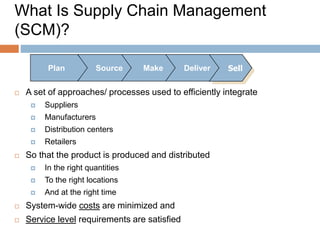
What Is Supply Chain Management
(SCM)?
 A set of approaches/ processes used to efficiently integrate
 Suppliers
 Manufacturers
 Distribution centers
 Retailers
 So that the product is produced and distributed
 In the right quantities
 To the right locations
 And at the right time
 System-wide costs are minimized and
 Service level requirements are satisfied
Plan Source Make Deliver Sell
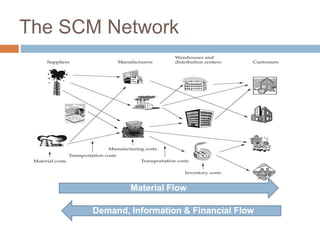
The SCM Network
Material Flow
Demand, Information & Financial Flow
The Importance of Supply Chain Management
 Dealing with uncertain environments – matching supply and demand
 Boeing announced a $2.6 billion write-off in 1997 due to “raw materials
shortages, internal and supplier parts shortages and productivity
inefficiencies”
 U.S Surgical Corporation announced a $22 million loss in 1993 due to
“larger than anticipated inventories on the shelves of hospitals”
 Hewlett-Packard and Dell found it difficult to obtain important components
for its PC’s from Taiwanese suppliers in 1999 due to a massive earthquake
 Shorter product life cycles of high-technology products
 Less opportunity to accumulate historical data on customer demand
 Wide choice of competing products makes it difficult to predict demand
 The growth of technologies such as the Internet enable greater
collaboration between supply chain trading partners
 If you don’t do it, your competitor will
 Major buyers such as Wal-Mart demand a level of “supply chain maturity”
of its suppliers
Why Is SCM Difficult?
 Efficiency and cost-effectiveness throughout the system is required
 Challenging to minimize system costs and maximize system service
levels
 Uncertainty & Risk is inherent to every supply chain
 Travel times
 Breakdowns of machines and vehicles
 Weather, natural catastrophe, war
 Local politics, labor conditions, border issues
 The complexity of the problem to globally optimize a supply chain is
significant
 Minimize internal costs
Supply Chain Imperatives for Success
 View the supply chain as a strategic asset and a
differentiator
 Wal-Mart’s partnership with Proctor & Gamble to automatically
replenish inventory
 Dell’s innovative direct-to-consumer sales and build-to-order
manufacturing
 Reduce uncertainty
 Forecasting
 Collaboration
 Integration
 Co-ordination is key
 Enterprise Resource Planning systems (ERP),
 Trust between partners and sharing of information, plans
ahead of time.
 Supply chain visibility. Need to know where in the chain the
material is. (RFID – radio frequency identification)
 Ability to respond to unplanned events – forecast errors,
equipment breakdowns, supply delays, weather, etc.
Needs effective monitoring, notifying, simulating alternate
courses of action. Postponement /delayed differentiation
helps.
Supply Chain Imperatives for Success
(cont’d)
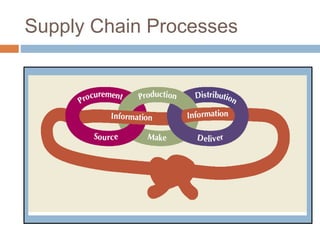
Supply Chain Processes
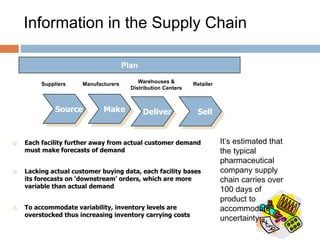
Information in the Supply Chain
Source Make Deliver Sell
Suppliers Manufacturers Warehouses &
Distribution Centers
Retailer
 Each facility further away from actual customer demand
must make forecasts of demand
 Lacking actual customer buying data, each facility bases
its forecasts on ‘downstream’ orders, which are more
variable than actual demand
 To accommodate variability, inventory levels are
overstocked thus increasing inventory carrying costs
It’s estimated that
the typical
pharmaceutical
company supply
chain carries over
100 days of
product to
accommodate
uncertainty
Plan
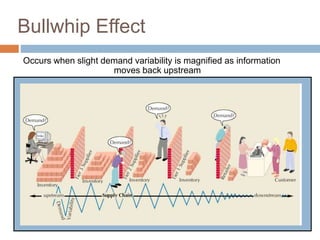
Bullwhip Effect
Occurs when slight demand variability is magnified as information
moves back upstream
Methods for Coping with the Bullwhip
 Reducing uncertainty.
 Centralizing information
 Reducing variability.
 Reducing variability inherent in the customer
demand process.
 “Everyday low pricing” (EDLP) strategy.
Methods for Coping with the Bullwhip
 Lead-time reduction
 Lead times magnify the increase in variability due to
demand forecasting.
 Strategic partnerships
 Changing the way information is shared and inventory is
managed
 Vendor managed inventory (VMI)
 Manufacturer manages the inventory of its product at the retailer
outlet
 VMI the manufacturer does not rely on the orders placed by a
retailer, thus avoiding the bullwhip effect entirely.
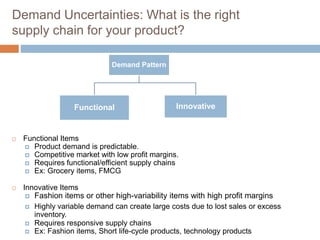
Demand Uncertainties: What is the right
supply chain for your product?
 Functional Items
 Product demand is predictable.
 Competitive market with low profit margins.
 Requires functional/efficient supply chains
 Ex: Grocery items, FMCG
 Innovative Items
 Fashion items or other high-variability items with high profit margins
 Highly variable demand can create large costs due to lost sales or excess
inventory.
 Requires responsive supply chains
 Ex: Fashion items, Short life-cycle products, technology products
Demand Pattern
Functional Innovative
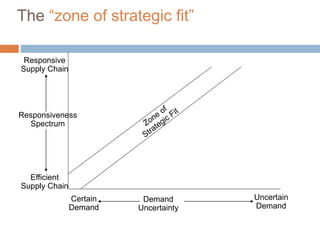
The “zone of strategic fit”
Demand
Uncertainty
Certain
Demand
Uncertain
Demand
Efficient
Supply Chain
Responsiveness
Spectrum
Responsive
Supply Chain
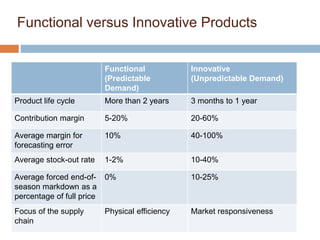
Functional versus Innovative Products
Functional
(Predictable
Demand)
Innovative
(Unpredictable Demand)
Product life cycle More than 2 years 3 months to 1 year
Contribution margin 5-20% 20-60%
Average margin for
forecasting error
10% 40-100%
Average stock-out rate 1-2% 10-40%
Average forced end-of-
season markdown as a
percentage of full price
0% 10-25%
Focus of the supply
chain
Physical efficiency Market responsiveness
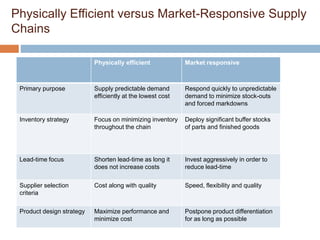
Physically Efficient versus Market-Responsive Supply
Chains
Physically efficient Market responsive
Primary purpose Supply predictable demand
efficiently at the lowest cost
Respond quickly to unpredictable
demand to minimize stock-outs
and forced markdowns
Inventory strategy Focus on minimizing inventory
throughout the chain
Deploy significant buffer stocks
of parts and finished goods
Lead-time focus Shorten lead-time as long it
does not increase costs
Invest aggressively in order to
reduce lead-time
Supplier selection
criteria
Cost along with quality Speed, flexibility and quality
Product design strategy Maximize performance and
minimize cost
Postpone product differentiation
for as long as possible
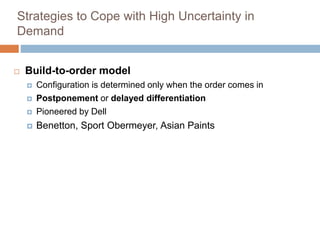
Strategies to Cope with High Uncertainty in
Demand
 Build-to-order model
 Configuration is determined only when the order comes in
 Postponement or delayed differentiation
 Pioneered by Dell
 Benetton, Sport Obermeyer, Asian Paints
Strategies to Cope with High Uncertainty in
Demand Cont’d
 Risk Pooling
 Demand Pooling/ Centralization/ Aggregation
 Keep larger inventories at distribution centers
 Suitable for products with long manufacturing lead times, such as
vehicles
Push, Pull, Push-Pull Systems
 Push Supply Chains
 Production and distribution decisions based on long-term
forecasts.
 Longer reaction time to changing marketplace:
 Inability to meet changing demand patterns
 Risk of product obsolescence
 Pull Supply Chains
 Coordinated with true customer demand rather than forecast
demand
 Firm does not hold any inventory and only responds to specific
orders.
 Difficult to take advantage of economies of scale
Push-Pull Strategy
 Some stages of the supply chain operated in a push-
based manner
 typically the initial stages
 Remaining stages employ a pull-based strategy.
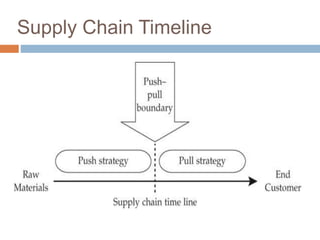
 Interface between the push-based stages and the pull-
based stages is the push–pull boundary.
Supply Chain Timeline
Impact of Demand Uncertainty and
Economies of Scale
 Demand Uncertainty:
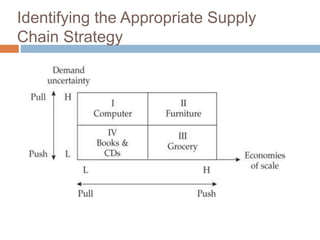
 Higher demand uncertainty leads to a preference for pull strategy.
 Lower demand uncertainty leads to an interest in managing the
supply chain based on a long-term forecast: push strategy.
 Economies of scale:
 The higher the importance of economies of scale in reducing cost
 The greater the value of aggregating demand
 The greater the importance of managing the supply chain based
on long-term forecast, a push-based strategy.
 Economies of scale are not important
 Aggregation does not reduce cost
 A pull-based strategy makes more sense.
Identifying the Appropriate Supply
Chain Strategy
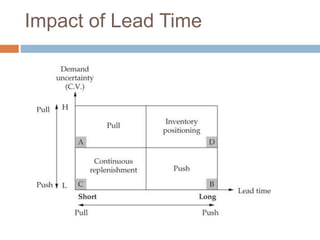
Impact of Lead Time
Sourcing Strategy
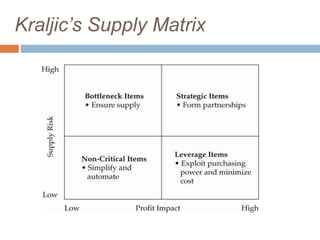
 Kraljic’s Supply Matrix
 Firm’s supply strategy should depend on two
dimensions
 profit impact
 Volume purchased
 percentage of total purchased cost
 impact on product quality
 business growth
 Supply risk
 Availability/number of suppliers
 make-or-buy opportunities
 substitution opportunities
Kraljic’s Supply Matrix
 Top right quadrant:
 Strategic items where supply risk and impact on profit are high
 Highest impact on customer experience
 Price is a large portion of the system cost
 Typically have a single supplier
 Focus on long-term partnerships with suppliers
 Bottom right quadrant
 Items with high impact on profit
 Low supply risk (leverage items)
 Many suppliers
 Small percentage of cost savings will have a large impact on
bottom line
 Focus on cost reduction by competition between
suppliers
Kraljic’s Supply Matrix
 Top left quadrant:
 High supply risk but low profit impact items.
 Bottleneck components
 Do not contribute a large portion of the product cost
 Suppliers have power position
 Ensure continuous supply, buy in bulk
 Focus on long-term contracts or by carrying stock (or
both)
 Bottom left quadrant:
 Non-critical items
 Simplify and automate the procurement process as much as
possible
 Use a decentralized procurement policy
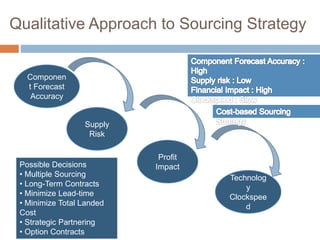
Qualitative Approach to Sourcing Strategy
Profit
Impact
Supply
Risk
Componen
t Forecast
Accuracy
Technolog
y
Clockspee
d
Possible Decisions
• Multiple Sourcing
• Long-Term Contracts
• Minimize Lead-time
• Minimize Total Landed
Cost
• Strategic Partnering
• Option Contracts
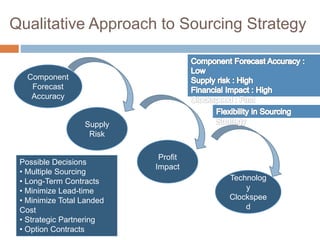
Qualitative Approach to Sourcing Strategy
Profit
Impact
Supply
Risk
Component
Forecast
Accuracy
Technolog
y
Clockspee
d
Possible Decisions
• Multiple Sourcing
• Long-Term Contracts
• Minimize Lead-time
• Minimize Total Landed
Cost
• Strategic Partnering
• Option Contracts
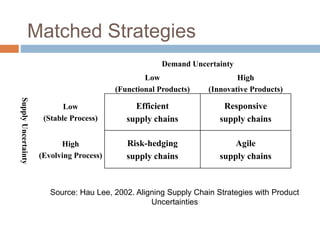
Matched Strategies
Source: Hau Lee, 2002. Aligning Supply Chain Strategies with Product
Uncertainties
Demand Uncertainty
Low
(Functional Products)
High
(Innovative Products)
Supply
Uncertainty
Low
(Stable Process)
Efficient
supply chains
Responsive
supply chains
High
(Evolving Process)
Risk-hedging
supply chains
Agile
supply chains

Intro Suppy chain management .pptx

  • 1.
  • 2.
    What Is SupplyChain Management (SCM)?  A set of approaches/ processes used to efficiently integrate  Suppliers  Manufacturers  Distribution centers  Retailers  So that the product is produced and distributed  In the right quantities  To the right locations  And at the right time  System-wide costs are minimized and  Service level requirements are satisfied Plan Source Make Deliver Sell
  • 3.
    The SCM Network MaterialFlow Demand, Information & Financial Flow
  • 4.
    The Importance ofSupply Chain Management  Dealing with uncertain environments – matching supply and demand  Boeing announced a $2.6 billion write-off in 1997 due to “raw materials shortages, internal and supplier parts shortages and productivity inefficiencies”  U.S Surgical Corporation announced a $22 million loss in 1993 due to “larger than anticipated inventories on the shelves of hospitals”  Hewlett-Packard and Dell found it difficult to obtain important components for its PC’s from Taiwanese suppliers in 1999 due to a massive earthquake  Shorter product life cycles of high-technology products  Less opportunity to accumulate historical data on customer demand  Wide choice of competing products makes it difficult to predict demand  The growth of technologies such as the Internet enable greater collaboration between supply chain trading partners  If you don’t do it, your competitor will  Major buyers such as Wal-Mart demand a level of “supply chain maturity” of its suppliers
  • 5.
    Why Is SCMDifficult?  Efficiency and cost-effectiveness throughout the system is required  Challenging to minimize system costs and maximize system service levels  Uncertainty & Risk is inherent to every supply chain  Travel times  Breakdowns of machines and vehicles  Weather, natural catastrophe, war  Local politics, labor conditions, border issues  The complexity of the problem to globally optimize a supply chain is significant  Minimize internal costs
  • 6.
    Supply Chain Imperativesfor Success  View the supply chain as a strategic asset and a differentiator  Wal-Mart’s partnership with Proctor & Gamble to automatically replenish inventory  Dell’s innovative direct-to-consumer sales and build-to-order manufacturing  Reduce uncertainty  Forecasting  Collaboration  Integration  Co-ordination is key  Enterprise Resource Planning systems (ERP),
  • 7.
     Trust betweenpartners and sharing of information, plans ahead of time.  Supply chain visibility. Need to know where in the chain the material is. (RFID – radio frequency identification)  Ability to respond to unplanned events – forecast errors, equipment breakdowns, supply delays, weather, etc. Needs effective monitoring, notifying, simulating alternate courses of action. Postponement /delayed differentiation helps. Supply Chain Imperatives for Success (cont’d)
  • 8.
  • 9.
    Information in theSupply Chain Source Make Deliver Sell Suppliers Manufacturers Warehouses & Distribution Centers Retailer  Each facility further away from actual customer demand must make forecasts of demand  Lacking actual customer buying data, each facility bases its forecasts on ‘downstream’ orders, which are more variable than actual demand  To accommodate variability, inventory levels are overstocked thus increasing inventory carrying costs It’s estimated that the typical pharmaceutical company supply chain carries over 100 days of product to accommodate uncertainty Plan
  • 10.
    Bullwhip Effect Occurs whenslight demand variability is magnified as information moves back upstream
  • 11.
    Methods for Copingwith the Bullwhip  Reducing uncertainty.  Centralizing information  Reducing variability.  Reducing variability inherent in the customer demand process.  “Everyday low pricing” (EDLP) strategy.
  • 12.
    Methods for Copingwith the Bullwhip  Lead-time reduction  Lead times magnify the increase in variability due to demand forecasting.  Strategic partnerships  Changing the way information is shared and inventory is managed  Vendor managed inventory (VMI)  Manufacturer manages the inventory of its product at the retailer outlet  VMI the manufacturer does not rely on the orders placed by a retailer, thus avoiding the bullwhip effect entirely.
  • 13.
    Demand Uncertainties: Whatis the right supply chain for your product?  Functional Items  Product demand is predictable.  Competitive market with low profit margins.  Requires functional/efficient supply chains  Ex: Grocery items, FMCG  Innovative Items  Fashion items or other high-variability items with high profit margins  Highly variable demand can create large costs due to lost sales or excess inventory.  Requires responsive supply chains  Ex: Fashion items, Short life-cycle products, technology products Demand Pattern Functional Innovative
  • 14.
    The “zone ofstrategic fit” Demand Uncertainty Certain Demand Uncertain Demand Efficient Supply Chain Responsiveness Spectrum Responsive Supply Chain
  • 15.
    Functional versus InnovativeProducts Functional (Predictable Demand) Innovative (Unpredictable Demand) Product life cycle More than 2 years 3 months to 1 year Contribution margin 5-20% 20-60% Average margin for forecasting error 10% 40-100% Average stock-out rate 1-2% 10-40% Average forced end-of- season markdown as a percentage of full price 0% 10-25% Focus of the supply chain Physical efficiency Market responsiveness
  • 16.
    Physically Efficient versusMarket-Responsive Supply Chains Physically efficient Market responsive Primary purpose Supply predictable demand efficiently at the lowest cost Respond quickly to unpredictable demand to minimize stock-outs and forced markdowns Inventory strategy Focus on minimizing inventory throughout the chain Deploy significant buffer stocks of parts and finished goods Lead-time focus Shorten lead-time as long it does not increase costs Invest aggressively in order to reduce lead-time Supplier selection criteria Cost along with quality Speed, flexibility and quality Product design strategy Maximize performance and minimize cost Postpone product differentiation for as long as possible
  • 17.
    Strategies to Copewith High Uncertainty in Demand  Build-to-order model  Configuration is determined only when the order comes in  Postponement or delayed differentiation  Pioneered by Dell  Benetton, Sport Obermeyer, Asian Paints
  • 18.
    Strategies to Copewith High Uncertainty in Demand Cont’d  Risk Pooling  Demand Pooling/ Centralization/ Aggregation  Keep larger inventories at distribution centers  Suitable for products with long manufacturing lead times, such as vehicles
  • 19.
    Push, Pull, Push-PullSystems  Push Supply Chains  Production and distribution decisions based on long-term forecasts.  Longer reaction time to changing marketplace:  Inability to meet changing demand patterns  Risk of product obsolescence  Pull Supply Chains  Coordinated with true customer demand rather than forecast demand  Firm does not hold any inventory and only responds to specific orders.  Difficult to take advantage of economies of scale
  • 20.
    Push-Pull Strategy  Somestages of the supply chain operated in a push- based manner  typically the initial stages  Remaining stages employ a pull-based strategy.  Interface between the push-based stages and the pull- based stages is the push–pull boundary.
  • 21.
  • 22.
    Impact of DemandUncertainty and Economies of Scale  Demand Uncertainty:  Higher demand uncertainty leads to a preference for pull strategy.  Lower demand uncertainty leads to an interest in managing the supply chain based on a long-term forecast: push strategy.  Economies of scale:  The higher the importance of economies of scale in reducing cost  The greater the value of aggregating demand  The greater the importance of managing the supply chain based on long-term forecast, a push-based strategy.  Economies of scale are not important  Aggregation does not reduce cost  A pull-based strategy makes more sense.
  • 23.
    Identifying the AppropriateSupply Chain Strategy
  • 24.
  • 25.
    Sourcing Strategy  Kraljic’sSupply Matrix  Firm’s supply strategy should depend on two dimensions  profit impact  Volume purchased  percentage of total purchased cost  impact on product quality  business growth  Supply risk  Availability/number of suppliers  make-or-buy opportunities  substitution opportunities
  • 26.
  • 27.
    Kraljic’s Supply Matrix Top right quadrant:  Strategic items where supply risk and impact on profit are high  Highest impact on customer experience  Price is a large portion of the system cost  Typically have a single supplier  Focus on long-term partnerships with suppliers  Bottom right quadrant  Items with high impact on profit  Low supply risk (leverage items)  Many suppliers  Small percentage of cost savings will have a large impact on bottom line  Focus on cost reduction by competition between suppliers
  • 28.
    Kraljic’s Supply Matrix Top left quadrant:  High supply risk but low profit impact items.  Bottleneck components  Do not contribute a large portion of the product cost  Suppliers have power position  Ensure continuous supply, buy in bulk  Focus on long-term contracts or by carrying stock (or both)  Bottom left quadrant:  Non-critical items  Simplify and automate the procurement process as much as possible  Use a decentralized procurement policy
  • 29.
    Qualitative Approach toSourcing Strategy Profit Impact Supply Risk Componen t Forecast Accuracy Technolog y Clockspee d Possible Decisions • Multiple Sourcing • Long-Term Contracts • Minimize Lead-time • Minimize Total Landed Cost • Strategic Partnering • Option Contracts
  • 30.
    Qualitative Approach toSourcing Strategy Profit Impact Supply Risk Component Forecast Accuracy Technolog y Clockspee d Possible Decisions • Multiple Sourcing • Long-Term Contracts • Minimize Lead-time • Minimize Total Landed Cost • Strategic Partnering • Option Contracts
  • 31.
    Matched Strategies Source: HauLee, 2002. Aligning Supply Chain Strategies with Product Uncertainties Demand Uncertainty Low (Functional Products) High (Innovative Products) Supply Uncertainty Low (Stable Process) Efficient supply chains Responsive supply chains High (Evolving Process) Risk-hedging supply chains Agile supply chains