SUPPLY CHAIN MANAGEMENT
SEMINAR GUIDE PREPARED BY
Dr. HEMMANT R THAKKA R MEHTA ANKUR D
En no 120110746007
December 13 1
PRESENTATION OUTLINE
 SUPPLY CHAIN MANAGEMENT
 LOGISTICS & SUPPLY CHAIN
MANAGEMENT
 DYNAMICS OF SUPPLY CHAIN
 NEW EMERGING WORLD CLASS
PRACTICSE IN SCM
 OUTSOURCING
 IT IN SCM
 ISSUES, CHALLENGES AND
OPPORTUNITIES IN IMPLEMENTATION
OF SCM December 13 2
SUPPLY CHAIN MANAGEMENT
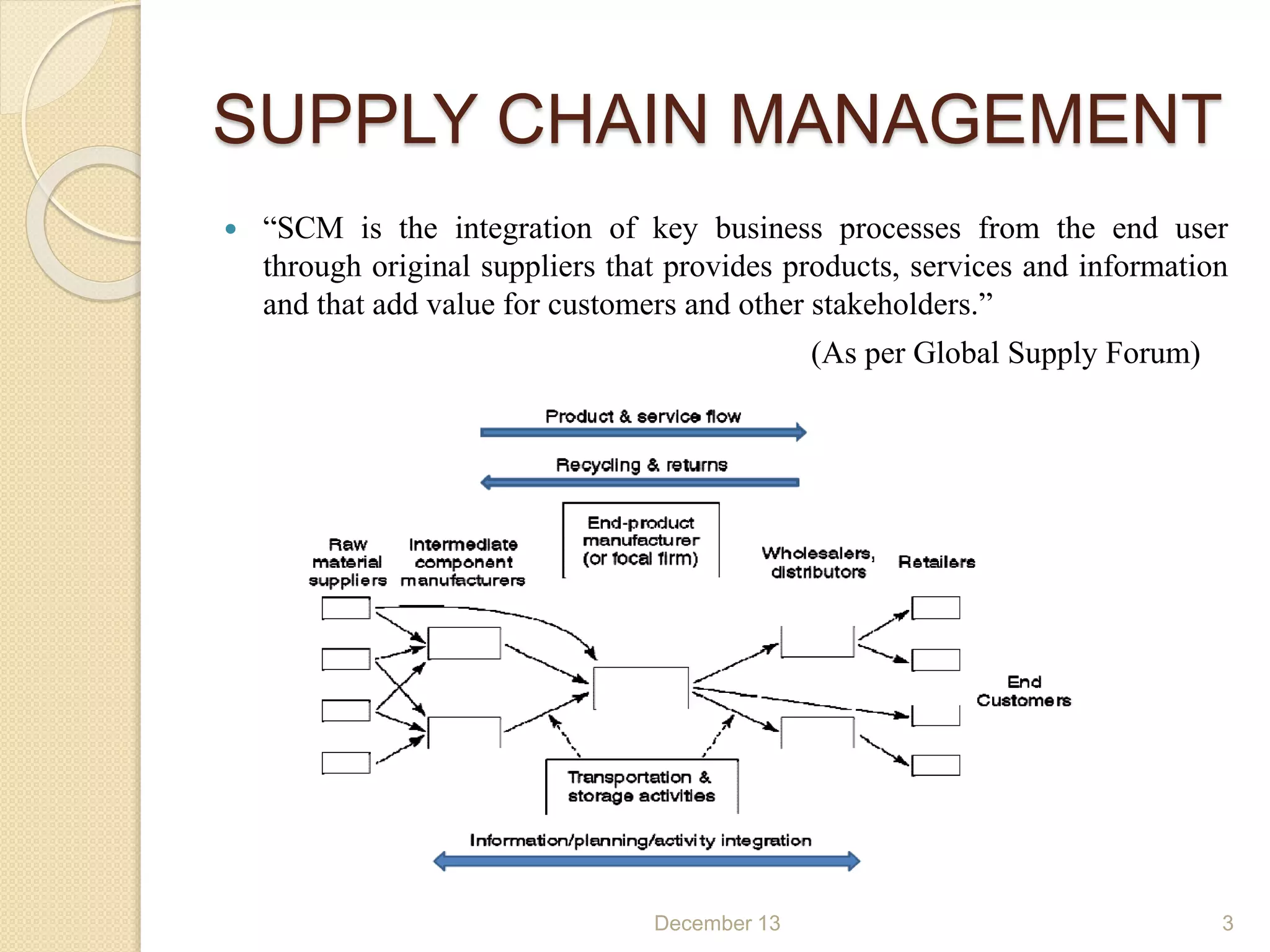
 “SCM is the integration of key business processes from the end user
through original suppliers that provides products, services and information
and that add value for customers and other stakeholders.”
(As per Global Supply Forum)
December 13 3
NECESSITY OF SCM FOR
INDUSTRY
 SCM is necessary because of relationship between each party. If every
party joins hand and work together, it will create cost savings and time to
market reduction and everyone will enjoy the benefit.
 It is to be efficient and cost-effective across the entire system.
 It is necessary to account for the suppliers’ suppliers and the customers’
customers because they have an impact on supply chain performance.
 Supply chain is very important because of flow of goods from one
destination to other destination with cost effective and on timely delivery of
goods to the business needs and gives the profit to the organization.
December 13 4
OBJECTIVE OF SCM
Primary
• Creating a value
for a customer.
• Responds to
customer needs
and demand
Secondary
• Profitability
• Responsiveness
• Turnover Rate
• Flexibility
• Communication
& Coordination
December 13 5
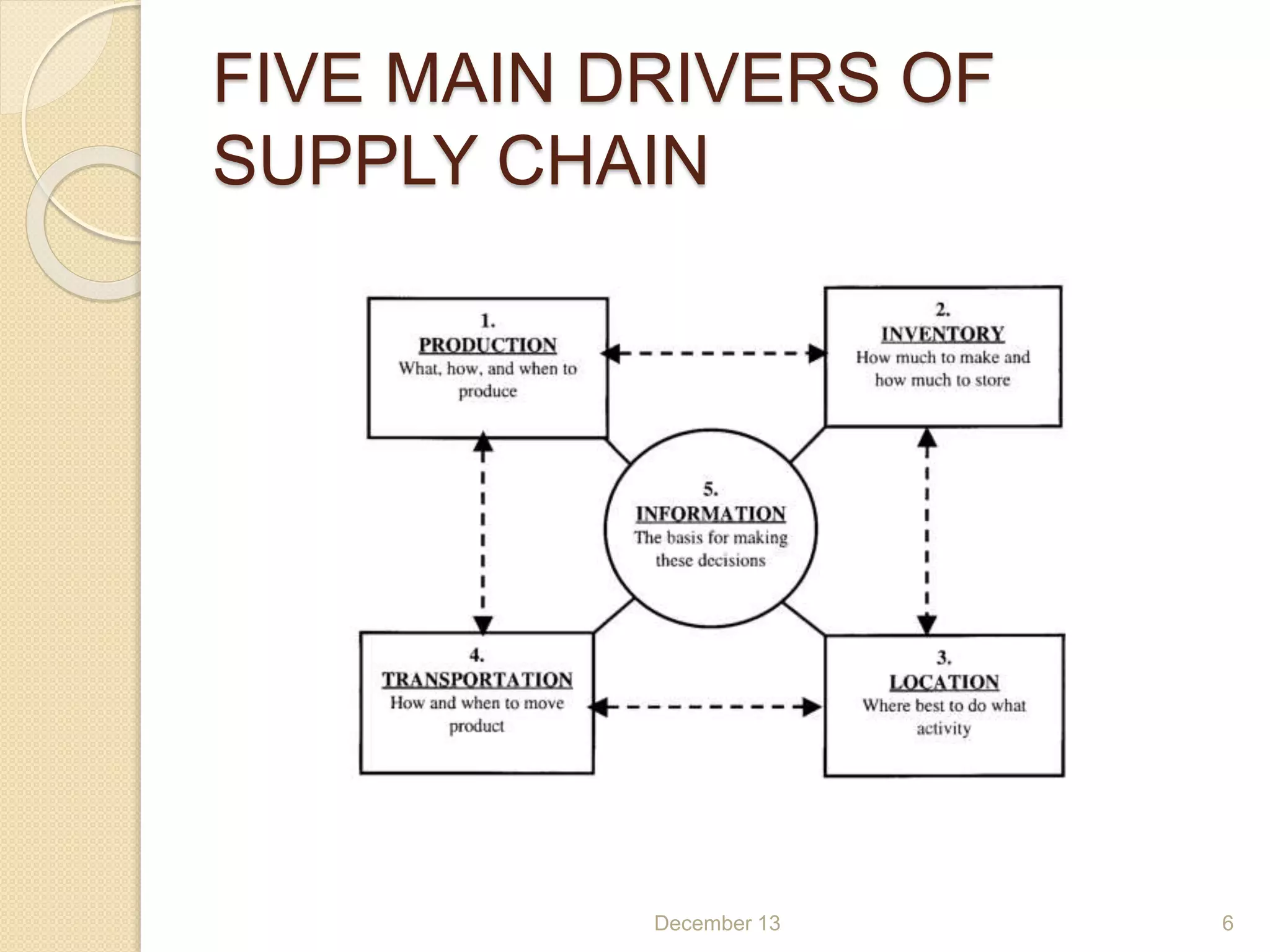
FIVE MAIN DRIVERS OF
SUPPLY CHAIN
December 13 6
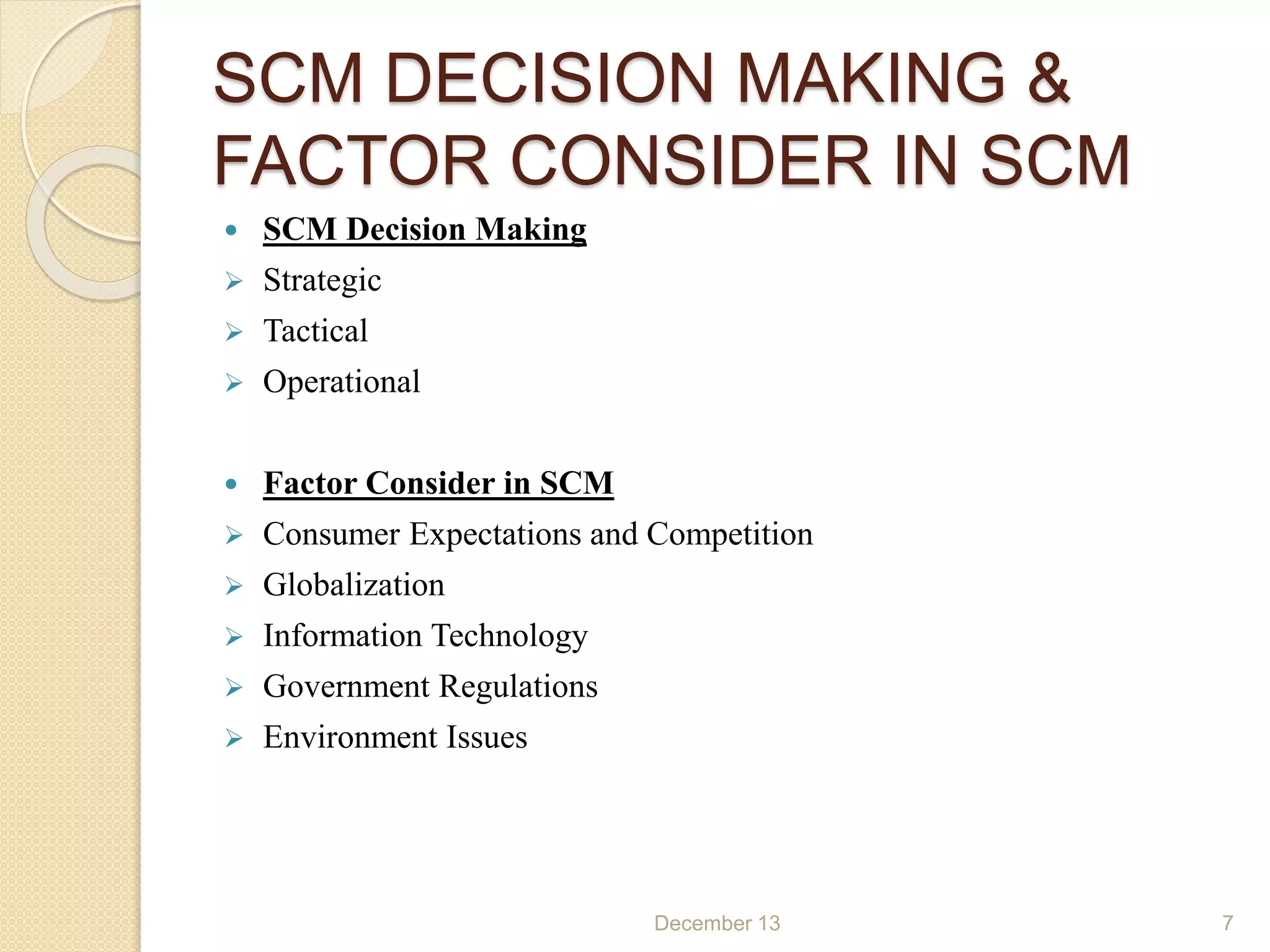
SCM DECISION MAKING &
FACTOR CONSIDER IN SCM
 SCM Decision Making
 Strategic
 Tactical
 Operational
 Factor Consider in SCM
 Consumer Expectations and Competition
 Globalization
 Information Technology
 Government Regulations
 Environment Issues
December 13 7
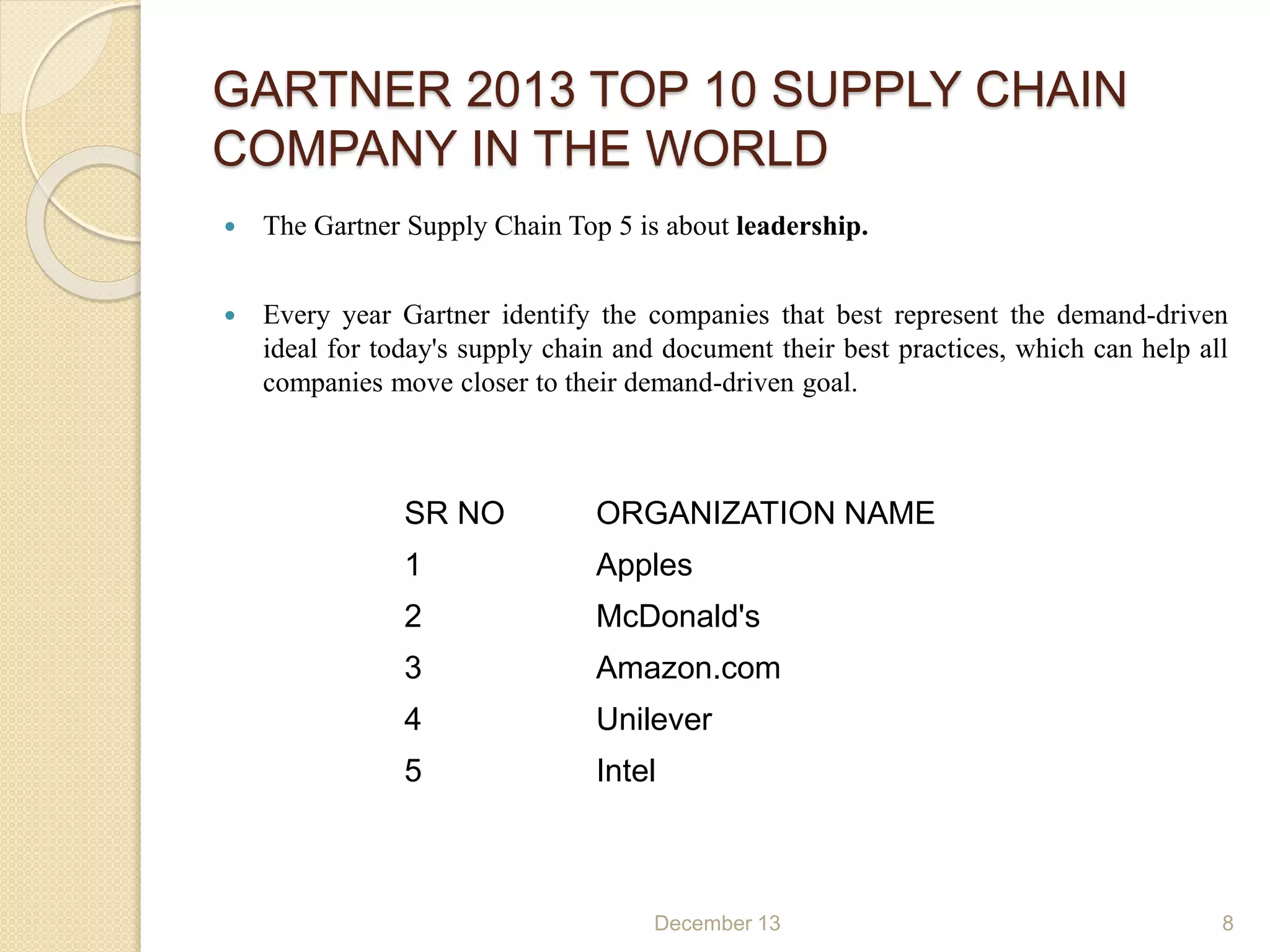
GARTNER 2013 TOP 10 SUPPLY CHAIN
COMPANY IN THE WORLD
 The Gartner Supply Chain Top 5 is about leadership.
 Every year Gartner identify the companies that best represent the demand-driven
ideal for today's supply chain and document their best practices, which can help all
companies move closer to their demand-driven goal.
SR NO ORGANIZATION NAME
1 Apples
2 McDonald's
3 Amazon.com
4 Unilever
5 Intel
December 13 8
LOGISTICS
 Logistics is an entire process of materials and products moving
into, through and out of the firm.
 Inbounding Logistics is one of the primary processes of
logistics, concentrating on purchasing and arranging the inbound
movement of materials, parts, and/or finished inventory from
suppliers to manufacturing or assembly plants, warehouses, or
retail stores.
 Outbound Logistics is the process related to the movement of
the final product and the related information flows from the end
of the production line to the end user.
December 13 9
LOGISTICS AND SCM
 Logistics focuses on the actual transportation and storage of goods.
 It deals with inbound and outbound freight, communications during transit,
storage and warehousing, delivery of goods and freight, coordination
among third party carries, fleet management, and other activities directly
related to the actual transportation of goods from one point to another.
Supply Chain Management for the most part, encompasses a bigger
picture.
 Supply Chain Management is the umbrella which covers all aspects of the
sourcing and procurement of goods.
 Impressive results, including dramatic reductions in cycle time and
accelerated cash flows, have been noted as a result of effective supply chain
management. SCM forms and manages the business to business links that
allow for the ultimate sale of goods to consumers.
December 13 10
Organizations Require Both
Logistics and SCM to
Succeed
 Logistics management is concerned with the
movement of goods and services from suppler to
consumer. SCM shares this concern, but
additionally is responsible for the flow of
information and funds from supplier to
consumer.
 Logistics and SCM cross paths it should be
expected that SCM and logistics will both
remain essentially free and essential for
organization to succeed in the business.
December 13 11
DYNAMICS OF SCM
(BULLWHIP EFFECT)
 The bullwhip effect is introduce in the supply chain due to human behavior
and increasing significantly at the end of the supply chain.
 Distorted information from one end of a supply chain to the other can lead
to tremendous inefficiencies.
 The bullwhip effect occurs when the demand order variability in the supply
chain are amplified as they moved up the supply chain.
December 13 12
CAUSES OF BULLWHIP
EFFECT
 Order Batching- for minimize
transportation cost.
 Price fluctuation- Effect of price
fluctuation.
 Shortage Gaming- Phantom demand
by customer/retailers.
 Faulty Demand Forecast Updating-
Safety stock build up at each level
December 13 13
COUNTERACT TO CONTROL
BULLWHIP EFFECT
Stabilize prices- Eliminating price
promotion
Eliminate gaming in shortage
Break order batches
Avoid multiple demand forecast
updates
Counterac
t the
Bullwhip
Effect
Stabilize
prices
Eliminate
gaming in
shortage
Break
order
batches
Avoid
multiple
demand
forecast
updates
December 13 14
VENDOR MANAGED INVENTORY
(VMI)
 Vendor Managed Inventory starts in the 1980s when mass retailers
started to require their suppliers to take control of the inventory
management.
 VMI is essentially an integrated approach whereby the inventory at the
distributor/retailer (downstream) is monitored and managed by the
manufacturer/vendor (upstream)
 This is one of the successful business models used by Wal-Mart. VMI
Projects at Wal-Mart have shown sales increases of 20 to 25 percent, and
30 percent inventory turnover improvements
 VMI is known as JIT - II
 THE STEP TO MAKE VIM WORK IN THE ORGANIZATION
i. Clarify expectations
ii. Agree on how to share information
iii. Keep communication channels open
December 13 15
BENEFITS OF VMI
 Dual Benefits
 Data entry errors are reduced due to computer to computer
communications. Speed of the processing is also improved.
 A true partnership is formed between the Manufacturer and
the Distributor. They work closer together and strengthen
their ties.
 Distributor Benefits
 The overall service level is improved by having the right
product at the right time.
 The manufacturer is more focused than ever on providing
great service.
 Manufacturer Benefits
 Lower inventory investments (raw and finished).
 Better scheduling and planning.
 Better market information.
December 13 16
THIRD PARTY LOGISTICS
(3PL) Armstrong & Associates in 1984 developed this concept.
 3PLs are external suppliers that perform all or part of a company’s
logistics functions, including:
“Transportation, Warehousing, Distribution, Financial services”
 Terms contract logistics and outsourcing are sometimes used in place of
3PL.
A & A’s TOP FIVE 3PL SERVICES (MAY-2012)
RANK 3PL LOGISTICS PROVIDER 2011 GROSS LOGISTICS
REVENUE(USD
MILLIONS)
1 DHL supply chain & forwarding 32,160
2 Kuehne + Nagel 22,181
3 DB schenker logistics 20,704
4 Nippon express 20,313
5 C.H Robinson worldwide 10,336
December 13 17
FORTH PARTY
LOGISTICS(4PL)
 The concept of a Fourth-Party Logistics (4PL) provider was
first defined by Andersen Consulting (Now Accenture).
 As supply chain integrator…..
“ A firm that assembles and manages the resources, capabilities
and technology of its own organization with those of
balancing service providers to deliver a comprehensive
supply chain solution.”
 4PLs manage and direct the activities of multiple 3PLs,
serving as an integrator
December 13 18
OUTSOURCING
 “The strategic use of outside resources to perform activates traditionally handled by
internal staff and resources”
 The ultimate goal of the outsourcing is to bring the tangible benefits to the business
and subsequently the customer.
REASON FOR COMPANY OUTSOURCING
Provide services that are scalable, secure and efficient while improving overall
service and reducing the cost.
December 13 19
 Off-Shoring-No commonly accepted definition off-shoring exists.
Services that US-based organizations purchase from abroad are consider in
off-shoring.
Example India is the leading country for U.S. offshore outsourcing.
 Near-Shoring-The term used to refer to the practice of getting work done
or services performed by people in neighboring countries.
Example Canada , Mexico to US , Sri Lanka to India
 In sourcing The act of bringing together a function that was performed
outside the organization to being performed inside the organization is called
in sourcing. It is opposite of outsourcing that is a service performs in house.
It is a reaction to outsourcing comprising.
December 13 20
PROBLEM WITH
OUTSOURCING
 Loss of Control
 Increased cash outflow
 Confidentiality and security
 Selection of supplier
 Too dependent on service provider
 Loss of staff or moral problems
 Provider may not understand business environment
December 13 21
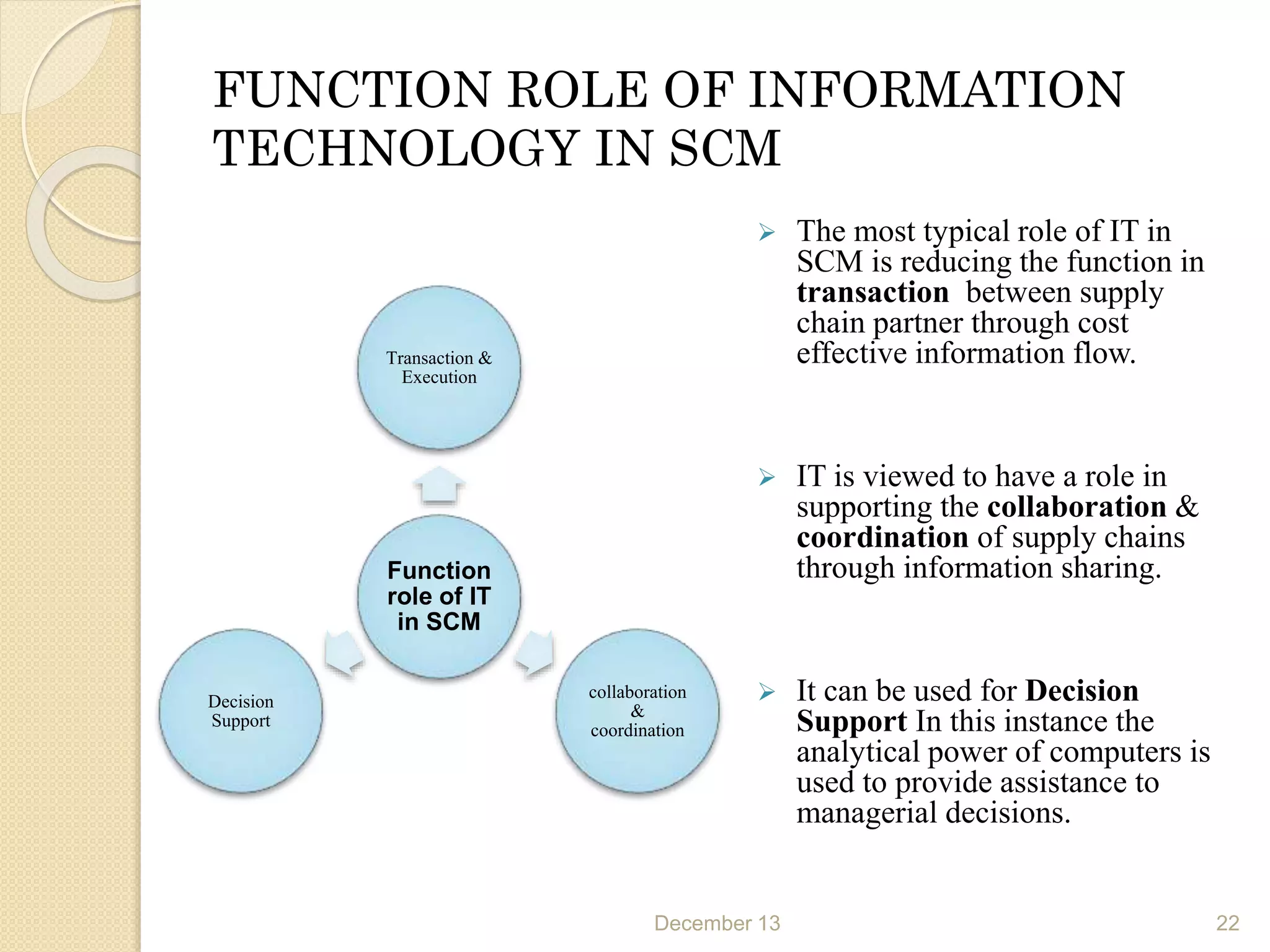
FUNCTION ROLE OF INFORMATION
TECHNOLOGY IN SCM
 The most typical role of IT in
SCM is reducing the function in
transaction between supply
chain partner through cost
effective information flow.
 IT is viewed to have a role in
supporting the collaboration &
coordination of supply chains
through information sharing.
 It can be used for Decision
Support In this instance the
analytical power of computers is
used to provide assistance to
managerial decisions.
Function
role of IT
in SCM
Transaction &
Execution
collaboration
&
coordination
Decision
Support
December 13 22
INFORMATION TECHNOLOGY FOR
SUPPLY CHAIN
 Software Systems
 Electronic Data Interchange (EDI)
 Material Requirements Planning (MRP)
 Manufacturing Resource Planning (MRP II)
 Enterprise Resource Planning (ERP)
 Supply Chain Management Systems (SCM)
 Customer Relationship Management (CRM)
 Internet-based Software
 Network Infrastructure
 Wide Area Network
 Internet (for E-commerce: B2B, B2C)
December 13 23
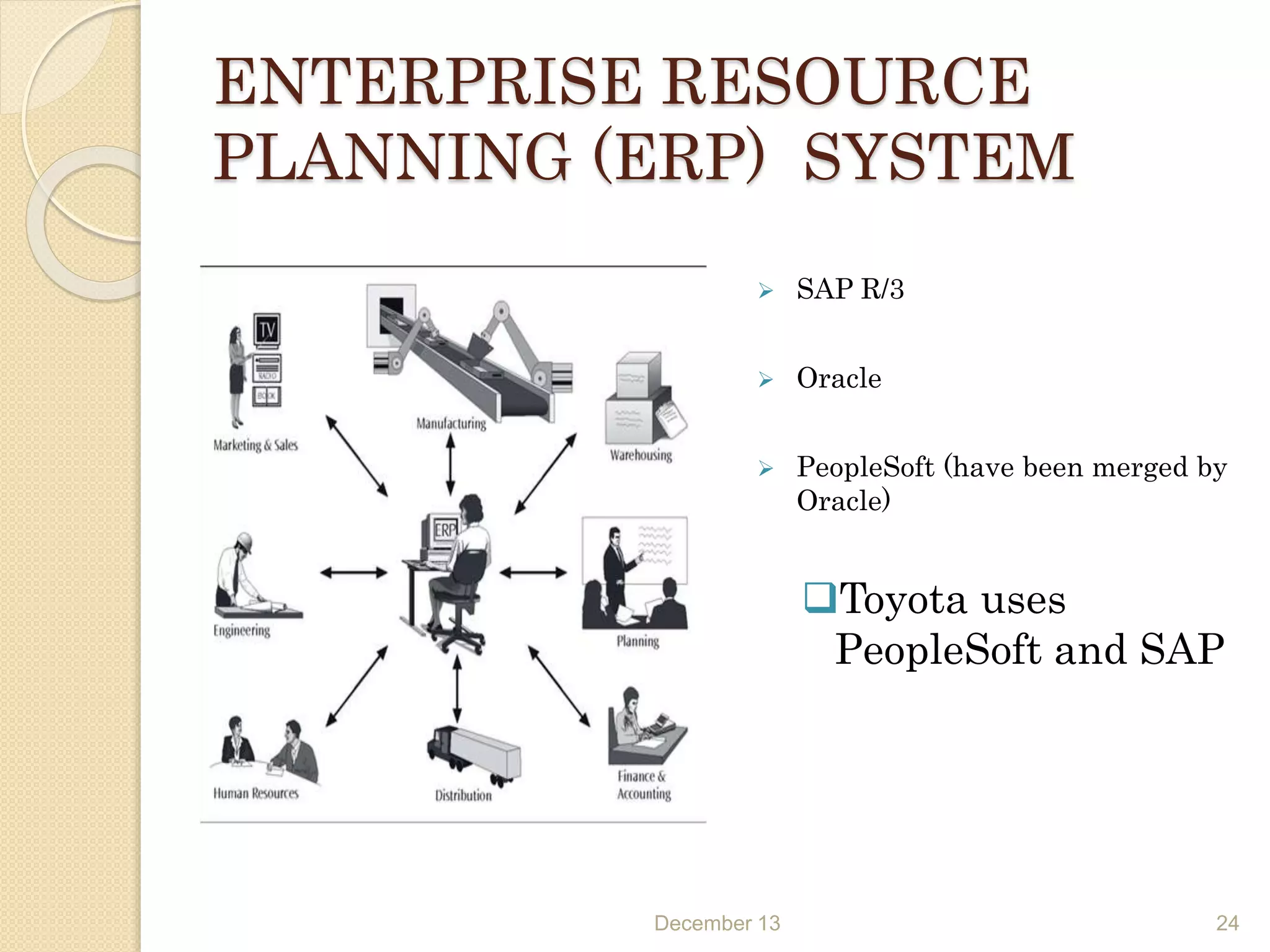
ENTERPRISE RESOURCE
PLANNING (ERP) SYSTEM
 SAP R/3
 Oracle
 PeopleSoft (have been merged by
Oracle)
Toyota uses
PeopleSoft and SAP
December 13 24
KEY IMPLEMENTATION
ISSUES
 SCM intent, orientation, organization and interrelationship
 SCM and use of IT practices and tools
 SCM and collaborative forecasting and planning
 SCM and transportation, logistics and warehousing
 Customer relationship
December 13 25
THE CHALLENGES
 A great challenge for supply chain managers, particularly in terms of
demand planning.
 The other problem lays in data transparency and supply chain inefficiencies
due to the cultural mindset.
 The other problem pertains to logistic service providers, say, third party
logistics (3PLs).
 The cost of distribution as a per cent of sales is ever increasing. too many
check post points in the country increases the cost of transportation.
 Some companies feel that employees resist to outsourcing due fearing of
losing their jobs and controls.
 The complexity of supply chain networks is particularly serious in
countries, such as India, China, and Korea. The distribution channels
involving 3-4 intermediaries between the manufacturer and the customer. In
the US and Europe, 1-2 intermediaries is the norm.
December 13 26
THE OPPORTUNITIES
 Indian companies still need to deploy SCM as a strategy to
reduce customer response time, improvement of service levels,
and time to develop market with new variants/products.
 There should be direct involvement of the customer at the
product design and planning stage.
 A dynamic optimization of logistic networks is required. The
clearing and forwarding agents and 3PLs-all have to be put to
optimal use.
 Use of technology e.g. bar coding should be made mandatory.
 The overhead costs for running a truck in India are very high. A
better cost control system must be in place to reduce costs.
December 13 27
REFERANCE
Reference Books:
 Sunil Sharma, “Supply Chain Management- concept,
practices and implementation” Oxford University Press.
 Sunil Chopra and Peter Meindl, “Supply Chain
Management”. Second Edition. Upper Saddle River: Pearson
Prentice Hall, 2004.
 Dr. Dawei Lu “Fundamentals of Supply Chain
Management.”
 DouglasM.Lambert, “SUPPLYCHAINMANAGEMENT-
Processes, Partnerships, Performance” Third Edition.
 Essentials of Supply Chain Management
 Shroeder. G, “Operations Management- Contemporary
Concepts and Cases” McGraw Hill publication.
December 13 28
Research Papers
 Hau L Lee, V Padmanabhan, and Seungjin Whang; “Sloan Management
Review”, Spring 1997, Volume 38, Issue 3, pp. 93-102
 Elisabeth ILIE-ZUDOR, Zsolt KEMÉNY, Péter EGRI, László
MONOSTORI” THE RFID TECHNOLOGY AND ITS CURRENT
APPLICATIONS” In proceedings of The Modern Information
Technology in the Innovation Processes of the Industrial Enterprises-
MITIP 2006, pp.29-36
 Thorsten Klaas,” Push-vs. Pull- Concept in Logistics Chain”, CEMS
Academic Conferences, Louvain-la-Neuve, May 7-9,1998
 Gurinder Singh Brar and Gagan Saini “Milk Run Logistics: Literature
Review and
 Directions” Proceedings of the World Congress on Engineering 2011 Vol
I, July 6 - 8, London, U.K.
 Prof. Himanshu S. Moharana, Dr. J.S. Murty, Dr. S. K. Senapati, Prof. K.
Khuntia”I MPORTANCE OF INFORMATION TECHNOLOGY FOR
EFFECTIVE SUPPLY CHAIN MANAGEMENT” International Journal
of Modern Engineering Research (IJMER), Vol.1, Issue.2, pp-747-75
December 13 29
 http://www.gartner.com/technology/supply-chain/top25.jsp
 http://en.wikipedia.org/wiki/Logistics
 http://logisticianslodge.wordpress.com/2010/03/07/logistics
-and-supply-chain-management-what-is-the-difference/
 http://www.aalhysterforklifts.com.au/index.php/about/blog-
post/what_is_the_bullwhip_effect_understanding_the_conc
ept_definition
 http://vijaysangamworld.wordpress.com/2010/07/06/push-
vs-pull-supply-chain/
 http://www.supplychain247.com/article/2013_top_50_globa
l_top_30_domestic_3pls
 http://supplychaininsights.com/sciwiki/index.php?title=Four
th-Party_Logistics_(4PL)
December 13 30
THANK YOU
December 13 31

Presentation on supply chain management

  • 1.
    SUPPLY CHAIN MANAGEMENT SEMINARGUIDE PREPARED BY Dr. HEMMANT R THAKKA R MEHTA ANKUR D En no 120110746007 December 13 1
  • 2.
    PRESENTATION OUTLINE  SUPPLYCHAIN MANAGEMENT  LOGISTICS & SUPPLY CHAIN MANAGEMENT  DYNAMICS OF SUPPLY CHAIN  NEW EMERGING WORLD CLASS PRACTICSE IN SCM  OUTSOURCING  IT IN SCM  ISSUES, CHALLENGES AND OPPORTUNITIES IN IMPLEMENTATION OF SCM December 13 2
  • 3.
    SUPPLY CHAIN MANAGEMENT “SCM is the integration of key business processes from the end user through original suppliers that provides products, services and information and that add value for customers and other stakeholders.” (As per Global Supply Forum) December 13 3
  • 4.
    NECESSITY OF SCMFOR INDUSTRY  SCM is necessary because of relationship between each party. If every party joins hand and work together, it will create cost savings and time to market reduction and everyone will enjoy the benefit.  It is to be efficient and cost-effective across the entire system.  It is necessary to account for the suppliers’ suppliers and the customers’ customers because they have an impact on supply chain performance.  Supply chain is very important because of flow of goods from one destination to other destination with cost effective and on timely delivery of goods to the business needs and gives the profit to the organization. December 13 4
  • 5.
    OBJECTIVE OF SCM Primary •Creating a value for a customer. • Responds to customer needs and demand Secondary • Profitability • Responsiveness • Turnover Rate • Flexibility • Communication & Coordination December 13 5
  • 6.
    FIVE MAIN DRIVERSOF SUPPLY CHAIN December 13 6
  • 7.
    SCM DECISION MAKING& FACTOR CONSIDER IN SCM  SCM Decision Making  Strategic  Tactical  Operational  Factor Consider in SCM  Consumer Expectations and Competition  Globalization  Information Technology  Government Regulations  Environment Issues December 13 7
  • 8.
    GARTNER 2013 TOP10 SUPPLY CHAIN COMPANY IN THE WORLD  The Gartner Supply Chain Top 5 is about leadership.  Every year Gartner identify the companies that best represent the demand-driven ideal for today's supply chain and document their best practices, which can help all companies move closer to their demand-driven goal. SR NO ORGANIZATION NAME 1 Apples 2 McDonald's 3 Amazon.com 4 Unilever 5 Intel December 13 8
  • 9.
    LOGISTICS  Logistics isan entire process of materials and products moving into, through and out of the firm.  Inbounding Logistics is one of the primary processes of logistics, concentrating on purchasing and arranging the inbound movement of materials, parts, and/or finished inventory from suppliers to manufacturing or assembly plants, warehouses, or retail stores.  Outbound Logistics is the process related to the movement of the final product and the related information flows from the end of the production line to the end user. December 13 9
  • 10.
    LOGISTICS AND SCM Logistics focuses on the actual transportation and storage of goods.  It deals with inbound and outbound freight, communications during transit, storage and warehousing, delivery of goods and freight, coordination among third party carries, fleet management, and other activities directly related to the actual transportation of goods from one point to another. Supply Chain Management for the most part, encompasses a bigger picture.  Supply Chain Management is the umbrella which covers all aspects of the sourcing and procurement of goods.  Impressive results, including dramatic reductions in cycle time and accelerated cash flows, have been noted as a result of effective supply chain management. SCM forms and manages the business to business links that allow for the ultimate sale of goods to consumers. December 13 10
  • 11.
    Organizations Require Both Logisticsand SCM to Succeed  Logistics management is concerned with the movement of goods and services from suppler to consumer. SCM shares this concern, but additionally is responsible for the flow of information and funds from supplier to consumer.  Logistics and SCM cross paths it should be expected that SCM and logistics will both remain essentially free and essential for organization to succeed in the business. December 13 11
  • 12.
    DYNAMICS OF SCM (BULLWHIPEFFECT)  The bullwhip effect is introduce in the supply chain due to human behavior and increasing significantly at the end of the supply chain.  Distorted information from one end of a supply chain to the other can lead to tremendous inefficiencies.  The bullwhip effect occurs when the demand order variability in the supply chain are amplified as they moved up the supply chain. December 13 12
  • 13.
    CAUSES OF BULLWHIP EFFECT Order Batching- for minimize transportation cost.  Price fluctuation- Effect of price fluctuation.  Shortage Gaming- Phantom demand by customer/retailers.  Faulty Demand Forecast Updating- Safety stock build up at each level December 13 13
  • 14.
    COUNTERACT TO CONTROL BULLWHIPEFFECT Stabilize prices- Eliminating price promotion Eliminate gaming in shortage Break order batches Avoid multiple demand forecast updates Counterac t the Bullwhip Effect Stabilize prices Eliminate gaming in shortage Break order batches Avoid multiple demand forecast updates December 13 14
  • 15.
    VENDOR MANAGED INVENTORY (VMI) Vendor Managed Inventory starts in the 1980s when mass retailers started to require their suppliers to take control of the inventory management.  VMI is essentially an integrated approach whereby the inventory at the distributor/retailer (downstream) is monitored and managed by the manufacturer/vendor (upstream)  This is one of the successful business models used by Wal-Mart. VMI Projects at Wal-Mart have shown sales increases of 20 to 25 percent, and 30 percent inventory turnover improvements  VMI is known as JIT - II  THE STEP TO MAKE VIM WORK IN THE ORGANIZATION i. Clarify expectations ii. Agree on how to share information iii. Keep communication channels open December 13 15
  • 16.
    BENEFITS OF VMI Dual Benefits  Data entry errors are reduced due to computer to computer communications. Speed of the processing is also improved.  A true partnership is formed between the Manufacturer and the Distributor. They work closer together and strengthen their ties.  Distributor Benefits  The overall service level is improved by having the right product at the right time.  The manufacturer is more focused than ever on providing great service.  Manufacturer Benefits  Lower inventory investments (raw and finished).  Better scheduling and planning.  Better market information. December 13 16
  • 17.
    THIRD PARTY LOGISTICS (3PL)Armstrong & Associates in 1984 developed this concept.  3PLs are external suppliers that perform all or part of a company’s logistics functions, including: “Transportation, Warehousing, Distribution, Financial services”  Terms contract logistics and outsourcing are sometimes used in place of 3PL. A & A’s TOP FIVE 3PL SERVICES (MAY-2012) RANK 3PL LOGISTICS PROVIDER 2011 GROSS LOGISTICS REVENUE(USD MILLIONS) 1 DHL supply chain & forwarding 32,160 2 Kuehne + Nagel 22,181 3 DB schenker logistics 20,704 4 Nippon express 20,313 5 C.H Robinson worldwide 10,336 December 13 17
  • 18.
    FORTH PARTY LOGISTICS(4PL)  Theconcept of a Fourth-Party Logistics (4PL) provider was first defined by Andersen Consulting (Now Accenture).  As supply chain integrator….. “ A firm that assembles and manages the resources, capabilities and technology of its own organization with those of balancing service providers to deliver a comprehensive supply chain solution.”  4PLs manage and direct the activities of multiple 3PLs, serving as an integrator December 13 18
  • 19.
    OUTSOURCING  “The strategicuse of outside resources to perform activates traditionally handled by internal staff and resources”  The ultimate goal of the outsourcing is to bring the tangible benefits to the business and subsequently the customer. REASON FOR COMPANY OUTSOURCING Provide services that are scalable, secure and efficient while improving overall service and reducing the cost. December 13 19
  • 20.
     Off-Shoring-No commonlyaccepted definition off-shoring exists. Services that US-based organizations purchase from abroad are consider in off-shoring. Example India is the leading country for U.S. offshore outsourcing.  Near-Shoring-The term used to refer to the practice of getting work done or services performed by people in neighboring countries. Example Canada , Mexico to US , Sri Lanka to India  In sourcing The act of bringing together a function that was performed outside the organization to being performed inside the organization is called in sourcing. It is opposite of outsourcing that is a service performs in house. It is a reaction to outsourcing comprising. December 13 20
  • 21.
    PROBLEM WITH OUTSOURCING  Lossof Control  Increased cash outflow  Confidentiality and security  Selection of supplier  Too dependent on service provider  Loss of staff or moral problems  Provider may not understand business environment December 13 21
  • 22.
    FUNCTION ROLE OFINFORMATION TECHNOLOGY IN SCM  The most typical role of IT in SCM is reducing the function in transaction between supply chain partner through cost effective information flow.  IT is viewed to have a role in supporting the collaboration & coordination of supply chains through information sharing.  It can be used for Decision Support In this instance the analytical power of computers is used to provide assistance to managerial decisions. Function role of IT in SCM Transaction & Execution collaboration & coordination Decision Support December 13 22
  • 23.
    INFORMATION TECHNOLOGY FOR SUPPLYCHAIN  Software Systems  Electronic Data Interchange (EDI)  Material Requirements Planning (MRP)  Manufacturing Resource Planning (MRP II)  Enterprise Resource Planning (ERP)  Supply Chain Management Systems (SCM)  Customer Relationship Management (CRM)  Internet-based Software  Network Infrastructure  Wide Area Network  Internet (for E-commerce: B2B, B2C) December 13 23
  • 24.
    ENTERPRISE RESOURCE PLANNING (ERP)SYSTEM  SAP R/3  Oracle  PeopleSoft (have been merged by Oracle) Toyota uses PeopleSoft and SAP December 13 24
  • 25.
    KEY IMPLEMENTATION ISSUES  SCMintent, orientation, organization and interrelationship  SCM and use of IT practices and tools  SCM and collaborative forecasting and planning  SCM and transportation, logistics and warehousing  Customer relationship December 13 25
  • 26.
    THE CHALLENGES  Agreat challenge for supply chain managers, particularly in terms of demand planning.  The other problem lays in data transparency and supply chain inefficiencies due to the cultural mindset.  The other problem pertains to logistic service providers, say, third party logistics (3PLs).  The cost of distribution as a per cent of sales is ever increasing. too many check post points in the country increases the cost of transportation.  Some companies feel that employees resist to outsourcing due fearing of losing their jobs and controls.  The complexity of supply chain networks is particularly serious in countries, such as India, China, and Korea. The distribution channels involving 3-4 intermediaries between the manufacturer and the customer. In the US and Europe, 1-2 intermediaries is the norm. December 13 26
  • 27.
    THE OPPORTUNITIES  Indiancompanies still need to deploy SCM as a strategy to reduce customer response time, improvement of service levels, and time to develop market with new variants/products.  There should be direct involvement of the customer at the product design and planning stage.  A dynamic optimization of logistic networks is required. The clearing and forwarding agents and 3PLs-all have to be put to optimal use.  Use of technology e.g. bar coding should be made mandatory.  The overhead costs for running a truck in India are very high. A better cost control system must be in place to reduce costs. December 13 27
  • 28.
    REFERANCE Reference Books:  SunilSharma, “Supply Chain Management- concept, practices and implementation” Oxford University Press.  Sunil Chopra and Peter Meindl, “Supply Chain Management”. Second Edition. Upper Saddle River: Pearson Prentice Hall, 2004.  Dr. Dawei Lu “Fundamentals of Supply Chain Management.”  DouglasM.Lambert, “SUPPLYCHAINMANAGEMENT- Processes, Partnerships, Performance” Third Edition.  Essentials of Supply Chain Management  Shroeder. G, “Operations Management- Contemporary Concepts and Cases” McGraw Hill publication. December 13 28
  • 29.
    Research Papers  HauL Lee, V Padmanabhan, and Seungjin Whang; “Sloan Management Review”, Spring 1997, Volume 38, Issue 3, pp. 93-102  Elisabeth ILIE-ZUDOR, Zsolt KEMÉNY, Péter EGRI, László MONOSTORI” THE RFID TECHNOLOGY AND ITS CURRENT APPLICATIONS” In proceedings of The Modern Information Technology in the Innovation Processes of the Industrial Enterprises- MITIP 2006, pp.29-36  Thorsten Klaas,” Push-vs. Pull- Concept in Logistics Chain”, CEMS Academic Conferences, Louvain-la-Neuve, May 7-9,1998  Gurinder Singh Brar and Gagan Saini “Milk Run Logistics: Literature Review and  Directions” Proceedings of the World Congress on Engineering 2011 Vol I, July 6 - 8, London, U.K.  Prof. Himanshu S. Moharana, Dr. J.S. Murty, Dr. S. K. Senapati, Prof. K. Khuntia”I MPORTANCE OF INFORMATION TECHNOLOGY FOR EFFECTIVE SUPPLY CHAIN MANAGEMENT” International Journal of Modern Engineering Research (IJMER), Vol.1, Issue.2, pp-747-75 December 13 29
  • 30.
     http://www.gartner.com/technology/supply-chain/top25.jsp  http://en.wikipedia.org/wiki/Logistics http://logisticianslodge.wordpress.com/2010/03/07/logistics -and-supply-chain-management-what-is-the-difference/  http://www.aalhysterforklifts.com.au/index.php/about/blog- post/what_is_the_bullwhip_effect_understanding_the_conc ept_definition  http://vijaysangamworld.wordpress.com/2010/07/06/push- vs-pull-supply-chain/  http://www.supplychain247.com/article/2013_top_50_globa l_top_30_domestic_3pls  http://supplychaininsights.com/sciwiki/index.php?title=Four th-Party_Logistics_(4PL) December 13 30
  • 31.