PRESENTATION ON INFORMATION
TECHNOLOGY MANAGEMENT IN SUPPLY
CHAIN
A CASE STUDY OF WAL-MART SUPPLY CHAIN
By Rohit Bhabal
HPGD/JA15/1299
Specialization:
International Business
Table of Contents
Section I: Introduction
1. Introduction to Supply Chain
2. Complex Supply Chain Network
3. Introduction to IT in supply chain
Section II: Theoretical View
1. Traditional View of Supply Chain
2. Consequences of Traditional View
3. Supply Chain Integration
4. Importance of IT Management In Supply Chain
5. Areas In Which IT Use For Optimizing Supply Chain
6. Benefits of Information Technology In Supply Chain
7. Various Types of IT Used In Supply Chain
7.1 Enterprise Resource Planning (ERP) Systems
7.2 Decision Support System
7.3 Transportation Management Systems
7.4 Advantaged of Transport Management System
7.5 Inventory Management System
7.6 Order Delivery Information Flow Without EDI
7.7 Order Delivery Information Flow With EDI
7.8 Bar Coding And Scanner
7.9 Tracking and Tracing Shipment
7.10 Process Flow of Tracking and Tracing In Shipment
7.11 Radio Frequency Identification
7.12 Reading Through RFID
7.13 Software Agents
7.14 Web Service Architecture
7.15 Distribution Requirement Planning
7.16 E-Commerce
7.17 Sales force Automation
8. Management of Information System
8.1 Objectives of Supply Chain MIS
8.2 Supply Chain MIS Development Process
9. E-SCM
9.1 Need for E-SCM
9.2 Benefits of E-SCM
Section III: Methodology of The Study
1. Summarized View of The Wal-Mart case
2. SWOT Analysis
Section IV: Conclusion and Suggestion
Section V: Limitation of Study
Section VI: Bibliography
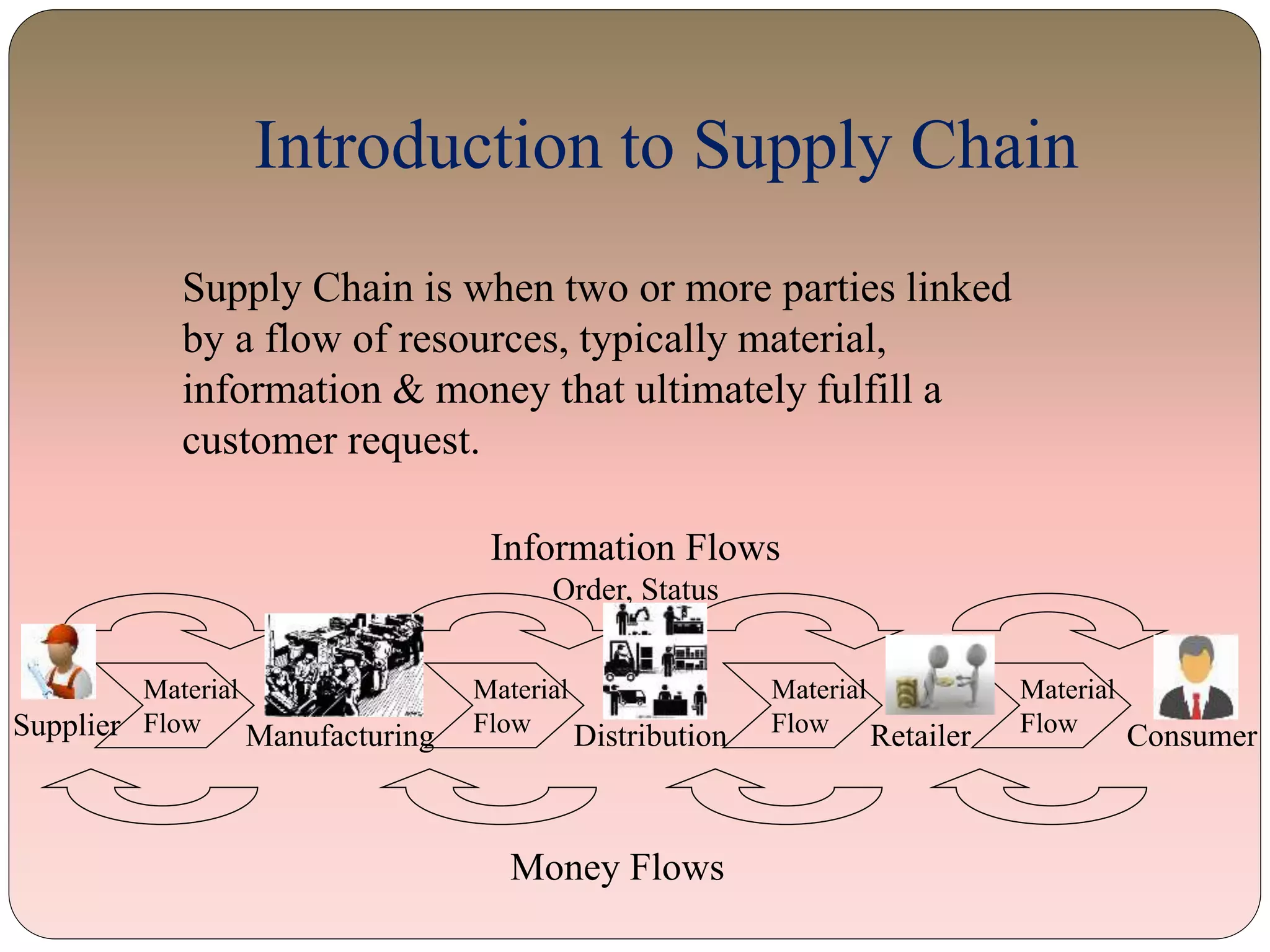
Material
Flow
Material
Flow
Material
Flow
Material
FlowManufacturing Distribution Retailer Consumer
Information Flows
Order, Status
Supplier
Money Flows
Supply Chain is when two or more parties linked
by a flow of resources, typically material,
information & money that ultimately fulfill a
customer request.
Introduction to Supply Chain
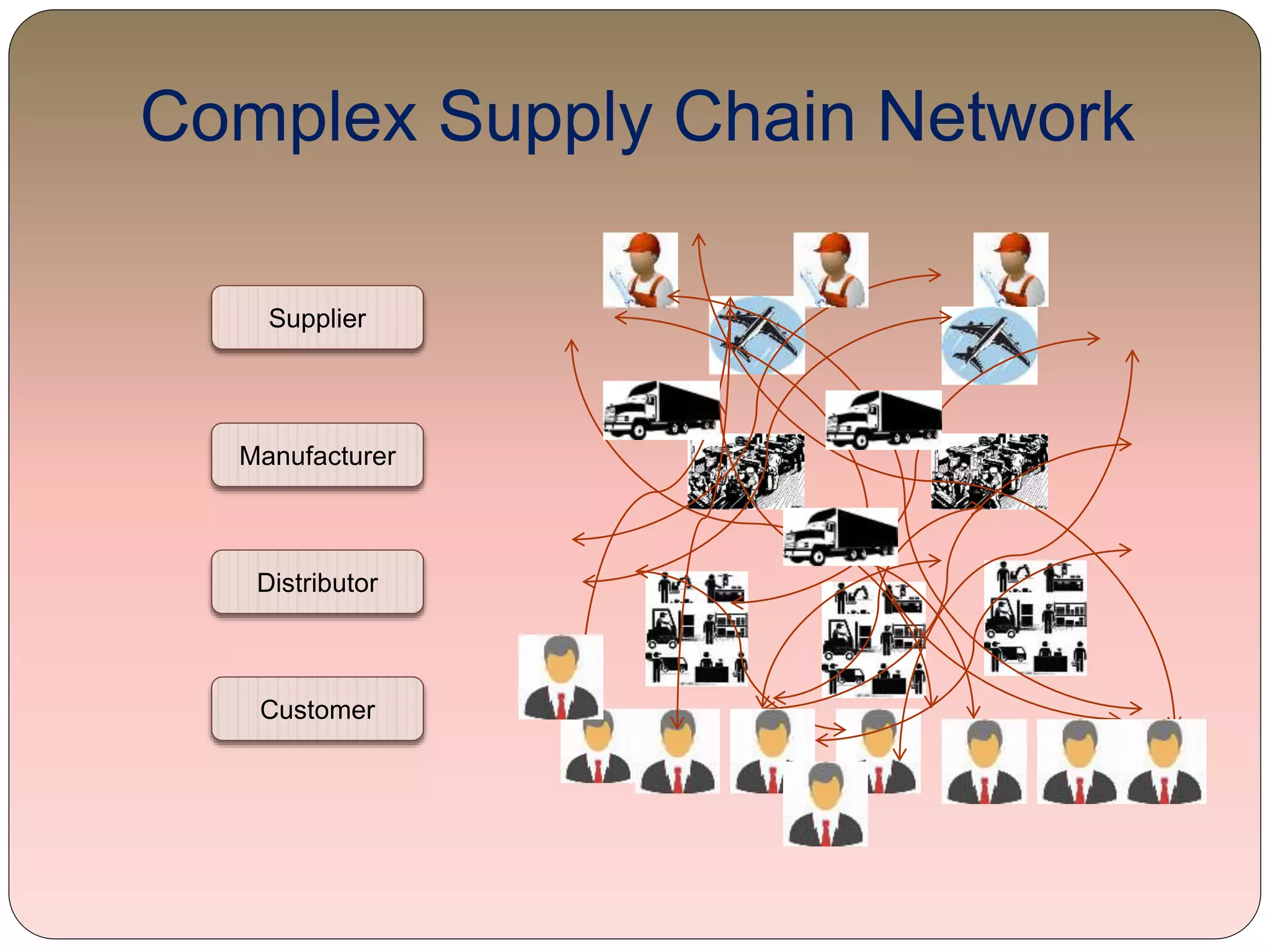
Customer
Supplier
Manufacturer
Distributor
Complex Supply Chain Network
Introduction to IT used in Supply
Chain
Recent development in technologies enables the organization
to avail information easily in their premises. These
technologies are helpful to coordinates the activities to
manage the supply chain.
In the field of supply chain management, there has always
been an abundance of data. Shipping bills alone make a lot of
information. Gathering the data is important; evaluating the
information, setting benchmarks and measuring performance
and progress is critical, the purity of raw material is important.
The small issues can have a measure impact.
From the data available many reports are generated, which
can pinpoint simple solutions that can generate cost saving
and or service improvements.
Section II:
Theoretical
View
Traditional View of Supply
Chain
1
• Focus on competition
2
• Supply Chains contain far more than the required
inventory
3
• Products are handled too many times (5/6 average)
4
• Physical carriers struggle to maintain costly equipment
on slim margins
5
• No player has enough information to synchronies
/optimizes the entire chain.
Consequences of Traditional
View
1
• Lack of knowledge of the end-to-end demand function
– high levels of uncertainty
2
• Erratic variations in demand (Bull whip effect)
3
• Fragmentation of processes and operations
4
• Lack of process integration with partners
5
• Need for integrated information systems
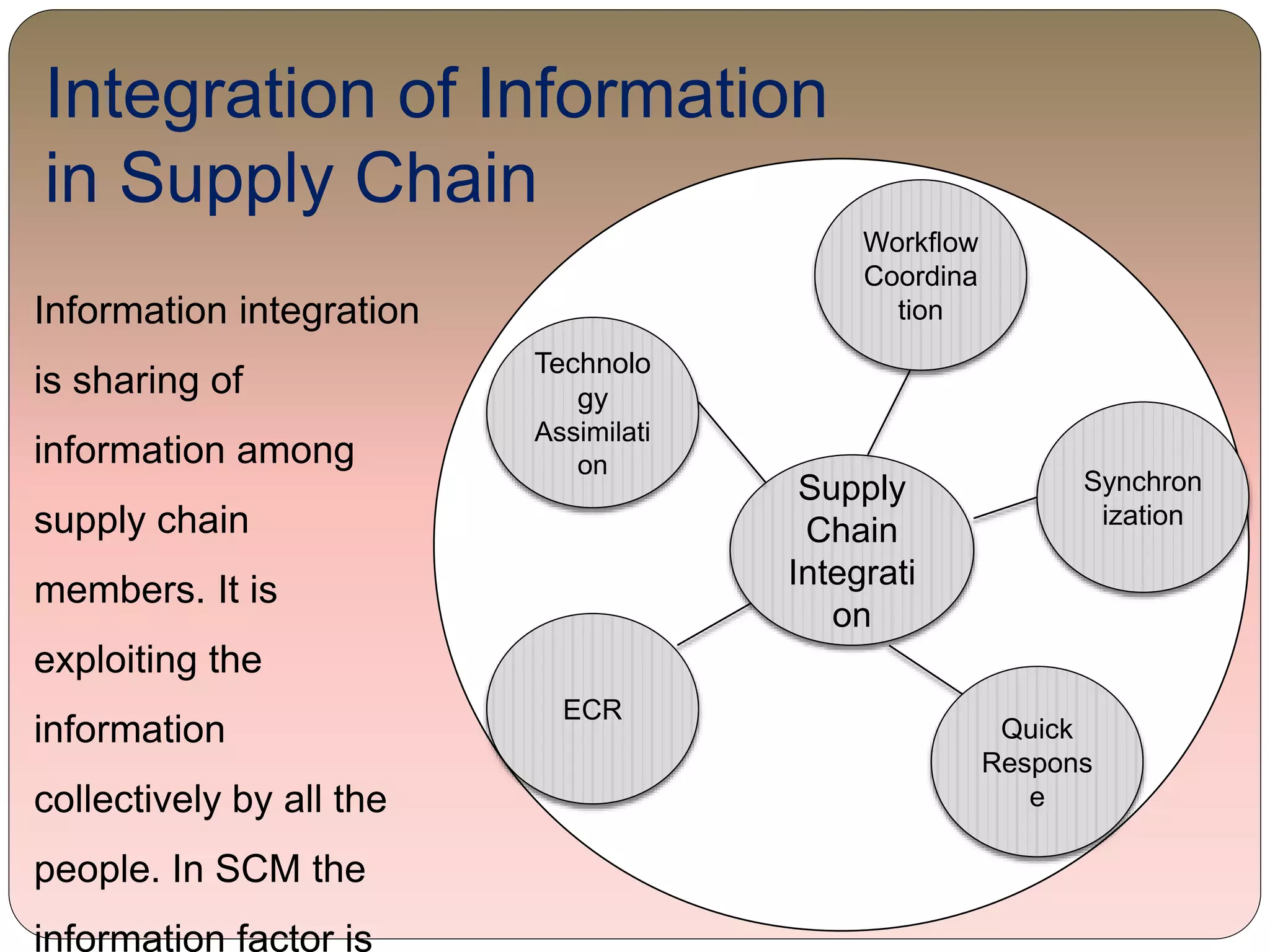
Supply
Chain
Integrati
on
Technolo
gy
Assimilati
on
ECR
Workflow
Coordina
tion
Synchron
ization
Quick
Respons
e
Integration of Information
in Supply Chain
Information integration
is sharing of
information among
supply chain
members. It is
exploiting the
information
collectively by all the
people. In SCM the
information factor is
Importance of IT
Management In Supply
Chain
Gathering and evaluating information
For report generation and decision making
Competitive advantage
Integrating and coordinating processes of supply chain
Cost of information sharing
Quick response
Benefits of Information
Technology In Supply Chain
Provide
information
availability
and
visibility
Enable a
single point
of contact
for data
Allow
decisions
based on
total supply
chain
Information
Enable
collaboration
with
Partners
Type of IT
Use in SCM
Drivers of Using
IT in SCM
Transaction
processing
Supply chain planning
and collaboration
Order tracking and
delivery coordination
•Reduction of Cost.
•Volume of Transactions.
•Speeding up Information transfer.
•Elimination of Human Errors.
•Unpredictable and logistically
demanding Environment.
•Project Orientation of the Business.
•In Transit Delivery Consolidation.
Areas In Which IT Use For Optimizing Supply
Chain
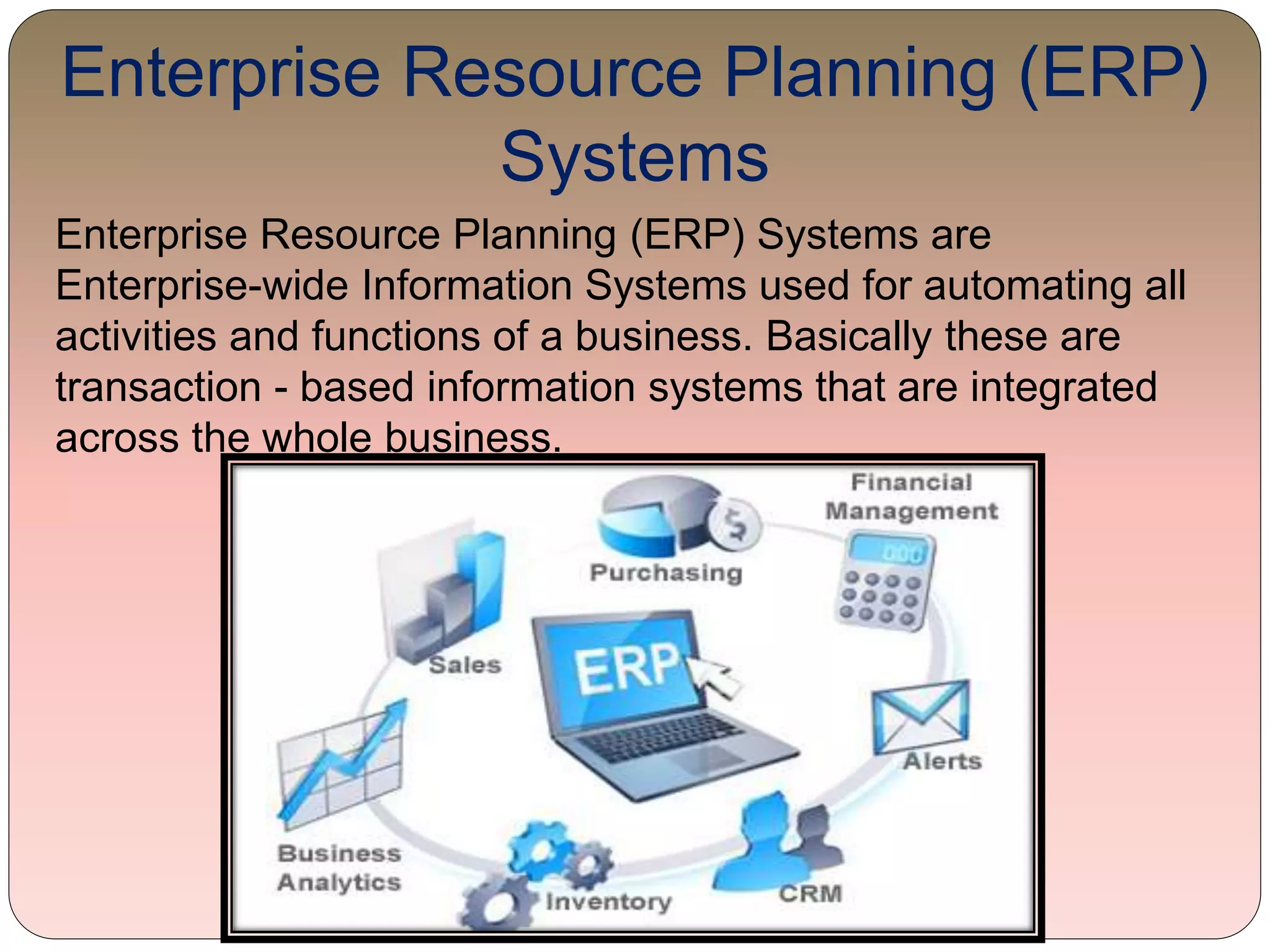
Enterprise Resource Planning (ERP)
Systems
Enterprise Resource Planning (ERP) Systems are
Enterprise-wide Information Systems used for automating all
activities and functions of a business. Basically these are
transaction - based information systems that are integrated
across the whole business.
Decision
Support
System
Integrate
Current
Information
Compare
Sales
Information
Forecast
Revenue
Information
Information
About
Consequenc
e of different
Alternative
Decisions
Transportation Management
Systems
Transportation Management Systems provide more visibility
into shipments and orders. Scheduling issues are also
addressed on time. Multiple transportation options can be
explored as a result of earlier visibility into the supply chain.
Timely communication
and status reports can
also be obtained. By
having control on its
supply chain,
businesses can make
efficient routing
decisions.
Advantaged of Transport
Management System
Increase
customer
service
Increase in
Warehouse
Efficiency
Develop
New
Delivery
Capabilities
Inventory
Reductions
Cash Flow
Improveme
nts
Inventory
Management
System
Defective
inventory
Return
Inventory
Inventory
forecasting
Inventory
valuation
Inventory
visibility
Future
inventory
Inventory
price
Availability
of place for
inventory
Inventory in
Hand
Demand
forecasting
Inventory
carrying
cost
Purchase
request
initiated in the
organization
Finance
department
Purchasing
department
Paper-based
information
Inventory and
warehousing
Receiving
department
Manufacturin
g department
Shipping
department
Sales
department
Paper-based
information
Finance
department
Buyer Seller
Order Delivery Information
Flow Without EDI
Payme
nt
Order
delivery
Order
confirmation
Bill
Finance
department
Sales
department
EDI capable
computer
Manufacturing
department
Shipping
department
Purchase
request
initiated in the
organization
EDI capable
computer
Purchasing
department
Receiving
department
Inventory and
warehousing
Finance
department
Buyer Seller
Payment
Automated order
confirmation
Billing
details
Purchase
order delivery
Order Delivery Information
Flow With EDI
Central
Warehouse
Distribution
center 1
Distribution
center 2
Retailer 1
Retailer 2
Retailer 3
Retailer 4
Retailer 5
Retailer 6
Material Flow
Information Flow
Distribution Requirement Planning
DRP system is a widely used and potentially
powerful technique for helping outbound
logistics systems manage and minimize
inbound inventories.
Bar Coding And
Scanner
Bar Codes are the representation of a number or code in a
form suitable for reading by machines. Bar codes are widely
used throughout the supply chain to identify and track goods at
all stages in the process. Bar codes are a series of different
width lines that may be presented in a horizontal order, called
ladder orientation, or a vertical order, called picket fence
orientation.
Process Flow of Tracking
and Tracing In Shipment
Run the tracking
list report in the
client’s system
Go to carrier
website
Get the carrier
name
Master BOL#
Container#
Get the unique File
number for each
shipment
transactions
Update the status
in client’s system
Output will reflect
in client’s web
tracking page
Track the current
container
movement status
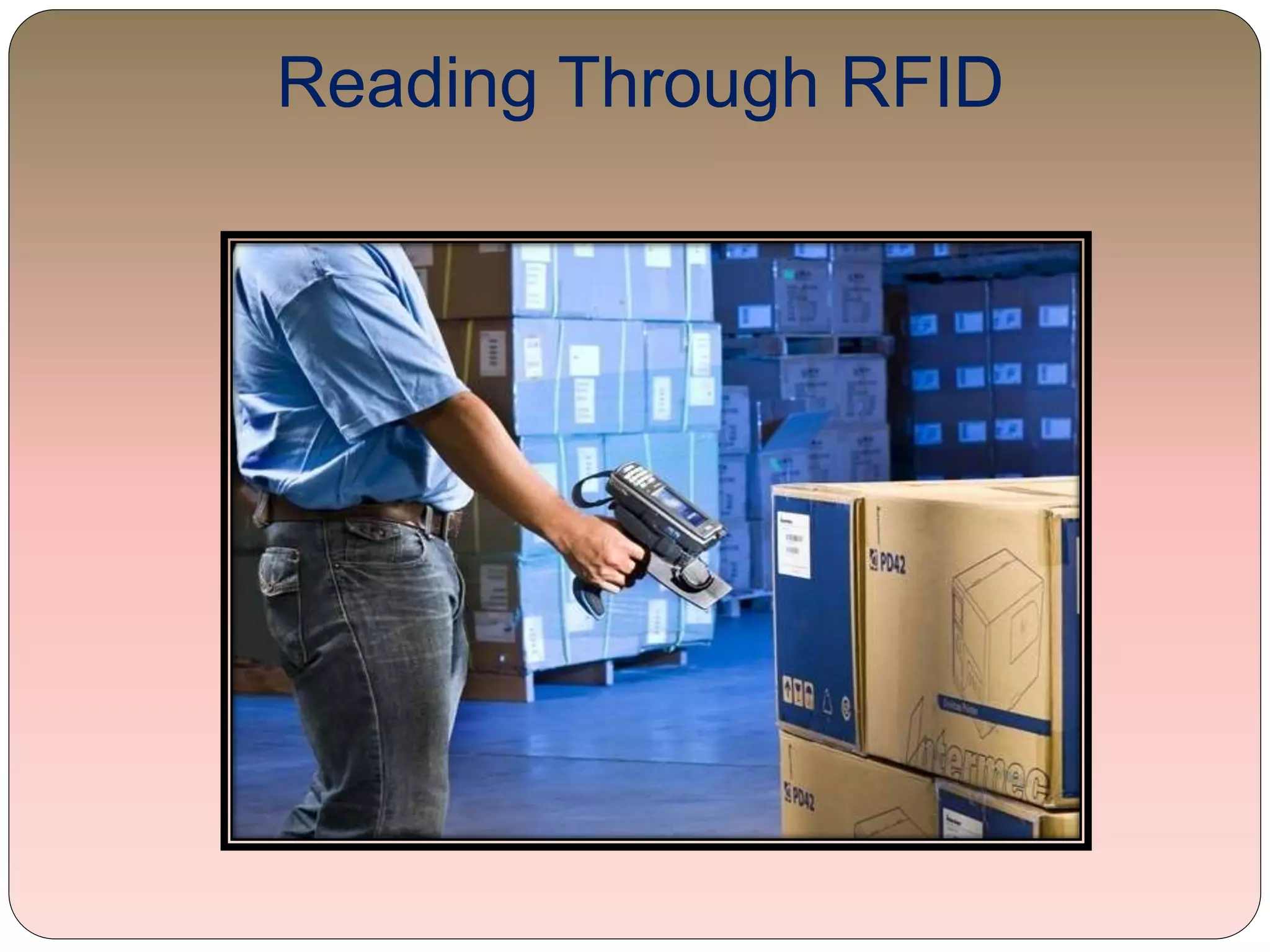
Radio Frequency
Identification
Both RFID and Bar codes are indeed, quite similar, both being auto-
ID technologies, which are intended to provide item identification.
The primary difference is the reading data from the items. In bar
coding, the reading device scans a printed label with optical laser or
imaging technology and in RFID; the reading device scans a tag by
using radio frequency signals.
Reading Through RFID
Software Agents
Buyer agents or
shopping bots
User agents
(personal agents)
Data
mining
agents
Monitoring and
Surveillance
Agent.
Manufacturer
C
Warehouse
A
Warehouse
B
Warehouse
C
Retailer
Configurato
r
Consumer
Manufacturer
A
Manufacturer
B
UDDI
Business
Registry
Logging
Web Service Architecture
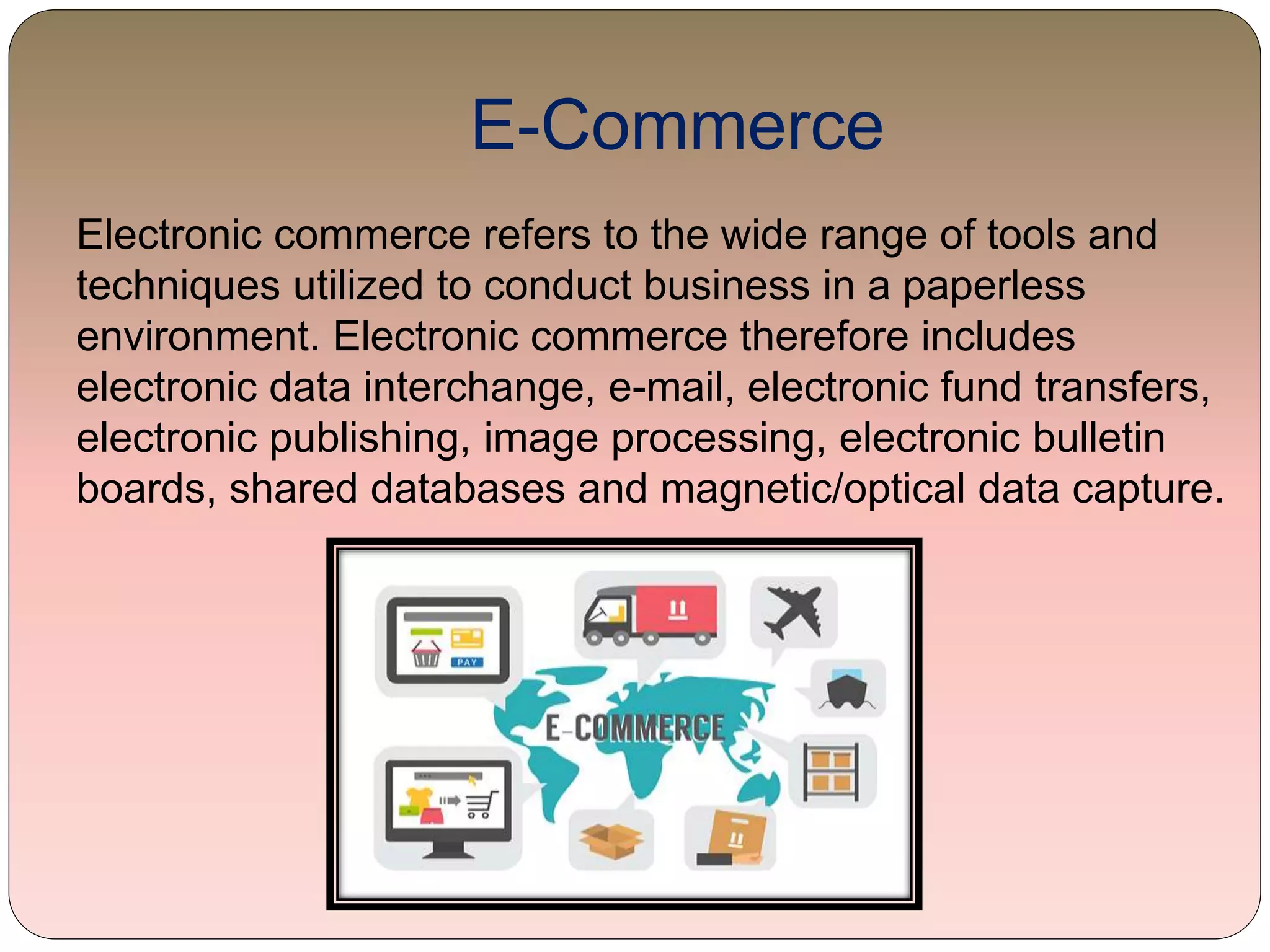
E-Commerce
Electronic commerce refers to the wide range of tools and
techniques utilized to conduct business in a paperless
environment. Electronic commerce therefore includes
electronic data interchange, e-mail, electronic fund transfers,
electronic publishing, image processing, electronic bulletin
boards, shared databases and magnetic/optical data capture.
Sales force
Automation
Software that automates
an organization’s sales
activities such as lead
distribution and tracking,
contact management,
sales process
management pipeline
management, sales
forecasting tools, and
automated generation of
quotes and orders. It is
Supply Chain
Management of
Information System
SC Management
Information System
(MIS) is a planned
system of collecting,
storing, and
disseminating data
in the form of
information needed
to carry out the
functions of
Objectives of Supply Chain MIS
1 • Operational Excellence
2 • New Products, Services and Business Models
3 • Services and Business Models
4 • Customer and Supplier Intimacy
5 • Improved Decision-making
6 • Competitive advantage, and Survival
Supply Chain MIS Development
Process
• The Supply Chain management information system
needs good planning.
• This system should deal with the management
information not with data processing alone.
• It should provide support for the management planning,
decision-making and action.
• It should provide support to the changing needs of
Supply Chain business management.
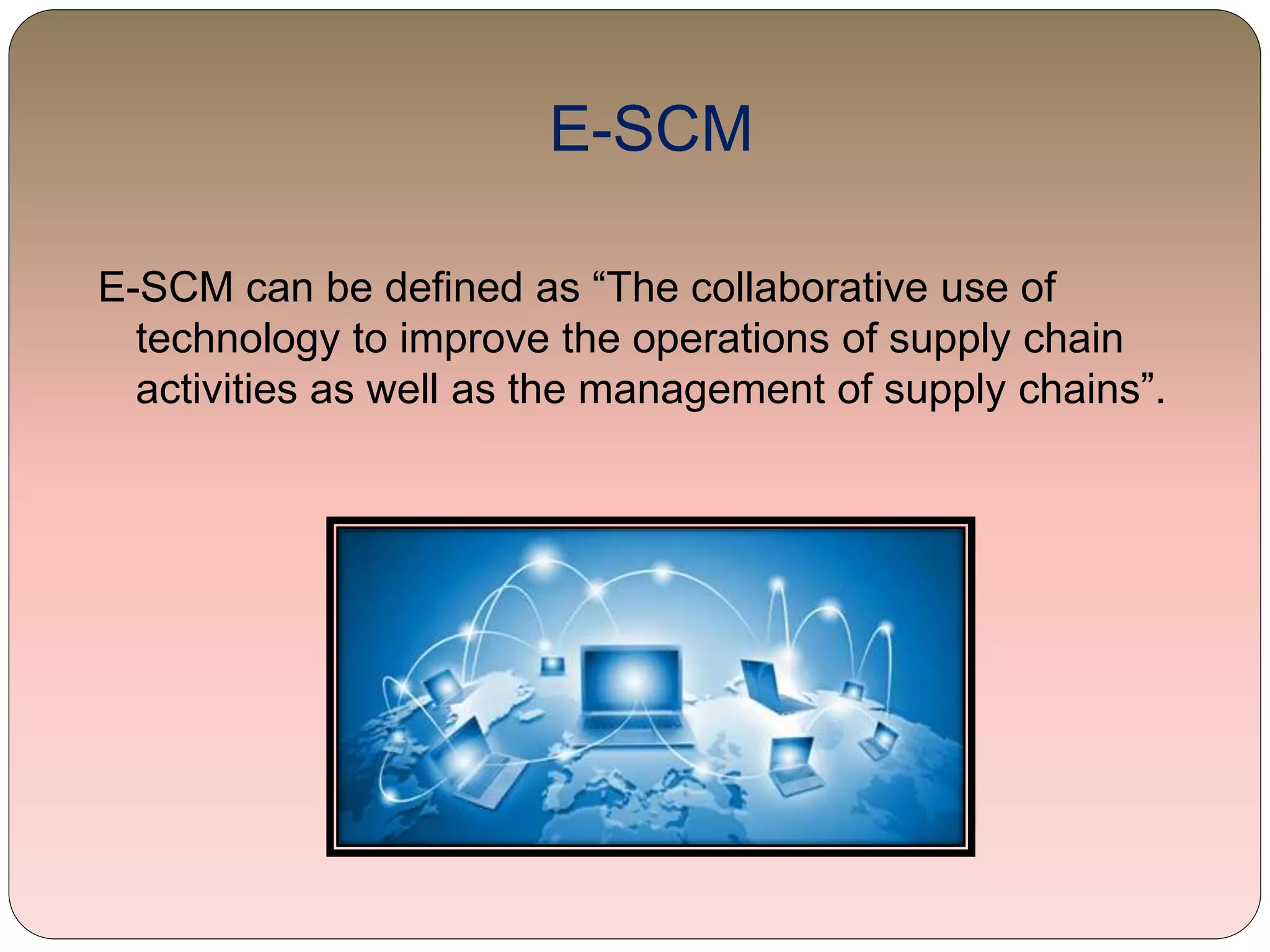
E-SCM
E-SCM can be defined as “The collaborative use of
technology to improve the operations of supply chain
activities as well as the management of supply chains”.
Need for E-SCM
• Globalization
• Change in SCM method
• To meet with growing demand of customer
• The effort to optimize the organization by having lower
inventory levels both in manufacture and distribution
• To carry out production with low inventory and low cost
and higher production.
• Outsourcing of some operational functions
• E-business and E-commerce of new era
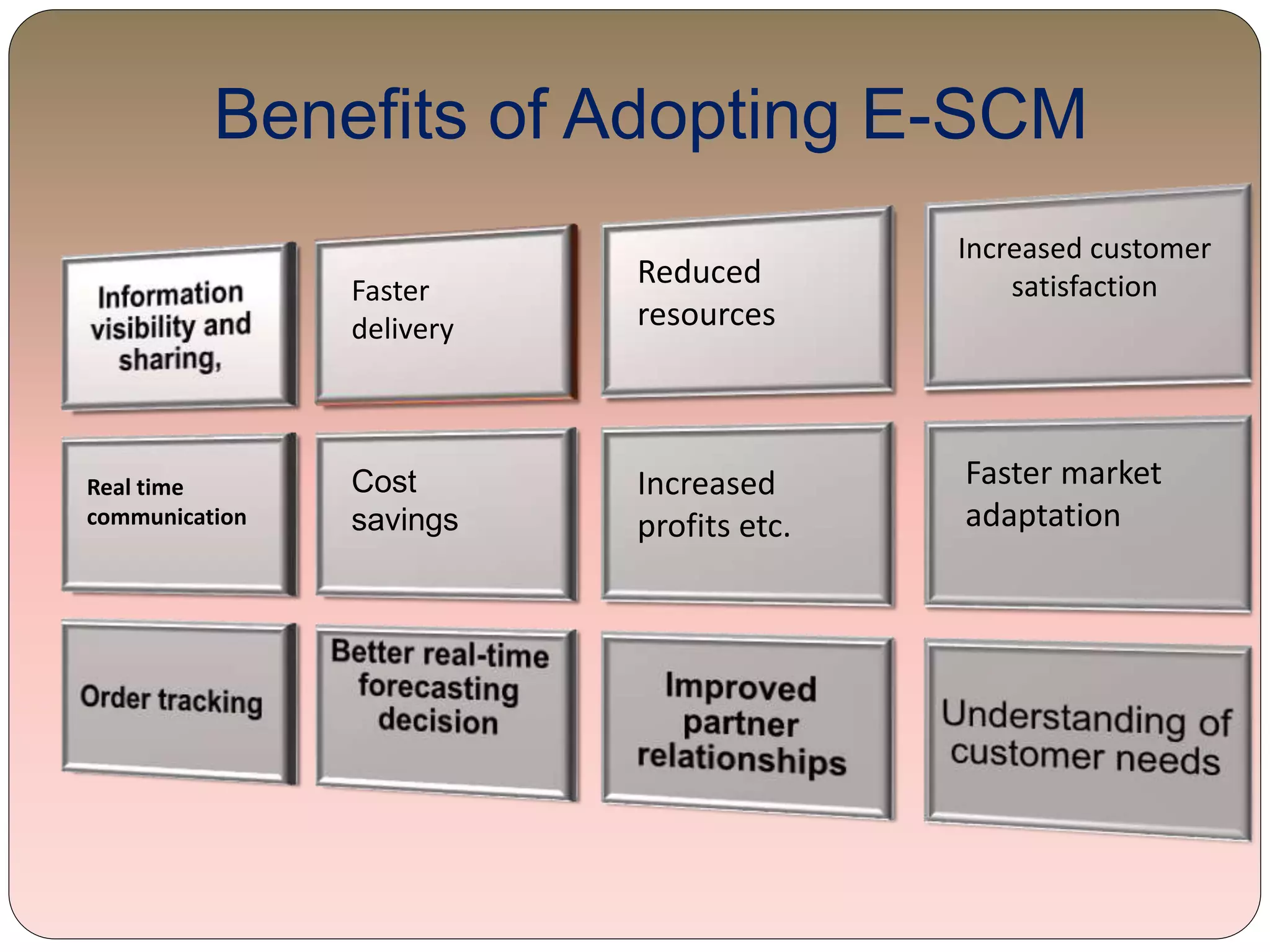
Benefits of Adopting E-SCM
Real time
communication
Faster
delivery
Cost
savings
Reduced
resources
Increased
profits etc.
Increased customer
satisfaction
Faster market
adaptation
Section III:
Methodology
of the Study
Summarized View of the
CaseWal-Mart is an American multinational retail corporation that
operates a chain of hypermarkets, discount department stores
and grocery stores. Wal-Mart has 11,539 stores and clubs in
28 countries, under a total of 63 banners. Wal-Mart is the
world's largest company by revenue, according to the Fortune
Global 500 list in 2016, as well as the largest private employer
in the world with 2.2 million employees.
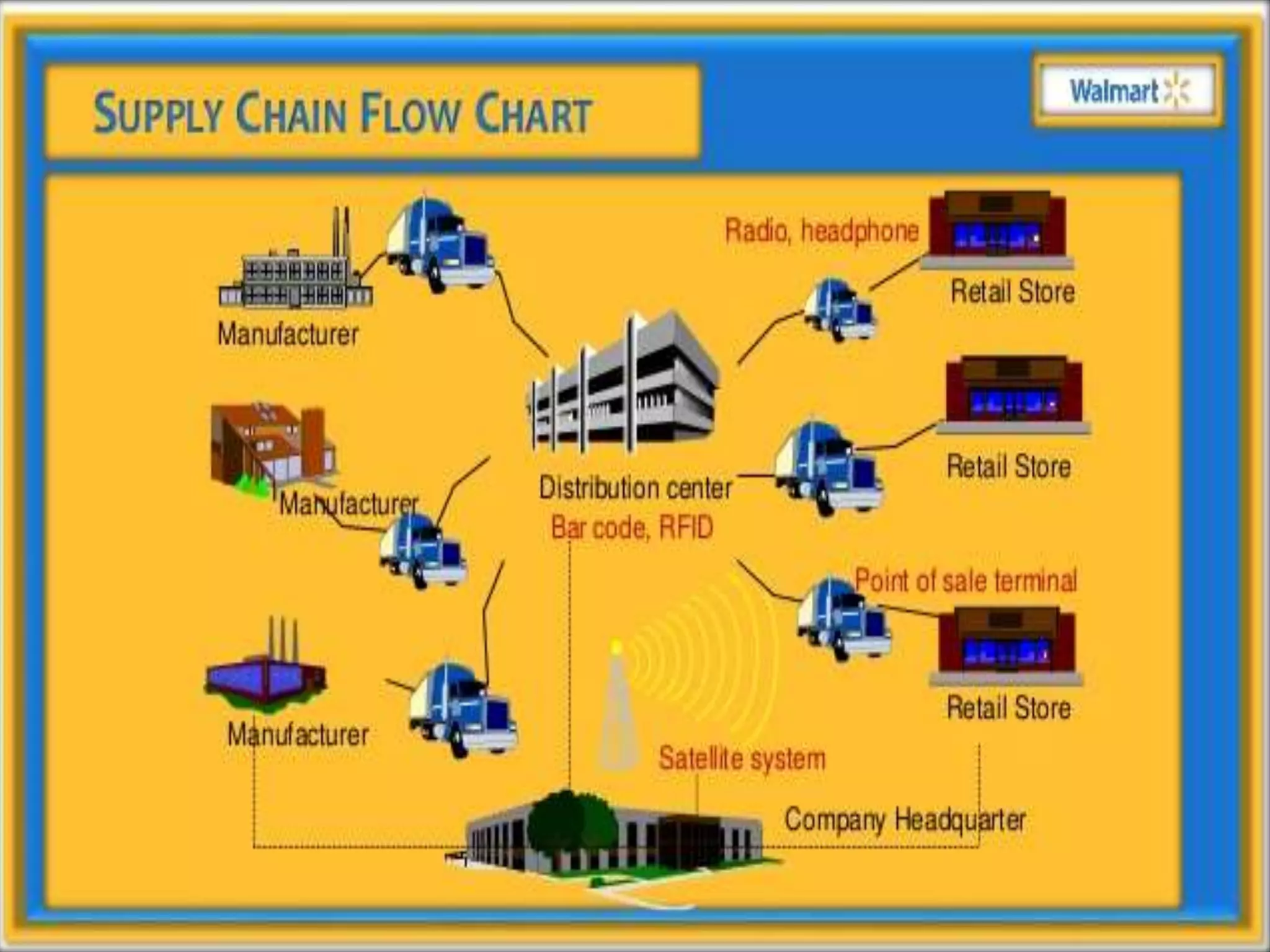
Wal-Mart’s SCM process is not based entirely on technology.
The company has a sprawling network of nearly 160
distribution centers covering almost 120 million square feet
and all within 130 miles of the stores it supplies, the retailer
also instituted cross-docking at its warehouses. Wal-Mart also
uses its own trucking fleet and drivers. Wal-Mart can improve
its HR management standards and product quality standards
to improve firm performance. Wal-Mart Stores Data Integrity
Wal-Mart has been able to stay ahead of the pack by taking
market share from competitors, but as consumers pull back on
discretionary spending, there is only so much business to go
around. The company has responded by increasing the
energy efficiency of its U.S. trucking fleet and many of its
buildings in the United States, Canada, and China. Supply
chains worldwide are reducing their packaging in response to
the company's demands. Wal-Mart already demands that
some suppliers evaluate their environmental footprints and
adhere to sustainability standards.
For almost five years, Wal-Mart executives have been
complaining about the company's struggles to keep its
shelves well stocked with merchandise. In April 2013, Wal-
Mart executives acknowledged it has an inventory
management problem; the company lost $3 billion in 2013
sales due to out of stock merchandise. That problem was
successfully solved by implementing technology called Radio
SWOT Analysis
Strengths of Wal-Mart: Wal-Mart has 11,539 stores and
clubs in 28 countries, under a total of 63 banners, majorly
based in US, Canada, UK, Argentina, Brazil, Japan and India
Wal-Mart is the world's largest company by revenue,
according to the Fortune Global 500 list in 2016, as well as
the largest private employer in the world with 2.2 million
employees, it had become the largest in terms of revenue.
The company has a sprawling network of nearly 160
distribution centers covering almost 120 million square feet
and all within 130 miles of the stores. The operations portion
of a supply chain focuses on demand planning, forecasting
and inventory management.
Wal-Mart committed to improving its environmental track
record in 2005 after environmental and social concerns
began to erode its public image. Environmentalists cited the
sprawling warehouse-sized stores as sources of air and water
Weaknesses of Wal-Mart - Wal-Mart’s Dirty Secret Since the
start of the current economic downturn, Wal-Mart has
outperformed its peers. And while it continues to do so, the
spread between them keeps shrinking, further dimming hopes
for an across-the-board recovery. Wal-Mart plans to combine
data on water use, greenhouse gas emissions, solid waste
production, and worker ethics into a database shared
worldwide, which the company said could be used to form the
first index of a product's lifecycle impact.
Wal-Mart Opportunities - Consumers have begun to realize
that shopping for food online is not only more time-efficient
and cost-effective, but is also more organized compared to the
in-store experience and can be done with less physical effort.
Food shopping online, this trend can only be strengthened by
rapidly advancing mobile technology accessibility. It is also a
chance for Wal-Mart. The company, in order to take
advantage of emerging new means of distribution, needs to
Wal-Mart’s Threats - Wal-Mart has been able to stay ahead
of the pack by taking market share from competitors, but as
consumers pull back on discretionary spending, there is only
so much business to go around. Discounter Target recently
announced that its own same-store sales are below plan,
and Federated Department Store has said that it, too, may
miss its September target. In early afternoon trading, Wal-
Mart shares were down 4.4%, Target sank 8% and
Federated fell 4.7%. The consumer is climbing into a shell,
“especially with regard to discretionary spending.” While
sales of consumables like groceries are holding up well,
apparel, for instance, which accounts for about 17% of Wal-
Mart’s earnings, has been quite weak for all retailers. When
you lose apparel sales, you lose more on the margins,
because they’re much higher in that segment.
Section IV:
Conclusion &
Suggestion
Conclusion of This Report
Industry trends like globalization, outsourcing, customization,
time to market and pricing pressure have compelled
enterprises to adopt efficient and effective supply chain
management technologies, practices, and policies.
Customer’s expectations are also increasing and companies
are prone to more and more uncertain environments in the
face of increasing competition. To survive, companies will find
that their conventional supply chain integration will have to be
expanded beyond their boundaries so as to integrate all
stakeholders. Adoption of Information Technology tools is vital
for such efforts. This report discusses the role of IT as an
enabler in Supply Chain Management and also highlights the
vast benefits to companies with a comprehensive IT strategy.
Suggestio
n
I Would Like To Suggest Some
Technical Aspects That Are Needed
For The Implementation of IT In Supply
Chain.
Project Management: The absence of full time and dedicated
project management is a recognized contributing factor to
unsuccessful implementations. A Project Sponsor needs to be
appointed and may be the same person who sponsored the
vendor software selection. The Project Sponsor should be a
senior SCM executive, or another senior executive who clearly
understand SCM strategy.
Implementation Methodology: Once objectives, deliverables
and project plans have been analyzed, most supply chain
management IT implementation can then be structured into a
four phase implementation methodology, i.e. Building Phase,
Test Phase, Training Phase, and Documentation Phase.
Section V:
Bibliography
Bibliography
https://en.wikipedia.org/wiki/Supply_chain_management_soft
ware
http://www.indianmba.com/faculty_column/fc461/fc461.html
http://www.supplychainbrain.com/content/general-scm/quality-
metrics/single-article-page/article/how-technology-can-ease-
supply-chain-management-and-mitigate-risk/
https://www.emyspot.com/
http://www.mbaskool.com/business-articles/operations/2083-
role-of-information-technology-in-supply-chain-
optimization.html
http://www.csiindia.org/document_library/Overview%20on%20I
nformation%20Technology%20Tolls%20for%20Supply%20Cha
in%20Management3963.pdf
http://www.tutorialspoint.com/management_information_syste
m/management_information_system_summary.htm
https://isapurnama.wordpress.com/2012/01/04/inventory-
E-commerce text book of Welingkar Institute of Management
by Prof. Nitin C. Kamat
Introduction to supply chain video of We Lecture (Welingkar
Institute of Management)
http://www.forbes.com/2002/09/30/0930walmart.html
http://blog.cayenneapps.com/2015/04/14/walmart-swot-
analysis/
http://www.worldwatch.org/node/6200
http://www.forbes.com/sites/paularosenblum/2014/05/22/wal
mart-could-solve-its-inventory-problem-and-improve-
earnings/#6516df5240ca
use of IT in supply chain management

use of IT in supply chain management

  • 1.
    PRESENTATION ON INFORMATION TECHNOLOGYMANAGEMENT IN SUPPLY CHAIN A CASE STUDY OF WAL-MART SUPPLY CHAIN By Rohit Bhabal HPGD/JA15/1299 Specialization: International Business
  • 2.
    Table of Contents SectionI: Introduction 1. Introduction to Supply Chain 2. Complex Supply Chain Network 3. Introduction to IT in supply chain Section II: Theoretical View 1. Traditional View of Supply Chain 2. Consequences of Traditional View 3. Supply Chain Integration 4. Importance of IT Management In Supply Chain
  • 3.
    5. Areas InWhich IT Use For Optimizing Supply Chain 6. Benefits of Information Technology In Supply Chain 7. Various Types of IT Used In Supply Chain 7.1 Enterprise Resource Planning (ERP) Systems 7.2 Decision Support System 7.3 Transportation Management Systems 7.4 Advantaged of Transport Management System 7.5 Inventory Management System 7.6 Order Delivery Information Flow Without EDI 7.7 Order Delivery Information Flow With EDI 7.8 Bar Coding And Scanner
  • 4.
    7.9 Tracking andTracing Shipment 7.10 Process Flow of Tracking and Tracing In Shipment 7.11 Radio Frequency Identification 7.12 Reading Through RFID 7.13 Software Agents 7.14 Web Service Architecture 7.15 Distribution Requirement Planning 7.16 E-Commerce 7.17 Sales force Automation 8. Management of Information System 8.1 Objectives of Supply Chain MIS
  • 5.
    8.2 Supply ChainMIS Development Process 9. E-SCM 9.1 Need for E-SCM 9.2 Benefits of E-SCM Section III: Methodology of The Study 1. Summarized View of The Wal-Mart case 2. SWOT Analysis Section IV: Conclusion and Suggestion Section V: Limitation of Study Section VI: Bibliography
  • 7.
    Material Flow Material Flow Material Flow Material FlowManufacturing Distribution RetailerConsumer Information Flows Order, Status Supplier Money Flows Supply Chain is when two or more parties linked by a flow of resources, typically material, information & money that ultimately fulfill a customer request. Introduction to Supply Chain
  • 8.
  • 9.
    Introduction to ITused in Supply Chain Recent development in technologies enables the organization to avail information easily in their premises. These technologies are helpful to coordinates the activities to manage the supply chain. In the field of supply chain management, there has always been an abundance of data. Shipping bills alone make a lot of information. Gathering the data is important; evaluating the information, setting benchmarks and measuring performance and progress is critical, the purity of raw material is important. The small issues can have a measure impact. From the data available many reports are generated, which can pinpoint simple solutions that can generate cost saving and or service improvements.
  • 10.
  • 11.
    Traditional View ofSupply Chain 1 • Focus on competition 2 • Supply Chains contain far more than the required inventory 3 • Products are handled too many times (5/6 average) 4 • Physical carriers struggle to maintain costly equipment on slim margins 5 • No player has enough information to synchronies /optimizes the entire chain.
  • 12.
    Consequences of Traditional View 1 •Lack of knowledge of the end-to-end demand function – high levels of uncertainty 2 • Erratic variations in demand (Bull whip effect) 3 • Fragmentation of processes and operations 4 • Lack of process integration with partners 5 • Need for integrated information systems
  • 13.
    Supply Chain Integrati on Technolo gy Assimilati on ECR Workflow Coordina tion Synchron ization Quick Respons e Integration of Information inSupply Chain Information integration is sharing of information among supply chain members. It is exploiting the information collectively by all the people. In SCM the information factor is
  • 14.
    Importance of IT ManagementIn Supply Chain Gathering and evaluating information For report generation and decision making Competitive advantage Integrating and coordinating processes of supply chain Cost of information sharing Quick response
  • 15.
    Benefits of Information TechnologyIn Supply Chain Provide information availability and visibility Enable a single point of contact for data Allow decisions based on total supply chain Information Enable collaboration with Partners
  • 16.
    Type of IT Usein SCM Drivers of Using IT in SCM Transaction processing Supply chain planning and collaboration Order tracking and delivery coordination •Reduction of Cost. •Volume of Transactions. •Speeding up Information transfer. •Elimination of Human Errors. •Unpredictable and logistically demanding Environment. •Project Orientation of the Business. •In Transit Delivery Consolidation. Areas In Which IT Use For Optimizing Supply Chain
  • 17.
    Enterprise Resource Planning(ERP) Systems Enterprise Resource Planning (ERP) Systems are Enterprise-wide Information Systems used for automating all activities and functions of a business. Basically these are transaction - based information systems that are integrated across the whole business.
  • 18.
  • 19.
    Transportation Management Systems Transportation ManagementSystems provide more visibility into shipments and orders. Scheduling issues are also addressed on time. Multiple transportation options can be explored as a result of earlier visibility into the supply chain. Timely communication and status reports can also be obtained. By having control on its supply chain, businesses can make efficient routing decisions.
  • 20.
    Advantaged of Transport ManagementSystem Increase customer service Increase in Warehouse Efficiency Develop New Delivery Capabilities Inventory Reductions Cash Flow Improveme nts
  • 21.
  • 22.
    Purchase request initiated in the organization Finance department Purchasing department Paper-based information Inventoryand warehousing Receiving department Manufacturin g department Shipping department Sales department Paper-based information Finance department Buyer Seller Order Delivery Information Flow Without EDI Payme nt Order delivery Order confirmation Bill
  • 23.
    Finance department Sales department EDI capable computer Manufacturing department Shipping department Purchase request initiated inthe organization EDI capable computer Purchasing department Receiving department Inventory and warehousing Finance department Buyer Seller Payment Automated order confirmation Billing details Purchase order delivery Order Delivery Information Flow With EDI
  • 24.
    Central Warehouse Distribution center 1 Distribution center 2 Retailer1 Retailer 2 Retailer 3 Retailer 4 Retailer 5 Retailer 6 Material Flow Information Flow Distribution Requirement Planning DRP system is a widely used and potentially powerful technique for helping outbound logistics systems manage and minimize inbound inventories.
  • 25.
    Bar Coding And Scanner BarCodes are the representation of a number or code in a form suitable for reading by machines. Bar codes are widely used throughout the supply chain to identify and track goods at all stages in the process. Bar codes are a series of different width lines that may be presented in a horizontal order, called ladder orientation, or a vertical order, called picket fence orientation.
  • 26.
    Process Flow ofTracking and Tracing In Shipment Run the tracking list report in the client’s system Go to carrier website Get the carrier name Master BOL# Container# Get the unique File number for each shipment transactions Update the status in client’s system Output will reflect in client’s web tracking page Track the current container movement status
  • 27.
    Radio Frequency Identification Both RFIDand Bar codes are indeed, quite similar, both being auto- ID technologies, which are intended to provide item identification. The primary difference is the reading data from the items. In bar coding, the reading device scans a printed label with optical laser or imaging technology and in RFID; the reading device scans a tag by using radio frequency signals.
  • 28.
  • 29.
    Software Agents Buyer agentsor shopping bots User agents (personal agents) Data mining agents Monitoring and Surveillance Agent.
  • 30.
  • 31.
    E-Commerce Electronic commerce refersto the wide range of tools and techniques utilized to conduct business in a paperless environment. Electronic commerce therefore includes electronic data interchange, e-mail, electronic fund transfers, electronic publishing, image processing, electronic bulletin boards, shared databases and magnetic/optical data capture.
  • 32.
    Sales force Automation Software thatautomates an organization’s sales activities such as lead distribution and tracking, contact management, sales process management pipeline management, sales forecasting tools, and automated generation of quotes and orders. It is
  • 33.
    Supply Chain Management of InformationSystem SC Management Information System (MIS) is a planned system of collecting, storing, and disseminating data in the form of information needed to carry out the functions of
  • 34.
    Objectives of SupplyChain MIS 1 • Operational Excellence 2 • New Products, Services and Business Models 3 • Services and Business Models 4 • Customer and Supplier Intimacy 5 • Improved Decision-making 6 • Competitive advantage, and Survival
  • 35.
    Supply Chain MISDevelopment Process • The Supply Chain management information system needs good planning. • This system should deal with the management information not with data processing alone. • It should provide support for the management planning, decision-making and action. • It should provide support to the changing needs of Supply Chain business management.
  • 36.
    E-SCM E-SCM can bedefined as “The collaborative use of technology to improve the operations of supply chain activities as well as the management of supply chains”.
  • 37.
    Need for E-SCM •Globalization • Change in SCM method • To meet with growing demand of customer • The effort to optimize the organization by having lower inventory levels both in manufacture and distribution • To carry out production with low inventory and low cost and higher production. • Outsourcing of some operational functions • E-business and E-commerce of new era
  • 38.
    Benefits of AdoptingE-SCM Real time communication Faster delivery Cost savings Reduced resources Increased profits etc. Increased customer satisfaction Faster market adaptation
  • 39.
  • 40.
    Summarized View ofthe CaseWal-Mart is an American multinational retail corporation that operates a chain of hypermarkets, discount department stores and grocery stores. Wal-Mart has 11,539 stores and clubs in 28 countries, under a total of 63 banners. Wal-Mart is the world's largest company by revenue, according to the Fortune Global 500 list in 2016, as well as the largest private employer in the world with 2.2 million employees. Wal-Mart’s SCM process is not based entirely on technology. The company has a sprawling network of nearly 160 distribution centers covering almost 120 million square feet and all within 130 miles of the stores it supplies, the retailer also instituted cross-docking at its warehouses. Wal-Mart also uses its own trucking fleet and drivers. Wal-Mart can improve its HR management standards and product quality standards to improve firm performance. Wal-Mart Stores Data Integrity
  • 41.
    Wal-Mart has beenable to stay ahead of the pack by taking market share from competitors, but as consumers pull back on discretionary spending, there is only so much business to go around. The company has responded by increasing the energy efficiency of its U.S. trucking fleet and many of its buildings in the United States, Canada, and China. Supply chains worldwide are reducing their packaging in response to the company's demands. Wal-Mart already demands that some suppliers evaluate their environmental footprints and adhere to sustainability standards. For almost five years, Wal-Mart executives have been complaining about the company's struggles to keep its shelves well stocked with merchandise. In April 2013, Wal- Mart executives acknowledged it has an inventory management problem; the company lost $3 billion in 2013 sales due to out of stock merchandise. That problem was successfully solved by implementing technology called Radio
  • 42.
    SWOT Analysis Strengths ofWal-Mart: Wal-Mart has 11,539 stores and clubs in 28 countries, under a total of 63 banners, majorly based in US, Canada, UK, Argentina, Brazil, Japan and India Wal-Mart is the world's largest company by revenue, according to the Fortune Global 500 list in 2016, as well as the largest private employer in the world with 2.2 million employees, it had become the largest in terms of revenue. The company has a sprawling network of nearly 160 distribution centers covering almost 120 million square feet and all within 130 miles of the stores. The operations portion of a supply chain focuses on demand planning, forecasting and inventory management. Wal-Mart committed to improving its environmental track record in 2005 after environmental and social concerns began to erode its public image. Environmentalists cited the sprawling warehouse-sized stores as sources of air and water
  • 43.
    Weaknesses of Wal-Mart- Wal-Mart’s Dirty Secret Since the start of the current economic downturn, Wal-Mart has outperformed its peers. And while it continues to do so, the spread between them keeps shrinking, further dimming hopes for an across-the-board recovery. Wal-Mart plans to combine data on water use, greenhouse gas emissions, solid waste production, and worker ethics into a database shared worldwide, which the company said could be used to form the first index of a product's lifecycle impact. Wal-Mart Opportunities - Consumers have begun to realize that shopping for food online is not only more time-efficient and cost-effective, but is also more organized compared to the in-store experience and can be done with less physical effort. Food shopping online, this trend can only be strengthened by rapidly advancing mobile technology accessibility. It is also a chance for Wal-Mart. The company, in order to take advantage of emerging new means of distribution, needs to
  • 44.
    Wal-Mart’s Threats -Wal-Mart has been able to stay ahead of the pack by taking market share from competitors, but as consumers pull back on discretionary spending, there is only so much business to go around. Discounter Target recently announced that its own same-store sales are below plan, and Federated Department Store has said that it, too, may miss its September target. In early afternoon trading, Wal- Mart shares were down 4.4%, Target sank 8% and Federated fell 4.7%. The consumer is climbing into a shell, “especially with regard to discretionary spending.” While sales of consumables like groceries are holding up well, apparel, for instance, which accounts for about 17% of Wal- Mart’s earnings, has been quite weak for all retailers. When you lose apparel sales, you lose more on the margins, because they’re much higher in that segment.
  • 46.
  • 47.
    Conclusion of ThisReport Industry trends like globalization, outsourcing, customization, time to market and pricing pressure have compelled enterprises to adopt efficient and effective supply chain management technologies, practices, and policies. Customer’s expectations are also increasing and companies are prone to more and more uncertain environments in the face of increasing competition. To survive, companies will find that their conventional supply chain integration will have to be expanded beyond their boundaries so as to integrate all stakeholders. Adoption of Information Technology tools is vital for such efforts. This report discusses the role of IT as an enabler in Supply Chain Management and also highlights the vast benefits to companies with a comprehensive IT strategy.
  • 48.
    Suggestio n I Would LikeTo Suggest Some Technical Aspects That Are Needed For The Implementation of IT In Supply Chain. Project Management: The absence of full time and dedicated project management is a recognized contributing factor to unsuccessful implementations. A Project Sponsor needs to be appointed and may be the same person who sponsored the vendor software selection. The Project Sponsor should be a senior SCM executive, or another senior executive who clearly understand SCM strategy. Implementation Methodology: Once objectives, deliverables and project plans have been analyzed, most supply chain management IT implementation can then be structured into a four phase implementation methodology, i.e. Building Phase, Test Phase, Training Phase, and Documentation Phase.
  • 49.
  • 50.
  • 51.
    E-commerce text bookof Welingkar Institute of Management by Prof. Nitin C. Kamat Introduction to supply chain video of We Lecture (Welingkar Institute of Management) http://www.forbes.com/2002/09/30/0930walmart.html http://blog.cayenneapps.com/2015/04/14/walmart-swot- analysis/ http://www.worldwatch.org/node/6200 http://www.forbes.com/sites/paularosenblum/2014/05/22/wal mart-could-solve-its-inventory-problem-and-improve- earnings/#6516df5240ca