
Supervising Counselors
in Training
J. LaVelle Ingram, Ph.D.
Key Points
 Supervision is a distinct intervention
that differs from training,
psychotherapy and consultation
 Supervision is a mentoring relationship &
provided by a member of the same
profession (e.g., psychologist, social
worker)
 Supervision is not a “voluntary”
relationship, although supervisees may
have some discretion over who they choose
as a supervisor
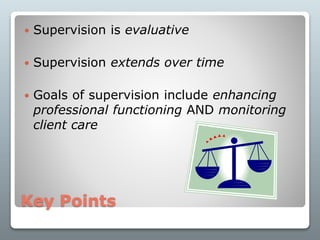
Key Points
 Supervision is evaluative
 Supervision extends over time
 Goals of supervision include enhancing
professional functioning AND monitoring
client care
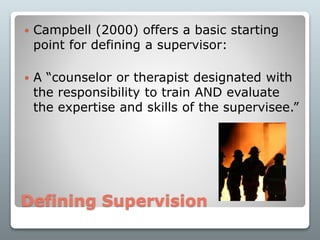
Defining Supervision
 Campbell (2000) offers a basic starting
point for defining a supervisor:
 A “counselor or therapist designated with
the responsibility to train AND evaluate
the expertise and skills of the supervisee.”
Defining Supervision
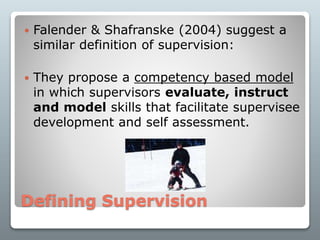
 Falender & Shafranske (2004) suggest a
similar definition of supervision:
 They propose a competency based model
in which supervisors evaluate, instruct
and model skills that facilitate supervisee
development and self assessment.
Ethically Responsible
 Campbell (2000) and Madden (2000)
stress the fact that supervisors-
Accept the ethical & legal responsibilities
of their supervisee & often need to be
competent in working within
organizational systems.
Supervisor Behaviors
Callahan, 2006; Magnuson & Wilcoxon, 1998)
have discussed –
Effective supervisory behaviors:
 Clarifying expectations
 Maintaining appropriate boundaries
 Being accessible and available
 Fostering exploration of new ideas
 Providing constructive criticism and positive
reinforcement
 Communicating effectively, and
 Working collaboratively
Supervisor Characteristics
These authors also identified preferred
personal qualities and characteristics of the
supervisor, including:
 Having a sense of humor
 Being sensitive and understanding,
 Being honest & open and
 Flexible & having
 Professional competence
Different Approaches
Heron’s (1988) model of supervision
describes Authoritative Supervision:
Interventions are prescriptive, that is they
 Direct behavior
 Inform, giving information & instruction
and
 Confront or challenge
VS
Different Approaches
Facilitative Supervision: Interventions
are cathartic, that is they-
 Release tension and strong emotions
 Catalytic- encourage self exploration & are
 Supportive
 Validating and
 Confirming
Supervision Competencies
Supervisor Knowledge
1. Knowledge of area being supervised
(psychotherapy, research, assessment,
etc.)
2. Knowledge of models, theories,
modalities, and research on supervision
3. Knowledge of professional/supervisee
development (how therapists develop, etc)
Supervision Competencies
Supervisor Knowledge cont.
4. Knowledge of ethics and legal issues
specific to supervision
5. Knowledge of evaluation, process
outcome
6. Awareness and knowledge of diversity in
all of its forms
Supervision Competencies
Supervisor Skills
1. Supervision modalities
2. Relationship skills- ability to build supervisory
relationship/alliance
3. Sensitivity to multiple roles with supervisee
and ability to perform & balance multiple roles
4. Ability to provide effective formative and
summative feedback
5. Ability to promote growth and self-
assessment in the trainee
6. Ability to conduct own self-assessment
process
Supervision Competencies
Supervisor Skills cont.
7. Ability to assess the learning needs and
developmental level of the supervisee
8. Ability to encourage and use evaluative
feedback from the trainee
9. Teaching and didactic skills
10. Ability to set appropriate boundaries and
seek consultation when supervisory issues
outside domain of supervisory competence
11. Flexibility
12. Scientific thinking and the translation of
scientific findings to practice throughout
professional development
Supervision Competencies
Supervisor Values
1. Responsibility for client and supervisee rests with the
supervisor
2. Respectful
3. Responsible for sensitivity to diversity in all its forms
4. Balance between support and challenging
5. Empowering
6. Commitment to lifelong learning and professional
growth
7. Balance between clinical and training needs
8. Value ethical principles
9. Commitment to knowing and utilizing available
psychological science related to supervision
10. Commitment to knowing one’s own limitations.
Supervision Competencies
Social Context
Overarching issues:
1. Diversity
2. Ethical and legal issues
3. Developmental process
4. Knowledge of the immediate system and
expectations within which the supervision is
conducted
5. Awareness of the socio-political context within
which the supervision is conducted
6. Creation of climate in which honest feedback is
the norm (both supportive and challenging)
Supervision Competency Training
Training of Supervision Competencies
1.Coursework in supervision including knowledge and skill
areas listed
2. Has received supervision of supervision including some
form of observation (videotape or audio-tape) with critical
feedback
Assessment of Supervision Competencies
1. Successful completion of course on supervision
2. Verification of previous supervision of supervision
documenting readiness to supervise independently
3. Evidence of direct observation (e.g., audio or videotape)
4. Documentation of supervisory experience reflecting
diversity
5. Documented supervisee feedback
6. Self-assessment and awareness of need for consultation
when necessary
7. Assessment of supervision outcomes– both individual and
group
Psychotherapy Based Supervision
The supervisor draws upon his or her own
theoretical orientation to inform the
supervision process, e.g.
 Psychodynamic
 Person-Centered
 Cognitive-Behavioral or
 Solution-focused
As the various approaches to therapy
highlight different goals and seek differing
data about therapeutic goals and success,
so do the different approaches to
supervision.
Theory-Based Supervision
Contributions of theory-based supervision
approaches in general include the
following: providing therapeutic relationship
conditions, modeling counseling
interventions, & providing a supervision
environment that is isomorphic (i.e.,
equivalent in structure) to the counseling
process (Thomas, 1994).
Theory-based Supervision
 Counseling theories also:
 Provide concepts for explaining human
behavior and
 interventions for promoting positive change
(Corey, 2005; Day, 2004), and offer
 Useful guides for conceptualizing client
situations and choosing & implementing
interventions
Cognitive-Behavioral Supervision
Cognitive behavioral supervision stresses
observable cognitions and behaviors such as
the supervisee’s reaction to the client (Hayes,
Corey, & Moulton, 2003).
Supervision techniques include:
 setting an agenda for supervision sessions,
 bridging from previous sessions
 assigning homework to the supervisee, &
 capsule summaries by the supervisor
(Liese &Beck, 1997)
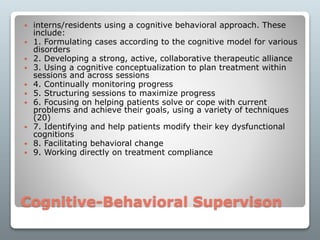
Cognitive-Behavioral Supervison
 interns/residents using a cognitive behavioral approach. These
include:
 1. Formulating cases according to the cognitive model for various
disorders
 2. Developing a strong, active, collaborative therapeutic alliance
 3. Using a cognitive conceptualization to plan treatment within
sessions and across sessions
 4. Continually monitoring progress
 5. Structuring sessions to maximize progress
 6. Focusing on helping patients solve or cope with current
problems and achieve their goals, using a variety of techniques
(20)
 7. Identifying and help patients modify their key dysfunctional
cognitions
 8. Facilitating behavioral change
 9. Working directly on treatment compliance
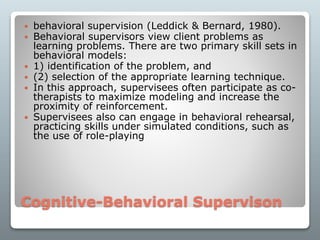
Cognitive-Behavioral Supervison
 behavioral supervision (Leddick & Bernard, 1980).
 Behavioral supervisors view client problems as
learning problems. There are two primary skill sets in
behavioral models:
 1) identification of the problem, and
 (2) selection of the appropriate learning technique.
 In this approach, supervisees often participate as co-
therapists to maximize modeling and increase the
proximity of reinforcement.
 Supervisees also can engage in behavioral rehearsal,
practicing skills under simulated conditions, such as
the use of role-playing
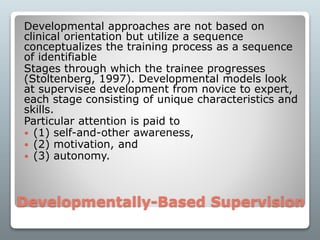
Developmentally-Based Supervision
Developmental approaches are not based on
clinical orientation but utilize a sequence
conceptualizes the training process as a sequence
of identifiable
Stages through which the trainee progresses
(Stoltenberg, 1997). Developmental models look
at supervisee development from novice to expert,
each stage consisting of unique characteristics and
skills.
Particular attention is paid to
 (1) self-and-other awareness,
 (2) motivation, and
 (3) autonomy.
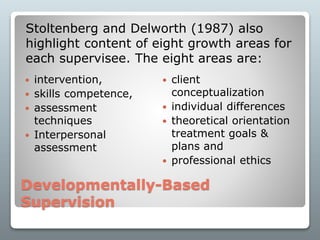
Developmentally-Based
Supervision
 intervention,
 skills competence,
 assessment
techniques
 Interpersonal
assessment
 client
conceptualization
 individual differences
 theoretical orientation
treatment goals &
plans and
 professional ethics
Stoltenberg and Delworth (1987) also
highlight content of eight growth areas for
each supervisee. The eight areas are:
Evaluating Supervisees
 Many authors provide guidelines for “fair”
evaluations. Campbell (2006), for example states
that supervisees should be given:
 Information, from the beginning, as to what is
expected of them
 Information as to who will receive the evaluative
feedback
 The criteria on which they will be judged and
copies of any evaluation forms
 Several examples of what is desired with goals
tied into specific behaviors
 Ongoing feedback as to how they are progressing
with regard to specific goals
 Plenty of opportunities to be successful and
helpful suggestions for improvement
Evaluating Supervisees-
Negatively
One of the most challenging supervisory situations is when there is a
need to provide a supervisee with a negative evaluation. ... The
following suggestions are helpful:
1)Adequately define criteria for evaluation, including what constitutes
positive and negative performance. It may be helpful to provide this
information in writing, so that there is no question that it has been
communicated.
2)Evaluate frequently, not only when the final evaluation is to occur.
Provide feedback and examples of how the supervisee can improve.
3)Use different techniques in evaluation. Use of case discussion only
does
not constitute a fair evaluation. When possible use objective rather
than subjective methods.
4)Seek consultation if needed.
5)Document, document, document.
6)Be prepared. Negative evaluation will likely be met emotionally,
anger,
sadness, accusations, tears
Supervisory Documentation
 A clinical supervision record should include the following
elements (Munson 2009; Kadushin, 2002; Campbell, 2002):
 The supervisory contract, if required by the agency, and
signed by the supervisor and the supervisee.
 A copy of the informed consent document, signed by the
supervisor and the supervisee.
 Requirements for therapist credentialing
(certification/licensure) and the extent to which each
supervisee
 meets those requirements.
 A brief summary supervisee experience, training and learning
needs
 A copy of the performance evaluations and all relevant
updates to these evaluations.
 A log of clinical supervision sessions, dates, times; and a
summary of key issues discussed; recommendations given by
the supervisor and actions taken by the therapist
Supervisory Documentation
 Documentation of cancelled or missed sessions
by either the supervisor or supervisee.
 A brief summary of each supervision session,
including specific examples that support
learning goals and objectives
 A risk management review summary, including
concerns about confidentiality, duty to warn
situations, crises, and the recommendations of
the supervisor concerning these situations.
 Significant problems encountered in the
supervision, and how they were resolved or
whether they remain unresolved
Conclusions
Supervisor must:

Supervision

  • 1.
  • 2.
    Key Points  Supervisionis a distinct intervention that differs from training, psychotherapy and consultation  Supervision is a mentoring relationship & provided by a member of the same profession (e.g., psychologist, social worker)  Supervision is not a “voluntary” relationship, although supervisees may have some discretion over who they choose as a supervisor
  • 3.
    Key Points  Supervisionis evaluative  Supervision extends over time  Goals of supervision include enhancing professional functioning AND monitoring client care
  • 4.
    Defining Supervision  Campbell(2000) offers a basic starting point for defining a supervisor:  A “counselor or therapist designated with the responsibility to train AND evaluate the expertise and skills of the supervisee.”
  • 5.
    Defining Supervision  Falender& Shafranske (2004) suggest a similar definition of supervision:  They propose a competency based model in which supervisors evaluate, instruct and model skills that facilitate supervisee development and self assessment.
  • 7.
    Ethically Responsible  Campbell(2000) and Madden (2000) stress the fact that supervisors- Accept the ethical & legal responsibilities of their supervisee & often need to be competent in working within organizational systems.
  • 8.
    Supervisor Behaviors Callahan, 2006;Magnuson & Wilcoxon, 1998) have discussed – Effective supervisory behaviors:  Clarifying expectations  Maintaining appropriate boundaries  Being accessible and available  Fostering exploration of new ideas  Providing constructive criticism and positive reinforcement  Communicating effectively, and  Working collaboratively
  • 9.
    Supervisor Characteristics These authorsalso identified preferred personal qualities and characteristics of the supervisor, including:  Having a sense of humor  Being sensitive and understanding,  Being honest & open and  Flexible & having  Professional competence
  • 10.
    Different Approaches Heron’s (1988)model of supervision describes Authoritative Supervision: Interventions are prescriptive, that is they  Direct behavior  Inform, giving information & instruction and  Confront or challenge VS
  • 11.
    Different Approaches Facilitative Supervision:Interventions are cathartic, that is they-  Release tension and strong emotions  Catalytic- encourage self exploration & are  Supportive  Validating and  Confirming
  • 12.
    Supervision Competencies Supervisor Knowledge 1.Knowledge of area being supervised (psychotherapy, research, assessment, etc.) 2. Knowledge of models, theories, modalities, and research on supervision 3. Knowledge of professional/supervisee development (how therapists develop, etc)
  • 13.
    Supervision Competencies Supervisor Knowledgecont. 4. Knowledge of ethics and legal issues specific to supervision 5. Knowledge of evaluation, process outcome 6. Awareness and knowledge of diversity in all of its forms
  • 14.
    Supervision Competencies Supervisor Skills 1.Supervision modalities 2. Relationship skills- ability to build supervisory relationship/alliance 3. Sensitivity to multiple roles with supervisee and ability to perform & balance multiple roles 4. Ability to provide effective formative and summative feedback 5. Ability to promote growth and self- assessment in the trainee 6. Ability to conduct own self-assessment process
  • 15.
    Supervision Competencies Supervisor Skillscont. 7. Ability to assess the learning needs and developmental level of the supervisee 8. Ability to encourage and use evaluative feedback from the trainee 9. Teaching and didactic skills 10. Ability to set appropriate boundaries and seek consultation when supervisory issues outside domain of supervisory competence 11. Flexibility 12. Scientific thinking and the translation of scientific findings to practice throughout professional development
  • 16.
    Supervision Competencies Supervisor Values 1.Responsibility for client and supervisee rests with the supervisor 2. Respectful 3. Responsible for sensitivity to diversity in all its forms 4. Balance between support and challenging 5. Empowering 6. Commitment to lifelong learning and professional growth 7. Balance between clinical and training needs 8. Value ethical principles 9. Commitment to knowing and utilizing available psychological science related to supervision 10. Commitment to knowing one’s own limitations.
  • 17.
    Supervision Competencies Social Context Overarchingissues: 1. Diversity 2. Ethical and legal issues 3. Developmental process 4. Knowledge of the immediate system and expectations within which the supervision is conducted 5. Awareness of the socio-political context within which the supervision is conducted 6. Creation of climate in which honest feedback is the norm (both supportive and challenging)
  • 18.
    Supervision Competency Training Trainingof Supervision Competencies 1.Coursework in supervision including knowledge and skill areas listed 2. Has received supervision of supervision including some form of observation (videotape or audio-tape) with critical feedback Assessment of Supervision Competencies 1. Successful completion of course on supervision 2. Verification of previous supervision of supervision documenting readiness to supervise independently 3. Evidence of direct observation (e.g., audio or videotape) 4. Documentation of supervisory experience reflecting diversity 5. Documented supervisee feedback 6. Self-assessment and awareness of need for consultation when necessary 7. Assessment of supervision outcomes– both individual and group
  • 19.
    Psychotherapy Based Supervision Thesupervisor draws upon his or her own theoretical orientation to inform the supervision process, e.g.  Psychodynamic  Person-Centered  Cognitive-Behavioral or  Solution-focused As the various approaches to therapy highlight different goals and seek differing data about therapeutic goals and success, so do the different approaches to supervision.
  • 20.
    Theory-Based Supervision Contributions oftheory-based supervision approaches in general include the following: providing therapeutic relationship conditions, modeling counseling interventions, & providing a supervision environment that is isomorphic (i.e., equivalent in structure) to the counseling process (Thomas, 1994).
  • 21.
    Theory-based Supervision  Counselingtheories also:  Provide concepts for explaining human behavior and  interventions for promoting positive change (Corey, 2005; Day, 2004), and offer  Useful guides for conceptualizing client situations and choosing & implementing interventions
  • 22.
    Cognitive-Behavioral Supervision Cognitive behavioralsupervision stresses observable cognitions and behaviors such as the supervisee’s reaction to the client (Hayes, Corey, & Moulton, 2003). Supervision techniques include:  setting an agenda for supervision sessions,  bridging from previous sessions  assigning homework to the supervisee, &  capsule summaries by the supervisor (Liese &Beck, 1997)
  • 23.
    Cognitive-Behavioral Supervison  interns/residentsusing a cognitive behavioral approach. These include:  1. Formulating cases according to the cognitive model for various disorders  2. Developing a strong, active, collaborative therapeutic alliance  3. Using a cognitive conceptualization to plan treatment within sessions and across sessions  4. Continually monitoring progress  5. Structuring sessions to maximize progress  6. Focusing on helping patients solve or cope with current problems and achieve their goals, using a variety of techniques (20)  7. Identifying and help patients modify their key dysfunctional cognitions  8. Facilitating behavioral change  9. Working directly on treatment compliance
  • 24.
    Cognitive-Behavioral Supervison  behavioralsupervision (Leddick & Bernard, 1980).  Behavioral supervisors view client problems as learning problems. There are two primary skill sets in behavioral models:  1) identification of the problem, and  (2) selection of the appropriate learning technique.  In this approach, supervisees often participate as co- therapists to maximize modeling and increase the proximity of reinforcement.  Supervisees also can engage in behavioral rehearsal, practicing skills under simulated conditions, such as the use of role-playing
  • 25.
    Developmentally-Based Supervision Developmental approachesare not based on clinical orientation but utilize a sequence conceptualizes the training process as a sequence of identifiable Stages through which the trainee progresses (Stoltenberg, 1997). Developmental models look at supervisee development from novice to expert, each stage consisting of unique characteristics and skills. Particular attention is paid to  (1) self-and-other awareness,  (2) motivation, and  (3) autonomy.
  • 26.
    Developmentally-Based Supervision  intervention,  skillscompetence,  assessment techniques  Interpersonal assessment  client conceptualization  individual differences  theoretical orientation treatment goals & plans and  professional ethics Stoltenberg and Delworth (1987) also highlight content of eight growth areas for each supervisee. The eight areas are:
  • 27.
    Evaluating Supervisees  Manyauthors provide guidelines for “fair” evaluations. Campbell (2006), for example states that supervisees should be given:  Information, from the beginning, as to what is expected of them  Information as to who will receive the evaluative feedback  The criteria on which they will be judged and copies of any evaluation forms  Several examples of what is desired with goals tied into specific behaviors  Ongoing feedback as to how they are progressing with regard to specific goals  Plenty of opportunities to be successful and helpful suggestions for improvement
  • 28.
    Evaluating Supervisees- Negatively One ofthe most challenging supervisory situations is when there is a need to provide a supervisee with a negative evaluation. ... The following suggestions are helpful: 1)Adequately define criteria for evaluation, including what constitutes positive and negative performance. It may be helpful to provide this information in writing, so that there is no question that it has been communicated. 2)Evaluate frequently, not only when the final evaluation is to occur. Provide feedback and examples of how the supervisee can improve. 3)Use different techniques in evaluation. Use of case discussion only does not constitute a fair evaluation. When possible use objective rather than subjective methods. 4)Seek consultation if needed. 5)Document, document, document. 6)Be prepared. Negative evaluation will likely be met emotionally, anger, sadness, accusations, tears
  • 29.
    Supervisory Documentation  Aclinical supervision record should include the following elements (Munson 2009; Kadushin, 2002; Campbell, 2002):  The supervisory contract, if required by the agency, and signed by the supervisor and the supervisee.  A copy of the informed consent document, signed by the supervisor and the supervisee.  Requirements for therapist credentialing (certification/licensure) and the extent to which each supervisee  meets those requirements.  A brief summary supervisee experience, training and learning needs  A copy of the performance evaluations and all relevant updates to these evaluations.  A log of clinical supervision sessions, dates, times; and a summary of key issues discussed; recommendations given by the supervisor and actions taken by the therapist
  • 30.
    Supervisory Documentation  Documentationof cancelled or missed sessions by either the supervisor or supervisee.  A brief summary of each supervision session, including specific examples that support learning goals and objectives  A risk management review summary, including concerns about confidentiality, duty to warn situations, crises, and the recommendations of the supervisor concerning these situations.  Significant problems encountered in the supervision, and how they were resolved or whether they remain unresolved
  • 31.