Advance Administration and Supervision
Elements Common to most
Observational Systems.
   •    purpose for the observation
   •   operational definitions of all the observed behaviors
   •   training procedures for observers
   •   a specific observational focus
   •   a setting
   •   a unit of time
   •   an observation schedule
   •   a method to record the data
   •   a method to process and analyze data
TYPES OF CLASSROOM
VISITS IN THE PHILPPINES

     •Scheduled Visit
     •Unscheduled Visit-
     •Invitational Visit-
TYPES OF SUPERVISION
OF INSTRUCTION
• CLINICAL SUPERVISION
  – It is a supervision that develops the
    teacher’s sense of responsibility to grow
    professionally, analyze his/her own
    performance and to accept change and
    assistance
• Concepts for Intervention in Clinical
  Supervision
    Self-analysis,
    Openness to change
    Willingness to accept assistance
    Self-direction
CHARACTERISTICS OF
CLINICAL SUPERVISION
 • 1. It is a deliberate intervention into
   the instructional process.
 • 2. It is goal oriented.
 • 3. It assumes a professional working
   relationship between teacher(s) and
   supervisor(s).
• 4. It requires a high degree of mutual
  trust, as reflected in understanding,
  support, and commitment to growth.
• 5. It is systematic, although it requires
  a flexible and continuously changing
  methodology.
• 6. It assumes that the supervisor
  knows about the analysis of
  instruction and learning and also
  about productive human interaction.
CLINICAL SUPERVISION MODEL
• 1. Pre-conference with teacher
• 2. Observation of the classroom
• 3. Analyzing and interpreting
  observation and determining conference
  approach Post-conference with
  teacher.
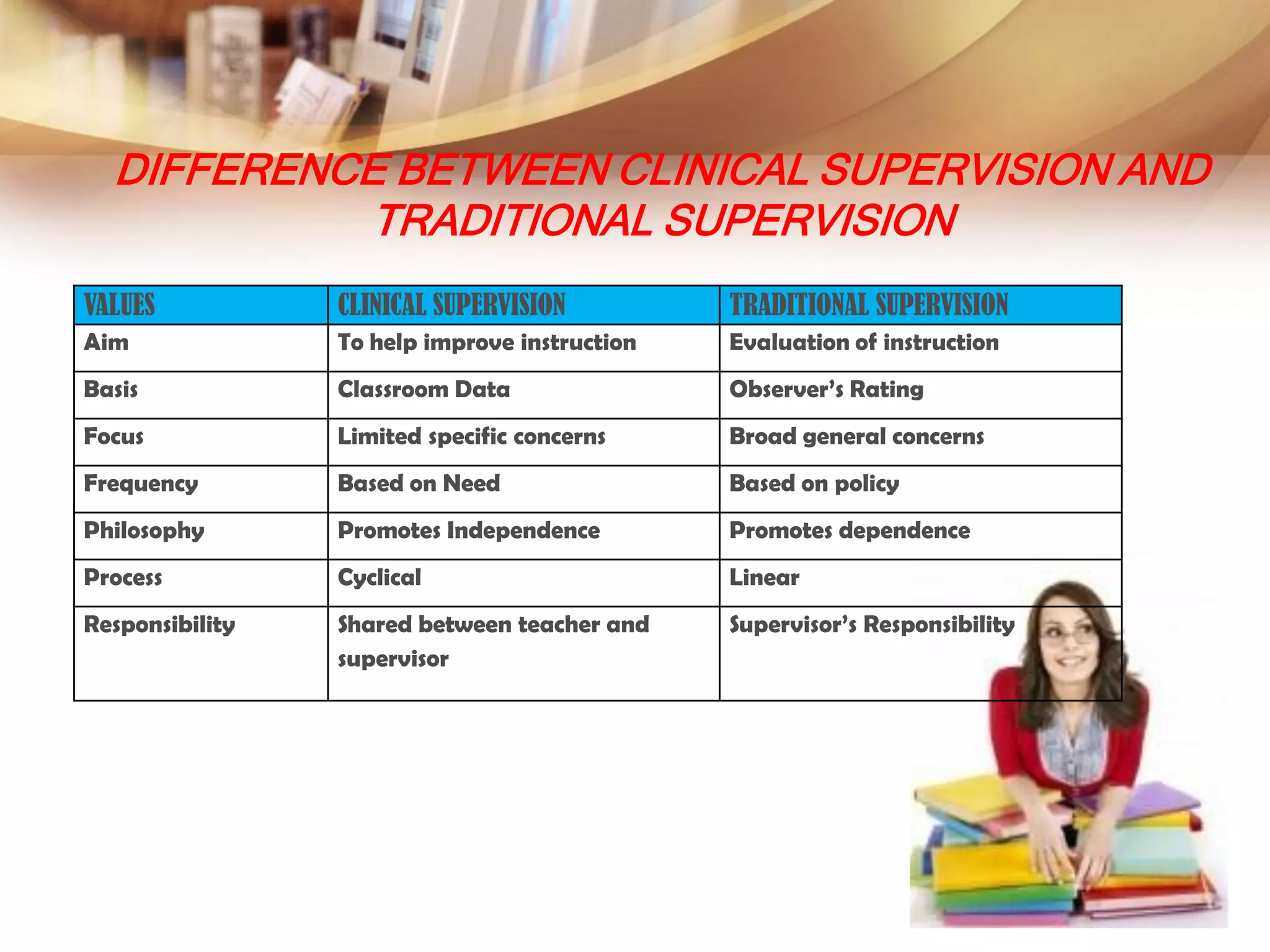
DIFFERENCE BETWEEN CLINICAL SUPERVISION AND
           TRADITIONAL SUPERVISION
VALUES           CLINICAL SUPERVISION          TRADITIONAL SUPERVISION
Aim              To help improve instruction   Evaluation of instruction
Basis            Classroom Data                Observer’s Rating
Focus            Limited specific concerns     Broad general concerns
Frequency        Based on Need                 Based on policy
Philosophy       Promotes Independence         Promotes dependence
Process          Cyclical                      Linear
Responsibility   Shared between teacher and    Supervisor’s Responsibility
                 supervisor
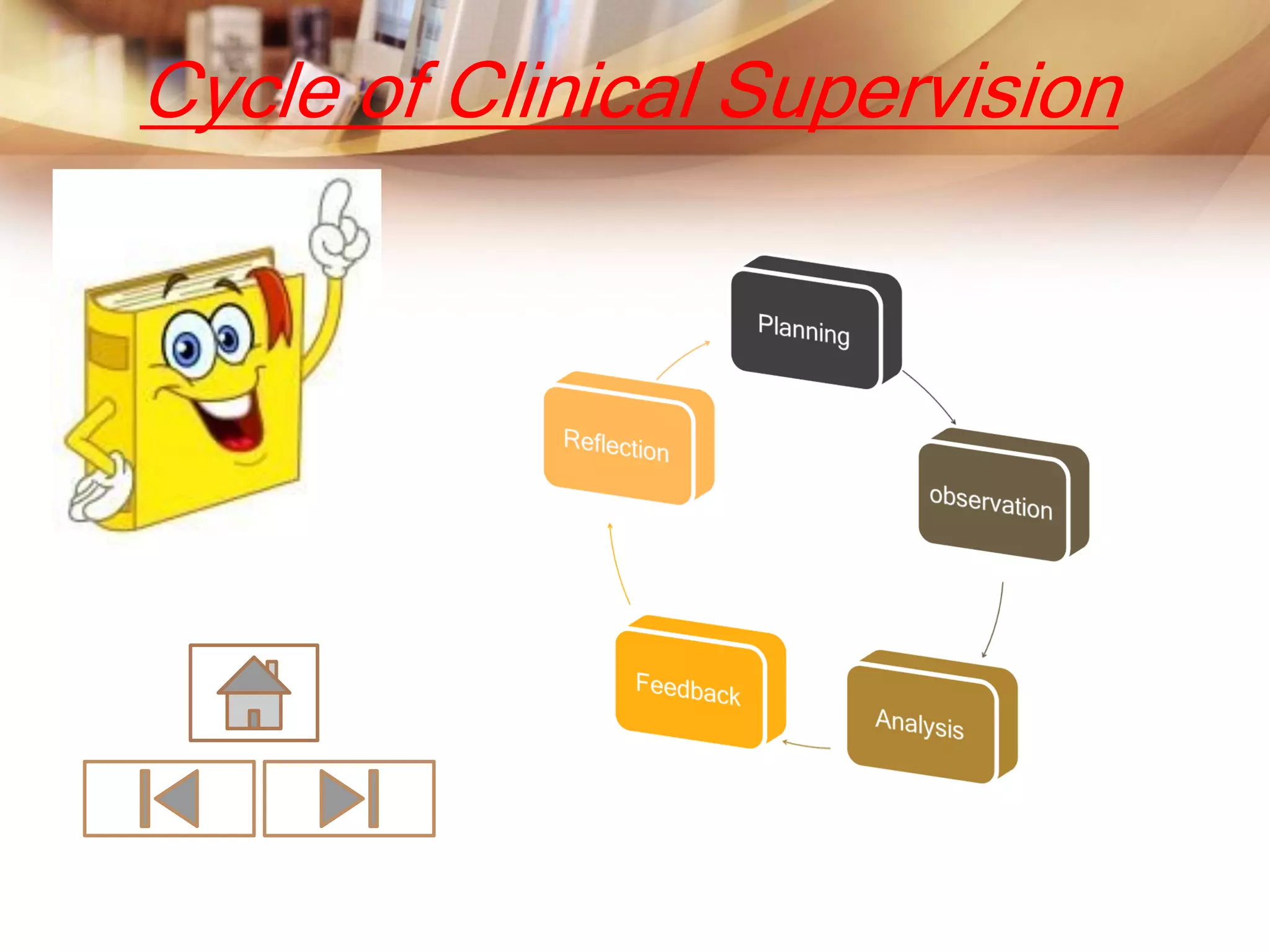
Cycle of Clinical Supervision
COGNITIVE COACHING

• This supervision engages the teacher
  to become supportive to collegial
  investigation, and reflection of the
  teaching-learning process .
Evaluative Steps in Cognitive Coaching
               Collaborative
                Reflection- comparing
                actual and desired
                student performance
               Evaluating
                appropriateness of
                teaching strategies
               Analyzing effects of
                teacher’s classroom
                behavior and other’s
Important Stages of Meta-Cognition
• Planning
      The coach helps teachers to think
  carefully through their planned
  lessons ; anticipate what might
  happen during the lesson; plan a way
  to document what will transpire
  during the lesson.
• Lesson Observation
           The classroom instruction is
   observed and documented as it takes
   place. Desired behaviors are used as
   bases for discussion during the
   reflection    conference.     Student
   achievement and strategies, and
   decisions made during the lesson are
   noted.
• Reflection Conference
    Coaches facilitate and mediate by
   helping teachers do the following:
• Summarize impressions and assessments of the
  lesson
• Recall the data supporting those impressions and
  assessments
• Express feelings about the lesson
• Compare the plan with the actual implementation
  of the lesson
• Analyze why desired outcomes were not
  achieved/achieved
• Deduce relationships between student
  achievement and teacher behavior
MENTORING

• This method is helping
  teacher by another teacher
  to develop one’s skills in
  teaching. It develops both
  the confidence of the
  teachers who are involved.
PEER ASSESSMENT

• A “peer” may be a co-worker, a
  partner, an associate, or a
  collaborator. Peers may assess or
  evaluate each other without feeling
  threatened and anxious of the
  possible loss of self-esteem because
  of proximity, equality, and safety that
  exist between and among them.
PORTOLIO ASSESSMENT
• Teacher portfolio is
  a collection of
  works, records,
   and documents
  demonstrating and
  highlighting a
  teacher’s
  knowledge and
  skills in teaching.
Contents of Teacher Portfolio
      –   Teacher’s background
      –   Class description: time, grade, and content
      –   Licensure examinations
      –   A personal statement of teaching philosophy and
          goals
      –   Faculty development effort such as workshops,
          seminars and programs
      –   Implemented lesson plans, handouts and notes.
      –   Graded student work such as tests, quizzes, and
          class projects.
      –   Video/audiotape of classroom lessons
      –   Colleagues observations on teaching
      –   Photographs of bulletin boards, chalkboards or
          projects
ACTION RESEARCH

 • It is an inquiry that teachers design
   and conduct in order to improve
   teaching performance. . The process
   provides teachers new opportunities
   to reflect on and evaluate their own
   teaching personally; explore and try
   out innovative ideas and assess how
   effective the innovations are.
• It promotes the concept of teacher-
  as-researcher which encourages
  teachers to be collaborators not only
  in improving teaching behavior, but
  also in revising curriculum, improving
  working environment,
  professionalizing teaching, and
  developing policy.
That in all things, God may
be glorified…!
thank you…

Instructional Superv ision

  • 1.
  • 3.
    Elements Common tomost Observational Systems. • purpose for the observation • operational definitions of all the observed behaviors • training procedures for observers • a specific observational focus • a setting • a unit of time • an observation schedule • a method to record the data • a method to process and analyze data
  • 4.
    TYPES OF CLASSROOM VISITSIN THE PHILPPINES •Scheduled Visit •Unscheduled Visit- •Invitational Visit-
  • 5.
    TYPES OF SUPERVISION OFINSTRUCTION • CLINICAL SUPERVISION – It is a supervision that develops the teacher’s sense of responsibility to grow professionally, analyze his/her own performance and to accept change and assistance
  • 6.
    • Concepts forIntervention in Clinical Supervision Self-analysis, Openness to change Willingness to accept assistance Self-direction
  • 7.
    CHARACTERISTICS OF CLINICAL SUPERVISION • 1. It is a deliberate intervention into the instructional process. • 2. It is goal oriented. • 3. It assumes a professional working relationship between teacher(s) and supervisor(s).
  • 8.
    • 4. Itrequires a high degree of mutual trust, as reflected in understanding, support, and commitment to growth. • 5. It is systematic, although it requires a flexible and continuously changing methodology. • 6. It assumes that the supervisor knows about the analysis of instruction and learning and also about productive human interaction.
  • 9.
    CLINICAL SUPERVISION MODEL •1. Pre-conference with teacher • 2. Observation of the classroom • 3. Analyzing and interpreting observation and determining conference approach Post-conference with teacher.
  • 10.
    DIFFERENCE BETWEEN CLINICALSUPERVISION AND TRADITIONAL SUPERVISION VALUES CLINICAL SUPERVISION TRADITIONAL SUPERVISION Aim To help improve instruction Evaluation of instruction Basis Classroom Data Observer’s Rating Focus Limited specific concerns Broad general concerns Frequency Based on Need Based on policy Philosophy Promotes Independence Promotes dependence Process Cyclical Linear Responsibility Shared between teacher and Supervisor’s Responsibility supervisor
  • 11.
    Cycle of ClinicalSupervision
  • 12.
    COGNITIVE COACHING • Thissupervision engages the teacher to become supportive to collegial investigation, and reflection of the teaching-learning process .
  • 13.
    Evaluative Steps inCognitive Coaching Collaborative Reflection- comparing actual and desired student performance Evaluating appropriateness of teaching strategies Analyzing effects of teacher’s classroom behavior and other’s
  • 14.
    Important Stages ofMeta-Cognition • Planning The coach helps teachers to think carefully through their planned lessons ; anticipate what might happen during the lesson; plan a way to document what will transpire during the lesson.
  • 15.
    • Lesson Observation The classroom instruction is observed and documented as it takes place. Desired behaviors are used as bases for discussion during the reflection conference. Student achievement and strategies, and decisions made during the lesson are noted.
  • 16.
    • Reflection Conference Coaches facilitate and mediate by helping teachers do the following: • Summarize impressions and assessments of the lesson • Recall the data supporting those impressions and assessments • Express feelings about the lesson • Compare the plan with the actual implementation of the lesson • Analyze why desired outcomes were not achieved/achieved • Deduce relationships between student achievement and teacher behavior
  • 17.
    MENTORING • This methodis helping teacher by another teacher to develop one’s skills in teaching. It develops both the confidence of the teachers who are involved.
  • 18.
    PEER ASSESSMENT • A“peer” may be a co-worker, a partner, an associate, or a collaborator. Peers may assess or evaluate each other without feeling threatened and anxious of the possible loss of self-esteem because of proximity, equality, and safety that exist between and among them.
  • 19.
    PORTOLIO ASSESSMENT • Teacherportfolio is a collection of works, records, and documents demonstrating and highlighting a teacher’s knowledge and skills in teaching.
  • 20.
    Contents of TeacherPortfolio – Teacher’s background – Class description: time, grade, and content – Licensure examinations – A personal statement of teaching philosophy and goals – Faculty development effort such as workshops, seminars and programs – Implemented lesson plans, handouts and notes. – Graded student work such as tests, quizzes, and class projects. – Video/audiotape of classroom lessons – Colleagues observations on teaching – Photographs of bulletin boards, chalkboards or projects
  • 21.
    ACTION RESEARCH •It is an inquiry that teachers design and conduct in order to improve teaching performance. . The process provides teachers new opportunities to reflect on and evaluate their own teaching personally; explore and try out innovative ideas and assess how effective the innovations are.
  • 22.
    • It promotesthe concept of teacher- as-researcher which encourages teachers to be collaborators not only in improving teaching behavior, but also in revising curriculum, improving working environment, professionalizing teaching, and developing policy.
  • 24.
    That in allthings, God may be glorified…!
  • 25.