Emmily C. Domingo
M.A. Ed. in GC
Dr. Bagaporo
http://web.stanford.edu/group/design_education/wikiupload/2/27/Helen_Evaluation.pdf
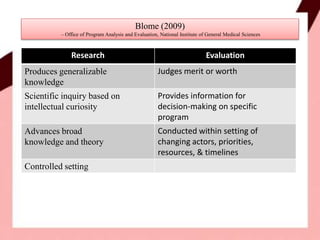
Research Evaluation
Produces generalizable
knowledge
Judges merit or worth
Scientific inquiry based on
intellectual curiosity
Provides information for
decision-making on specific
program
Advances broad
knowledge and theory
Conducted within setting of
changing actors, priorities,
resources, & timelines
Controlled setting
Blome (2009)
– Office of Program Analysis and Evaluation, National Institute of General Medical Sciences
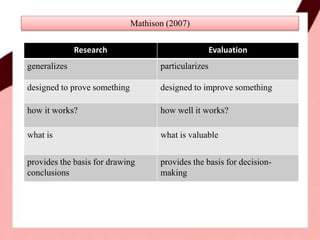
Research Evaluation
generalizes particularizes
designed to prove something designed to improve something
how it works? how well it works?
what is what is valuable
provides the basis for drawing
conclusions
provides the basis for decision-
making
Mathison (2007)
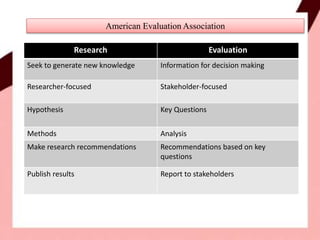
American Evaluation Association
Research Evaluation
Seek to generate new knowledge Information for decision making
Researcher-focused Stakeholder-focused
Hypothesis Key Questions
Methods Analysis
Make research recommendations Recommendations based on key
questions
Publish results Report to stakeholders
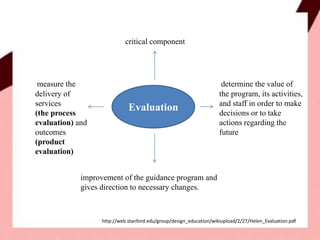
Evaluation
critical component
determine the value of
the program, its activities,
and staff in order to make
decisions or to take
actions regarding the
future
measure the
delivery of
services
(the process
evaluation) and
outcomes
(product
evaluation)
http://web.stanford.edu/group/design_education/wikiupload/2/27/Helen_Evaluation.pdf
improvement of the guidance program and
gives direction to necessary changes.
Importance of Evaluating the Program
Gibson and Mitchell (1995) define program evaluation as a systematic set
of data collection and analysis of activities, undertaken to determine the
value of a program in order to aid management, program planning, staff
development, public accountability and promotion.
Shertzer and Stone view evaluation as necessary to provide for the
effectiveness of achieving program goals, in relation to specific standards.
Importance of Evaluating the Program
verifies or rejects practices by indicating what works and what does not,
and shows the extent to which an activity is effective. It helps the
implementors to do away with unproductive innovations.
provides a basis for improvement in terms of operation and
implementation strategies.
suggests a continuous search for better ways of doing things, and a
willingness to look at performance, and increases the search for
improvement.
provides an insight into the program, and helps implementors to
understand their functions and the consequences of what they do.
places responsibility on individuals, and increases the participation of
beneficiaries. It helps in the allocation of roles and responsibilities.
determine the impact of the guidance program on students, faculty,
parents, and school climate;
know if they are accomplishing their goals;
identify what remains to be accomplished;
identify effective components of the program;
eliminate or improve less effective components of the program;
adapt and refine the guidance program and implementation process;
identify unintended consequences of the program (both positive and
negative);
identify other areas that need to be addressed;
establish goals for the counselors’ professional development;
determine staffing needs and workload adjustments;
determine additional resources required to adequately carry forward the
program; and
provide accountability information to educators and the community
Importance of Evaluating the Program
Evaluation results should be used to make further program
improvements.
Counselors and administrators will use the results to make modifications
to the program
to compare the implemented program with the program standards.
 Administrators and policy-makers will utilize the evaluation to make
decisions about the content, quality, and effectiveness of the services and
to allocate financial and staffing resources for the program.
They also will utilize the information to describe the program to the
community or to seek the community’s support for program
improvements.
Importance of Evaluation Results
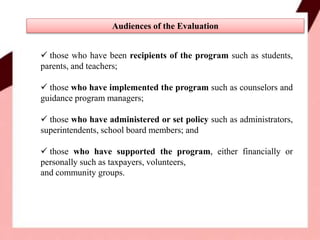
Audiences of the Evaluation
 those who have been recipients of the program such as students,
parents, and teachers;
 those who have implemented the program such as counselors and
guidance program managers;
 those who have administered or set policy such as administrators,
superintendents, school board members; and
 those who have supported the program, either financially or
personally such as taxpayers, volunteers,
and community groups.
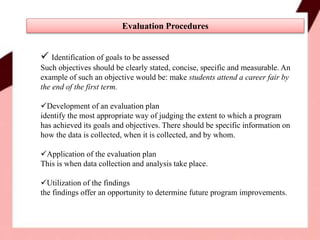
Evaluation Procedures
 Identification of goals to be assessed
Such objectives should be clearly stated, concise, specific and measurable. An
example of such an objective would be: make students attend a career fair by
the end of the first term.
Development of an evaluation plan
identify the most appropriate way of judging the extent to which a program
has achieved its goals and objectives. There should be specific information on
how the data is collected, when it is collected, and by whom.
Application of the evaluation plan
This is when data collection and analysis take place.
Utilization of the findings
the findings offer an opportunity to determine future program improvements.
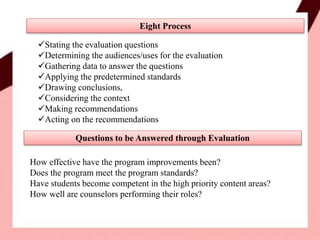
Stating the evaluation questions
Determining the audiences/uses for the evaluation
Gathering data to answer the questions
Applying the predetermined standards
Drawing conclusions,
Considering the context
Making recommendations
Acting on the recommendations
Eight Process
Questions to be Answered through Evaluation
How effective have the program improvements been?
Does the program meet the program standards?
Have students become competent in the high priority content areas?
How well are counselors performing their roles?

Evaluating the guidance program

  • 1.
    Emmily C. Domingo M.A.Ed. in GC Dr. Bagaporo
  • 2.
  • 3.
    Research Evaluation Produces generalizable knowledge Judgesmerit or worth Scientific inquiry based on intellectual curiosity Provides information for decision-making on specific program Advances broad knowledge and theory Conducted within setting of changing actors, priorities, resources, & timelines Controlled setting Blome (2009) – Office of Program Analysis and Evaluation, National Institute of General Medical Sciences
  • 4.
    Research Evaluation generalizes particularizes designedto prove something designed to improve something how it works? how well it works? what is what is valuable provides the basis for drawing conclusions provides the basis for decision- making Mathison (2007)
  • 5.
    American Evaluation Association ResearchEvaluation Seek to generate new knowledge Information for decision making Researcher-focused Stakeholder-focused Hypothesis Key Questions Methods Analysis Make research recommendations Recommendations based on key questions Publish results Report to stakeholders
  • 6.
    Evaluation critical component determine thevalue of the program, its activities, and staff in order to make decisions or to take actions regarding the future measure the delivery of services (the process evaluation) and outcomes (product evaluation) http://web.stanford.edu/group/design_education/wikiupload/2/27/Helen_Evaluation.pdf improvement of the guidance program and gives direction to necessary changes.
  • 7.
    Importance of Evaluatingthe Program Gibson and Mitchell (1995) define program evaluation as a systematic set of data collection and analysis of activities, undertaken to determine the value of a program in order to aid management, program planning, staff development, public accountability and promotion. Shertzer and Stone view evaluation as necessary to provide for the effectiveness of achieving program goals, in relation to specific standards.
  • 8.
    Importance of Evaluatingthe Program verifies or rejects practices by indicating what works and what does not, and shows the extent to which an activity is effective. It helps the implementors to do away with unproductive innovations. provides a basis for improvement in terms of operation and implementation strategies. suggests a continuous search for better ways of doing things, and a willingness to look at performance, and increases the search for improvement. provides an insight into the program, and helps implementors to understand their functions and the consequences of what they do. places responsibility on individuals, and increases the participation of beneficiaries. It helps in the allocation of roles and responsibilities.
  • 9.
    determine the impactof the guidance program on students, faculty, parents, and school climate; know if they are accomplishing their goals; identify what remains to be accomplished; identify effective components of the program; eliminate or improve less effective components of the program; adapt and refine the guidance program and implementation process; identify unintended consequences of the program (both positive and negative); identify other areas that need to be addressed; establish goals for the counselors’ professional development; determine staffing needs and workload adjustments; determine additional resources required to adequately carry forward the program; and provide accountability information to educators and the community Importance of Evaluating the Program
  • 10.
    Evaluation results shouldbe used to make further program improvements. Counselors and administrators will use the results to make modifications to the program to compare the implemented program with the program standards.  Administrators and policy-makers will utilize the evaluation to make decisions about the content, quality, and effectiveness of the services and to allocate financial and staffing resources for the program. They also will utilize the information to describe the program to the community or to seek the community’s support for program improvements. Importance of Evaluation Results
  • 11.
    Audiences of theEvaluation  those who have been recipients of the program such as students, parents, and teachers;  those who have implemented the program such as counselors and guidance program managers;  those who have administered or set policy such as administrators, superintendents, school board members; and  those who have supported the program, either financially or personally such as taxpayers, volunteers, and community groups.
  • 12.
    Evaluation Procedures  Identificationof goals to be assessed Such objectives should be clearly stated, concise, specific and measurable. An example of such an objective would be: make students attend a career fair by the end of the first term. Development of an evaluation plan identify the most appropriate way of judging the extent to which a program has achieved its goals and objectives. There should be specific information on how the data is collected, when it is collected, and by whom. Application of the evaluation plan This is when data collection and analysis take place. Utilization of the findings the findings offer an opportunity to determine future program improvements.
  • 13.
    Stating the evaluationquestions Determining the audiences/uses for the evaluation Gathering data to answer the questions Applying the predetermined standards Drawing conclusions, Considering the context Making recommendations Acting on the recommendations Eight Process Questions to be Answered through Evaluation How effective have the program improvements been? Does the program meet the program standards? Have students become competent in the high priority content areas? How well are counselors performing their roles?