CLINICAL SUPERVISION
A vehicle for developing professional, responsible teachers who were  capable of analyzing their own performance open to change and assistance from others self-directing.
Cogan insists that the proper domain of clinical supervision is  “  the classroom behavior of the teacher, not the teacher as a person.“
In order  to bring  about  the desired change in classroom behavior, it is necessary  that  the  teacher  observes: 1. the behavior to be changed: 2. the desired change; and 3. the professional satisfaction that will  be derived from doing  so.
It is a technology for improving instruction.  It is a goal-oriented, combining the needs of the school with personal growth needs of those who work within the school It is a deliberate intervention in the instructional process. It assumes a professional working relationship between teacher and supervisor. It requires a high degree of mutual trust as reflected in understanding, support, and commitment to growth.
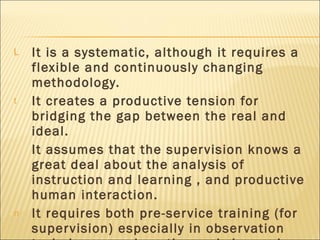
It is a systematic, although it requires a flexible and continuously changing methodology. It creates a productive tension for bridging the gap between the real and ideal. It assumes that the supervision knows a great deal about the analysis of instruction and learning , and productive human interaction. It requires both pre-service training (for supervision) especially in observation techniques, and continuously in service reflection on effective approaches.
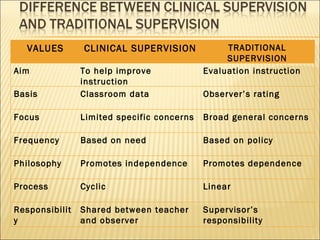
VALUES CLINICAL SUPERVISION TRADITIONAL SUPERVISION Aim To help improve instruction Evaluation instruction Basis Classroom data Observer’s rating Focus Limited specific concerns Broad general concerns Frequency Based on need Based on policy Philosophy Promotes independence Promotes dependence Process Cyclic Linear Responsibility Shared between teacher and observer Supervisor’s responsibility
 
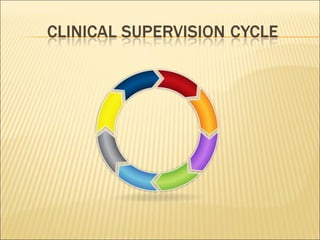
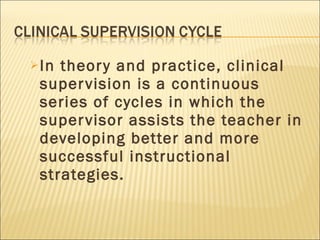
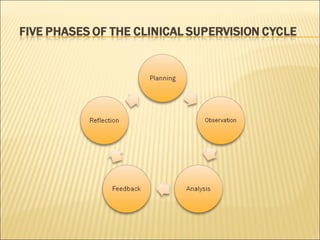
In theory and practice, clinical supervision is a continuous series of cycles in which the supervisor assists the teacher in developing better and more successful instructional strategies.
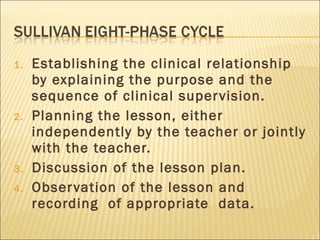
Establishing the clinical relationship by explaining the purpose and the sequence of clinical supervision. Planning the lesson, either independently by the teacher or jointly with the teacher. Discussion of the lesson plan. Observation of the lesson and recording  of appropriate  data.
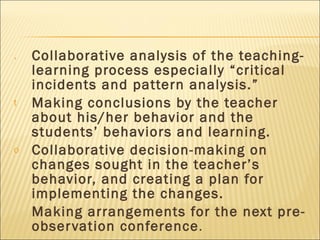
Collaborative analysis of the teaching-learning process especially “critical incidents and pattern analysis.”  Making conclusions by the teacher about his/her behavior and the students’ behaviors and learning. Collaborative decision-making on changes sought in the teacher’s behavior, and creating a plan for implementing the changes. Making arrangements for the next pre-observation conference .
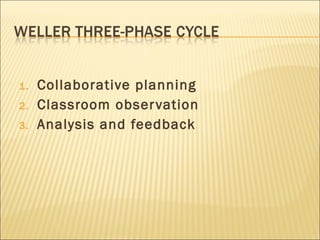
Collaborative planning Classroom observation Analysis and feedback
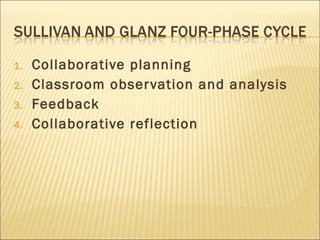
Collaborative planning Classroom observation and analysis Feedback Collaborative reflection
Pre-observation conference Classroom observation Data analysis and strategy Post-observation conference Post-conference analysis


Clinical supervision mhy_dr

  • 1.
  • 2.
    A vehicle fordeveloping professional, responsible teachers who were capable of analyzing their own performance open to change and assistance from others self-directing.
  • 3.
    Cogan insists thatthe proper domain of clinical supervision is “ the classroom behavior of the teacher, not the teacher as a person.“
  • 4.
    In order to bring about the desired change in classroom behavior, it is necessary that the teacher observes: 1. the behavior to be changed: 2. the desired change; and 3. the professional satisfaction that will be derived from doing so.
  • 5.
    It is atechnology for improving instruction. It is a goal-oriented, combining the needs of the school with personal growth needs of those who work within the school It is a deliberate intervention in the instructional process. It assumes a professional working relationship between teacher and supervisor. It requires a high degree of mutual trust as reflected in understanding, support, and commitment to growth.
  • 6.
    It is asystematic, although it requires a flexible and continuously changing methodology. It creates a productive tension for bridging the gap between the real and ideal. It assumes that the supervision knows a great deal about the analysis of instruction and learning , and productive human interaction. It requires both pre-service training (for supervision) especially in observation techniques, and continuously in service reflection on effective approaches.
  • 7.
    VALUES CLINICAL SUPERVISIONTRADITIONAL SUPERVISION Aim To help improve instruction Evaluation instruction Basis Classroom data Observer’s rating Focus Limited specific concerns Broad general concerns Frequency Based on need Based on policy Philosophy Promotes independence Promotes dependence Process Cyclic Linear Responsibility Shared between teacher and observer Supervisor’s responsibility
  • 8.
  • 9.
    In theory andpractice, clinical supervision is a continuous series of cycles in which the supervisor assists the teacher in developing better and more successful instructional strategies.
  • 10.
    Establishing the clinicalrelationship by explaining the purpose and the sequence of clinical supervision. Planning the lesson, either independently by the teacher or jointly with the teacher. Discussion of the lesson plan. Observation of the lesson and recording of appropriate data.
  • 11.
    Collaborative analysis ofthe teaching-learning process especially “critical incidents and pattern analysis.” Making conclusions by the teacher about his/her behavior and the students’ behaviors and learning. Collaborative decision-making on changes sought in the teacher’s behavior, and creating a plan for implementing the changes. Making arrangements for the next pre-observation conference .
  • 12.
    Collaborative planning Classroomobservation Analysis and feedback
  • 13.
    Collaborative planning Classroomobservation and analysis Feedback Collaborative reflection
  • 14.
    Pre-observation conference Classroomobservation Data analysis and strategy Post-observation conference Post-conference analysis
  • 15.
  • 16.