Visual
Impairment
• Visual impairment (VI) refers
to a significant functional loss
of vision that cannot be
corrected by medication,
surgical operation, or
ordinary optical lenses such as
spectacles.
Loss of visual field:
• Photophobia- inability to look at
sight
• Diplopia- double vision
• Visual distortion or distortion of
images
• Visual perceptual difficulties or
difficulties of perception
• Or any combination of the above
features
Levels Of Visual
Impairment
1. MILD VISUAL IMPAIRMENT
• Can read relatively larger characters
• No difficulty in identifying shapes,
colours and brightness contracts
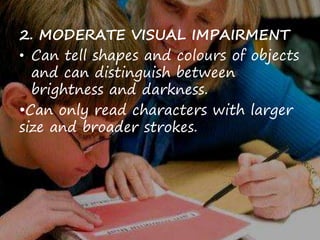
2. MODERATE VISUAL IMPAIRMENT
• Can tell shapes and colours of objects
and can distinguish between
brightness and darkness.
•Can only read characters with larger
size and broader strokes.
3. SEVERE VISUAL IMPAIRMENT:
•Can only distinguish more obvious
changes in brightness and darkness.
• May not see anything (completely
blind).
TYPES OF VISUAL
IMPAIRMENT:
• Low visual acuity
• Blindness
• Legal blindness
• Visual acuity
SYMPTOMS :
• Daily Activities: Squinting to
get an object in focus,
Trouble locating familiar
objects in a familiar
environment, Wearing
mismatched clothing.
• Mobility: Leaning against
the wall when walking ,
Running into objects,
Difficulty walking on uneven
surfaces.
• Eating/Drinking: Difficulty
getting food onto a utensil
and serving from a platter,
Frequently spilling food
• Reading/Writing: Difficulty
writing on the lines of a
piece of paper, Frequent
complaining that the lighting
is inadequate for reading or
writing
Causes
1. Inherited conditions of
blindness and vision
impairment
2. Infections of the eyes
3. AIDS related visual
impairment
Injury to Eyes Amblyopia
Cataract
Trachoma Diabetic retinopathy
Glaucoma Age Macular
degeneration
Cancer of eyes
EPIDEMIOLOGY
• By age: More than 82%
of all people who are
blind are 50 years of age
and older. 1.4 million
blind children below age
15.
• By gender: females have a
significantly higher risk of being
visually impaired than males.
• By geography: . More than 90% of
the world's visually impaired live in
developing countries.
COMMUNICATION BARRIERS:
Many people are uncomfortable with
communicating with the blind, and
this can cause communication barriers
.
• Lack of facial expressions, mimics, or
body gestures/responses
• Non-verbal gestures that could imply
the visually impaired individual not
appearing interested
• Speaking when not anticipated or not
speaking when anticipated
• Fear of offending the visually impaired
• Standing too close and invading the
personal comfort level
• Having to exercise or ignore feelings
of pity
• Being uncomfortable with touching
objects or people.
• A look of detachment or
disengagement.
• Dependency
Diagnosis
Tests for visual impairment
1. Snellen test
• Also known as the visual
acuity test.
• Snellen’s chart is used.
2. Visual field test
• a person can see without tilting or
turning one’s head.
• This measures the peripheral vision
of the eyes.
3. Tonometry test
• uses specialized instruments to
determine fluid pressure inside the
eye to evaluate for glaucoma.
4. Ocular Motility Assessment
• This tests if there is squint of other
problems in the movement of the
eyeballs.
Other tests:
• Visually evoked
potential (VEP)
• Electroretinogram
(ERG)
• Electro-oculogram
(EOG)
Treatment
• Control of diabetes
• Cotaract surgery
• Magnification systems
• Glaucoma
• Drugs: The drugs may include Beta-
blockers like betaxolol hydrochloride
or carbonic anhydrase inhibitors
dorzolamide and Sympathomimetics
like brimonidine tartrate.
Optical aids
• -Improving far sight:
TV,Theater, Cinema
• -Improving near sight:
Reading, Writing, Crafts
• -Improving sensitivity
to contrast:Special
lights,Magnified
games,Watches,special
phones, etc.
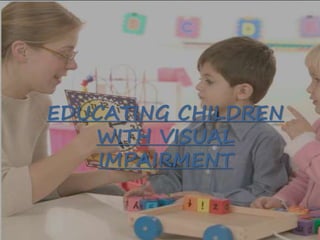
EDUCATING CHILDREN
WITH VISUAL
IMPAIRMENT
• What is IDEA?
• Three basic elements in educating visually
impaired children
-specialized services, books and materials in
appropriate media (including braille), as well
as specialized equipment and technology
-a full range of program options and
support services so that the Individualized
Education Program (IEP) team can select the
most appropriate placement
-be adequate personnel preparation
programs to train staff to provide specialized
services which address the unique academic
and non-academic curriculum needs
• COMPUTERS
• PHONICS
• ELECTRONIC AIDS
INSTITUTIONS FOR
VISUALLY IMPAIRED
CHILDREN IN PAKISTAN
AKAB SCHOOL FOR
BLIND:
Established in 2000
Located in Mirpur Azad
Kashmir
Aziz Jehan Begum Trust
for the Blind:
established in 1989 by Ms.
Salma Kishwar Jan
Ida Rieu School:
founded in 1923 in Karachi
Government High School
for Blind Girls:
Shamsabad, Rawalpindi
Govt. Sunrise Institute for
the Blind:
Ravi Road, Lahore
PREVENTION
• Regular eye examinations:
Most people should have their eyes
tested at least once every two years.
It is very important for drivers and
people whose eyesight may be
affected by their occupation, such as
those who use computer monitors,
to have regular eye examinations
Children should also have regular eye
examinations.
- The Health Service Executive (HSE)
is obliged to provide optical services
free of charge to certain groups.
There are several other ways to
reduce the risk of visual impairment:
• Protect your eyes from the sun.
Ultra violet (UV) rays from the sun
can damage your eyesight so in bright
sunlight, wear a pair of good-quality
sunglasses that protect your eyes from
both UVA and UVB rays.
• Find out whether there is a
history of glaucoma or eye
disease in your family.
• Hypertension-Hypertension is
when the pressure of the blood
in your bloodstream is regularly
above 140/90 mmHG.
• Pain- Pain is an unpleasant
physical or emotional feeling
that your body produces as a
warning sign that it has been
damaged.
CONCLUSION:
Visual impairment is increasing
especially among older people.
Communication and different ways of
being able to communicate with
visually impaired clients must be
tailored to individual needs and
available at all times.
visual impairment

visual impairment

  • 1.
  • 2.
    • Visual impairment(VI) refers to a significant functional loss of vision that cannot be corrected by medication, surgical operation, or ordinary optical lenses such as spectacles.
  • 3.
    Loss of visualfield: • Photophobia- inability to look at sight • Diplopia- double vision • Visual distortion or distortion of images • Visual perceptual difficulties or difficulties of perception • Or any combination of the above features
  • 4.
  • 5.
    1. MILD VISUALIMPAIRMENT • Can read relatively larger characters • No difficulty in identifying shapes, colours and brightness contracts
  • 6.
    2. MODERATE VISUALIMPAIRMENT • Can tell shapes and colours of objects and can distinguish between brightness and darkness. •Can only read characters with larger size and broader strokes.
  • 7.
    3. SEVERE VISUALIMPAIRMENT: •Can only distinguish more obvious changes in brightness and darkness. • May not see anything (completely blind).
  • 8.
  • 9.
    • Low visualacuity • Blindness • Legal blindness • Visual acuity
  • 10.
  • 11.
    • Daily Activities:Squinting to get an object in focus, Trouble locating familiar objects in a familiar environment, Wearing mismatched clothing. • Mobility: Leaning against the wall when walking , Running into objects, Difficulty walking on uneven surfaces.
  • 12.
    • Eating/Drinking: Difficulty gettingfood onto a utensil and serving from a platter, Frequently spilling food • Reading/Writing: Difficulty writing on the lines of a piece of paper, Frequent complaining that the lighting is inadequate for reading or writing
  • 13.
  • 14.
    1. Inherited conditionsof blindness and vision impairment 2. Infections of the eyes 3. AIDS related visual impairment
  • 15.
    Injury to EyesAmblyopia Cataract
  • 16.
  • 17.
  • 18.
  • 19.
    EPIDEMIOLOGY • By age:More than 82% of all people who are blind are 50 years of age and older. 1.4 million blind children below age 15.
  • 20.
    • By gender:females have a significantly higher risk of being visually impaired than males. • By geography: . More than 90% of the world's visually impaired live in developing countries.
  • 21.
    COMMUNICATION BARRIERS: Many peopleare uncomfortable with communicating with the blind, and this can cause communication barriers
  • 22.
    . • Lack offacial expressions, mimics, or body gestures/responses • Non-verbal gestures that could imply the visually impaired individual not appearing interested • Speaking when not anticipated or not speaking when anticipated • Fear of offending the visually impaired • Standing too close and invading the personal comfort level
  • 23.
    • Having toexercise or ignore feelings of pity • Being uncomfortable with touching objects or people. • A look of detachment or disengagement. • Dependency
  • 24.
  • 25.
    Tests for visualimpairment 1. Snellen test • Also known as the visual acuity test. • Snellen’s chart is used.
  • 26.
    2. Visual fieldtest • a person can see without tilting or turning one’s head. • This measures the peripheral vision of the eyes.
  • 27.
    3. Tonometry test •uses specialized instruments to determine fluid pressure inside the eye to evaluate for glaucoma.
  • 28.
    4. Ocular MotilityAssessment • This tests if there is squint of other problems in the movement of the eyeballs.
  • 29.
    Other tests: • Visuallyevoked potential (VEP) • Electroretinogram (ERG) • Electro-oculogram (EOG)
  • 30.
  • 31.
    • Control ofdiabetes • Cotaract surgery • Magnification systems • Glaucoma • Drugs: The drugs may include Beta- blockers like betaxolol hydrochloride or carbonic anhydrase inhibitors dorzolamide and Sympathomimetics like brimonidine tartrate.
  • 32.
    Optical aids • -Improvingfar sight: TV,Theater, Cinema • -Improving near sight: Reading, Writing, Crafts • -Improving sensitivity to contrast:Special lights,Magnified games,Watches,special phones, etc.
  • 33.
  • 34.
    • What isIDEA? • Three basic elements in educating visually impaired children -specialized services, books and materials in appropriate media (including braille), as well as specialized equipment and technology -a full range of program options and support services so that the Individualized Education Program (IEP) team can select the most appropriate placement -be adequate personnel preparation programs to train staff to provide specialized services which address the unique academic and non-academic curriculum needs
  • 35.
  • 36.
  • 37.
    AKAB SCHOOL FOR BLIND: Establishedin 2000 Located in Mirpur Azad Kashmir Aziz Jehan Begum Trust for the Blind: established in 1989 by Ms. Salma Kishwar Jan
  • 38.
    Ida Rieu School: foundedin 1923 in Karachi Government High School for Blind Girls: Shamsabad, Rawalpindi Govt. Sunrise Institute for the Blind: Ravi Road, Lahore
  • 39.
  • 40.
    • Regular eyeexaminations: Most people should have their eyes tested at least once every two years. It is very important for drivers and people whose eyesight may be affected by their occupation, such as those who use computer monitors, to have regular eye examinations
  • 41.
    Children should alsohave regular eye examinations. - The Health Service Executive (HSE) is obliged to provide optical services free of charge to certain groups.
  • 42.
    There are severalother ways to reduce the risk of visual impairment: • Protect your eyes from the sun. Ultra violet (UV) rays from the sun can damage your eyesight so in bright sunlight, wear a pair of good-quality sunglasses that protect your eyes from both UVA and UVB rays.
  • 43.
    • Find outwhether there is a history of glaucoma or eye disease in your family. • Hypertension-Hypertension is when the pressure of the blood in your bloodstream is regularly above 140/90 mmHG. • Pain- Pain is an unpleasant physical or emotional feeling that your body produces as a warning sign that it has been damaged.
  • 44.
    CONCLUSION: Visual impairment isincreasing especially among older people. Communication and different ways of being able to communicate with visually impaired clients must be tailored to individual needs and available at all times.