DSS *COMPARING
CHARACTERISTICS
English language learners, Both, and just Hearing loss
ENGLISH LANGUAGE
LEARNERS











ELL CONTINUED







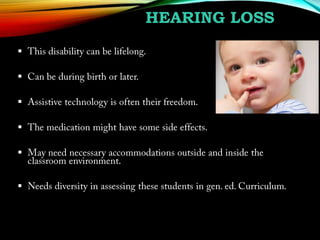
HEARING LOSS














HEARING LOSS
CONTINUED






ELL AND HEARING LOSS
DISABILITY


























By Gunjandeep Kaur Bedi
& Robin Berger
According to the IDEA, a
hearing impairment is a
hearing loss so severe that it
impacts a student’s ability to
process linguistic information
and academic performance,
requiring special education
and related services.
Hearing Impairment is a broad term
that includes both deaf and hard of
hearing disabilities.
The term “deaf” is used to describe a
person who has severe hearing loss.
“Hard of hearing” is the term used for
people who may experience mild to
severe hearing loss.
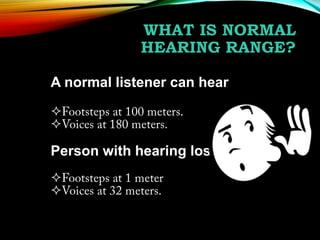
WHAT IS NORMAL
HEARING RANGE?
A normal listener can hear



Person with hearing los




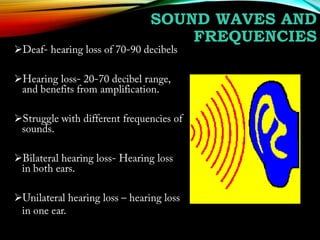
SOUND WAVES AND
FREQUENCIES









in
units called decibels .
TYPES OF HEARING
LOSS
•

•

•
•
ACTIVITY: AN IDEA OF
WHAT ITS LIKE.
WHAT CAUSES HEARING
LOSS
•
•
•
•
•
•
•
GENERAL
CHARACTERISTICS
•
•
•

•
•

•
•

•

•

•
•
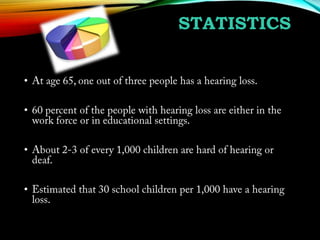
STATISTICS
•
•

•

•
SOME RANDOM FACTS
•

•

•

•
SPEAK NORMALLY
• http://www.youtube.com/watch?v=_xT3e0HySKY

•
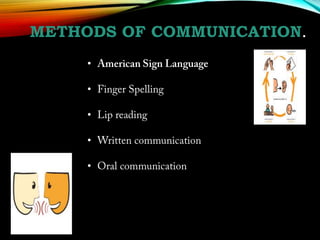
METHODS OF COMMUNICATION.
•

•
•

•
•
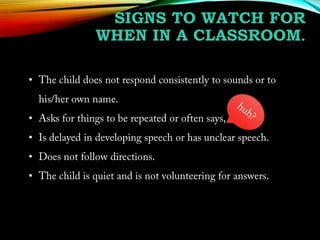
SIGNS TO WATCH FOR
WHEN IN A CLASSROOM.
•
•

•
•
•
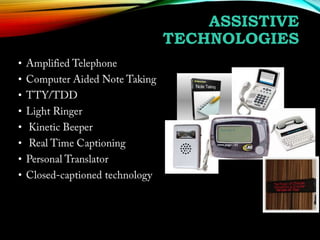
ASSISTIVE
TECHNOLOGIES
•
•
•

•
•
•
•
•
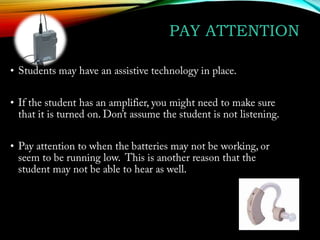
PAY ATTENTION
•

•

•
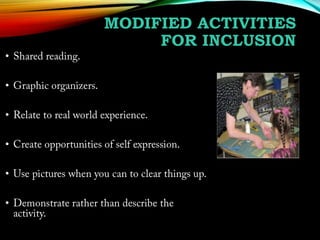
MODIFIED ACTIVITIES
FOR INCLUSION
•
•

•
•
•
•
•
•
•
•
•
•
•
•

•

•
•
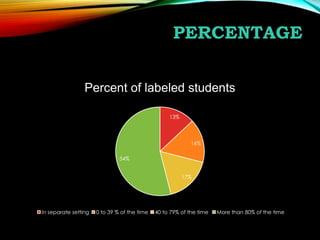
PERCENTAGE
Percent of labeled students
13%

16%
54%
17%

In separate setting

0 to 39 % of the time

40 to 79% of the time

More than 80% of the time
DID YOU KNOW….






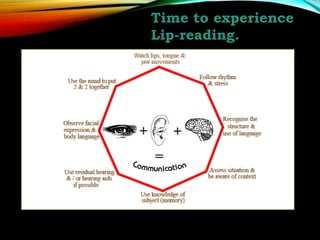
Time to experience
Lip-reading.
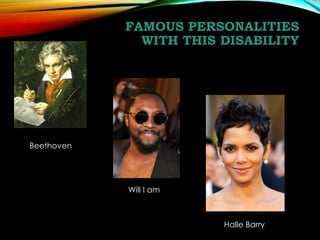
FAMOUS PERSONALITIES
WITH THIS DISABILITY

Beethoven

Will I am

Halle Barry
REFERENCES
• Turnbull, A. 2013.Exceptional Lives, Pearson Education Inc.
• http://www.myhearingaids.net/bilateral-hearing-loss/
• http://www.cochlear.com/wps/wcm/connect/us/home/about
-us-and-hearing-loss/hearing-loss-explained/hearing-lossexplained?utm_source=MSN&utm_medium=cpc&utm_term=wh
at%20is%20conductive%20hearing%20loss^22355378116&utm_c
ontent=3342214604&utm_campaign=Hearing%20Loss%20EM^45
558
• https://angel.spcollege.edu/section/default.asp?id=EEX3012%5
F3729%5F0475
• http://www.webmd.com/a-to-z-guides/hearing-loss-causessymptoms-treatment
• http://www.emedicinehealth.com/hearing_loss/article_em.htm
• http://hearingloss.org/.

Hearing impairment ppt

Editor's Notes

  • #3 ROBIN
  • #4 ROBIN
  • #5 ROBIN
  • #6 GUNJAN
  • #7 GUNJAN
  • #8 GUNJAN
  • #9 ROBIN
  • #10 ROBIN
  • #11 ROBIN
  • #12 2 ROBIN 2 GUNJAN
  • #13 ACTING IMPAIRED
  • #14 GUNJAN
  • #15 GUNJANDeaf - Haring loss of 70-90 decibels.Hard - Hearing loss of 20 to 70 decibels. Communicates primarily through speaking.
  • #16 ROBIN
  • #17 ROBIN
  • #18 ROBINConductive hearing - Depending on the amount of hearing loss, it may be treated with medications, surgery, hearing aids or a bone conduction implant.
  • #19 ROBIN – EAR BUD ACTIVITY
  • #20 ROBINPrenatal causes- lack of oxygen during child birth. and in first few months, Rubella, Toxoplasmosis ,herpes virus, syphilis, and cytomegalovirus.
  • #21 ROBIN
  • #22 GUNJAN
  • #23 GUNJAN
  • #24 GUNJAN
  • #25 GUNJANApproximately 12% of the U.S. population or 38 million Americans have a significant hearing loss.
  • #26 GUNJAN – VIDEO MUTEROBIN – VIDEO EXPLAIN.
  • #27 GUNJAN ASL is the primary language of people who are deaf. It consists of combination of hand movements and positions to express thoughts and phrases.Finger Spelling – This is a manual form of communication in which the hand and fingers spell out letters of the alphabet to form words.Lip-reading – Even though it is a difficult skill it can be a helpful visual cues for the person who is deaf. One should not assume that a deaf person whom you are talking can lip read.Written communication – This can be done by using pen and pencil to convey their message.Oral communication.
  • #28 ROBIN – HANDSIGNAL ACTIVITY
  • #29 GUNJANDoes not follow directions. This sometimes is mistaken for not paying attention or ignoring, which instead could be the result of partial or complete hearing loss.
  • #30 ROBIN
  • #31 ROBINIf the student has an amplifier, you might need to make sure that it is turned on. Don’t assume the student is not listening
  • #32 GUNJAN
  • #33 GUNJAN
  • #34 GUNJAN
  • #35 ROBIN
  • #36 ROBIN
  • #37 GUNJAN
  • #38 ROBIN