Supercoiling of DNA
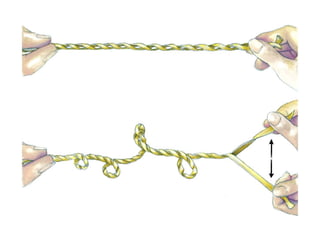
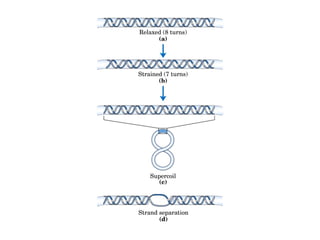
1. Topology
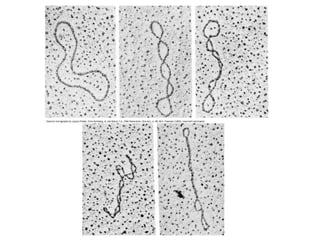
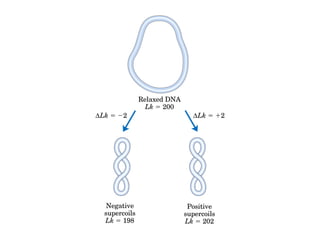
   A. Right handed supercoiling = negative supercoiling
   (underwinding)
   B. Left handed supercoiling = positive supercoiling
   C. Relaxed state is with no bends
   D. DNA must be constrained: plasmid DNA or by
   proteins
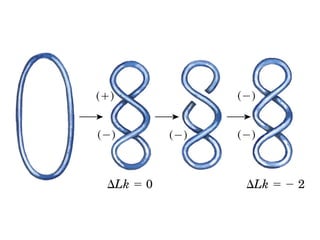
   E. Unraveling the DNA at one position changes the
   superhelicity -
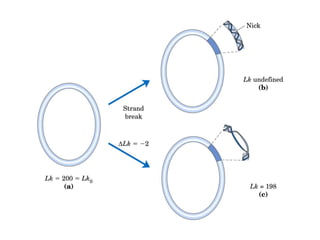
   F. Topology only defined for continuous deformation
   - no strand breakage
Supercoiling of DNA
1. Topology
   A. Right handed supercoiling = negative supercoiling
   (underwinding)
   B. Left handed supercoiling = positive supercoiling
   C. Relaxed state is with no bends
   D. DNA must be constrained: plasmid DNA or by
   proteins
   E. Unraveling the DNA at one position changes the
   superhelicity -
   F. Topology only defined for continuous deformation
   - no strand breakage
Supercoiling of DNA
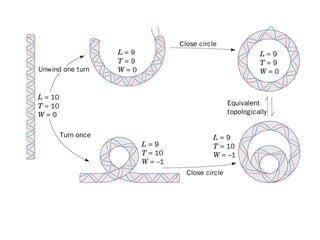
2. Numerical expression for degree of supercoiling
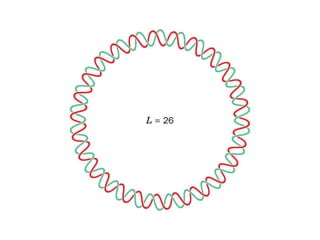
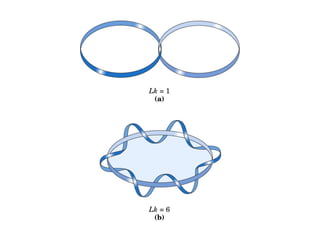
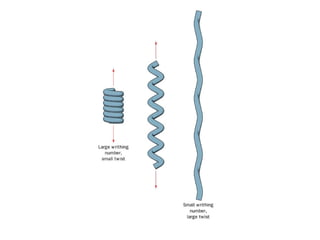
   A. Equation Lk=Tw+Wr
   B. L:linking number, # of times that one DNA
   strand winds about the others strands, is always an
   integer
   C. T: twist,# of revolutions about the duplex helix
   D. W: writhe, # of turns of the duplex axis about
   the superhelical axis
      by definition the measure of the degree of
   supercoiling
   E. specific linking difference or superhelical
   density=∆Lk/Lk0
Supercoiling of DNA
2. Numerical expression for degree of supercoiling
   A. Equation Lk=Tw+Wr
   B. L:linking number, # of times that one DNA
   strand winds about the others strands, is always an
   integer
   C. T: twist,# of revolutions about the duplex helix
   D. W: writhe, # of turns of the duplex axis about
   the superhelical axis
      by definition the measure of the degree of
   supercoiling
   E. specific linking difference or superhelical
   density=∆Lk/Lk0
Supercoiling of DNA
2. Numerical expression for degree of supercoiling
   A. Equation Lk=Tw+Wr
   B. L:linking number, # of times that one DNA
   strand winds about the others strands, is always an
   integer
   C. T: twist,# of revolutions about the duplex helix
   D. W: writhe, # of turns of the duplex axis about
   the superhelical axis
      by definition the measure of the degree of
   supercoiling
   E. specific linking difference or superhelical
   density=∆Lk/Lk0
Supercoiling of DNA
1. Topology
   A. Right handed supercoiling = negative supercoiling
   (underwinding)
   B. Left handed supercoiling = positive supercoiling
   C. Relaxed state is with no bends
   D. DNA must be constrained: plasmid DNA or by
   proteins
   E. Unraveling the DNA at one position changes the
   superhelicity -
   F. Topology only defined for continuous deformation
   - no strand breakage
Supercoiling of DNA
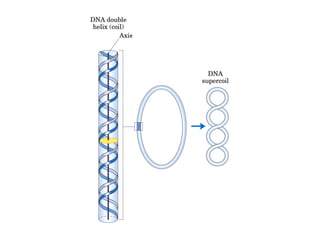
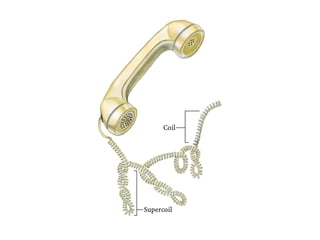
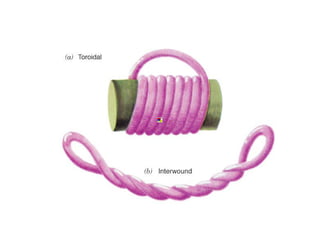
3. DNA compaction requires special form
  of supercoiling
     A. Interwound: supercoiling of DNA
  in solution
     B. Toroidal- tight left handed turns,
  packing of DNA
      both forms are interconvertible
Supercoiling of DNA
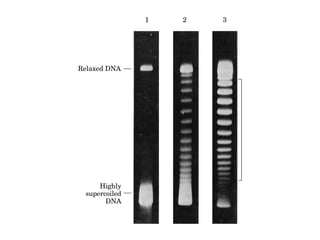
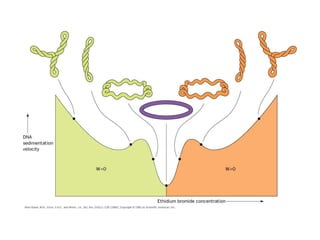
4. Methods for measuring supercoiling -
  based on how compact the DNA is
    A. Gel electrophoresis
         i. 1 dimensional
         ii. 2 dimensional
    B. Density sedimentation
Supercoiling of DNA
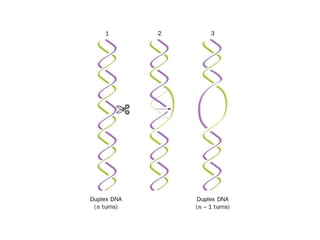
4. Topoisomerases are required to relieve
  torsional strain
  A. Topoisomerases I :
          breaks only one strand
  B. Topoisomerase II :
          breaks both strands
Supercoiling of DNA
4. Topoisomerases are required to relieve torsional
   strain
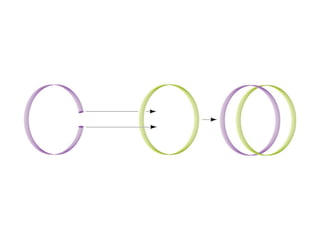
   A. Topoisomerases I - breaks only one strand
      i. monomeric protein
      ii. after nicking DNA the 5'-PO4 is covalently linked to
   enzyme (prokaryotes)
          or the 3' end is linked to the enzyme (eukaryotes)
      iii. evidence is the formation of catenates
      iv. E. coli Topo I relaxes negatively supercoiled DNA
      v. introduces a change of increments of 1 in writhe
Supercoiling of DNA
4. Topoisomerases are required to relieve torsional
   strain
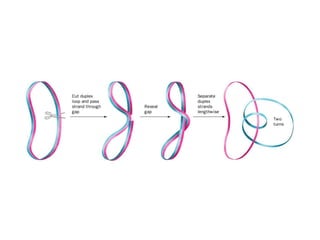
   B. Topoisomerase II - breaks both strands
      i. supercoils DNA at the expense of ATP
   hydrolysis
      ii. two subunits: (alpha)2 and (beta)2
      iii. becomes covalently linked to the alpha subunit
      iv. relaxes both negative and positively
   supercoiled DNA
      v. introduces a change in increments of 2 in
   writhe.
Supercoiling

Supercoiling

  • 1.
    Supercoiling of DNA 1.Topology A. Right handed supercoiling = negative supercoiling (underwinding) B. Left handed supercoiling = positive supercoiling C. Relaxed state is with no bends D. DNA must be constrained: plasmid DNA or by proteins E. Unraveling the DNA at one position changes the superhelicity - F. Topology only defined for continuous deformation - no strand breakage
  • 3.
    Supercoiling of DNA 1.Topology A. Right handed supercoiling = negative supercoiling (underwinding) B. Left handed supercoiling = positive supercoiling C. Relaxed state is with no bends D. DNA must be constrained: plasmid DNA or by proteins E. Unraveling the DNA at one position changes the superhelicity - F. Topology only defined for continuous deformation - no strand breakage
  • 5.
    Supercoiling of DNA 2.Numerical expression for degree of supercoiling A. Equation Lk=Tw+Wr B. L:linking number, # of times that one DNA strand winds about the others strands, is always an integer C. T: twist,# of revolutions about the duplex helix D. W: writhe, # of turns of the duplex axis about the superhelical axis by definition the measure of the degree of supercoiling E. specific linking difference or superhelical density=∆Lk/Lk0
  • 8.
    Supercoiling of DNA 2.Numerical expression for degree of supercoiling A. Equation Lk=Tw+Wr B. L:linking number, # of times that one DNA strand winds about the others strands, is always an integer C. T: twist,# of revolutions about the duplex helix D. W: writhe, # of turns of the duplex axis about the superhelical axis by definition the measure of the degree of supercoiling E. specific linking difference or superhelical density=∆Lk/Lk0
  • 11.
    Supercoiling of DNA 2.Numerical expression for degree of supercoiling A. Equation Lk=Tw+Wr B. L:linking number, # of times that one DNA strand winds about the others strands, is always an integer C. T: twist,# of revolutions about the duplex helix D. W: writhe, # of turns of the duplex axis about the superhelical axis by definition the measure of the degree of supercoiling E. specific linking difference or superhelical density=∆Lk/Lk0
  • 15.
    Supercoiling of DNA 1.Topology A. Right handed supercoiling = negative supercoiling (underwinding) B. Left handed supercoiling = positive supercoiling C. Relaxed state is with no bends D. DNA must be constrained: plasmid DNA or by proteins E. Unraveling the DNA at one position changes the superhelicity - F. Topology only defined for continuous deformation - no strand breakage
  • 19.
    Supercoiling of DNA 3.DNA compaction requires special form of supercoiling A. Interwound: supercoiling of DNA in solution B. Toroidal- tight left handed turns, packing of DNA both forms are interconvertible
  • 21.
    Supercoiling of DNA 4.Methods for measuring supercoiling - based on how compact the DNA is A. Gel electrophoresis i. 1 dimensional ii. 2 dimensional B. Density sedimentation
  • 24.
    Supercoiling of DNA 4.Topoisomerases are required to relieve torsional strain A. Topoisomerases I : breaks only one strand B. Topoisomerase II : breaks both strands
  • 27.
    Supercoiling of DNA 4.Topoisomerases are required to relieve torsional strain A. Topoisomerases I - breaks only one strand i. monomeric protein ii. after nicking DNA the 5'-PO4 is covalently linked to enzyme (prokaryotes) or the 3' end is linked to the enzyme (eukaryotes) iii. evidence is the formation of catenates iv. E. coli Topo I relaxes negatively supercoiled DNA v. introduces a change of increments of 1 in writhe
  • 28.
    Supercoiling of DNA 4.Topoisomerases are required to relieve torsional strain B. Topoisomerase II - breaks both strands i. supercoils DNA at the expense of ATP hydrolysis ii. two subunits: (alpha)2 and (beta)2 iii. becomes covalently linked to the alpha subunit iv. relaxes both negative and positively supercoiled DNA v. introduces a change in increments of 2 in writhe.