DNA supercoiling
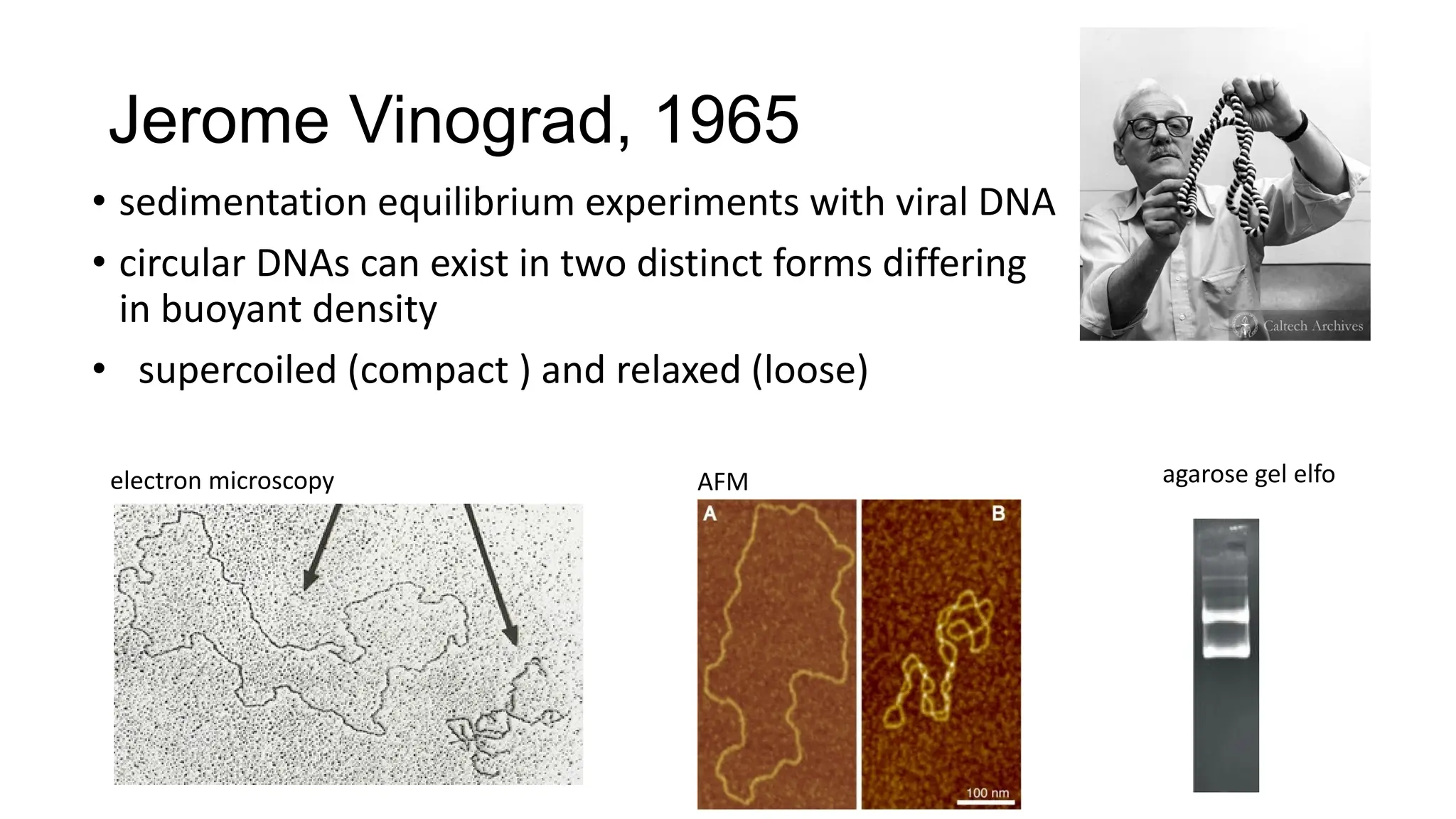
Jerome Vinograd, 1965
• sedimentation equilibrium experiments with viral DNA
• circular DNAs can exist in two distinct forms differing
in buoyant density
• supercoiled (compact ) and relaxed (loose)
electron microscopy AFM agarose gel elfo
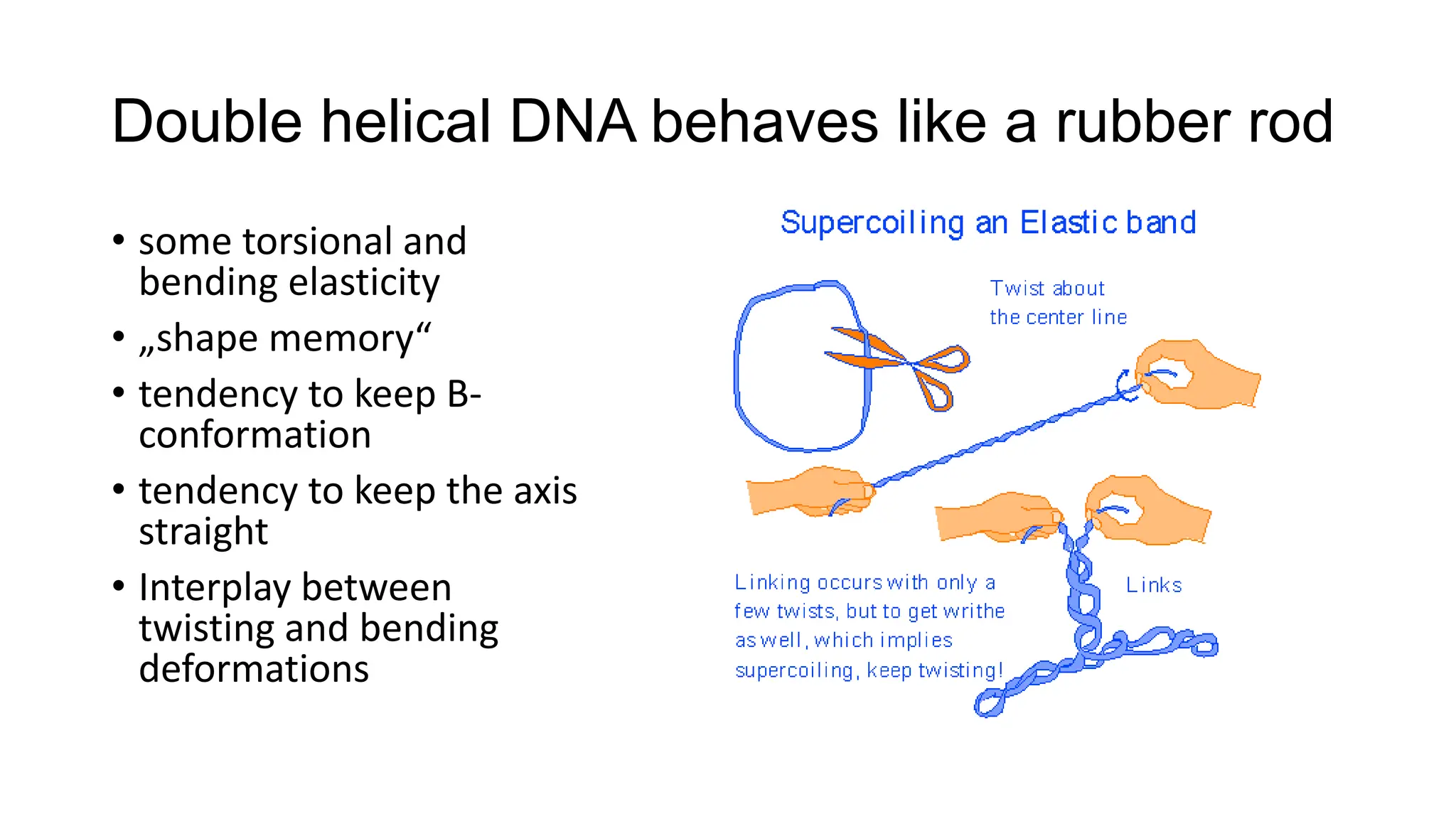
Double helical DNA behaves like a rubber rod
• some torsional and
bending elasticity
• „shape memory“
• tendency to keep B-
conformation
• tendency to keep the axis
straight
• Interplay between
twisting and bending
deformations
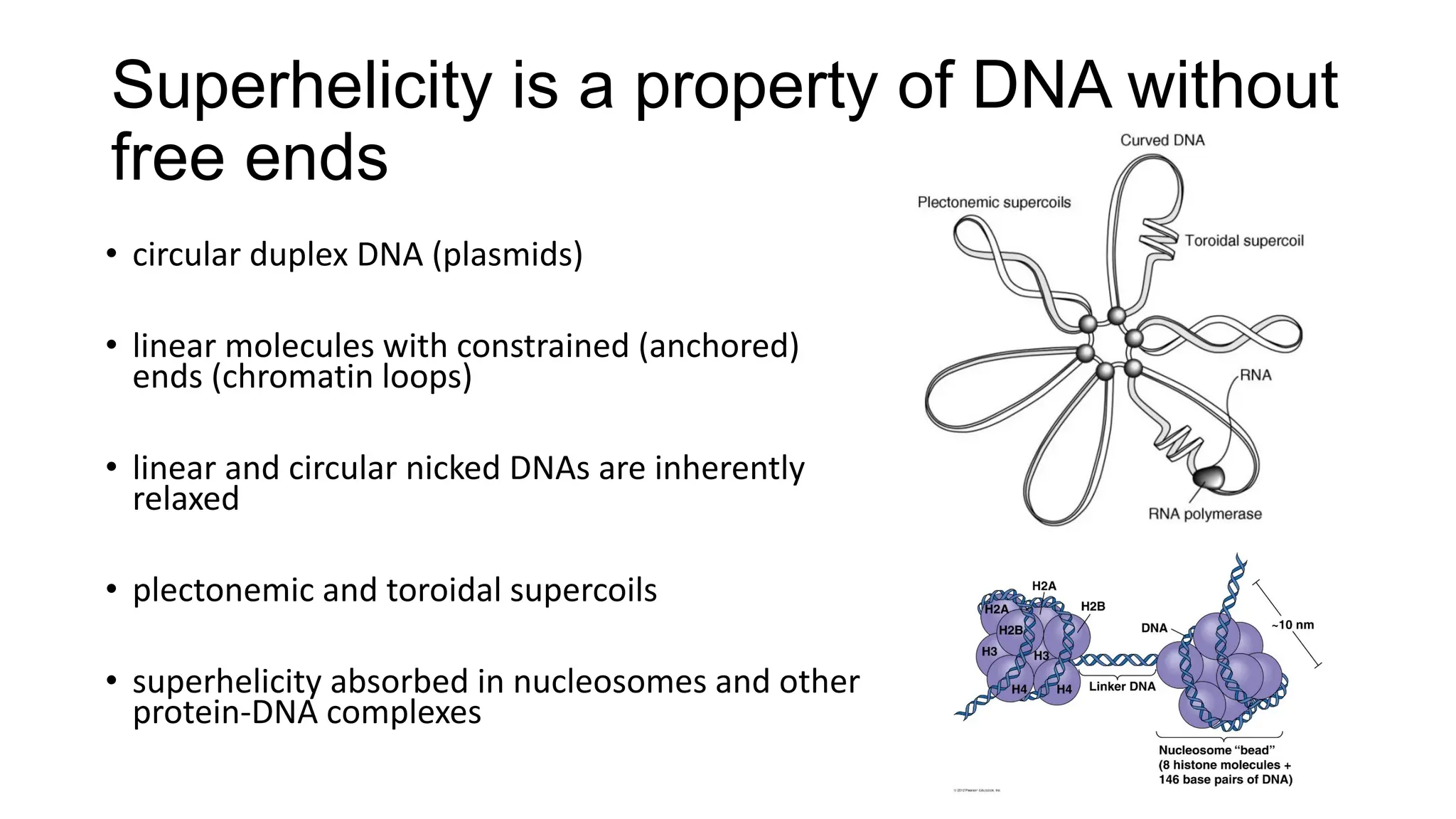
Superhelicity is a property of DNA without
free ends
• circular duplex DNA (plasmids)
• linear molecules with constrained (anchored)
ends (chromatin loops)
• linear and circular nicked DNAs are inherently
relaxed
• plectonemic and toroidal supercoils
• superhelicity absorbed in nucleosomes and other
protein-DNA complexes
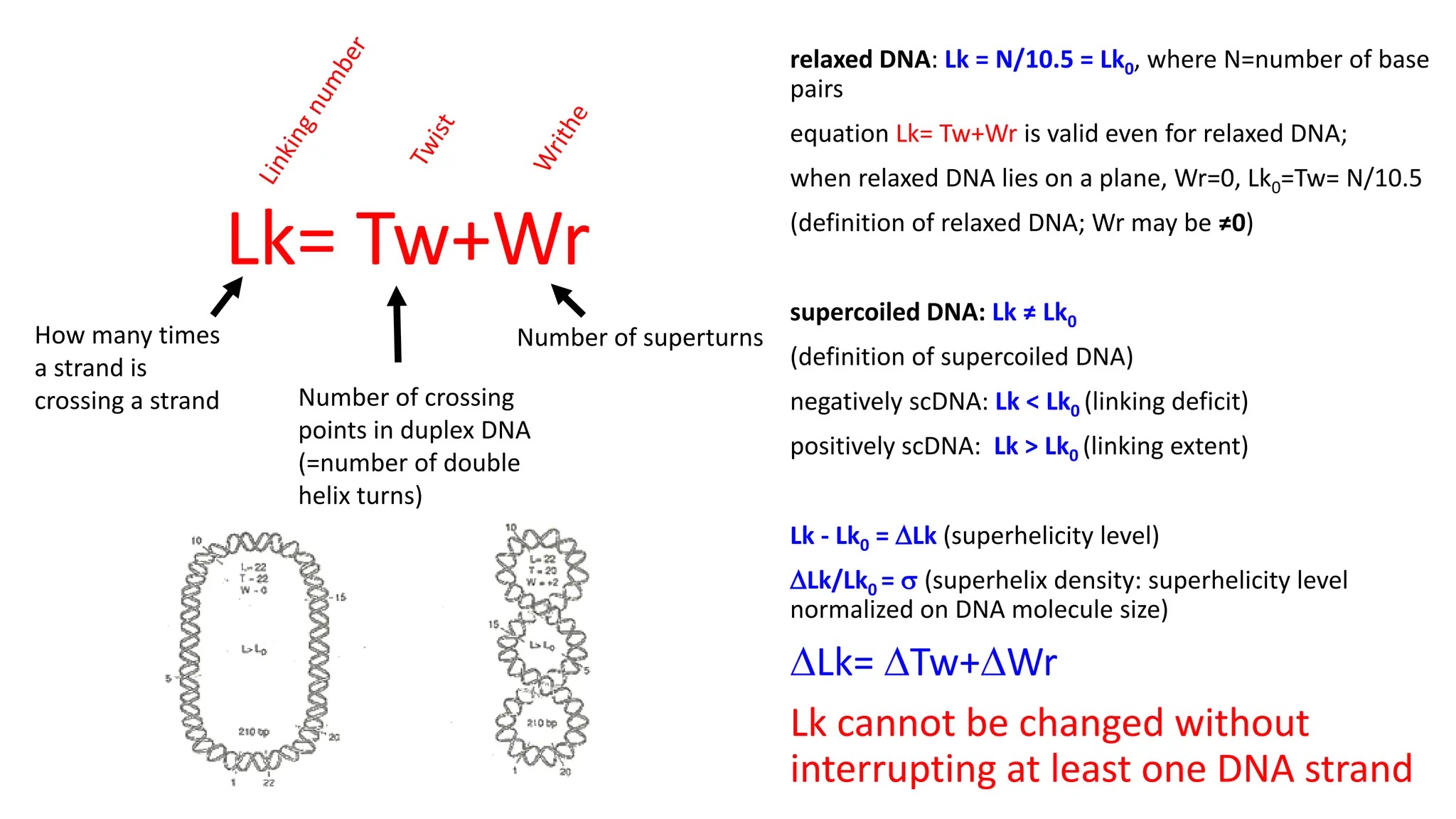
Lk= Tw+Wr
How many times
a strand is
crossing a strand Number of crossing
points in duplex DNA
(=number of double
helix turns)
Number of superturns
relaxed DNA: Lk = N/10.5 = Lk0, where N=number of base
pairs
equation Lk= Tw+Wr is valid even for relaxed DNA;
when relaxed DNA lies on a plane, Wr=0, Lk0=Tw= N/10.5
(definition of relaxed DNA; Wr may be ≠0)
supercoiled DNA: Lk ≠ Lk0
(definition of supercoiled DNA)
negatively scDNA: Lk < Lk0 (linking deficit)
positively scDNA: Lk > Lk0 (linking extent)
Lk - Lk0 = DLk (superhelicity level)
DLk/Lk0 = s (superhelix density: superhelicity level
normalized on DNA molecule size)
DLk= DTw+DWr
Lk cannot be changed without
interrupting at least one DNA strand
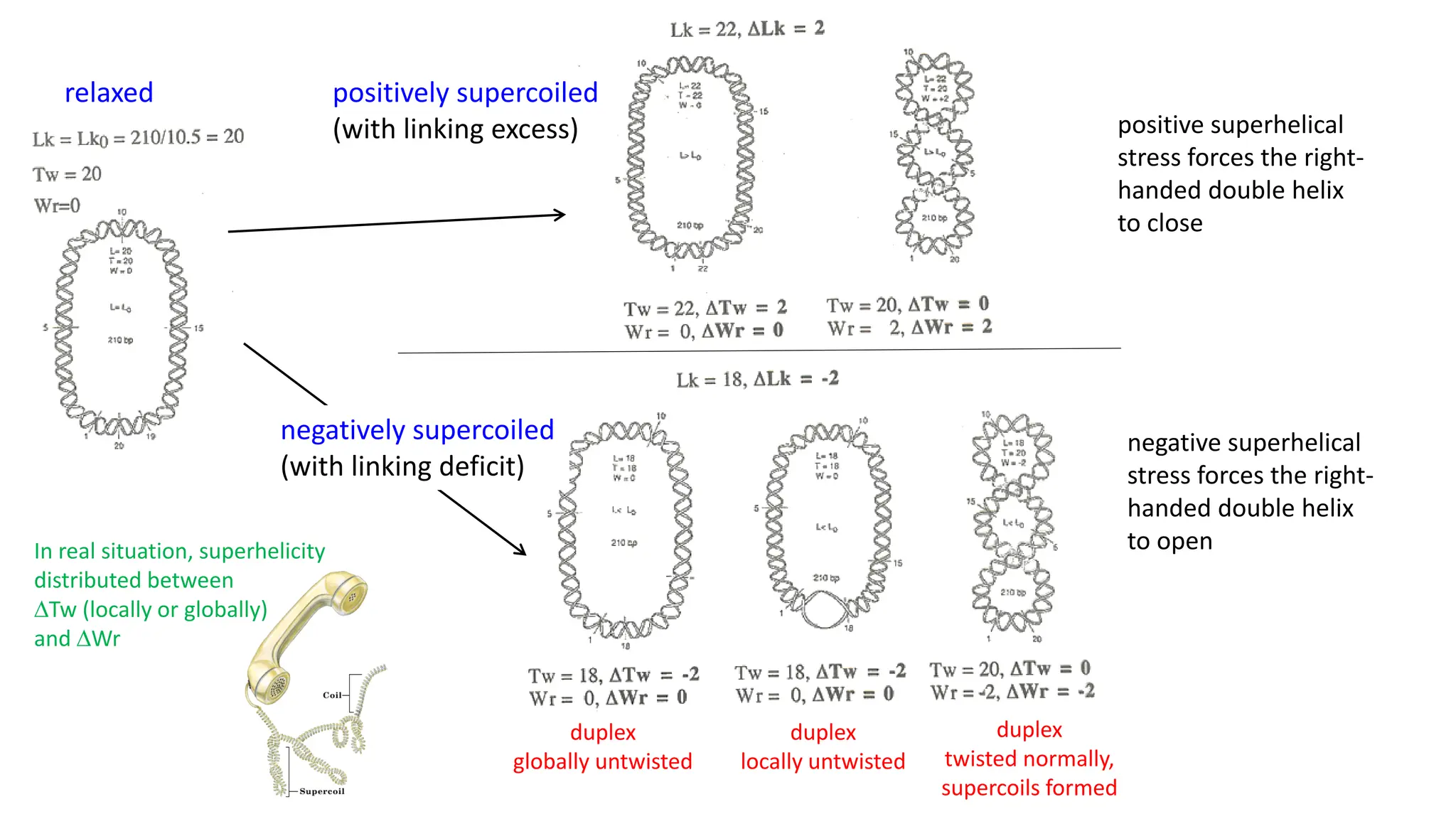
relaxed positively supercoiled
(with linking excess)
duplex
globally untwisted
duplex
locally untwisted
duplex
twisted normally,
supercoils formed
In real situation, superhelicity
distributed between
DTw (locally or globally)
and DWr
negatively supercoiled
(with linking deficit)
positive superhelical
stress forces the right-
handed double helix
to close
negative superhelical
stress forces the right-
handed double helix
to open
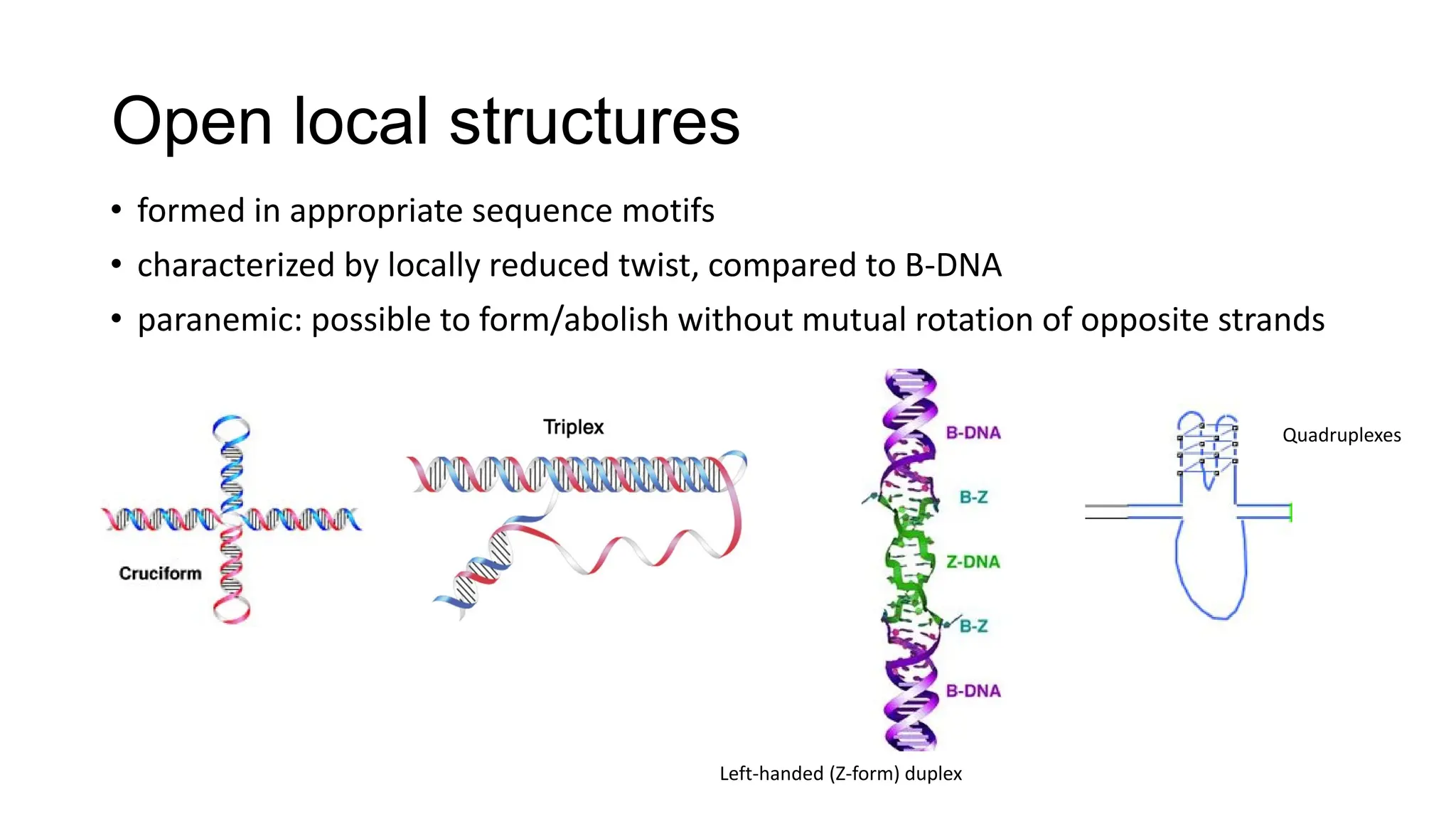
Open local structures
• formed in appropriate sequence motifs
• characterized by locally reduced twist, compared to B-DNA
• paranemic: possible to form/abolish without mutual rotation of opposite strands
Left-handed (Z-form) duplex
Quadruplexes
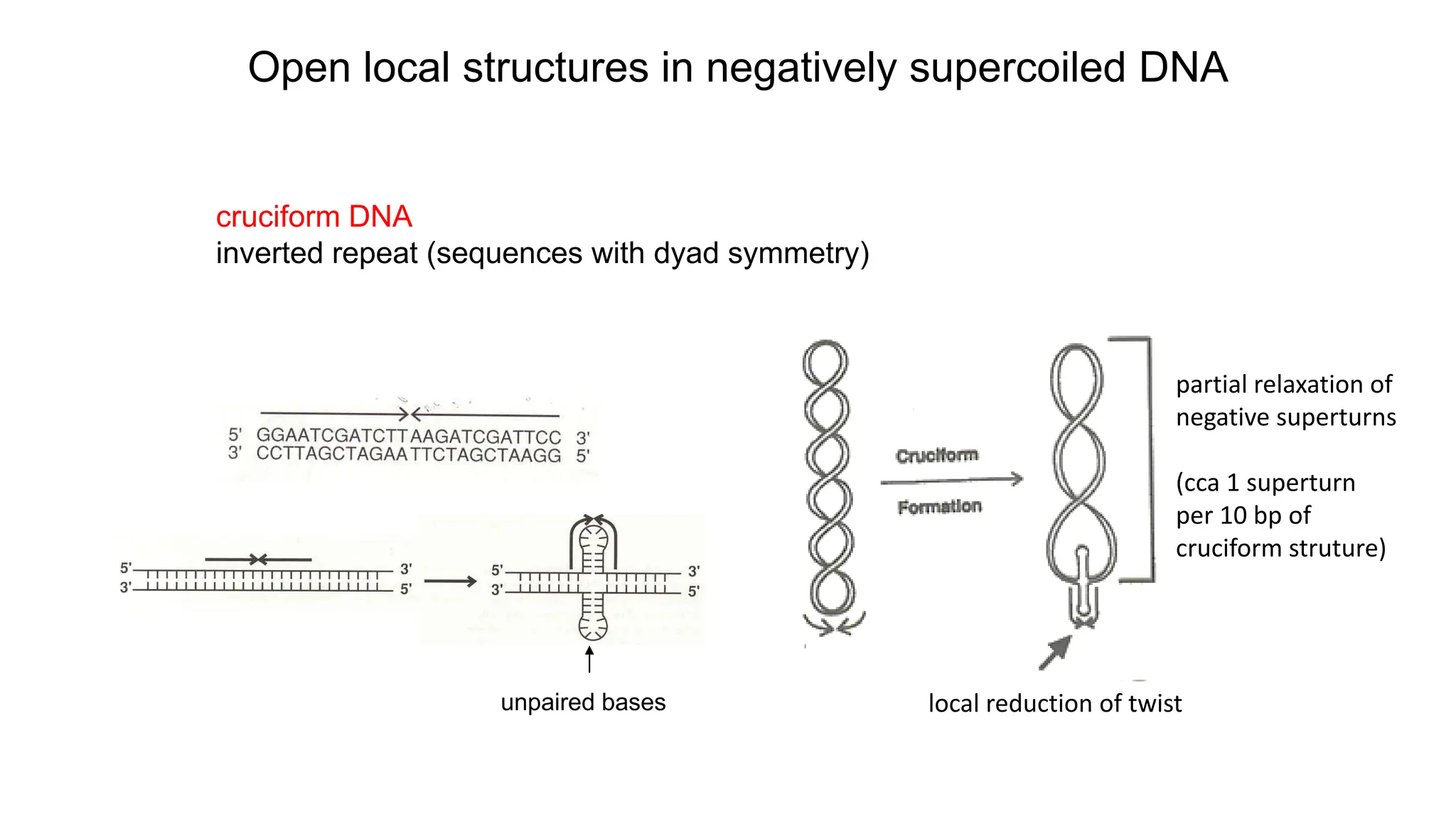
cruciform DNA
inverted repeat (sequences with dyad symmetry)
Open local structures in negatively supercoiled DNA
unpaired bases local reduction of twist
partial relaxation of
negative superturns
(cca 1 superturn
per 10 bp of
cruciform struture)
Open local structures in negatively supercoiled
DNA
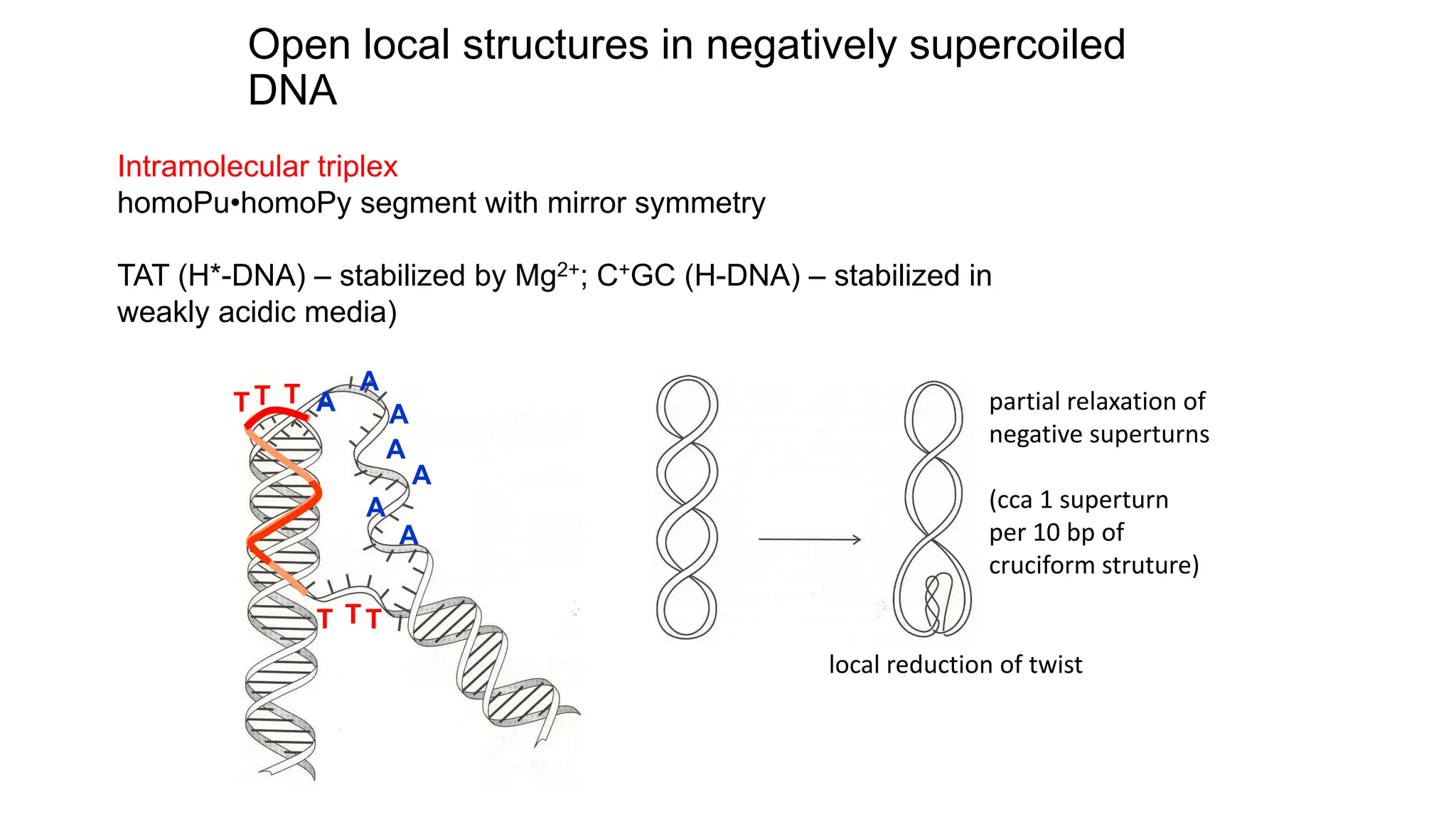
Intramolecular triplex
homoPu•homoPy segment with mirror symmetry
TAT (H*-DNA) – stabilized by Mg2+; C+GC (H-DNA) – stabilized in
weakly acidic media)
T
T
T
T
T T
A
A
A
A
A
A
A
local reduction of twist
partial relaxation of
negative superturns
(cca 1 superturn
per 10 bp of
cruciform struture)
Open local structures in negatively supercoiled
DNA
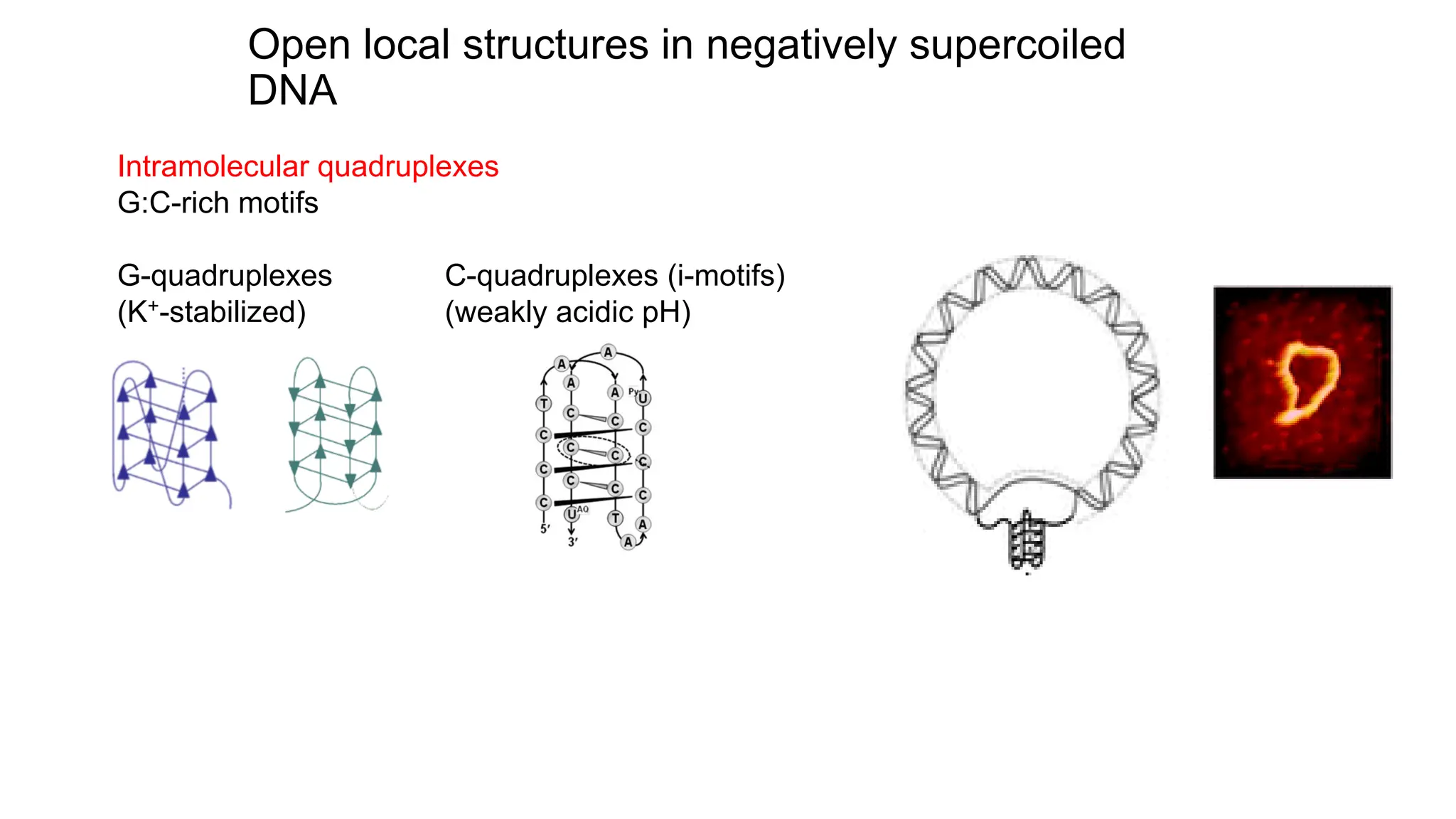
Intramolecular quadruplexes
G:C-rich motifs
G-quadruplexes C-quadruplexes (i-motifs)
(K+-stabilized) (weakly acidic pH)
Open local structures in negatively supercoiled
DNA
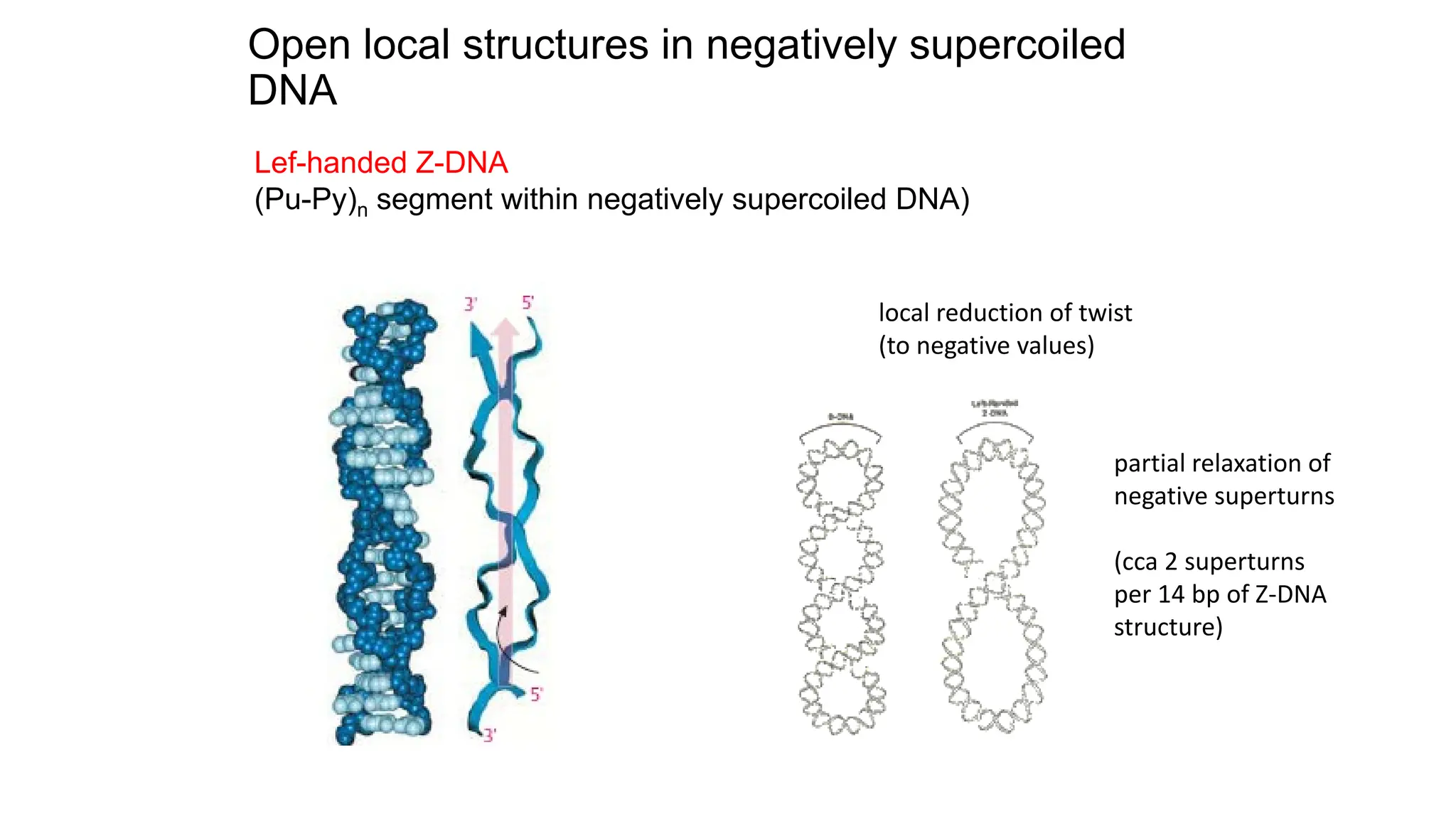
Lef-handed Z-DNA
(Pu-Py)n segment within negatively supercoiled DNA)
local reduction of twist
(to negative values)
partial relaxation of
negative superturns
(cca 2 superturns
per 14 bp of Z-DNA
structure)
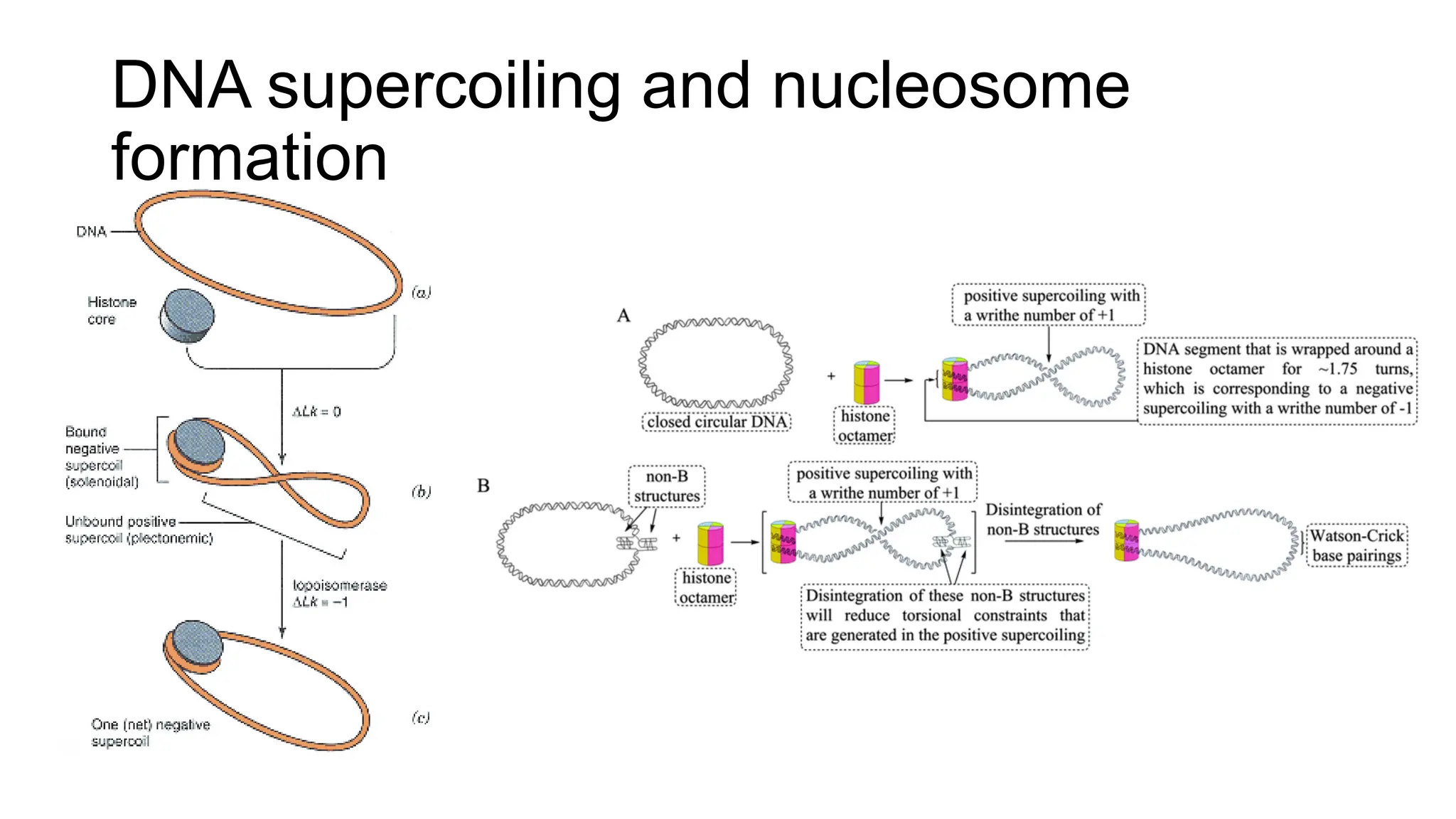
DNA supercoiling and nucleosome
formation
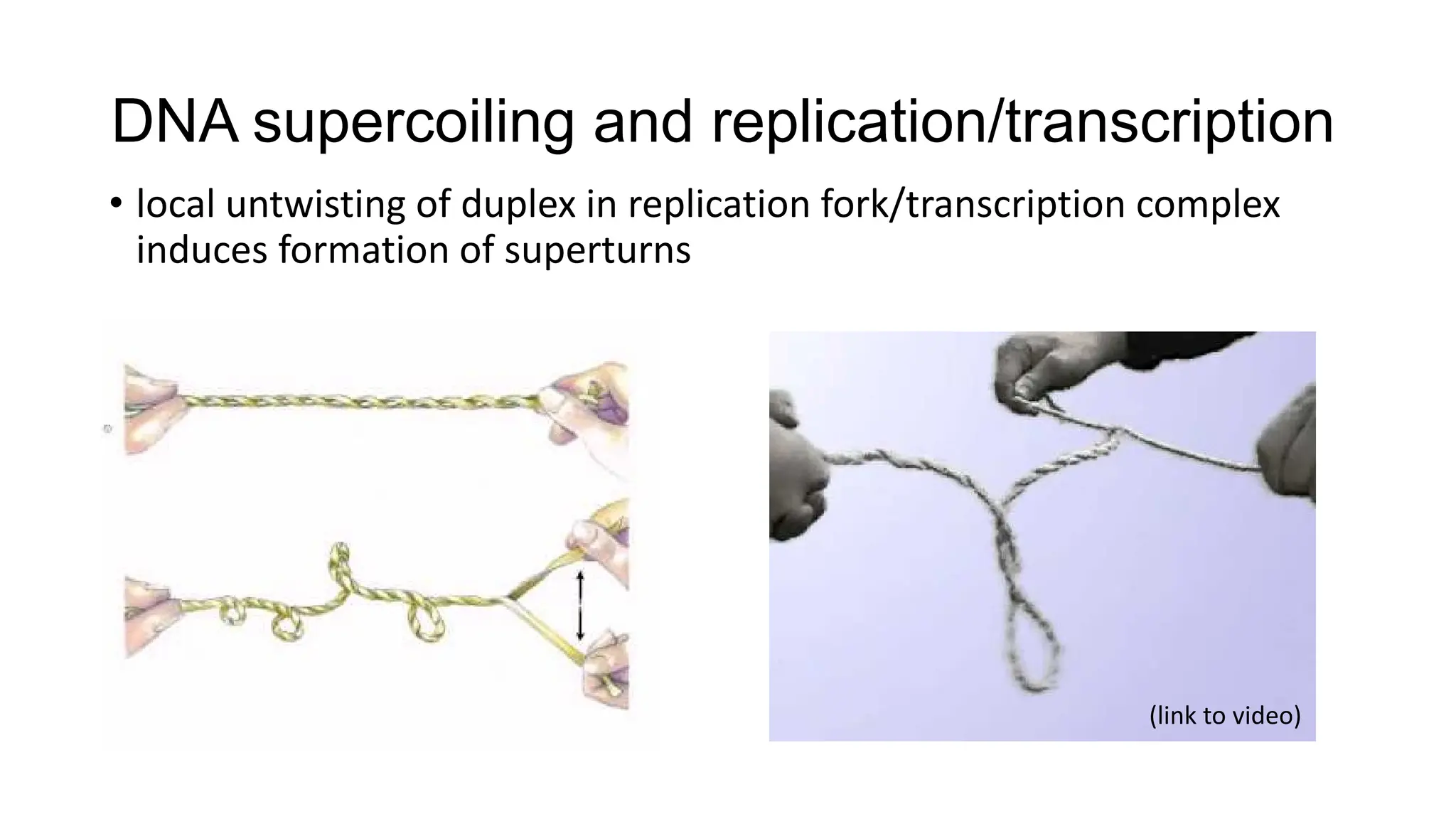
DNA supercoiling and replication/transcription
• local untwisting of duplex in replication fork/transcription complex
induces formation of superturns
(link to video)
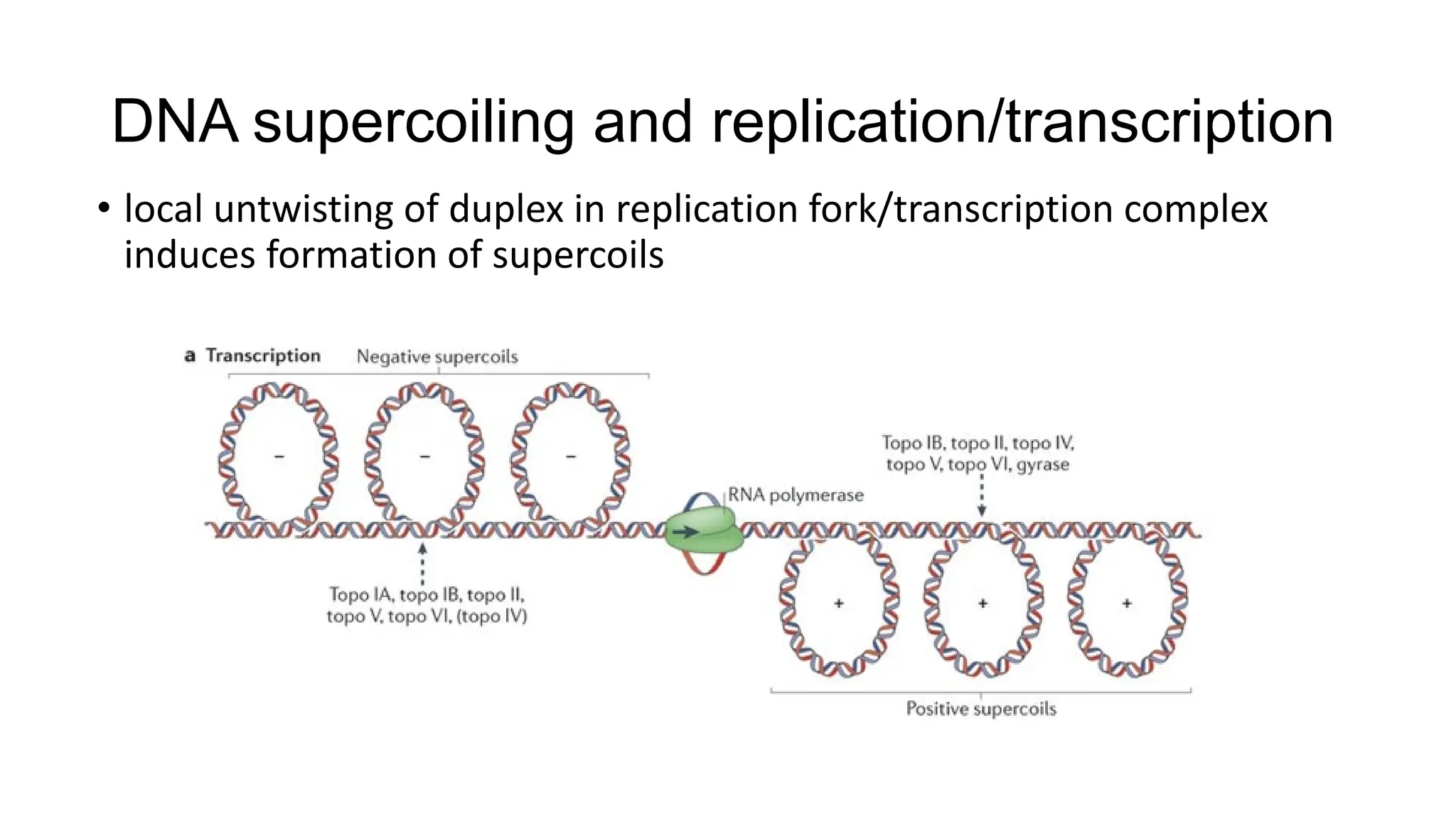
DNA supercoiling and replication/transcription
• local untwisting of duplex in replication fork/transcription complex
induces formation of supercoils
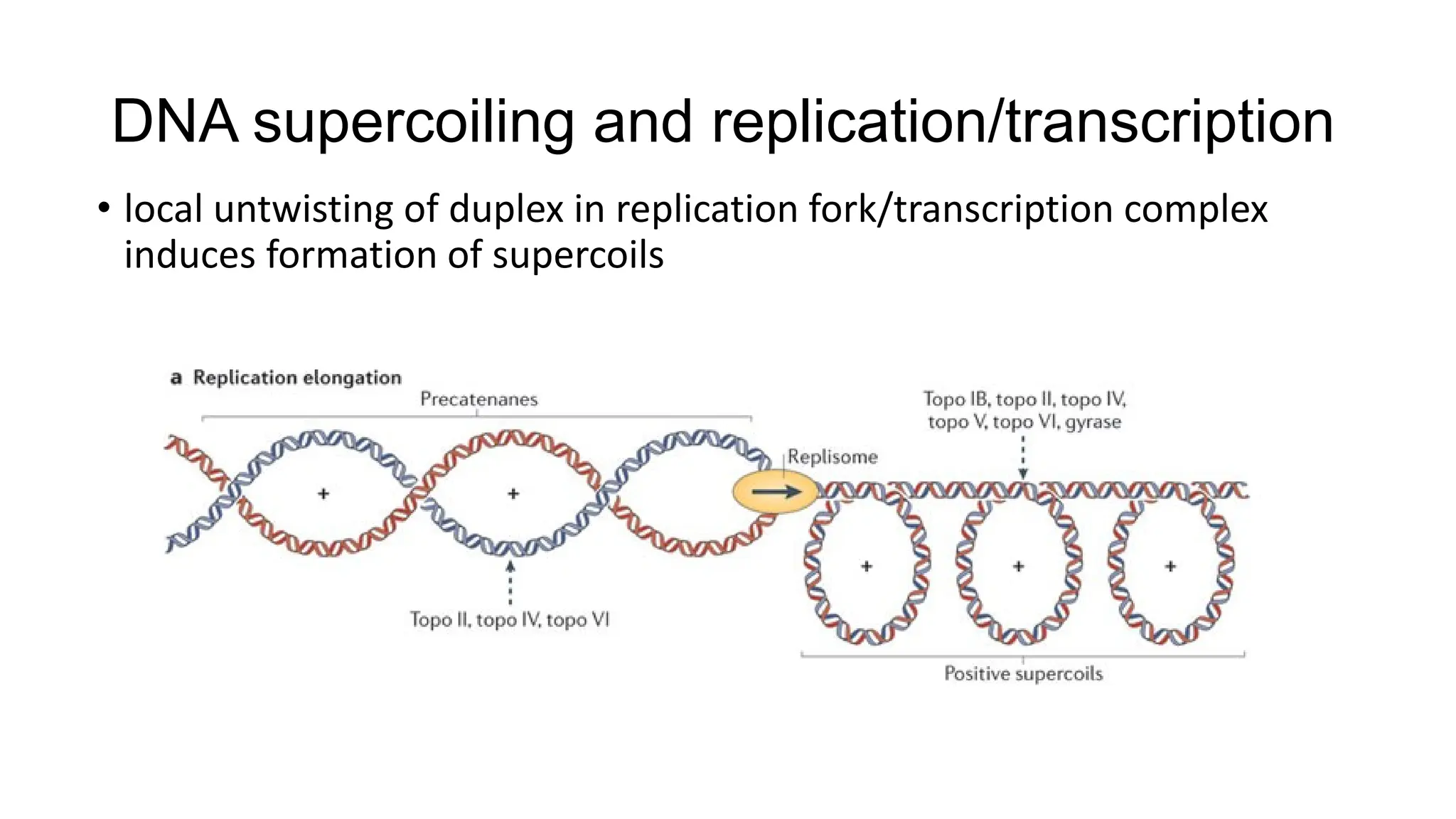
DNA supercoiling and replication/transcription
• local untwisting of duplex in replication fork/transcription complex
induces formation of supercoils
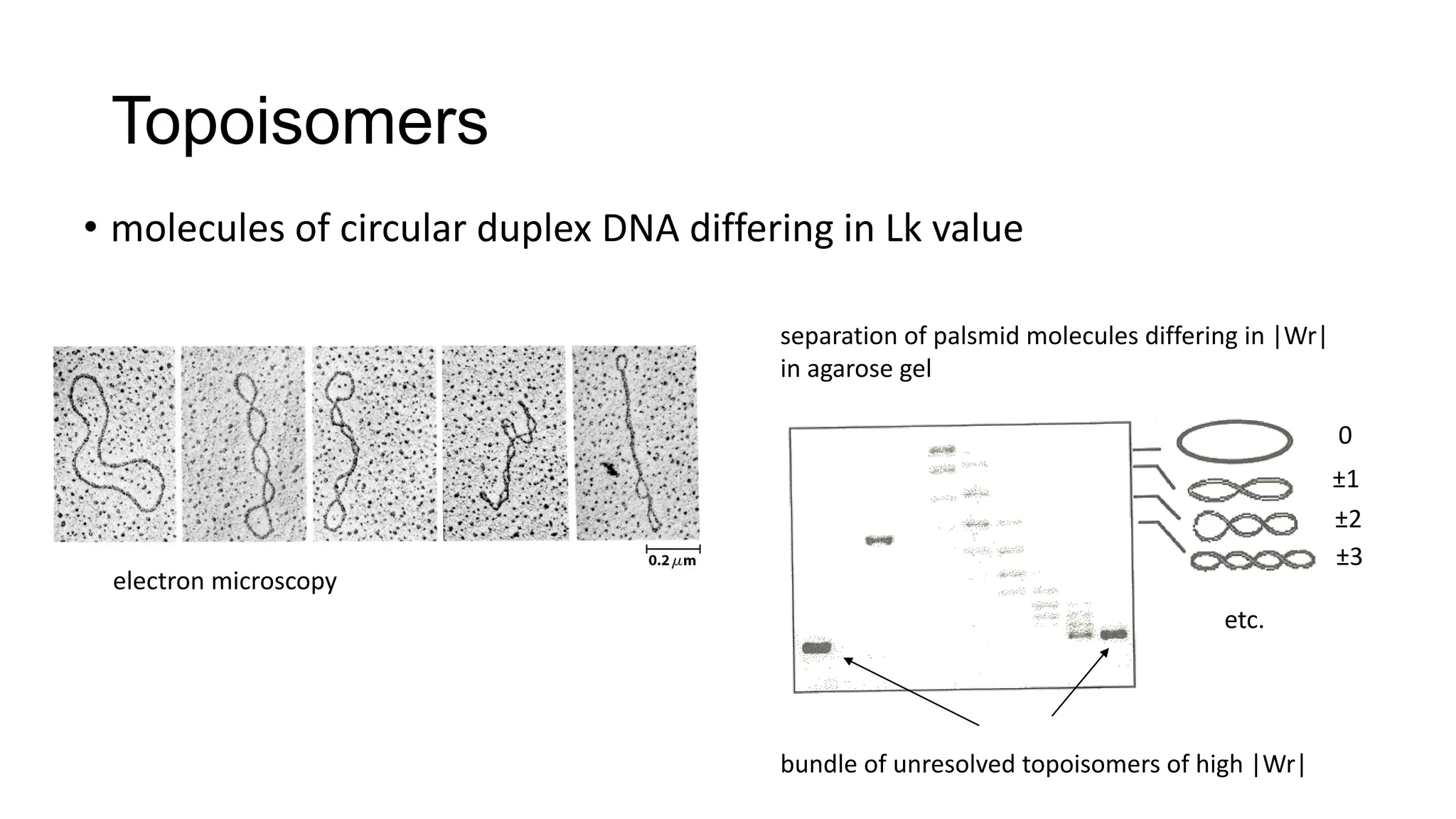
Topoisomers
• molecules of circular duplex DNA differing in Lk value
separation of palsmid molecules differing in |Wr|
in agarose gel
0
±1
±2
±3
etc.
bundle of unresolved topoisomers of high |Wr|
electron microscopy
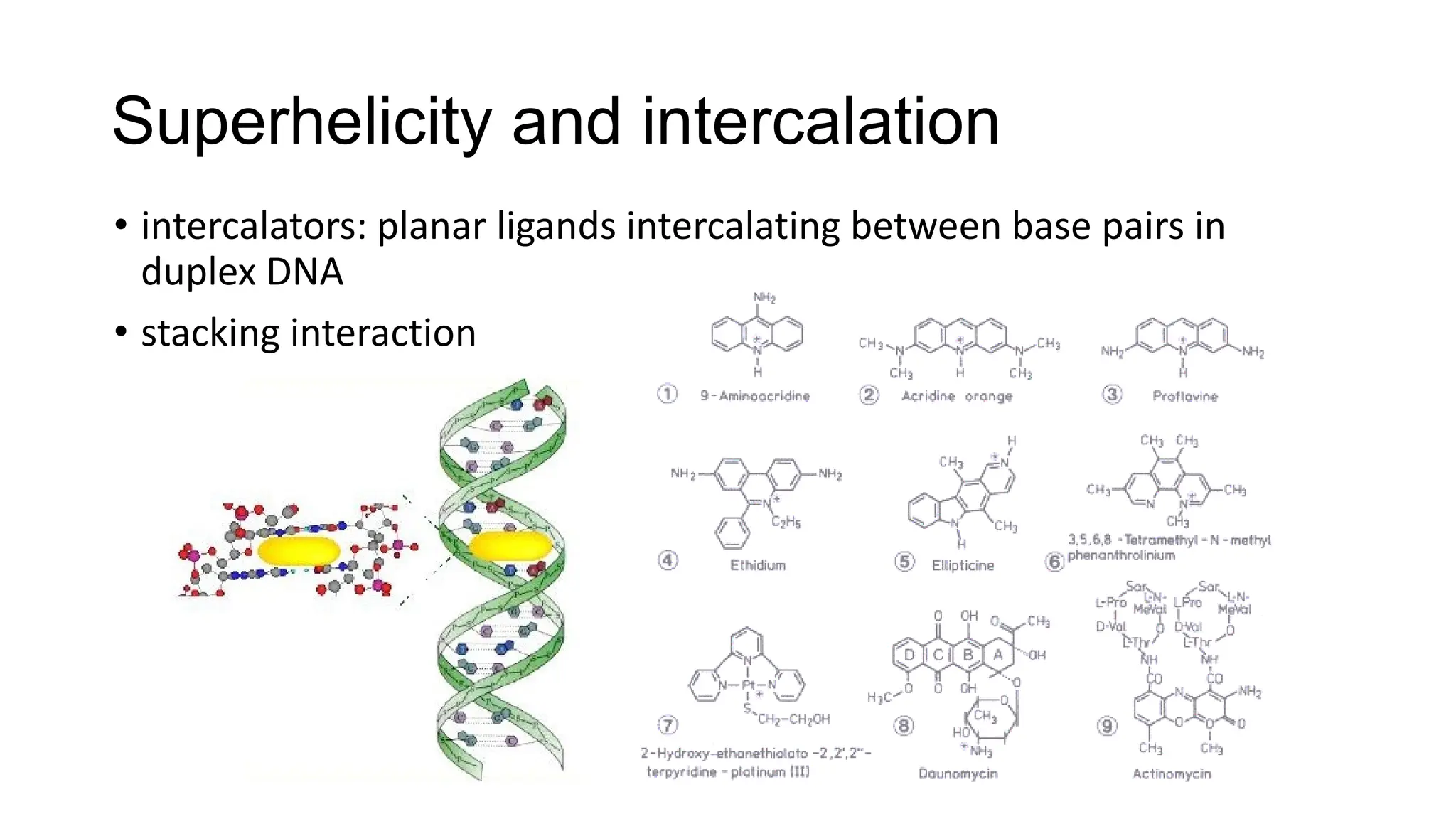
Superhelicity and intercalation
• intercalators: planar ligands intercalating between base pairs in
duplex DNA
• stacking interaction
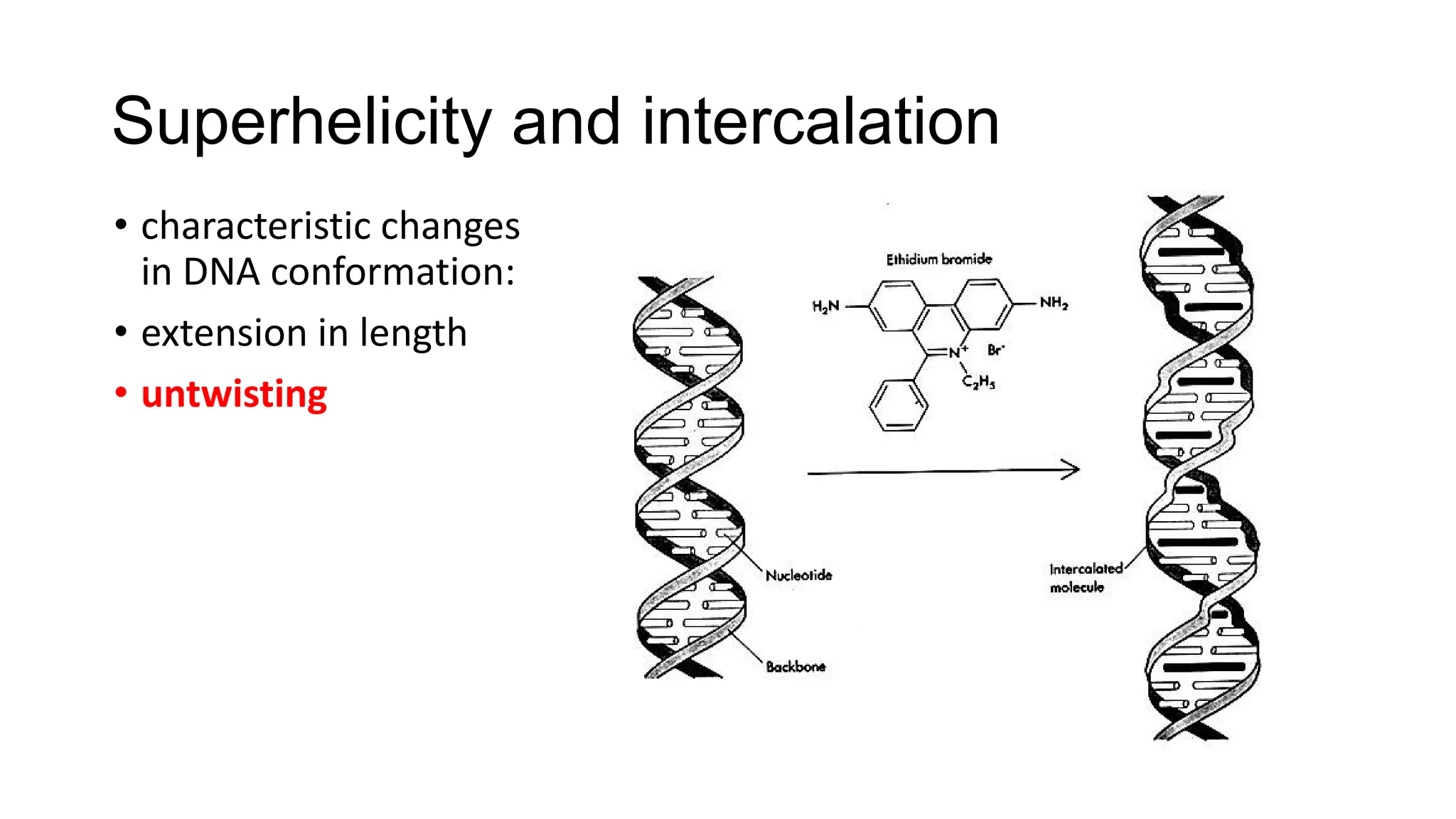
Superhelicity and intercalation
• characteristic changes
in DNA conformation:
• extension in length
• untwisting
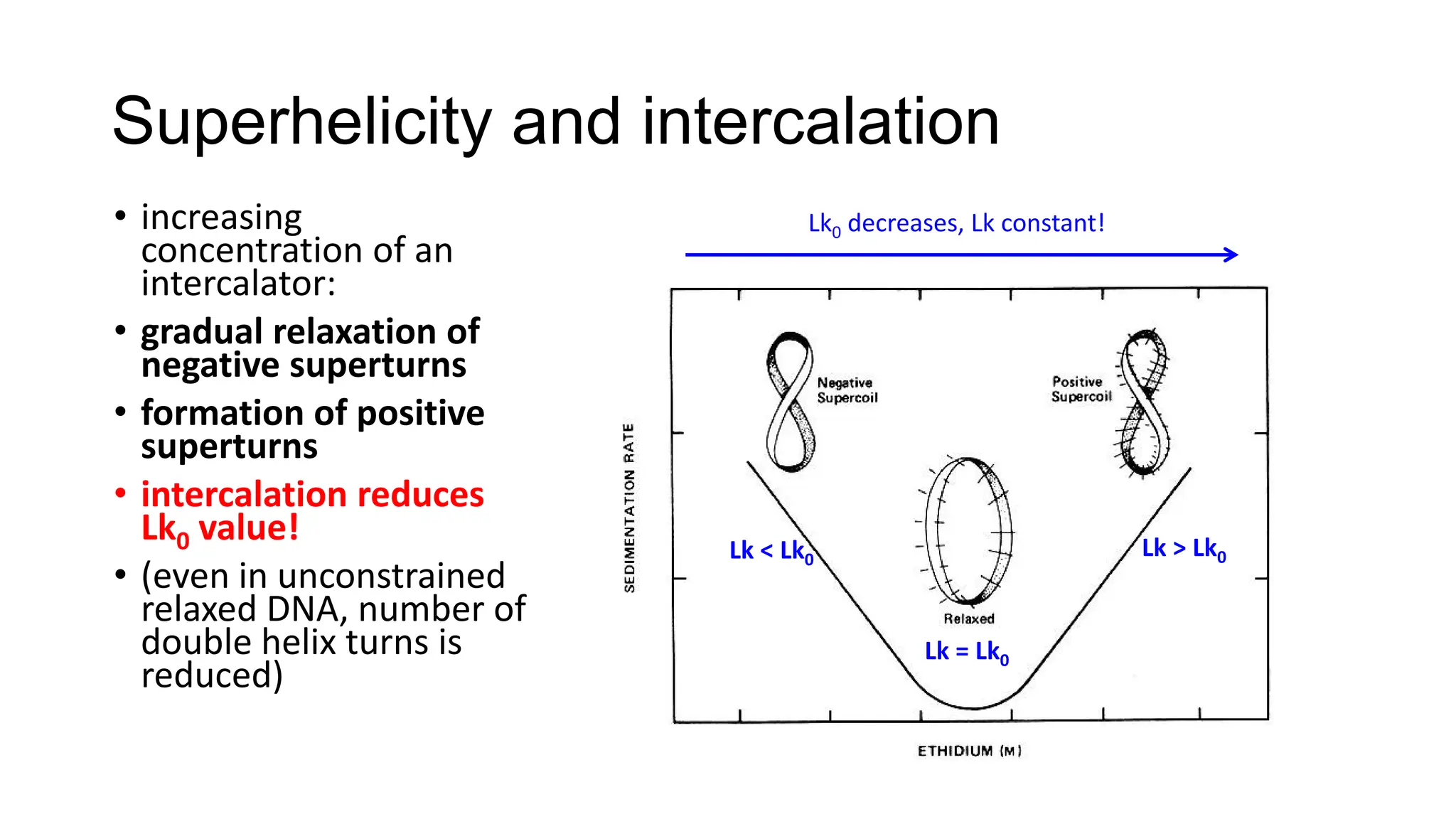
Superhelicity and intercalation
• increasing
concentration of an
intercalator:
• gradual relaxation of
negative superturns
• formation of positive
superturns
• intercalation reduces
Lk0 value!
• (even in unconstrained
relaxed DNA, number of
double helix turns is
reduced)
Lk < Lk0
Lk > Lk0
Lk = Lk0
Lk0 decreases, Lk constant!
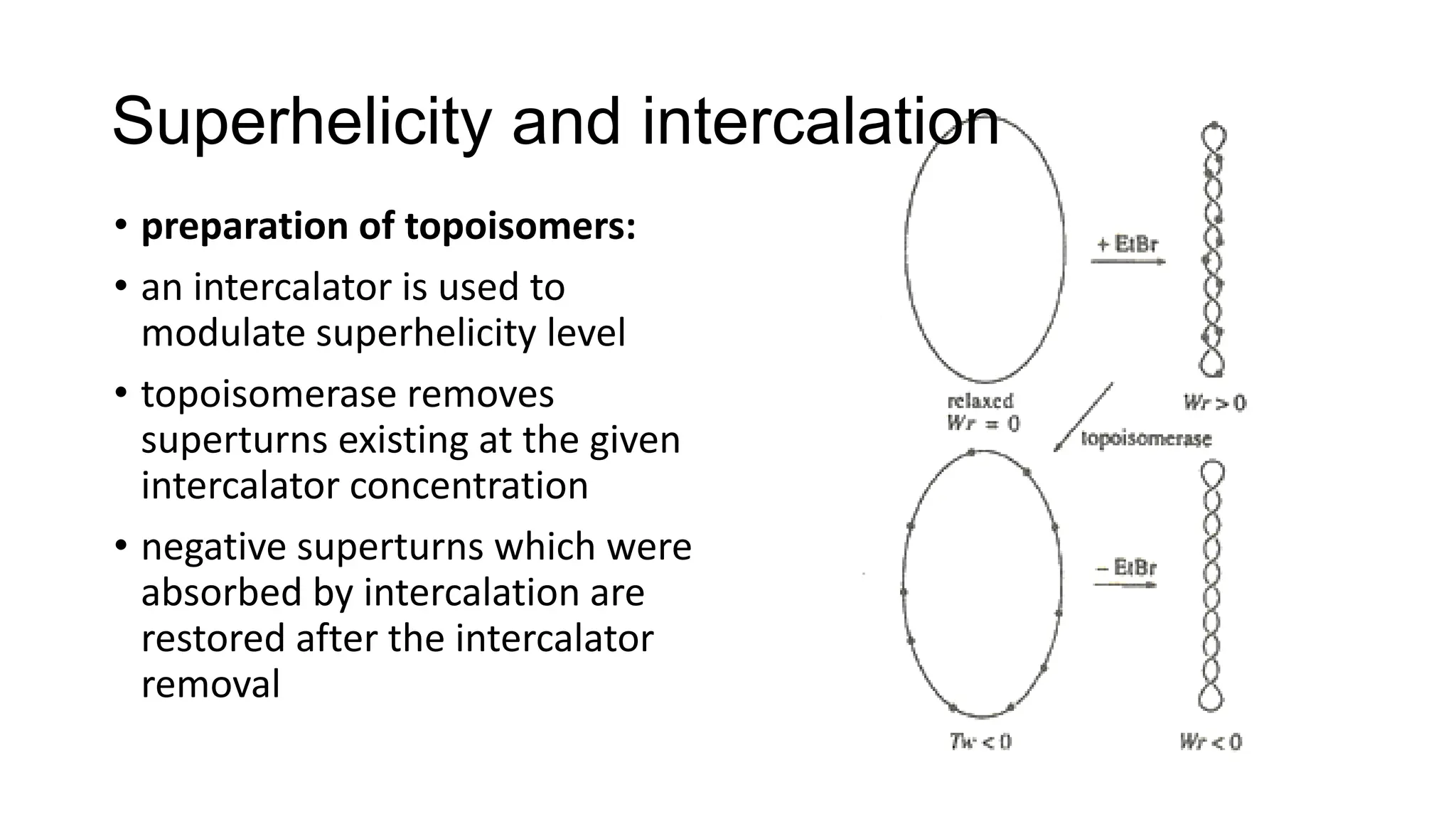
Superhelicity and intercalation
• preparation of topoisomers:
• an intercalator is used to
modulate superhelicity level
• topoisomerase removes
superturns existing at the given
intercalator concentration
• negative superturns which were
absorbed by intercalation are
restored after the intercalator
removal
2D electrophoresis of topoisomers
and detection of structural transitions
• open local structures are formed in scDNA with sufficiently negative
superhelix density
• they absorb a part of the superhelical stress, which is reflected in
reduction of Wr (number of superturns)
• decrease of the negative superhelicity causes the open structures to
disintegrate and B-DNA duplex to reform
• negative superhelicity reduction can be attained by intercalation
2D electrophoresis of topoisomers
and detection of structural transitions
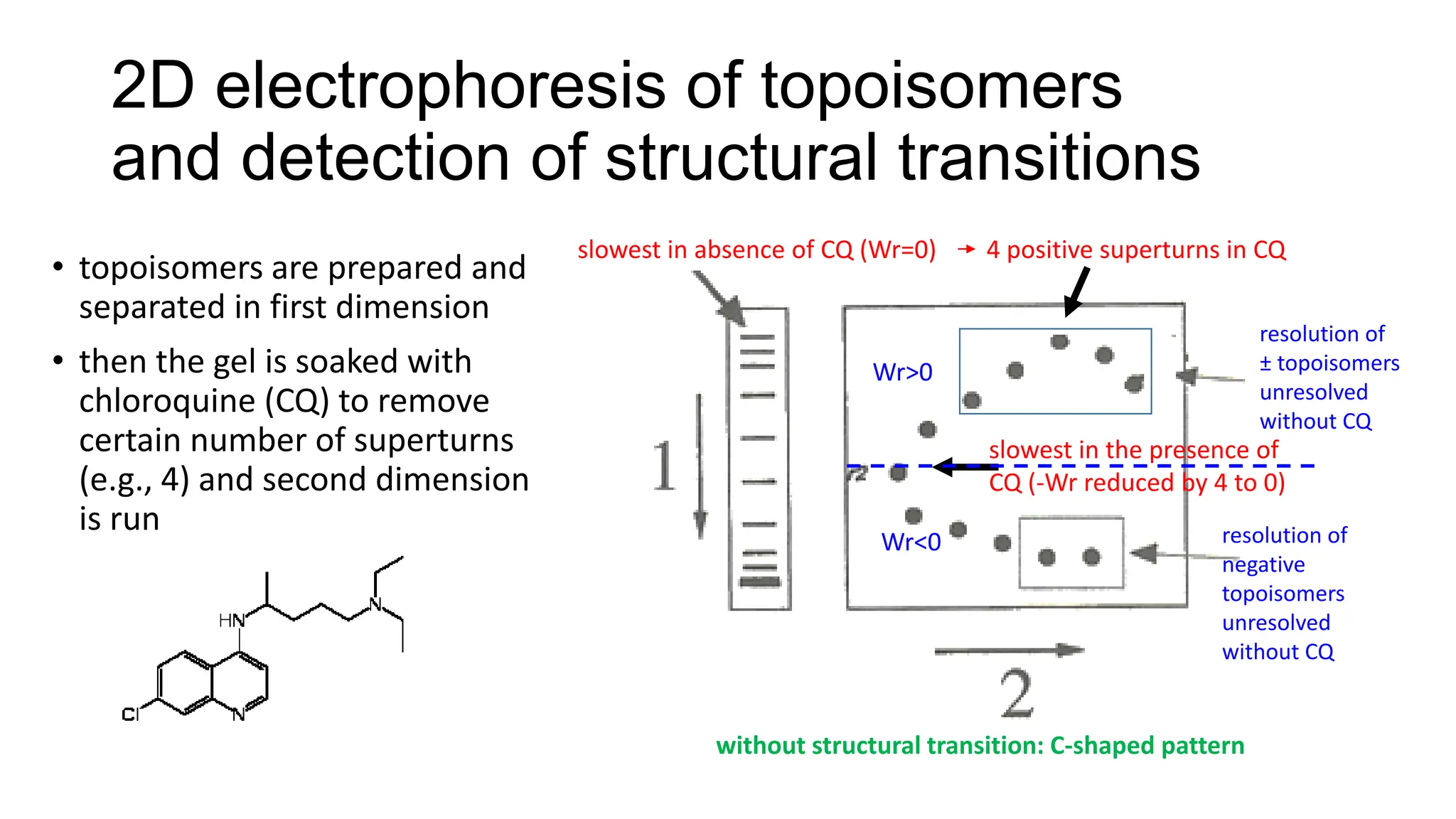
• topoisomers are prepared and
separated in first dimension
• then the gel is soaked with
chloroquine (CQ) to remove
certain number of superturns
(e.g., 4) and second dimension
is run
slowest in absence of CQ (Wr=0)
slowest in the presence of
CQ (-Wr reduced by 4 to 0)
4 positive superturns in CQ
resolution of
± topoisomers
unresolved
without CQ
resolution of
negative
topoisomers
unresolved
without CQ
Wr>0
Wr<0
without structural transition: C-shaped pattern
2D electrophoresis of topoisomers
and detection of structural transitions
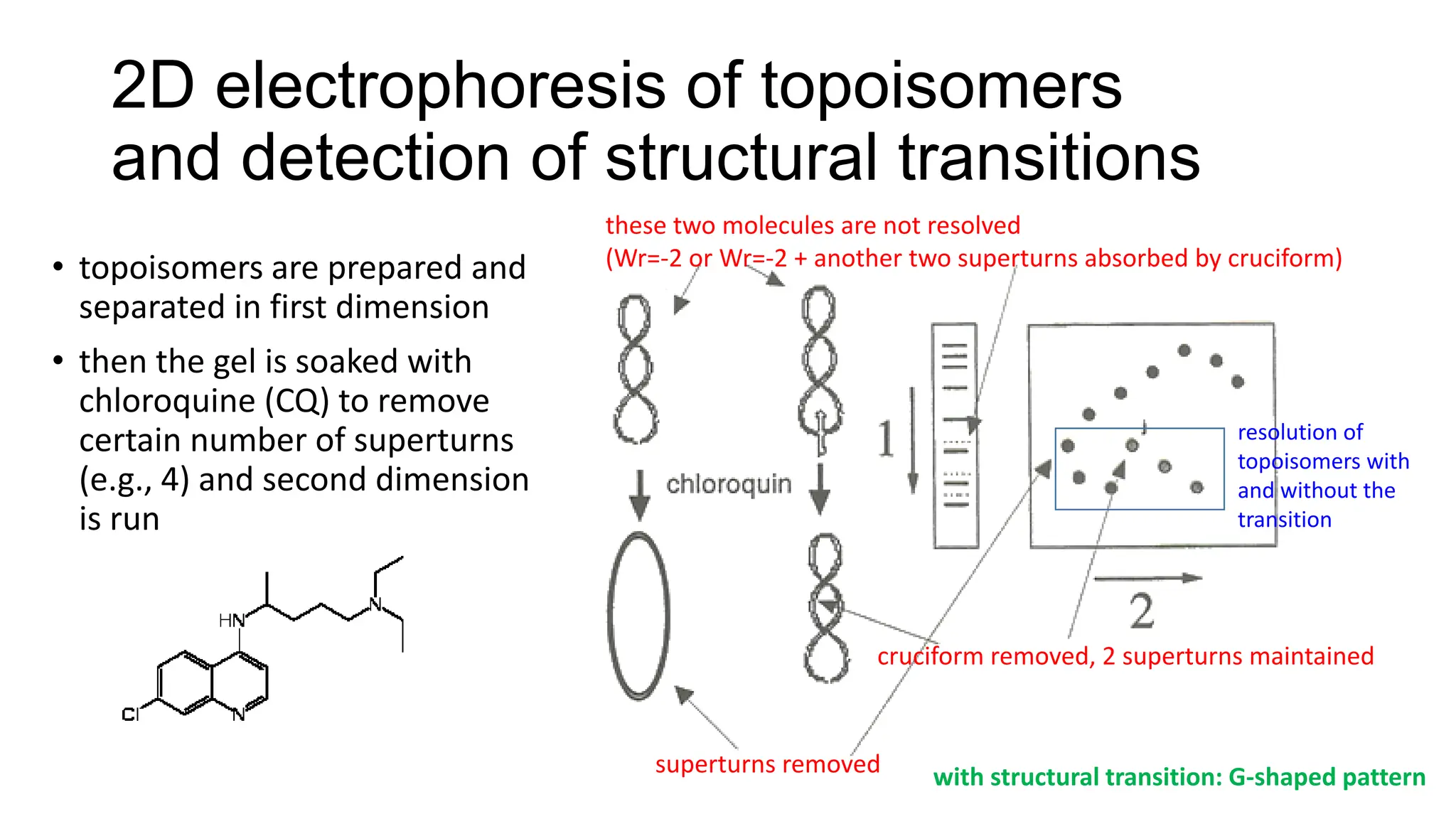
• topoisomers are prepared and
separated in first dimension
• then the gel is soaked with
chloroquine (CQ) to remove
certain number of superturns
(e.g., 4) and second dimension
is run
with structural transition: G-shaped pattern
these two molecules are not resolved
(Wr=-2 or Wr=-2 + another two superturns absorbed by cruciform)
superturns removed
cruciform removed, 2 superturns maintained
resolution of
topoisomers with
and without the
transition
Chemical probing of non-B structures (to
recall)
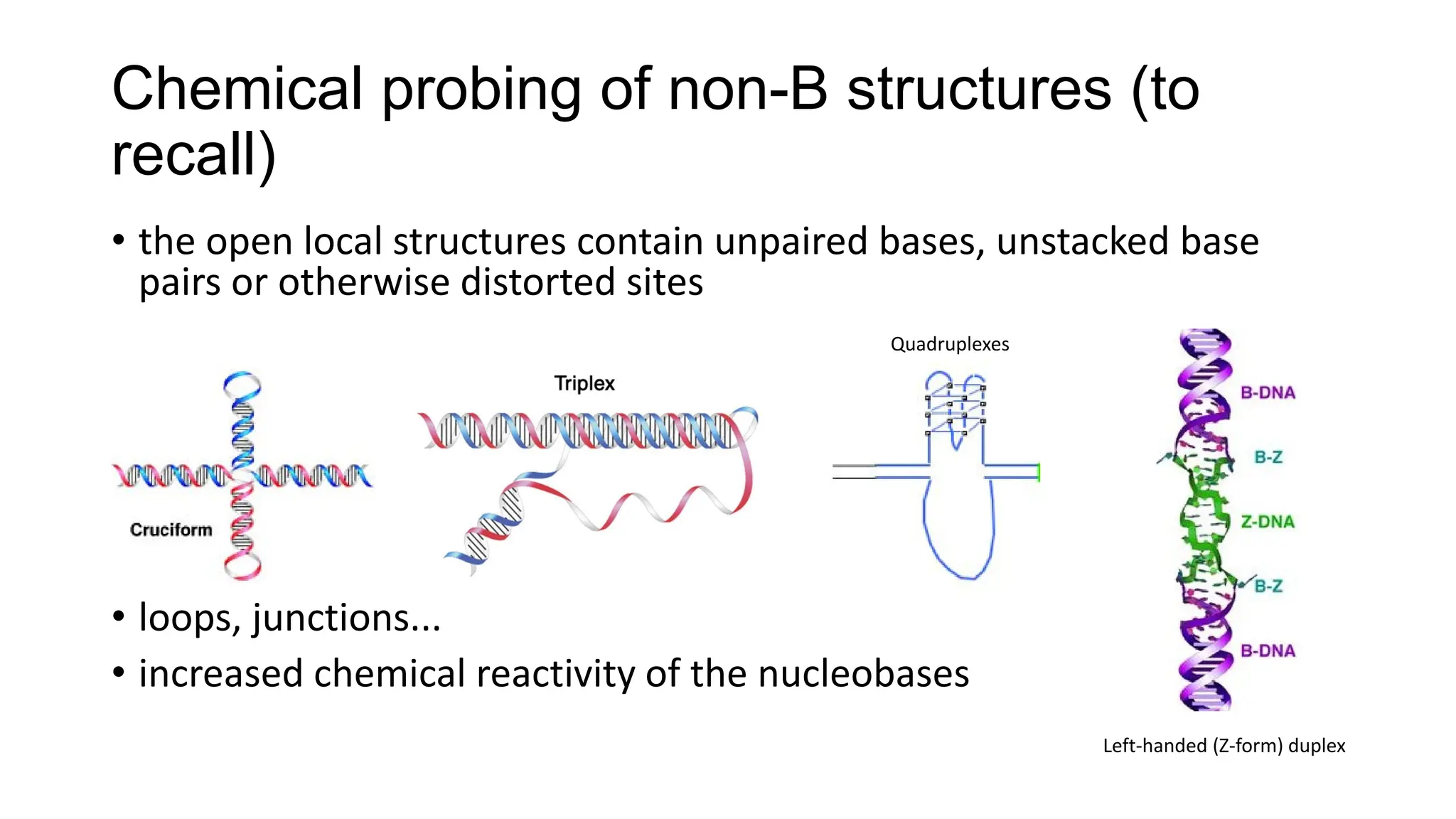
• the open local structures contain unpaired bases, unstacked base
pairs or otherwise distorted sites
• loops, junctions...
• increased chemical reactivity of the nucleobases
Left-handed (Z-form) duplex
Quadruplexes
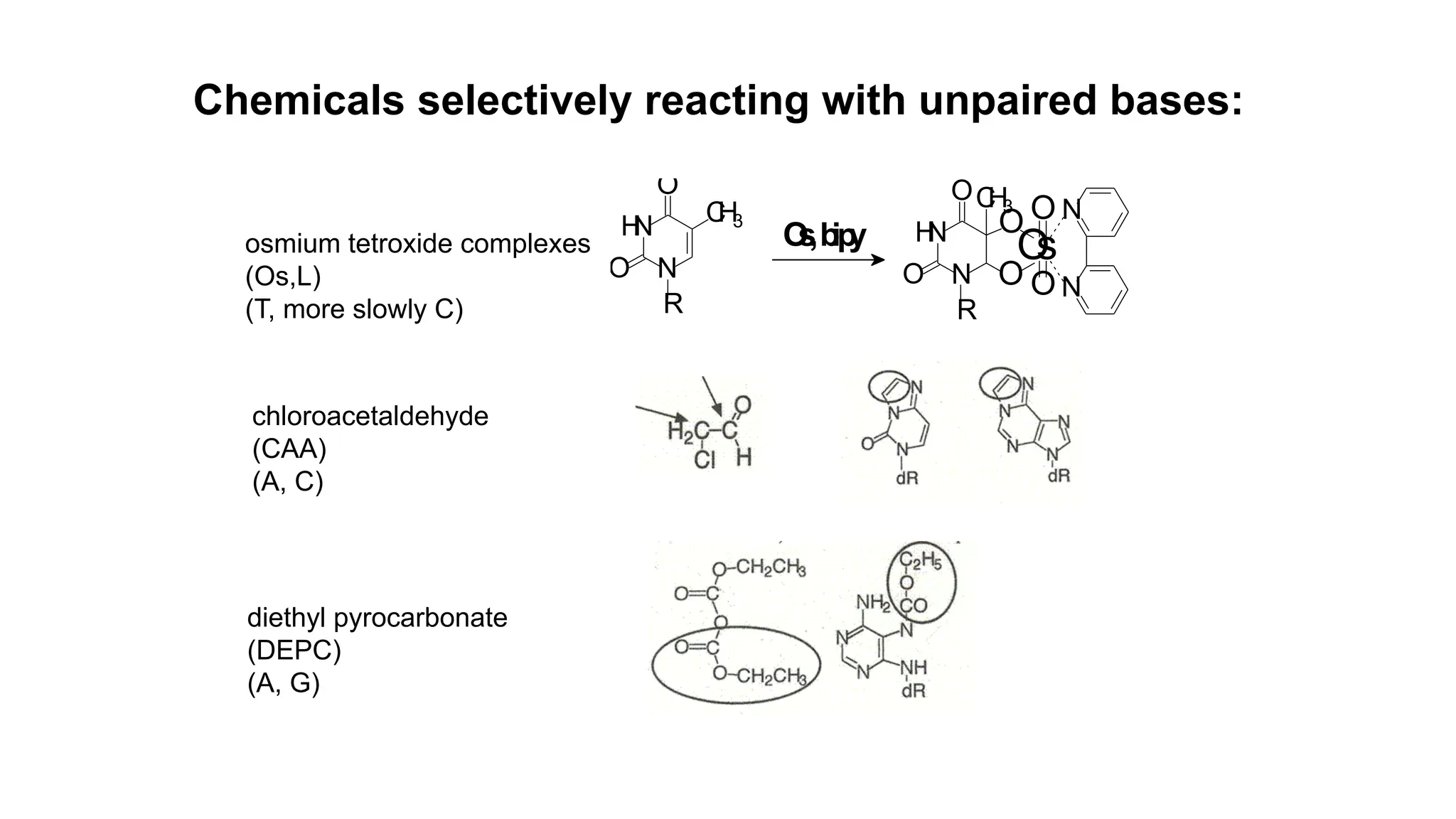
Chemicals selectively reacting with unpaired bases:
N
N
H
O
O
C
H3
O
s
,b
ip
y
N
N
H
O
OC
H3
O
O
O
s
O
O
N
N
R R
osmium tetroxide complexes
(Os,L)
(T, more slowly C)
chloroacetaldehyde
(CAA)
(A, C)
diethyl pyrocarbonate
(DEPC)
(A, G)
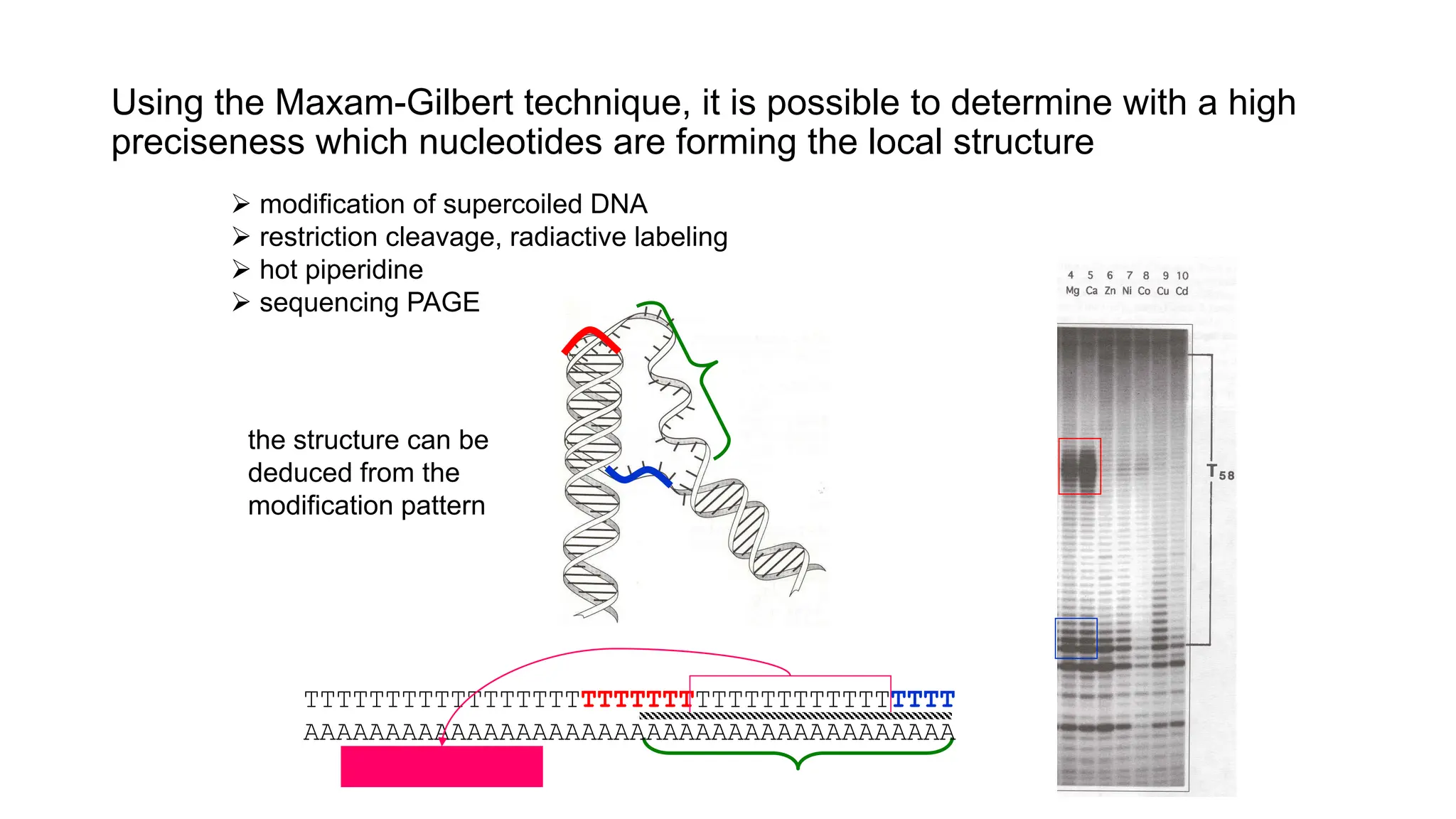
Using the Maxam-Gilbert technique, it is possible to determine with a high
preciseness which nucleotides are forming the local structure
 modification of supercoiled DNA
 restriction cleavage, radiactive labeling
 hot piperidine
 sequencing PAGE
the structure can be
deduced from the
modification pattern
TTTTTTTTTTTTTTTTTTTTTTTTTTTTTTTTTTTTTTTT
AAAAAAAAAAAAAAAAAAAAAAAAAAAAAAAAAAAAAAAA
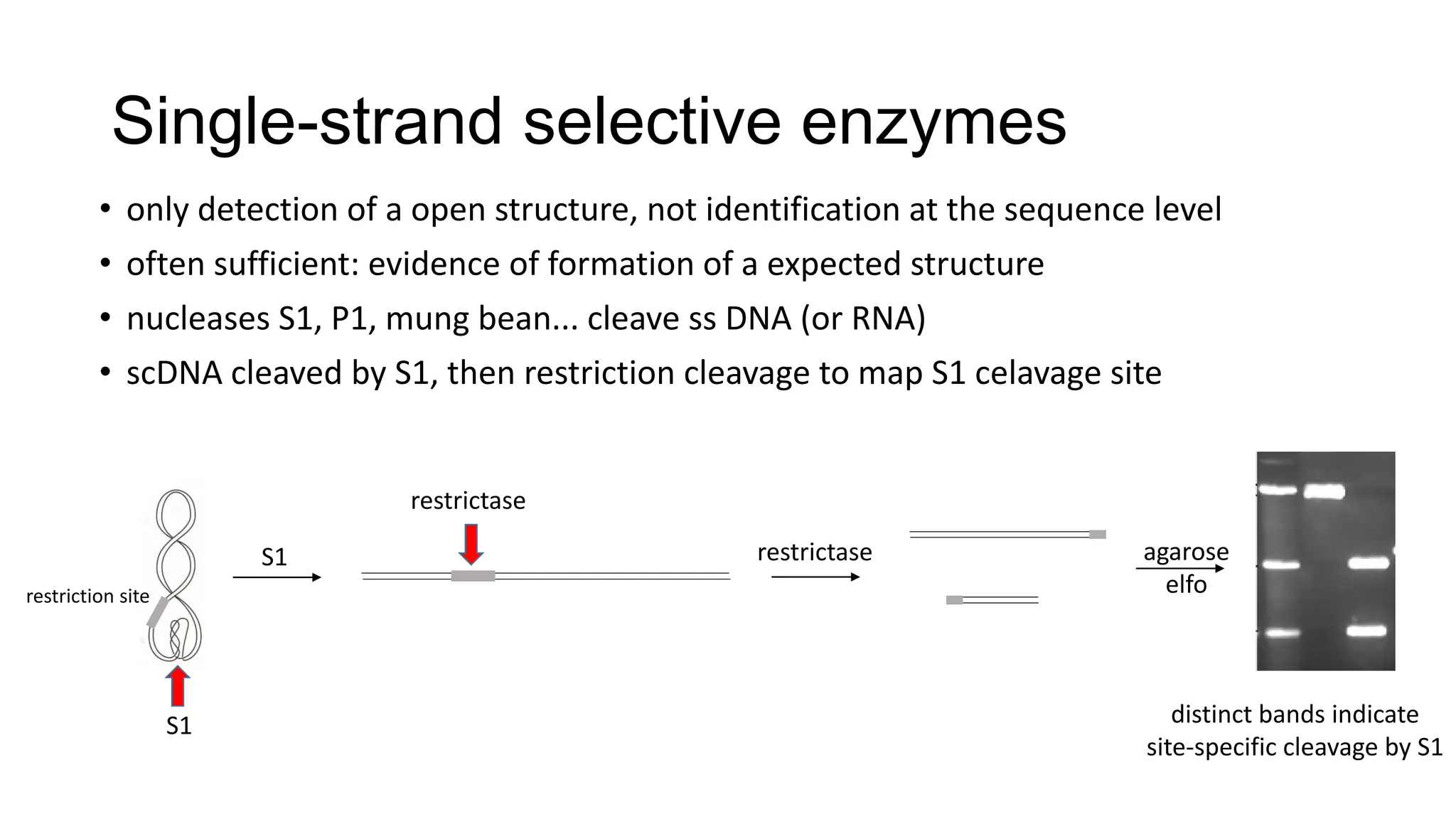
Single-strand selective enzymes
• only detection of a open structure, not identification at the sequence level
• often sufficient: evidence of formation of a expected structure
• nucleases S1, P1, mung bean... cleave ss DNA (or RNA)
• scDNA cleaved by S1, then restriction cleavage to map S1 celavage site
S1
S1
restriction site
restrictase
restrictase
agarose
elfo
distinct bands indicate
site-specific cleavage by S1
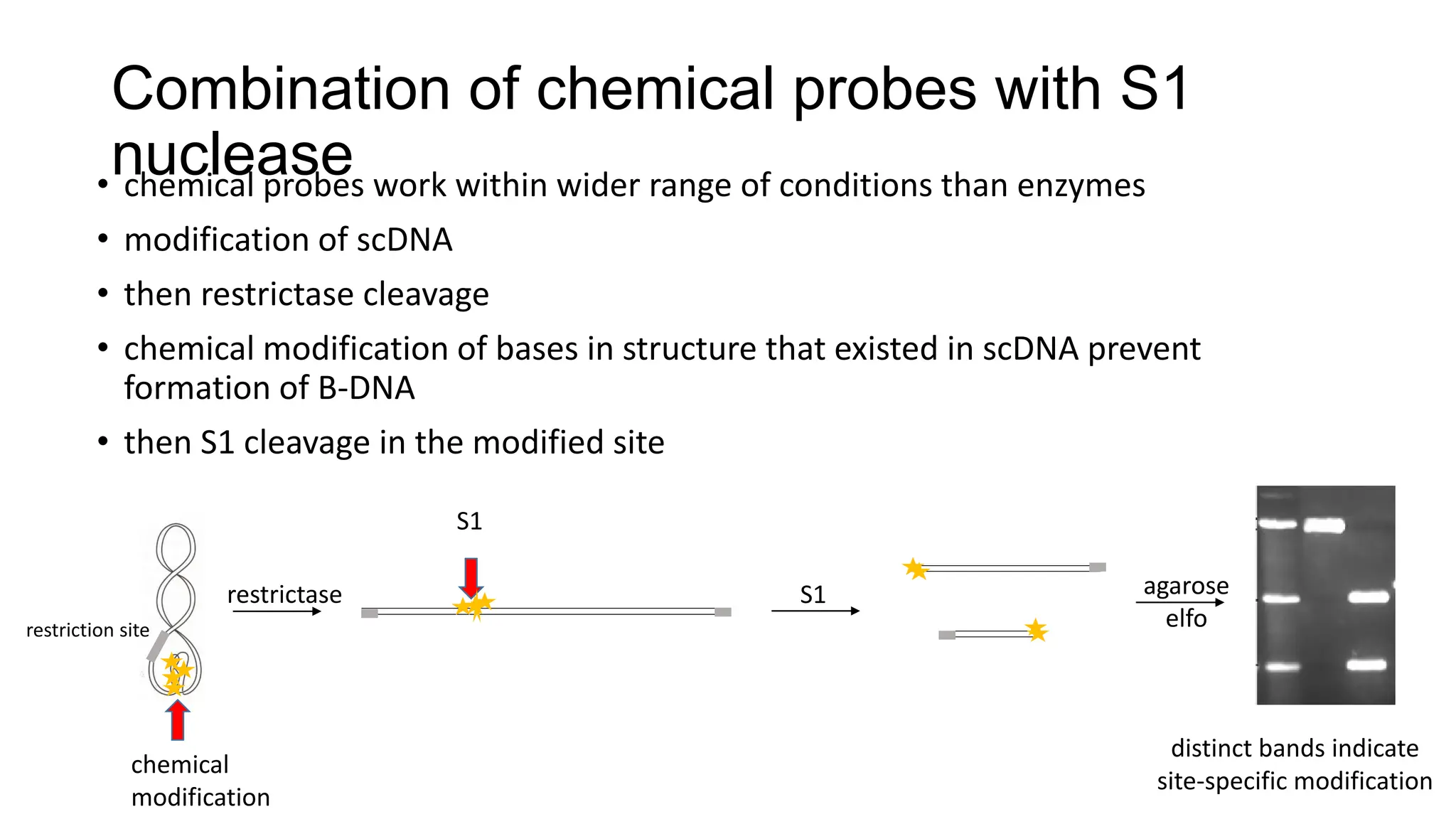
Combination of chemical probes with S1
nuclease
• chemical probes work within wider range of conditions than enzymes
• modification of scDNA
• then restrictase cleavage
• chemical modification of bases in structure that existed in scDNA prevent
formation of B-DNA
• then S1 cleavage in the modified site
S1
chemical
modification
restriction site
restrictase
S1
agarose
elfo
distinct bands indicate
site-specific modification
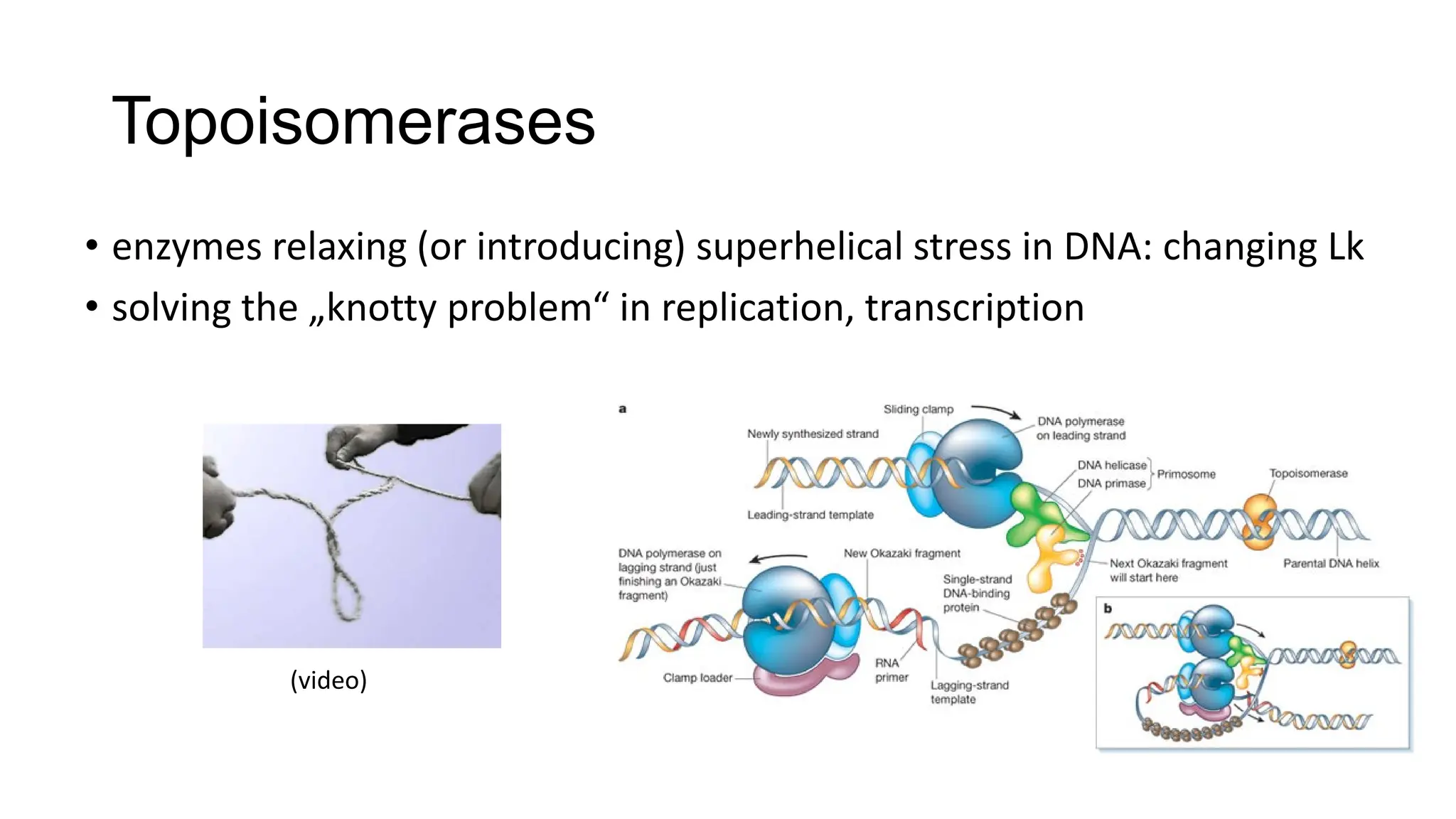
Topoisomerases
• enzymes relaxing (or introducing) superhelical stress in DNA: changing Lk
• solving the „knotty problem“ in replication, transcription
(video)
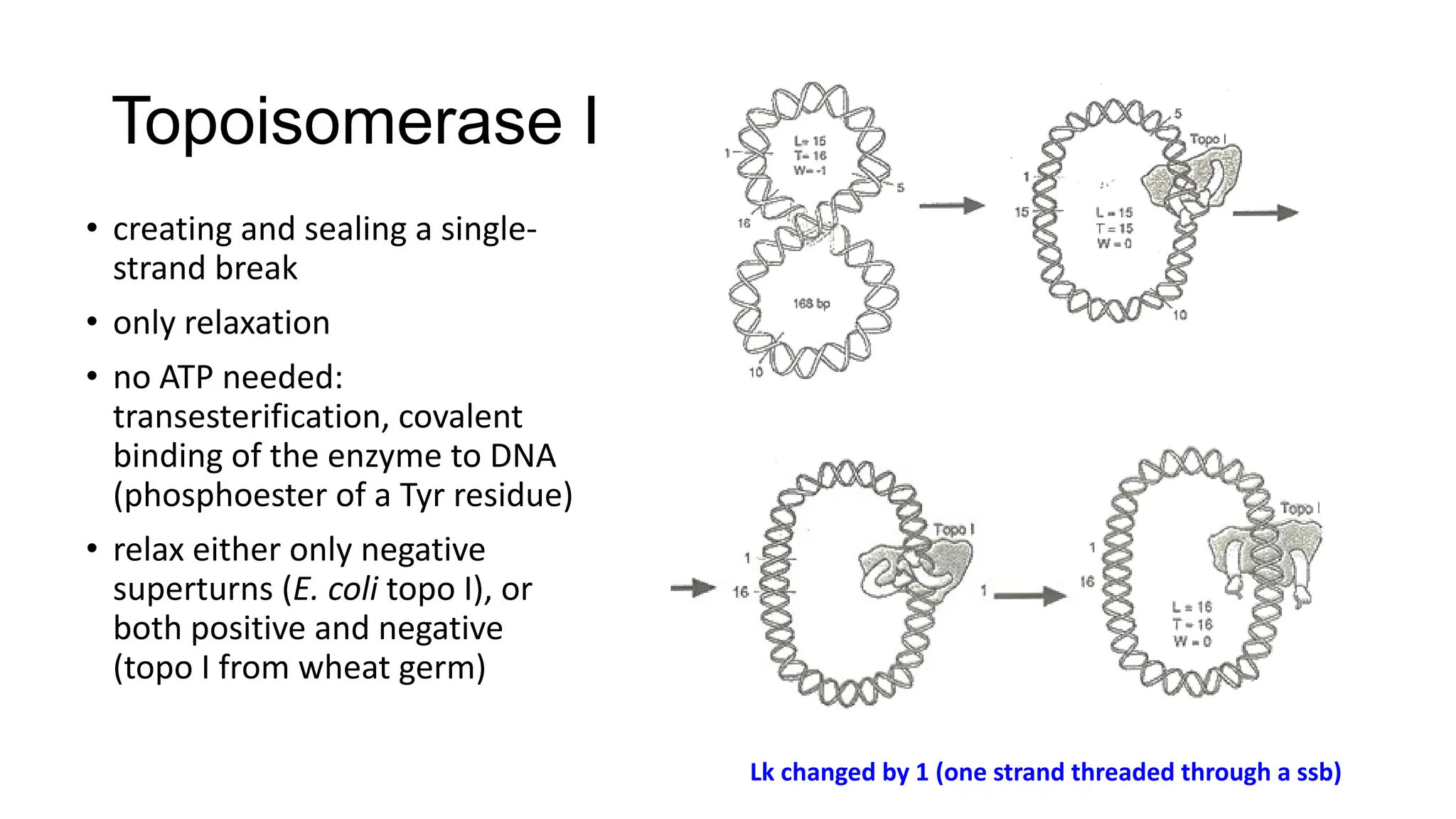
Topoisomerase I
• creating and sealing a single-
strand break
• only relaxation
• no ATP needed:
transesterification, covalent
binding of the enzyme to DNA
(phosphoester of a Tyr residue)
• relax either only negative
superturns (E. coli topo I), or
both positive and negative
(topo I from wheat germ)
Lk changed by 1 (one strand threaded through a ssb)
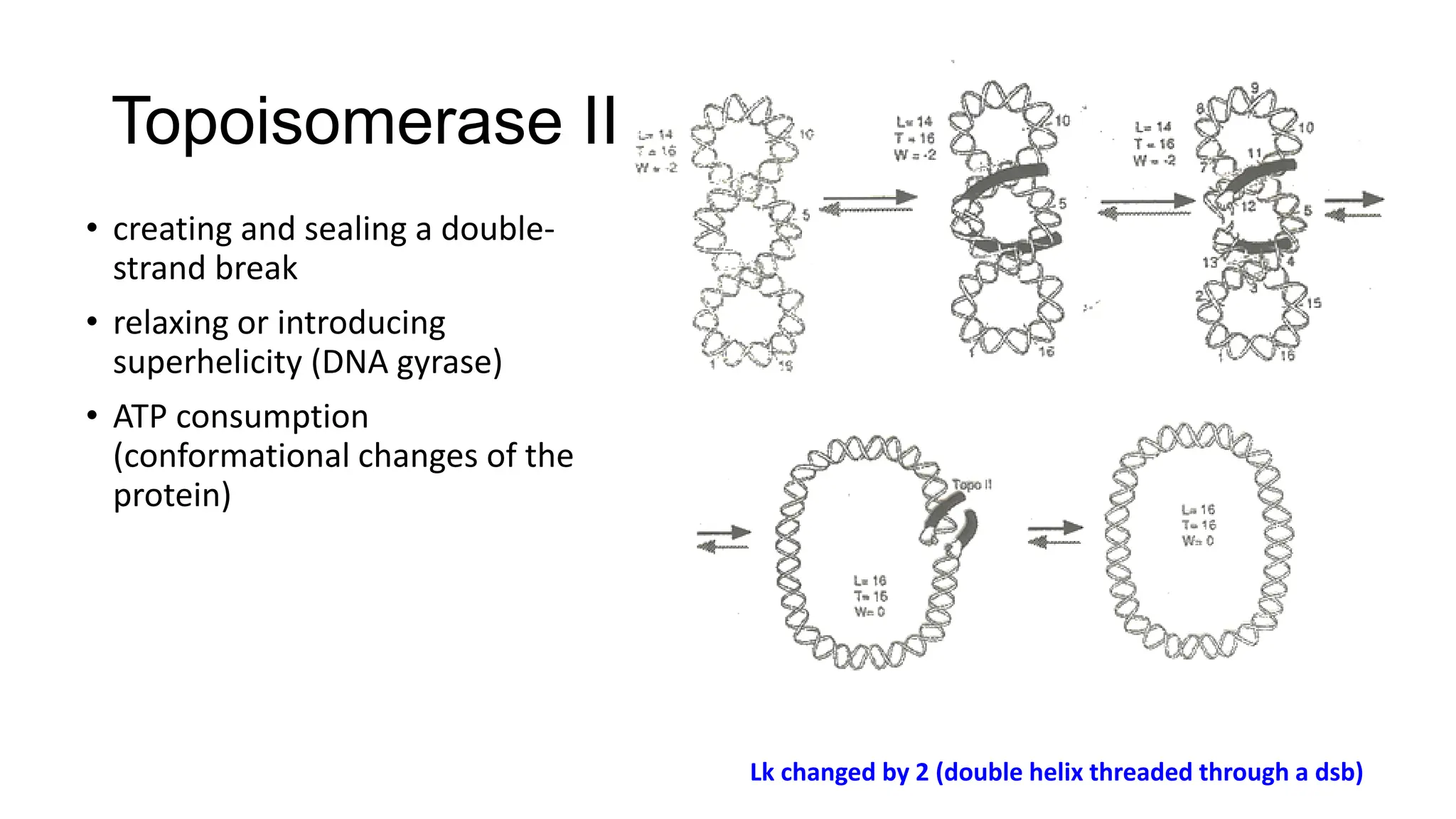
Topoisomerase II
• creating and sealing a double-
strand break
• relaxing or introducing
superhelicity (DNA gyrase)
• ATP consumption
(conformational changes of the
protein)
Lk changed by 2 (double helix threaded through a dsb)
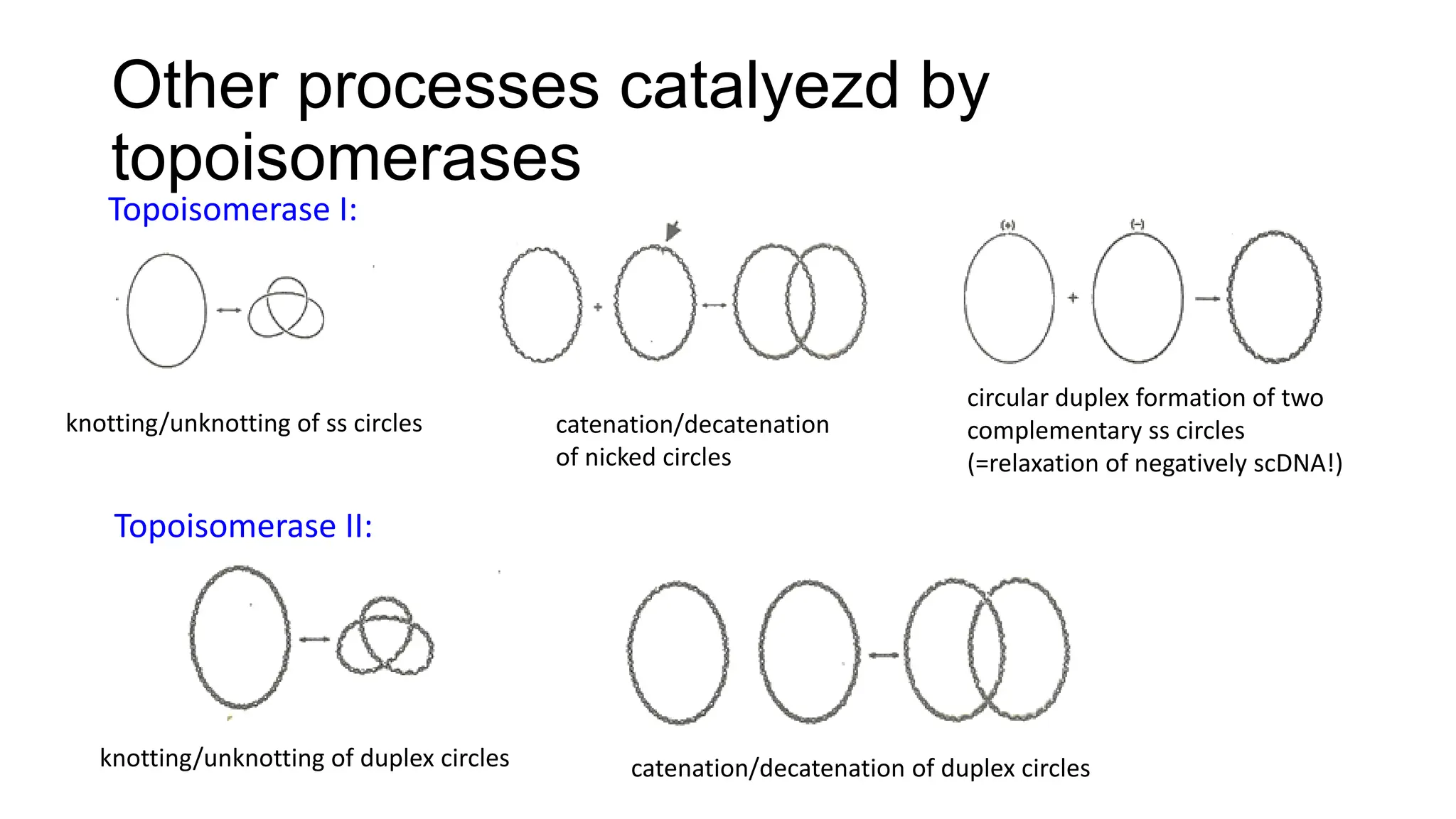
Other processes catalyezd by
topoisomerases
Topoisomerase I:
Topoisomerase II:
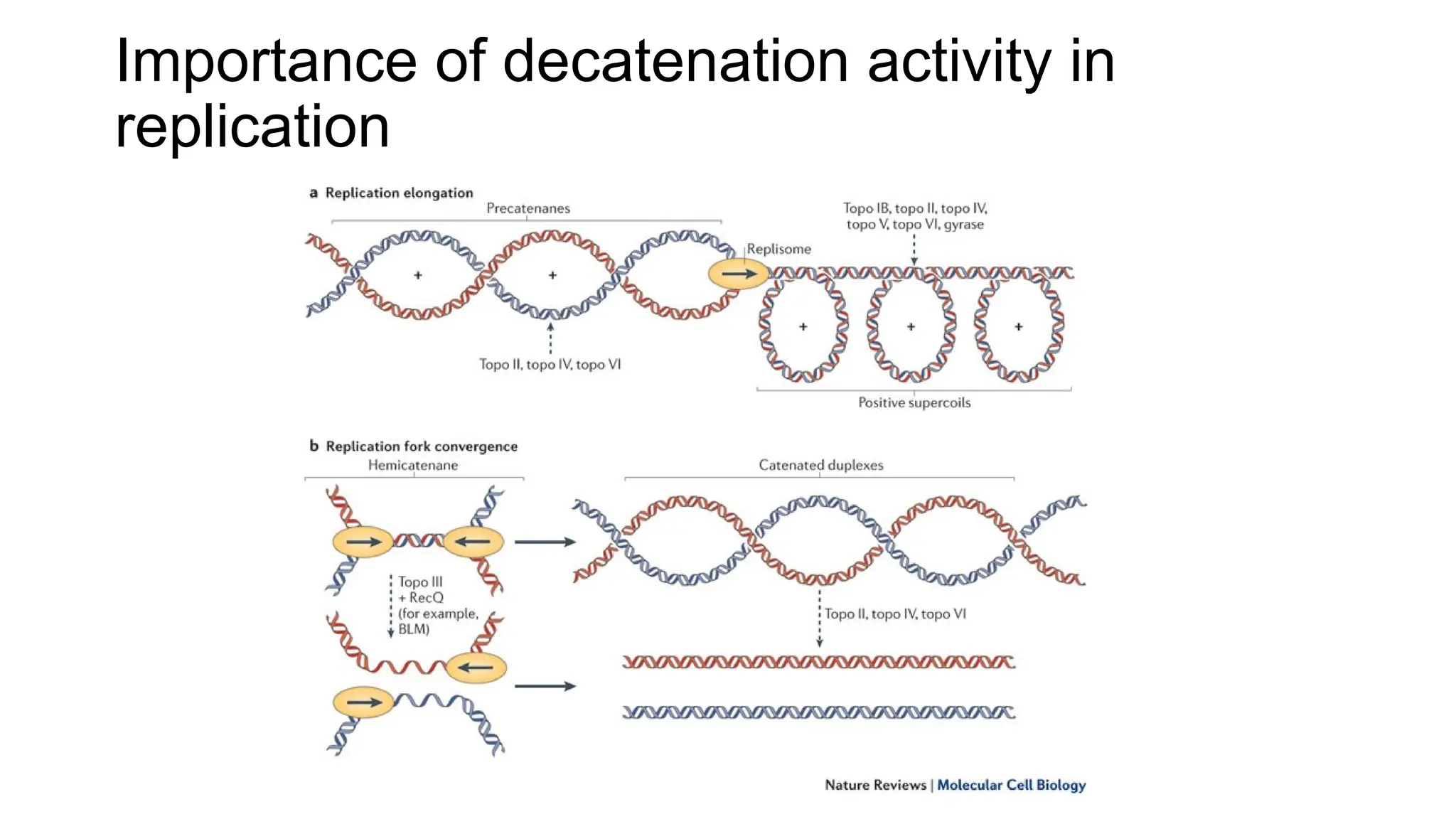
knotting/unknotting of ss circles catenation/decatenation
of nicked circles
circular duplex formation of two
complementary ss circles
(=relaxation of negatively scDNA!)
knotting/unknotting of duplex circles catenation/decatenation of duplex circles
Importance of decatenation activity in
replication

the supercoiling of DNA- description PDF.pdf

  • 1.
  • 2.
    Jerome Vinograd, 1965 •sedimentation equilibrium experiments with viral DNA • circular DNAs can exist in two distinct forms differing in buoyant density • supercoiled (compact ) and relaxed (loose) electron microscopy AFM agarose gel elfo
  • 3.
    Double helical DNAbehaves like a rubber rod • some torsional and bending elasticity • „shape memory“ • tendency to keep B- conformation • tendency to keep the axis straight • Interplay between twisting and bending deformations
  • 4.
    Superhelicity is aproperty of DNA without free ends • circular duplex DNA (plasmids) • linear molecules with constrained (anchored) ends (chromatin loops) • linear and circular nicked DNAs are inherently relaxed • plectonemic and toroidal supercoils • superhelicity absorbed in nucleosomes and other protein-DNA complexes
  • 5.
    Lk= Tw+Wr How manytimes a strand is crossing a strand Number of crossing points in duplex DNA (=number of double helix turns) Number of superturns relaxed DNA: Lk = N/10.5 = Lk0, where N=number of base pairs equation Lk= Tw+Wr is valid even for relaxed DNA; when relaxed DNA lies on a plane, Wr=0, Lk0=Tw= N/10.5 (definition of relaxed DNA; Wr may be ≠0) supercoiled DNA: Lk ≠ Lk0 (definition of supercoiled DNA) negatively scDNA: Lk < Lk0 (linking deficit) positively scDNA: Lk > Lk0 (linking extent) Lk - Lk0 = DLk (superhelicity level) DLk/Lk0 = s (superhelix density: superhelicity level normalized on DNA molecule size) DLk= DTw+DWr Lk cannot be changed without interrupting at least one DNA strand
  • 6.
    relaxed positively supercoiled (withlinking excess) duplex globally untwisted duplex locally untwisted duplex twisted normally, supercoils formed In real situation, superhelicity distributed between DTw (locally or globally) and DWr negatively supercoiled (with linking deficit) positive superhelical stress forces the right- handed double helix to close negative superhelical stress forces the right- handed double helix to open
  • 7.
    Open local structures •formed in appropriate sequence motifs • characterized by locally reduced twist, compared to B-DNA • paranemic: possible to form/abolish without mutual rotation of opposite strands Left-handed (Z-form) duplex Quadruplexes
  • 8.
    cruciform DNA inverted repeat(sequences with dyad symmetry) Open local structures in negatively supercoiled DNA unpaired bases local reduction of twist partial relaxation of negative superturns (cca 1 superturn per 10 bp of cruciform struture)
  • 9.
    Open local structuresin negatively supercoiled DNA Intramolecular triplex homoPu•homoPy segment with mirror symmetry TAT (H*-DNA) – stabilized by Mg2+; C+GC (H-DNA) – stabilized in weakly acidic media) T T T T T T A A A A A A A local reduction of twist partial relaxation of negative superturns (cca 1 superturn per 10 bp of cruciform struture)
  • 10.
    Open local structuresin negatively supercoiled DNA Intramolecular quadruplexes G:C-rich motifs G-quadruplexes C-quadruplexes (i-motifs) (K+-stabilized) (weakly acidic pH)
  • 11.
    Open local structuresin negatively supercoiled DNA Lef-handed Z-DNA (Pu-Py)n segment within negatively supercoiled DNA) local reduction of twist (to negative values) partial relaxation of negative superturns (cca 2 superturns per 14 bp of Z-DNA structure)
  • 12.
    DNA supercoiling andnucleosome formation
  • 13.
    DNA supercoiling andreplication/transcription • local untwisting of duplex in replication fork/transcription complex induces formation of superturns (link to video)
  • 14.
    DNA supercoiling andreplication/transcription • local untwisting of duplex in replication fork/transcription complex induces formation of supercoils
  • 15.
    DNA supercoiling andreplication/transcription • local untwisting of duplex in replication fork/transcription complex induces formation of supercoils
  • 16.
    Topoisomers • molecules ofcircular duplex DNA differing in Lk value separation of palsmid molecules differing in |Wr| in agarose gel 0 ±1 ±2 ±3 etc. bundle of unresolved topoisomers of high |Wr| electron microscopy
  • 17.
    Superhelicity and intercalation •intercalators: planar ligands intercalating between base pairs in duplex DNA • stacking interaction
  • 18.
    Superhelicity and intercalation •characteristic changes in DNA conformation: • extension in length • untwisting
  • 19.
    Superhelicity and intercalation •increasing concentration of an intercalator: • gradual relaxation of negative superturns • formation of positive superturns • intercalation reduces Lk0 value! • (even in unconstrained relaxed DNA, number of double helix turns is reduced) Lk < Lk0 Lk > Lk0 Lk = Lk0 Lk0 decreases, Lk constant!
  • 20.
    Superhelicity and intercalation •preparation of topoisomers: • an intercalator is used to modulate superhelicity level • topoisomerase removes superturns existing at the given intercalator concentration • negative superturns which were absorbed by intercalation are restored after the intercalator removal
  • 21.
    2D electrophoresis oftopoisomers and detection of structural transitions • open local structures are formed in scDNA with sufficiently negative superhelix density • they absorb a part of the superhelical stress, which is reflected in reduction of Wr (number of superturns) • decrease of the negative superhelicity causes the open structures to disintegrate and B-DNA duplex to reform • negative superhelicity reduction can be attained by intercalation
  • 22.
    2D electrophoresis oftopoisomers and detection of structural transitions • topoisomers are prepared and separated in first dimension • then the gel is soaked with chloroquine (CQ) to remove certain number of superturns (e.g., 4) and second dimension is run slowest in absence of CQ (Wr=0) slowest in the presence of CQ (-Wr reduced by 4 to 0) 4 positive superturns in CQ resolution of ± topoisomers unresolved without CQ resolution of negative topoisomers unresolved without CQ Wr>0 Wr<0 without structural transition: C-shaped pattern
  • 23.
    2D electrophoresis oftopoisomers and detection of structural transitions • topoisomers are prepared and separated in first dimension • then the gel is soaked with chloroquine (CQ) to remove certain number of superturns (e.g., 4) and second dimension is run with structural transition: G-shaped pattern these two molecules are not resolved (Wr=-2 or Wr=-2 + another two superturns absorbed by cruciform) superturns removed cruciform removed, 2 superturns maintained resolution of topoisomers with and without the transition
  • 24.
    Chemical probing ofnon-B structures (to recall) • the open local structures contain unpaired bases, unstacked base pairs or otherwise distorted sites • loops, junctions... • increased chemical reactivity of the nucleobases Left-handed (Z-form) duplex Quadruplexes
  • 25.
    Chemicals selectively reactingwith unpaired bases: N N H O O C H3 O s ,b ip y N N H O OC H3 O O O s O O N N R R osmium tetroxide complexes (Os,L) (T, more slowly C) chloroacetaldehyde (CAA) (A, C) diethyl pyrocarbonate (DEPC) (A, G)
  • 26.
    Using the Maxam-Gilberttechnique, it is possible to determine with a high preciseness which nucleotides are forming the local structure  modification of supercoiled DNA  restriction cleavage, radiactive labeling  hot piperidine  sequencing PAGE the structure can be deduced from the modification pattern TTTTTTTTTTTTTTTTTTTTTTTTTTTTTTTTTTTTTTTT AAAAAAAAAAAAAAAAAAAAAAAAAAAAAAAAAAAAAAAA
  • 27.
    Single-strand selective enzymes •only detection of a open structure, not identification at the sequence level • often sufficient: evidence of formation of a expected structure • nucleases S1, P1, mung bean... cleave ss DNA (or RNA) • scDNA cleaved by S1, then restriction cleavage to map S1 celavage site S1 S1 restriction site restrictase restrictase agarose elfo distinct bands indicate site-specific cleavage by S1
  • 28.
    Combination of chemicalprobes with S1 nuclease • chemical probes work within wider range of conditions than enzymes • modification of scDNA • then restrictase cleavage • chemical modification of bases in structure that existed in scDNA prevent formation of B-DNA • then S1 cleavage in the modified site S1 chemical modification restriction site restrictase S1 agarose elfo distinct bands indicate site-specific modification
  • 29.
    Topoisomerases • enzymes relaxing(or introducing) superhelical stress in DNA: changing Lk • solving the „knotty problem“ in replication, transcription (video)
  • 30.
    Topoisomerase I • creatingand sealing a single- strand break • only relaxation • no ATP needed: transesterification, covalent binding of the enzyme to DNA (phosphoester of a Tyr residue) • relax either only negative superturns (E. coli topo I), or both positive and negative (topo I from wheat germ) Lk changed by 1 (one strand threaded through a ssb)
  • 31.
    Topoisomerase II • creatingand sealing a double- strand break • relaxing or introducing superhelicity (DNA gyrase) • ATP consumption (conformational changes of the protein) Lk changed by 2 (double helix threaded through a dsb)
  • 32.
    Other processes catalyezdby topoisomerases Topoisomerase I: Topoisomerase II: knotting/unknotting of ss circles catenation/decatenation of nicked circles circular duplex formation of two complementary ss circles (=relaxation of negatively scDNA!) knotting/unknotting of duplex circles catenation/decatenation of duplex circles
  • 33.
    Importance of decatenationactivity in replication