DNA SUPERCOILING
1
What is Supercoilimg
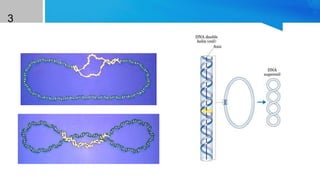
• The term "supercoiling" means literally the coiling of a coil.
• DNA supercoiling is generally a manifestation of structural
strain.
• Supercoiling occurs when the molecule relieves the helical
stress by twisting around itself. Overtwisting leads to postive
supercoiling, while undertwisting leads to negative
supercoiling.
2
• If DNA is in the form of a circular molecule, or if the ends are
rigidly held so that it forms a loop, then overtwisting or
undertwisting leads to the supercoiled state.
3
4
Positive and Negative Supercoiling
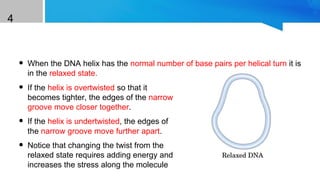
• When the DNA helix has the normal number of base pairs per helical turn it is
in the relaxed state.
• If the helix is overtwisted so that it
becomes tighter, the edges of the narrow
groove move closer together.
• If the helix is undertwisted, the edges of
the narrow groove move further apart.
• Notice that changing the twist from the
relaxed state requires adding energy and
increases the stress along the molecule
5
Positive supercoiling
6
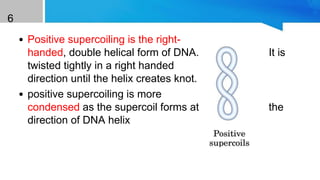
• Positive supercoiling is the right-
handed, double helical form of DNA. It is
twisted tightly in a right handed
direction until the helix creates knot.
• positive supercoiling is more
condensed as the supercoil forms at the
direction of DNA helix
7
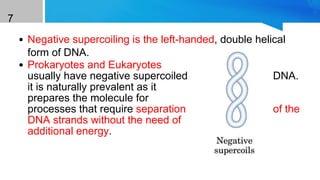
• Negative supercoiling is the left-handed, double helical
form of DNA.
• Prokaryotes and Eukaryotes
usually have negative supercoiled DNA.
it is naturally prevalent as it
prepares the molecule for
processes that require separation of the
DNA strands without the need of
additional energy.
How Supercoils are formed ?
8
• During the process of cellular events like replication and
transcription ,the DNA strand needs to be separated from
each other
• Once the DNA strand needs to be separated from each
other at that location, the twist number gets reduced .This
creates tension in the DNA so the writhe is formed to
compansate for the tension in the strand .
• Some enzymes like topoisomarase can relieve the stress
thus reduceing the Linking number.
7 Linking Number, Twist, and
Writhe
• To study these loops, mathematicians have created three quantities that
describe the loops and their relationship to each other.
• Linking number--The number of times the two strands are
intertwined.it is also the number of cleaves necessary for
separating two DNA strands.It will be constant.
• Twist--It is most easily imagined as the number of times each of
the curves rotates around the central axis of the double helix.
10
• Writhe--the number of times the central axis C makes loops
about itself.
Numerical expression for degree of
supercoiling
11
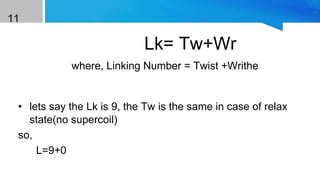
Lk= Tw+Wr
where, Linking Number = Twist +Writhe
Example
• lets say the Lk is 9, the Tw is the same in case of relax
state(no supercoil)
so,
L=9+0
12
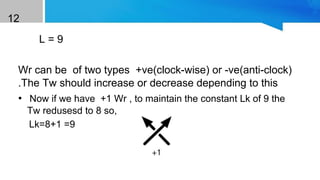
L = 9
Wr can be of two types +ve(clock-wise) or -ve(anti-clock)
.The Tw should increase or decrease depending to this
• Now if we have +1 Wr , to maintain the constant Lk of 9 the
Tw redusesd to 8 so,
Lk=8+1 =9
13
The DNA being right handed ,when supercoiled in clockwise
direction the twist value should decrease to compensate and
accommodate that writhe otherwise the DNA will break apar.this
is energy consumeing and forms strong supercoiling
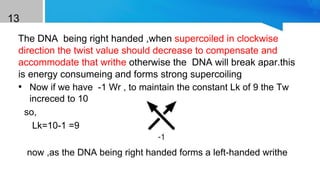
• Now if we have -1 Wr , to maintain the constant Lk of 9 the Tw
increced to 10
so,
Lk=10-1 =9
now ,as the DNA being right handed forms a left-handed writhe
14
that is anti-clockwise .It dewinds the DNA and makes a writhe
that is easier to remove and so the Tw is increased to
compansate the negetive writhe
DNA Topoisomerases
• DNA topoisomerases are enzymes found in all cell types
.These enzymes act to regulate DNA supercoiling by
catalysing the winding and unwinding of DNA strands.
15
• They do this by making an incision that breaks the DNA
backbone, so they can then pass the DNA strands
through one another, swivelling and relaxing/coiling the
DNA before resealing the breaks.
• DNA topoisomerases can be divided into two groups
based on the number of strands that they break.
Class I DNA Topoisomerases
Break one strand of a DNA helix.
16
• ATP independent (except for reverse gyrase).
• Mechanism involves rotating the broken strand around
the intact strand to relax (unwind) the strain on the DNA
helix, followed by resealing the ends of the broken
strand.
• Play an important role in DNA replication and
transcription
Class II Topoisomerase
17
• Break two strands of a DNA helix.Class II DNA
Topoisomerases
• ATP dependent.
• Mechanism involves passing an intact DNA helix through
the gap made by the broken DNA helix, then resealing
the strands
• Play an important role in chromosome condensation and
in the segregation of daughter chromosomes during cell
division
THANK YOU

Lec.Two.pdf

  • 1.
  • 2.
    1 What is Supercoilimg •The term "supercoiling" means literally the coiling of a coil. • DNA supercoiling is generally a manifestation of structural strain. • Supercoiling occurs when the molecule relieves the helical stress by twisting around itself. Overtwisting leads to postive supercoiling, while undertwisting leads to negative supercoiling.
  • 3.
    2 • If DNAis in the form of a circular molecule, or if the ends are rigidly held so that it forms a loop, then overtwisting or undertwisting leads to the supercoiled state.
  • 4.
  • 5.
    4 Positive and NegativeSupercoiling • When the DNA helix has the normal number of base pairs per helical turn it is in the relaxed state. • If the helix is overtwisted so that it becomes tighter, the edges of the narrow groove move closer together. • If the helix is undertwisted, the edges of the narrow groove move further apart. • Notice that changing the twist from the relaxed state requires adding energy and increases the stress along the molecule
  • 6.
  • 7.
    6 • Positive supercoilingis the right- handed, double helical form of DNA. It is twisted tightly in a right handed direction until the helix creates knot. • positive supercoiling is more condensed as the supercoil forms at the direction of DNA helix
  • 8.
    7 • Negative supercoilingis the left-handed, double helical form of DNA. • Prokaryotes and Eukaryotes usually have negative supercoiled DNA. it is naturally prevalent as it prepares the molecule for processes that require separation of the DNA strands without the need of additional energy. How Supercoils are formed ?
  • 9.
    8 • During theprocess of cellular events like replication and transcription ,the DNA strand needs to be separated from each other • Once the DNA strand needs to be separated from each other at that location, the twist number gets reduced .This creates tension in the DNA so the writhe is formed to compansate for the tension in the strand . • Some enzymes like topoisomarase can relieve the stress thus reduceing the Linking number.
  • 10.
    7 Linking Number,Twist, and Writhe • To study these loops, mathematicians have created three quantities that describe the loops and their relationship to each other. • Linking number--The number of times the two strands are intertwined.it is also the number of cleaves necessary for separating two DNA strands.It will be constant. • Twist--It is most easily imagined as the number of times each of the curves rotates around the central axis of the double helix.
  • 11.
    10 • Writhe--the numberof times the central axis C makes loops about itself. Numerical expression for degree of supercoiling
  • 12.
    11 Lk= Tw+Wr where, LinkingNumber = Twist +Writhe Example • lets say the Lk is 9, the Tw is the same in case of relax state(no supercoil) so, L=9+0
  • 13.
    12 L = 9 Wrcan be of two types +ve(clock-wise) or -ve(anti-clock) .The Tw should increase or decrease depending to this • Now if we have +1 Wr , to maintain the constant Lk of 9 the Tw redusesd to 8 so, Lk=8+1 =9
  • 14.
    13 The DNA beingright handed ,when supercoiled in clockwise direction the twist value should decrease to compensate and accommodate that writhe otherwise the DNA will break apar.this is energy consumeing and forms strong supercoiling • Now if we have -1 Wr , to maintain the constant Lk of 9 the Tw increced to 10 so, Lk=10-1 =9 now ,as the DNA being right handed forms a left-handed writhe
  • 15.
    14 that is anti-clockwise.It dewinds the DNA and makes a writhe that is easier to remove and so the Tw is increased to compansate the negetive writhe DNA Topoisomerases • DNA topoisomerases are enzymes found in all cell types .These enzymes act to regulate DNA supercoiling by catalysing the winding and unwinding of DNA strands.
  • 16.
    15 • They dothis by making an incision that breaks the DNA backbone, so they can then pass the DNA strands through one another, swivelling and relaxing/coiling the DNA before resealing the breaks. • DNA topoisomerases can be divided into two groups based on the number of strands that they break. Class I DNA Topoisomerases Break one strand of a DNA helix.
  • 17.
    16 • ATP independent(except for reverse gyrase). • Mechanism involves rotating the broken strand around the intact strand to relax (unwind) the strain on the DNA helix, followed by resealing the ends of the broken strand. • Play an important role in DNA replication and transcription Class II Topoisomerase
  • 18.
    17 • Break twostrands of a DNA helix.Class II DNA Topoisomerases • ATP dependent. • Mechanism involves passing an intact DNA helix through the gap made by the broken DNA helix, then resealing the strands • Play an important role in chromosome condensation and in the segregation of daughter chromosomes during cell division
  • 19.