Maslow's Hierarchy of Needs
Hadeeqa Waleed
Educationist
Overview of Maslow theory
• Maslow first introduced his concept of a hierarchy of needs in
his 1943 paper "A Theory of Human Motivation" and his
subsequent book Motivation and Personality. This hierarchy
suggests that people are motivated to fulfill basic needs
before moving on to other, more advanced needs.
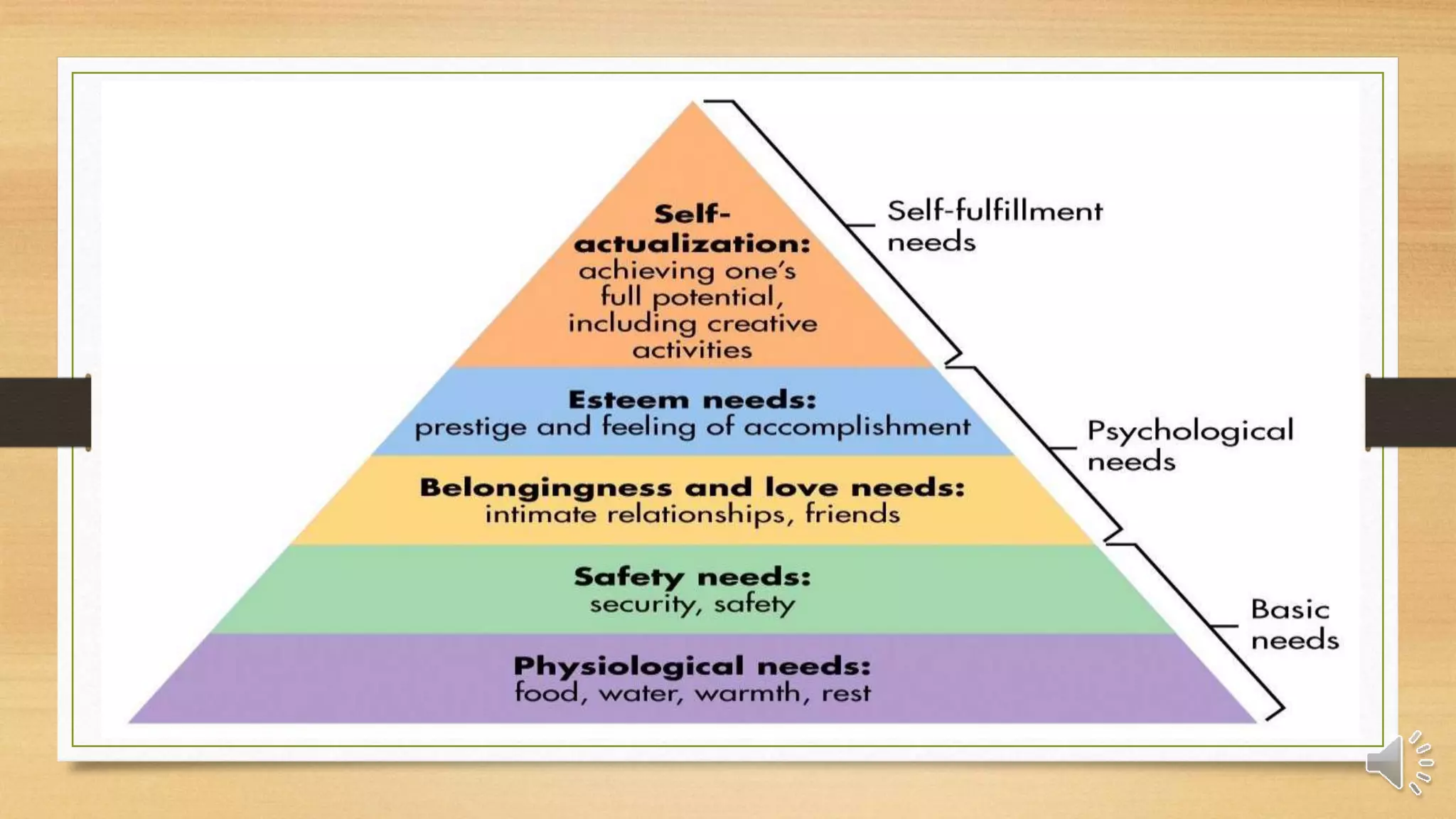
• Maslow's hierarchy of needs is a motivational theory in
psychology comprising a five-tier model of human needs,
often depicted as hierarchical levels within a pyramid.
• Maslow (1943) initially stated that individuals
must satisfy lower level deficit needs before
progressing on to meet higher level growth
needs. However, he later clarified that
satisfaction of a needs is not an “all-or-none”
phenomenon, admitting that his earlier
statements may have given “the false
impression that a need must be satisfied 100
percent before the next need emerges” (1987,
p. 69).
• Maslow’s hierarchy of needs is A theory of
psychology explaining
human motivation based on the pursuit of
different levels of needs. The theory states that
humans are motivated to fulfill their needs in A
hierarchical order. This order begins with the
most basic needs before moving on to more
advanced needs. The ultimate goal, according
to this theory, is to reach the fifth level of the
hierarchy: self-actualization.
• Physiological Needs
• Physiological needs are the lowest level
of Maslow’s hierarchy of needs. They are
the most essential things a person needs
to survive. They include the need for
shelter, water, food, warmth, rest, and
health. A person’s motivation at this level
derives from their instinct to survive.
Safety Needs
• The second level of Maslow’s hierarchy of needs consists of safety needs.
Safety, or security needs, relate to a person’s need to feel safe and secure
in their life and surroundings. Motivation comes from the need for law,
order, and protection from unpredictable and dangerous conditions.
• There are many examples of safety needs in modern society. To find
stability and security, a person must consider their physical safety. This
means seeking protection from the elements, violent conditions, or health
threats and sickness. Additionally, an individual needs economic safety to
live and thrive in modern societies. This refers to the need for job security,
stable income, and savings. One method of achieving economic safety is
to learn proper investment strategies.
Love And Belonging Needs
• The third level of Maslow’s hierarchy of needs is love
and belonging needs. Humans are social creatures
that crave interaction with others. This level of the
hierarchy outlines the need for friendship, intimacy,
family, and love. Humans have the need to give and
receive love; to feel like they belong in a group. When
deprived of these needs, individuals may experience
loneliness or depression.
•
Esteem Needs
• The fourth level of Maslow’s hierarchy of needs is esteem
needs. Esteem needs are related to a person’s need to gain
recognition, status, and feel respected. Once someone has
fulfilled their love and belonging needs, they seek to fulfill their
esteem needs.
• Maslow broke up esteem needs into two categories: the need
for respect from others and the need for respect from oneself.
Respect from others relates to achieving fame, prestige, and
recognition. Respect from oneself relates to dignity,
confidence, competence, independence, and freedom.
•
Self-actualization Need
• The fifth and final level of Maslow’s
hierarchy of needs is self-actualization
needs. Self-actualization relates to the
realization of an individual’s full potential.
At this level, people strive to become the
best that they possibly can be.
• The need for self-actualization can manifest in
different ways, such as:
1.Obtaining skills (e.g., financial modeling skills)
2.Continued education (e.g., online training
courses)
3.Utilizing skills, knowledge, and talents
4.Pursuing life dreams
5.Seeking happiness
•One person may strive to become the
best parent and everyone’s best
friend. Another person might aim to
become a millionaire and
philanthropist. Others may work
toward becoming a famous athlete. In
general, self-actualization is the
pursuit of personal growth.
•
• Deficiency Needs vs. Growth Needs
• Maslow believed that these needs are similar to instincts and play a
major role in motivating behavior.2Physiological, security, social,
and esteem needs are deficiency needs, which arise due to
deprivation. Satisfying these lower-level needs is important in order
to avoid unpleasant feelings or consequences.
• Maslow termed the highest level of the pyramid as growth needs.
These needs don't stem from a lack of something, but rather from a
desire to grow as a person.
• While the theory is generally portrayed as a fairly rigid hierarchy,
Maslow noted that the order in which these needs are fulfilled does
not always follow this standard progression. For example, he
noted that for some individuals, the need for self-esteem is more
important than the need for love. For others, the need for creative
fulfillment may supersede even the most basic needs.
Hierarchy of needs summary
• (A) Human Beings Are Motivated By A Hierarchy Of Needs.
• (B) Needs Are Organized In A Hierarchy Of Prepotency In
Which More Basic Needs Must Be More Or Less Met (Rather
Than All Or None) Prior To Higher Needs.
• (C) The Order Of Needs Is Not Rigid But Instead May Be
Flexible Based On External Circumstances Or Individual
Differences.
• (D) Most Behavior Is Multi-motivated, That Is, Simultaneously
Determined By More Than One Basic Need.

Maslow hierarchy of needs

  • 1.
    Maslow's Hierarchy ofNeeds Hadeeqa Waleed Educationist
  • 2.
    Overview of Maslowtheory • Maslow first introduced his concept of a hierarchy of needs in his 1943 paper "A Theory of Human Motivation" and his subsequent book Motivation and Personality. This hierarchy suggests that people are motivated to fulfill basic needs before moving on to other, more advanced needs. • Maslow's hierarchy of needs is a motivational theory in psychology comprising a five-tier model of human needs, often depicted as hierarchical levels within a pyramid.
  • 3.
    • Maslow (1943)initially stated that individuals must satisfy lower level deficit needs before progressing on to meet higher level growth needs. However, he later clarified that satisfaction of a needs is not an “all-or-none” phenomenon, admitting that his earlier statements may have given “the false impression that a need must be satisfied 100 percent before the next need emerges” (1987, p. 69).
  • 4.
    • Maslow’s hierarchyof needs is A theory of psychology explaining human motivation based on the pursuit of different levels of needs. The theory states that humans are motivated to fulfill their needs in A hierarchical order. This order begins with the most basic needs before moving on to more advanced needs. The ultimate goal, according to this theory, is to reach the fifth level of the hierarchy: self-actualization.
  • 6.
    • Physiological Needs •Physiological needs are the lowest level of Maslow’s hierarchy of needs. They are the most essential things a person needs to survive. They include the need for shelter, water, food, warmth, rest, and health. A person’s motivation at this level derives from their instinct to survive.
  • 7.
    Safety Needs • Thesecond level of Maslow’s hierarchy of needs consists of safety needs. Safety, or security needs, relate to a person’s need to feel safe and secure in their life and surroundings. Motivation comes from the need for law, order, and protection from unpredictable and dangerous conditions. • There are many examples of safety needs in modern society. To find stability and security, a person must consider their physical safety. This means seeking protection from the elements, violent conditions, or health threats and sickness. Additionally, an individual needs economic safety to live and thrive in modern societies. This refers to the need for job security, stable income, and savings. One method of achieving economic safety is to learn proper investment strategies.
  • 8.
    Love And BelongingNeeds • The third level of Maslow’s hierarchy of needs is love and belonging needs. Humans are social creatures that crave interaction with others. This level of the hierarchy outlines the need for friendship, intimacy, family, and love. Humans have the need to give and receive love; to feel like they belong in a group. When deprived of these needs, individuals may experience loneliness or depression. •
  • 9.
    Esteem Needs • Thefourth level of Maslow’s hierarchy of needs is esteem needs. Esteem needs are related to a person’s need to gain recognition, status, and feel respected. Once someone has fulfilled their love and belonging needs, they seek to fulfill their esteem needs. • Maslow broke up esteem needs into two categories: the need for respect from others and the need for respect from oneself. Respect from others relates to achieving fame, prestige, and recognition. Respect from oneself relates to dignity, confidence, competence, independence, and freedom. •
  • 10.
    Self-actualization Need • Thefifth and final level of Maslow’s hierarchy of needs is self-actualization needs. Self-actualization relates to the realization of an individual’s full potential. At this level, people strive to become the best that they possibly can be.
  • 11.
    • The needfor self-actualization can manifest in different ways, such as: 1.Obtaining skills (e.g., financial modeling skills) 2.Continued education (e.g., online training courses) 3.Utilizing skills, knowledge, and talents 4.Pursuing life dreams 5.Seeking happiness
  • 12.
    •One person maystrive to become the best parent and everyone’s best friend. Another person might aim to become a millionaire and philanthropist. Others may work toward becoming a famous athlete. In general, self-actualization is the pursuit of personal growth. •
  • 13.
    • Deficiency Needsvs. Growth Needs • Maslow believed that these needs are similar to instincts and play a major role in motivating behavior.2Physiological, security, social, and esteem needs are deficiency needs, which arise due to deprivation. Satisfying these lower-level needs is important in order to avoid unpleasant feelings or consequences. • Maslow termed the highest level of the pyramid as growth needs. These needs don't stem from a lack of something, but rather from a desire to grow as a person. • While the theory is generally portrayed as a fairly rigid hierarchy, Maslow noted that the order in which these needs are fulfilled does not always follow this standard progression. For example, he noted that for some individuals, the need for self-esteem is more important than the need for love. For others, the need for creative fulfillment may supersede even the most basic needs.
  • 14.
    Hierarchy of needssummary • (A) Human Beings Are Motivated By A Hierarchy Of Needs. • (B) Needs Are Organized In A Hierarchy Of Prepotency In Which More Basic Needs Must Be More Or Less Met (Rather Than All Or None) Prior To Higher Needs. • (C) The Order Of Needs Is Not Rigid But Instead May Be Flexible Based On External Circumstances Or Individual Differences. • (D) Most Behavior Is Multi-motivated, That Is, Simultaneously Determined By More Than One Basic Need.