Gagne’s Nine Level
of Learning
HADEEQA WALEED
EDUCATIONIST
• Gagne's Nine Levels of Learning provide a
step-by-step approach that can help managers,
trainers, and facilitators structure their training
so that their students or teams get the most
from their learning opportunities.
• In this article and infographic, we'll examine
Gagne's Nine Levels of Learning, and we'll
review how to apply this tool when training
your team.
• Background to the Model
• Robert Gagne (1916–2002) was an educational
psychologist who pioneered the science of instruction in
the 1940s. His book "The Conditions of Learning," first
published in 1965, identified the mental conditions that
are necessary for effective learning.
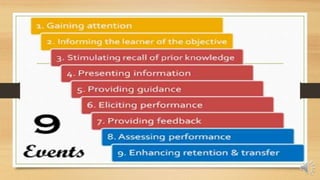
• Gagne created a nine-step process that detailed each
element required for effective learning. The model is
useful for all types of learning, but this article focuses on
applying it to training your team in a work environment.
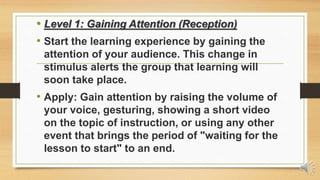
• Level 1: Gaining Attention (Reception)
• Start the learning experience by gaining the
attention of your audience. This change in
stimulus alerts the group that learning will
soon take place.
• Apply: Gain attention by raising the volume of
your voice, gesturing, showing a short video
on the topic of instruction, or using any other
event that brings the period of "waiting for the
lesson to start" to an end.
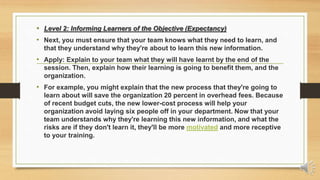
• Level 2: Informing Learners of the Objective (Expectancy)
• Next, you must ensure that your team knows what they need to learn, and
that they understand why they're about to learn this new information.
• Apply: Explain to your team what they will have learnt by the end of the
session. Then, explain how their learning is going to benefit them, and the
organization.
• For example, you might explain that the new process that they're going to
learn about will save the organization 20 percent in overhead fees. Because
of recent budget cuts, the new lower-cost process will help your
organization avoid laying six people off in your department. Now that your
team understands why they're learning this new information, and what the
risks are if they don't learn it, they'll be more motivated and more receptive
to your training.
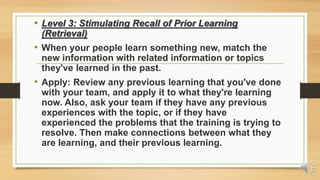
• Level 3: Stimulating Recall of Prior Learning
(Retrieval)
• When your people learn something new, match the
new information with related information or topics
they've learned in the past.
• Apply: Review any previous learning that you've done
with your team, and apply it to what they're learning
now. Also, ask your team if they have any previous
experiences with the topic, or if they have
experienced the problems that the training is trying to
resolve. Then make connections between what they
are learning, and their previous learning.
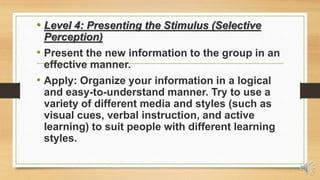
• Level 4: Presenting the Stimulus (Selective
Perception)
• Present the new information to the group in an
effective manner.
• Apply: Organize your information in a logical
and easy-to-understand manner. Try to use a
variety of different media and styles (such as
visual cues, verbal instruction, and active
learning) to suit people with different learning
styles.
• Level 5: Providing Learning Guidance
(Semantic Encoding)
• To help your team learn and retain the
information, provide alternative approaches
that illustrate the information that you're trying
to convey.
• Apply: Help your team learn more effectively
by including examples, case studies, graphics,
story telling, analogies.
• Level 6: Eliciting Performance (Responding)
• At this stage, you need to ensure that your people
can demonstrate their knowledge of what you've
taught them. The way that they show this depends
on what they're learning.
• Apply: If you've taught a new process or skill, ask
your people to demonstrate how to use it role
playing exercises can be useful for this). If you've
taught new information, ask questions so that
they can show their knowledge.
• Level 7: Providing Feedback (Reinforcement)
• After your team demonstrates their knowledge,
provide feedback
• and reinforce any points as necessary.
• Apply: Imagine that you've taught your team a new
technique for handling difficult customers. After
several role playing scenarios, you notice that a few
team members aren't assertive enough to calm the
customer in this fictional "tense situation." Your
feedback and tips point out their mistakes so that
they can correct them.
• Level 8: Assessing Performance (Retrieval)
• Your team should be able to complete a test, or
other measurement tool, to show that they've
learned the material or skill effectively. Team
members should complete this test
independently, without any help or coaching
from you.
• Apply: Tests, short questionnaires, or even
essays can be good ways of testing your
team's new knowledge.
• Level 9: Enhancing Retention and Transfer (Generalization)
• In this last stage, your team members show that they've
retained information by transferring their new knowledge or
skill to situations that are different from the ones you've
trained them on.
• Apply: Repeated practice is the best way to ensure that people
retain information and use it effectively. Make sure that your
team has enough opportunity to use their learning on a regular
basis. Schedule "practice runs" if you've been training on a
new process, or have a follow-up session to review
information or skills.
• As people become more proficient, schedule in variants of the
practice runs and expose people to different situations, so that
they become comfortable generalizing.

Gagne nine level of learning

  • 1.
    Gagne’s Nine Level ofLearning HADEEQA WALEED EDUCATIONIST
  • 2.
    • Gagne's NineLevels of Learning provide a step-by-step approach that can help managers, trainers, and facilitators structure their training so that their students or teams get the most from their learning opportunities. • In this article and infographic, we'll examine Gagne's Nine Levels of Learning, and we'll review how to apply this tool when training your team.
  • 3.
    • Background tothe Model • Robert Gagne (1916–2002) was an educational psychologist who pioneered the science of instruction in the 1940s. His book "The Conditions of Learning," first published in 1965, identified the mental conditions that are necessary for effective learning. • Gagne created a nine-step process that detailed each element required for effective learning. The model is useful for all types of learning, but this article focuses on applying it to training your team in a work environment.
  • 5.
    • Level 1:Gaining Attention (Reception) • Start the learning experience by gaining the attention of your audience. This change in stimulus alerts the group that learning will soon take place. • Apply: Gain attention by raising the volume of your voice, gesturing, showing a short video on the topic of instruction, or using any other event that brings the period of "waiting for the lesson to start" to an end.
  • 6.
    • Level 2:Informing Learners of the Objective (Expectancy) • Next, you must ensure that your team knows what they need to learn, and that they understand why they're about to learn this new information. • Apply: Explain to your team what they will have learnt by the end of the session. Then, explain how their learning is going to benefit them, and the organization. • For example, you might explain that the new process that they're going to learn about will save the organization 20 percent in overhead fees. Because of recent budget cuts, the new lower-cost process will help your organization avoid laying six people off in your department. Now that your team understands why they're learning this new information, and what the risks are if they don't learn it, they'll be more motivated and more receptive to your training.
  • 7.
    • Level 3:Stimulating Recall of Prior Learning (Retrieval) • When your people learn something new, match the new information with related information or topics they've learned in the past. • Apply: Review any previous learning that you've done with your team, and apply it to what they're learning now. Also, ask your team if they have any previous experiences with the topic, or if they have experienced the problems that the training is trying to resolve. Then make connections between what they are learning, and their previous learning.
  • 8.
    • Level 4:Presenting the Stimulus (Selective Perception) • Present the new information to the group in an effective manner. • Apply: Organize your information in a logical and easy-to-understand manner. Try to use a variety of different media and styles (such as visual cues, verbal instruction, and active learning) to suit people with different learning styles.
  • 9.
    • Level 5:Providing Learning Guidance (Semantic Encoding) • To help your team learn and retain the information, provide alternative approaches that illustrate the information that you're trying to convey. • Apply: Help your team learn more effectively by including examples, case studies, graphics, story telling, analogies.
  • 10.
    • Level 6:Eliciting Performance (Responding) • At this stage, you need to ensure that your people can demonstrate their knowledge of what you've taught them. The way that they show this depends on what they're learning. • Apply: If you've taught a new process or skill, ask your people to demonstrate how to use it role playing exercises can be useful for this). If you've taught new information, ask questions so that they can show their knowledge.
  • 11.
    • Level 7:Providing Feedback (Reinforcement) • After your team demonstrates their knowledge, provide feedback • and reinforce any points as necessary. • Apply: Imagine that you've taught your team a new technique for handling difficult customers. After several role playing scenarios, you notice that a few team members aren't assertive enough to calm the customer in this fictional "tense situation." Your feedback and tips point out their mistakes so that they can correct them.
  • 12.
    • Level 8:Assessing Performance (Retrieval) • Your team should be able to complete a test, or other measurement tool, to show that they've learned the material or skill effectively. Team members should complete this test independently, without any help or coaching from you. • Apply: Tests, short questionnaires, or even essays can be good ways of testing your team's new knowledge.
  • 13.
    • Level 9:Enhancing Retention and Transfer (Generalization) • In this last stage, your team members show that they've retained information by transferring their new knowledge or skill to situations that are different from the ones you've trained them on. • Apply: Repeated practice is the best way to ensure that people retain information and use it effectively. Make sure that your team has enough opportunity to use their learning on a regular basis. Schedule "practice runs" if you've been training on a new process, or have a follow-up session to review information or skills. • As people become more proficient, schedule in variants of the practice runs and expose people to different situations, so that they become comfortable generalizing.