A BRIEF COMPUTER HISTORY
Delivered By: Mr. Karthiban
Executive MSc in Project Management ,
BSc (Hons) in Computing ,
MBCS, BTEC HND in CSD
About Computer
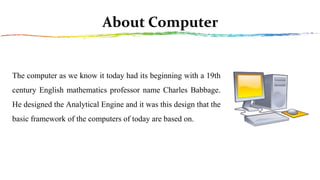
The computer as we know it today had its beginning with a 19th
century English mathematics professor name Charles Babbage.
He designed the Analytical Engine and it was this design that the
basic framework of the computers of today are based on.
What is Computer
Computer is an electronic device that is designed to work with Information.
The term computer is derived from the Latin term ‘computare’, this means
to calculate or programmable machine.
Computer can not do anything without a Program. It represents the decimal numbers
through a string of binary digits.
The Word 'Computer' usually refers to the Center Processor Unit plus Internal memory.
About Computer
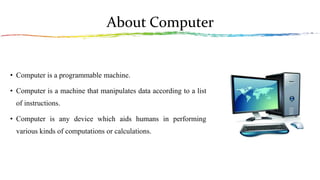
• Computer is a programmable machine.
• Computer is a machine that manipulates data according to a list
of instructions.
• Computer is any device which aids humans in performing
various kinds of computations or calculations.
Basic characteristics about computer
Speed
As you know computer can work very fast. It takes only few
seconds for calculations that we take hours to complete. You will be
surprised to know that computer can perform millions (1,000,000)
of instructions and even more per second.
Therefore, we determine the speed of computer in terms of
microsecond (10-6 part of a second) or nanosecond (10 to the power
-9 part of a second). From this you can imagine how fast your
computer performs work.
Accuracy
The degree of accuracy of computer is very high and every
calculation is performed with the same accuracy.
The accuracy level is 7. determined on the basis of design of
computer. The errors in computer are due to human and
inaccurate data.
Diligence
A computer is free from tiredness, lack of concentration,
fatigue, etc. It can work for hours without creating any error.
If millions of calculations are to be performed, a computer
will perform every calculation with the same accuracy. Due
to this capability it overpowers human being in routine type
of work.
Versatility
It means the capacity to perform completely different
type of work. You may use your computer to prepare
payroll slips. Next moment you may use it for
inventory management or to prepare electric bills.
Power of Remembering
Computer has the power of storing any amount
of information or data. Any information can be stored
and recalled as long as you require it, for any numbers of
years. It depends entirely upon you how much data you
want to store in a computer and when to lose or retrieve
these data.
No IQ
Computer is a dumb machine and it cannot do any
work without instruction from the user. It performs
the instructions at tremendous speed and with
accuracy. It is you to decide what you want to do and
in what sequence. So a computer cannot take its own
decision as you can.
No Feeling
It does not have feelings or emotion, taste, knowledge
and experience. Thus it does not get tired even after
long hours of work. It does not distinguish between
users.
Storage
The Computer has an in-built memory where it can
store a large amount of data. You can also store data
in secondary storage devices such as floppies, which
can be kept outside your computer and can be
carried to other computers.
History of Computers
Earliest Computer
• Originally calculations were computed by humans, whose job title was computers.
• These human computers were typically engaged in the calculation of a mathematical
expression.
• The calculations of this period were specialized and expensive, requiring years of training in
mathematics.
• The first use of the word "computer" was recorded in 1613, referring to a person who carried
out calculations, or computations, and the word continued to be used in that sense until the
middle of the 20th century.
Tally stick
A tally stick was an ancient memory aid device
used to record and document numbers,
quantities, or even messages. Tally sticks first
appear as animal bones carved with notches
during the Upper Paleolithic.
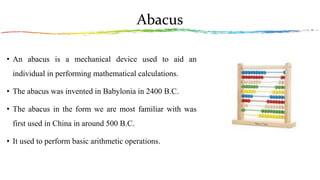
Abacus
• An abacus is a mechanical device used to aid an
individual in performing mathematical calculations.
• The abacus was invented in Babylonia in 2400 B.C.
• The abacus in the form we are most familiar with was
first used in China in around 500 B.C.
• It used to perform basic arithmetic operations.
Napier’s Bones
• Invented by John Napier in 1614.
• Napier's bones is a manually-operated calculating
device created by John Napier of Merchiston for
calculation of products and quotients of numbers.
• Allowed the operator to multiply, divide and
calculate square and cube roots by moving the rods
around and placing them in specially constructed
boards.
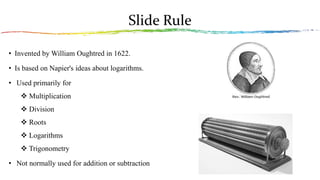
Slide Rule
• Invented by William Oughtred in 1622.
• Is based on Napier's ideas about logarithms.
• Used primarily for
 Multiplication
 Division
 Roots
 Logarithms
 Trigonometry
• Not normally used for addition or subtraction
Pascaline
• Pascal's calculator (also known as the arithmetic machine
or Pascaline) is a mechanical calculator invented by
Blaise Pascal in the early 17th century.
• It was its limitation to addition and subtraction.
• It is too expensive.
Stepped Reckoner
• The step reckoner (or stepped reckoner) was a digital mechanical
calculator invented by the German mathematician Gottfried
Wilhelm Leibniz around 1672 and completed in 1694.
• The machine that can add, subtract, multiply and divide
automatically.
• The name comes from the translation of the German term for its
operating mechanism, Staffelwalze, meaning 'stepped drum'.
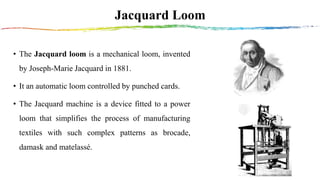
Jacquard Loom
• The Jacquard loom is a mechanical loom, invented
by Joseph-Marie Jacquard in 1881.
• It an automatic loom controlled by punched cards.
• The Jacquard machine is a device fitted to a power
loom that simplifies the process of manufacturing
textiles with such complex patterns as brocade,
damask and matelassé.
Arithmometer
• A mechanical calculator invented by Thomas de
Colmar in 1820,
• The first reliable, useful and commercially
successful calculating machine.
• The machine could perform the four basic
mathematic functions.
• The first mass-produced calculating machine.
Difference Engine and Analytical Engine
• It an automatic, mechanical calculator designed to
tabulate polynomial functions.
• Invented by Charles Babbage in 1822 and 1834
• It is the first mechanical computer.
First Computer Programmer
• In 1840, Augusta Ada Byron suggests to
Babbage that he use the binary system.
• She writes programs for the Analytical Engine.
Augusta Ada Byron
Scheutzian Calculation Engine
• Invented by Per Georg Scheutz in 1843.
• Based on Charles Babbage's difference engine.
• The first printing calculator.
Per Georg Scheutz
Scheutzian Calculation Engine
Tabulating Machine
• The tabulating machine was an electromechanical
machine designed to assist in summarizing information
stored on punched cards.
• Invented by Herman Hollerith, the machine was developed
to help process data for the 1890 U.S. Census.
Tabulating Machine
Herman Hollerith
Havard Mark 1
• Also known as IBM Automatic Sequence
Controlled Calculator (ASCC).
• Invented by Howard H. Aiken in 1943
• The first electro-mechanical computer.
Howard H. Aiken
Havard Mark 1
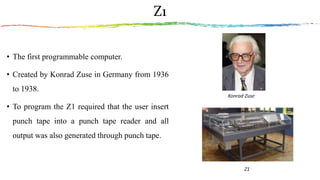
Z1
• The first programmable computer.
• Created by Konrad Zuse in Germany from 1936
to 1938.
• To program the Z1 required that the user insert
punch tape into a punch tape reader and all
output was also generated through punch tape.
Z1
Konrad Zuse
Atanasoff-Berry Computer (ABC)
• It was the first electronic digital computing
device.
• Invented by Professor John Atanasoff and
graduate student Clifford Berry at Iowa State
University between 1939 and 1942.
Professor John Atanasoff
Atanasoff-Berry Computer
ENIAC
• ENIAC stands for Electronic Numerical Integrator
and Computer.
• It was the first electronic general purpose computer.
• Completed in 1946.
• Developed by John Presper Eckert and John W.
Mauchl.
ENIAC
John Presper Eckert and John W. Mauchl.
UNIVAC 1
• The UNIVAC I (UNIVersal Automatic
Computer 1) was the first commercial
computer.
• Designed by J. Presper Eckert and John
Mauchly.
UNIVAC 1
J. Presper Eckert and John Mauchly
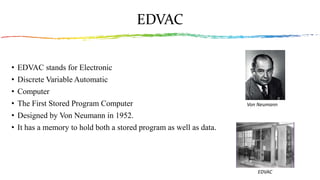
EDVAC
• EDVAC stands for Electronic
• Discrete Variable Automatic
• Computer
• The First Stored Program Computer
• Designed by Von Neumann in 1952.
• It has a memory to hold both a stored program as well as data.
EDVAC
Von Neumann
The First Portable Computer
• Osborne 1 – the first portable computer.
• Released in 1981 by the Osborne
Computer Corporation.
Osborne 1
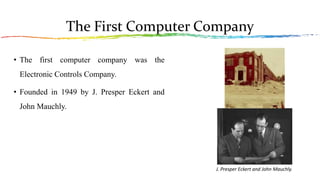
The First Computer Company
• The first computer company was the
Electronic Controls Company.
• Founded in 1949 by J. Presper Eckert and
John Mauchly.
J. Presper Eckert and John Mauchly.
Computer Generations
• 1940 – 1956: First Generation – Vacuum Tubes
• 1956 – 1963: Second Generation – Transistors
• 1964 – 1971: Third Generation – Integrated Circuits
• 1972 – 2010: Fourth Generation – Microprocessors
• 2010- : Fifth Generation – Artificial Intelligence
1940 – 1956: First Generation – Vacuum
Tubes
These early computers used vacuum tubes as circuitry and
magnetic drums for memory.
As a result they were enormous, literally taking up entire
rooms and costing a fortune to run.
These were inefficient materials which generated a lot of
heat, sucked huge electricity and subsequently generated a
lot of heat which caused ongoing breakdowns. Vacuum Tubes
1940 – 1956: First Generation – Vacuum
Tubes
• These first generation computers relied on ‘machine language’ (which is the most basic
programming language that can be understood by computers).
• These computers were limited to solving one problem at a time.
• Input was based on punched cards and paper tape.
• Output came out on print-outs.
• The two notable machines of this era were the UNIVAC and ENIAC machines – the
UNIVAC is the first every commercial computer which was purchased in 1951 by a business
– the US Census Bureau.
1956 – 1963: Second Generation –
Transistors
• The replacement of vacuum tubes by transistors saw the advent of the
second generation of computing.
• Although first invented in 1947, transistors weren’t used significantly
in computers until the end of the 1950s.
• They were a big improvement over the vacuum tube, despite still
subjecting computers to damaging levels of heat.
• However they were hugely superior to the vacuum tubes, making
computers smaller, faster, cheaper and less heavy on electricity use.
• They still relied on punched card for input/printouts.
1956 – 1963: Second Generation –
Transistors
The language evolved from cryptic binary language to symbolic (‘assembly’) languages.
This meant programmers could create instructions in words.
About the same time high level programming languages were being developed (early
versions of COBOL and FORTRAN).
Transistor-driven machines were the first computers to store instructions into their
memories – moving from magnetic drum to magnetic core ‘technology’.
The early versions of these machines were developed for the atomic energy industry.
1964 – 1971: Third Generation – Integrated
Circuits
• By this phase, transistors were now being miniaturised and put on silicon chips
(called semiconductors).
• This led to a massive increase in speed and efficiency of these machines.
• These were the first computers where users interacted using keyboards and monitors
which interfaced with an operating system, a significant leap up from the punch
cards and printouts.
• This enabled these machines to run several applications at once using a central
program which functioned to monitor memory.
• As a result of these advances which again made machines cheaper and smaller, a
new mass market of users emerged during the ‘60s.
1972 – 2010: Fourth Generation –
Microprocessors
• This revolution can be summed in one word: Intel. The chip-maker
developed the Intel 4004 chip in 1971, which positioned all computer
components (CPU, memory, input/output controls) onto a single chip.
• What filled a room in the 1940s now fit in the palm of the hand.
• The Intel chip housed thousands of integrated circuits.
• The year 1981 saw the first ever computer (IBM) specifically designed for
home use and 1984 saw the MacIntosh introduced by Apple.
• Microprocessors even moved beyond the realm of computers and into an
increasing number of everyday products.
1972 – 2010: Fourth Generation –
Microprocessors
• The increased power of these small computers meant they could be linked, creating
networks.
• Which ultimately led to the development, birth and rapid evolution of the Internet.
• Other major advances during this period have been the Graphical user interface (GUI), the
mouse and more recently the astounding advances in lap-top capability and hand-held
devices.
2010- : Fifth Generation – Artificial
Intelligence
• Computer devices with artificial intelligence are still in development,
but some of these technologies are beginning to emerge and be used
such as voice recognition.
• AI is a reality made possible by using parallel processing and
superconductors. Leaning to the future, computers will be radically
transformed again by quantum computation, molecular and nano
technology.
• The essence of fifth generation will be using these technologies to
ultimately create machines which can process and respond to natural
language, and have capability to learn and organise themselves.
A Brief Computer History

A Brief Computer History

  • 1.
    A BRIEF COMPUTERHISTORY Delivered By: Mr. Karthiban Executive MSc in Project Management , BSc (Hons) in Computing , MBCS, BTEC HND in CSD
  • 2.
    About Computer The computeras we know it today had its beginning with a 19th century English mathematics professor name Charles Babbage. He designed the Analytical Engine and it was this design that the basic framework of the computers of today are based on.
  • 3.
    What is Computer Computeris an electronic device that is designed to work with Information. The term computer is derived from the Latin term ‘computare’, this means to calculate or programmable machine. Computer can not do anything without a Program. It represents the decimal numbers through a string of binary digits. The Word 'Computer' usually refers to the Center Processor Unit plus Internal memory.
  • 4.
    About Computer • Computeris a programmable machine. • Computer is a machine that manipulates data according to a list of instructions. • Computer is any device which aids humans in performing various kinds of computations or calculations.
  • 5.
  • 6.
    Speed As you knowcomputer can work very fast. It takes only few seconds for calculations that we take hours to complete. You will be surprised to know that computer can perform millions (1,000,000) of instructions and even more per second. Therefore, we determine the speed of computer in terms of microsecond (10-6 part of a second) or nanosecond (10 to the power -9 part of a second). From this you can imagine how fast your computer performs work.
  • 7.
    Accuracy The degree ofaccuracy of computer is very high and every calculation is performed with the same accuracy. The accuracy level is 7. determined on the basis of design of computer. The errors in computer are due to human and inaccurate data.
  • 8.
    Diligence A computer isfree from tiredness, lack of concentration, fatigue, etc. It can work for hours without creating any error. If millions of calculations are to be performed, a computer will perform every calculation with the same accuracy. Due to this capability it overpowers human being in routine type of work.
  • 9.
    Versatility It means thecapacity to perform completely different type of work. You may use your computer to prepare payroll slips. Next moment you may use it for inventory management or to prepare electric bills.
  • 10.
    Power of Remembering Computerhas the power of storing any amount of information or data. Any information can be stored and recalled as long as you require it, for any numbers of years. It depends entirely upon you how much data you want to store in a computer and when to lose or retrieve these data.
  • 11.
    No IQ Computer isa dumb machine and it cannot do any work without instruction from the user. It performs the instructions at tremendous speed and with accuracy. It is you to decide what you want to do and in what sequence. So a computer cannot take its own decision as you can.
  • 12.
    No Feeling It doesnot have feelings or emotion, taste, knowledge and experience. Thus it does not get tired even after long hours of work. It does not distinguish between users.
  • 13.
    Storage The Computer hasan in-built memory where it can store a large amount of data. You can also store data in secondary storage devices such as floppies, which can be kept outside your computer and can be carried to other computers.
  • 14.
  • 15.
    Earliest Computer • Originallycalculations were computed by humans, whose job title was computers. • These human computers were typically engaged in the calculation of a mathematical expression. • The calculations of this period were specialized and expensive, requiring years of training in mathematics. • The first use of the word "computer" was recorded in 1613, referring to a person who carried out calculations, or computations, and the word continued to be used in that sense until the middle of the 20th century.
  • 16.
    Tally stick A tallystick was an ancient memory aid device used to record and document numbers, quantities, or even messages. Tally sticks first appear as animal bones carved with notches during the Upper Paleolithic.
  • 17.
    Abacus • An abacusis a mechanical device used to aid an individual in performing mathematical calculations. • The abacus was invented in Babylonia in 2400 B.C. • The abacus in the form we are most familiar with was first used in China in around 500 B.C. • It used to perform basic arithmetic operations.
  • 18.
    Napier’s Bones • Inventedby John Napier in 1614. • Napier's bones is a manually-operated calculating device created by John Napier of Merchiston for calculation of products and quotients of numbers. • Allowed the operator to multiply, divide and calculate square and cube roots by moving the rods around and placing them in specially constructed boards.
  • 19.
    Slide Rule • Inventedby William Oughtred in 1622. • Is based on Napier's ideas about logarithms. • Used primarily for  Multiplication  Division  Roots  Logarithms  Trigonometry • Not normally used for addition or subtraction
  • 20.
    Pascaline • Pascal's calculator(also known as the arithmetic machine or Pascaline) is a mechanical calculator invented by Blaise Pascal in the early 17th century. • It was its limitation to addition and subtraction. • It is too expensive.
  • 21.
    Stepped Reckoner • Thestep reckoner (or stepped reckoner) was a digital mechanical calculator invented by the German mathematician Gottfried Wilhelm Leibniz around 1672 and completed in 1694. • The machine that can add, subtract, multiply and divide automatically. • The name comes from the translation of the German term for its operating mechanism, Staffelwalze, meaning 'stepped drum'.
  • 22.
    Jacquard Loom • TheJacquard loom is a mechanical loom, invented by Joseph-Marie Jacquard in 1881. • It an automatic loom controlled by punched cards. • The Jacquard machine is a device fitted to a power loom that simplifies the process of manufacturing textiles with such complex patterns as brocade, damask and matelassé.
  • 23.
    Arithmometer • A mechanicalcalculator invented by Thomas de Colmar in 1820, • The first reliable, useful and commercially successful calculating machine. • The machine could perform the four basic mathematic functions. • The first mass-produced calculating machine.
  • 24.
    Difference Engine andAnalytical Engine • It an automatic, mechanical calculator designed to tabulate polynomial functions. • Invented by Charles Babbage in 1822 and 1834 • It is the first mechanical computer.
  • 25.
    First Computer Programmer •In 1840, Augusta Ada Byron suggests to Babbage that he use the binary system. • She writes programs for the Analytical Engine. Augusta Ada Byron
  • 26.
    Scheutzian Calculation Engine •Invented by Per Georg Scheutz in 1843. • Based on Charles Babbage's difference engine. • The first printing calculator. Per Georg Scheutz Scheutzian Calculation Engine
  • 27.
    Tabulating Machine • Thetabulating machine was an electromechanical machine designed to assist in summarizing information stored on punched cards. • Invented by Herman Hollerith, the machine was developed to help process data for the 1890 U.S. Census. Tabulating Machine Herman Hollerith
  • 28.
    Havard Mark 1 •Also known as IBM Automatic Sequence Controlled Calculator (ASCC). • Invented by Howard H. Aiken in 1943 • The first electro-mechanical computer. Howard H. Aiken Havard Mark 1
  • 29.
    Z1 • The firstprogrammable computer. • Created by Konrad Zuse in Germany from 1936 to 1938. • To program the Z1 required that the user insert punch tape into a punch tape reader and all output was also generated through punch tape. Z1 Konrad Zuse
  • 30.
    Atanasoff-Berry Computer (ABC) •It was the first electronic digital computing device. • Invented by Professor John Atanasoff and graduate student Clifford Berry at Iowa State University between 1939 and 1942. Professor John Atanasoff Atanasoff-Berry Computer
  • 31.
    ENIAC • ENIAC standsfor Electronic Numerical Integrator and Computer. • It was the first electronic general purpose computer. • Completed in 1946. • Developed by John Presper Eckert and John W. Mauchl. ENIAC John Presper Eckert and John W. Mauchl.
  • 32.
    UNIVAC 1 • TheUNIVAC I (UNIVersal Automatic Computer 1) was the first commercial computer. • Designed by J. Presper Eckert and John Mauchly. UNIVAC 1 J. Presper Eckert and John Mauchly
  • 33.
    EDVAC • EDVAC standsfor Electronic • Discrete Variable Automatic • Computer • The First Stored Program Computer • Designed by Von Neumann in 1952. • It has a memory to hold both a stored program as well as data. EDVAC Von Neumann
  • 34.
    The First PortableComputer • Osborne 1 – the first portable computer. • Released in 1981 by the Osborne Computer Corporation. Osborne 1
  • 35.
    The First ComputerCompany • The first computer company was the Electronic Controls Company. • Founded in 1949 by J. Presper Eckert and John Mauchly. J. Presper Eckert and John Mauchly.
  • 36.
  • 37.
    Computer Generations • 1940– 1956: First Generation – Vacuum Tubes • 1956 – 1963: Second Generation – Transistors • 1964 – 1971: Third Generation – Integrated Circuits • 1972 – 2010: Fourth Generation – Microprocessors • 2010- : Fifth Generation – Artificial Intelligence
  • 38.
    1940 – 1956:First Generation – Vacuum Tubes These early computers used vacuum tubes as circuitry and magnetic drums for memory. As a result they were enormous, literally taking up entire rooms and costing a fortune to run. These were inefficient materials which generated a lot of heat, sucked huge electricity and subsequently generated a lot of heat which caused ongoing breakdowns. Vacuum Tubes
  • 39.
    1940 – 1956:First Generation – Vacuum Tubes • These first generation computers relied on ‘machine language’ (which is the most basic programming language that can be understood by computers). • These computers were limited to solving one problem at a time. • Input was based on punched cards and paper tape. • Output came out on print-outs. • The two notable machines of this era were the UNIVAC and ENIAC machines – the UNIVAC is the first every commercial computer which was purchased in 1951 by a business – the US Census Bureau.
  • 40.
    1956 – 1963:Second Generation – Transistors • The replacement of vacuum tubes by transistors saw the advent of the second generation of computing. • Although first invented in 1947, transistors weren’t used significantly in computers until the end of the 1950s. • They were a big improvement over the vacuum tube, despite still subjecting computers to damaging levels of heat. • However they were hugely superior to the vacuum tubes, making computers smaller, faster, cheaper and less heavy on electricity use. • They still relied on punched card for input/printouts.
  • 41.
    1956 – 1963:Second Generation – Transistors The language evolved from cryptic binary language to symbolic (‘assembly’) languages. This meant programmers could create instructions in words. About the same time high level programming languages were being developed (early versions of COBOL and FORTRAN). Transistor-driven machines were the first computers to store instructions into their memories – moving from magnetic drum to magnetic core ‘technology’. The early versions of these machines were developed for the atomic energy industry.
  • 42.
    1964 – 1971:Third Generation – Integrated Circuits • By this phase, transistors were now being miniaturised and put on silicon chips (called semiconductors). • This led to a massive increase in speed and efficiency of these machines. • These were the first computers where users interacted using keyboards and monitors which interfaced with an operating system, a significant leap up from the punch cards and printouts. • This enabled these machines to run several applications at once using a central program which functioned to monitor memory. • As a result of these advances which again made machines cheaper and smaller, a new mass market of users emerged during the ‘60s.
  • 43.
    1972 – 2010:Fourth Generation – Microprocessors • This revolution can be summed in one word: Intel. The chip-maker developed the Intel 4004 chip in 1971, which positioned all computer components (CPU, memory, input/output controls) onto a single chip. • What filled a room in the 1940s now fit in the palm of the hand. • The Intel chip housed thousands of integrated circuits. • The year 1981 saw the first ever computer (IBM) specifically designed for home use and 1984 saw the MacIntosh introduced by Apple. • Microprocessors even moved beyond the realm of computers and into an increasing number of everyday products.
  • 44.
    1972 – 2010:Fourth Generation – Microprocessors • The increased power of these small computers meant they could be linked, creating networks. • Which ultimately led to the development, birth and rapid evolution of the Internet. • Other major advances during this period have been the Graphical user interface (GUI), the mouse and more recently the astounding advances in lap-top capability and hand-held devices.
  • 45.
    2010- : FifthGeneration – Artificial Intelligence • Computer devices with artificial intelligence are still in development, but some of these technologies are beginning to emerge and be used such as voice recognition. • AI is a reality made possible by using parallel processing and superconductors. Leaning to the future, computers will be radically transformed again by quantum computation, molecular and nano technology. • The essence of fifth generation will be using these technologies to ultimately create machines which can process and respond to natural language, and have capability to learn and organise themselves.