Evolution
   of
Computers
The Abacus
It was the earliest
calculating machine
probably originated
in China about
3,000 years ago.

In China it is also
known as Swan
Pan.
 It is consists of a rectangular
  wooden frame with horizontal
  rods.
 It is consist of several columns,

  farthest to the right represent
  ‘ones’, the next one ‘tens the
  hundreds and so on.’
John Napier

A mathematician,
developed a device
having a set of rods
made of bones.

 In 1964, John Napier
introduced Logarithms.
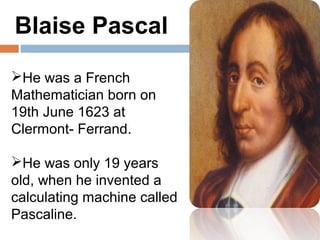
Blaise Pascal
He was a French
Mathematician born on
19th June 1623 at
Clermont- Ferrand.

He was only 19 years
old, when he invented a
calculating machine called
Pascaline.
Analog Computer
These are fundamentally
different in principle from the
modern digital computers.

It is use in simple devices,
even they are mechanically
complicated.
Joseph- Marie
Jacquard (1752-1834)
He introduced a
new weaving loom in
1805.
The Jacquards

Weaving System
using punched card
attracted many
scientist.
Charles Babbage (1792-1871)

He was inspired by the punched Card
to idea, developed an idea of using
punched cards to input data.


He continued his efforts and put
forward an idea of a machine that
can do 60 calculations per second.
The Analytical Engine stamped the
foundation for modern computing.
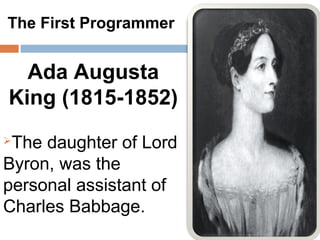
The First Programmer


  Ada Augusta
King (1815-1852)
The daughter of Lord
Byron, was the
personal assistant of
Charles Babbage.
She suggested binary data
storage and wrote the first
computer program for the
Analytical Engine.

The ADA software was named
George Boole (1815-1864)
He was self taught
English Mathematician

His theory of Boolean
logic became
fundamental to the
design of computer
circuitry.
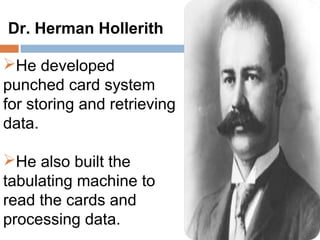
Dr. Herman Hollerith

He developed
punched card system
for storing and retrieving
data.

He also built the
tabulating machine to
read the cards and
processing data.
He started Tabulated Machines
Companies in 1896.

In 1911 , this company became the
Computing Tabulating Recording
Company and now the International
Business machines, simply IBM.
Digital Era
Claude Shannon
He suggested 1’s
and 0’s of binary
systems can be
considered ‘ON’ and
OFF position of the
flow of current.
Dr. John Vincent Atanasoff


He built the first
electronic
computer named
Atanasoff Berry
Computer.
J. Presper Eckert and
John William Mauchy

They developed general
purpose computer,
Electronic Numerical
Integrator and Calculator
(ENIAC).
This computer has 1800
valves consuming 100
kilowatts of power and
weighed several tons.
John Von Neuman

He introduced an
idea of entering the
program of instructions
into the machines for
its procedures as the
numerical data is
entered.
Admiral Grace Hopper
She developed this
idea and it was
designed and built by
Mauchy and Eckert. The
first commercial
electronic digital
computer capable of
using stored programs
was called Universal
Automatic Calculator
(UNIVAC).
Transistors
In 1947, computers
entered a second
generation by the
introduction of
transistors.

It was developed by
the American physicist
William Shockley.
Evolu

Evolu

  • 1.
    Evolution of Computers
  • 2.
    The Abacus It wasthe earliest calculating machine probably originated in China about 3,000 years ago. In China it is also known as Swan Pan.
  • 3.
     It isconsists of a rectangular wooden frame with horizontal rods.  It is consist of several columns, farthest to the right represent ‘ones’, the next one ‘tens the hundreds and so on.’
  • 4.
    John Napier A mathematician, developeda device having a set of rods made of bones.  In 1964, John Napier introduced Logarithms.
  • 5.
    Blaise Pascal He wasa French Mathematician born on 19th June 1623 at Clermont- Ferrand. He was only 19 years old, when he invented a calculating machine called Pascaline.
  • 6.
    Analog Computer These arefundamentally different in principle from the modern digital computers. It is use in simple devices, even they are mechanically complicated.
  • 7.
    Joseph- Marie Jacquard (1752-1834) Heintroduced a new weaving loom in 1805. The Jacquards Weaving System using punched card attracted many scientist.
  • 8.
    Charles Babbage (1792-1871) Hewas inspired by the punched Card to idea, developed an idea of using punched cards to input data. He continued his efforts and put forward an idea of a machine that can do 60 calculations per second. The Analytical Engine stamped the foundation for modern computing.
  • 9.
    The First Programmer Ada Augusta King (1815-1852) The daughter of Lord Byron, was the personal assistant of Charles Babbage.
  • 10.
    She suggested binarydata storage and wrote the first computer program for the Analytical Engine. The ADA software was named
  • 11.
    George Boole (1815-1864) Hewas self taught English Mathematician His theory of Boolean logic became fundamental to the design of computer circuitry.
  • 12.
    Dr. Herman Hollerith Hedeveloped punched card system for storing and retrieving data. He also built the tabulating machine to read the cards and processing data.
  • 13.
    He started TabulatedMachines Companies in 1896. In 1911 , this company became the Computing Tabulating Recording Company and now the International Business machines, simply IBM.
  • 14.
    Digital Era Claude Shannon Hesuggested 1’s and 0’s of binary systems can be considered ‘ON’ and OFF position of the flow of current.
  • 15.
    Dr. John VincentAtanasoff He built the first electronic computer named Atanasoff Berry Computer.
  • 16.
    J. Presper Eckertand John William Mauchy They developed general purpose computer, Electronic Numerical Integrator and Calculator (ENIAC). This computer has 1800 valves consuming 100 kilowatts of power and weighed several tons.
  • 17.
    John Von Neuman Heintroduced an idea of entering the program of instructions into the machines for its procedures as the numerical data is entered.
  • 18.
    Admiral Grace Hopper Shedeveloped this idea and it was designed and built by Mauchy and Eckert. The first commercial electronic digital computer capable of using stored programs was called Universal Automatic Calculator (UNIVAC).
  • 19.
    Transistors In 1947, computers entereda second generation by the introduction of transistors. It was developed by the American physicist William Shockley.