What is globalisation and how is it changing people’s lives? Know the meaning of the word ‘globalisation’; Understand the process of globalisation; Be able to outline the factors which have accelerated globalisation; Examine global patterns and trends in migration; Assess the link between globalisation and population movements.
Globalisation and population change Demographic changes are an important part of globalisation. Economic growth leads to an increase in the number of people living in a region due to changes in birth rate (BR), death rate (DR) and natural increase (NI).
Stage 1 : BR and DR both high and fluctuating.  There are no countries at this stage, only small regions. No access to birth control, high infant mortality, poor diet and hygiene.
Stage 2:  e.g. Ethopia DR falling due to better diet, improved medical facilities and better sanitation.  BR remains high so population growing.
Stage 3:  e.g. Bangladesh BR now fall rapidly due to improved knowledge of family planning and a changing role of women.  DR continues to fall.
Stage 4:  e.g. Poland BR and DR are both low and fluctuating. BR is still slightly higher, so the population is increasing.  Characteristic of most MEDCs.
Stage 5:  e.g. Russian Federation Some countries are now moving to the point where DR is higher than the BR.  Therefore the population is falling.
Globalisation and migration Globalisation also has a strong influence on migration. Can concentrate new factories (wealth) in certain areas, making them more attractive Rural areas may modernise and cause a reduction in jobs (mechanisation of farming) Intervening obstacles may be removed e.g. EU
 
 
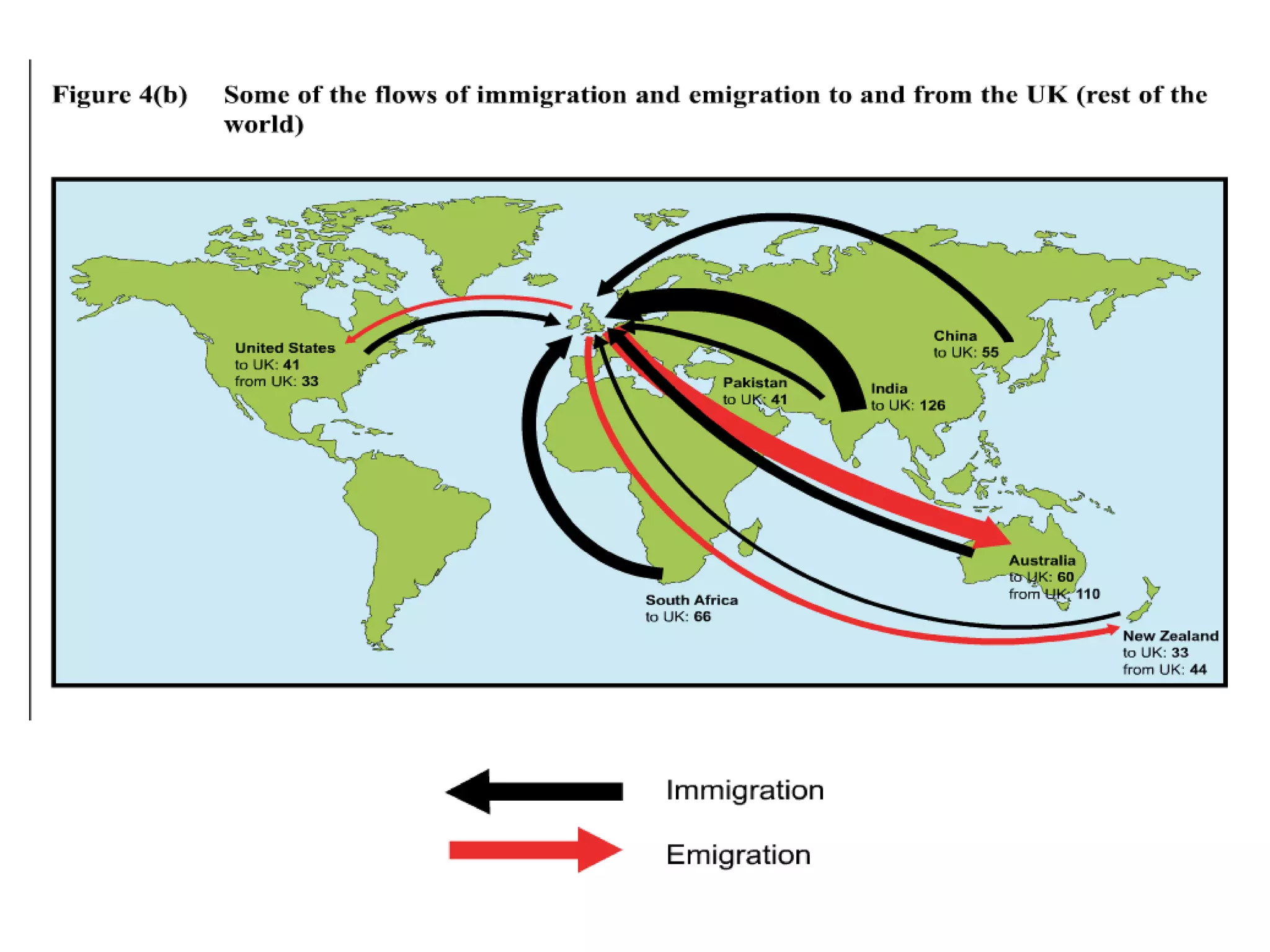
Net immigration by country
Net emigration by country
Push and pull factors Push factors Forcing people away from where they live now Pull factors Attracting people to a new area MIGRATION
Lee’s Model of Intervening Obstacles
Lee’s Model of Intervening Obstacles Social obstacles – family links, illiteracy, lack of education Economic obstacles – cost of moving, setting up new home / business etc Political obstacles – immigration policy Lack of information about the destination


Lesson 2 What Is Globalisation And How Is It Changing Peoples Lives

  • 1.
    What is globalisationand how is it changing people’s lives? Know the meaning of the word ‘globalisation’; Understand the process of globalisation; Be able to outline the factors which have accelerated globalisation; Examine global patterns and trends in migration; Assess the link between globalisation and population movements.
  • 2.
    Globalisation and populationchange Demographic changes are an important part of globalisation. Economic growth leads to an increase in the number of people living in a region due to changes in birth rate (BR), death rate (DR) and natural increase (NI).
  • 3.
    Stage 1 :BR and DR both high and fluctuating. There are no countries at this stage, only small regions. No access to birth control, high infant mortality, poor diet and hygiene.
  • 4.
    Stage 2: e.g. Ethopia DR falling due to better diet, improved medical facilities and better sanitation. BR remains high so population growing.
  • 5.
    Stage 3: e.g. Bangladesh BR now fall rapidly due to improved knowledge of family planning and a changing role of women. DR continues to fall.
  • 6.
    Stage 4: e.g. Poland BR and DR are both low and fluctuating. BR is still slightly higher, so the population is increasing. Characteristic of most MEDCs.
  • 7.
    Stage 5: e.g. Russian Federation Some countries are now moving to the point where DR is higher than the BR. Therefore the population is falling.
  • 8.
    Globalisation and migrationGlobalisation also has a strong influence on migration. Can concentrate new factories (wealth) in certain areas, making them more attractive Rural areas may modernise and cause a reduction in jobs (mechanisation of farming) Intervening obstacles may be removed e.g. EU
  • 9.
  • 10.
  • 11.
  • 12.
  • 13.
    Push and pullfactors Push factors Forcing people away from where they live now Pull factors Attracting people to a new area MIGRATION
  • 14.
    Lee’s Model ofIntervening Obstacles
  • 15.
    Lee’s Model ofIntervening Obstacles Social obstacles – family links, illiteracy, lack of education Economic obstacles – cost of moving, setting up new home / business etc Political obstacles – immigration policy Lack of information about the destination
  • 16.
  • 17.
  • 18.