1
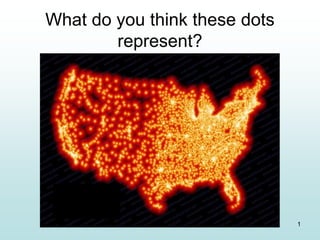
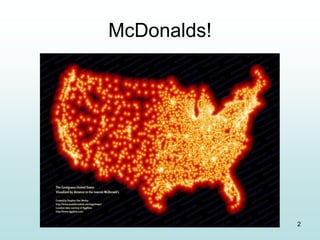
What do you think these dots
represent?
2
McDonalds!
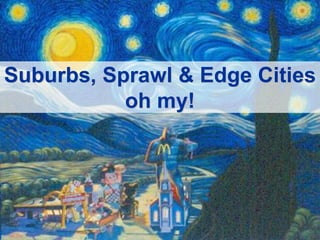
Suburbs, Sprawl & Edge Cities
oh my!
4
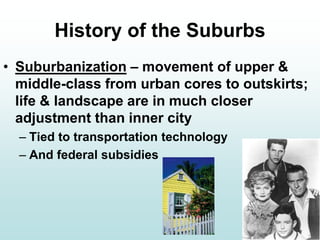
History of the Suburbs
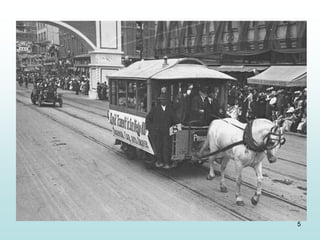
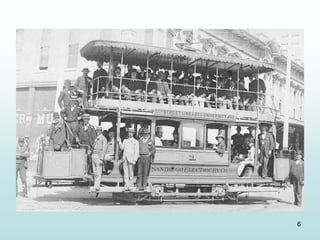
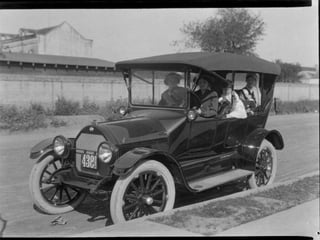
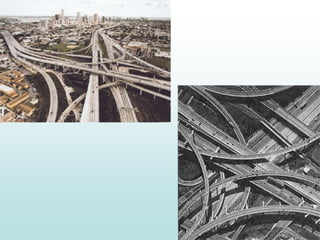
• Suburbanization – movement of upper &
middle-class from urban cores to outskirts;
life & landscape are in much closer
adjustment than inner city
– Tied to transportation technology
– And federal subsidies
5
6
7
8
9
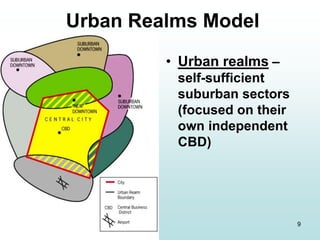
Urban Realms Model
• Urban realms –
self-sufficient
suburban sectors
(focused on their
own independent
CBD)
10
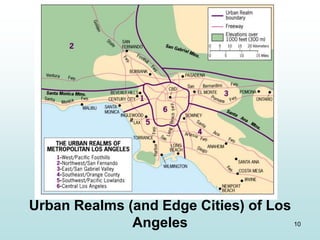
Urban Realms (and Edge Cities) of Los
Angeles
11
Growth of Suburbs
• Residential land uses
–Escaping urban ills, spreading out
• Retail followed the market
• Industry followed the employees
–More space, new buildings
–Good transportation access
12
3 Waves of Suburbanization
1. Suburbanization after WWII
2. Malling of US (moving
marketplace to suburbs in
1960s & 70s)
3. Edge cities (moving jobs to
suburbs in 1980s & 90s)
13
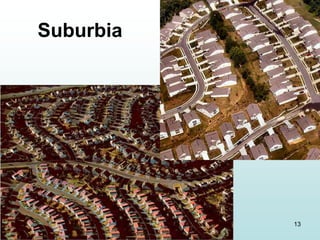
Suburbia
14
15
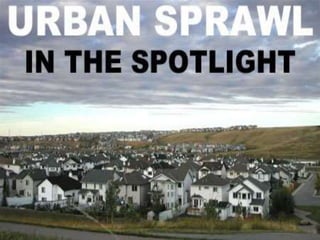
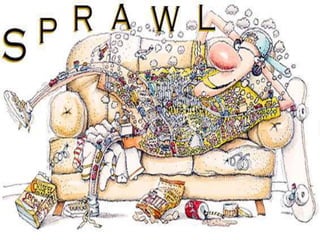
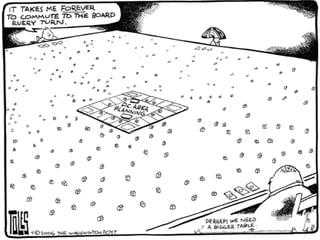
What is Urban Sprawl?
• unrestricted growth in many American
urban areas of housing, commercial
development, and roads over large
expanses of land, with little concern for
urban planning
16
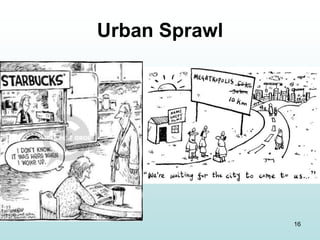
Urban Sprawl
17
18
19
Edge Cities
• Edge cities
– Sub-centers instead of CBD
– “Shadow governments”
• Edge cities have extensive office & retail
space, few residential buildings (not cities
30 years ago)
• Refocusing of commuting on suburb-to-
suburb and city-to-suburb "reverse
commuting"
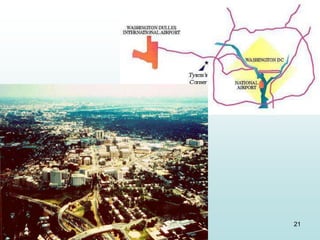
• Examples: Tysons Corner, VA
20
Edge Cities are characterized by:
a. Shopping malls
b. High-tech light manufacturing
c. Corporate headquarters
d. White-collar firms
e. Entertainment and hotel complexes
f. Airport complexes
g. Frequently located at intersections of
major freeways
21
22
Suburbs and Inner cities
• Suburban residents and jobs came from
somewhere
• Growth now limited to suburbs
• Segregation by class, race
• Falling tax income, rising service needs
• Spatial mismatch: jobs moved, poor didn’t
– But agglomeration still matters
– And immigrants still arrive in cities
• Increasing redevelopment of downtowns
(i.e. gentrification)
23
– 90’s: 1st decade since WWII that inner
cities have grown; still problem-ridden
zones – loss of tax revenues (from
residents moving to suburbs)
– Gentrification – rehabilitation of inner
city housing w/ favorable locations to
CBD & employment
– Commercialization – e.g. “River Front”;
attracts tourism & business, but NOT
permanent residents
Urban America
Urban Sprawl Scenario
• A small town was established in the late 19th century. It
was located about twenty-five miles from a major city.
Since the trip to the city was too long for people to make
on a daily basis, the town was self-sufficient and did not
consider itself a suburb.
• With the opening of a freeway between this town and the
city in the 1960s, some people began to use the town as
a "bedroom community." Within the last decade, the
town has experienced a huge influx of people from the
central city and other suburbs. Many new subdivisions
have been developed, along with shopping malls and
"business parks."
24
TASK – USE THE WHITEBOARDS TO SKETCH
THIS TOWN AS YOU THINK IT WOULD LOOK
TODAY.
Writing Prompt
The suburb and its sprawling counterpart
affect the environment, people's daily
lives, and the local and regional economy
– What allures people to the suburbs? Why?
– What can be some negatives of suburban
life? Explain
25

Suburbs sprawl and_edge_cities

  • 1.
    1 What do youthink these dots represent?
  • 2.
  • 3.
    Suburbs, Sprawl &Edge Cities oh my!
  • 4.
    4 History of theSuburbs • Suburbanization – movement of upper & middle-class from urban cores to outskirts; life & landscape are in much closer adjustment than inner city – Tied to transportation technology – And federal subsidies
  • 5.
  • 6.
  • 7.
  • 8.
  • 9.
    9 Urban Realms Model •Urban realms – self-sufficient suburban sectors (focused on their own independent CBD)
  • 10.
    10 Urban Realms (andEdge Cities) of Los Angeles
  • 11.
    11 Growth of Suburbs •Residential land uses –Escaping urban ills, spreading out • Retail followed the market • Industry followed the employees –More space, new buildings –Good transportation access
  • 12.
    12 3 Waves ofSuburbanization 1. Suburbanization after WWII 2. Malling of US (moving marketplace to suburbs in 1960s & 70s) 3. Edge cities (moving jobs to suburbs in 1980s & 90s)
  • 13.
  • 14.
  • 15.
    15 What is UrbanSprawl? • unrestricted growth in many American urban areas of housing, commercial development, and roads over large expanses of land, with little concern for urban planning
  • 16.
  • 17.
  • 18.
  • 19.
    19 Edge Cities • Edgecities – Sub-centers instead of CBD – “Shadow governments” • Edge cities have extensive office & retail space, few residential buildings (not cities 30 years ago) • Refocusing of commuting on suburb-to- suburb and city-to-suburb "reverse commuting" • Examples: Tysons Corner, VA
  • 20.
    20 Edge Cities arecharacterized by: a. Shopping malls b. High-tech light manufacturing c. Corporate headquarters d. White-collar firms e. Entertainment and hotel complexes f. Airport complexes g. Frequently located at intersections of major freeways
  • 21.
  • 22.
    22 Suburbs and Innercities • Suburban residents and jobs came from somewhere • Growth now limited to suburbs • Segregation by class, race • Falling tax income, rising service needs • Spatial mismatch: jobs moved, poor didn’t – But agglomeration still matters – And immigrants still arrive in cities • Increasing redevelopment of downtowns (i.e. gentrification)
  • 23.
    23 – 90’s: 1stdecade since WWII that inner cities have grown; still problem-ridden zones – loss of tax revenues (from residents moving to suburbs) – Gentrification – rehabilitation of inner city housing w/ favorable locations to CBD & employment – Commercialization – e.g. “River Front”; attracts tourism & business, but NOT permanent residents Urban America
  • 24.
    Urban Sprawl Scenario •A small town was established in the late 19th century. It was located about twenty-five miles from a major city. Since the trip to the city was too long for people to make on a daily basis, the town was self-sufficient and did not consider itself a suburb. • With the opening of a freeway between this town and the city in the 1960s, some people began to use the town as a "bedroom community." Within the last decade, the town has experienced a huge influx of people from the central city and other suburbs. Many new subdivisions have been developed, along with shopping malls and "business parks." 24 TASK – USE THE WHITEBOARDS TO SKETCH THIS TOWN AS YOU THINK IT WOULD LOOK TODAY.
  • 25.
    Writing Prompt The suburband its sprawling counterpart affect the environment, people's daily lives, and the local and regional economy – What allures people to the suburbs? Why? – What can be some negatives of suburban life? Explain 25