Case Studies – Internal Migration (UK) Since 1980 – the pattern of international migration in the UK has been from: North – South Drift (Regional Migration) Urban – Rural (Counter urbanisation) Inner – Outer City Areas (suburbanisation) Why? Regions such as NE had relied on coalfields, shipyards, iron and steel and heavy engineering to provide 1000s of jobs – these industries declined – making 1000s unemployed In contrast – the SE was a focus of economic growth – 1981-1996 – net inforw to the south (due to higher wages and lower unemployment – particular growth in Surrey, Kent, E Anglia, Dorset) Case Study 1. North – South Drift (1960s onwards)
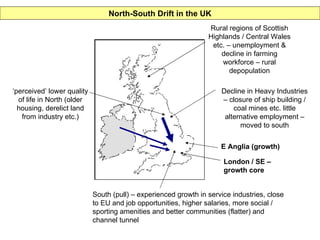
‘ perceived’ lower quality of life in North (older housing, derelict land from industry etc.) Rural regions of Scottish Highlands / Central Wales etc. – unemployment & decline in farming workforce – rural depopulation Decline in Heavy Industries – closure of ship building / coal mines etc. little alternative employment – moved to south South (pull) – experienced growth in service industries, close to EU and job opportunities, higher salaries, more social / sporting amenities and better communities (flatter) and channel tunnel E Anglia (growth) London / SE – growth core North-South Drift in the UK
Case Study 2. Counter-urbanisation See your notes on Counter urbanisation in the settlement unit for this (good cross over – will help with revision!) Just a few reminders: Who moves? Younger families  (looking for more open space and larger properties) Higher Income Groups  (able to afford larger houses and the costs of commuting) Those with Higher Skills  (looking for work in modern / footloose industries) Reasons for Counter-urbanisation Pressures in city  (traffic, pollution etc.) Technological Change  (teleworking etc.) Improved communications  / car owershup Urban renewal process  (forced re-housing) BUT REMEMBER  - some reversal of movement in 1990s – regeneration of inner city areas – e.g. London Docklands.
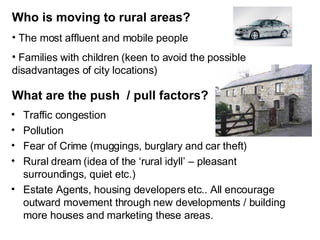
Who is moving to rural areas? Traffic congestion Pollution Fear of Crime (muggings, burglary and car theft) Rural dream (idea of the ‘rural idyll’ – pleasant surroundings, quiet etc.) Estate Agents, housing developers etc.. All encourage outward movement through new developments / building more houses and marketing these areas. What are the push  / pull factors? The most affluent and mobile people Families with children (keen to avoid the possible disadvantages of city locations)
What factors have helped counterurbanisation? Technological change – fax, blackberry, email, phones, internet – led to growth of ‘teleworking’ or ‘electronic commuting’ (people working from home – encouraging rural living) Freezers, telephone, TV etc.. allow rural lifestyle but not isolation improvements in road / motorway networks make commuting easier encouraging people to move out from the cities (gradually congestion sets in and cycle begins again) Urban renewal processes during the 50’s/60s meant that due to slum clearance large numbers of people had to move from inner city areas – most were rehoused on council estate on edge of city – or beyond the city in New Towns / overspill settlements.
Consequences for the Rural Settlement of Urbanisation Counterurbanisation leads to the growth of suburbanised / dormitory / commuter villages and towns e.g. St Ives (commuter town), Fulbourn, Cherry Hinton etc.. Negative Effects   House prices increase – locals young people cannot afford to buy property in areas they grew up local resentment caused lack of appreciation of traditional customs of village life by newcomers – change in community spirit dormitory villages lose vitality and community spirit (very quiet during the day) increase in population Positive Effects Improvement in services – e.g. gas mains, cable TV, supports local schools supports some local facilities (e.g. pub, builders etc.) – although others may close increased car pollution, accidents in area.
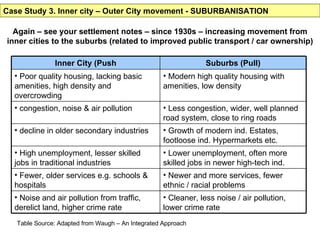
Case Study 3. Inner city – Outer City movement - SUBURBANISATION Again – see your settlement notes – since 1930s – increasing movement from inner cities to the suburbs (related to improved public transport / car ownership) Table Source: Adapted from Waugh – An Integrated Approach Cleaner, less noise / air pollution, lower crime rate Noise and air pollution from traffic, derelict land, higher crime rate Newer and more services, fewer ethnic / racial problems Fewer, older services e.g. schools & hospitals Lower unemployment, often more skilled jobs in newer high-tech ind. High unemployment, lesser skilled jobs in traditional industries Growth of modern ind. Estates, footloose ind. Hypermarkets etc. decline in older secondary industries Less congestion, wider, well planned road system, close to ring roads congestion, noise & air pollution Modern high quality housing with amenities, low density Poor quality housing, lacking basic amenities, high density and overcrowding Suburbs (Pull) Inner City (Push
CONSEQUENCES FOR THE INNER CITY Advantages Disadvantages CONSEQUENCES FOR THE SUBURBS Advantages Disadvantages Reduces unemployment  space for immigrants moving in Reduced pressure on services Leaves a decaying heart reduced community spirit Local councils receive less money from taxes Less investment Social unrest and increased crime increased use and demand for services increase house building Cost of living and houses increase Increase in industry and offices Increase in pollution and traffic congestion decrease in farmland due to the urban sprawl Consequences for the Receiving and Losing area:

Internal Migration in the UK

  • 1.
    Case Studies –Internal Migration (UK) Since 1980 – the pattern of international migration in the UK has been from: North – South Drift (Regional Migration) Urban – Rural (Counter urbanisation) Inner – Outer City Areas (suburbanisation) Why? Regions such as NE had relied on coalfields, shipyards, iron and steel and heavy engineering to provide 1000s of jobs – these industries declined – making 1000s unemployed In contrast – the SE was a focus of economic growth – 1981-1996 – net inforw to the south (due to higher wages and lower unemployment – particular growth in Surrey, Kent, E Anglia, Dorset) Case Study 1. North – South Drift (1960s onwards)
  • 2.
    ‘ perceived’ lowerquality of life in North (older housing, derelict land from industry etc.) Rural regions of Scottish Highlands / Central Wales etc. – unemployment & decline in farming workforce – rural depopulation Decline in Heavy Industries – closure of ship building / coal mines etc. little alternative employment – moved to south South (pull) – experienced growth in service industries, close to EU and job opportunities, higher salaries, more social / sporting amenities and better communities (flatter) and channel tunnel E Anglia (growth) London / SE – growth core North-South Drift in the UK
  • 3.
    Case Study 2.Counter-urbanisation See your notes on Counter urbanisation in the settlement unit for this (good cross over – will help with revision!) Just a few reminders: Who moves? Younger families (looking for more open space and larger properties) Higher Income Groups (able to afford larger houses and the costs of commuting) Those with Higher Skills (looking for work in modern / footloose industries) Reasons for Counter-urbanisation Pressures in city (traffic, pollution etc.) Technological Change (teleworking etc.) Improved communications / car owershup Urban renewal process (forced re-housing) BUT REMEMBER - some reversal of movement in 1990s – regeneration of inner city areas – e.g. London Docklands.
  • 4.
    Who is movingto rural areas? Traffic congestion Pollution Fear of Crime (muggings, burglary and car theft) Rural dream (idea of the ‘rural idyll’ – pleasant surroundings, quiet etc.) Estate Agents, housing developers etc.. All encourage outward movement through new developments / building more houses and marketing these areas. What are the push / pull factors? The most affluent and mobile people Families with children (keen to avoid the possible disadvantages of city locations)
  • 5.
    What factors havehelped counterurbanisation? Technological change – fax, blackberry, email, phones, internet – led to growth of ‘teleworking’ or ‘electronic commuting’ (people working from home – encouraging rural living) Freezers, telephone, TV etc.. allow rural lifestyle but not isolation improvements in road / motorway networks make commuting easier encouraging people to move out from the cities (gradually congestion sets in and cycle begins again) Urban renewal processes during the 50’s/60s meant that due to slum clearance large numbers of people had to move from inner city areas – most were rehoused on council estate on edge of city – or beyond the city in New Towns / overspill settlements.
  • 6.
    Consequences for theRural Settlement of Urbanisation Counterurbanisation leads to the growth of suburbanised / dormitory / commuter villages and towns e.g. St Ives (commuter town), Fulbourn, Cherry Hinton etc.. Negative Effects House prices increase – locals young people cannot afford to buy property in areas they grew up local resentment caused lack of appreciation of traditional customs of village life by newcomers – change in community spirit dormitory villages lose vitality and community spirit (very quiet during the day) increase in population Positive Effects Improvement in services – e.g. gas mains, cable TV, supports local schools supports some local facilities (e.g. pub, builders etc.) – although others may close increased car pollution, accidents in area.
  • 7.
    Case Study 3.Inner city – Outer City movement - SUBURBANISATION Again – see your settlement notes – since 1930s – increasing movement from inner cities to the suburbs (related to improved public transport / car ownership) Table Source: Adapted from Waugh – An Integrated Approach Cleaner, less noise / air pollution, lower crime rate Noise and air pollution from traffic, derelict land, higher crime rate Newer and more services, fewer ethnic / racial problems Fewer, older services e.g. schools & hospitals Lower unemployment, often more skilled jobs in newer high-tech ind. High unemployment, lesser skilled jobs in traditional industries Growth of modern ind. Estates, footloose ind. Hypermarkets etc. decline in older secondary industries Less congestion, wider, well planned road system, close to ring roads congestion, noise & air pollution Modern high quality housing with amenities, low density Poor quality housing, lacking basic amenities, high density and overcrowding Suburbs (Pull) Inner City (Push
  • 8.
    CONSEQUENCES FOR THEINNER CITY Advantages Disadvantages CONSEQUENCES FOR THE SUBURBS Advantages Disadvantages Reduces unemployment space for immigrants moving in Reduced pressure on services Leaves a decaying heart reduced community spirit Local councils receive less money from taxes Less investment Social unrest and increased crime increased use and demand for services increase house building Cost of living and houses increase Increase in industry and offices Increase in pollution and traffic congestion decrease in farmland due to the urban sprawl Consequences for the Receiving and Losing area: