First cities appear in different parts of the world, but those that will exert a deeper
influence in Europe are located in the Middle East, more specifically in Mesopotamia,
and a little later, in Egypt.
CITY IN CRETE

CITY IN GREECE
CITY IN ROME
MEDIEVAL CHRISTIAN CITY
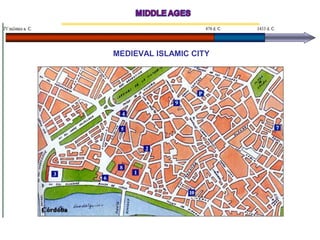
MEDIEVAL ISLAMIC CITY
CITY IN THE RENAISSANCE
There is an
increase interest
in urbanization
which results in:
• projecting the
ideal layout of a
city which would
solve all needs of
sanitation,
defense,
communications
…
•Restructuring
and enhance
existing cities
by opening up
new squares ,
buildings,
fountains, parks,
etc
HISTORIC
CENTRE
The dominant city in this moment (preindustrial city ) becomes too small

• City walls will be demolished
• Wide roads are opened up
• Around it new neigbourhoods
emerge

The middle-class residential
areas (ensanches)

HISTORIC
CENTRE

With the
INDUSTRIAL
REVOLUTION

The workers residential areas, next to the
factories (low-quality housing)
An example: MADRID
Up to 1850:
• Preindustrial city or historic
city
Up to 1850:
• Preindustrial city or historic
city
Up to 1915:
• Ensanche

An example: MADRID
Up to 1850:
• Preindustrial city or historic
city
Up to 1915:
• Ensanche
• Workers neighbourhoods

An example: MADRID
Growth of cities in the XX century
has sped up exponentially,
adding new elements to the
periphery such as:

NON- RESIDENTIAL AREAS
Commercial and leisure areas
Industrial areas

RESIDENTIAL AREAS
High-class neighbourhoods
Workers neighbourhoods

Shacks
Equipment areas (universities, sport facilities, hospitals, …)

Current development has shaped all
cities today in a similar way and we
can find more or less in almost all of
them a typical structure.
CENTRAL ZONE
•Historic centre
•C.B.D.
•Ensanche

PERIPHERY
• Residential areas:

- high-class neighbourhoods

- Workers neighbourhoods

• Non-residental areas:- Industrial areas
- Commercial and leisure areas
- Equipment areas (hospitals, sport facilities, universities …)

- Shacks
Public Buildings eg. Town
Hall (Plaza de la Villa)

What typical
characteristics
of a Historic
Centre are
shown here?

Busy – lots of pedestrians

Markets
Most commercial stores–
why?

Lots of tourists

What typical
characteristics
of a Historic
Centre are
shown here?
Museums

What typical
characteristics
of a Historic
Centre are
shown here?
Some of the oldest buildings
(Palacio Real)

Historic/ old street pattern –
often some narrow streets

Very accessible – public transport & traffic
management required due to congestion.
What typical
characteristics
of a Historic
Centre are
shown here?
Housing
Low-quality, old and in bad
condition
High-quality
Three-four storey buildings
High density
Entertainment – e.g.
restaurants

Entertainment e.g. pubs

What typical
characteristics
of a Historic
Centre are
shown here?
Entertainment e.g. cinemas
(although increasingly these are
moving further out of town)
Good accessibility

Few residential areas

What typical
characteristics
of a CBD are
shown here?
The Tallest Buildings
Why?
A CASE STUDY OF URBAN TRAFFIC MANAGEMENT

MADRID
CAUSES OF TRAFFIC PROBLEMS IN MADRID
• CBD (historic centre) – oldest part of city – road network originally built
for horse-drawn traffic – not able to cope with high traffic flows (many
narrow roads)
• Increased card ownership over the last 50 years with increasing

wealth
• Last 20 years – increase metropolitan area & more people on the road
• Commuter traffic increasingly a problem (people travelling into the city
to work)
• More people travelling in for shopping / entertainment
What are the Traffic Problems in Madrid?
• Heavy Traffic Congestion – particularly in rush hours – make
deliveries / people going to/out of work
• Movement of traffic slow in narrow streets
• High volume of through traffic
• High pollution levels from exhaust (particularly in hot summer
conditions)
• Lost work hours (workers increasingly late due to congestion) – costs
employers
• Shortage of Parking
• Problems for emergency services trying to get through
congested streets
What are the solutions to traffic problems in Madrid?

More parking lots
Campaigns to use
public transport
CYCLE LANES
And
BUS LANES
Why?
RISING BOLLARDS

RESTRICTED
AREAS FOR
CARS
PEDESTRIANISED
AREAS
Encouraging electric
vehicles
Other Traffic Management Measures:
• Increase Car Parking Fees (discourage traffic in centre –
encourage use of public transport)

Other possible solutions in the future?
URBAN
PROJECTS
DURING XIX
CENTURY
ENSANCHE
Orthogonal plan
Outside the historic centre
Open spaces and squares
PLAN CASTRO 1860

Carlos María de Castro
Blocks of houses with straight
corners (creates little squares in
the crossing of streets)
Inner courtyards
Good communications
Services (electricity, drainage
system, hospitals )
WORKERS NEIGHBOURHOODS
• Developed during the 19th century –
due to rapid expansion of industry (led
to the demand for workers)
• As more moved to the cities – there
was a demand for low cost houses for
the workers
• This resulted in high-density cheap
housing (fitting as many houses as
possible in a small area
• People had to live close to work
(close to the factory) due to lack of
transport
These neighbourhoods spread southwards: Carabancheles, Puente de Toledo and
Puente de Vallecas) and outside the ensanche (northwards, Tetuan; north-eastwards,
Prosperidad and la Guindalera).
What types of land-use are found in these areas?
19th Century workers houses

Railways

Industry – large factories built during the
industrial revolution (now some knocked
down / converted)

Main Roads (often now ring roads
taking traffic out of CBDs)

M-30
Typical Characteristics of Inner City Areas
• High Density Housing
• Mainly one-storey houses (some enlarged
to 3-4 stories)
• Few Amenities (little or no sanitation)
• Today, some mainly occupied by ethnic
minorities, with low incomes, high
unemployment rates
Problems in XIX industrial Areas today
1. Industrial Decline

6. Overcrowding

2. Abandoned Warehouses – eyesore
and led to vandalism

7. High crime rate

3. Poor Quality Housing
4. Lack of Open Space
5. Unemployment

8. Lack of Parking Spaces
9. Atmospheric Pollution (factories /
traffic)
10. Lots of heavy traffic (for industry)
LOCATION: Proyecto Plan Especial Río Manzanares

A Case Study of Urban Redevelopment / Renewal

MADRID RIO
GARDEN CITY MOVEMENT
Ebenezer Howard´s "Garden Cities of To-morrow"
•Cheap rural land
•32,000 person population cap
•Public parks and private lawns
•Wide roads (Grand Avenue)
•Radial layout
•Commercial, industrial, residential, and public
uses are clearly differentiated from each other
spatially
Arturo Soria y Mata - Ciudad Lineal
Creation in 1894 Compañía Madrileña
de Urbanización
•Cheap land
•Different types of houses, proces and qualities (with garden and
sanitary services)
•Lineal layout
•Street train to connect the new city with the periphery towns and
the capital.
1955 Ciudad Lineal crossed by
new airport highway
Today Calle
Arturo Soria
PERIPHERY
From 1960s onwards
Residential areas

High- quality for middle classes (Mirasierra )
Low-quality for workers (San Blas)

Shacks

From the 90s
Non- Residential areas
Industrial areas

Business and service areas

Equipment areas
Universities

Hospitals

Shopping Centres
Madrid Metropolitan area

•Cities around the urban area
that depend on it economically.
•Commuters move everyday to
the city to work.
• Similar residential areas as in
the periphery (some luxury
neighbourhoods: La Moraleja) .

Cities

  • 2.
    First cities appearin different parts of the world, but those that will exert a deeper influence in Europe are located in the Middle East, more specifically in Mesopotamia, and a little later, in Egypt.
  • 3.
  • 4.
  • 5.
  • 6.
  • 7.
    CITY IN THERENAISSANCE There is an increase interest in urbanization which results in: • projecting the ideal layout of a city which would solve all needs of sanitation, defense, communications … •Restructuring and enhance existing cities by opening up new squares , buildings, fountains, parks, etc
  • 8.
  • 9.
    The dominant cityin this moment (preindustrial city ) becomes too small • City walls will be demolished • Wide roads are opened up • Around it new neigbourhoods emerge The middle-class residential areas (ensanches) HISTORIC CENTRE With the INDUSTRIAL REVOLUTION The workers residential areas, next to the factories (low-quality housing)
  • 10.
    An example: MADRID Upto 1850: • Preindustrial city or historic city
  • 11.
    Up to 1850: •Preindustrial city or historic city Up to 1915: • Ensanche An example: MADRID
  • 12.
    Up to 1850: •Preindustrial city or historic city Up to 1915: • Ensanche • Workers neighbourhoods An example: MADRID
  • 13.
    Growth of citiesin the XX century has sped up exponentially, adding new elements to the periphery such as: NON- RESIDENTIAL AREAS Commercial and leisure areas Industrial areas RESIDENTIAL AREAS High-class neighbourhoods Workers neighbourhoods Shacks Equipment areas (universities, sport facilities, hospitals, …) Current development has shaped all cities today in a similar way and we can find more or less in almost all of them a typical structure.
  • 20.
    CENTRAL ZONE •Historic centre •C.B.D. •Ensanche PERIPHERY •Residential areas: - high-class neighbourhoods - Workers neighbourhoods • Non-residental areas:- Industrial areas - Commercial and leisure areas - Equipment areas (hospitals, sport facilities, universities …) - Shacks
  • 22.
    Public Buildings eg.Town Hall (Plaza de la Villa) What typical characteristics of a Historic Centre are shown here? Busy – lots of pedestrians Markets
  • 23.
    Most commercial stores– why? Lotsof tourists What typical characteristics of a Historic Centre are shown here?
  • 24.
    Museums What typical characteristics of aHistoric Centre are shown here? Some of the oldest buildings (Palacio Real) Historic/ old street pattern – often some narrow streets Very accessible – public transport & traffic management required due to congestion.
  • 25.
    What typical characteristics of aHistoric Centre are shown here? Housing Low-quality, old and in bad condition High-quality Three-four storey buildings High density
  • 26.
    Entertainment – e.g. restaurants Entertainmente.g. pubs What typical characteristics of a Historic Centre are shown here? Entertainment e.g. cinemas (although increasingly these are moving further out of town)
  • 27.
    Good accessibility Few residentialareas What typical characteristics of a CBD are shown here? The Tallest Buildings Why?
  • 28.
    A CASE STUDYOF URBAN TRAFFIC MANAGEMENT MADRID
  • 29.
    CAUSES OF TRAFFICPROBLEMS IN MADRID • CBD (historic centre) – oldest part of city – road network originally built for horse-drawn traffic – not able to cope with high traffic flows (many narrow roads) • Increased card ownership over the last 50 years with increasing wealth • Last 20 years – increase metropolitan area & more people on the road • Commuter traffic increasingly a problem (people travelling into the city to work) • More people travelling in for shopping / entertainment
  • 30.
    What are theTraffic Problems in Madrid? • Heavy Traffic Congestion – particularly in rush hours – make deliveries / people going to/out of work • Movement of traffic slow in narrow streets • High volume of through traffic • High pollution levels from exhaust (particularly in hot summer conditions) • Lost work hours (workers increasingly late due to congestion) – costs employers • Shortage of Parking • Problems for emergency services trying to get through congested streets
  • 31.
    What are thesolutions to traffic problems in Madrid? More parking lots Campaigns to use public transport
  • 32.
  • 33.
  • 34.
  • 35.
  • 36.
    Other Traffic ManagementMeasures: • Increase Car Parking Fees (discourage traffic in centre – encourage use of public transport) Other possible solutions in the future?
  • 37.
  • 38.
    ENSANCHE Orthogonal plan Outside thehistoric centre Open spaces and squares PLAN CASTRO 1860 Carlos María de Castro
  • 39.
    Blocks of houseswith straight corners (creates little squares in the crossing of streets) Inner courtyards Good communications Services (electricity, drainage system, hospitals )
  • 41.
    WORKERS NEIGHBOURHOODS • Developedduring the 19th century – due to rapid expansion of industry (led to the demand for workers) • As more moved to the cities – there was a demand for low cost houses for the workers • This resulted in high-density cheap housing (fitting as many houses as possible in a small area • People had to live close to work (close to the factory) due to lack of transport
  • 42.
    These neighbourhoods spreadsouthwards: Carabancheles, Puente de Toledo and Puente de Vallecas) and outside the ensanche (northwards, Tetuan; north-eastwards, Prosperidad and la Guindalera).
  • 43.
    What types ofland-use are found in these areas? 19th Century workers houses Railways Industry – large factories built during the industrial revolution (now some knocked down / converted) Main Roads (often now ring roads taking traffic out of CBDs) M-30
  • 44.
    Typical Characteristics ofInner City Areas • High Density Housing • Mainly one-storey houses (some enlarged to 3-4 stories) • Few Amenities (little or no sanitation) • Today, some mainly occupied by ethnic minorities, with low incomes, high unemployment rates
  • 45.
    Problems in XIXindustrial Areas today 1. Industrial Decline 6. Overcrowding 2. Abandoned Warehouses – eyesore and led to vandalism 7. High crime rate 3. Poor Quality Housing 4. Lack of Open Space 5. Unemployment 8. Lack of Parking Spaces 9. Atmospheric Pollution (factories / traffic) 10. Lots of heavy traffic (for industry)
  • 46.
    LOCATION: Proyecto PlanEspecial Río Manzanares A Case Study of Urban Redevelopment / Renewal MADRID RIO
  • 47.
    GARDEN CITY MOVEMENT EbenezerHoward´s "Garden Cities of To-morrow" •Cheap rural land •32,000 person population cap •Public parks and private lawns •Wide roads (Grand Avenue) •Radial layout •Commercial, industrial, residential, and public uses are clearly differentiated from each other spatially
  • 48.
    Arturo Soria yMata - Ciudad Lineal Creation in 1894 Compañía Madrileña de Urbanización
  • 49.
    •Cheap land •Different typesof houses, proces and qualities (with garden and sanitary services) •Lineal layout •Street train to connect the new city with the periphery towns and the capital.
  • 50.
    1955 Ciudad Linealcrossed by new airport highway
  • 51.
  • 52.
  • 53.
    Residential areas High- qualityfor middle classes (Mirasierra ) Low-quality for workers (San Blas) Shacks From the 90s
  • 54.
    Non- Residential areas Industrialareas Business and service areas Equipment areas
  • 55.
  • 56.
    Madrid Metropolitan area •Citiesaround the urban area that depend on it economically. •Commuters move everyday to the city to work. • Similar residential areas as in the periphery (some luxury neighbourhoods: La Moraleja) .

Editor's Notes

  • #42 http://www.conservationtech.com/x-MILLTOWNS/RL-Photographs-4x5/England-4x5s.htm
  • #44 http://www.edu.dudley.gov.uk/teachandlearnresources/dudleycd/strbrdge/ http://gallery.virtualbrum.co.uk/slideshow.php?set_albumName=aerial