Chapter 11 Lesson 1
s u b s t a n c e s
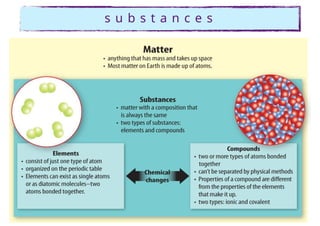
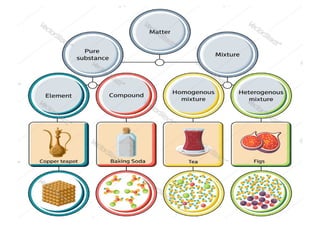
• A substance is matter that is always made up of
the same combination of atoms.
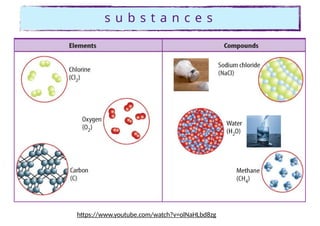
• There are two types of substances — elements and
compounds.
• The composition of elements and compounds
doesn’t change. Therefore, all elements and
compounds are substances.
s u b s t a n c e s
s u b s t a n c e s
https://www.youtube.com/watch?v=olNaHLbd8zg
Elements
• An element is a type of matter made of just one
kind of atom.
• Elements are pure substances.
Elements
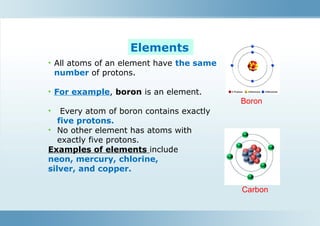
• All atoms of an element have the same
number of protons.
• For example, boron is an element.
• Every atom of boron contains exactly
five protons.
• No other element has atoms with
exactly five protons.
Examples of elements include
neon, mercury, chlorine,
silver, and copper.
Boron
Carbon
Copyright © Houghton Mifflin Harcourt Publishing Company
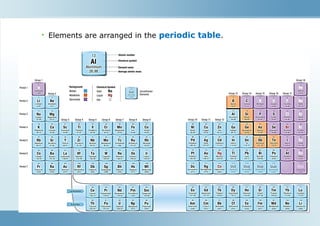
• Elements are arranged in the periodic table.
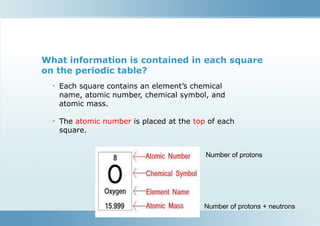
What information is contained in each square
on the periodic table?
• Each square contains an element’s chemical
name, atomic number, chemical symbol, and
atomic mass.
• The atomic number is placed at the top of each
square.
Number of protons
Number of protons + neutrons
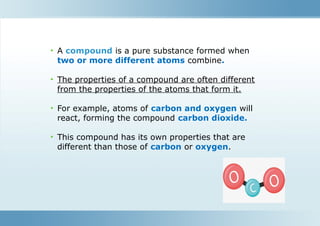
• A compound is a pure substance formed when
two or more different atoms combine.
• The properties of a compound are often different
from the properties of the atoms that form it.
• For example, atoms of carbon and oxygen will
react, forming the compound carbon dioxide.
• This compound has its own properties that are
different than those of carbon or oxygen.
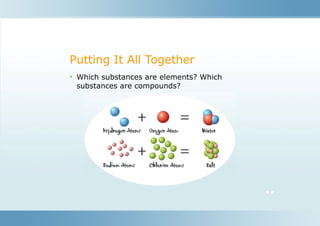
Putting It All Together
• Which substances are elements? Which
substances are compounds?
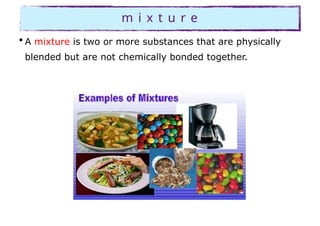
m i x t u r e
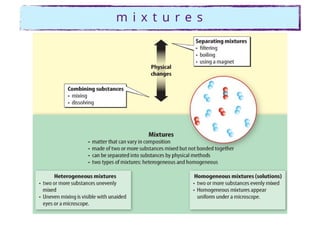
• A mixture is two or more substances that are physically
blended but are not chemically bonded together.
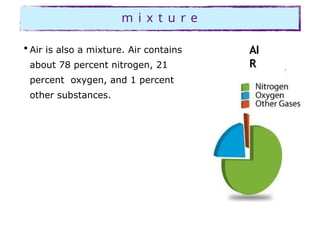
• Air is also a mixture. Air contains
about 78 percent nitrogen, 21
percent oxygen, and 1 percent
other substances.
m i x t u r e
AI
R
h e t e r o g e n e o u s /
h o m o g e n e o u s
m i x t u r e s
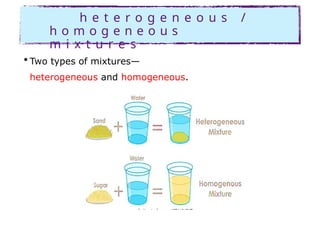
• Two types of mixtures—
heterogeneous and homogeneous.
h e t e r o g e n e o u s m i x t u r e s
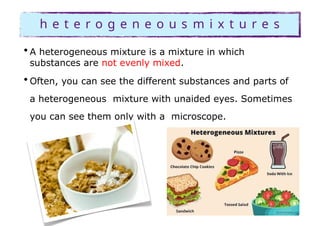
• A heterogeneous mixture is a mixture in which
substances are not evenly mixed.
• Often, you can see the different substances and parts of
a heterogeneous mixture with unaided eyes. Sometimes
you can see them only with a microscope.
h o m o g e n e o u s m i x t u r e s
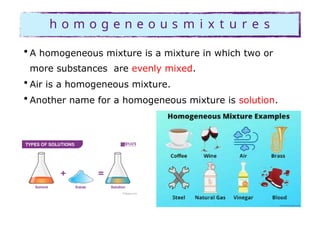
• A homogeneous mixture is a mixture in which two or
more substances are evenly mixed.
• Air is a homogeneous mixture.
• Another name for a homogeneous mixture is solution.
h o m o g e n e o u s m i x t u r e s
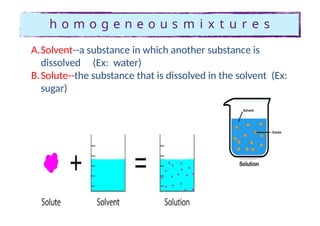
A.Solvent--a substance in which another substance is
dissolved (Ex: water)
B.Solute--the substance that is dissolved in the solvent (Ex:
sugar)
h e t e r o g e n e o u
s m i x t u r e
h o m o g e n e o u
s m i x t u r e
https://www.youtube.com/watch?v=o-XSY-jUwig
h o w d o c o m p o u n d s
a n d m i x t u r e s
d i ff e r ?
• The substances that make up a mixture are not
chemically bonded.
• Mixing is a physical change. The substances that exist
before mixing still exist in the mixture.
h o w d o c o m p o u n d s
a n d m i x t u r e s
d i ff e r ?
SUBSTANCES KEEP THEIR PROPERTIES
• Substances that make up a mixture are not changed
chemically.
• You can observe some of their properties in the
mixture.
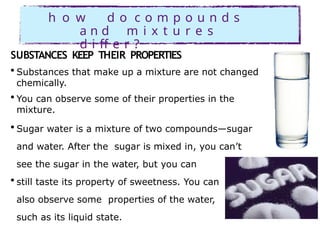
• Sugar water is a mixture of two compounds—sugar
and water. After the sugar is mixed in, you can’t
see the sugar in the water, but you can
• still taste its property of sweetness. You can
also observe some properties of the water,
such as its liquid state.
h o w d o c o m p o u n d s
a n d m i x t u r e s
d i ff e r ?
COMPOUNDS DO NOT KEEP THEIR PROPERTIES
• The properties of a compound can be different from the
properties of the elements that make it up.
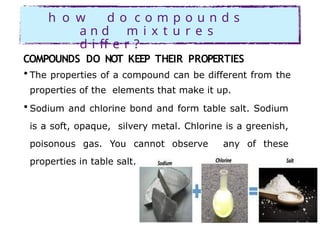
• Sodium and chlorine bond and form table salt. Sodium
is a soft, opaque, silvery metal. Chlorine is a greenish,
poisonous gas. You cannot observe any of these
properties in table salt.
h o w d o c o m p o u n d s
a n d m i x t u r e s
d i ff e r ?
MIXTURES CAN BE SEPARATED
• The substances that make up a mixture are not chemically
bonded together.
• As a result, you can separate them from each other
using physical methods.
• The physical properties of one substance are different
from those of another. You can use these differences to
separate the substances.
• In contrast, you can separate compounds only by a chemical
change that breaks the bonds between the elements.
Ways of separating mixtures:
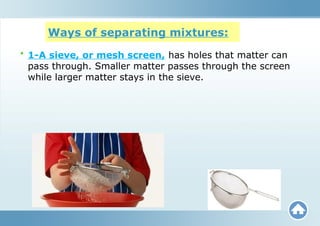
• 1-A sieve, or mesh screen, has holes that matter can
pass through. Smaller matter passes through the screen
while larger matter stays in the sieve.
Ways of separating mixtures:
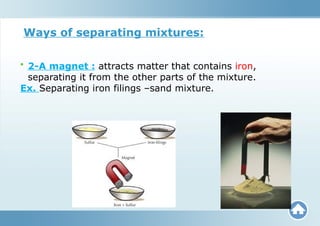
• 2-A magnet : attracts matter that contains iron,
separating it from the other parts of the mixture.
Ex. Separating iron filings –sand mixture.
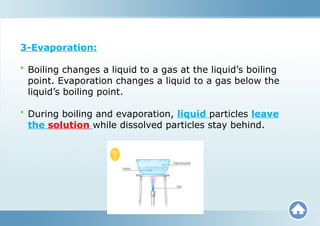
3-Evaporation:
• Boiling changes a liquid to a gas at the liquid’s boiling
point. Evaporation changes a liquid to a gas below the
liquid’s boiling point.
• During boiling and evaporation, liquid particles leave
the solution while dissolved particles stay behind.
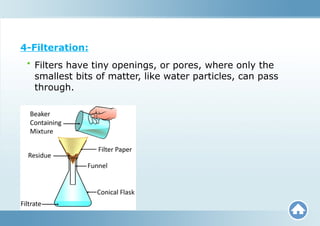
4-Filteration:
• Filters have tiny openings, or pores, where only the
smallest bits of matter, like water particles, can pass
through.
m i x t u r e s
substances and mixtures.pptx grade 6 integrated science

substances and mixtures.pptx grade 6 integrated science

  • 1.
  • 2.
    s u bs t a n c e s
  • 3.
    • A substanceis matter that is always made up of the same combination of atoms. • There are two types of substances — elements and compounds. • The composition of elements and compounds doesn’t change. Therefore, all elements and compounds are substances. s u b s t a n c e s
  • 4.
    s u bs t a n c e s https://www.youtube.com/watch?v=olNaHLbd8zg
  • 5.
    Elements • An elementis a type of matter made of just one kind of atom. • Elements are pure substances.
  • 6.
    Elements • All atomsof an element have the same number of protons. • For example, boron is an element. • Every atom of boron contains exactly five protons. • No other element has atoms with exactly five protons. Examples of elements include neon, mercury, chlorine, silver, and copper. Boron Carbon
  • 7.
    Copyright © HoughtonMifflin Harcourt Publishing Company • Elements are arranged in the periodic table.
  • 8.
    What information iscontained in each square on the periodic table? • Each square contains an element’s chemical name, atomic number, chemical symbol, and atomic mass. • The atomic number is placed at the top of each square. Number of protons Number of protons + neutrons
  • 9.
    • A compoundis a pure substance formed when two or more different atoms combine. • The properties of a compound are often different from the properties of the atoms that form it. • For example, atoms of carbon and oxygen will react, forming the compound carbon dioxide. • This compound has its own properties that are different than those of carbon or oxygen.
  • 10.
    Putting It AllTogether • Which substances are elements? Which substances are compounds?
  • 11.
    m i xt u r e • A mixture is two or more substances that are physically blended but are not chemically bonded together.
  • 12.
    • Air isalso a mixture. Air contains about 78 percent nitrogen, 21 percent oxygen, and 1 percent other substances. m i x t u r e AI R
  • 13.
    h e te r o g e n e o u s / h o m o g e n e o u s m i x t u r e s • Two types of mixtures— heterogeneous and homogeneous.
  • 14.
    h e te r o g e n e o u s m i x t u r e s • A heterogeneous mixture is a mixture in which substances are not evenly mixed. • Often, you can see the different substances and parts of a heterogeneous mixture with unaided eyes. Sometimes you can see them only with a microscope.
  • 15.
    h o mo g e n e o u s m i x t u r e s • A homogeneous mixture is a mixture in which two or more substances are evenly mixed. • Air is a homogeneous mixture. • Another name for a homogeneous mixture is solution.
  • 16.
    h o mo g e n e o u s m i x t u r e s A.Solvent--a substance in which another substance is dissolved (Ex: water) B.Solute--the substance that is dissolved in the solvent (Ex: sugar)
  • 17.
    h e te r o g e n e o u s m i x t u r e h o m o g e n e o u s m i x t u r e https://www.youtube.com/watch?v=o-XSY-jUwig
  • 18.
    h o wd o c o m p o u n d s a n d m i x t u r e s d i ff e r ? • The substances that make up a mixture are not chemically bonded. • Mixing is a physical change. The substances that exist before mixing still exist in the mixture.
  • 19.
    h o wd o c o m p o u n d s a n d m i x t u r e s d i ff e r ? SUBSTANCES KEEP THEIR PROPERTIES • Substances that make up a mixture are not changed chemically. • You can observe some of their properties in the mixture. • Sugar water is a mixture of two compounds—sugar and water. After the sugar is mixed in, you can’t see the sugar in the water, but you can • still taste its property of sweetness. You can also observe some properties of the water, such as its liquid state.
  • 20.
    h o wd o c o m p o u n d s a n d m i x t u r e s d i ff e r ? COMPOUNDS DO NOT KEEP THEIR PROPERTIES • The properties of a compound can be different from the properties of the elements that make it up. • Sodium and chlorine bond and form table salt. Sodium is a soft, opaque, silvery metal. Chlorine is a greenish, poisonous gas. You cannot observe any of these properties in table salt.
  • 21.
    h o wd o c o m p o u n d s a n d m i x t u r e s d i ff e r ? MIXTURES CAN BE SEPARATED • The substances that make up a mixture are not chemically bonded together. • As a result, you can separate them from each other using physical methods. • The physical properties of one substance are different from those of another. You can use these differences to separate the substances. • In contrast, you can separate compounds only by a chemical change that breaks the bonds between the elements.
  • 22.
    Ways of separatingmixtures: • 1-A sieve, or mesh screen, has holes that matter can pass through. Smaller matter passes through the screen while larger matter stays in the sieve.
  • 23.
    Ways of separatingmixtures: • 2-A magnet : attracts matter that contains iron, separating it from the other parts of the mixture. Ex. Separating iron filings –sand mixture.
  • 24.
    3-Evaporation: • Boiling changesa liquid to a gas at the liquid’s boiling point. Evaporation changes a liquid to a gas below the liquid’s boiling point. • During boiling and evaporation, liquid particles leave the solution while dissolved particles stay behind.
  • 25.
    4-Filteration: • Filters havetiny openings, or pores, where only the smallest bits of matter, like water particles, can pass through.
  • 26.
    m i xt u r e s