Module 2
MOTION
Lesson 1
DESCRIBING MOTION
DESCRIBING POSITION
How would you describe
where you are right now?
Each description states
your location relative to a
certain point.
 A Reference point is the starting
point you choose to describe the
location, or position of an object.
 A Position is an object’s distance and
direction from a reference point.
 A complete description of your
position includes a distance, a
direction and a reference point.
DESCRIBING POSITION
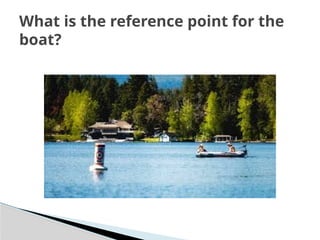
What is the reference point for the
boat?
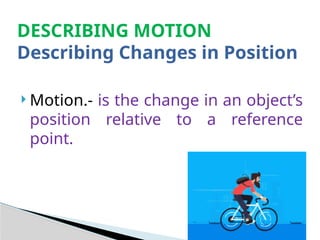
 Motion.- is the change in an object’s
position relative to a reference
point.
DESCRIBING MOTION
Describing Changes in Position
 An object is in motion if its position
changes relative to a reference
point.
DESCRIBING MOTION
Motion Relative to a Reference
Point.
https://www.youtube.com/watch?v=ccn-tSovM7o
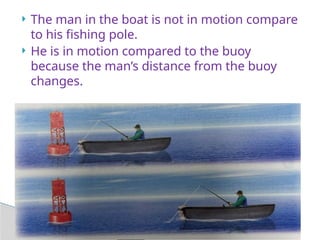
 The man in the boat is not in motion compare
to his fishing pole.
 He is in motion compared to the buoy
because the man’s distance from the buoy
changes.
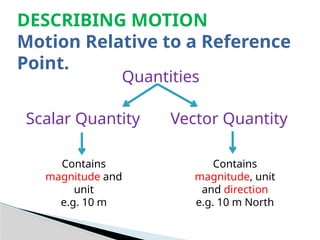
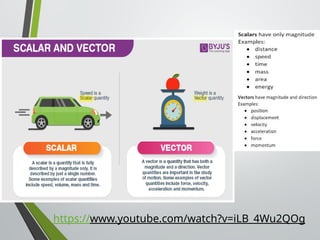
Quantities
Scalar Quantity Vector Quantity
DESCRIBING MOTION
Motion Relative to a Reference
Point.
Contains
magnitude and
unit
e.g. 10 m
Contains
magnitude, unit
and direction
e.g. 10 m North
https://www.youtube.com/watch?v=iLB_4Wu2QOg
DESCRIBING MOTION
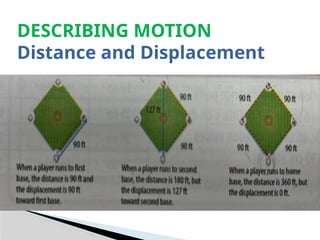
Distance and Displacement
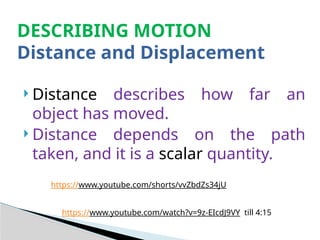
 Distance describes how far an
object has moved.
 Distance depends on the path
taken, and it is a scalar quantity.
DESCRIBING MOTION
Distance and Displacement
https://www.youtube.com/shorts/vvZbdZs34jU
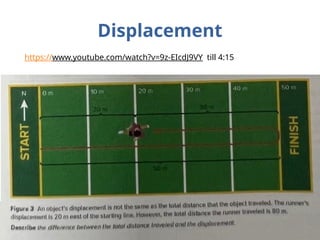
https://www.youtube.com/watch?v=9z-EIcdJ9VY till 4:15
 Displacement is the difference
between the initial position and
final position of an object.
 Displacement is the distance and
direction of the object’s change in
position.
 Displacement is a vector quantity
because it has direction.
DESCRIBING MOTION
Distance and Displacement
DESCRIBING MOTION
Distance and Displacement
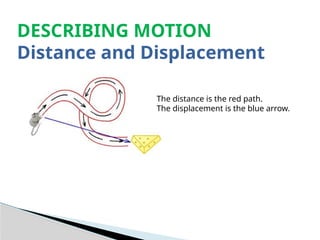
The distance is the red path.
The displacement is the blue arrow.
Distance vs Displacement
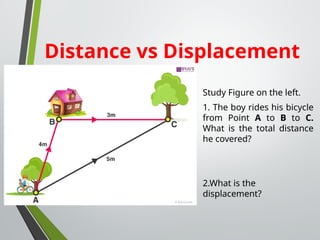
Study Figure on the left.
1. The boy rides his bicycle
from Point A to B to C.
What is the total distance
he covered?
2.What is the
displacement?
Distance and Displacement
HOUSE
Starting Point
SCHOOL
Ending Point
1 Km
1 Km
0.5 Km
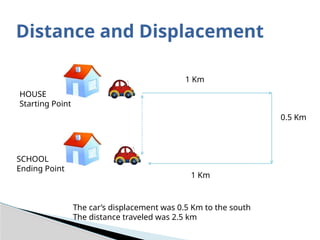
The car’s displacement was 0.5 Km to the south
The distance traveled was 2.5 km
Displacement
https://www.youtube.com/watch?v=9z-EIcdJ9VY till 4:15
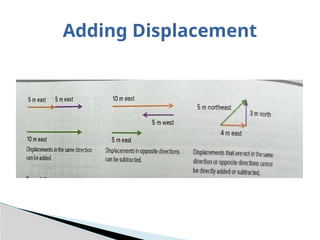
Adding Displacement
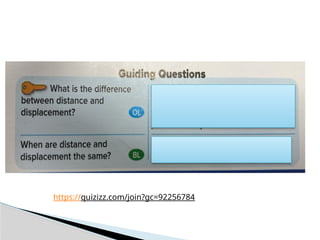
https://quizizz.com/join?gc=92256784
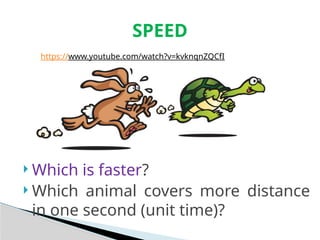
SPEED
 Which is faster?
 Which animal covers more distance
in one second (unit time)?
https://www.youtube.com/watch?v=kvknqnZQCfI
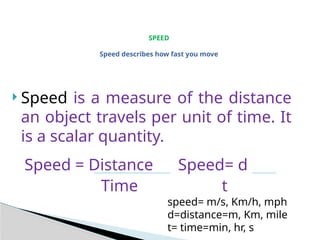
 Speed is a measure of the distance
an object travels per unit of time. It
is a scalar quantity.
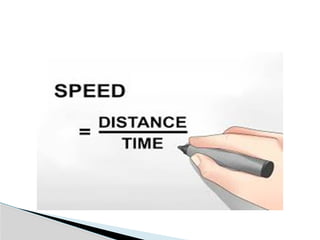
Speed = Distance Speed= d
Time t
SPEED
Speed describes how fast you move
speed= m/s, Km/h, mph
d=distance=m, Km, mile
t= time=min, hr, s
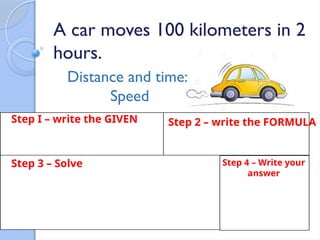
A car moves 100 kilometers in 2
hours.
Distance and time:
Speed
Step I – write the GIVEN Step 2 – write the FORMULA
Step 3 – Solve Step 4 – Write your
answer
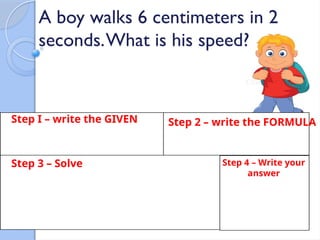
Step I – write the GIVEN Step 2 – write the FORMULA
Step 3 – Solve Step 4 – Write your
answer
A boy walks 6 centimeters in 2
seconds.What is his speed?
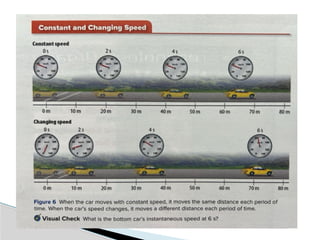
 Constant Speed is is the rate of
change of position in which the same
distance is traveled.
 Instantaneous speed is speed at a
specific instant in time.
SPEED
 Average speed is the total distance
traveled divided by the total time
taken to travel that distance.
 https://www.youtube.com/watch?v=_
cwhvYk67EI
SPEED
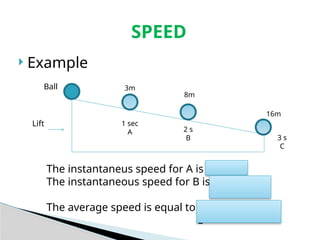
 Example
SPEED
Ball
Lift 1 sec
A 2 s
B 3 s
C
3m
8m
16m
The instantaneus speed for A is 3 m/s
The instantaneous speed for B is 8m= 4m/s
2s
The average speed is equal to 16m = 5.3 m/s
3
SPEED
Average Speed
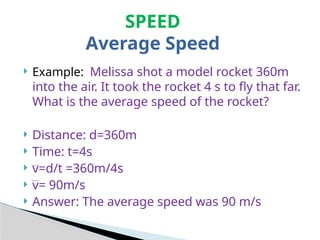
 Example: Melissa shot a model rocket 360m
into the air. It took the rocket 4 s to fly that far.
What is the average speed of the rocket?
 Distance: d=360m
 Time: t=4s
 v=d/t =360m/4s
 v= 90m/s
 Answer: The average speed was 90 m/s
SPEED
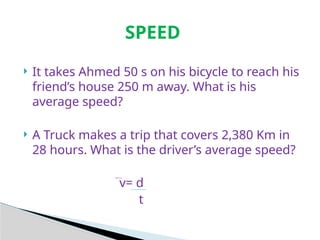
 It takes Ahmed 50 s on his bicycle to reach his
friend’s house 250 m away. What is his
average speed?
 A Truck makes a trip that covers 2,380 Km in
28 hours. What is the driver’s average speed?
v= d
t
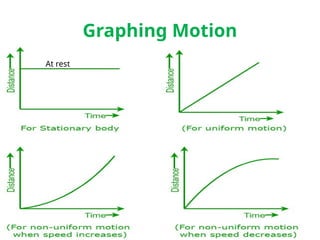
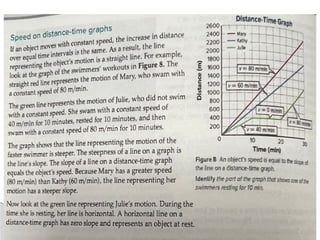
Graphing Motion
At rest
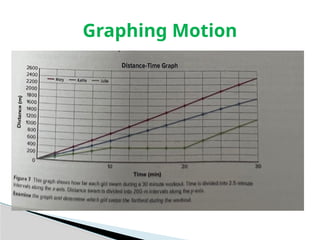
Graphing Motion
Describing Motion.pptx physical science grade 9

Describing Motion.pptx physical science grade 9

  • 1.
  • 2.
    DESCRIBING POSITION How wouldyou describe where you are right now? Each description states your location relative to a certain point.
  • 3.
     A Referencepoint is the starting point you choose to describe the location, or position of an object.  A Position is an object’s distance and direction from a reference point.  A complete description of your position includes a distance, a direction and a reference point. DESCRIBING POSITION
  • 4.
    What is thereference point for the boat?
  • 5.
     Motion.- isthe change in an object’s position relative to a reference point. DESCRIBING MOTION Describing Changes in Position
  • 6.
     An objectis in motion if its position changes relative to a reference point. DESCRIBING MOTION Motion Relative to a Reference Point. https://www.youtube.com/watch?v=ccn-tSovM7o
  • 7.
     The manin the boat is not in motion compare to his fishing pole.  He is in motion compared to the buoy because the man’s distance from the buoy changes.
  • 8.
    Quantities Scalar Quantity VectorQuantity DESCRIBING MOTION Motion Relative to a Reference Point. Contains magnitude and unit e.g. 10 m Contains magnitude, unit and direction e.g. 10 m North
  • 9.
  • 10.
  • 11.
     Distance describeshow far an object has moved.  Distance depends on the path taken, and it is a scalar quantity. DESCRIBING MOTION Distance and Displacement https://www.youtube.com/shorts/vvZbdZs34jU https://www.youtube.com/watch?v=9z-EIcdJ9VY till 4:15
  • 12.
     Displacement isthe difference between the initial position and final position of an object.  Displacement is the distance and direction of the object’s change in position.  Displacement is a vector quantity because it has direction. DESCRIBING MOTION Distance and Displacement
  • 13.
    DESCRIBING MOTION Distance andDisplacement The distance is the red path. The displacement is the blue arrow.
  • 14.
    Distance vs Displacement StudyFigure on the left. 1. The boy rides his bicycle from Point A to B to C. What is the total distance he covered? 2.What is the displacement?
  • 15.
    Distance and Displacement HOUSE StartingPoint SCHOOL Ending Point 1 Km 1 Km 0.5 Km The car’s displacement was 0.5 Km to the south The distance traveled was 2.5 km
  • 16.
  • 17.
  • 18.
  • 19.
    SPEED  Which isfaster?  Which animal covers more distance in one second (unit time)? https://www.youtube.com/watch?v=kvknqnZQCfI
  • 20.
     Speed isa measure of the distance an object travels per unit of time. It is a scalar quantity. Speed = Distance Speed= d Time t SPEED Speed describes how fast you move speed= m/s, Km/h, mph d=distance=m, Km, mile t= time=min, hr, s
  • 22.
    A car moves100 kilometers in 2 hours. Distance and time: Speed Step I – write the GIVEN Step 2 – write the FORMULA Step 3 – Solve Step 4 – Write your answer
  • 23.
    Step I –write the GIVEN Step 2 – write the FORMULA Step 3 – Solve Step 4 – Write your answer A boy walks 6 centimeters in 2 seconds.What is his speed?
  • 25.
     Constant Speedis is the rate of change of position in which the same distance is traveled.  Instantaneous speed is speed at a specific instant in time. SPEED
  • 26.
     Average speedis the total distance traveled divided by the total time taken to travel that distance.  https://www.youtube.com/watch?v=_ cwhvYk67EI SPEED
  • 27.
     Example SPEED Ball Lift 1sec A 2 s B 3 s C 3m 8m 16m The instantaneus speed for A is 3 m/s The instantaneous speed for B is 8m= 4m/s 2s The average speed is equal to 16m = 5.3 m/s 3
  • 28.
    SPEED Average Speed  Example:Melissa shot a model rocket 360m into the air. It took the rocket 4 s to fly that far. What is the average speed of the rocket?  Distance: d=360m  Time: t=4s  v=d/t =360m/4s  v= 90m/s  Answer: The average speed was 90 m/s
  • 29.
    SPEED  It takesAhmed 50 s on his bicycle to reach his friend’s house 250 m away. What is his average speed?  A Truck makes a trip that covers 2,380 Km in 28 hours. What is the driver’s average speed? v= d t
  • 30.
  • 31.